
Cloud-Native 5G Core Software Market Size and Share
Market Overview
| Study Period | 2020 - 2031 |
|---|---|
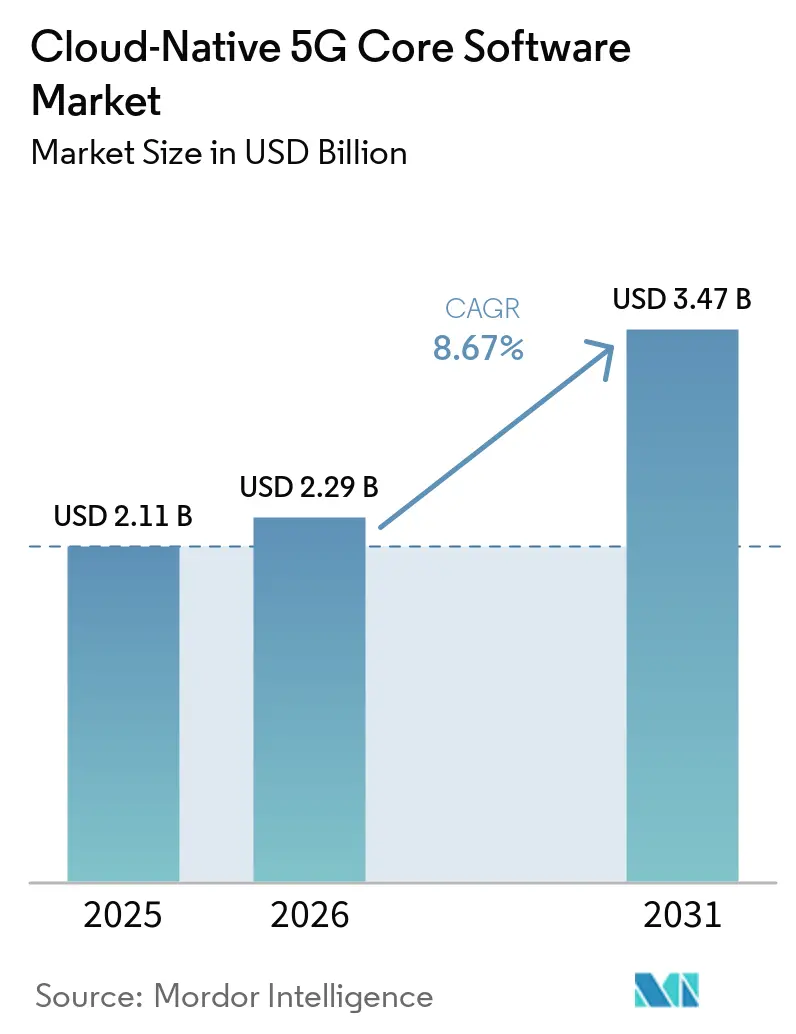
| Market Size (2026) | USD 2.29 Billion |
| Market Size (2031) | USD 3.47 Billion |
| Growth Rate (2026 - 2031) | 8.67 % |
| Fastest Growing Market | Africa |
| Largest Market | Asia-Pacific |
| Market Concentration | Medium |
Major Players *Disclaimer: Major Players sorted in no particular order Image © Mordor Intelligence. Reuse requires attribution under CC BY 4.0. | |
Cloud-Native 5G Core Software Market Analysis by Mordor Intelligence
The cloud-native 5G core software market size was USD 2.11 billion in 2025 and is forecast to reach USD 3.47 billion by 2031, advancing at a CAGR of 8.67% during 2026-2031. Standalone 5G deployments are shifting the cloud-native 5G core software market toward software-defined functions that can support network slicing, RedCap devices, and 5G-Advanced services. This transition changes operator spending because these capabilities require a native standalone core rather than an extension of non-standalone architecture. Enterprise services, private networks, and network APIs are widening the revenue case for core modernization, although operators still face high migration costs and uncertain returns. Established suppliers retain an advantage through long operator relationships and integration capability, while software-native suppliers can compete where operators seek open, cloud-ready designs. Public cloud delivery, managed platforms, and distributed user-plane functions are creating opportunities for operators that need lower deployment barriers, automation, and local performance control.
Key Report Takeaways
- By component, solutions held 78.22% of the cloud-native 5G core software market share in 2025, while services are expected to grow at a CAGR of 8.89% through 2031.
- By deployment model, On-Premise and Dedicated Telco Cloud held 48.36% of the cloud-native 5G core software market share in 2025, while public cloud are expected to grow at a CAGR of 9.11% through 2031.
- By architecture, standalone 5G core accounted for 72.33% of the cloud-native 5G core software market share in 2025, and are expected to grow at a CAGR of 9.23% through 2031.
- By application, enhanced mobile broadband held 46.48% share in 2025, while network slicing is projected to expand at a 9.34% CAGR through 2031.
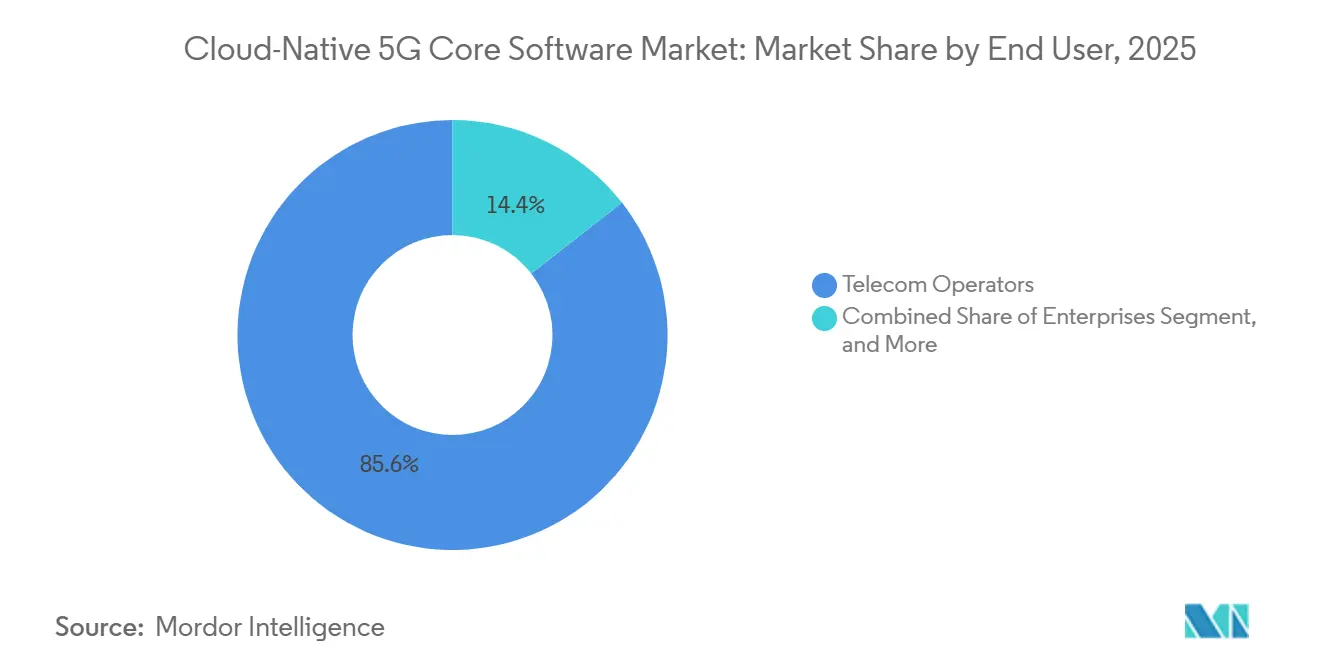
- By end user, telecom operators accounted for 85.56% of spending in 2025, while enterprises is projected to expand at a 9.22% CAGR through 2031.
- By organization size, large enterprises held 84.44% of spending in 2025, while small and medium enterprises are projected to expand at a 9.16% CAGR through 2031.
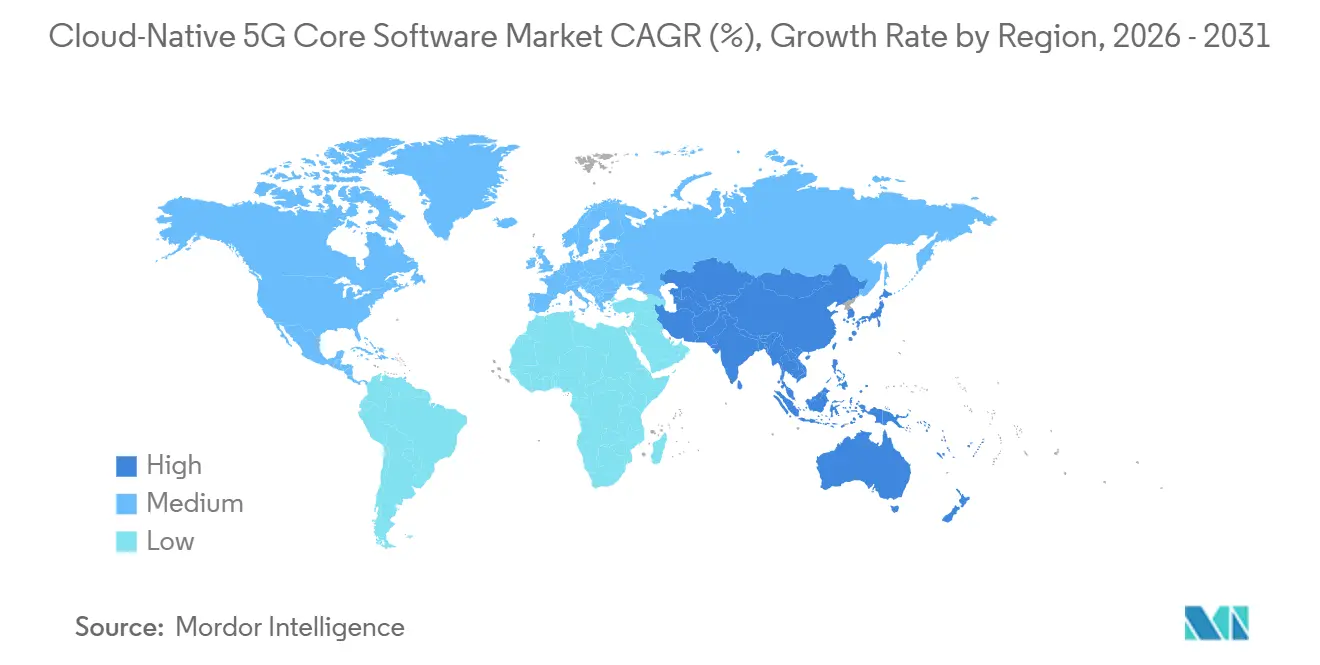
- By geography, Asia-Pacific held 33.42% share in 2025, while Africa is projected to expand at a 9.26% CAGR through 2031.
Key Report Takeaways
| Segmentation | Segment | Metric | Year | Value |
|---|---|---|---|---|
| By Component | Solutions | Market Share | 2025 | 78.22% |
| By Component | Services | CAGR | 2031 | 8.89% |
| By Deployment Model | On-Premise and Dedicated Telco Cloud | Market Share | 2025 | 48.36% |
| By Deployment Model | Public Cloud | CAGR | 2031 | 9.11% |
| By Architecture | Standalone 5G Core | Market Share | 2025 | 72.33% |
| By Architecture | Standalone 5G Core | CAGR | 2031 | 9.23% |
| By Application | Enhanced Mobile Broadband | Market Share | 2025 | 46.48% |
| By Application | Network Slicing | CAGR | 2031 | 9.34% |
| By End User | Telecom Operators | Market Share | 2025 | 85.56% |
| By End User | Enterprises | CAGR | 2031 | 9.22% |
| By Organization Size | Large Enterprises | Market Share | 2025 | 84.44% |
| By Organization Size | Small and Medium Enterprises | CAGR | 2031 | 9.16% |
| By Geography | Asia-Pacific | Market Share | 2025 | 33.42% |
| By Geography | Africa | CAGR | 2031 | 9.26% |
| Source: Mordor Intelligence | ||||
Note: Market size and forecast figures in this report are generated using Mordor Intelligence’s proprietary estimation framework, updated with the latest available data and insights as of January 2026.
Global Cloud-Native 5G Core Software Market Trends and Insights
Drivers Impact Analysis*
| Driver | (~) % Impact on CAGR Forecast | Geographic Relevance | Impact Timeline |
|---|---|---|---|
| Accelerated Standalone 5G Rollouts | +2.5% | Global, led by Asia-Pacific, North America, and Western Europe | Short term (≤ 2 years) |
| Enterprise and Private 5G Monetization | +1.8% | North America, Europe, Asia-Pacific, and the Middle East | Medium term (2-4 years) |
| Cloud-Native Service-Based Architecture Adoption | +1.3% | Global, with early intensity in Japan, Germany, Belgium, and South Korea | Medium term (2-4 years) |
| Distributed Edge User-Plane Deployments | +0.9% | North America, Europe, Asia-Pacific, and the Middle East | Medium term (2-4 years) |
| RedCap and Massive IoT Traffic Expansion | +0.6% | Global, with commercial launches concentrated in Asia-Pacific and North America | Short term (≤ 2 years) |
| Open Gateway API Exposure and Core-as-a-Service Models | +0.4% | Global, concentrated in markets with mature standalone deployment | Long term (≥ 4 years) |
| Source: Mordor Intelligence | |||
Accelerated Standalone 5G Rollouts
Standalone 5G architecture is becoming the operating baseline for the cloud-native 5G core software market rather than a premium network option. The Global Mobile Suppliers Association reported that 95 operators had launched commercial standalone 5G by April 2026, while 184 operators in 76 countries were investing in the technology. The same association reported that 35 operators were investing in 5G-Advanced, which requires a standalone core and extends the need for this architecture beyond early network slicing programs.[1] Operators therefore face a shorter decision window because the functions needed for 5G-Advanced cannot be delivered through a non-standalone core. This demand is reinforced where public policy and spectrum incentives encourage upgrades from older network designs. The resulting deployment cycle favors suppliers that can migrate operator workloads while keeping existing mobile services available.
Enterprise and Private 5G Monetization
Enterprise private 5G is moving from limited demonstrations toward production systems that require dependable core functions. NTT DATA expanded Cargill's private 5G deployment to 50 operating sites across the United States and Europe, with plans for more than 100 additional sites each year.[2] The deployment supports robotics, connected workers, and industrial automation, which require control over latency, device access, and service quality. These projects increasingly need dedicated core slices or compact edge cores instead of a shared mobile network environment. Manufacturing remains important, but logistics, ports, mining, and energy sites also need reliable local connectivity for automated operations. The cloud-native 5G core software market benefits when operators and enterprises select modular software that can isolate services for different sites and workloads.
Cloud-Native Service-Based Architecture Adoption
Service-based architecture gives cloud-native 5G core functions a standard method to exchange data through application programming interfaces. 3GPP identifies OpenAPIs as a means of making service-based architecture interfaces available to developers and the wider ecosystem.[3] NTT DOCOMO and NEC launched a commercial cloud-native core network on Amazon Web Services, using agentic AI and GitOps automation in the deployment. NEC reported that this approach significantly reduced core design and construction time compared with conventional methods. This type of automation can reduce the operational burden associated with frequent software releases and network configuration changes. Operators that adopt a fully cloud-native design can support network slicing, network APIs, and automated operations with fewer constraints from earlier virtualized designs.
Distributed Edge User-Plane Deployments
Distributed user-plane functions move traffic processing closer to the point where an application or device is located. NVIDIA describes distributed user-plane architecture as a way to support local AI traffic handling at the network edge with accelerated computing and data processing units. This design can reduce the delay caused when traffic travels from an industrial site to a centralized data center and back. It is relevant to remote control, machine automation, immersive applications, and other services that need predictable response times. The cloud-native 5G core software market can therefore gain from software that allows operators to manage local breakout functions across many edge locations. Suppliers that combine user-plane software, orchestration, and performance monitoring may be better positioned for enterprise contracts that require defined service levels.
Restraints Impact Analysis*
| Restraint | (~) % Impact on CAGR Forecast | Geographic Relevance | Impact Timeline |
|---|---|---|---|
| High Migration Cost and Uncertain 5G Monetization | -2.2% | Global, with greater intensity in South America and Africa | Short term (≤ 2 years) |
| Legacy EPC Integration Complexity | -1.4% | Global, particularly affecting operators with large installed LTE bases in North America and Europe | Medium term (2-4 years) |
| Multi-Cloud Observability and Cloud-Native Skills Gap | -0.9% | Global, most acute in South America, Africa, and parts of Southeast Asia | Medium term (2-4 years) |
| Signaling Attack Surface and Sovereign Cloud Constraints | -0.6% | Europe, the Middle East, and Asia-Pacific | Long term (≥ 4 years) |
| Source: Mordor Intelligence | |||
High Migration Cost and Uncertain 5G Monetization
Migration costs continue to constrain the pace of standalone core adoption. Operators with non-standalone networks must manage fourth-generation and fifth-generation services simultaneously, increasing costs during the transition. Commercial returns depend on enterprise services that remain underdeveloped in many markets. The Global System for Mobile Communications Association reported that Open Gateway aligned a broad range of operator groups and networks with CAMARA application programming interface standards. Quality on Demand and fraud prevention interfaces may offer a clearer revenue path, but their commercial impact at scale remains unproven. This uncertainty encourages operators to phase upgrades or adopt managed deployment models that reduce upfront costs.
Legacy EPC Integration Complexity
Moving from an Evolved Packet Core to a cloud-native 5G core requires operators to coordinate older virtual network functions with newer containerized functions. This coexistence can create duplicate operating processes, complex service assurance work, and additional training needs. Operators also need to move subscribers without affecting voice, data, authentication, charging, or policy services. The cloud-native 5G core software industry must therefore provide migration tooling and multivendor management that can work across older and newer environments. 3GPP management specifications provide an interoperability reference, but individual operator environments still require extensive integration and testing. The complexity can delay legacy core retirement even when a standalone architecture offers clearer long-term operating benefits.
*Our forecasts treat driver/restraint impacts as directional, not additive. The impact forecasts reflect baseline growth, mix effects, and variable interactions.
Segment Analysis
By Component: Solutions Remain the Main Spending Area as Services Gain Importance
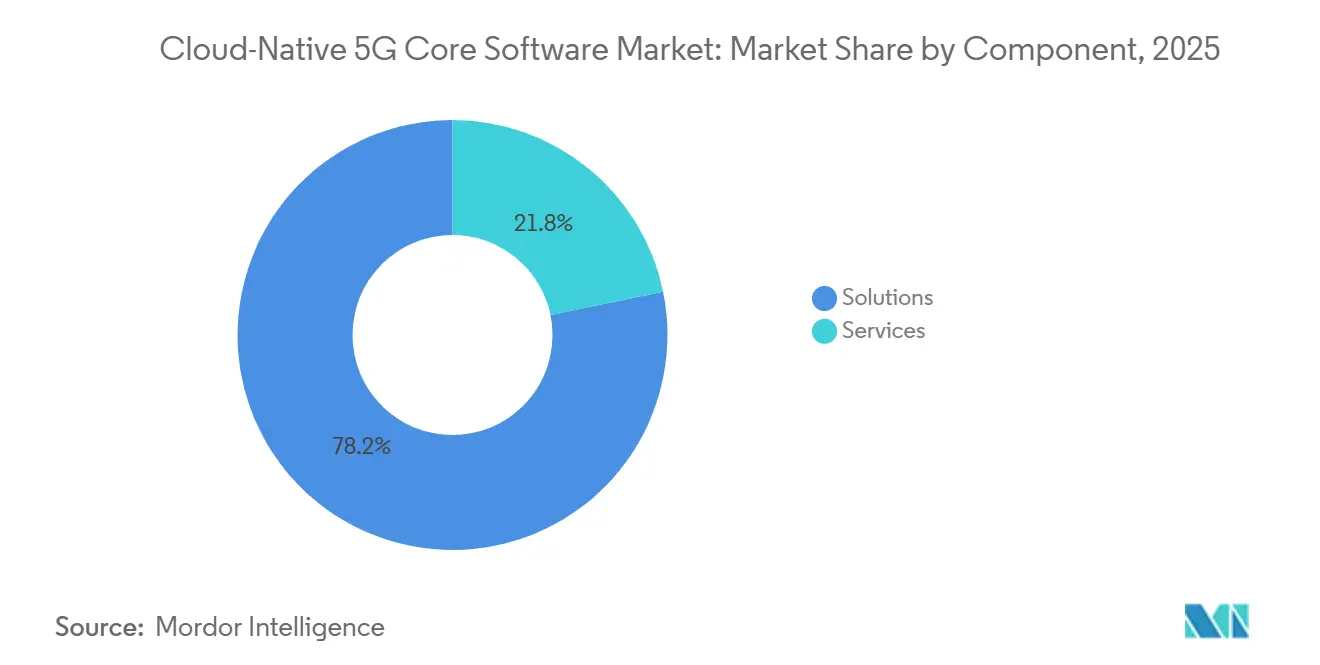
Solutions accounted for 78.22% of spending in 2025, reflecting the initial software investment required to modernize core networks. Operators purchase functions for session management, authentication, policy control, charging, and subscriber data as part of this platform layer. These functions form the operating base for standalone services and must integrate with radio, transport, cloud, and operational systems. Mavenir reported significant energy savings from its cloud-native 5G core software in Deutsche Telekom's live standalone network through full-stack energy efficiency and dynamic hardware and software scaling. The result shows why operators increasingly assess solution platforms based on energy use and operational efficiency, in addition to network capabilities. Large core replacements continue to favor solution spending because operators must establish the platform before they can fully adopt supporting services.
Services are advancing at a 8.89% CAGR through 2031 as operators increase the number of cloud-native functions in production. Integration, managed operations, software release management, orchestration, and security work become more important when networks use several vendors and cloud environments. This work is difficult to standardize because each operator has a different subscriber base, data environment, and legacy network structure. The cloud-native 5G core software market size for services is supported by the need to operate continuous software delivery and maintain policy controls across distributed functions. Service providers can also help operators use automation without building large internal teams for each platform. The cloud-native 5G core software industry is likely to see services gain share when open architectures create more integration work than single-vendor deployments.

By Deployment Model: Dedicated Environments Lead While Public Cloud Gains Pace
On-premise and dedicated telco cloud environments held 48.36% in 2025 because operators value infrastructure control and local data handling. These environments are often used where national policy, internal security rules, or operational practices limit broader use of public cloud infrastructure. Hybrid cloud remains relevant because it lets operators keep sensitive workloads in a controlled setting while using external cloud capacity for selected functions. Public cloud is projected to expand at a 9.11% CAGR through 2031, supported by production deployments that have reduced concerns about the model. Nokia and Amazon Web Services launched a commercial 5G Core SaaS service with Belgium's Citymesh in February 2026, allowing the operator to subscribe to 4G and 5G core capabilities without managing physical hardware. The service included network slicing, IMS, Internet of Things connectivity, and automation capabilities.
The public cloud model can lower the initial infrastructure burden for operators that lack large internal cloud teams. It can also shorten access to elastic computing capacity and managed software platforms. NTT DOCOMO and NEC's commercial deployment on Amazon Web Services provided another example that large operators can use public cloud for production core workloads. However, data residency, lawful access requirements, and internal network control policies can still limit full migration in many countries. The cloud-native 5G core software market will therefore continue to use hybrid approaches where control-plane, user-plane, and operations functions are placed in different environments. This balance allows suppliers to offer portability across dedicated, public, and hybrid infrastructure instead of treating deployment choice as a fixed decision.
By Architecture: Standalone Core Has Become the Primary Investment Model
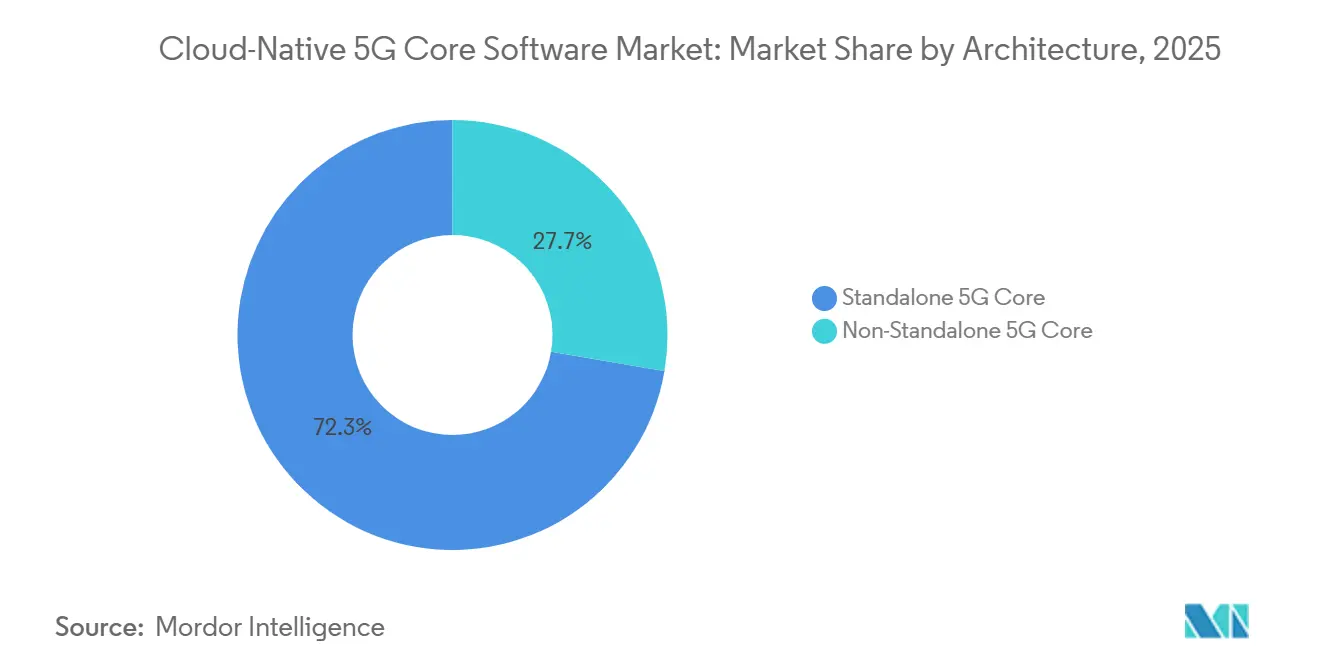
Standalone 5G core held 72.33% of spending in 2025, and Services are expanding at a 9.23% CAGR, confirming that native 5G architecture had moved beyond the earlier transitional phase. Standalone design supports functions such as network slicing, RedCap, and 5G-Advanced that cannot be delivered in full through a non-standalone arrangement. Non-standalone systems remain in use where operators are extending coverage or managing a gradual transition from LTE. Ericsson was selected by Three UK to build a cloud-native, standalone mobile packet core with 9 terabits per second of capacity across a distributed data center network. The planned capacity was more than 3 times Three UK's existing core capacity. Such projects show that major operators are making standalone core architecture a long-term capacity platform rather than a limited service addition.
The architecture choice affects the range of services that operators can sell to enterprises and consumers. A standalone core can enforce separate quality and policy settings for different slices, devices, and applications. It can also support service-based interfaces that make automation and external API exposure more practical. 3GPP standards support common service-based interfaces, which can reduce some interoperability barriers for multivendor deployments. The cloud-native 5G core software market size for standalone architecture is tied to this ability to connect technical capability with new service models. Non-standalone investment is expected to remain concentrated on coverage expansion and coexistence needs rather than on the most advanced 5G features.
By Application: eMBB Leads Current Demand While Network Slicing Advances Faster
Enhanced mobile broadband accounted for 46.48% of spending in 2025 because consumer mobile traffic remains the largest immediate workload for 5G networks. This application requires stable subscriber management, data routing, policy control, and charging at a national scale. It gives operators the base utilization needed to justify major core investments during the early stages of standalone deployment. Network slicing is projected to expand at a 9.34% CAGR through 2031 as enterprise users seek service levels that standard connectivity cannot provide. The cloud-native 5G core software market benefits because slicing needs coordinated control-plane and user-plane functions, along with clear policy enforcement. Suppliers must help operators design, activate, monitor, and bill slices for different types of service.
Network Slicing is advancing at a 9.34% CAGR through 2031. Network slicing supports differentiated connectivity for enterprise, Internet of Things, gaming, fixed wireless access, and mission-critical uses. It allows operators to set defined performance rules for particular applications or customer groups. Enhanced mobile broadband remains important because it produces the broad subscriber traffic on which other services are built. Ultra-reliable low-latency communications, massive machine-type communications, fixed wireless access, private 5G, and Voice over New Radio add different traffic and policy requirements. These applications increase the need for flexible software that can allocate resources and protect service quality across several workloads. The cloud-native 5G core software market is therefore moving from broad connectivity management toward application-specific service control.
By End User: Telecom Operators Account for Most Spending as Enterprise Demand Develops
Telecom operators accounted for 85.56% of end-user spending in 2025 because they own the public network infrastructure that requires core modernization. Their purchases cover large subscriber populations, national coverage footprints, and wide sets of interdependent network systems. Operators also need core functions to support consumer mobile, fixed wireless, voice, and Internet of Things services. Enterprises are expected to be the fastest-growing end-user group as private 5G and managed network options become more accessible. Samsung and Hyundai Motor completed an end-to-end RedCap trial on a private 5G network at Hyundai's Ulsan plant in February 2025. The trial covered vehicle inspection, sensor networks, and factory automation, which demonstrate how enterprise sites can use dedicated connectivity for operating processes.
Enterprise is advancing at a 9.22% CAGR through 2031. Enterprise demand extends across manufacturing, energy and utilities, transportation and logistics, healthcare, and government services. These users often require isolated resources, local processing, and service assurance suited to specific applications. Cable and fixed-line operators also have a role because they can use 5G core software to support converged services and fixed wireless access. The Global System for Mobile Communications Association has positioned Open Gateway APIs as a route for operators to expose network capabilities to developers and enterprises. Fraud prevention and Quality on Demand are relevant examples because they can turn core network capabilities into defined enterprise services. The cloud-native 5G core software market will gain from these models if operators can convert technical features into repeatable offers for business users.
By Organization Size: Large Enterprises Lead While SMEs Gain Access Through Managed Models
Large enterprises held 84.44% of organization-size spending in 2025 because they have the capital, technical resources, and operational scale to implement private or hosted 5G environments. Their sites often involve complex processes that make dedicated wireless control more valuable. Large organizations can also support internal teams that work with operators, system integrators, and cloud providers. Small and medium enterprises are projected to expand at a 9.16% CAGR through 2031 as Core-as-a-Service and managed private 5G reduce initial infrastructure requirements. Nokia's 5G Core SaaS deployment with Citymesh showed how operators can subscribe to core capabilities rather than manage hardware directly. This model can give smaller operators and business users access to production-grade functions at a recurring service cost.
Managed platforms may be especially relevant to light manufacturing, last-mile logistics, and retail sites with clear automation needs but limited network skills. These users do not always need a large, fully customized core deployment. They need reliable connectivity, device management, and service controls that can be operated with limited internal resources. Core-as-a-Service can package those functions with integration and support. The cloud-native 5G core software market can broaden when suppliers simplify ordering, activation, and ongoing management for smaller customers. The transition also creates opportunities for specialized providers that support mobile virtual network operators and enterprise sites with modular software.
Geography Analysis
Asia-Pacific held 33.42% of the cloud-native 5G core software sector share in 2025, supported by operator scale, government-led digital programs, and active standalone deployment. The region combines large consumer traffic volumes with a wide set of industrial and public-sector use cases. China has supported major RedCap activity for smart-city and industrial Internet of Things applications, which creates a sizable device and service base for core platforms. Japan advanced public-cloud core deployment when NTT DOCOMO and NEC launched a commercial 5G core on Amazon Web Services in early 2026. NEC stated that automation significantly reduced the related design and construction time, highlighting the importance of cloud operations in the regional market. Australia and Southeast Asia remain at earlier stages of the standalone deployment cycle, but operators are adding cloud-native voice and core capabilities as they prepare for more advanced services. Nokia agreed to deploy a cloud-native communication suite for Optus in 2025 to support enhanced 5G voice services for its customer base.
North America and Europe are mature mobile regions that are still investing in core upgrades and API-based service models. AT&T achieved nationwide 5G RedCap coverage across more than 200 million points of presence in 2025, providing a broad foundation for connected devices and future standalone traffic demand. The United States is also central to Open Gateway activity, with mobile operators working to expose standardized network capabilities through common interfaces. Europe combines large established networks with stricter data, security, and sovereignty requirements that favor dedicated and hybrid deployment patterns. The cloud-native 5G core software market size in Europe is supported by upgrades that consolidate inherited systems and prepare networks for slicing. Proximus launched 5G+ in Belgium in April 2026, initially for business customers with compatible plans, and identified slicing applications for emergency services, payment traffic, and media. Germany, the United Kingdom, France, and Nordic countries continue to show strong standalone momentum, while Russia follows a more limited domestic infrastructure path.
Africa is projected to expand at a 9.26% CAGR through 2031, as operators in South Africa and Nigeria evaluate cloud-native core deployment ahead of wider 5G coverage. This path can avoid some later migration work because operators can adopt containerized functions from the start. It also leaves investment exposed to spectrum timing, device availability, and the pace of commercial demand. The Middle East is progressing through Gulf Cooperation Council-led standalone rollouts and uses RedCap for public safety and Internet of Things applications. South America is at an earlier stage, with investment shaped by local spectrum policy, operator consolidation, and the need to establish enterprise demand. Open Gateway provides a common commercial framework that can influence core investment decisions across these regions by connecting network capabilities with developer-facing services.
Competitive Landscape
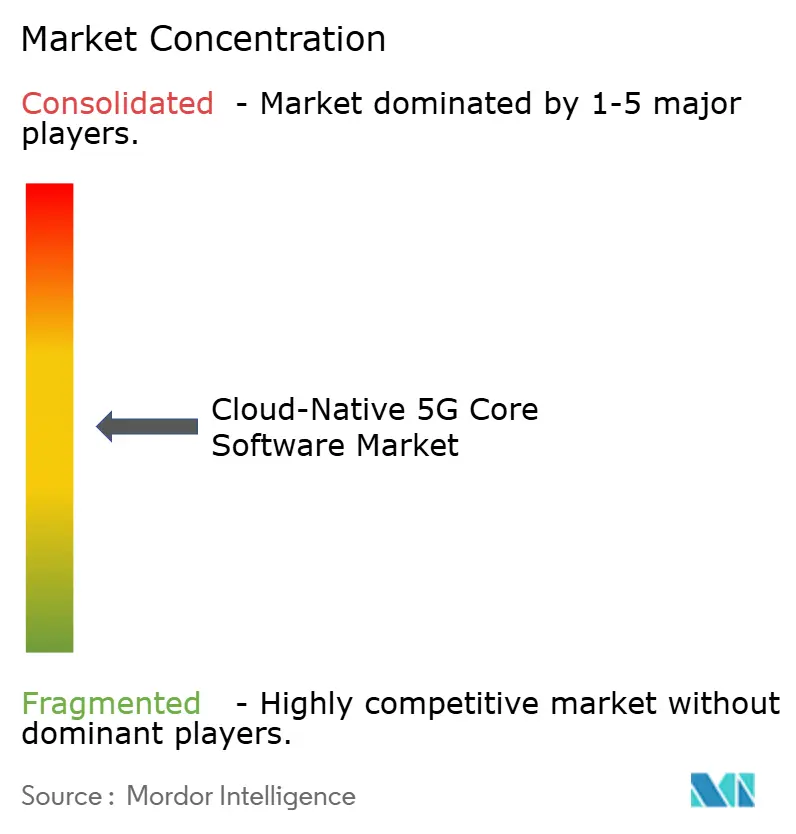
The cloud-native 5G core software market has moderate concentration, with Ericsson, Nokia, and Huawei holding leading positions through established operator contracts and deep integration experience. Samsung and NEC have meaningful regional positions in Asia-Pacific, while Mavenir, Oracle, Cisco, and Amdocs compete in software-focused and North American opportunities. Competition centers on the contrast between end-to-end standalone core stacks and platform-agnostic software that can work across several cloud environments. Established suppliers can offer long-term operational support and proven migration processes. Software-native competitors can appeal to operators that want greater vendor choice, automation, and cloud portability. The cloud-native 5G core software market remains open to challengers when operators build greenfield standalone networks or redesign their cloud strategy.
Mavenir demonstrated a sustainability-focused position by reporting energy savings at Deutsche Telekom's live standalone network. Nokia and Amazon Web Services demonstrated a managed-core approach with the Citymesh 5G Core SaaS launch in February 2026. NEC and NTT DOCOMO demonstrated an automation-led strategy through their commercial cloud deployment in Japan. These moves show that providers are competing on operating efficiency, managed delivery, and deployment speed in addition to core functionality. Smaller operators and mobile virtual network operators may favor subscription-based offerings because they reduce the need to operate physical infrastructure. Larger operators may maintain several suppliers to preserve technical options and reduce reliance on a single platform.
Opportunities remain in lightweight enterprise cores, managed services for smaller operators, and automation tools that reduce operating complexity. Private 5G users in manufacturing and logistics need systems that can provide local control without requiring large internal network teams. Suppliers can differentiate by providing automated lifecycle management, simple integration, and portable deployment across private and public cloud environments. Standards activity around service-based management and network slicing continues to shape product design and operator procurement requirements. Compliance with interoperability requirements is important because operators need to coordinate network functions from more than 1 supplier. The cloud-native 5G core software market will reward vendors that combine standards alignment with practical migration support and commercial models suited to different operator sizes.
Cloud-Native 5G Core Software Industry Leaders
-
Huawei Technologies Co., Ltd.
-
Telefonaktiebolaget LM Ericsson
-
ZTE Corporation
-
Nokia Corporation
-
NEC Corporation
- *Disclaimer: Major Players sorted in no particular order
Recent Industry Developments
- May 2026: Telefónica Germany migrated its first 100,000 mobile customers to Mavenir's cloud-native IMS solution running on Amazon Web Services, under a multi-year contract extension announced in February 2025. The migration is expected to cover the first few million subscribers during 2026, confirming production-scale viability of cloud-native voice on a public cloud platform and establishing a cost and agility benchmark for European carrier IMS modernization.
- April 2026: Proximus became the first operator in Belgium to launch 5G+ (5G Standalone), initially serving business customers on compatible rate plans. The launch enables end-to-end network slicing for enterprise applications including emergency services, payment traffic, and media, with residential and small-business rollout planned for summer 2026.
- March 2026: NTT DOCOMO and NEC launched Japan's first commercial 5G core network on AWS, simultaneously completing the world's first automated 5G core design and construction in a commercial environment using Agentic AI and GitOps. Construction time was reduced by 80% compared with conventional methods, establishing a new automation benchmark for cloud-native core deployment.
- February 2026: Mavenir confirmed that its cloud-native 5G core software achieved up to 65% energy savings in live network validation at Deutsche Telekom using Full Stack Energy Efficiency and dynamic software and hardware scaling, setting a benchmark for sustainable standalone core operations in Europe.
Global Cloud-Native 5G Core Software Market Report Scope
Cloud-Native 5G Core Software Market refers to software products and platforms that provide the control-plane and user-plane functions of 5G standalone core networks through cloud-native architectures. It includes containerized network functions such as AMF, SMF, UPF, PCF, AUSF, UDM, NRF, and related policy, charging, security, and subscriber-management functions.
The Cloud-Native 5G Core Software Market Report is Segmented by Component (Solutions, and Services), Deployment (On-Premise and Dedicated Telco Cloud, Public Cloud, and Hybrid Cloud), Architecture (Standalone, and Non-Standalone), Application (Enhanced Mobile Broadband, Massive Machine-Type Communications, Ultra-Reliable Low-Latency Communications, Fixed Wireless Access, Network Slicing, Private 5G Networks, and Voice over New Radio), End User (Telecom Operators, Enterprises, and Cable Operators and Fixed-Line Operators), Size (Large Enterprises, and Small and Medium Enterprises), and Geography (North America, South America, Europe, Asia-Pacific, Middle East, and Africa). The Market Forecasts are Provided in Terms of Value (USD).
| Solutions |
| Services |
| On-Premise and Dedicated Telco Cloud |
| Public Cloud |
| Hybrid Cloud |
| Standalone 5G Core |
| Non-Standalone 5G Core |
| Enhanced Mobile Broadband |
| Massive Machine-Type Communications |
| Ultra-Reliable Low-Latency Communications |
| Fixed Wireless Access |
| Network Slicing |
| Private 5G Networks |
| Voice over New Radio |
| Telecom Operators | |
| Enterprises | Manufacturing |
| Energy and Utilities | |
| Transportation and Logistics | |
| Healthcare | |
| Government and Public Safety | |
| Media and Entertainment | |
| Automotive | |
| BFSI | |
| Cable Operators and Fixed-Line Operators |
| Large Enterprises |
| Small and Medium Enterprises |
| North America | United States |
| Canada | |
| Mexico | |
| South America | Brazil |
| Argentina | |
| Rest of South America | |
| Europe | Germany |
| United Kingdom | |
| France | |
| Spain | |
| Russia | |
| Rest of Europe | |
| Asia-Pacific | China |
| India | |
| Japan | |
| South Korea | |
| Australia | |
| ASEAN | |
| Rest of Asia-Pacific | |
| Middle East | Saudi Arabia |
| United Arab Emirates | |
| Turkey | |
| Rest of Middle East | |
| Africa | South Africa |
| Nigeria | |
| Rest of Africa |
| By Component | Solutions | |
| Services | ||
| By Deployment Model | On-Premise and Dedicated Telco Cloud | |
| Public Cloud | ||
| Hybrid Cloud | ||
| By Architecture | Standalone 5G Core | |
| Non-Standalone 5G Core | ||
| By Application | Enhanced Mobile Broadband | |
| Massive Machine-Type Communications | ||
| Ultra-Reliable Low-Latency Communications | ||
| Fixed Wireless Access | ||
| Network Slicing | ||
| Private 5G Networks | ||
| Voice over New Radio | ||
| By End User | Telecom Operators | |
| Enterprises | Manufacturing | |
| Energy and Utilities | ||
| Transportation and Logistics | ||
| Healthcare | ||
| Government and Public Safety | ||
| Media and Entertainment | ||
| Automotive | ||
| BFSI | ||
| Cable Operators and Fixed-Line Operators | ||
| By Organization Size | Large Enterprises | |
| Small and Medium Enterprises | ||
| By Geography | North America | United States |
| Canada | ||
| Mexico | ||
| South America | Brazil | |
| Argentina | ||
| Rest of South America | ||
| Europe | Germany | |
| United Kingdom | ||
| France | ||
| Spain | ||
| Russia | ||
| Rest of Europe | ||
| Asia-Pacific | China | |
| India | ||
| Japan | ||
| South Korea | ||
| Australia | ||
| ASEAN | ||
| Rest of Asia-Pacific | ||
| Middle East | Saudi Arabia | |
| United Arab Emirates | ||
| Turkey | ||
| Rest of Middle East | ||
| Africa | South Africa | |
| Nigeria | ||
| Rest of Africa | ||
Key Questions Answered in the Report
What is the size of the cloud-native 5G core software market?
The cloud-native 5G core software market was USD 2.11 billion in 2025 and is forecast to reach USD 3.47 billion by 2031, advancing at an 8.67% CAGR during 2026-2031.
Which deployment model is expected to expand fastest in the cloud-native 5G core software market?
Public cloud is projected to expand at a 9.11% CAGR through 2031, supported by production Core-as-a-Service deployments.
Why is standalone 5G core important for the cloud-native 5G core software market?
It supports network slicing, RedCap, 5G-Advanced, service-based APIs, and differentiated enterprise services that non-standalone designs cannot fully provide.
Which application is projected to expand fastest in the cloud-native 5G core software market?
Network slicing is projected to expand at a 9.34% CAGR through 2031 because enterprises need defined service quality for specialized workloads.
Which region is expected to expand fastest?
Africa is projected to expand at a 9.26% CAGR through 2031 as operators adopt cloud-native core functions ahead of wider coverage rollout.
How can smaller businesses access 5G core capabilities?
Core-as-a-Service and managed private 5G models can reduce hardware, integration, and operating barriers for small and medium enterprises.