
Cloud Incident Response Services Market Size and Share
Market Overview
| Study Period | 2020 - 2031 |
|---|---|
| Market Size (2026) | USD 4.94 Billion |
| Market Size (2031) | USD 12.02 Billion |
| Growth Rate (2026 - 2031) | 19.46 % |
| Fastest Growing Market | Asia-Pacific |
| Largest Market | North America |
| Market Concentration | Medium |
Major Players *Disclaimer: Major Players sorted in no particular order Image © Mordor Intelligence. Reuse requires attribution under CC BY 4.0. | |
Cloud Incident Response Services Market Analysis by Mordor Intelligence
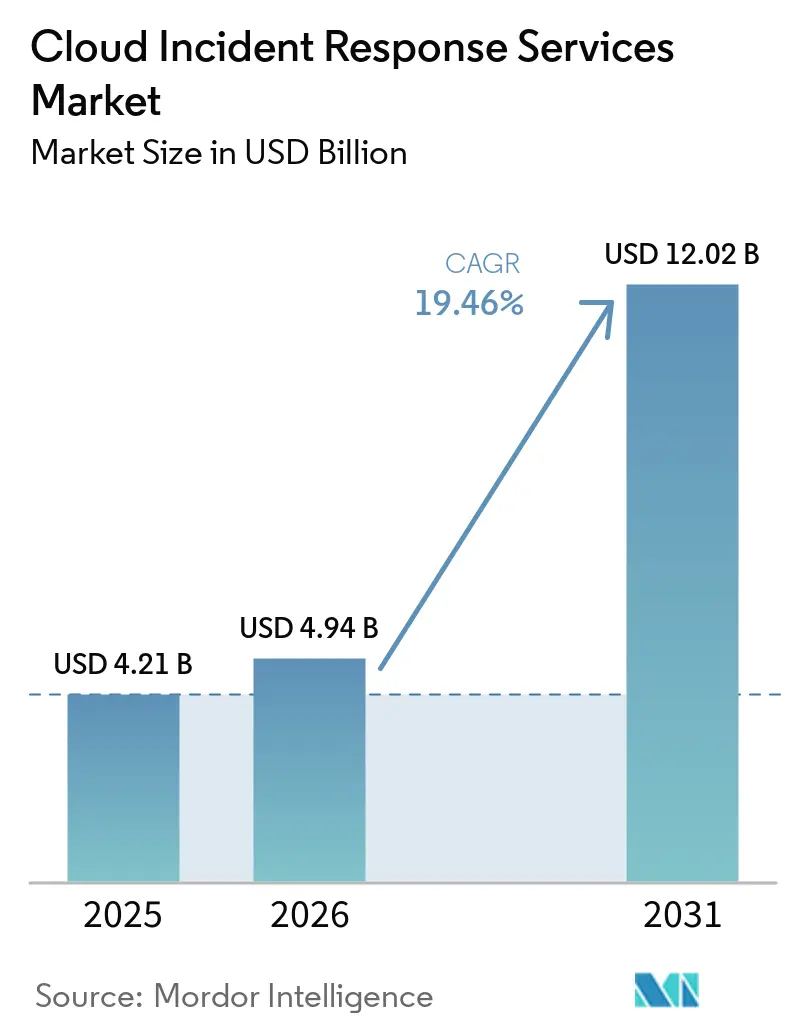
The cloud incident response services market size is projected to expand from USD 4.21 billion in 2025 and USD 4.94 billion in 2026 to USD 12.02 billion by 2031, registering a CAGR of 19.46% between 2026 to 2031. Organizations are increasing spending on specialist response support as cloud breaches become harder for internal teams to investigate and contain. Multi-cloud deployments, shorter disclosure deadlines, and cloud-native attack methods are changing how response services are purchased. Retainer-based programs are gaining preference because they provide access to responders before an incident begins. Identity compromise and AI-enabled attack activity are raising the urgency of continuous detection and response. The cloud incident response services market is therefore moving from isolated, reactive engagements toward ongoing services that support faster containment and reporting.
Key Report Takeaways
- By service type, containment and mitigation held 32.86% of spending in the cloud incident response services market in 2025, while managed detection and response is projected to expand at a 23.17% CAGR through 2031.
- By cloud environment, public cloud held 54.29% of the cloud incident response services market in 2025 and is expected to expand at a 22.86% CAGR through 2031.
- By organization size, large enterprises accounted for 67.43% of spending in 2025, while small and medium-sized enterprises are projected to grow at a 24.31% CAGR through 2031.
- By end-user industry, BFSI held 26.61% of spending in 2025, while the healthcare and life sciences industry is forecast to expand at a 21.88% CAGR through 2031.
- By geography, North America held 36.74% of the cloud incident response services market in 2025, while Asia-Pacific is projected to expand at a 24.63% CAGR through 2031.
Note: Market size and forecast figures in this report are generated using Mordor Intelligence’s proprietary estimation framework, updated with the latest available data and insights as of January 2026.
Global Cloud Incident Response Services Market Trends and Insights
Drivers Impact Analysis*
| DRIVER | (~) % IMPACT ON CAGR FORECAST | GEOGRAPHIC RELEVANCE | IMPACT TIMELINE |
|---|---|---|---|
| Rising Cloud Identity and API Abuse | +4.2% | Global, concentrated in North America and Europe | Short term (≤ 2 years) |
| AI-Accelerated Attacker Tradecraft | +3.8% | Global, with early intensity in North America and Asia-Pacific | Short term (≤ 2 years) |
| Regulatory and Cyber-Insurance Response Obligations | +3.5% | North America and Europe, with spillover to Asia-Pacific and Middle East | Medium term (2-4 years) |
| Multi-Cloud and Ephemeral Workload Complexity | +3% | Global, with accelerating adoption in Asia-Pacific | Medium term (2-4 years) |
| Machine-Readable Evidence and Automated Containment | +2.5% | North America and Europe, with accelerating adoption in Asia-Pacific | Medium term (2-4 years) |
| Shortage of Specialized Cloud Forensics Talent | +2.2% | Global, with pronounced gaps in Asia-Pacific and South America | Long term (≥ 4 years) |
| Source: Mordor Intelligence | |||
Rising Cloud Identity and API Abuse
Identity-related investigations are taking a larger share of response retainer budgets because cloud breaches often begin with compromised credentials or permissions. Identity controls influence access throughout the attack path, so response teams must examine them beyond the first point of entry. Compromised accounts can allow an attacker to use ordinary cloud services while avoiding attention from controls that rely on unfamiliar behavior. Response teams must reconstruct consent chains, token histories, service-account privilege paths, and changes to access policies. That work requires specialists who understand how identity is implemented across cloud platforms and connected applications. The cloud incident response services market favors providers with dedicated cloud identity forensic skills instead of general response playbooks adapted from on-premises environments.
AI-Accelerated Attacker Tradecraft
AI became part of operational attack activity during 2025, which changed the time available for investigation and containment. Google Mandiant identified PROMPTFLUX in June 2025, a tool that queried the Gemini API to rewrite its VBScript source code regularly and create polymorphic behavior.[1]Google Cloud, “AI Risk and Resilience: A Mandiant Special Report,” Google Cloud, cloud.google.com Attack automation can reduce the time between access, lateral movement, and data theft. It also makes repeated variations of malicious activity harder to detect with static rules alone. These conditions increase the need for automated triage that can act before analysts review each alert. They increase demand for response providers that connect detection and containment in a single operating model.
Regulatory and Cyber-Insurance Response Obligations
Regulatory obligations are making incident response a structured operating requirement rather than an activity started only after a breach. Financial entities subject to the EU Digital Operational Resilience Act must maintain disciplined processes for classifying, reporting, and closing material information and communications technology incidents. Organizations handling personal information can also face overlapping obligations across privacy and cybersecurity frameworks. These requirements make documented response procedures, tested communication paths, and reliable evidence handling more important during provider selection. Cyber-insurance carriers are also making pre-contracted response retainers relevant to policy terms and premium assessments. The cloud incident response services market benefits when buyers procure readiness services before an incident rather than during an active crisis.
Multi-Cloud and Ephemeral Workload Complexity
Multi-cloud environments make incident response more difficult because responders must reconcile separate logging structures and access models. The SANS 2025 Multicloud Survey found that organizations using 3 or more cloud environments reported longer containment times than single-cloud users.[2]SANS Institute, “SANS 2025 Multicloud Survey: Securing Multiple Clouds at Scale,” SANS Institute, sans.org Containers and serverless functions can end before responders collect volatile evidence, which raises the value of automated preservation. Different platforms may retain records for different periods and make them available through different tools. Organizations with diverse cloud estates are increasingly choosing platform-inclusive retainers because sourcing help during an incident can delay containment. This operating complexity supports sustained demand across the cloud incident response services market.
Restraints Impact Analysis*
| RESTRAINT | (~) % IMPACT ON CAGR FORECAST | GEOGRAPHIC RELEVANCE | IMPACT TIMELINE |
|---|---|---|---|
| Evidence Gaps From Logging Misconfiguration | -2.8% | Global, concentrated in small and medium-sized enterprise segments across all regions | Short term (≤ 2 years) |
| Data Sovereignty and Cross-Border Evidence Restrictions | -2.4% | Europe, Asia-Pacific, and Middle East | Medium term (2-4 years) |
| Fragmented Tooling and Shared-Responsibility Ambiguity | -1.8% | Global, pronounced in multi-cloud enterprises | Medium term (2-4 years) |
| Ephemeral Workload Volatility During Investigation | -1.5% | Global, with North America and Asia-Pacific most affected | Short term (≤ 2 years) |
| Source: Mordor Intelligence | |||
Evidence Gaps From Logging Misconfiguration
Cloud response depends on complete telemetry, yet logging configurations often leave important evidence unavailable at the time of an investigation. Palo Alto Networks reported that attackers exploited misconfigured access and identity controls in nearly half of the cloud breaches covered by its 2025 global incident response report.[3]Palo Alto Networks, “The Rising Stakes of Cyber Resilience: What the 2025 Global Incident Response Report Means for Business Leaders,” Palo Alto Networks, paloaltonetworks.es Organizations may limit detailed API logging to control storage costs, but this can remove the records needed to establish an attacker’s path and the scope of a breach. Default settings can be particularly inadequate for container and serverless workloads, where event volumes are high and retention periods may be short. Retainers and automated playbooks cannot replace source information that was never captured. This constraint can reduce the effectiveness of the cloud incident response services market for organizations that have not prepared their logging environment.
Data Sovereignty and Cross-Border Evidence Restrictions
Cloud investigations often involve information stored or processed in several jurisdictions. Privacy and data security rules can limit how personal information is extracted, transferred, and retained for forensic analysis. These restrictions may require separate evidence environments for multinational organizations, which divides visibility and slows coordination. Advance contractual access rights and legal review can also be necessary before an external responder receives cloud data. Organizations without established arrangements may face delays when they are least able to absorb them. Providers with local evidence-handling capability and regulatory knowledge have a clearer position within the cloud incident response services market.
*Our forecasts treat driver/restraint impacts as directional, not additive. The impact forecasts reflect baseline growth, mix effects, and variable interactions.
Segment Analysis
By Service Type: Managed Detection and Response Drives Service Growth
Managed detection and response is projected to expand at a 23.17% CAGR during 2026-2031, making it the fastest-growing service type. Its retainer model combines continuous monitoring, threat hunting, and response execution under one agreement. This structure avoids procurement delays that can occur when a buyer seeks emergency assistance after a breach. CrowdStrike introduced Agentic MDR in March 2026, combining autonomous AI agents with Falcon Complete analysts to automate high-friction security work. The offering reflects the growing value placed on a closer connection between detection and containment. The cloud incident response services market size for managed detection and response is supported by organizations that cannot maintain their own round-the-clock threat intelligence and response teams.
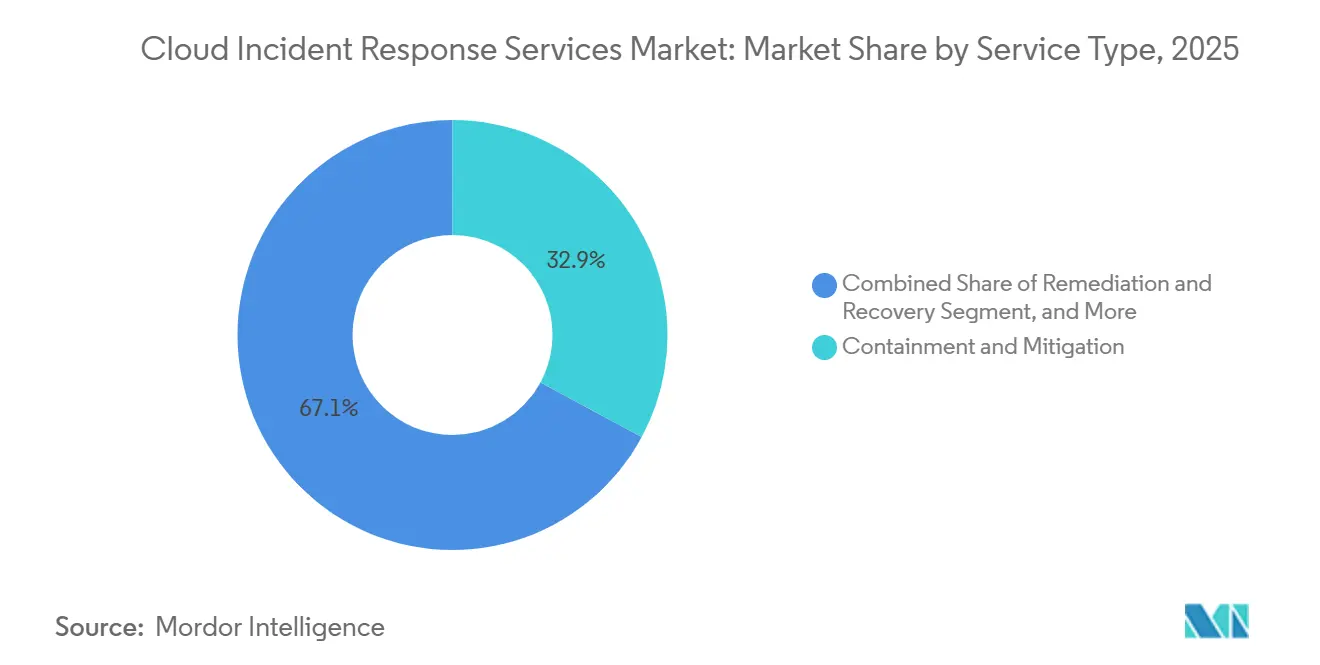
Containment and mitigation accounted for 32.86% of service-type spending in 2025, the largest share of Cloud incident response services within this segmentation. Stopping the spread of an incident remains the immediate operating priority after a breach is confirmed. Investigation and digital forensics commonly follow containment because responders need to establish what occurred and preserve evidence. Remediation and recovery then focus on restoring services, correcting controls, and reducing the chance of recurrence. Other service configurations include cloud identity retainers and outcome-based arrangements. The service mix, therefore, reflects the order in which many organizations manage a cloud security incident.



By Cloud Environment: Public Cloud Remains the Main Deployment Context
Public cloud held 54.29% of deployment-context spending in 2025 and is projected to expand at a 22.86% CAGR during 2026-2031. This position reflects the concentration of enterprise workloads and security events in public cloud platforms. AWS, Microsoft Azure, and Google Cloud provide telemetry that specialized response platforms are increasingly designed to collect and analyze. CrowdStrike extended its real-time cloud detection and response capabilities to Google Cloud in April 2026. The expansion supports a unified response across distributed environments. Public cloud, therefore, holds the leading market share in cloud incident response services for the deployment context.
Private, hybrid, and multi-cloud environments require different evidence collection methods and responder expertise. Hybrid deployments require teams to correlate on-premises and cloud records that may use different schemas and retention periods. Multi-cloud estates add identity and permission challenges because accounts and tokens can span cloud boundaries. IBM found that hybrid and multi-cloud breaches took longer to identify and contain than breaches in a single environment.[4]IBM and Censinet, “Study: Impact of Cloud Vendor Breaches on Healthcare,” Censinet, censinet.com Organizations are investing in automated evidence preservation to capture the volatile state before scaling policies remove affected instances. These conditions keep specialized deployment knowledge important across the cloud incident response services market.
By Organization Size: Small and Medium-Sized Enterprises Gain Access to Managed Services
Small and medium-sized enterprises are projected to grow at a 24.31% CAGR during 2026-2031, the highest rate by organization size. Subscription retainers, outcome-based pricing, and shared security operations centers are making specialist support more accessible to smaller buyers. These organizations often cannot build and staff internal incident response programs at enterprise scale. ISACA reported in 2025 that 55% of cybersecurity teams were understaffed and 65% had unfilled cybersecurity positions.[5]ISACA, “New ISACA Study: Despite Understaffed Cybersecurity Teams, Fewer Enterprises Are Training Staff for Security Roles,” Business Wire, businesswire.com The shortage is especially difficult for smaller organizations competing for certified professionals. Cyber-insurance incentives for documented retainers add another reason for SMEs to consider proactive coverage.
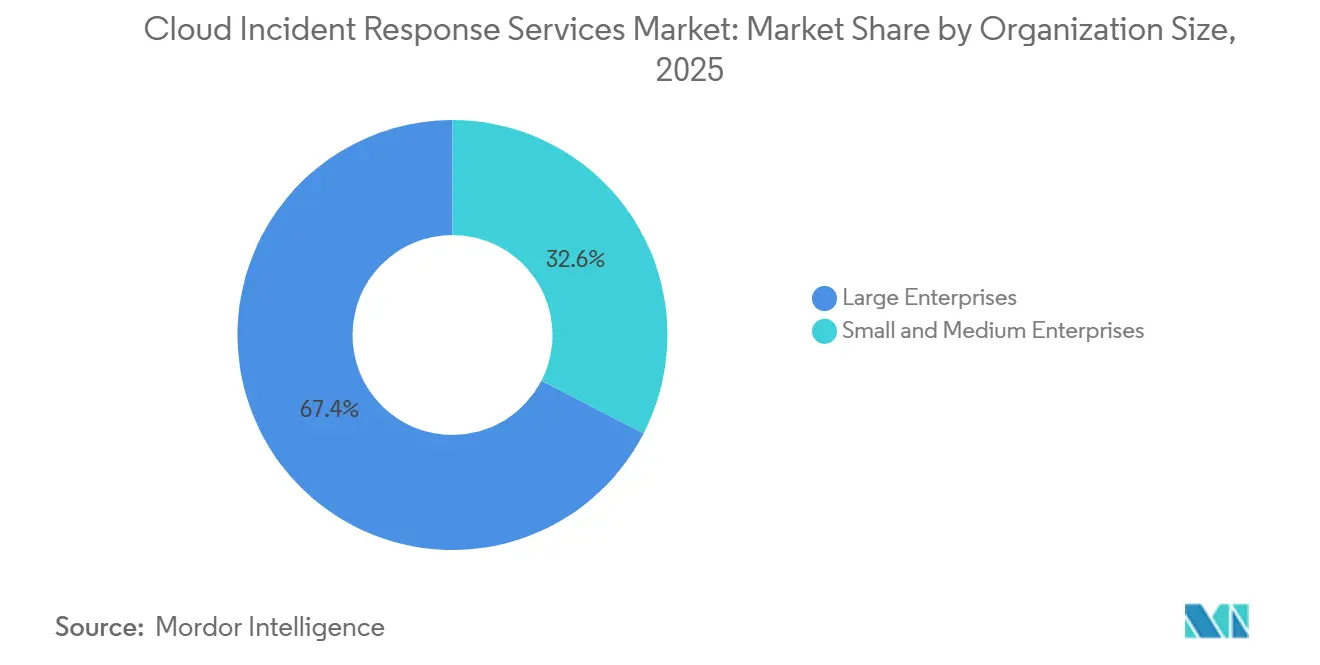
Large enterprises accounted for 67.43% of organizational-size spending in 2025, giving them the largest cloud incident response services market share in this segment. Their demand is tied to large cloud estates, board-level cybersecurity oversight, compliance obligations, and higher potential breach costs. Providers are adapting enterprise-grade services into defined subscriptions with specified response times and automated triage. Cloud-native delivery reduces the infrastructure spending required by earlier response models. SMEs can use similar telemetry pipelines and containment workflows, but at a scale that reflects their environment and risk exposure. This narrower capability gap broadens the addressable buyer base for the cloud incident response services market.
By End-User Industry: Healthcare and Life Sciences Expands Fastest
The healthcare and life sciences industry is forecast to expand at a 21.88% CAGR during 2026-2031, driven by high breach costs and cloud migration involving patient information. IBM reported that the average cost of a healthcare data breach in the United States was USD 7.42 million per incident in 2025. The sector has sensitive patient data, connected medical devices, and reporting requirements that can complicate each response engagement. Healthcare providers need responders who can work within clinical operating constraints as well as technical response procedures. Rapid investigation can also matter where systems support patient care and operational continuity. These requirements support specialized service demand in the cloud incident response services market.
BFSI held 26.61% of end-user spending in 2025, which was the largest cloud incident response services market share by end-user industry. Financial organizations must manage security, privacy, payment, and disclosure obligations while responding to incidents. Government and public administration require controlled evidence handling and coordinated notification across agencies. IT and telecommunications, energy and utilities, and industrial manufacturing each present distinct requirements, including industrial control system and cloud environment coordination in energy settings. Retail, e-commerce, transportation, and logistics are expanding response spending as digital supply chains increase cloud exposure. Education and research institutions remain exposed to state-sponsored threats while often investing less in cloud response than their risk profile would suggest.
Geography Analysis
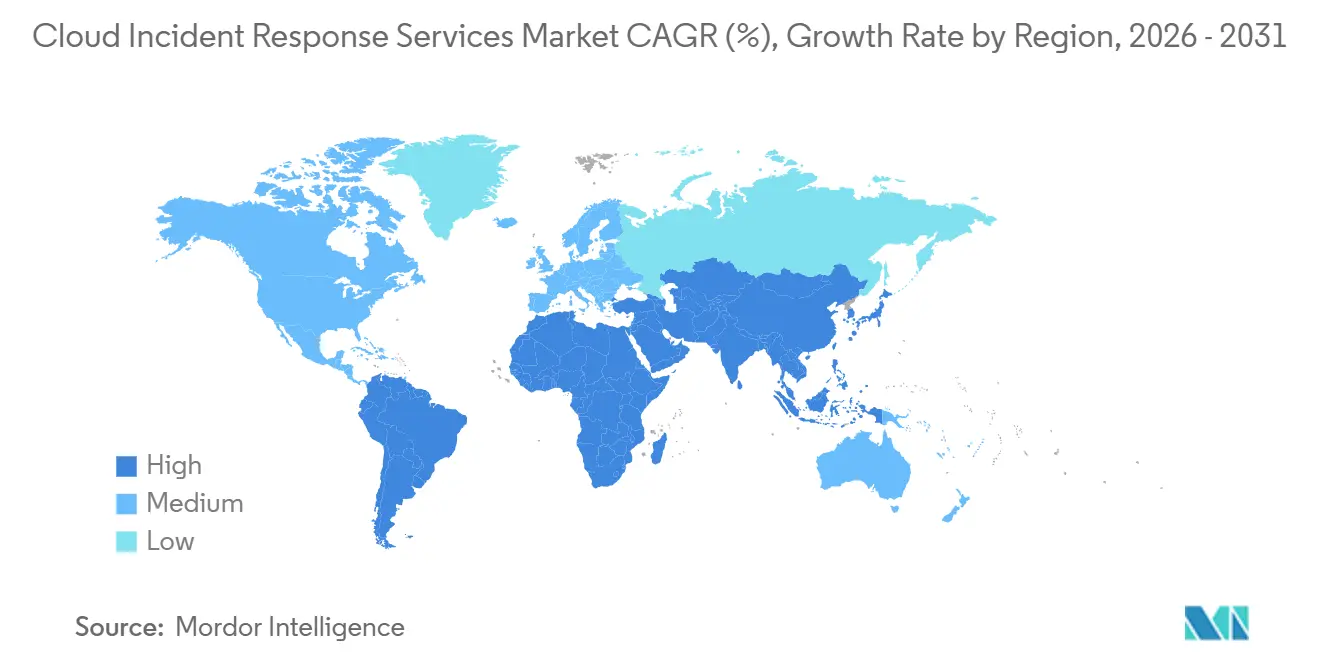
North America held 36.74% of the global cloud incident response services market in 2025, the largest regional share. Enterprise cloud adoption, established provider networks, and response-readiness spending underpin its position. SEC cybersecurity disclosure requirements have increased board attention to materiality assessments and prepared response programs. Canada’s privacy framework and Mexico’s focus on digital infrastructure security extend demand beyond the United States. Buyers increasingly seek pre-arranged response support instead of emergency sourcing after an event.
Asia-Pacific is forecast to expand at a 24.63% CAGR during 2026-2031, the fastest regional rate. Cloud adoption and government cybersecurity requirements are expanding the need for prepared response services across the region. India’s data protection framework and global delivery centers increase the importance of handling sensitive multinational information. Singapore and Australia are also influencing procurement through cloud configuration and breach-response requirements. Providers that can support local evidence residency and regulatory response are well placed to serve this regional demand.
Europe is shaped by DORA, NIS2, and GDPR requirements, especially in financial centers across Germany, the United Kingdom, France, and Benelux. South America is developing from a smaller base, with demand in Brazil and Argentina centered on financial institutions and government entities. Saudi Arabia and the United Arab Emirates have increased incident-planning requirements for critical infrastructure operators. South Africa and Nigeria lead African adoption among financial services and telecommunications firms, although provider availability and specialized skills limit near-term progress.

Competitive Landscape
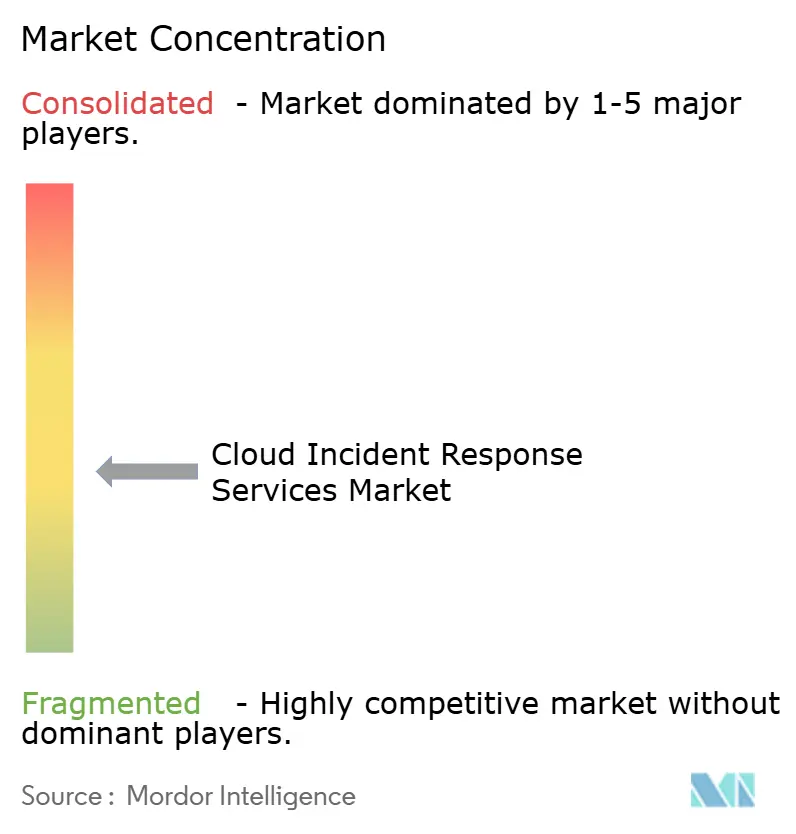
The cloud incident response services market has moderate-to-high concentration among premium providers serving large enterprises and financial institutions. Platform vendors, global consulting firms, and providers aligned with major cloud platforms compete for high-value retainers. The mid-market is more fragmented because regional managed security providers vary in forensic depth and cloud response coverage. CrowdStrike launched Agentic MDR in March 2026 and expanded its work with IBM to connect Charlotte AI with IBM’s Autonomous Threat Operations Machine. The move combines managed services with AI-enabled investigation and containment workflows.
Palo Alto Networks completed its acquisition of Chronosphere in January 2026 for USD 3.35 billion to connect cloud observability and security data pipelines. The company also acquired Console in September 2026 to add agentic security operations capabilities to its Cortex platform.[6]Palo Alto Networks, “Palo Alto Networks Acquires Console to Agentify Security,” Palo Alto Networks, paloaltonetworks.com These actions show how larger vendors are adding service capabilities through acquisitions and product development. Providers with unified telemetry, automated evidence collection, and containment capabilities can reduce manual investigation work. Trust certifications remain important when financial institutions assess third-party response providers.
Market openings include managed evidence residency, identity-focused retainers for multi-cloud credential estates, and pricing tied to containment and recovery outcomes. Cribl acquired technology assets from Radiant Security’s AI-native security operations center product in August 2026. The deal reflects interest in security data pipelines as a route to investigation workflow value. No combined share for the largest providers was supplied, so the market remains best characterized as moderately concentrated at the premium end and fragmented in the mid-market.
Cloud Incident Response Services Industry Leaders
Accenture plc
Arctic Wolf Networks, Inc.
BAE Systems plc
Check Point Software Technologies Ltd.
Cisco Systems, Inc.
- *Disclaimer: Major Players sorted in no particular order

Recent Industry Developments
- August 2026: Cribl acquired technology assets from Radiant Security's AI-native security operations center product, incorporating autonomous alert triage, investigation, and resolution into its telemetry data platform. This marked Cribl's second security technology acquisition in 2026, following its CardinalOps acquisition in July.
- August 2026: CrowdStrike announced the availability of the Falcon platform on Google Cloud infrastructure, enabling regional in-country data processing that supports data localization and sovereignty requirements. The deployment gave customers unified AI-native security coverage across multi-cloud environments while aligning with operational compliance obligations.
- April 2026: CrowdStrike extended Cloud Detection and Response capabilities to Google Cloud, delivering real-time, unified protection across hybrid and multi-cloud environments. The expansion shifted cloud security from posture-only tools to integrated real-time response pipelines across AWS, Azure, and Google Cloud simultaneously.
- April 2026: Palo Alto Networks completed the acquisition of Koi, a pioneer in agentic endpoint security, integrating its capabilities into Prisma AIRS and Cortex XDR. The completion established a new protection category, Agentic Endpoint Security, covering AI-driven endpoint tools that operate with deep data access and expanded permissions.


Global Cloud Incident Response Services Market Report Scope
The cloud incident response services market includes specialized cybersecurity consulting and managed services that help organizations detect, investigate, contain, and recover from security incidents affecting cloud infrastructure, applications, and data across IaaS, PaaS, SaaS, and multi-cloud environments. These services cover incident detection and triage, cloud forensics, threat hunting, ransomware response, cloud account compromise remediation, compliance reporting, and post-incident security hardening. Cloud security professionals with expertise in AWS, Azure, Google Cloud, and SaaS platforms provide these services to minimize business disruption, preserve evidence, meet regulatory requirements, and restore secure cloud operations after security breaches, data exfiltration, insider threats, and advanced persistent threats.
The Cloud Incident Response Services Market Report is Segmented by Service Type (Investigation and Digital Forensics, Containment and Mitigation, Remediation and Recovery, Managed Detection and Response, and Other Service Types), Cloud Environment (Public Cloud, Private Cloud, Hybrid Cloud, and Multi-Cloud), Organization Size (Large Enterprises, and Small and Medium-Sized Enterprises), Industry Vertical (Government and Public Administration, Industrial Manufacturing, Retail and E-Commerce, Transportation and Logistics, Energy and Utilities, Oil and Gas, IT and Telecommunication, Media and Entertainment, Education and Research Institutions, Healthcare and Life Sciences, Banking, Financial Services, and Insurance (BFSI), and Other Industry Verticals), and Geography (North America, South America, Europe, Asia-Pacific, Middle East, and Africa). The Market Forecasts are Provided in Terms of Value (USD).
| Investigation and Digital Forensics |
| Containment and Mitigation |
| Remediation and Recovery |
| Managed Detection and Response |
| Other Service Types |
| Public Cloud |
| Private Cloud |
| Hybrid Cloud |
| Multi-Cloud |
| Large Enterprises |
| Small and Medium Enterprises |
| Government and Public Administration |
| Industrial Manufacturing |
| Retail and E-Commerce |
| Transportation and Logistics |
| Energy and Utilities |
| Oil and Gas |
| IT and Telecommunication |
| Media and Entertainment |
| Education and Research Institutions |
| Healthcare and Life Sciences |
| Banking, Financial Services, and Insurance (BFSI) |
| Other Industry Verticals |
| North America | United States |
| Canada | |
| Mexico | |
| South America | Brazil |
| Argentina | |
| Rest of South America | |
| Europe | Germany |
| United Kingdom | |
| France | |
| Italy | |
| Spain | |
| Rest of Europe | |
| Asia-Pacific | China |
| Japan | |
| India | |
| South Korea | |
| Australia | |
| Rest of Asia-Pacific | |
| Middle East | Saudi Arabia |
| United Arab Emirates | |
| Rest of Middle East | |
| Africa | South Africa |
| Nigeria | |
| Rest of Africa |
| By Service Type | Investigation and Digital Forensics | |
| Containment and Mitigation | ||
| Remediation and Recovery | ||
| Managed Detection and Response | ||
| Other Service Types | ||
| By Cloud Environment | Public Cloud | |
| Private Cloud | ||
| Hybrid Cloud | ||
| Multi-Cloud | ||
| By Organization Size | Large Enterprises | |
| Small and Medium Enterprises | ||
| By Industry Vertical | Government and Public Administration | |
| Industrial Manufacturing | ||
| Retail and E-Commerce | ||
| Transportation and Logistics | ||
| Energy and Utilities | ||
| Oil and Gas | ||
| IT and Telecommunication | ||
| Media and Entertainment | ||
| Education and Research Institutions | ||
| Healthcare and Life Sciences | ||
| Banking, Financial Services, and Insurance (BFSI) | ||
| Other Industry Verticals | ||
| By Geography | North America | United States |
| Canada | ||
| Mexico | ||
| South America | Brazil | |
| Argentina | ||
| Rest of South America | ||
| Europe | Germany | |
| United Kingdom | ||
| France | ||
| Italy | ||
| Spain | ||
| Rest of Europe | ||
| Asia-Pacific | China | |
| Japan | ||
| India | ||
| South Korea | ||
| Australia | ||
| Rest of Asia-Pacific | ||
| Middle East | Saudi Arabia | |
| United Arab Emirates | ||
| Rest of Middle East | ||
| Africa | South Africa | |
| Nigeria | ||
| Rest of Africa | ||


Key Questions Answered in the Report
What is the size of the cloud incident response services market?
The cloud incident response services market size is projected to expand from USD 4.21 billion in 2025 and USD 4.94 billion in 2026 to USD 12.02 billion by 2031, registering a CAGR of 19.46% between 2026 to 2031. The forecast reflects higher spending on specialist cloud response services as organizations prepare for identity abuse, complex cloud environments, and faster-moving attacks. It also reflects a wider shift from isolated emergency engagements toward established response programs.
Why are organizations buying cloud incident response retainers?
Retainers provide prepared access to specialized responders and avoid procurement delays during a cloud security incident. They also support continuous monitoring, documented escalation processes, and access to technical skills that many organizations cannot retain internally on a full-time basis. This allows security leaders to define response responsibilities before evidence and operational time become constrained.
Which service type is growing fastest through 2031?
Managed detection and response is projected to grow at a 23.17% CAGR through 2031 because it combines continuous monitoring, threat hunting, and response execution. The model gives buyers a single arrangement for detecting suspicious activity, assessing its severity, and taking prompt containment action. Its value is strongest where internal teams cannot provide consistent coverage across cloud services.
Which cloud environment leads demand for incident response services?
Public cloud held 54.29% of deployment-context spending in 2025 and is projected to grow at a 22.86% CAGR through 2031. Its lead reflects the location of a large share of enterprise workloads and the availability of cloud-platform telemetry that response teams can use during investigations. Public cloud response services also need to preserve evidence from workloads that can change quickly.
Which organizations are expanding cloud response spending fastest?
Small and medium-sized enterprises are projected to grow at a 24.31% CAGR through 2031 as managed services make specialist response capabilities more accessible. Subscription retainers, shared security operations models, and automated triage reduce the financial and staffing barriers that previously limited adoption by smaller organizations. These options help smaller teams receive structured support without building a large internal response function.
Which region is growing fastest for cloud incident response services?
Asia-Pacific is projected to grow at a 24.63% CAGR through 2031, supported by cloud adoption and cybersecurity requirements. Regional buyers are increasing focus on response readiness, local evidence handling, and services that align with the operating and regulatory needs of rapidly digitizing economies. This creates demand for providers that can work across varied national requirements and cloud environments.
Page last updated on:


 Your data is secure and never sold or shared.


