
Citizen Services AI Market Size and Share
Market Overview
| Study Period | 2020 - 2031 |
|---|---|
| Market Size (2026) | USD 19.81 Billion |
| Market Size (2031) | USD 79.9 Billion |
| Growth Rate (2026 - 2031) | 32.18 % |
| Fastest Growing Market | Asia Pacific |
| Largest Market | North America |
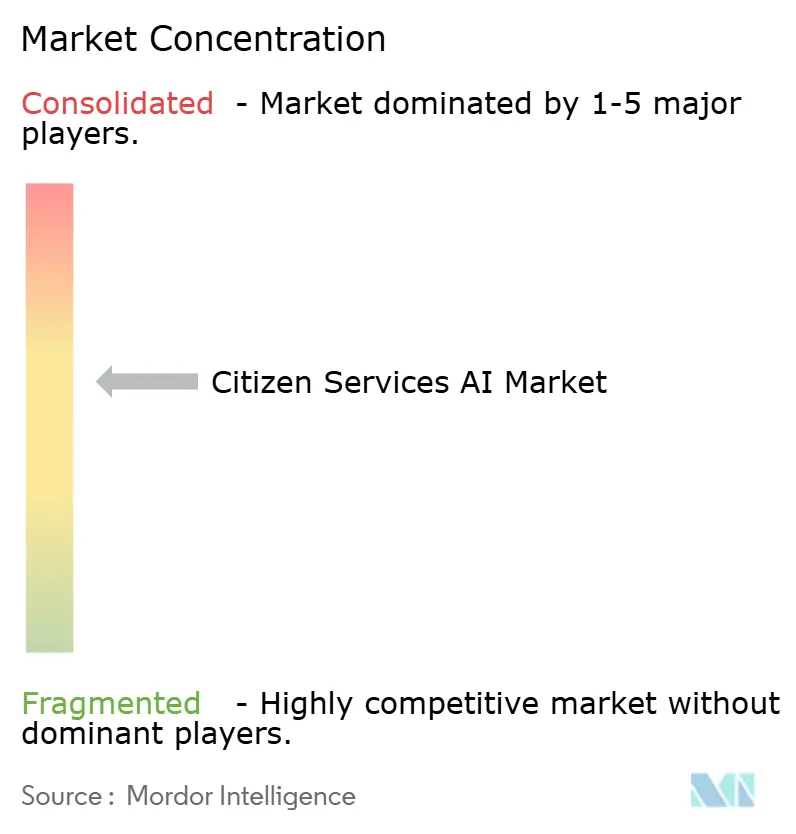
| Market Concentration | Medium |
Major Players *Disclaimer: Major Players sorted in no particular order Image © Mordor Intelligence. Reuse requires attribution under CC BY 4.0. | |
Citizen Services AI Market Analysis by Mordor Intelligence
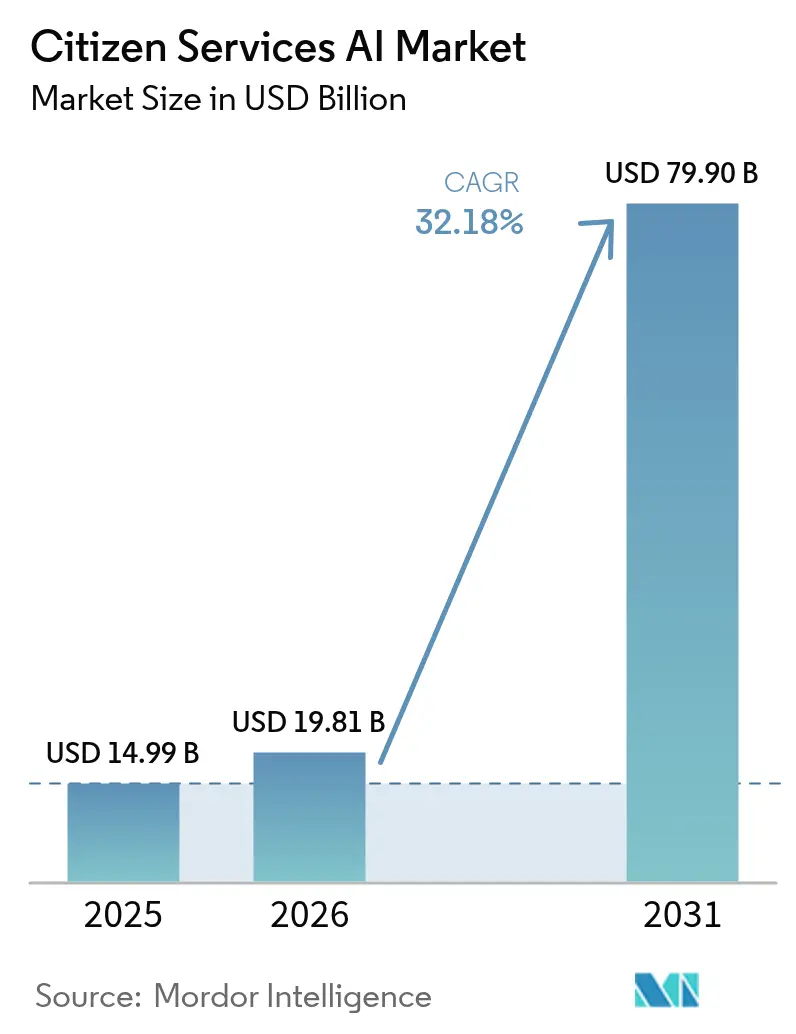
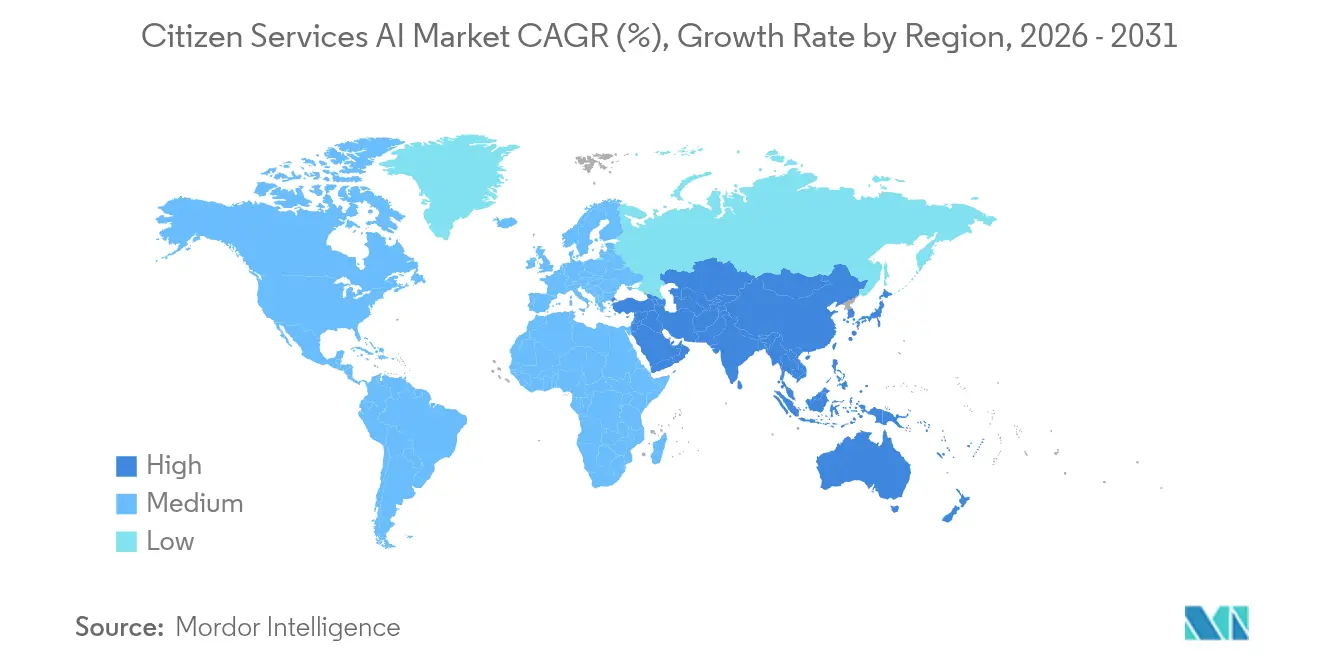
The Citizen services AI market size is expected to grow from USD 14.99 billion in 2025 to USD 19.81 billion in 2026 and is forecast to reach USD 79.9 billion by 2031 at 32.18% CAGR over 2026-2031. This swift rise illustrates how governments are replacing reactive workflows with predictive, autonomous public-service delivery. Federal agencies alone allocated USD 5.6 billion to AI programs between fiscal years 2022-2024, and the Biden administration has requested a further USD 3 billion for federal AI modernization in 2025. Rising sovereign-AI mandates, Section 508 accessibility rules, and the spread of low-code platforms jointly accelerate adoption, while integrated cloud suites make large-scale deployments feasible. North America controls 46% of the Citizen services AI market, yet Asia-Pacific is advancing at a 37% CAGR as large national AI investments, such as South Korea’s USD 735 billion sovereign-AI program, gather pace. Machine-learning tools still lead with 38% share, but generative AI is scaling at 38% growth as agencies lean on conversational interfaces to boost citizen engagement. [1]
Key Report Takeaways
- By technology, machine learning held 37.40% of the Citizen services AI market share in 2025, while generative AI is projected to grow at a 36.2% CAGR through 2031.
- By component, solutions and platforms captured 61.20% of the Citizen services AI market size in 2025; managed services are forecast to expand at a 34.4% CAGR.
- By deployment model, cloud accounted for 70.10% of the Citizen services AI market size in 2025, whereas hybrid and edge deployments are rising at a 37.5% CAGR.
- By application, public safety and emergency response commanded a 26.30% share of the Citizen services AI market size in 2025, while citizen engagement is advancing at a 37.8% CAGR.
- By end-user tier, state and provincial agencies led with a 34.20% share of the Citizen services AI market in 2025; county and municipal governments record the highest projected CAGR at 36.6%.
- By geography, North America dominated with 45.30% revenue share in 2025; Asia-Pacific is forecast to post a 35.6% CAGR to 2031.
Note: Market size and forecast figures in this report are generated using Mordor Intelligence’s proprietary estimation framework, updated with the latest available data and insights as of 2026.
Market Trends and Insights
Drivers Impact Analysis of Citizen Services AI Market*
| Driver | (~) % Impact on CAGR Forecast | Geographic Relevance | Impact Timeline |
|---|---|---|---|
| Growing public sector funding earmarked for AI modernization | +8.50% | Global, with North America and EU leading | Medium term (2-4 years) |
| Mandates for digital accessibility and inclusive citizen engagement | +6.20% | North America and EU, expanding to APAC | Short term (≤ 2 years) |
| Advances in low-code / no-code AI platforms enabling rapid deployment | +7.10% | Global, particularly beneficial for smaller municipalities | Short term (≤ 2 years) |
| Integration of 5G and edge computing for real-time civic services | +4.80% | APAC core, spill-over to North America | Medium term (2-4 years) |
| Adoption of AI digital twins for urban planning and infrastructure | +3.90% | Global, with early gains in smart cities | Long term (≥ 4 years) |
| Rise of AI-powered proactive social safety-net interventions | +2.70% | North America and EU, pilot programs in APAC | Long term (≥ 4 years) |
| Source: Mordor Intelligence | |||
Growing public sector funding earmarked for AI modernization
Federal AI spending rose 177% in small-business set-asides between 2018-2023, transforming AI from pilot projects into core infrastructure. The National Security Commission on AI recommends annual non-defense spending of USD 32 billion by 2026 to secure continued momentum. Executive Order 14110 now requires every federal agency to appoint a chief AI officer, embedding sustained budgets and accountability. California alone draws from USD 138.9 billion in overall SLED IT budgets for 2025 deployments. These moves signal that reliable, multi-year funding has become a structural driver rather than an isolated event.[2]
Mandates for digital accessibility and inclusive citizen engagement
Section 508 compliance pushes agencies to design AI that serves diverse language and ability needs; 24% of U.S. residents speak a language other than English at home, heightening demand for multilingual assistants. The Biden administration’s AI order prioritizes equity, turning accessibility from a compliance box into a growth catalyst. Singapore’s government chatbot, which lets residents contact any civil servant via Facebook Messenger, shows how AI democratizes access to officials. Agencies therefore invest in real-time translation, voice navigation, and adaptive interfaces to expand service reach while cutting call-center costs.
Advances in low-code / no-code AI platforms enabling rapid deployment
Low-code AI reduces technical barriers, letting agencies prototype in weeks rather than quarters. Montana’s Department of Justice built DMV chatbots despite tight budgets, proving small teams can launch enterprise-grade services. Vendors such as ServiceNow integrate Microsoft Copilot and domain-specific models so workflows, data policies, and security controls are pre-configured, shortening learning curves. Standardized playbooks, like the U.S. Department of Energy’s Generative AI Reference Guide, further cut time-to-value by codifying best practices in governance and ethics.
Integration of 5G and edge computing for real-time civic services
Edge processing keeps latency in the millisecond range, critical for traffic optimization, public-safety video analytics, and disaster response. Pittsburgh’s AI traffic lights trimmed emissions 21% while cutting journey times 26%, showing the tangible impact of local inference. U.S. federal agencies are now urged to invest in GPU-accelerated edge nodes to meet surging AI workloads, and multicloud strategies ensure that sensitive data remains sovereign while still tapping hyperscale compute burst capacity.
Restraints Impact Analysis of Citizen Services AI Market*
| Restraint | (~) % Impact on CAGR Forecast | Geographic Relevance | Impact Timeline |
|---|---|---|---|
| Budget volatility and fiscal austerity cycles in municipalities | -4.30% | Global, particularly affecting smaller municipalities | Short term (≤ 2 years) |
| Public skepticism over algorithmic transparency and privacy | -3.80% | North America and EU, emerging in APAC | Medium term (2-4 years) |
| Fragmented legacy data architectures hampering AI training | -5.10% | Global, more severe in older government systems | Medium term (2-4 years) |
| Shortage of domain-specific annotated datasets for civic use-cases | -2.90% | Global, with variations by local language and context | Long term (≥ 4 years) |
| Source: Mordor Intelligence | |||
Budget volatility and fiscal austerity cycles in municipalities
Smaller jurisdictions often operate on annual, cash-constrained budgets that make multiyear AI projects difficult to sustain. Wake County, North Carolina paid SAS USD 707,587 since 2018 to automate property assessments, yet similar outlays are the first cut during downturns. Only 24% of state CIOs report mature data-governance frameworks for generative AI, underscoring resource limitations that extend well beyond software licensing. Competitive federal grant programs cushion some risk, but their episodic nature forces agencies to favour short-term ROI over systemic transformation. [3]
Public scepticism over algorithmic transparency and privacy
Citizens question opaque automated decisions that affect benefits, licenses, or public safety. The U.K. Government’s GPT-4o chatbot faced criticism for hallucinated answers, highlighting accuracy concerns. In the United States, lawmakers raised alarms after an AI-driven review cancelled more than 650 Department of Veterans Affairs contracts, reinforcing demands for explainable AI. Agencies must now budget for robust model-audit tools and public engagement programs, lengthening deployment cycles and increasing costs.
*Our forecasts treat driver/restraint impacts as directional, not additive. The impact forecasts reflect baseline growth, mix effects, and variable interactions.
Citizen Services AI Market Segment Analysis
By Technology:
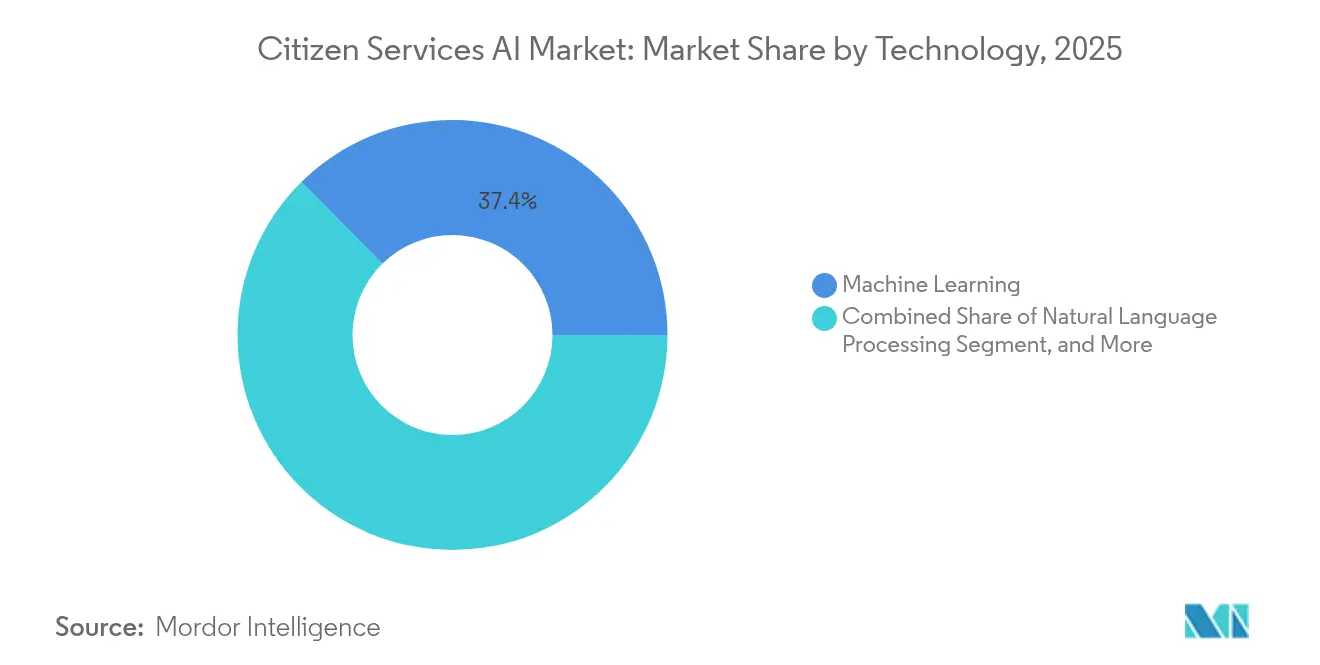
Machine learning’s maturity meets generative AI disruptionMachine learning accounted for 37.40% of the Citizen services AI market in 2025 as agencies relied on predictive analytics for fraud detection, infrastructure monitoring, and permit backlogs. Its dominance stems from proven toolkits, pre-trained models, and a decade of incremental policy guidelines that derisk procurement. Yet generative AI and large language models are expanding at a 36.2% CAGR, propelled by rising demand for conversational interfaces that handle routine inquiries without staff intervention. The Social Security Administration’s employee-facing chatbot illustrates how natural-language tools streamline internal workflows. Computer-vision AI, bolstered by Costa Mesa’s manhole-inspection pilot, is also scaling as video archives become a rich data source for infrastructure analytics. Facial recognition retains a foothold in border control and secure facility access even as regulators impose tighter guardrails. Cutting-edge techniques such as federated and reinforcement learning enter pilot stages, especially inside defense agencies pursuing sovereign data strategies. Together, these shifts suggest that machine learning will remain foundational, but generative AI will gradually command higher budget shares through 2031, reshaping value capture across the Citizen services AI market.
Generative-AI momentum is visible in procurement notices stipulating large-language-model integration, multilingual output, and retrieval-augmented generation. OpenAI’s USD 200 million Department of Defense award indicates federal appetite for frontier models aligned with classified-data controls. As agencies invest in synthetic-data generation to offset annotation shortfalls, model-training cycles shorten and broaden use-case coverage. Specialized hardware accelerators, from NVIDIA H100 GPUs to Intel Habana Gaudi 3 chips, enter agency spending plans to sustain compute-hungry fine-tunes. Although generative AI currently represents a smaller slice of the Citizen services AI market size, its rapidly growing install base positions it to overtake several traditional analytics categories by the decade’s close.

By Component:
Integrated solutions pull ahead of point productsSolutions and platforms captured 61.20% of the Citizen services AI market size in 2025 as agencies gravitated toward unified suites that bundle orchestration, model catalogues, and governance dashboards. This preference results from procurement simplification: a single authority-to-operate certificate covers multiple functions, reducing compliance overhead. ServiceNow’s Digital Government Transformation Suite exemplifies this trend, embedding a workflow data fabric, AI agents, and asset-management tools into a single, FedRAMP-authorized stack. Managed services, projected to grow at a 34.4% CAGR, appeal to local governments that lack in-house data-science talent; the Department of Homeland Security’s DHSChat serves 19,000 staff via a centrally managed generative AI backbone.Professional services remain critical for change management, risk assessments, and staff training, while hardware accelerators resurface due to the increasing demand for edge and on-premises workloads. Vendors pursue vertical partnerships with Oracle, Palantir, and Microsoft, as well as ServiceNow, to combine infrastructure, analytics, and domain templates in one sale. That integration drives longer contract durations, locking in incremental module sales and raising switching costs. Consequently, platform consolidation is set to deepen, reinforcing the primacy of end-to-end suites in the Citizen services AI market.
By Deployment Model:
Cloud still leads, sovereignty drives hybrid surgeCloud deployments accounted for 70.10% of the Citizen services AI market in 2025 given their near-instant scalability and pay-as-you-go economics. FedRAMP and StateRAMP certifications further speed procurement, turning commercial SaaS products into compliant government workloads. Yet hybrid and edge architectures are advancing at a 37.5% CAGR, driven by data-sovereignty rules and real-time use cases. Nutanix reports that agencies increasingly spread workloads across three or more hyperscalers to avoid vendor lock-in while keeping sensitive datasets on-premises. Oracle-Palantir sovereign clouds exemplify this shift by combining dedicated regions with policy-based data egress controls.Edge nodes stationed in intersections, patrol vehicles, or utility substations push inference closer to the event source, slashing latency for traffic lights, gun-shot detection, and wildfire alerts. Agencies adopt lightweight container orchestration to synchronize edge models with cloud-based retraining pipelines, preserving model accuracy without compromising localized decision making. As policy makers refine data-classification regimes, hybrid architectures will likely become the de facto blueprint, reshaping spending mixes within the Citizen services AI market.
By Application:
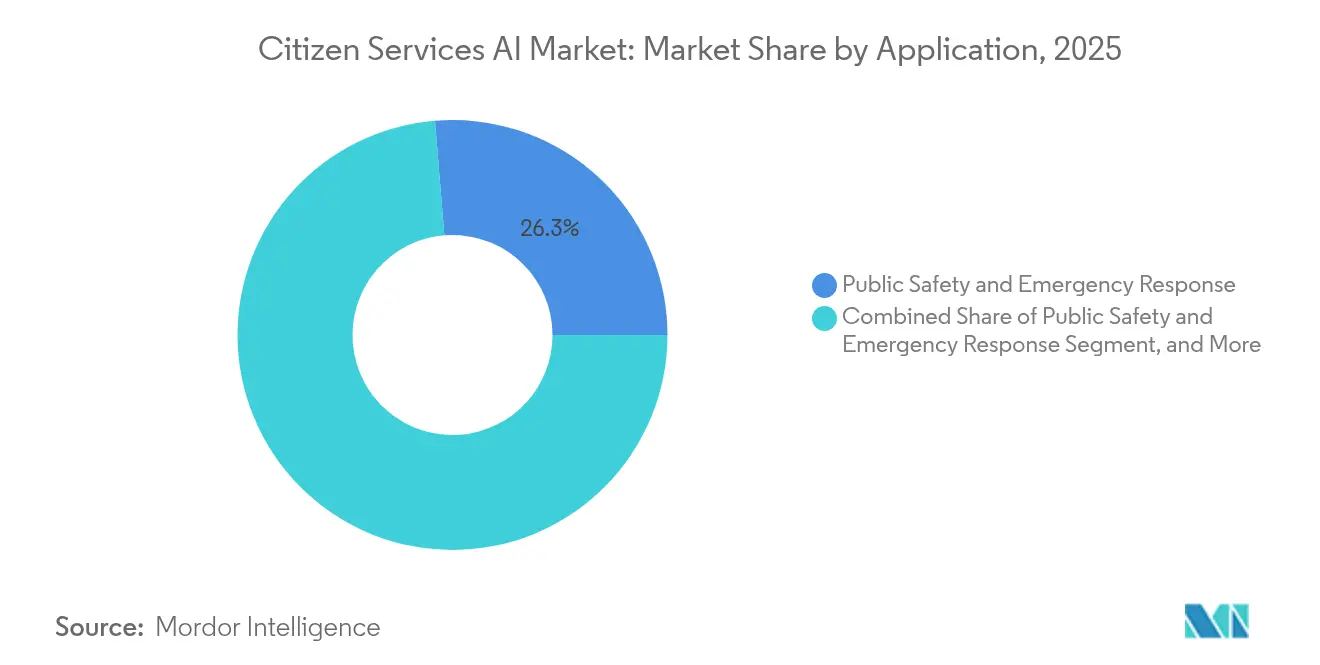
Public safety remains anchor, citizen engagement scales fastestPublic safety and emergency response held 26.30% of the Citizen services AI market size in 2025 owing to long-standing investments in predictive policing, 911 call triage, and disaster-response simulation. AI traffic-optimization in Las Vegas cut crashes 17%, illustrating strong ROI in life-critical contexts. Simultaneously, contact-center automation for benefits inquiries or permit status drives the citizen-engagement segment’s 37.8% CAGR. Amarillo’s digital assistant “Emma” serves non-English-speaking residents, reducing call-center hold times and improving service ratings.
Healthcare, social services, and utilities follow closely behind as agencies use AI to predict Medicaid churn, allocate shelter beds, or proactively dispatch repair crews. Tax and revenue departments modernize fraud detection through anomaly-scanning algorithms. Environmental regulators test AI-based inspections that flag violations via drone footage, expanding the “other applications” bucket. These diverse opportunities ensure continued broad-based demand across the Citizen services AI market.
By End-User Tier:
States dominate volume; municipalities post top growthState and provincial agencies commanded a 34.20% share of the Citizen services AI market in 2025, leveraging larger IT budgets and broad statutory mandates. Durham County’s rollout of Moveworks chatbots across 30 departments demonstrates how mid-tier governments follow state templates to fast-track transformation. Municipalities, however, are expanding at a 36.6% CAGR as cloud subscriptions and low-code builders make sophisticated tools accessible without dedicated data centers.
Federal-level entities focus on mission-critical, often classified workloads, driving demand for on-prem secure enclaves. Government-owned enterprises such as public utilities experiment with AI for predictive maintenance and customer self-service. Successful county pilots feed state policy toolkits, which subsequently inform federal guidelines. This virtuous cycle strengthens collective momentum within the Citizen Services AI market.
Geography Analysis
North America Citizen Services AI Market
North America’s 45.30% revenue share in 2025 reflects USD 5.6 billion in federal AI outlays since 2022, and statewide programs ranging from California’s multi-sector pilots to Oklahoma’s procurement optimization drive. Federal roadmaps, such as DHS’s AI blueprint, align pilot projects for immigration training and hazard mitigation. Municipal innovations from Seattle’s AI traffic signal timing to Spokane County’s body-camera analytics show that local governments actively shape adoption curves.
APAC Citizen Services AI Market
Asia-Pacific records the fastest regional CAGR at 35.6% through 2031. South Korea’s USD 735 billion sovereign-AI program, Japan’s USD 100 million generative-AI supercomputer, and Singapore’s nation-wide chatbots illustrate multi-country commitment to domestic AI ecosystems. In China, algorithm-regulation mandates are reshaping supplier go-to-market strategies, while Australia’s USD 101.2 million AI-adoption fund aims to create 1.2 million tech jobs by 2030, extending demand beyond federal agencies into education and healthcare.
EMEA and South America Citizen Services AI Market
Europe adopts a governance-led approach, developing comprehensive AI procurement guidelines that emphasize transparency and accountability. The U.K.’s chatbot demonstrates early-stage execution issues that regulators aim to correct through revised service-level metrics. Israel and the UAE incubate smart-city pilots, South Africa tests grant-management bots, and Brazil drafts an AI-governance framework. These diverse trajectories suggest no single blueprint but a spectrum of localized growth paths across the Citizen services AI market.
Regulatory Landscape
Policy and compliance requirements for citizen-service AI are tightening around transparency, safety, accessibility, and accountability, with noticeable divergence across regions. In the European Union, the AI Act introduces enforceable transparency obligations under Article 50 starting August 2, 2026, which affects citizen-facing chatbots and other AI-enabled service interfaces. In the United States, governance continues to be anchored in standards and evaluation, including the March 2026 GSA and NIST partnership through the Center for AI Standards and Innovation (CAISI) to standardize evaluation of AI tools for federal operations, complemented by NIST's February 2026 AI Agent Standards Initiative for voluntary guidance on autonomous agents.
Several governments are pairing national strategies with implementation bodies and adoption targets that feed directly into procurement. The UAE Cabinet approved a May 2026 federal framework to deploy agentic AI across 50% of government services and operations, increasing demand for auditable agent workflows in regulated government cloud environments. India released AI Governance Guidelines in February 2026, establishing an AI Safety Institute and expert committees to steer risk management and deployment practices. OECD 2026 reporting also highlights uneven maturity in citizen engagement mechanisms for AI deployments, reinforcing the need for explainability and public feedback loops in service delivery systems.
Value Chain Analysis
The value chain for citizen services AI spans data origination and governance, model development and orchestration, deployment infrastructure, and continuous operations within public-sector controls. Upstream inputs include digitized records from agencies and government-owned enterprises, data-fabric and interoperability layers that connect legacy systems, and cloud and edge compute that host models and retrieval pipelines. Platform vendors (hyperscalers and application suites) package these inputs into compliant environments, where procurement and authority-to-operate requirements favor integrated stacks that bundle workflow automation, identity and access controls, monitoring, and guardrails for citizen-facing interactions.
Midstream, systems integrators and consulting firms translate agency missions into use cases, configure domain templates, and establish responsible AI processes. Managed service providers then run model operations, including audit logging, drift monitoring, and incident handling, for resource-constrained municipalities. Downstream delivery is carried through omnichannel citizen engagement, including web portals, contact centers, and messaging, alongside operational systems in public safety, utilities, and social services. Bottlenecks concentrate around fragmented legacy architectures, scarcity of annotated civic datasets, and privacy and security compliance, which pushes agencies toward ecosystem models where governments and private partners co-develop solutions under standardized governance toolkits and accountable-official structures such as those required by the US Feb 2025 M-25-21 directive.
Competitive Landscape
The Citizen Services AI market is moderately fragmented. Hyperscalers, including Microsoft, Amazon, and Google, dominate infrastructure, while ServiceNow, IBM, Oracle, and Palantir lead in application platforms. Vendors increasingly secure FedRAMP High or StateRAMP authorizations to access public budgets. Oracle’s partnership with Palantir enables Foundry to run within regulated sovereign-cloud regions, thereby addressing data-residency rules for defense clients. ServiceNow’s expanded ties with Microsoft and Google integrate AI agents directly into 365 and Google Workspace, embedding capabilities where government knowledge workers already operate.
Niche entrants carve white-space positions. Ordinal AI provides retrieval-augmented generation tailored to city charters and municipal codes, offering source-linked answers that alleviate transparency concerns. Anthropic’s Claude Gov targets national-security users with air-gapped model-hosting. OpenAI’s USD 200 million defense deal underscores how AI-native firms bypass traditional integrators by pursuing direct Agency-Other-Transaction agreements.
Strategic moves center on joint reference architectures, sovereign-cloud capacity reservations, and industry-specific accelerators. Hardware specialists NVIDIA and Intel court agencies with secure multi-instance GPU partitions that enforce workload isolation. Consulting arms of Deloitte and Accenture assist change management but increasingly bundle proprietary accelerators, blurring lines between service and software. These dynamics keep switching costs high but encourage modular, standards-based interfaces across the Citizen services AI market.
Citizen Services AI Industry Leaders
-
Microsoft Corporation
-
ServiceNow, Inc.
-
Amazon Web Services, Inc.
-
International Business Machines Corporation
-
Accenture plc
- *Disclaimer: Major Players sorted in no particular order
Citizen Services AI Market Companies Covered in this Report
- ServiceNow Inc.
- Microsoft Corporation
- International Business Machines Corporation
- Accenture plc
- NVIDIA Corporation
- Intel Corporation
- Alphabet Inc. (Google Cloud)
- Amazon Web Services, Inc.
- Oracle Corporation
- Palantir Technologies Inc.
- Salesforce, Inc.
- Pegasystems Inc.
- Baidu, Inc.
- Tencent Holdings Ltd.
- Alibaba Group Holding Limited
- NEC Corporation
- SAP SE
- Cisco Systems, Inc.
- BMC Software, Inc.
- Tyler Technologies, Inc.
- SAS Institute Inc.
- Thales Group
- Genpact Limited
- Conduent Incorporated
- Appian Corporation
Market Opportunities and Future Outlook
A near-term whitespace area is the modernization of end-to-end citizen engagement into agent-assisted service journeys that span multiple departments while preserving auditability and accessibility. Government-led platforms and programs create tangible entry points for vendors and integrators: Andhra Pradeshs Mana Mitra platform expanded to deliver 1,126 government services across 35 departments and identified 98 AI use cases under a state AI Acceleration Project (July 2026), while Rio de Janeiro launched a WhatsApp-based AI agent to connect residents to public services (June 2026). These deployments raise demand for multilingual conversational AI, retrieval-augmented generation with source-linked responses, and standardized content governance to reduce hallucination risk in public information contexts.
Another opportunity is in the enabling layer, including public-sector compute, shared reference architectures, and workforce readiness programs that convert pilots into reusable capabilities. The UK Compute Roadmap (July 2025) committed up to GBP 2 billion to build a public compute ecosystem and expand the AI Research Resource, and the OECD Digital Government Outlook 2026 reported that 89% of 36 OECD countries have implemented AI training programs for government employees, widening the addressable base for low-code and governed citizen-developer tooling. In parallel, national governance structures introduced in 2026, for example Indias AI Safety Institute and Irelands AI Advisory Unit and AI Fellowship program, create procurement pull for compliance-ready platforms that embed risk management, transparency controls, and lifecycle evaluation into day-to-day service operations.
Recent Industry Developments in Citizen Services AI Market
- July 2026: Microsoft announced the creation of Microsoft Frontier Company, backed by a USD 2.5 billion investment, to deploy 6,000 experts and engineers into client organizations to accelerate AI adoption. This expansion of embedded delivery capacity is designed to help organizations move faster from pilots to production for governed AI use cases in high-compliance public sector environments, where execution bandwidth often constrains scaling.
- May 2026: ServiceNow announced general availability of Build Agent in ServiceNow Studio and extended its skills into major AI coding tools including Cursor, Windsurf, Claude Code, and GitHub Copilot. Broad IDE integration helps government and vendor development teams standardize how AI-assisted builds connect to platform context, security controls, and audit requirements.
- June 2025: OpenAI secured a USD 200 million US Department of Defense contract to prototype frontier AI systems for national-security missions. The award reinforced federal willingness to fund advanced model development and deployment pathways, influencing vendor roadmaps for secure, restricted-data use cases that often extend into civilian agency architectures.
Citizen Services AI Market Report Scope and Research Methodology
Market Definition and Coverage
This market covers AI software and related services that help public agencies deliver citizen-facing services, such as answering queries, routing requests, detecting fraud, and improving service delivery across common government touchpoints.
Scope exclusions: This sizing excludes AI used only for internal government back-office work that does not directly support citizen service delivery.
Segments Covered in This Report
- By Technology
- Machine Learning
- Natural Language Processing
- Computer Vision and Image Processing
- Generative AI and Large Language Models
- Facial and Biometric Recognition
- Other AI Techniques
- By Component
- Solutions / Platforms
- Services
- Professional Services
- Managed Services
- Hardware Accelerators
- By Deployment Model
- Cloud
- On-premises
- Hybrid and Edge
- By Application
- Traffic and Transportation Management
- Public Safety and Emergency Response
- Healthcare and Social Services
- Utilities and Smart Infrastructure
- Citizen Engagement and Contact Centers
- Taxation and Revenue Management
- Other Applications
- By End-User
- Federal / National Agencies
- State and Provincial Agencies
- County and Municipal Governments
- Government-Owned Enterprises
- By Geography
- North America
- United States
- Canada
- Mexico
- Europe
- United Kingdom
- Germany
- France
- Italy
- Rest of Europe
- Asia-Pacific
- China
- Japan
- India
- South Korea
- Rest of Asia-Pacific
- Middle East
- Israel
- Saudi Arabia
- United Arab Emirates
- Turkey
- Rest of Middle East
- Africa
- South Africa
- Egypt
- Rest of Africa
- South America
- Brazil
- Argentina
- Rest of South America
- North America
Data Sources, Market Sizing, and Validation
Desk Research
Desk research starts by grounding the demand context for citizen services, then narrowing into the AI spend that is clearly linked to service delivery. We referenced public sources such as the OECD Digital Government indicators, World Bank GovTech and digital public infrastructure materials, the US GSA guidance for digital services, and NIST AI risk and governance publications. We also reviewed EU digital policy documents and public procurement guidance, including AI-related requirements, to understand common buying patterns and compliance drivers.
To convert the context into market inputs, we cross-checked government procurement notices and award summaries, public budget documents, and agency modernization roadmaps where available, which helped validate adoption pace and typical contract structures. Company annual reports, investor presentations, and reputable press coverage were used to confirm product positioning and revenue exposure to public sector service workflows. Where gaps remained in vendor mapping and deal activity, we used paid subscriptions supporting company financials and intelligence, along with patents and public contracts and tenders, selectively. The desk sources mentioned here are illustrative, and other public and commercial references were also used for data collection, clarification, and validation.
Primary Interviews and Surveys
Primary work focused on validating what is actually being bought and deployed, and how budgets get split between platforms and services in citizen-facing programs. We spoke with solution and service providers, system integrators, and public sector buyers and advisors, and then tested assumptions on deployment mix, pricing direction, and adoption barriers across APAC, EMEA, and the Americas.
Distribution of primary research fieldwork respondents
| Company type | Respondent position | Region |
|---|---|---|
| Top tier: 28% | CXOs: 14% | APAC: 40% |
| Mid tier: 54% | Functional/Unit leaders: 33% | EMEA: 37% |
| Smaller Players: 18% | Managers: 53% | Americas: 23% |
Market-Sizing & Forecasting
Sizing begins with a top-down build that reconstructs the addressable spend from public digital government and citizen service modernization activity, then filters it to AI-enabled portions using observed adoption and rollout patterns. The totals are corroborated with selective bottom-up approximations, including sampled contract values by use case, typical annual software subscriptions plus services attachments, and vendor revenue exposure checks. This step is mainly used to adjust for over-counting and missed pockets.
Inputs used in the model include the number and scale of digital citizen service programs, procurement intensity for AI-enabled contact centers and self-service portals, growth in case volumes and service ticket loads, cloud versus on-premises deployment preference in government, and the service-to-software ratio seen in implementation-heavy deals. For forecasting, scenario analysis is used so the base case reflects what agencies say they can fund and deploy, and then sensitivity is applied around policy acceleration, compliance constraints, and project timing slippage. Where bottom-up coverage is thin in smaller countries or for local governments, gaps are handled through regional penetration proxies anchored to comparable digital maturity signals, and then checked in interviews before finalization.
Data Validation & Update Cycle
Validation is done through triangulation across model outputs, desk indicators, and field feedback, followed by variance checks that look for outliers in growth rates, pricing, and deployment shares. When an assumption creates a sharp jump that does not match procurement signals or expert expectations, we revisit the inputs, re-check supporting documents, and re-contact relevant respondents to confirm what changed. A second analyst review is also completed so the logic, math, and scope mapping are consistent across regions and years.
The report is refreshed annually, with interim updates triggered when material events occur, such as major policy mandates, large multi-year contract waves, or meaningful changes in deployment standards. Before delivery, a final update pass is performed so clients receive the latest market view aligned to the most recent public information and interview feedback.
Mordor Intelligence's Citizen Services AI Market Estimate Compared With Other Published Estimates
Published market sizes for citizen services AI often vary because underlying definitions are not aligned, and because different studies apply different timing, currency, and pricing assumptions. We also see gaps when one estimate is built from procurement signals, while another is derived from broad AI spend proxies that are not tightly linked to citizen service delivery.
Back-office AI used only for internal HR, finance, or general IT operations sits outside Mordor Intelligence's scope here, which commonly lowers totals versus studies that blend citizen services with wider public sector AI spending. Differences also come from whether professional services are fully counted, how multi-year contracts are annualized, and whether ASP progression is assumed to rise quickly with advanced features even when deployments remain in pilot mode. Finally, refresh cadence matters because public procurement cycles can shift within a year, and currency conversion timing can move the reported USD value.
Benchmark comparison
| Source | Market Size | Gaps in Research Methodology |
|---|---|---|
| Mordor Intelligence | USD 19.81 B (2026) | |
| Trade Publisher A | USD 3.28 B (2024) | Uses a narrower revenue pool and a different base year, and the lower CAGR suggests limited inclusion of higher-value deployments and services-heavy implementations that are visible in active government programs. |
| Industry Analyst Group B | USD 9.11 B (2025) | Applies a closer definition than broad public sector AI, but its year and growth window differ, and it can understate the impact of large-scale rollouts when contract timing and annualization are not normalized consistently. |
The comparison shows that year selection, what gets counted as citizen service delivery, and how contracts and services are annualized can create wide spreads even when the topic label looks the same. Our approach keeps the estimate traceable to procurement and deployment signals, and it remains repeatable because the key inputs can be checked and re-tested each update cycle.
Key Questions Answered in the Report
What is the current size of the Citizen services AI market?
The Citizen services AI market reached USD 19.81 billion in 2026 and is projected to grow to USD 79.9 billion by 2031 at a 32.18% CAGR.
Which region leads spending on citizen-service AI solutions?
North America held 45.30% of global revenue in 2025, driven by substantial U.S. federal and state investments.
Which application is expanding fastest?
Citizen engagement and contact-center automation is the fastest-growing application segment, advancing at a 37.8% CAGR through 2031.
Why are hybrid and edge deployments gaining popularity?
Agencies adopt hybrid and edge architectures to keep sensitive data sovereign and to support real-time services such as traffic management that require ultra-low latency.
Who are the leading platform vendors in this market?
ServiceNow, IBM, Oracle, Microsoft, and Palantir dominate the platform layer, while cloud infrastructure is led by Microsoft Azure, Amazon Web Services, and Google Cloud.
What is the main barrier to wider adoption of AI in government?
The leading barriers are budget volatility in smaller jurisdictions, public concerns about algorithmic transparency, and fragmented legacy data architectures that complicate model training.