
CI/CD Pipeline Security Market Size and Share
Market Overview
| Study Period | 2020 - 2031 |
|---|---|
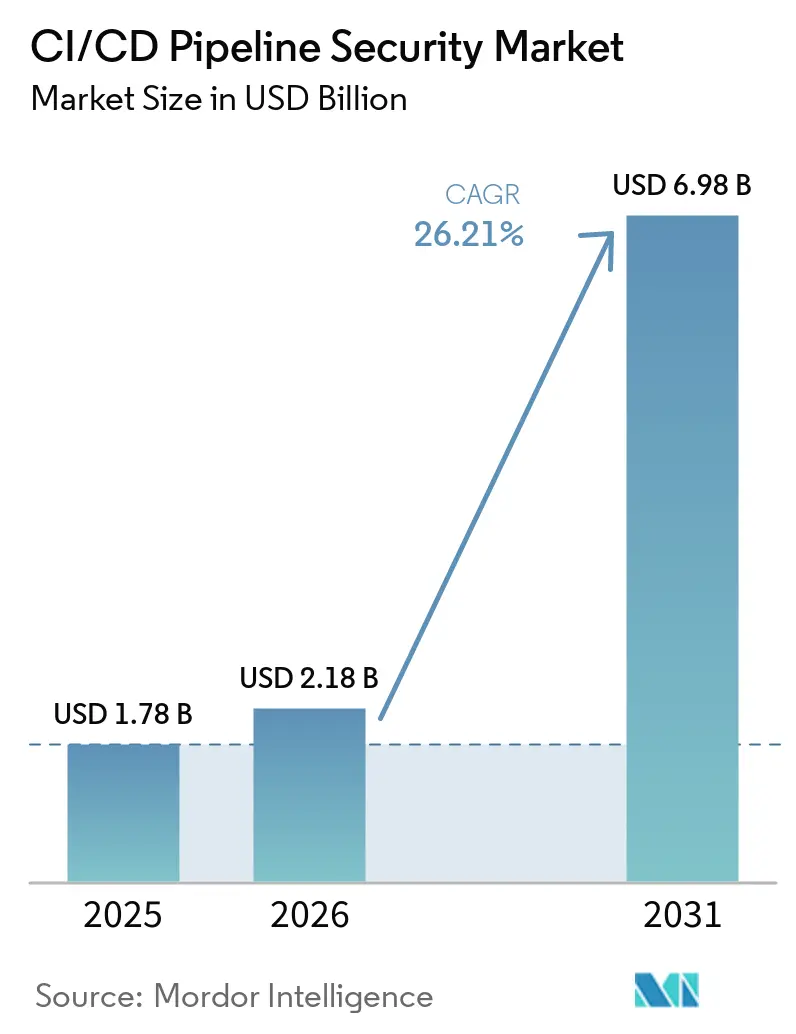
| Market Size (2026) | USD 2.18 Billion |
| Market Size (2031) | USD 6.98 Billion |
| Growth Rate (2026 - 2031) | 26.21 % |
| Fastest Growing Market | Asia-Pacific |
| Largest Market | North America |
| Market Concentration | Medium |
Major Players *Disclaimer: Major Players sorted in no particular order Image © Mordor Intelligence. Reuse requires attribution under CC BY 4.0. | |
CI/CD Pipeline Security Market Analysis by Mordor Intelligence
The CI/CD pipeline security market size was valued at USD 1.78 billion in 2025 and is estimated to grow from USD 2.18 billion in 2026 to reach USD 6.98 billion by 2031, at a CAGR of 26.21% during the forecast period (2026-2031). Attackers increasingly target build systems because one compromised pipeline can affect many production deployments. Supply-chain compromise has become a repeatable attack method rather than an isolated software risk. Regulatory requirements are moving pipeline controls into procurement and supplier assurance processes. AI coding agents also expand the number of identities, prompts, and credentials operating within development workflows. These conditions support demand for integrated controls that fit established developer processes.
Key Report Takeaways
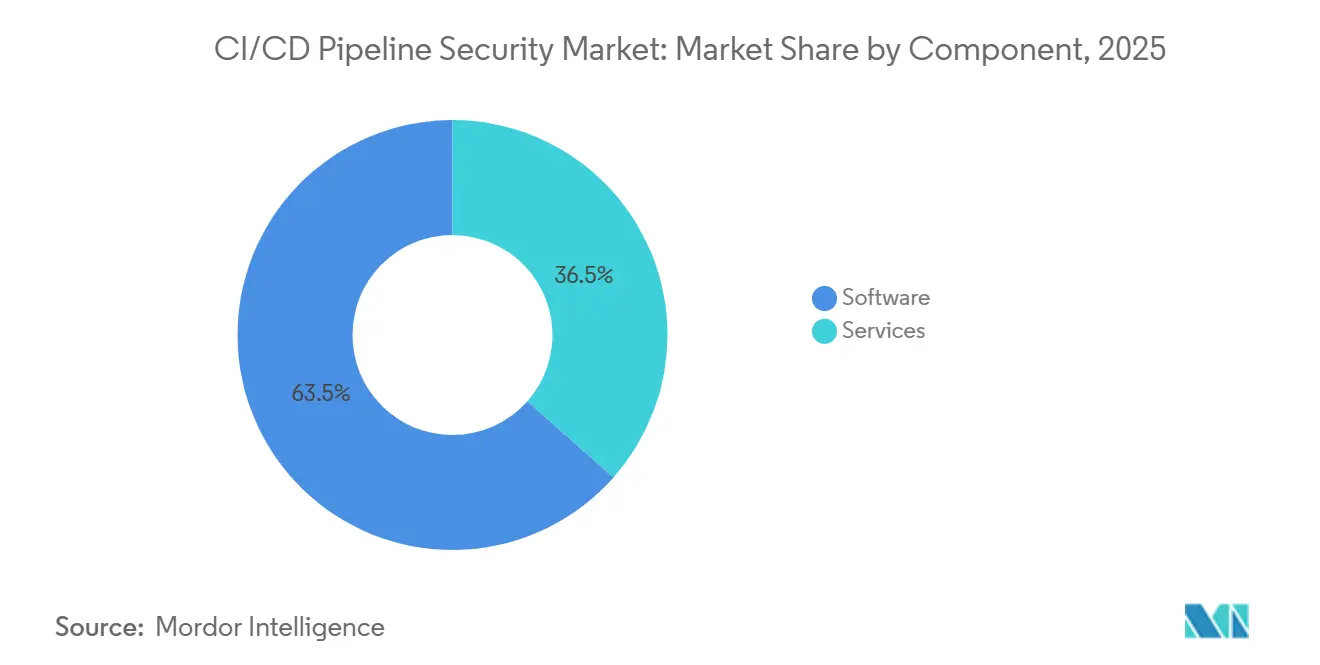
- By component, software held 63.48% of the CI/CD pipeline security market in 2025, while services are projected to expand at a 27.93% CAGR through 2031.
- By deployment mode, cloud-based deployment held 71.28% of the total in 2025 and is expected to grow at a 28.31% CAGR through 2031.
- By organization size, large enterprises accounted for 69.53% of revenue in the CI/CD pipeline security market in 2025, while small and medium-sized enterprises are projected to advance at a 27.84% CAGR through 2031.
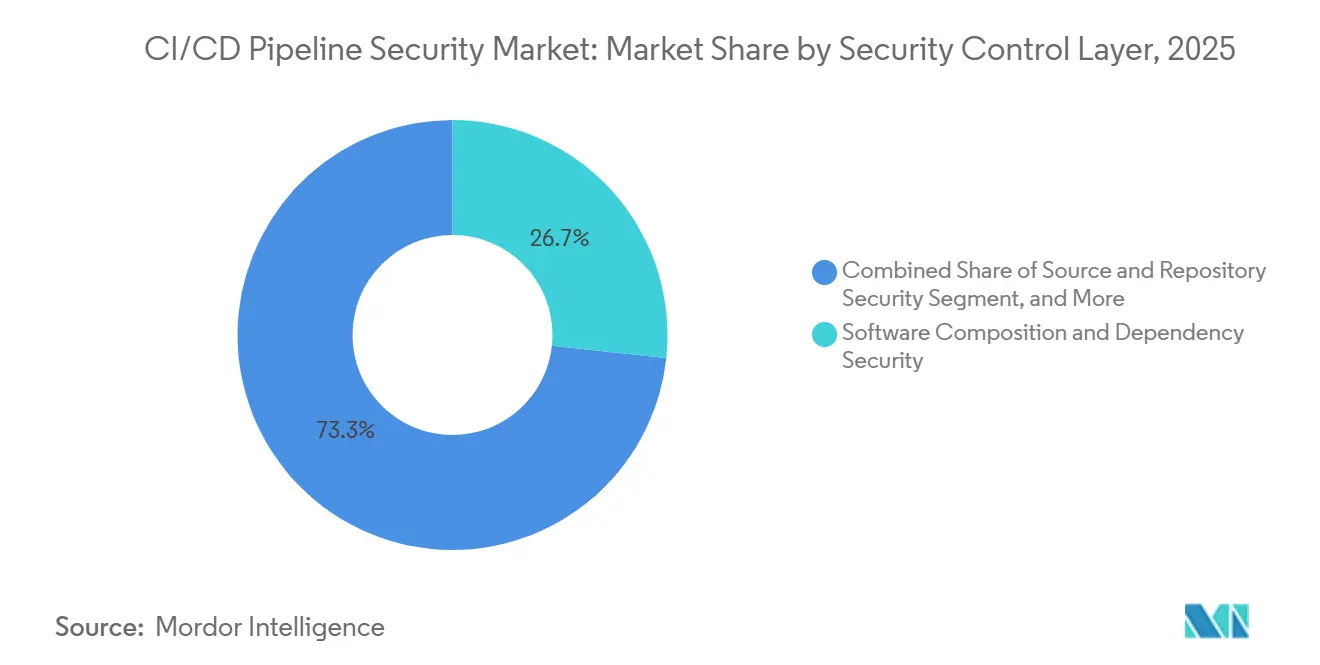
- By security control layer, software composition and dependency security accounted for 26.71% in 2025, while secrets and non-human identity security is expected to expand at a 28.62% CAGR through 2031.
- By industry vertical, IT and telecommunication held 27.64% in 2025, while retail and e-commerce is projected to grow at a 29.17% CAGR through 2031.
- By geography, North America held 44.76% in 2025, while Asia-Pacific is expected to expand at a 28.54% CAGR through 2031 in the CI/CD pipeline security market.
Note: Market size and forecast figures in this report are generated using Mordor Intelligence’s proprietary estimation framework, updated with the latest available data and insights as of January 2026.
Global CI/CD Pipeline Security Market Trends and Insights
Drivers Impact Analysis*
| DRIVER | (~) % IMPACT ON CAGR FORECAST | GEOGRAPHIC RELEVANCE | IMPACT TIMELINE |
|---|---|---|---|
| Software Supply-Chain Attack Exposure | +5.8% | Global | Short term (≤ 2 years) |
| Compliance-Driven Security Gates in CI/CD | +5.3% | North America and Europe, spillover to Asia-Pacific and Middle East and Africa | Medium term (2-4 years) |
| AI-Generated Code and Agentic Pipeline Expansion | +4.9% | Global, with early intensity in North America and Asia-Pacific | Short term (≤ 2 years) |
| Cloud-Native and Kubernetes Release Complexity | +3.7% | North America, Europe, Asia-Pacific | Medium term (2-4 years) |
| Shift-Left Developer Feedback and Automated Remediation | +2.9% | Global | Medium term (2-4 years) |
| Customer and Procurement Evidence Requirements | +2.4% | North America and Europe | Long term (≥ 4 years) |
| Source: Mordor Intelligence | |||
Software Supply-Chain Attack Exposure
Supply chain compromise is now the second-most common initial breach pathway worldwide. The CI/CD pipeline security market is responding because attackers can gain wider access through a compromised build environment. ReversingLabs reported a 73% rise in open-source malware during 2025. Sonatype recorded one new malicious package every 6 minutes in the first quarter of 2026. It's reported that the volume of malicious packages increased by 156% year over year. CERT-FR documented a 2025 npm compromise that spread through more than 700 packages within 72 hours and affected over 25,000 GitHub repositories. This exposure increases the value of behavioral monitoring alongside dependency scanning.
Compliance-Driven Security Gates in CI/CD
Compliance requirements are turning pipeline controls into legal and supplier-assurance obligations. NIST published its live DevSecOps Practices guidance in March 2026 with participation from 14 technology companies.[1]National Institute of Standards and Technology, “SP 1800-44, Secure Software Development, Security, and Operations DevSecOps Practices,” National Institute of Standards and Technology, csrc.nist.gov The guidance identifies CI/CD controls as a practical route for implementing the Secure Software Development Framework. The EU Cyber Resilience Act requires the reporting of actively exploited vulnerabilities to ENISA within 24 hours, effective from September 11, 2026. Automated software bills of materials and pipeline-based vulnerability tracking can support this reporting process. The CI/CD pipeline security market also benefits when enterprise buyers request security evidence from software suppliers. That pressure can extend adoption to smaller suppliers that would otherwise delay investment.
AI-Generated Code and Agentic Pipeline Expansion
AI agents within development workflows pose security issues that older tools were not designed to address. Microsoft reported in June 2026 that untrusted GitHub content could expose runner secrets through the Claude Code GitHub Action.[2]Microsoft Security, “Securing CI/CD in an Agentic World, Claude Code GitHub Action Case,” Microsoft Security Blog, microsoft.com The issue required multiple patch cycles across Claude Code versions. The Cloud Security Alliance reported that 57% of organizations had deployed self-hosted AI agents in CI/CD workflows by early 2026. The association also found that AI-assisted commits exposed secrets at nearly twice the rate of human-only commits. This creates demand for agent trust checks, secure prompt handling, and runtime observation of automated workflow actors. These needs add a distinct layer of demand to the CI/CD pipeline security market.
Cloud-Native and Kubernetes Release Complexity
Containerized releases create many artifacts that must be reviewed across code, configuration, and runtime settings. Each container image, Helm chart, and infrastructure-as-code file has its own dependencies and provenance needs. This environment makes point-in-time scanning less effective when controls are not placed in the release workflow. A review of public projects found that unpinned or mutable dependencies affected 55% of the projects reviewed. The same review found over-broad or undeclared permissions in 54% of projects. Faster release cycles can introduce new misconfiguration paths before security teams review them. The CI/CD pipeline security market gains from tools that connect code, artifacts, permissions, and build activity.
Restraints Impact Analysis*
| RESTRAINT | (~) % IMPACT ON CAGR FORECAST | GEOGRAPHIC RELEVANCE | IMPACT TIMELINE |
|---|---|---|---|
| False-Positive Fatigue and Build-Velocity Trade-Offs | -2.1% | Global | Short term (≤ 2 years) |
| Pipeline Toolchain Fragmentation and Integration Burden | -1.7% | Global | Medium term (2-4 years) |
| Shortage of DevSecOps and Software Supply-Chain Specialists | -1.1% | Asia-Pacific and South America, highest gap, North America and Europe, wage-driven pressure | Long term (≥ 4 years) |
| Self-Hosted Runner and Privileged-Access Exposure | -0.8% | Global | Medium term (2-4 years) |
| Source: Mordor Intelligence | |||
False-Positive Fatigue and Build-Velocity Trade-Offs
Alert overload can cause teams to turn off security gates or set them to warning-only mode. More than 71% of development teams reported that much of their security-alert volume was noise. False positives, duplicate findings, and unclear recommendations all slow response times. Legacy static analysis and composition analysis tools can produce false-positive rates above 40%. Developers may deprioritize alerts when the tools do not show exploitability or business relevance. This can weaken the risk signal even after an organization has deployed controls. The CI/CD pipeline security market, therefore, depends on accurate prioritization and usable remediation workflows.
Pipeline Toolchain Fragmentation and Integration Burden
Organizations often operate multiple security and pipeline products that do not share alert formats or identity models. Separate tools require separate application programming interface authentication and ongoing connector maintenance. This can prevent teams from forming a consolidated view of release risk. Integration work also grows when vendors revise application programming interfaces or data models. Buyers increasingly require compatibility with GitHub Actions, GitLab CI, Jenkins, or CircleCI before selecting new controls. That requirement protects incumbent integrations but can slow the adoption of new products. It can also limit the pace at which the CI/CD pipeline security market converts interest into active deployments.
*Our forecasts treat driver/restraint impacts as directional, not additive. The impact forecasts reflect baseline growth, mix effects, and variable interactions.
Segment Analysis
By Component: Software Leads, While Services Grow Faster
Software held 63.48% of the CI/CD pipeline security market share in 2025. Buyers favored controls embedded in CI/CD platforms over separate scanners that add workflow steps. GitHub Advanced Security, GitLab security modules, and JFrog Advanced Security reflect this platform-centered purchasing pattern. A shared console can help security teams manage several control layers under one license. This approach can reduce the need to reconcile findings from disconnected applications. Software also supports centralized policies, reporting, and developer feedback. These capabilities matter where large release programs must apply consistent controls across repositories. The CI/CD pipeline security industry, therefore, places strong value on tools that work inside normal build processes. Platform integration can also improve adoption when developers avoid switching between screens.
Services are projected to grow at a 27.93% CAGR through 2031. Many organizations lack internal staff who can configure and operate supply-chain controls. Managed services are increasingly focused on recurring monitoring rather than one-time deployment work. AI coding agents also create behavior-monitoring requirements that internal teams may not be ready to manage. NIST noted that operationalizing Secure Software Development Framework-aligned DevSecOps practices can require external expertise and technology partnerships. This supports continued demand for managed detection and response in pipeline environments. Services can help companies tune policies without placing the full operating burden on developers. The CI/CD pipeline security market may therefore see software revenue reinforced by recurring operational support. This relationship reflects the practical limits of in-house DevSecOps capacity.


By Deployment Mode: Cloud-Based Delivery Holds Both Scale and Growth
Cloud-based deployment held 71.28% of the CI/CD pipeline security market in 2025. It is also projected to grow at a 28.31% CAGR through 2031. Managed runners on GitHub, GitLab, and AWS CodeBuild have moved build activity into cloud delivery environments. SaaS controls can use the same access and authentication layer as the pipeline. This reduces certificate-management work compared with many on-premises implementations. GitHub's March 2026 roadmap included a Layer 7 egress firewall for hosted runners. It also included near-real-time execution telemetry for enterprise users.[3]GitHub, Inc., “What’s Coming to Our GitHub Actions 2026 Security Roadmap,” GitHub Blog, github.blog These features strengthen the operational case for cloud-based security controls. They also support the CI/CD pipeline security market as hosted build systems expand.
On-premises delivery remains relevant for defense, financial services, and critical infrastructure users. Data sovereignty and air-gap requirements can still prevent full SaaS adoption. Its position is declining as regulated organizations adopt hybrid architectures. Hybrid delivery serves enterprises with legacy pipelines and cloud-native orchestration in parallel. It can offer more flexibility than a single deployment model. It can also meet domestic hosting rules for critical application build systems. National requirements for sovereign software can make hybrid deployment the only compliant option. The CI/CD pipeline security industry retains demand across all deployment models because security obligations remain similar. However, the cloud model offers the broadest integration with managed development platforms.
By Organization Size: Large Enterprises Lead, While SMEs Expand Access
Large enterprises captured 69.53% of the CI/CD pipeline security market in 2025. These organizations manage large numbers of teams, repositories, and artifact registries. Their needs extend beyond single-tool deployment to coordinated policy governance. Enterprise buyers often require centralized software bill of materials generation and audit-ready evidence. They also have complex multi-cloud and multi-business-unit environments. That complexity makes professional services important during integration and operational rollout. Central policy management can help enterprises apply standards across independently selected CI/CD stacks. These buyers typically prioritize platform-level capability and reporting depth. The CI/CD pipeline security market continues to draw its largest revenue base from this group.
Small and medium-sized enterprises are projected to grow at a 27.84% CAGR through 2031. Developer-tier SaaS pricing and usage-based billing lower the entry cost for smaller teams. Endor Labs introduced AURI in March 2026 with a free tier for individual developers and AI coding agents. The offering supports integrations with Cursor, Claude Code, and Visual Studio Code. Larger buyers can also request software bills of materials and attestation from their suppliers. Many of those suppliers are smaller software organizations. This creates adoption pressure through commercial relationships rather than direct regulation. The CI/CD pipeline security market can therefore reach SMEs through both product packaging and customer requirements. Smaller organizations may adopt focused controls before moving to broader platforms.
By Security Control Layer: Dependency Security Leads, While Identity Protection Rises
Software composition and dependency security held 26.71% of the CI/CD pipeline security market share in 2025. Enterprises continue to invest in this layer because open-source dependencies remain a common attack route. Sonatype recorded a new malicious package every 6 minutes during the first quarter of 2026.[4]Sonatype, “2026 State of the Software Supply Chain,” Sonatype, sonatype.com It's reported that the volume of malicious packages grew 156% year over year. Dependency scanning alone does not address every build-system threat. Source and repository security, workflow and runner controls, and container security are also gaining attention. Artifact signing and provenance controls support stronger evidence of release. Recent compromises have shown that layers above and below the dependency graph can be targeted independently. The CI/CD pipeline security industry is therefore expanding from package review into broader pipeline protection.
Secrets and non-human identity security is projected to expand at a 28.62% CAGR through 2031. AI coding agents can accumulate credentials faster than manual governance processes can review them. Silverfort found that 80% of non-human identities had high or critical posture issues. Those issues included exposure to credential theft, excessive permissions, and weak rotation practices. The OWASP Non-Human Identity Top 10 is becoming a reference point for identity governance. It is aligned with the NIST Cybersecurity Framework 2.0. Other emerging layers include AI model provenance and Model Context Protocol server security. These categories are in their early stages of development in 2026. They may become more distinct as agentic development practices mature.

By Industry Vertical: IT and Telecommunication Leads, While Retail and E-Commerce Grows Fastest
IT and telecommunication held 27.64% of the CI/CD pipeline security market in 2025. The sector has long used high-velocity DevOps practices across complex cloud infrastructure. Telecom operators also have critical infrastructure obligations that increase supply-chain security needs. Government, public administration, BFSI, and healthcare form the next established group of users. Each faces compliance requirements that can make pipeline controls a necessary operating expense. US federal supplier obligations, the Digital Operational Resilience Act, and medical-device cybersecurity guidance support this demand. Large distributed environments also need traceable evidence of what entered production. This gives the CI/CD pipeline security industry a clear role in regulated release governance. The sector's early adoption supports its leading revenue position.
Retail and e-commerce is projected to grow at a 29.17% CAGR through 2031. Digital merchants handle consumer data and update services at a fast pace. Payment and checkout libraries also make them visible targets for supply-chain attacks. Google Cloud described supply-chain compromise activity that included web skimmers deployed through compromised third-party libraries. This threat can shift investment toward controls placed before releases reach commerce systems. Industrial manufacturing, transportation and logistics, and energy and utilities also use more software-defined operations. These sectors are adopting pipeline controls where they had little previous need. Media, education, research institutions, and oil and gas remain at earlier adoption stages. Supplier assurance requirements may increase their use of the CI/CD pipeline security market over time.
Geography Analysis
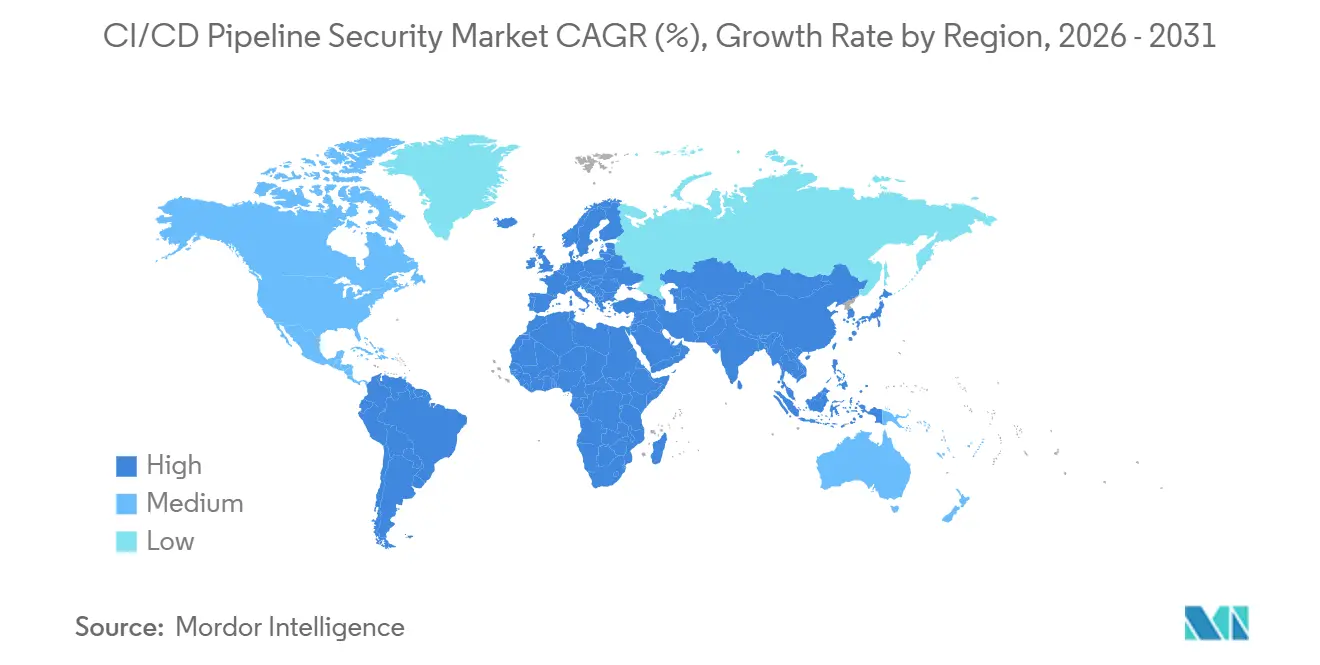
North America held 44.76% of the CI/CD pipeline security market in 2025. The region combines a large cloud-native enterprise base with a dense independent software vendor ecosystem. Federal procurement requirements also make software attestation important for government suppliers. NIST's Secure Software Development Framework supports a common basis for implementing secure development practices. Executive Order 14028 and Executive Order 14306 reinforce the policy setting for federal software suppliers. Canada and Mexico add demand through supply chains linked to US enterprises. Automotive and financial services relationships are important in that cross-border activity. North America also has a high concentration of specialist vendors. This proximity supports product adoption and competitive pressure.
Europe is seeing strong regulatory demand across mature software markets. The Cyber Resilience Act creates a 24-hour reporting requirement for actively exploited vulnerabilities from September 11, 2026. Pipeline-integrated monitoring and automated software bills of materials can support the required reporting process. Germany led European adoption in the supplied assessment, with 76.7% of companies applying security controls during the build phase. The United Kingdom has separate requirements for connected-device manufacturers under its Product Security and Telecommunications Infrastructure Act. NIS2 also raises supply-chain expectations across 18 critical sectors. These overlapping obligations make compliance a major source of demand for CI/CD pipeline security tools.
Asia-Pacific is projected to grow at a 28.54% CAGR through 2031. Japan announced a supply-chain security evaluation system in December 2025 with 3-star and 4-star certification levels planned for fiscal year 2026.[5]Ministry of Economy, Trade and Industry, “Supply Chain Security Evaluation System Policy Draft,” Ministry of Economy, Trade and Industry, meti.go.jp The framework can spread supplier requirements through automotive, semiconductor, and consumer electronics value chains. India's technology-services sector faces security requirements from US and European clients. South Korea includes supply-chain controls within its ISMS-P certification regime for organizations handling personal data. China is also developing parallel verification approaches within its domestic cloud-native ecosystem. South America and Middle East and Africa remain earlier-stage regions. Brazil and the United Arab Emirates are the most developed countries in their respective regions, supported largely by global enterprise standards.

Competitive Landscape
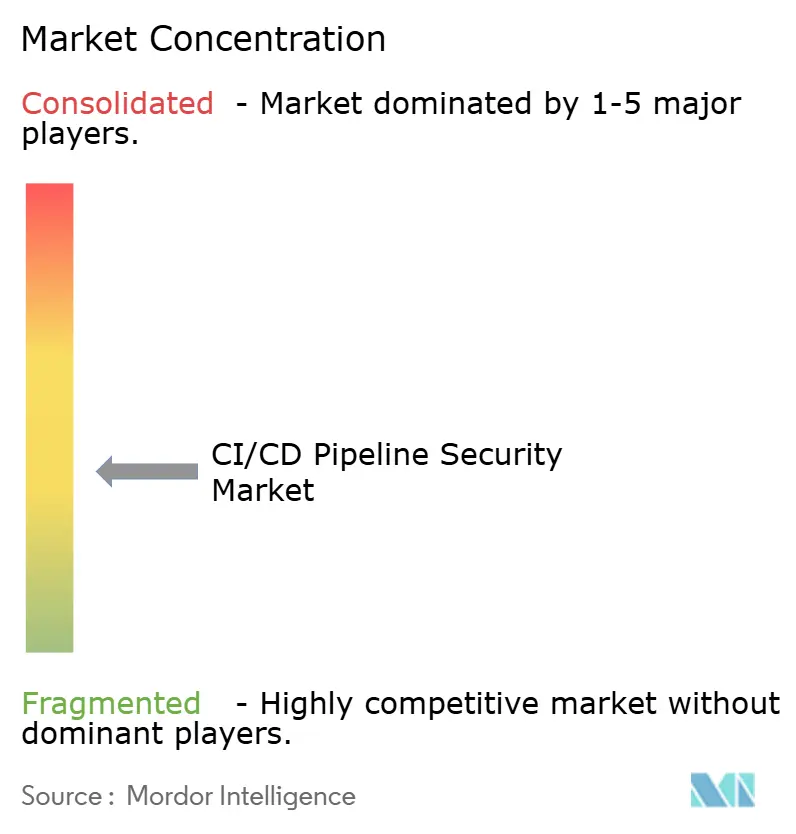
The CI/CD pipeline security market remains moderately fragmented, with more than 25 active vendors across overlapping capability areas. Application security posture management, secrets management, software bills of materials, container security, and pipeline monitoring are all contested areas. Specialist vendors compete through detection accuracy, workflow integration, and automated remediation. The competitive focus is shifting from one-time scanning to continuous posture management, supported by evidence. Platform vendors can use established enterprise relationships to extend their coverage. Palo Alto Networks introduced a Software Supply Chain Security module in Cortex Cloud in August 2026. The module includes Supply Chain Trust Scores and an Attack Threat Center. This approach ties newly disclosed vulnerabilities and malicious packages to customer environments. It reflects the pressure on point products to show stronger workflow coverage.
AI-agent governance remains an open product area within the CI/CD pipeline security market. No supplier had complete coverage for security controls governing AI agents in CI/CD workflows during 2026. OX Security launched its AI-Native Application Protection Platform in July 2026.[6]OX Security, “OX Security Launches First AINAPP Platform,” OX Security, ox.security The platform covered the agentic development lifecycle from prompts through runtime. Cycode released agentic code scanning in September 2026 using deterministic and agentic analysis. JFrog also announced a September 2026 integration with Wiz to connect artifact provenance with cloud runtime visibility. These moves show that product roadmaps are converging around connected build-time and runtime evidence.
Framework conformance is becoming more important in enterprise requests for proposal. SLSA provenance, Sigstore keyless signing, and ENISA-aligned software bill-of-materials formats can serve as evaluation signals. This is particularly relevant in European and US federal buying processes. The CI/CD pipeline security market also has room for vendors that reduce false positives without delaying releases. Customers want evidence that controls will fit existing orchestration stacks. GitHub's 2026 roadmap added policy-driven execution controls and scoped secrets for workflows. These platform features raise the standard for independent providers. The CI/CD pipeline security market is likely to reward vendors that combine usable developer workflows with auditable security evidence.
CI/CD Pipeline Security Industry Leaders
Legit Security Ltd.
Cycode, Inc.
Xygeni, Inc.
Scribe Security Ltd.
Endor Labs, Inc.
- *Disclaimer: Major Players sorted in no particular order

Recent Industry Developments
- August 2026: Palo Alto Networks, Inc. introduced Software Supply Chain Security as a dedicated module within Cortex Cloud on August 5, 2026, incorporating Supply Chain Trust Scores, scoring software integrity from 0 to 100 based on SBOM dependency security and build-environment provenance, and a Supply Chain Attack Threat Center that continuously maps newly disclosed CVEs and malicious packages to customer environments.
- July 2026: OX Security, Inc. launched its AI-Native Application Protection Platform on July 28, 2026, the first security platform governing the complete agentic development lifecycle from prompt to runtime, establishing a category that integrates AI-user governance, code security, cloud enforcement, and agentic penetration testing in a single context lake where each finding carries lineage from decision to production risk.
- March 2026: GitHub, Inc. published its GitHub Actions 2026 Security Roadmap on March 26, 2026, announcing deterministic dependency locking to commit SHAs, policy-driven execution controls, scoped secrets bound to specific workflow identities, and a native Layer 7 egress firewall for GitHub-hosted runners, directly addressing recent CI/CD supply-chain attack vectors.
- March 2026: Endor Labs, Inc. launched AURI on March 3, 2026, a unified security intelligence platform for agentic software development, offering a free developer tier via MCP integration with Cursor, Claude Code, and Visual Studio Code, while extending across CI/CD pipelines and workflows for enterprise deployments. The platform covers more than 5 million applications and conducts over 1 million security scans per week.


Global CI/CD Pipeline Security Market Report Scope
The CI/CD pipeline security market comprises specialized security solutions designed to protect continuous integration and continuous deployment pipelines from vulnerabilities, misconfigurations, and adversarial attacks throughout the software delivery lifecycle. These platforms provide capabilities such as pipeline-as-code scanning, secrets detection in build configurations, build process integrity verification, artifact signing and provenance tracking, dependency vulnerability assessment during builds, and runtime monitoring of pipeline execution to prevent supply chain attacks, credential theft, unauthorized code injection, and compromised build artifacts from reaching production environments, enabling organizations to maintain secure software delivery practices, comply with regulatory requirements, and ensure that only trusted, validated code progresses through development, staging, and production deployments.
The CI/CD Pipeline Security Market Report is Segmented by Component (Software, and Services), Deployment Mode (Cloud, On-Premises, and Hybrid), Organization Size (Large Enterprises, and Small and Medium-Sized Enterprises), Security Control Layer (Source and Repository Security, CI/CD Workflow and Runner Security, Software Composition and Dependency Security, Container and Infrastructure-as-Code Security, Artifact Integrity, Signing, and Provenance, Secrets and Non-Human Identity Security, and Other Security Control Layers), Industry Vertical (Government and Public Administration, Industrial Manufacturing, Retail and E-Commerce, Transportation and Logistics, Energy and Utilities, Oil and Gas, IT and Telecommunication, Media and Entertainment, Education and Research Institutions, Healthcare and Life Sciences, Banking, Financial Services, and Insurance (BFSI), and Other Industry Verticals), and Geography (North America, South America, Europe, Asia-Pacific, and Middle East and Africa). The Market Forecasts are Provided in Terms of Value (USD).
| Software |
| Services |
| Cloud |
| On-Premises |
| Hybrid |
| Large Enterprises |
| Small and Medium-Sized Enterprises |
| Source and Repository Security |
| CI/CD Workflow and Runner Security |
| Software Composition and Dependency Security |
| Container and Infrastructure-as-Code Security |
| Artifact Integrity, Signing, and Provenance |
| Secrets and Non-Human Identity Security |
| Other Security Control Layers |
| Government and Public Administration |
| Industrial Manufacturing |
| Retail and E-Commerce |
| Transportation and Logistics |
| Energy and Utilities |
| Oil and Gas |
| IT and Telecommunication |
| Media and Entertainment |
| Education and Research Institutions |
| Healthcare and Life Sciences |
| Banking, Financial Services, and Insurance (BFSI) |
| Other Industry Verticals |
| North America | United States | |
| Canada | ||
| Mexico | ||
| South America | Brazil | |
| Argentina | ||
| Rest of South America | ||
| Europe | Germany | |
| United Kingdom | ||
| France | ||
| Italy | ||
| BENELUX | ||
| Rest of Europe | ||
| Asia-Pacific | China | |
| Japan | ||
| India | ||
| South Korea | ||
| Australia | ||
| Rest of Asia-Pacific | ||
| Middle East and Africa | Middle East | United Arab Emirates |
| Saudi Arabia | ||
| Rest of Middle East | ||
| Africa | South Africa | |
| Nigeria | ||
| Egypt | ||
| Rest of Africa | ||
| By Component | Software | ||
| Services | |||
| By Deployment Mode | Cloud | ||
| On-Premises | |||
| Hybrid | |||
| By Organization Size | Large Enterprises | ||
| Small and Medium-Sized Enterprises | |||
| By Security Control Layer | Source and Repository Security | ||
| CI/CD Workflow and Runner Security | |||
| Software Composition and Dependency Security | |||
| Container and Infrastructure-as-Code Security | |||
| Artifact Integrity, Signing, and Provenance | |||
| Secrets and Non-Human Identity Security | |||
| Other Security Control Layers | |||
| By Industry Vertical | Government and Public Administration | ||
| Industrial Manufacturing | |||
| Retail and E-Commerce | |||
| Transportation and Logistics | |||
| Energy and Utilities | |||
| Oil and Gas | |||
| IT and Telecommunication | |||
| Media and Entertainment | |||
| Education and Research Institutions | |||
| Healthcare and Life Sciences | |||
| Banking, Financial Services, and Insurance (BFSI) | |||
| Other Industry Verticals | |||
| By Geography | North America | United States | |
| Canada | |||
| Mexico | |||
| South America | Brazil | ||
| Argentina | |||
| Rest of South America | |||
| Europe | Germany | ||
| United Kingdom | |||
| France | |||
| Italy | |||
| BENELUX | |||
| Rest of Europe | |||
| Asia-Pacific | China | ||
| Japan | |||
| India | |||
| South Korea | |||
| Australia | |||
| Rest of Asia-Pacific | |||
| Middle East and Africa | Middle East | United Arab Emirates | |
| Saudi Arabia | |||
| Rest of Middle East | |||
| Africa | South Africa | ||
| Nigeria | |||
| Egypt | |||
| Rest of Africa | |||


Key Questions Answered in the Report
What is the CI/CD pipeline security market size?
The CI/CD pipeline security market size was valued at USD 1.78 billion in 2025 and is estimated to grow from USD 2.18 billion in 2026 to reach USD 6.98 billion by 2031, at a CAGR of 26.21% during the forecast period (2026-2031).
What is driving demand for CI/CD pipeline security?
Supply-chain attacks, compliance obligations, cloud-native release complexity, and AI coding agents are increasing the need for pipeline controls.
Which component leads CI/CD pipeline security spending?
Software led with 63.48% of revenue in 2025 because buyers favor embedded platform controls and centralized management.
Which deployment model is growing fastest?
Cloud-based deployment held 71.28% in 2025 and is projected to grow at a 28.31% CAGR through 2031.
Which region is growing fastest for CI/CD pipeline security?
Asia-Pacific is projected to grow at a 28.54% CAGR through 2031, supported by new supply-chain requirements and global customer demands.
Which end-user vertical is expanding fastest?
Retail and e-commerce is projected to grow at a 29.17% CAGR through 2031 due to payment-library risks, consumer-data responsibilities, and fast release cycles.
Page last updated on:





