
China Integrated Circuit (IC) Market Size and Share
Market Overview
| Study Period | 2020 - 2031 |
|---|---|
| Forecast Data Period | 2026 - 2031 |
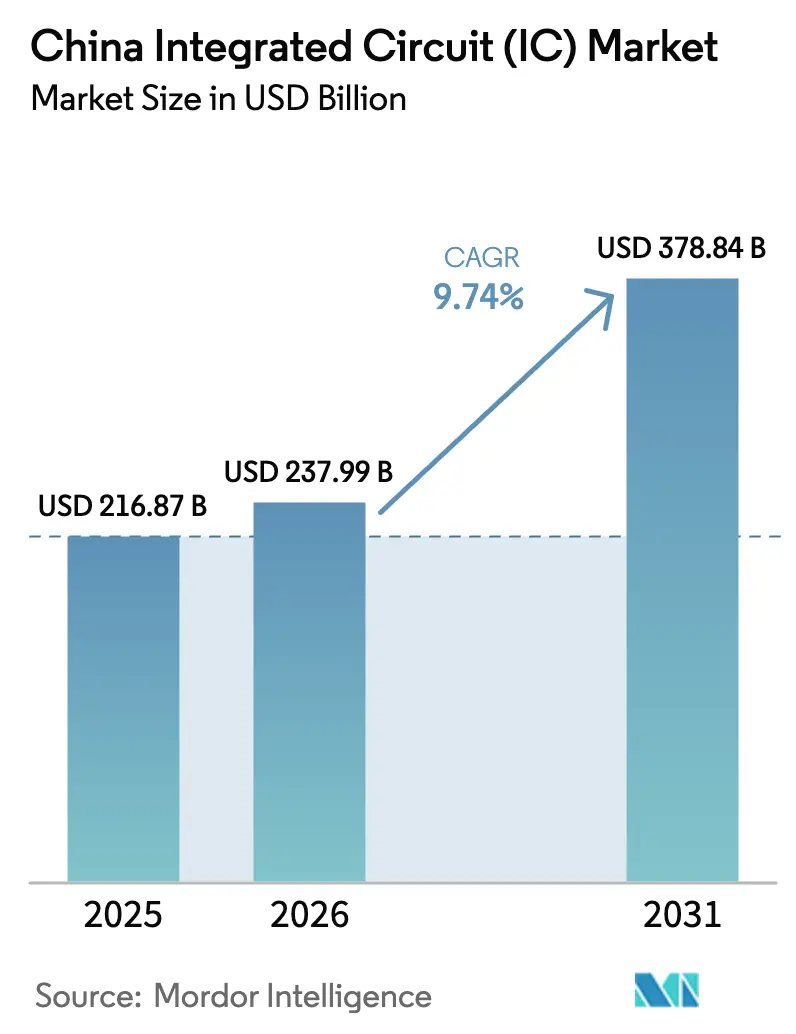
| Base Year Market Size (2025) | USD 216.87 Billion |
| Market Size (2026) | USD 237.99 Billion |
| Market Size (2031) | USD 378.84 Billion |
| Growth Rate (2026 - 2031) | 9.74 % |
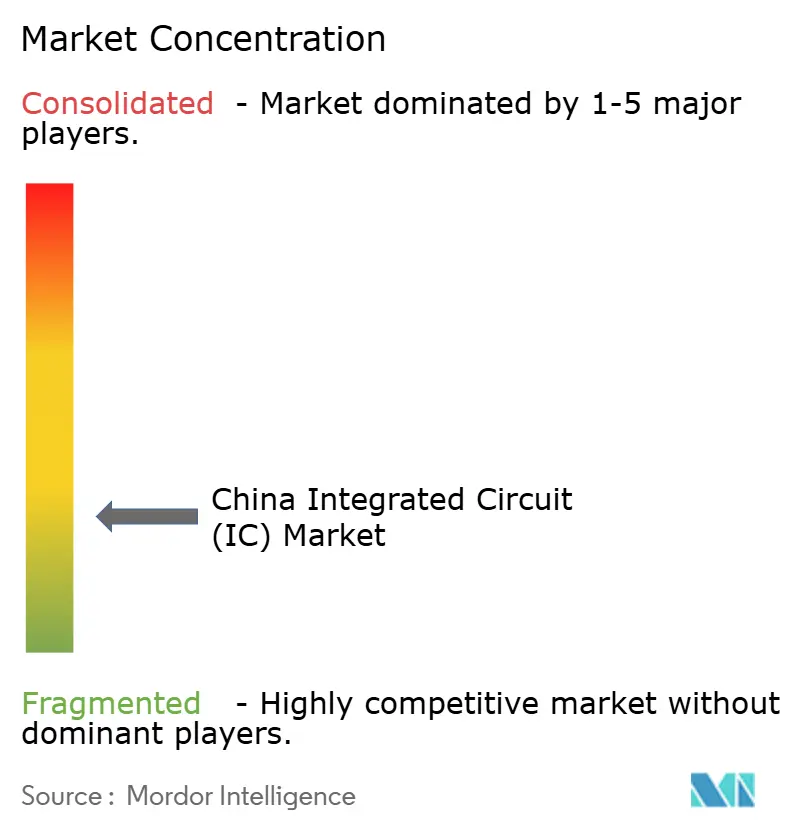
| Market Concentration | Low |
Major Players-Market-ML.webp) *Disclaimer: Major Players sorted in no particular order Image © Mordor Intelligence. Reuse requires attribution under CC BY 4.0. | |
China Integrated Circuit (IC) Market Analysis by Mordor Intelligence
The China integrated circuit market size is expected to grow from USD 216.87 billion in 2025 to USD 237.99 billion in 2026 and is forecast to reach USD 378.84 billion by 2031 at 9.74% CAGR over 2026-2031. This momentum stems from the government’s third-phase National Integrated Circuit Industry Investment Fund, a USD 47.5 billion vehicle that accelerates fab construction and advanced memory production. Memory devices retain a commanding foothold, while logic chips for AI and automotive electronics are rising fastest. Stricter export controls have intensified localization, pushing domestic foundries to refine mature-node capacity and explore alternative process techniques. Large-scale EV adoption, hyperscale data-center build-outs, and industrial IoT upgrades round out a demand profile that supports new entrants across materials, equipment, and chip design.
Key Report Takeaways
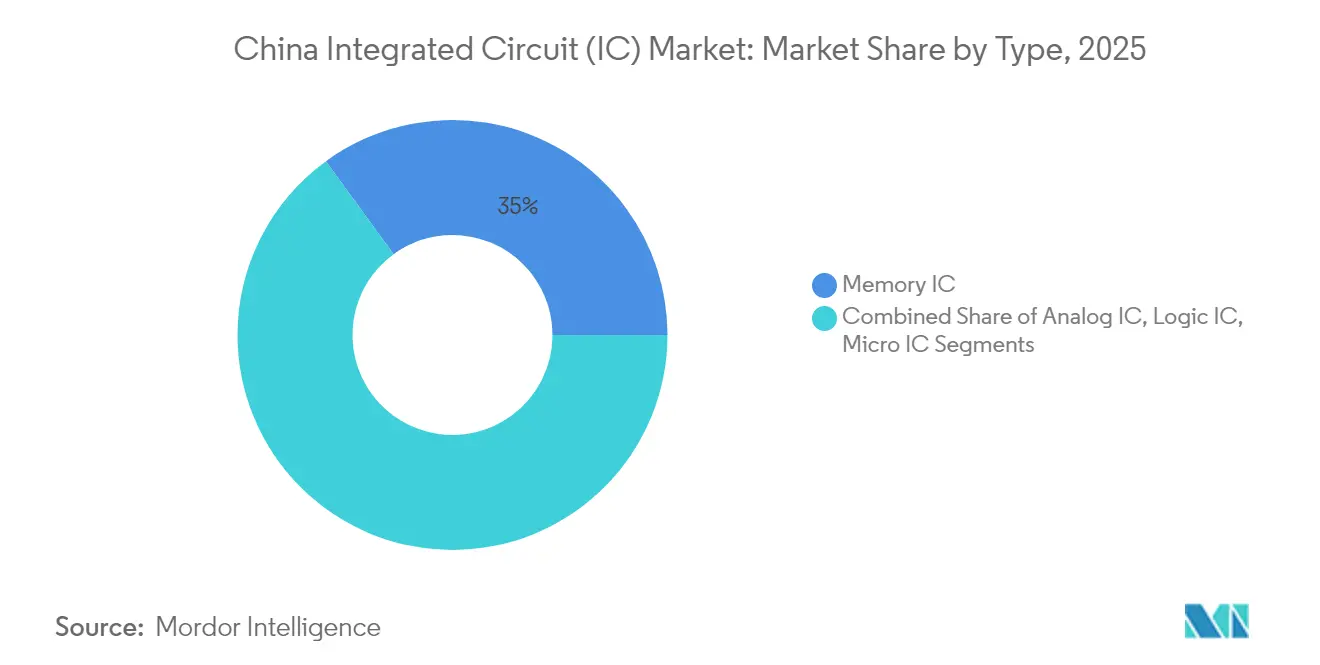
- By type, memory ICs captured 35.02% of the China integrated circuit market share in 2025; logic ICs are advancing at a 9.55% CAGR through 2031.
- By wafer size, 300 mm lines held 71.45% revenue share in 2025, whereas 450 mm pilot capacity is projected to expand at a 13.22% CAGR to 2031.
- By process node, ≤28 nm technology accounted for 62.50% of the China integrated circuit market size in 2025; the 16/14 nm tier is growing fastest at 11.78% CAGR.
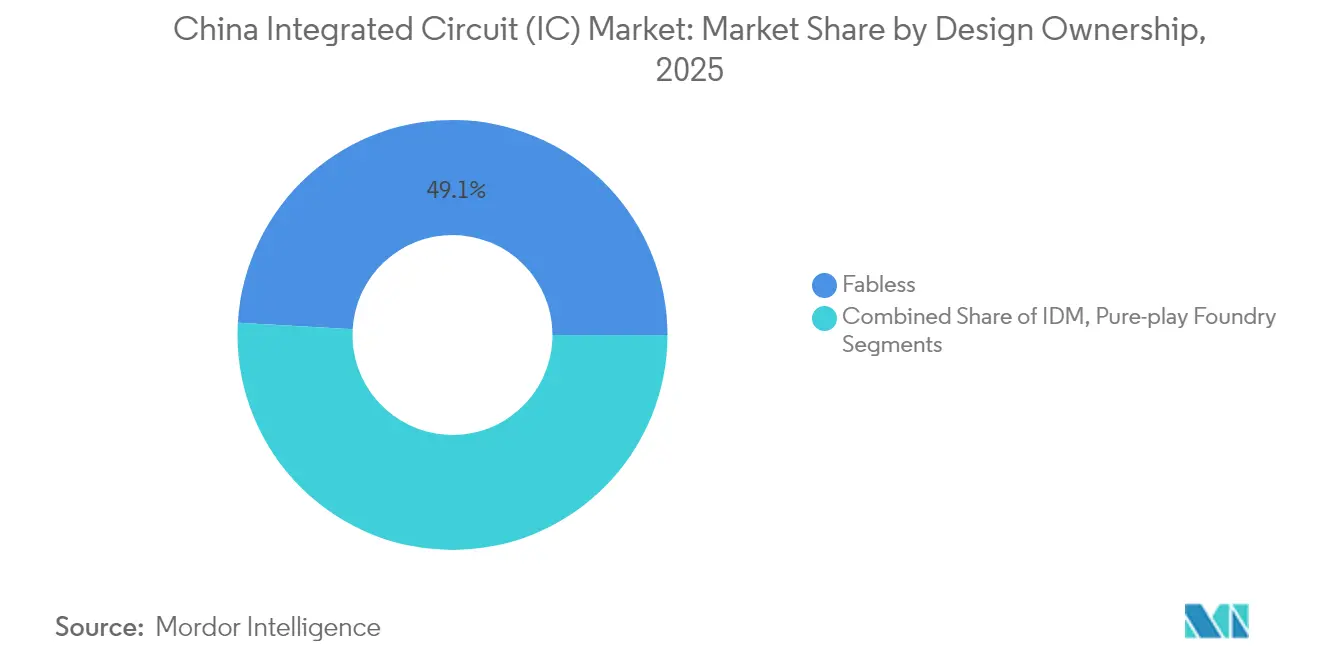
- By design ownership, fabless firms led with a 49.10% share in 2025, while pure-play foundries post the highest projected CAGR at 9.98% through 2031.
- By application, consumer electronics held 45.75% of China's integrated circuit market share in 2025, and automotive IC demand is set to rise at an 11.02% CAGR.
- By geography, East China generated more than 25% of national revenue in 2025, underscoring the region’s dense cluster of fabs and design centers.
Note: Market size and forecast figures in this report are generated using Mordor Intelligence’s proprietary estimation framework, updated with the latest available data and insights as of 2026.
Competitive positioning in China includes both locally based firms and those operating across multiple regions. The market landscape in the global integrated circuits industry research shows how these players are arranged internationally.
China Integrated Circuit (IC) Market Trends and Insights
Drivers Impact Analysis*
| Driver | (~) % Impact on CAGR Forecast | Geographic Relevance | Impact Timeline |
|---|---|---|---|
| National Semiconductor Fund Phase III | +2.8% | East and South-Central China | Medium term (2-4 years) |
| EV and NEV Policy Push | +1.9% | National, strongest in East and South-Central | Medium term (2-4 years) |
| Hyperscale AI/Cloud Build-outs | +1.7% | Shanghai, Beijing, Guangdong | Short term (≤ 2 years) |
| Made-in-China IoT Deployments | +1.2% | Manufacturing provinces | Medium term (2-4 years) |
| Sanctions-Driven Localization | +1.6% | National | Long term (≥ 4 years) |
| Surge in 5G Base-Stations | +0.6% | Tier-1 and Tier-2 cities | Short term (≤ 2 years) |
| Source: Mordor Intelligence | |||
National Semiconductor Fund Phase III Driving Fab Capacity Expansion
The USD 47.5 billion third-phase Big Fund channels capital directly into high-bandwidth memory and advanced DRAM projects. With the Ministry of Finance holding 17.44%, close oversight ensures alignment with national technology goals. YMTC has already lifted output to 500,000 3D NAND wafers per month, fortifying China’s position in premium storage devices. Mature-node expansions that underpin automotive and industrial chips receive priority funding, bridging immediate shortfalls caused by import restrictions. The program’s structure ties milestone financing to capacity targets, narrowing gaps with leading overseas manufacturers and stimulating local toolmakers. Collectively, these initiatives quicken the scale-up of domestic fabs and firm long-term supply security across the China integrated circuit market.
EV and NEV Policy Push Boosting Demand for Automotive-grade ICs
China sold 11 million electric vehicles in 2024, equal to nearly half of national car sales.[1]International Energy Agency, “Global EV Outlook 2025,” iea.org Aggressive purchase subsidies and dual-credit mandates translate into surging orders for power management ICs, SiC modules, and automotive microcontrollers. BYD Semiconductor’s power module share hit 28.9% in 2023 as the company vertically integrated silicon carbide and IGBT lines into its EV stack. With the automotive IC pool forecast at USD 23 billion in 2025, local foundries are tailoring 28 nm and 16 nm processes for functional safety compliance. Partnerships between carmakers and chip designers deepen, accelerating qualification cycles and fostering an ecosystem that anchors future mobility electronics inside the China integrated circuit market.
Hyperscale AI/Cloud Build-outs Creating Custom Accelerator Demand
Cloud capital expenditure will climb 20-25% YoY in 2025 as Tencent, Alibaba, and Baidu deploy AI servers at scale. Export-control pressure is hastening domestic ASIC development, trimming the foreign GPU share of China’s AI compute purchases from 63% in 2024 to a projected 41.5% in 2025. Firms such as Huawei and Cambricon are taping out 7 nm and 5 nm AI cores, driving demand for high-density HBM stacks at YMTC and CXMT. Foundries gain additional revenue from packaging services optimized for large-die chiplets. The resulting feedback loop of in-country design and fabrication keeps more value inside the China integrated circuit market, sustaining a high-growth pocket even under geopolitical constraints.
Made-in-China IoT Deployments in “Digital Workshop” Manufacturing
Industrial modernization delivered 4.514 billion IC units in 2024, a 22.2% increase year-on-year.[2]National Bureau of Statistics of China, “Statistical Communiqué 2024,” stats.gov.cn The Ministry of Industry and Information Technology’s “Digital Workshop” framework equips factories with sensor-rich edge nodes that require ultra-reliable microcontrollers. Local vendors respond by ruggedizing 40 nm and 22 nm platforms for high-temperature, high-EMI settings common in steel and petrochemical plants. Demand cascades to analog front-end suppliers and protocol-stack IP providers, expanding the mid-tier of the China integrated circuit market. Scaled deployments are expected to grow most quickly in coastal manufacturing belts, but central provinces are also incorporating IoT tooling to ease labor-cost pressures.
Restraints Impact Analysis*
| Restraint | (~) % Impact on CAGR Forecast | Geographic Relevance | Impact Timeline |
|---|---|---|---|
| Restricted Access to EUV Lithography Tools | -1.8% | East China | Long term (≥ 4 years) |
| Acute Shortage of Senior IC Engineers | -1.3% | National tech hubs | Medium term (2-4 years) |
| Price Erosion from 28 nm Over-capacity | -0.7% | National | Short term (≤ 2 years) |
| Persistent IP and Patent Litigation Risks | -0.5% | Global | Medium term (2-4 years) |
| Source: Mordor Intelligence | |||
Restricted Access to EUV Lithography Tools
Export controls bar Chinese fabs from purchasing ASML’s EUV scanners, stalling mass-production economics below 7 nm. SMIC has replicated 7 nm logic using multi-patterned DUV, yet higher mask counts raise cost and reduce yield. Stricter Dutch and Japanese licensing rules, effective April 2025, deepen the bottleneck. This restraint pushes domestic R&D toward indigenous lithography but widens the cost gap with rivals leveraging full EUV. High-performance computing segments therefore, lean on advanced packaging and chiplet approaches to bridge performance shortfalls while policymakers negotiate for partial exemption
Acute Shortage of Senior IC Design and Process Engineers
Roughly 70,000 skilled positions remain unfilled, especially for FinFET process integration and high-bandwidth memory layout. Rising salary inflation inflates project budgets and lengthens time-to-market, eroding competitiveness. Firms establish satellite R&D offices in Singapore and Munich to access broader talent pools, while universities roll out fast-track semiconductor curricula. Though these initiatives broaden the funnel, hands-on expertise builds slowly, making this a medium-term drag on the China integrated circuit market.
*Our forecasts treat driver/restraint impacts as directional, not additive. The impact forecasts reflect baseline growth, mix effects, and variable interactions.
Segment Analysis
By Type: Memory IC Dominates Amid Logic Growth
Memory devices accounted for 35.02% of China integrated circuit market share in 2025 on the back of YMTC’s 3D NAND ramp-up and CXMT’s DDR5 debut. The China integrated circuit market size tied to memory is set to expand steadily as the Big Fund channels billions into high-bandwidth memory lines. Logic ICs, however, are poised for a 9.55% CAGR as AI inference, autonomous driving domains, and edge computing broaden demand for performance-dense SoCs.
The mixed-signal subset posts healthy gains because converged analog-digital architectures are critical for automotive sensors and industrial controls. Analog ICs remain indispensable in high-reliability sectors, giving local fabs with 180 nm and 90 nm assets enduring relevance. Micro IC demand accelerates alongside IoT proliferation, where domestic CPU players such as Loongson offer non-ARM alternatives that further localize the stack.



By Wafer Size: 450 mm Pilot Signals Future Scaling
The 300 mm format generated 71.45% of national revenue in 2025 as SMIC, Hua Hong, and several JV fabs maxed out capacity. These lines underpin most advanced logic, memory, and RF shipments and provide the cost base from which the China integrated circuit market scales. A nascent 450 mm pilot, projected to grow 13.22% CAGR, demonstrates China’s willingness to leapfrog international hesitation and secure long-term manufacturing edge.
Older ≤200 mm fabs sustain niche analog, power, and display-driver production. Government incentives permit selective modernization of 200 mm equipment to safeguard domestic supply of specialty nodes. This tiered wafer-size landscape creates flexibility, allowing manufacturers to balance capex risk while meeting differentiated product portfolios.
By Process Node: Legacy Dominance with Advanced-Node Momentum
Legacy ≤28 nm nodes represented 62.50% of the China integrated circuit market size in 2025, supplying cost-sensitive automotive and industrial segments. Subsidized tool procurement and plentiful engineering know-how make this space a bastion of self-reliance. Meanwhile, 16/14 nm runs at a brisk 11.78% CAGR, validating China’s incremental path toward finer geometries even without EUV.
The 10 nm and 7 nm echelons, implemented via advanced DUV multi-patterning, grant domestic smartphone and AI chipsets competitive performance, albeit at higher cost. This dual-track model positions foundries to monetize mature nodes today while investing in next-gen research that may mitigate EUV restrictions over the long haul.
By Design Ownership: Fabless Innovation Drives Ecosystem
Fabless companies captured 49.10% revenue in 2025, reflecting China’s edge in system-level insight and rapid design cycles. High-profile houses like HiSilicon and UNISOC iterate mobile and IoT designs attuned to domestic standards, keeping IP value local. Pure-play foundries, advancing at 9.98% CAGR, convert policy funding into new 28 nm and 14 nm modules, tightening supply chains inside the China integrated circuit market.
IDMs, highlighted by BYD Semiconductor, marry process ownership with dedicated end-use-EV traction inverters and onboard chargers. This integration builds yield learning into product design, boosting performance reliability for critical automotive electronics. The tripartite structure-fabless, foundry, IDM-now interacts in deeper co-development cycles that speed silicon bring-up and improve overall capital efficiency.
By Application: Automotive Segment Accelerates Amid Consumer Electronics Leadership
Consumer electronics led revenue with 45.75% China integrated circuit market share in 2025, powered by Guangdong’s manufacturing muscle. Smartphones, PCs, and wearables consume high volumes of memory, processors, and power management ICs, anchoring baseline fab-utilization rates. That said, automotive applications record an 11.02% CAGR, with EV content per unit climbing steeply as vehicles shift to zonal architectures and ADAS platforms.
Telecom infrastructure maintains steady demand for RF front-ends and switch matrices as 5G densification progresses. Industrial IoT deployments produce a secondary surge for rugged microcontrollers and sensor fusion ASICs. This diversification shelters the China integrated circuit market from single-segment volatility and seeds new specializations among design houses.
Geography Analysis
East China-including Shanghai, Jiangsu, and Zhejiang-generated more than a quarter of national semiconductor revenue in 2025. The Yangtze River Delta cluster, anchored by SMIC’s multiple fabs and a dense web of CAD software firms, benefits from proximity to tier-one universities and mature logistics infrastructure. Government subsidies offset land and utility costs, prompting fresh 300 mm and 200 mm expansions for memory and analog output. Regional co-operation agreements streamline permitting and accelerate time-to-fab, sustaining East China’s leadership within the China integrated circuit market.
South-Central provinces-especially Guangdong-hold the second-largest share, leveraging a USD 642 billion electronics industry that pulls through large ASIC and connectivity chip volumes. Shenzhen’s concentration of fabless start-ups fosters rapid tape-out cycles for AIoT devices, while local OSAT houses package chips destined for nearby smartphone plants. Hunan and Hubei add backend capacity and advanced materials, broadening the region’s capability stack.
Central and western corridors-Chongqing, Sichuan, Shaanxi-are gaining momentum as policy incentives entice fabs inland. Chongqing targets a trillion-yuan IC cluster, focusing on automotive-grade semiconductors to align with the city’s vehicle assembly base. Xi’an leverages historic defense microelectronics institutes to nurture memory and compound-semiconductor ventures. PwC’s 2024 survey shows 47% of multinationals considering these regions for production relocation, signaling a gradual rebalancing of the China integrated circuit market’s geographic footprint.
Mordor Intelligence tracks the integrated circuits market across other major regions such as Europe, with additional country-level coverage spanning South Korea, Taiwan, and United States, each reflecting localized structural drivers, restraints and more.
Regulatory Landscape
China’s integrated circuit sector is being shaped by a more formalized supply-chain security and industrial-policy framework, alongside targeted fiscal support for qualifying semiconductor projects. State Council Decree 834 (Regulations on the Security of Industrial and Supply Chains) took effect on April 7, 2026, expanding authorities’ mandate to monitor risks in key sectors including integrated circuits, and enabling escalation mechanisms when critical supply is disrupted. In parallel, the government’s 2026 policy signaling continues to position integrated circuits as a strategic emerging pillar industry, reinforcing alignment between industrial planning and capital deployment into domestic capacity.
On the incentives side, authorities opened the application window for the 2026 tax incentive list for integrated circuit enterprises/projects (April 7 to April 19, 2026), linking eligibility to formally recognized project and enterprise status. Another State Council instrument, Decree 835 (Regulations on Countering Improper Extraterritorial Jurisdiction by Foreign States), also became effective on April 7, 2026, adding compliance complexity for multinational supply chains and China-based semiconductor operations. Together with external export-control constraints that limit access to EUV lithography equipment, these measures increase localization efforts, compliance documentation, and procurement traceability across the China integrated circuit market.
Value Chain Analysis
China’s integrated circuit value chain spans upstream equipment and materials, chip design (fabless and IDM), wafer fabrication, and OSAT and system integration, with policy and geopolitics influencing each handoff. At the manufacturing layer, SMIC anchors domestic foundry capacity with 8-inch and 12-inch wafer fabrication footprints across Shanghai, Beijing, Tianjin, and Shenzhen, and positions its ecosystem around platform-style services that connect process technologies with design enablement and IP support. In memory, YMTC’s ongoing architecture development (including Xtacking iterations) and collaboration with local equipment suppliers such as AMEC show how domestic process learning is being paired with local toolchain participation.
Downstream, hyperscale cloud and AI build-outs and electronics assembly clusters (notably in East China and South-Central China) pull demand through packaging, testing, and module integration, while export controls and lithography constraints shift more value toward mature-node scaling, DUV-based advanced-node workarounds, and advanced packaging approaches. Decree 834 also adds a governance overlay to the chain by allowing authorities to intervene in industrial and supply-chain security events, including coordination of supply organization and reserves management in critical sectors such as integrated circuits. This increases the importance of multi-sourcing, local substitution readiness, and compliance-grade supply visibility for materials, tools, and critical components.
Competitive Landscape
China’s semiconductor arena combines pockets of fragmented. SMIC, Hua Hong, YMTC, and CXMT command core manufacturing nodes, yet a long tail of more than 1,000 fabless firms populates consumer, industrial, and AI niches. Subsidized R&D budgets push companies beyond capacity chases toward proprietary IP in materials, lithography, and advanced packaging. Huawei’s cumulative CNY 215 billion (USD 30.00 billion) investment bankrolls internal chip programs and underwrites joint ventures that fill supply-chain gaps.
White-space remains in semiconductor tools and design-automation software. Naura and ACM Research have raised the domestic share of etch, deposition, and cleaning gear to one-third, yet EDA suites still depend heavily on U.S. vendors. Domestic start-ups are prototyping RISC-V cores and 2.5D interposers, creating disruptive wedges in server and edge-AI verticals. Geopolitical pressures further complicate strategy, with export-license constraints forcing JVs to engineer “clean rooms” entirely free of restricted technology.
Strategic moves highlight a pivot to value-added differentiation. SMIC’s 28 nm capacity build in Beijing, Huawei’s 7 nm Kirin 9000S reveal, and BYD Semiconductor’s funding expansion for SiC illustrate vertical integration designed to lock in captive demand. Collective learning curves spread quickly across the ecosystem, compressing time lag between international and domestic specifications and reinforcing the resilience of the China integrated circuit market.
China Integrated Circuit (IC) Industry Leaders
Semiconductor Manufacturing International Corporation (SMIC)
HiSilicon (Huawei Technologies Co., Ltd)
Yangtze Memory Technologies Co (YMTC)
UNISOC
Naura Technology Group
- *Disclaimer: Major Players sorted in no particular order

Market Opportunities and Future Outlook
Industrial policy and demand-side build-outs are creating concrete opportunities across memory, mature-node automotive and industrial devices, and domestically oriented AI compute stacks. In 2026 policy guidance, integrated circuits were designated among the country’s emerging pillar industries, with an industry target of 10 trillion yuan by 2030. This supports opportunities for local ecosystem vendors that can qualify for official incentive programs and enterprise/project lists. The April 2026 opening of the 2026 tax incentive list application window for IC enterprises/projects provides an actionable route for eligible participants to lower operating costs and finance capacity and R&D activities.
Supply-chain localization also creates openings where imports face friction. Reuters reported in April 2026 that YMTC planned two additional factories in Wuhan to expand NAND and DRAM capacity, indicating continued large-scale domestic investment in memory supply security. On the foundry side, SMIC’s Q1 2026 update indicated foreign clients shifting orders back to China, which expands the addressable base for China-based wafer capacity, domestic EDA and IP enablement, and packaging and test services tied to local production and delivery. The April 2026 effectiveness of Decree 834 further raises supply assurance requirements, favoring domestic suppliers that can demonstrate continuity plans, traceability, and rapid substitution capability across equipment, materials, and critical subsystems.
Recent Industry Developments
- July 2026: Dongfang Suanxin unveiled the DF1000 14nm 3D AI chip, a near-memory computing device developed on a domestic supply chain with 520 TFLOPS (BF16), aiming for mass production by year-end 2026. The rollout expands domestic 14nm AI chip capability and reduces reliance on high-end foreign nodes.
- May 2026: SMIC (Semiconductor Manufacturing International Corporation) Q1 2026 results announced; revenue US$2.505 billion and guidance for 14% - 16% QoQ growth. The quarter highlights China foundry performance and AI packaging focus, pointing to capacity utilization growth and AI-oriented packaging initiatives to support domestic AI chip supply.
- April 2026: YMTC (Yangtze Memory Technologies Co) plans to build two additional factories in Wuhan to complement an existing facility, aiming to more than double total production capacity. Enhances national NAND supply security and scales memory production capacity.


Research Methodology Framework and Report Scope
Market Definition and Coverage
For this methodology, the China integrated circuit market covers the revenue generated from integrated circuits supplied into China, across chip categories used in electronics and industrial systems, measured in USD for a consistent view over time.
Scope exclusions: We exclude semiconductor equipment, raw wafer materials, and pure semiconductor services that do not result in an IC revenue value.
Segmentation Overview
- By Type
- Analog IC
- General-purpose IC
- Application-specific IC
- Logic IC
- TTL
- CMOS
- Mixed-Signal IC
- Memory IC
- DRAM
- NAND/NOR Flash
- Other Memories (SRAM, EEPROM)
- Micro IC
- Microprocessors (MPU)
- Microcontrollers (MCU)
- Digital Signal Processors
- Analog IC
- By Wafer Size
- = 200 mm
- 300 mm
- 450 mm (Pilot)
- By Process Node
- = 65 nm (Legacy)
- 45/40 nm
- 28 nm
- 16/14 nm
- 10/7 nm
- By Design Ownership
- Fabless
- IDM
- Pure-play Foundry
- By Application
- Consumer Electronics
- Automotive
- IT and Telecommunications
- Industrial and Automation
- Other Applications
- By Geography
- East China (Shanghai, Jiangsu, Zhejiang)
- South-Central China (Guangdong, Hunan, Hubei)
- North China (Beijing, Tianjin, Hebei)
- Northeast China (Liaoning, Jilin, Heilongjiang)
- Southwest China (Sichuan, Chongqing, Yunnan)
- Northwest China (Shaanxi, Gansu, Xinjiang)
Data Sources, Market Sizing, and Validation
Desk Research
Desk research was used to anchor the model to public, repeatable signals that reflect how the IC ecosystem is moving in China. We referenced official trade and production series, along with policy and industry releases, to understand demand and supply direction before assumptions were finalized.
Typical sources included public statistics and releases such as China Customs import and export data, National Bureau of Statistics production indicators, Ministry of Industry and Information Technology updates, and publications from industry bodies such as the China Semiconductor Industry Association and global semiconductor statistics releases. We also reviewed company filings and investor presentations for revenue mix and end use exposure, and we supplemented this with paid subscriptions for company financials and intelligence, news and financials, and patent databases to track technology focus and capacity related announcements. The sources listed here are illustrative, and many other public documents were used for data collection, cross-checking, and clarification.
Primary Interviews and Surveys
Primary interviews and structured surveys were used to sanity-check the desk assumptions and to fill gaps that public data cannot explain cleanly, such as pricing direction by chip type and normalization of short-term inventory swings. We spoke with respondents across the value chain, including chip design, wafer fabrication, packaging and testing, distributors, and large downstream electronics manufacturers, and coverage was balanced across China supply hubs and end market demand centers.
Distribution of primary research fieldwork respondents
| Company type | Respondent position |
|---|---|
| Top tier: 32% | CXOs: 13% |
| Mid tier: 53% | Functional/Unit leaders: 30% |
| Smaller Players: 15% | Managers: 57% |
Market-Sizing & Forecasting
Sizing starts with a top-down build where production and trade indicators are used to reconstruct the China IC demand pool, which is then converted into value using blended price and mix assumptions by major IC groups. To keep the totals realistic, the output is corroborated with selective bottom-up approximations such as sampled ASP times volume checks for high-volume device types, plus supplier and channel feedback to adjust for timing effects.
Key inputs in the model include integrated circuit import and export values and unit volumes, domestic IC production units, shifts in memory versus logic mix, utilization direction at mature-node capacity (where shortages and oversupply show up first), and electronics manufacturing momentum in areas like smartphones, EV electronics, and data center build-outs. When a variable was not available at the needed frequency, gaps were handled by using the closest official proxy series and then confirming direction and magnitude through interviews.
Forecasts were developed using scenario analysis, where end market demand signals and pricing paths were stress-tested under a base case and alternative cases, and then aligned to the consensus range coming from primary respondents. This keeps the forecast practical because it ties the outlook to observable drivers like trade flows, output trends, and mix shifts, rather than relying on a single assumption.
Data Validation & Update Cycle
Validation is done through triangulation across independent signals, where model results are compared with trade values, production units, and the revenue direction implied by public financial disclosures. Outliers are flagged when the implied pricing or growth rate deviates too far from what interviews indicate, and those items are reworked before sign-off.
A multi-step review is followed, where a second analyst checks calculations, unit consistency, and currency conversion logic, and then a final pass is done to ensure assumptions match the narrative drivers. Reports are refreshed annually, and interim updates are made when there are material events such as policy changes, sharp pricing swings, or major capacity additions. Before delivery, a fresh data pass is performed so clients receive the latest updated view.
Mordor Intelligence's China Integrated Circuit Market Size Compared Against Other Published Estimates
Published market values for China integrated circuits can look far apart because the underlying definition is not always the same, and the timing of currency conversion and price cycles can shift the value meaningfully. Differences also come from how firms handle imports versus domestic production, and whether they treat design, manufacturing, and packaging revenues as one combined pool.
The main gap comes from mixing up China IC industry sales (design plus manufacturing plus packaging and testing) with a chips-only revenue view, where Mordor Intelligence counts only integrated circuit value and keeps adjacent packaging and service revenues outside the total, and it also refreshes the price and mix assumptions into the 2025 base year. Other estimates may lean on a single published sales figure, apply a broad growth rate, and then miss the rebalancing between memory and logic that changes the average selling price path.
Benchmark comparison
| Source | Market Size | Gaps in Research Methodology |
|---|---|---|
| Mordor Intelligence | USD 216.87 B (2025) | |
| Industry Association A | USD 208.00 B (2024) | Often reported as total China IC industry sales across design, manufacturing, and packaging/testing, which can expand the scope beyond chips-only value and can also reflect a different currency timing. |
| Trade Journal B | USD 260.80 B (2024) | May align closer to a broad semiconductor market value for China and not strictly integrated circuits, and can embed a more aggressive price rebound assumption from the memory upcycle. |
The table shows that most of the spread is explained by scope choices and how pricing cycles are translated into a single-year value. By keeping the scope tied to IC revenue and checking the result against trade, production, and mix indicators, the final number stays traceable to clear variables and steps that can be repeated year over year.


Key Questions Answered in the Report
What is the current value of the China integrated circuit market?
The China integrated circuit market size is USD 237.99 billion in 2026 and is forecast to reach USD 378.84 billion by 2031.
Which segment holds the largest share of China’s IC revenue?
Memory ICs lead with 35.02% market share, reflecting substantial domestic capacity in 3D NAND and DRAM.
How fast is automotive semiconductor demand growing in China?
Automotive IC revenue is projected to grow at an 11.02% CAGR from 2026 to 2031, driven by record EV production.
Why is East China the primary semiconductor hub?
Shanghai, Jiangsu, and Zhejiang offer dense fab clusters, top-tier universities, and targeted subsidies, collectively providing more than 25% of national IC output in 2025.
What impact do export controls have on China’s advanced-node ambitions?
Restrictions on EUV tools slow sub-7 nm scaling, but domestic foundries are pursuing multi-patterned DUV techniques and chiplet architectures to partially offset the limitation.
How substantial is government funding for China’s semiconductor expansion?
The third-phase National IC Fund alone injects USD 47.5 billion, focusing on high-value memory and mature-node scaling to bolster self-sufficiency.
Page last updated on:


 Your data is secure and never sold or shared.


