
IC Socket Market Size and Share
Market Overview
| Study Period | 2020 - 2031 |
|---|---|
| Market Size (2026) | USD 1.19 Billion |
| Market Size (2031) | USD 1.51 Billion |
| Growth Rate (2026 - 2031) | 4.80 % |
| Fastest Growing Market | Asia Pacific |
| Largest Market | Asia Pacific |
| Market Concentration | Medium |
Major Players *Disclaimer: Major Players sorted in no particular order Image © Mordor Intelligence. Reuse requires attribution under CC BY 4.0. | |
IC Socket Market Analysis by Mordor Intelligence
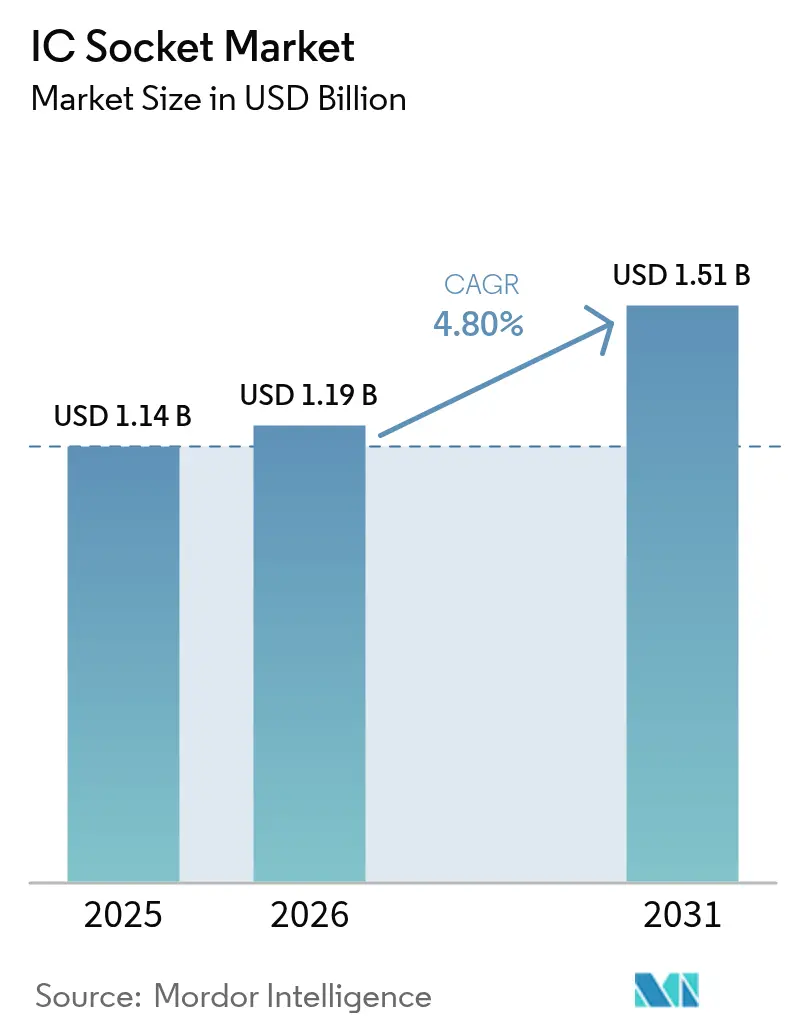
IC socket market size in 2026 is estimated at USD 1.19 billion, growing from 2025 value of USD 1.14 billion with 2031 projections showing USD 1.51 billion, growing at 4.8% CAGR over 2026-2031. Current growth stems from the semiconductor sector’s pivot toward advanced packaging that relies on heterogeneous integration, chiplet-based designs, and ever-smaller pitch requirements. Fine-pitch socket innovations, higher pin-count ASICs, and rising demand from 5G infrastructure, automotive zonal architectures, and AI accelerators are reshaping competitive priorities. Incumbent suppliers are blending advanced materials with modular designs to balance reliability, thermal control, and ease of maintenance, while supply-chain resilience remains a pivotal purchasing criterion.
Key Report Takeaways
- By socket type, test and burn-in sockets led with 33.40% revenue share of the IC socket market in 2025, while fine-pitch BGA/CSP/WLCSP sockets are set to expand at a 7.1% CAGR through 2031.
- By IC package type, BGA/μBGA packages captured 40.40% of the IC socket market size in 2025; LGA/PGA/CGA configurations are projected to advance at a 6.6% CAGR to 2031.
- By application, CPU and processor applications commanded a 35.90% share of the IC socket market in 2025, whereas RF and analog components hold the fastest-growing slot at a 6.9% CAGR through 2031.
- By end-user industry, consumer electronics captured 38.60% of the IC socket market size in 2025; the automotive industry is projected to advance at a 6.5% CAGR to 2031.
- By Geography, Asia-Pacific accounted for 44.40% of the IC socket market share in 2025 and is progressing at a 6.3% CAGR during the forecast period.
Note: Market size and forecast figures in this report are generated using Mordor Intelligence’s proprietary estimation framework, updated with the latest available data and insights as of 2026.
Market Trends and Insights
Drivers Impact Analysis of IC Socket Market*
| Driver | (~) % Impact on CAGR Forecast | Geographic Relevance | Impact Timeline |
|---|---|---|---|
| Surging smartphone and tablet production | +0.8% | APAC core, spill-over to MEA | Medium term (2-4 years) |
| 5G network roll-outs boosting RF device demand | +1.2% | Global, early gains in North America and EU | Short term (≤ 2 years) |
| Automotive zonal-architecture ECU proliferation | +0.9% | Germany, Japan, United States | Long term (≥ 4 years) |
| Higher pin-count ASICs in AI accelerators | +1.1% | North America and APAC | Medium term (2-4 years) |
| Rapid adoption of chiplet-based packaging | +0.7% | Global, led by advanced foundries | Long term (≥ 4 years) |
| In-line test sockets for OSAT known-good-die | +0.4% | Taiwan and South Korea | Short term (≤ 2 years) |
| Source: Mordor Intelligence | |||
5G Network Roll-outs Boosting RF Device Demand
Global 5G infrastructure deployment is reshaping RF component socket design, with frequencies now reaching 100 GHz and requiring materials that reduce insertion loss while maintaining tight impedance control. The shift from 4G to 5G multiplies RF components per base station by roughly three, elevating socket use in both final product qualification and system-level validation.[1]Heterogeneous Integration Roadmap 2023, IEEE, eps.ieee.org System-in-package adoption for millimeter-wave modules further magnifies demand, particularly across early-adopter regions in North America and Europe.
Automotive Zonal-Architecture ECU Proliferation
Consolidation of distributed automotive ECUs into centralized processing hubs raises pin counts and thermal loads, driving the need for automotive-grade sockets qualified under AEC-Q100 and capable of higher-current densities.[2]Automotive Solutions, Molex, molex.com Regulatory momentum behind software-defined vehicles in Germany, Japan, and the United States quickens the uptake of these specialized solutions.
Higher Pin-Count ASICs in AI Accelerators
AI accelerators now integrate upwards of 12 HBM stacks, forcing socket vendors to engineer contact schemes that support data rates above 1.2 TB/s per stack while preserving signal integrity. Chiplet-based architectures demand sockets that validate heterogeneous dies under multiple voltage domains, especially in North American and Asian data-center projects.
Rapid Adoption of Chiplet-Based Packaging
Chiplet approaches necessitate sockets able to test individual dies and fully integrated packages within modular fixtures aligned to IEEE 1838 guidelines.[3]D2D Interface Specification, Open Compute Foundation, opencompute.org Cost and yield advantages accelerate adoption across high-performance computing, networking, and emerging automotive functions.
Restraints Impact Analysis of IC Socket Market*
| Restraint | (~) % Impact on CAGR Forecast | Geographic Relevance | Impact Timeline |
|---|---|---|---|
| High initial tooling and probe-card costs | −0.6% | Global, acutely felt by smaller firms | Short term (≤ 2 years) |
| Socket life-cycle shortened by advanced nodes | −0.4% | Advanced foundry regions | Medium term (2-4 years) |
| Supply-chain exposure to ceramic substrate shortages | −0.8% | Global, acute in APAC | Short term (≤ 2 years) |
| Environmental regulation on beryllium-copper alloys | −0.3% | EU and North America | Long term (≥ 4 years) |
| Source: Mordor Intelligence | |||
High Initial Tooling and Probe-Card Costs
Advanced probe cards exceed USD 500,000 per configuration, with 16–20-week lead times due to sub-micron contact geometries.[4]Jing-Wei Chen, “Probe Card Tutorial,” Tektronix, tek.com Emerging packaging formats such as CoWoS demand fresh tooling, raising entry barriers for niche socket providers unable to amortize fixed costs across large volumes.
Supply-Chain Exposure to Ceramic Substrate Shortages
Lead times for ABF substrates exceed 26 weeks, forcing redesigns around alternative materials that can inflate costs by up to 25%.[5]Corporate Presentation, Unimicron Technology, unimicron.com Concentrated production hubs in Taiwan and Japan heighten geographic risk and complicate capacity planning.
*Our forecasts treat driver/restraint impacts as directional, not additive. The impact forecasts reflect baseline growth, mix effects, and variable interactions.
IC Socket Market Segment Analysis
By Socket Type:
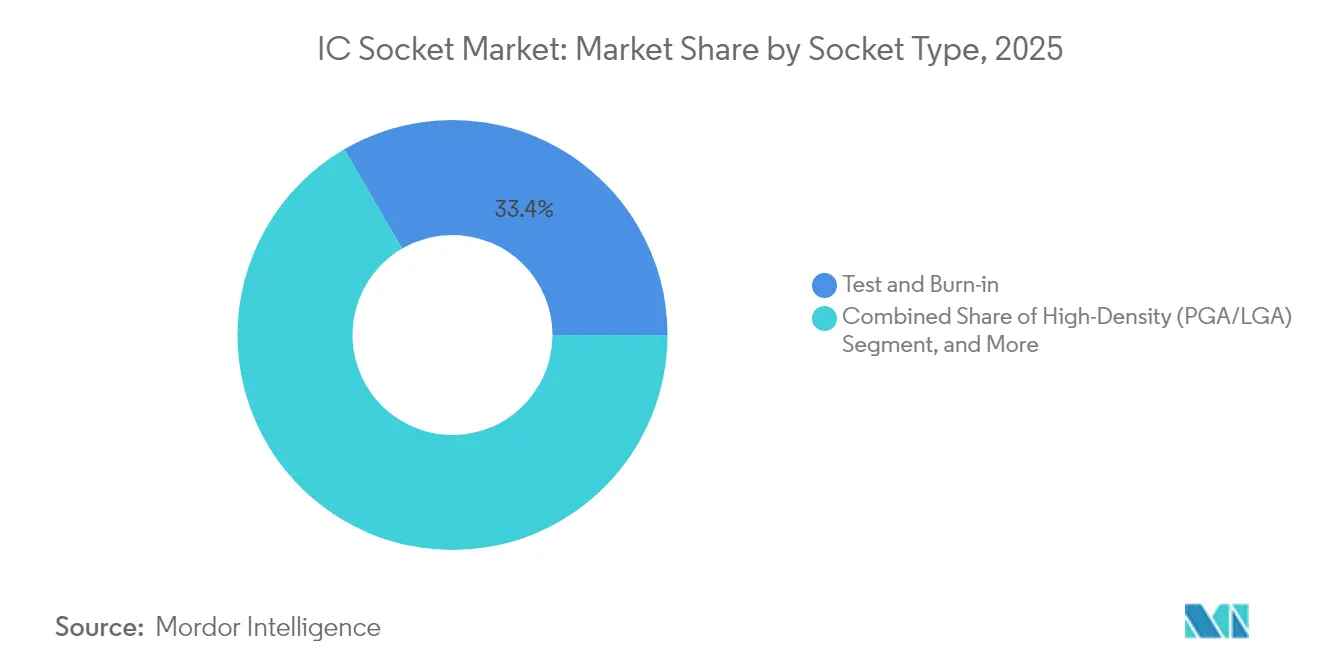
Fine-Pitch Drives InnovationTest and burn-in sockets controlled 33.40% of the IC socket market share in 2025, mirroring the industry’s quality-assurance focus. Fine-pitch BGA/CSP/WLCSP sockets, projected at a 7.1% CAGR, cater to device miniaturization and advanced packaging demands. The IC socket market size for fine-pitch variants is forecast to widen notably as mobile and wearable devices shrink form factors.
Manufacturers invest in sub-0.35 mm pitch capabilities and durable contacts that extend useful life across fewer allowable test cycles at advanced nodes. Predictive maintenance and modular inserts help control the total cost of ownership while supporting compatibility with evolving test-handler ecosystems.



By IC Package Type:
BGA Maintains DominanceBGA/μBGA packages retained 40.40% of the IC socket market size in 2025, linked to their thermal efficiency and interconnect density. LGA/PGA/CGA sockets are gaining at a 6.6% CAGR as server and automotive designers prioritize field-replaceable units.
Sockets now feature programmable pin mapping and adaptive contact force to accommodate mixed package types within a single handler, reducing downtime and tooling spend. Compliance with RoHS and REACH is steering material choices toward beryllium-free alloys, even as suppliers strive to match legacy electrical performance.
By Application:
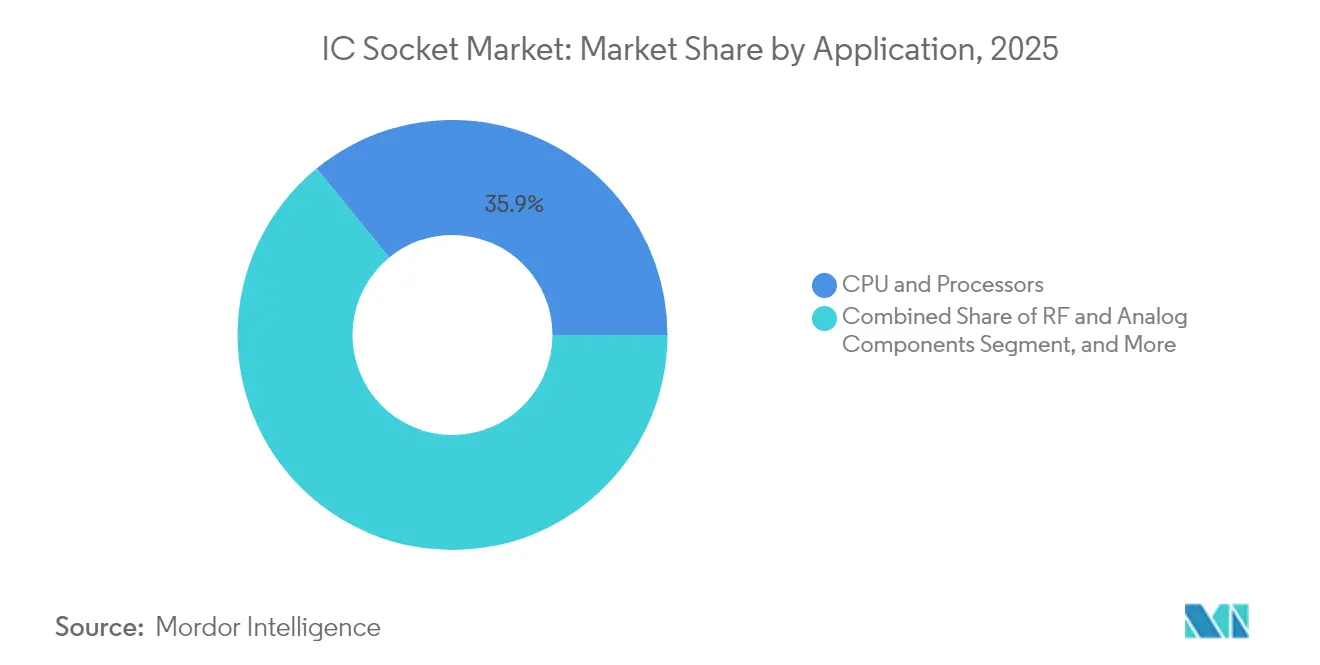
RF Components Lead GrowthCPU and processor testing held 35.90% of the IC socket market in 2025. RF and analog components represent the fastest-growing application at 6.9% CAGR, fueled by 5G and Wi-Fi 7 proliferation. Memory modules continue steady expansion, aided by data-center buildouts requiring greater DRAM density.
Silicon photonics places new optical coupling and thermal management demands on sockets, prompting hybrid electrical-optical designs that integrate alignment mechanisms for photonic ICs. Automotive ADAS programs call for sockets capable of extended temperature and vibration endurance.
By End-User Industry:
Automotive AcceleratesConsumer electronics preserved a 38.60% revenue share in 2025, though growth moderates as devices mature. Automotive applications deliver the highest CAGR at 6.5% as electric and autonomous vehicles elevate per-car semiconductor content.
Healthcare and medical devices emerge as a notable niche, necessitating biocompatible and sterilization-ready socket materials. The blending of consumer-grade processors into automotive designs creates cross-segment socket requirements that favor versatile, high-throughput test solutions.
Geography Analysis
APAC IC Socket Market
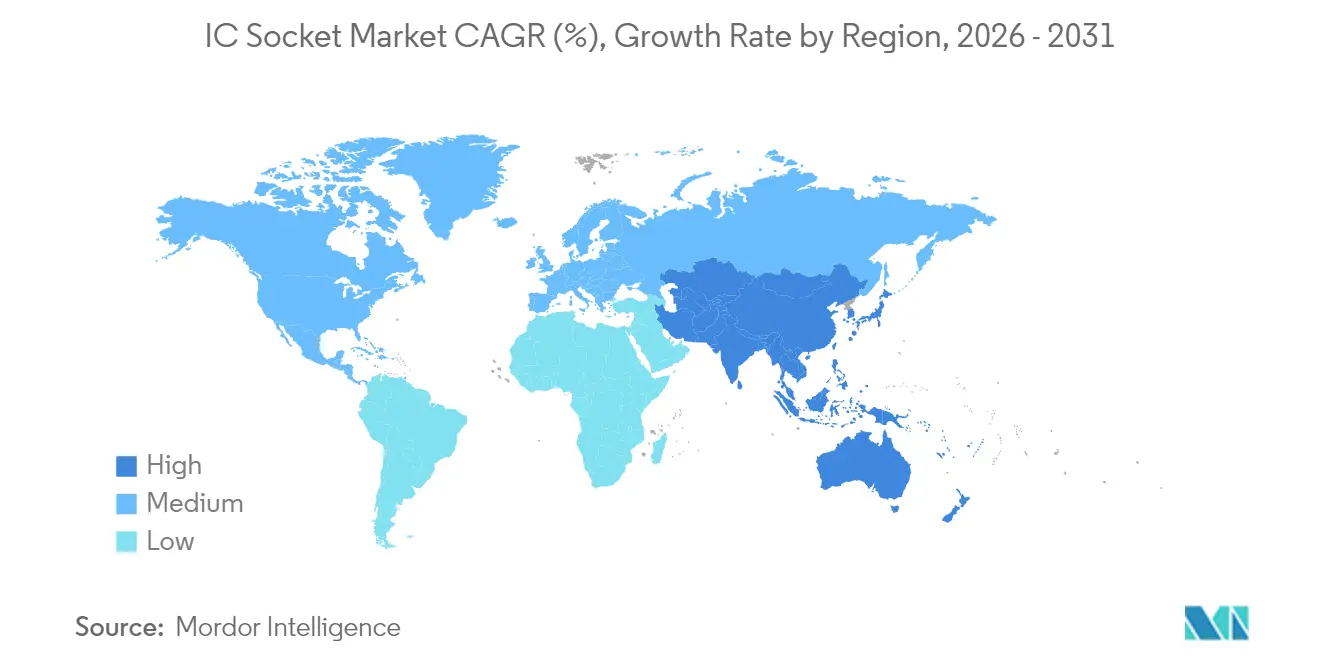
Asia-Pacific captured 44.40% of the IC socket market in 2025 and is set to climb at a 6.3% CAGR through 2031 as regional foundries expand and governments subsidize semiconductor self-sufficiency. China dominates consumer electronics assembly, while Taiwan and South Korea excel in advanced memory and logic nodes. India is surfacing as a cost-sensitive packaging alternative, buoyed by incentive schemes.
North America IC Socket Market
North America ranks second, anchored by automotive, aerospace, and data-center demand. Domestic manufacturing projects such as TSMC’s Arizona fab and Intel’s Ohio build-out are poised to increase localized socket procurement. AI accelerator development in Silicon Valley drives some of the most challenging socket specifications for HBM-rich packages.
Europe IC Socket Market
Europe emphasizes automotive and industrial applications. German tier-1 suppliers require AEC-Q qualified sockets with robust thermal cycling performance. France and the Netherlands contribute to research and development on high-density interconnects. Meanwhile, regulatory leadership in environmental standards pushes European buyers toward beryllium-free contact materials.

Regulatory Landscape
IC socket design and commercialization sit at the intersection of international mechanical and interface standards, alongside region-specific environmental and trade compliance regimes. Interoperability for semiconductor test and burn-in sockets is anchored to the IEC 60191 series (including IEC 60191-6-13 for open-top sockets and IEC 60191-6-16 terminology), helping align socket form factors and test-interface conventions across global ATE and handler ecosystems.
Compliance requirements are also shaping material selection and documentation through hazardous-substance controls (RoHS/REACH-aligned programs). This supports the market shift toward beryllium-free contact alternatives already reflected in supplier design priorities. Trade policy further affects sourcing and landed costs for socket components and derivative electronics: in January 2026, the United States initiated a Section 232 semiconductor trade action process that introduced a path for additional duties on targeted semiconductor-related products, adding another variable for procurement planning across globally distributed socket supply chains.
Value Chain Analysis
The IC socket value chain starts with upstream inputs such as engineering polymers for housings, spring-contact and alloy materials, and precision plating chemistries, followed by high-tolerance processes including contact forming, injection molding, and multi-stage plating. Midstream value creation centers on socket design and fabrication, including fine-pitch alignment features, controlled-impedance structures, and thermal paths. Downstream delivery then runs through direct OEM/OSAT engagement and specialized electronics distribution, especially for lower-volume and legacy packages, with qualification tied to ATE and handler platforms.
Bottlenecks are increasingly tied to high-throughput manufacturing steps constrained by mechanical life limits, high-density ball alignment, and labor-intensive handling in programming and test flows. This can extend lead times when demand spikes for advanced-package burn-in. The chain is also linked to broader advanced-packaging capacity and substrate availability: as chiplet and HBM-rich packages expand, the need for supply assurance increases for sockets used in test and known-good-die workflows. Constraints in packaging substrates (for example, FC-BGA tightness discussed in the ecosystem) can therefore ripple into the timing and mix of socket orders needed to support AI and server programs.
Competitive Landscape
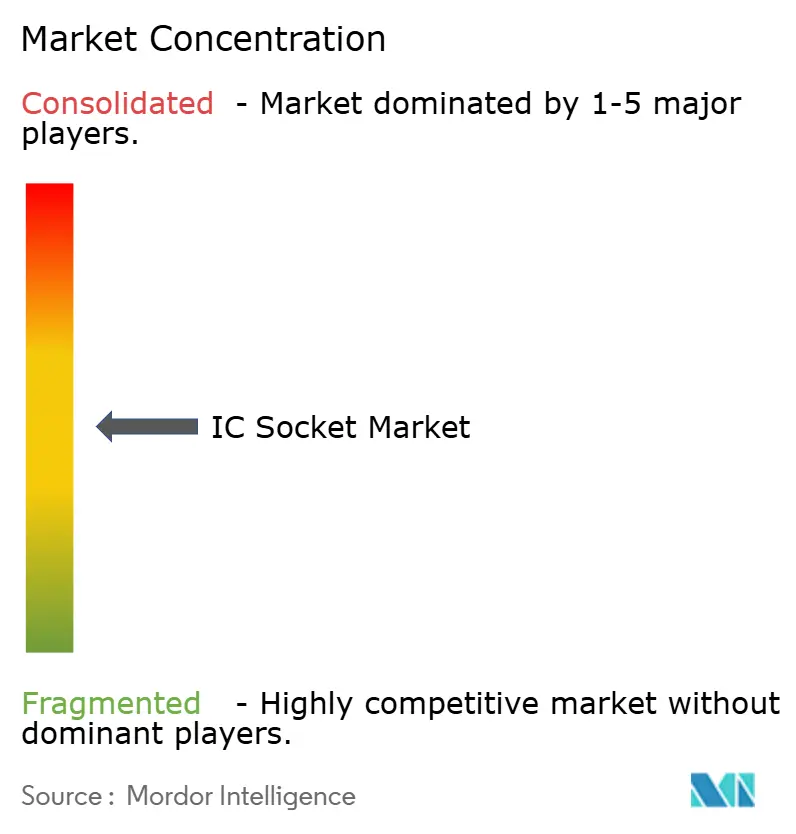
The IC socket market features moderate concentration. TE Connectivity, Smiths Interconnect, and Yamaichi Electronics maintain the broadest portfolios, buttressed by in-house materials science and global support networks. Mid-tier competitors focus on vertical niches such as high-frequency RF, wafer-level burn-in, or extreme-temperature automotive sockets.
Strategic moves include TE Connectivity’s rollout of modular contact blocks that shorten time-to-market for custom fine-pitch test heads, Smiths Interconnect’s expansion of spring-probe geometries for millimeter-wave applications, and Yamaichi’s investment in fully automated inspection lines that bolster repeatability for sub-0.3 mm pitch sockets.
Technology disruptors leverage additive manufacturing and precision micromachining to produce low-volume, custom sockets for AI accelerators and silicon photonics, challenging incumbents on agility. Supply-chain resilience differentiates suppliers able to secure ABF substrate allocations or qualify alternative laminates when shortages arise.
IC Socket Industry Leaders
TE Connectivity PLC
Yamaichi Electronics Co., Ltd.
Smiths Interconnect Inc.
Enplas Corporation
Sensata Technologies Holding plc
- *Disclaimer: Major Players sorted in no particular order
IC Socket Market Companies Covered in this Report
- TE Connectivity PLC
- Smiths Interconnect Inc.
- Yamaichi Electronics Co., Ltd.
- Enplas Corporation
- ISC Co., Ltd.
- Sensata Technologies Holding plc
- Ironwood Electronics, Inc.
- Plastronics Socket Company, Inc.
- INNO Global Inc.
- 3M Company
- Amphenol Corp.
- Molex LLC (Koch Industries)
- Foxconn Interconnect Technology Ltd.
- Samtec Inc.
- Loranger International Corp.
- Aries Electronics Inc.
- Mill-Max Manufacturing Corp.
- WinWay Technology Co., Ltd.
- Cohu, Inc.

Market Opportunities and Future Outlook
Whitespace is emerging in high-speed, high-power test sockets that can keep pace with advanced packaging and AI server ASIC ramps. In these applications, pin counts, thermal density, and signal integrity requirements push sockets beyond conventional connector performance. Supply-side strain is also visible, with extended lead times reported for several socket categories (and industry market intelligence indicating 18 to 24 weeks by Q2 2026 for certain test and legacy microcontroller sockets). Vendors that can shorten cycle times through modular designs, faster tooling turnarounds, and tighter integration with test-handler ecosystems have a clearer path to win share.
Opportunity also clusters around sockets engineered for evolving interconnect requirements from roadmaps and standards bodies, including tighter pitch scaling and higher-frequency validation for next-generation wireless and datacom. On the product side, Smiths Interconnect introduced DaVinci Gen V as a next-generation test socket platform aimed at very high data-rate digital and high-frequency requirements, which reflects how suppliers are treating socket portfolios as performance-critical test-floor assets. Separately, continued investment in advanced packaging capacity and semiconductor test equipment utilization supports demand for burn-in and qualification sockets used across OSAT and IDM production flows.
Recent Industry Developments in IC Socket Market
- March 2026: TE Connectivity launched 56G MezzaWave connectors and cable assemblies based on an open-pin-field array platform, extending high-speed interconnect options for dense compute systems. The move builds enabling infrastructure around server and accelerator hardware where socketing, test, and validation workflows face tighter signal-integrity margins at higher data rates.
- August 2025: Smiths Interconnect secured a contract win for its DaVinci Gen V test sockets to be used as an exclusive test socket in the specified program. The award ties qualification sockets to platform-level test strategies and increases the focus on proven reliability and throughput for suppliers supporting advanced-package device ramps.
- November 2024: Cohu introduced the Neon Inspection and Metrology Platform for HBM devices. By expanding inspection and metrology capability around HBM-focused production, the launch complements next-generation burn-in and test socket deployments that must manage tighter defect control and higher thermal and electrical loads.


IC Socket Market Report Scope and Research Methodology
Market Definition and Coverage
For this study, the IC socket market covers revenue generated from sockets that mechanically and electrically connect integrated circuits to a board for production, burn-in, and testing use cases, and for applications that need easy insertion and replacement.
Scope exclusions: We exclude the value of the IC chips themselves and broader electronic connectors that are not purpose-built as IC sockets.
Segments Covered in This Report
- By Socket Type
- Test and Burn-in
- Board-to-Board / Through-Hole (DIP, SIP)
- High-Density (PGA/LGA)
- Fine-pitch BGA / CSP / WLCSP
- By IC Package Type
- DIP
- QFP / SOP
- BGA / μBGA
- LGA / PGA / CGA
- By Application
- CPU and Processors
- Memory Modules (DRAM, NAND)
- Sensor Devices
- RF and Analog Components
- Optoelectronic / Photonic ICs
- By End-User Industry
- Consumer Electronics
- Automotive
- Industrial and Automation
- Telecommunications and Datacom
- Aerospace and Defense
- Healthcare and Medical Devices
- Geography
- North America
- South America
- Europe
- Asia-Pacific
- Middle East
- Africa
Data Sources, Market Sizing, and Validation
Desk Research
Desk research was used to set the market boundary and build the first demand picture across electronics manufacturing and semiconductor testing. We leaned on public sources such as USITC trade data, UN Comtrade, OECD and World Bank macro indicators, and technical publications from IEEE and similar journals to map how socket use shifts with semiconductor package changes.
To anchor company and market signals, we also reviewed annual reports, earnings call transcripts, investor decks, and updates shared through industry association websites and reputed press. Where it helped, we referenced paid subscriptions for company financials and intelligence, patent databases for technology direction, and shipment-level import and export datasets to sanity-check regional flows. The desk research sources listed here are illustrative only, and many other public references were used for data collection, validation, and clarification.
Primary Interviews and Surveys
Primary work was done through expert interviews and structured surveys across socket makers, distributors, and electronics and test operations, so the assumptions on pricing, product mix, and replacement cycles could be tightened. Coverage was balanced across major manufacturing and testing hubs in APAC, EMEA, and the Americas, then the feedback was used to confirm desk findings and to correct weak spots where public data is thin.
Distribution of primary research fieldwork respondents
| Company type | Respondent position | Region |
|---|---|---|
| Top tier: 36% | CXOs: 14% | APAC: 42% |
| Mid tier: 44% | Functional/Unit leaders: 35% | EMEA: 32% |
| Smaller Players: 20% | Managers: 51% | Americas: 26% |
Market-Sizing & Forecasting
The sizing logic starts from a top-down reconstruction of the demand pool, where semiconductor assembly and test activity, along with electronics production indicators, are translated into socket consumption by package and use case, and then priced into value. Once the model outputs were formed, they were corroborated with selective bottom-up approximations, mainly supplier revenue mapping, sampled unit price by socket type, and channel checks to adjust totals when the first pass looked too high or too low.
Key inputs used in the model include semiconductor test intensity (burn-in and final test needs), IC package trends that affect socket designs, electronics production growth by region, average selling price ranges by socket type, and replacement and reuse rates that change effective annual demand. For forecasting, we relied on scenario analysis supported by expert consensus, because end demand can swing with cycles in consumer electronics and data center builds. When bottom-up visibility was incomplete for smaller players, gaps were handled using share estimates and regional mix logic validated through interviews, followed by reasonableness checks against trade and production signals.
Data Validation & Update Cycle
Validation is done in layers so outliers get caught early, and then reviewed again before publication. Analysts compare model results against independent signals such as trade flows for relevant subcomponents, semiconductor production and test indicators, and implied pricing bands by socket category.
If a variance looks material, we re-check the assumptions, revisit conversion and currency timing, and re-contact primary respondents to confirm what changed and why. Reviews are completed in multiple analyst steps before sign-off, followed by an annual refresh cycle, with interim updates when there are major market events. Before delivery, a fresh pass is done so clients receive the latest updated view with the same scope and logic applied consistently.
Mordor Intelligence's Ic Socket Market Size Compared With Other Published Estimates
Published market sizes for IC sockets often differ because the included socket categories, base year timing, and the way pricing is averaged across types can change from one study to another. Even small choices, like whether production sockets and test or burn-in sockets are both counted in full, can move the final number.
The benchmark table shows a visible spread across 2025 and 2026 figures, and in Mordor Intelligence's model the value is tied to IC socket sales revenue only, with chips and non-socket connectors excluded and the forecast path checked against semiconductor test and electronics output signals.
Benchmark comparison
| Source | Market Size | Gaps in Research Methodology |
|---|---|---|
| Mordor Intelligence | USD 1.19 B (2026) | |
| Trade Publisher A | USD 1.15 B (2025) | Uses a different base year and mixes a broader set of socket types and applications, which can pull the average price down when lower-cost sockets carry more weight. |
| Global Consultancy B | USD 1.09 B (2025) | Applies a narrower demand proxy tied to selected applications and a conservative pricing progression, which tends to undercount sockets linked to semiconductor testing and burn-in cycles. |
Taken together, the main reason for the gap is not one single input, but a mix of scope boundaries, base-year choice, and how price and mix are blended across socket categories. By keeping the steps traceable to a clear demand pool and then cross-checking with interview feedback and external activity indicators, the estimate stays repeatable and easier to audit over time.


Key Questions Answered in the Report
What is the current valuation of the IC socket market?
The IC socket market size stands at USD 1.19 billion in 2026.
How fast is the IC socket market expected to grow?
It is projected to post a 4.8% CAGR between 2026 and 2031.
Which region leads global demand for IC sockets?
Asia-Pacific holds 44.40% market share, reflecting strong manufacturing depth.
Which socket type is growing the fastest?
Fine-pitch BGA/CSP/WLCSP sockets are forecast at a 7.1% CAGR through 2031.
Why is the automotive sector important for IC sockets?
Zonal architectures and higher semiconductor content drive a 6.5% CAGR in automotive applications.
What is the biggest supply-chain challenge facing socket vendors?
Persistent shortages of ceramic ABF substrates that extend lead times and raise costs.
Page last updated on:





