
China GPU Cooling Solutions Market Size and Share
Market Overview
| Study Period | 2020 - 2031 |
|---|---|
| Base Year Market Size (2025) | USD 3.23 Billion |
| Market Size (2026) | USD 4.11 Billion |
| Market Size (2031) | USD 15.60 Billion |
| Growth Rate (2026 - 2031) | 30.59 % |
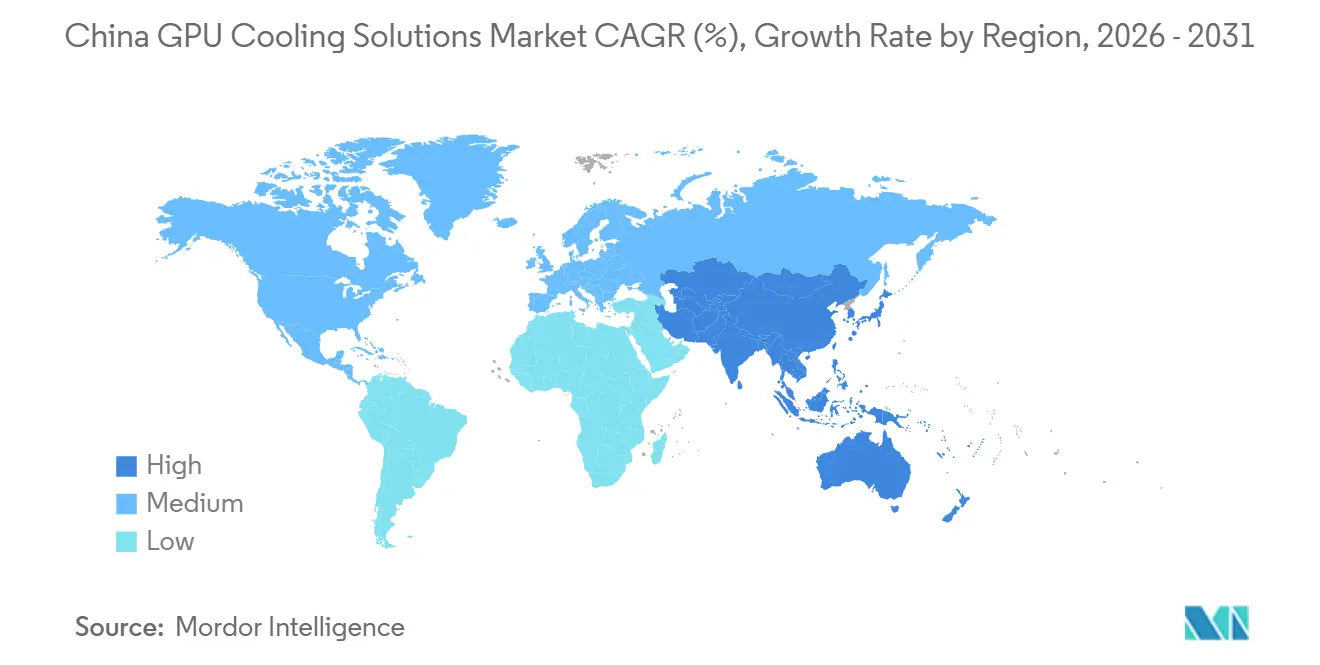
| Fastest Growing Market | Asia-Pacific |
| Largest Market | North America |
Major Players *Disclaimer: Major Players sorted in no particular order Image © Mordor Intelligence. Reuse requires attribution under CC BY 4.0. | |
China GPU Cooling Solutions Market Analysis by Mordor Intelligence
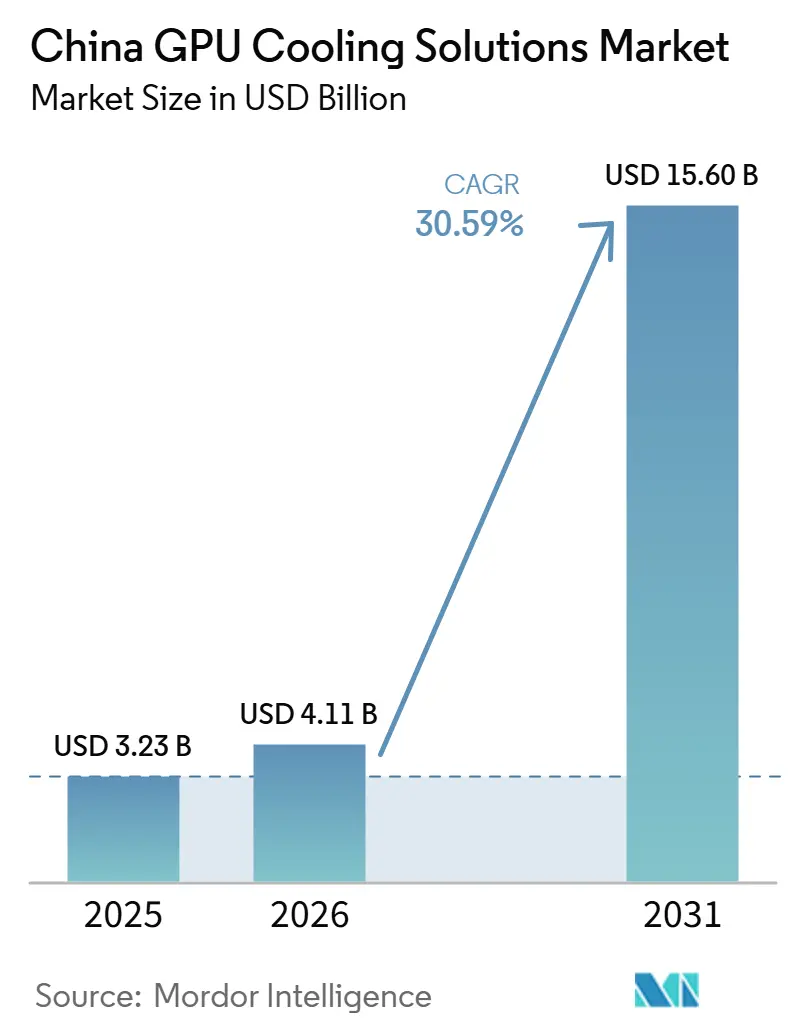
The China GPU cooling solutions market size is expected to be USD 3.23 billion in 2025, USD 4.11 billion in 2026, and reach USD 15.60 billion by 2031, growing at a CAGR of 30.59% from 2026 to 2031. Explosive demand for sovereign generative-AI capacity, Beijing’s policy pressure to locate clusters near renewable energy, and the move to 700-1,000-watt accelerators are reshaping cooling choices. Direct-to-chip liquid loops and single-phase immersion tanks are displacing legacy air systems because they cut energy use, fit ever-denser racks, and help operators comply with the Beijing municipal PUE cap of 1.3.[1]Beijing Municipal Government, “2025 Notice on Data Center Energy Consumption Control,” beijing.gov.cn Suppliers that can integrate pumps, cold plates, smart manifolds, and dielectric fluids in prefabricated skids now win contracts in less than 12 months, compared with the 18-month cycles typical before 2024. At the same time, the Eastern Data Western Computing program funnels workloads to Inner Mongolia, Gansu, and Guizhou, where wind and hydro resources allow immersion-cooled farms to reach PUE below 1.10 while selling recovered heat to district networks.
Key Report Takeaways
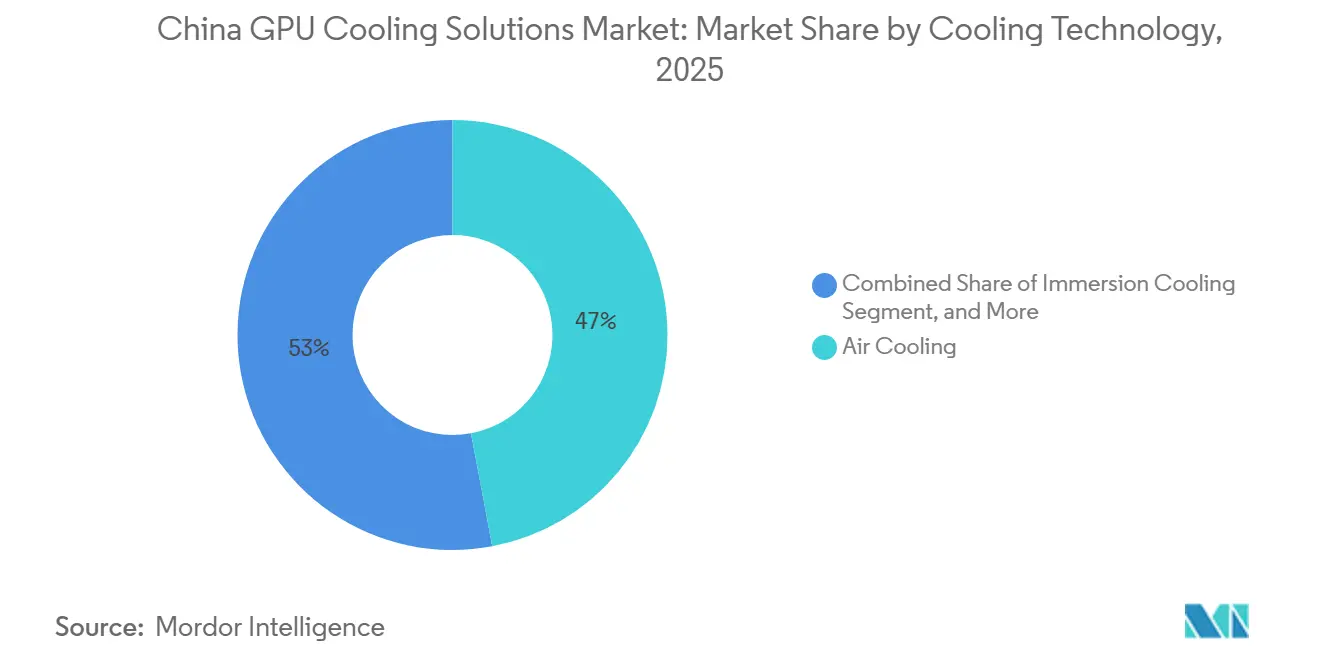
- By cooling technology, air cooling led with 47.04% of the GPU cooling solutions market share in 2025, whereas immersion cooling is forecast to post a 25.50% CAGR through 2031.
- By cooling level, server and rack-level systems captured 59.02% of the GPU cooling solutions market size in 2025 and are projected to expand at a 26.10% CAGR.
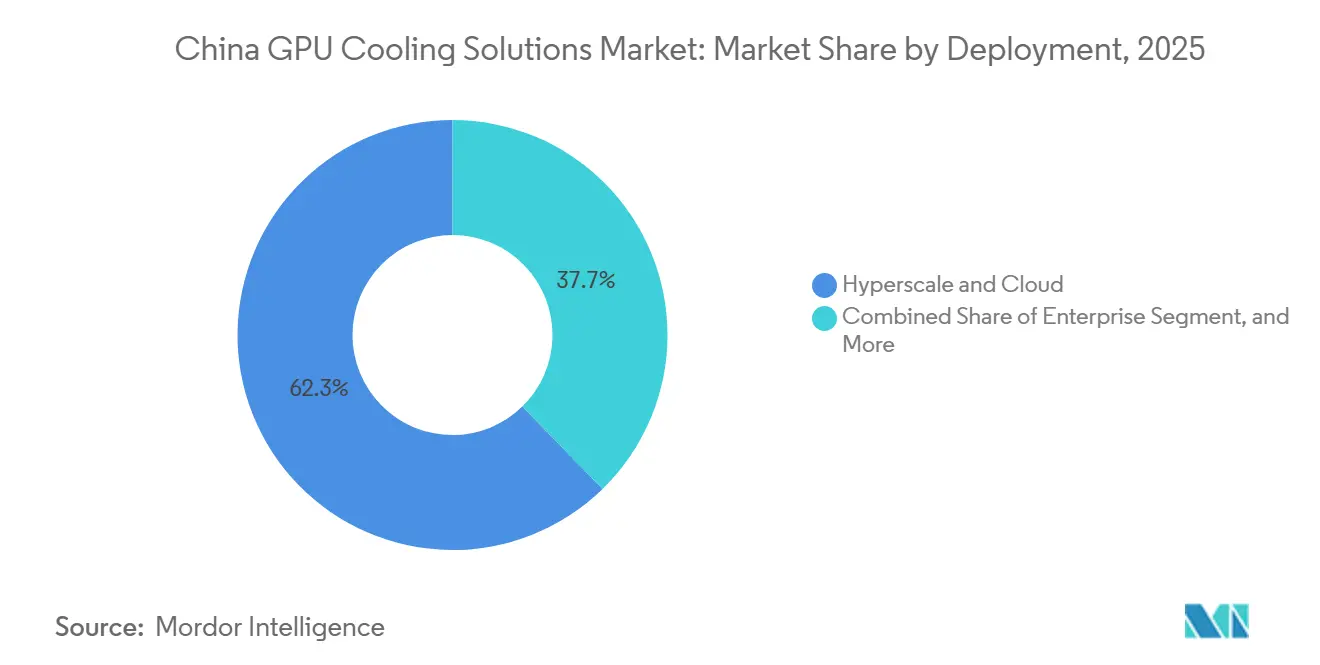
- By deployment, hyperscale and cloud installations held 62.30% share of the GPU cooling solutions market in 2025, while the enterprise segment is set to grow at a 26.30% CAGR over 2026-2031.
- By GPU power density, the 300 W-700 W bracket commanded 51.10% share of the graphics processing unit (GPU) cooling solutions market in 2025; accelerators above 700 W are expected to progress at a 27.80% CAGR.
Note: Market size and forecast figures in this report are generated using Mordor Intelligence’s proprietary estimation framework, updated with the latest available data and insights as of January 2026.
China GPU Cooling Solutions Market Trends and Insights
Drivers Impact Analysis*
| Driver | (~) % Impact on CAGR Forecast | Geographic Relevance | Impact Timeline |
|---|---|---|---|
| Rapid Expansion of AI Clusters | +8.7% | Beijing-Tianjin-Hebei, Yangtze River Delta, Greater Bay Area, Inner Mongolia, Guizhou | Short term (≤ 2 years) |
| Government Incentives for Domestic GPU Supply | +7.2% | National pilots in Shanghai, Shenzhen, Chengdu, Wuhan | Medium term (2-4 years) |
| GPUs Exceeding 700 W | +6.5% | National early adoption in hyperscale and HPC clusters | Short term (≤ 2 years) |
| Immersion Cooling in Crypto Farms | +3.8% | Inner Mongolia, Xinjiang, offshore sites in Kazakhstan and United States | Medium term (2-4 years) |
| Edge Inference in Smart Manufacturing | +2.9% | Jiangsu, Zhejiang, Guangdong | Long term (≥ 4 years) |
| Waste Heat Recovery for District Heating | +1.5% | Beijing, Hebei, Shanxi, Liaoning, Heilongjiang | Long term (≥ 4 years) |
| Source: Mordor Intelligence | |||
Rapid Expansion of AI Clusters in Chinese Hyperscale Data Centers
ByteDance’s 500 megawatt colocation deal with VNET and DeepSeek’s Inner Mongolia build highlight how racks now exceed 50 kilowatts, a level that renders air paths thermodynamically untenable.[2]Alibaba Cloud, “Zhangbei Immersion Cooling Achieves PUE 1.09,” alibabacloud.com Alibaba Cloud’s Zhangbei campus combined immersion tanks and wind power to cut PUE to 1.09, proving liquid systems can meet both energy and ESG targets. The Fifteenth Five-Year Plan instructs operators to colocate compute with renewables, collapsing build cycles to under a year. Vendors with prefabricated manifolds, sealed coolant loops, and remote-commissioning services now close orders in weeks, giving them a strategic edge in the China GPU cooling solutions market.
Government Incentives for Domestic GPU Manufacturing and Ecosystem Localization
The Ministry of Industry and Information Technology offers tax rebates to server makers that certify local content across cold plates, pumps, and heat exchangers.[3]Ministry of Industry and Information Technology, “2025 Guidelines on Domestic GPU Supply Chain,” miit.gov.cn Huawei’s March 2026 Xinghe AI Fabric 2.0 switch features integrated liquid channels, cutting the rack footprint 30% while anchoring procurement inside China. Shanghai and Shenzhen have opened liquid-cooling test labs that pool research bodies with component suppliers, shrinking prototype loops from six months to eight weeks. These measures secure supply resilience and accelerate time-to-compliance with the 2027 China RoHS fluorocarbon cap.[4]Ministry of Ecology and Environment, “GB 26572-2025 RoHS Amendment,” mee.gov.cn
Rising GPU Thermal Design Power Exceeding 700 W in Next-Generation Accelerators
AMD’s 1,000-watt MI325X and planned 1,400-watt MI355X shift thermal design beyond the reach of even high-static-pressure air coolers. NVIDIA’s 700-watt H200, though throttled for export, still needs cold plates to keep junctions below 85 °C. Operators therefore lock in liquid infrastructure at the concept stage, cementing multi-year service revenue for cooling vendors. Older sites running sub-500-watt cards stay on air, creating a dual-track China graphics processing unit (GPU) cooling solutions market.
Growing Adoption of Immersion Cooling in Cryptocurrency Mining Farms
Residual mining in Inner Mongolia and Xinjiang, plus offshore moves to Kazakhstan, keep demand for single-phase immersion alive. Sugon’s C8000 V3.0 tank cools 1 000 GPUs in one enclosure and reaches PUE 1.08, shortening payback to under 36 months where power rates top USD 0.10 /kWh. As idle mining rigs pivot to AI inference, operators favor immersion tanks that support both hash rate and large-language model training, thereby expanding the addressable base of the China GPU cooling solutions market.
Restraints Impact Analysis*
| Restraint | (~) % Impact on CAGR Forecast | Geographic Relevance | Impact Timeline |
|---|---|---|---|
| High Upfront Capital Expenditure | −5.3% | Tier-2 and Tier-3 cities lacking low-cost financing | Short term (≤ 2 years) |
| Fluorocarbon-Free Dielectric Fluid Shortages | −3.6% | Chemical clusters in Jiangsu and Zhejiang | Medium term (2-4 years) |
| Talent Shortage in Liquid Cooling | −2.4% | Western provinces including Gansu, Ningxia, Qinghai | Long term (≥ 4 years) |
| Grid Water-Use Restrictions | −1.8% | Beijing, Hebei, Shanxi, Inner Mongolia | Medium term (2-4 years) |
| Source: Mordor Intelligence | |||
High Upfront Capital Expenditure for Liquid and Immersion Cooling Infrastructure
Turner and Townsend’s Data Center Cost Index shows a 15-25% capex premium for direct-to-chip loops and 40-60% for immersion tanks, adding USD 3-6 million to a 10 MW build. Hyperscalers amortize this over long contracts, but smaller firms in Xi’an or Chengdu often defer upgrades. Where industrial power falls below USD 0.06 /kWh, payback on immersion stretches past four years, locking many operators into air cooling and slowing part of the China GPU cooling solutions market.
Limited Availability of Fluorocarbon-Free Dielectric Fluids Meeting China RoHS
The GB 26572-2025 standard bans PFAS-laden fluids from August 2027. 3M’s widely used Novec line contains restricted compounds, and domestic substitutes are still climbing the thermal-stability curve. Schneider Electric and Castrol opened a Shanghai lab to commercialize bio-based fluids, but full output is slated for late 2027. Supply tightness could leave immersion integrators with empty tanks just as 1,000-watt accelerators hit volume, a material headwind for the China GPU cooling solutions market.
*Our forecasts treat driver/restraint impacts as directional, not additive. The impact forecasts reflect baseline growth, mix effects, and variable interactions.
Segment Analysis
By Cooling Technology Immersion Gains As Thermal Limits Rise
Immersion cooling is expected to record the fastest growth among cooling technologies, with a CAGR of 25.50%, supported by rising demand from hyperscale data center operators seeking to reduce power usage effectiveness (PUE) to below 1.10. Air cooling accounted for a substantial 47.04% share in 2025, reflecting its established deployment in racks with power densities below 500 watts. However, as AI workloads increase, rack-level heat loads are rising, prompting operators to adopt liquid-based alternatives to improve thermal efficiency and support higher computing density. Direct-to-chip cooling loops are increasingly being retrofitted in brownfield facilities where floor-loading limitations and ceiling-height constraints make full immersion tank deployment impractical. In Beijing pilot deployments, Inspur’s cold-plate cabinets achieved a PUE of 1.15, demonstrating the operational viability of liquid cooling in existing data center environments. Hybrid cooling systems, which combine fan walls with rear-door heat exchangers, are also gaining traction as enterprises seek to operate AI servers alongside legacy IT infrastructure without fully redesigning their facilities.
Alibaba Cloud’s Zhangbei facility combines immersion cooling with surplus wind power, strengthening the competitiveness of renewable energy-rich regions in the Chinese GPU cooling solutions market. Sugon’s C8000 megawatt-scale immersion tank further demonstrates the capability of domestic players to advance directly toward ultra-dense cooling architectures designed for high-performance computing and AI workloads. Air cooling is expected to remain relevant for edge inference deployments in factory halls and similar distributed environments, particularly where GPU power consumption remains below 300 watts. As a result, the market is likely to remain segmented by deployment type. Liquid cooling technologies are expected to dominate new AI cluster installations that require high-density computing and advanced thermal management, while a large base of legacy data centers will continue to rely on optimized air cooling systems supported by incremental efficiency upgrades.



By Cooling Level Rack-Level Designs Anchor Retrofit Programs
In 2025, server and rack-level loops commanded a 59.02% market share and are projected to grow at a robust 26.10% CAGR, thanks to their simplified deployment and alignment with OEM warranties. These solutions are gaining traction due to their ability to streamline operations and reduce complexities in data center cooling systems. Schneider Electric’s EcoStruxure skid introduces an innovative design by positioning manifolds at the rear of the rack, allowing operators to phase in liquid cooling row by row. This phased approach not only enhances operational flexibility but also minimizes downtime during implementation. On the other hand, Huawei’s liquid-cooled 51.2 Tbps switch excels in delivering peak density performance, making it a preferred choice for high-performance environments. However, its reliance on a single hardware roadmap limits flexibility for operators seeking diverse hardware options.
Operators are increasingly favoring rack loops as a strategic measure to mitigate risks associated with future silicon transitions, a critical factor in the Chinese GPU cooling solutions market. This preference is particularly evident in a 2025 survey conducted by CDCC, where 68% of managers indicated their choice of rack loops for new data halls. Rack loops offer scalability and adaptability, making them a reliable option for evolving technological demands. However, the impending release of AMD’s 1,400-watt MI355X is expected to drive a shift towards component-level cold plates, especially for top-tier AI training facilities. These cold plates are likely to become essential for managing the high thermal output of advanced GPUs, gradually altering the market dynamics after 2028. This anticipated shift underscores the need for operators to balance their cooling strategies to accommodate future advancements.
By Deployment Enterprise Uptake Accelerates Under Provincial AI Mandates
Hyperscalers claimed 62.30% of the 2025 market value, but enterprise demand is set to surge with a 26.30% CAGR. This growth is primarily driven by factories in Jiangsu, Zhejiang, and Guangdong, which are increasingly adopting on-premise inference solutions. These solutions help reduce latency and ensure data protection, addressing critical operational needs. Lenovo's Neptune racks, featuring a PUE of 1.1 and delivering 40% energy savings, are designed to fit seamlessly into small server rooms without requiring structural modifications. Furthermore, provincial rebates for local AI computing are incentivizing enterprises to allocate more budgets toward advanced computing infrastructure. These factors collectively underscore the growing demand for efficient, localized AI solutions in the enterprise segment.
Government and research HPC labs are increasingly turning to immersion cooling techniques to maximize GPU density within constrained physical spaces. For instance, Tsinghua's 2025 upgrade demonstrated the effectiveness of this approach by tripling GPU counts within capped footprints. Edge micro-centers are also evolving, combining PLCs with AI cards and adopting hybrid coil systems to enhance performance. This trend of dispersed deployment points is significantly expanding the GPU cooling solutions market in China. Additionally, integrators are capitalizing on this growth by offering modular, self-contained units equipped with remote telemetry for efficient monitoring and management. These advancements are driving innovation and meeting the rising demand for scalable and efficient cooling solutions in the region.
By GPU Power Density Above-700 W Tier Surges As 1 000 W Accelerators Arrive
The above-700-watt segment is projected to grow at a 27.80% CAGR, driven by the adoption of AMD MI325X rolls and custom ASICs that incorporate cold plates at the design stage. This growth highlights the increasing demand for high-performance cooling solutions. In 2025, the 300-700 watt bracket maintained a 51.10% market share, supported by the widespread use of NVIDIA A100 and H100 clusters. Meanwhile, boards below 300 watts are experiencing a steady decline as businesses transition from consumer-grade cards to purpose-built inference silicon, reflecting a shift in market preferences.
Google’s planned 980-watt TPU v7 demonstrates that hyperscalers worldwide, including their Chinese counterparts, are standardizing liquid cooling as a fundamental requirement for new rack deployments. This trend underscores the growing importance of advanced cooling technologies in handling high-power silicon. As a result, the market share of air-based cooling systems in the China graphics processing unit (GPU) cooling solutions market is expected to decrease. This decline aligns with the growing adoption of 1,000-watt silicon, which requires more efficient, robust cooling solutions to meet performance demands.
Geography Analysis
Inner Mongolia, Gansu, and Guizhou are leading regions for greenfield builds due to their abundant wind and hydro resources, which significantly lower energy costs and enable PUE levels below 1.10. For instance, DeepSeek’s liquid-cooled campus in Ordos exemplifies this trend, utilizing modular immersion halls connected to 300 MW wind farms. Meanwhile, Beijing, Shanghai, and Jiangsu focus on enterprise retrofits, combining rear-door heat exchangers with chilled plates to optimize AI node deployment in high-value urban areas. These developments highlight the regional variations in cooling infrastructure strategies across China.
Shenzhen’s Greater Bay Area serves as the central hub for hardware supply, hosting key manufacturers like Sanhua and Lansi, which produce heat exchangers for server OEMs on a just-in-time basis. In contrast, northern provinces face water scarcity, prompting Beijing to impose a cap of 1.5 liters of water per kWh. This has driven operators to adopt closed-loop liquid cooling systems or advanced evaporative towers. Additionally, waste-heat monetization is gaining traction, as seen in Huiyuan Cowins’ initiative to redirect 85% of outlet heat to 10,000 households in Hebei, generating USD 1.7 million in annual revenue.
Guizhou benefits from a mild climate and low-cost hydropower at USD 0.05 per kWh, which reduces operational expenses. However, its remote location limits its suitability for latency-sensitive workloads. On the other hand, factories in Jiangsu and Zhejiang are increasingly adopting compact hybrid cabinets to support on-site robotics AI. This geographical divide compels vendors in the China graphics processing unit (GPU) cooling solutions market to diversify their offerings, providing immersion tanks with heat recovery systems for northern regions and rack-level cooling loops with minimal water usage for southern areas.

Competitive Landscape
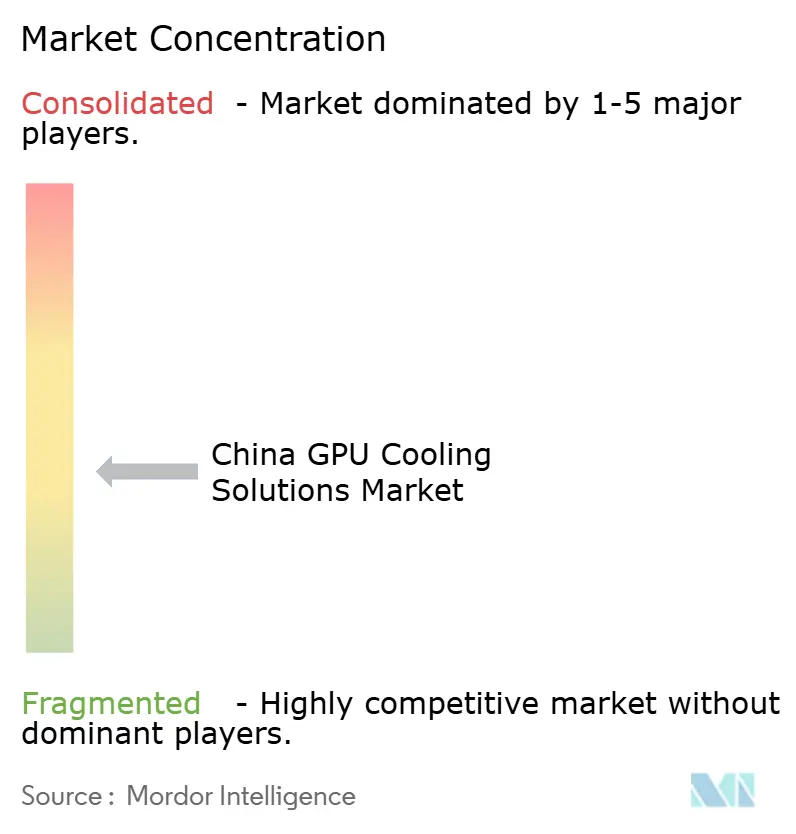
The market remains moderately concentrated, with no supplier holding a dominant revenue position. Schneider Electric, Vertiv, and Asetek deliver comprehensive liquid cooling platforms backed by strong global R&D capabilities. Schneider’s partnership with Castrol supports the development of bio-based cooling fluids, helping address upcoming PFAS regulatory restrictions. Domestic players, including Envicool, Kehua, Lansi, and Sanhua, benefit from local sourcing mandates and shorter lead times, while supplying cooling components such as plates and pumps for integration into Inspur and Sugon servers. This competitive landscape enables domestic firms to strengthen their position against global players in the China GPU cooling solutions market.
Sugon’s C8000 V3.0 immersion tank is designed for ultra-dense computing clusters that traditional rack-level cooling systems cannot handle. Inspur accelerates deployment timelines by delivering GPU trays pre-equipped with cold plates, reducing integration efforts for end-users. Vertiv’s CoolPhase Flex solution caters to enterprises that prefer hybrid cooling systems, combining air and liquid cooling within a single rack. These innovations address diverse customer needs, from high-density data centers to enterprises transitioning to liquid cooling technologies. Such tailored solutions are driving adoption across various segments of the market.
M&A activity is gaining momentum, with CoolIT set to acquire Ecolab’s data-center division for USD 4.75 billion in Q3 2026. This acquisition will consolidate patents on advanced manifolds and smart control valves, enhancing CoolIT’s technological edge. The focus on technology differentiation is intensifying, particularly in predictive maintenance. Huawei’s iCooling software, for instance, optimizes energy consumption by 15% through real-time modulation of flow rates based on GPU telemetry. Vendors that integrate fluid dynamics with AI-driven control systems are well-positioned to capture a significant share of the China GPU cooling solutions market, as innovation becomes a key competitive factor.
China GPU Cooling Solutions Industry Leaders
CoolIT Systems Inc.
Asetek A/S
Inspur Electronic Information Industry Co., Ltd.
Huawei Technologies Co., Ltd.
Schneider Electric SE
- *Disclaimer: Major Players sorted in no particular order

Recent Industry Developments
- April 2026: Sugon unveiled the C8000 V3.0 megawatt immersion tank capable of cooling 1 000 GPUs at PUE 1.08, targeting hyperscale AI clusters and mining conversions.
- March 2026: Huawei launched the Xinghe AI Fabric 2.0 51.2 Tbps liquid-cooled switch, shrinking rack footprint by 30%.
- January 2026: Huiyuan Cowins began supplying district heat to 10 000 Hebei households after commissioning a data-center waste-heat recovery loop.
- December 2025: Copeland partnered with China Mobile to deliver 500 kW of direct-to-chip capacity at the Zhangjiakou AI inference hall.


China GPU Cooling Solutions Market Report Scope
The China GPU Cooling Solutions Market Report is Segmented by Cooling Technology (Air Cooling, Liquid Cooling, Immersion Cooling, and Hybrid Cooling), Cooling Level (Component-Level Cooling, and Server and Rack-Level Cooling), Deployment (Hyperscale and Cloud, Enterprise, Government and Research HPC, and Edge), GPU Power Density (Below 300W, 300W-700W, and Above 700W), and Geography. The Market Forecasts are Provided in Terms of Value (USD).
| Air Cooling |
| Liquid Cooling (Direct-to-Chip) |
| Immersion Cooling |
| Hybrid Cooling |
| Component-Level Cooling |
| Server and Rack-Level Cooling |
| Hyperscale and Cloud |
| Enterprise |
| Government and Research (HPC) |
| Edge |
| Below 300W |
| 300W - 700W |
| Above 700W |
| By Cooling Technology | Air Cooling |
| Liquid Cooling (Direct-to-Chip) | |
| Immersion Cooling | |
| Hybrid Cooling | |
| By Cooling Level | Component-Level Cooling |
| Server and Rack-Level Cooling | |
| By Deployment | Hyperscale and Cloud |
| Enterprise | |
| Government and Research (HPC) | |
| Edge | |
| By GPU Power Density | Below 300W |
| 300W - 700W | |
| Above 700W |


Key Questions Answered in the Report
What is the current China GPU cooling solutions market size and growth outlook?
The market is valued at USD 4.11 billion in 2026 and is projected to reach USD 15.60 billion by 2031, growing at a 30.59% CAGR.
Which cooling technology is expanding the fastest in China?
Immersion cooling leads with a projected 25.50% CAGR, driven by hyperscale AI clusters that require PUE below 1.10.
Why are rack-level liquid systems favored for retrofits?
Rack-level loops install without motherboard redesigns, preserve OEM warranties, and let operators liquid-cool high-density racks while leaving legacy rows on air.
How will China RoHS regulations affect immersion cooling fluids?
From August 2027, PFAS-based fluids face restrictions, forcing vendors to adopt bio-based or re-formulated dielectric liquids and potentially tightening supply.
What segments account for most spending today?
Hyperscale and cloud operators hold 62.30% of 2025 outlays, but enterprises show the quickest spending growth at a 26.30% CAGR through 2031.
Which regions show the strongest pipeline of new AI data centers?
Inner Mongolia, Gansu, and Guizhou dominate greenfield builds because of cheap renewable power, while Beijing and Shanghai anchor dense enterprise retrofits.
Page last updated on:





