
Market Overview
| Study Period | 2020 - 2031 |
|---|---|
| Forecast Data Period | 2026 - 2031 |
| Base Year Market Size (2025) | 2.90 Billion Liters |
| Market Volume (2026) | 2.9 Billion Liters |
| Market Volume (2031) | 2.92 Billion Liters |
| Growth Rate (2026 - 2031) | 0.10 % |
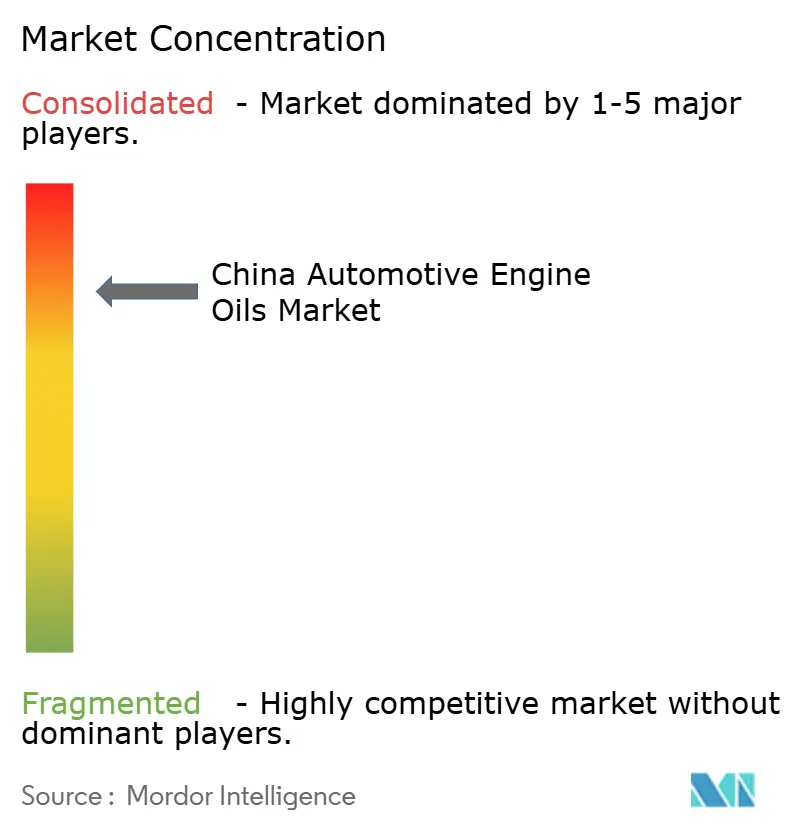
| Market Concentration | High |
Major Players *Disclaimer: Major Players sorted in no particular order Image © Mordor Intelligence. Reuse requires attribution under CC BY 4.0. | |
China Automotive Engine Oils Market Analysis by Mordor Intelligence
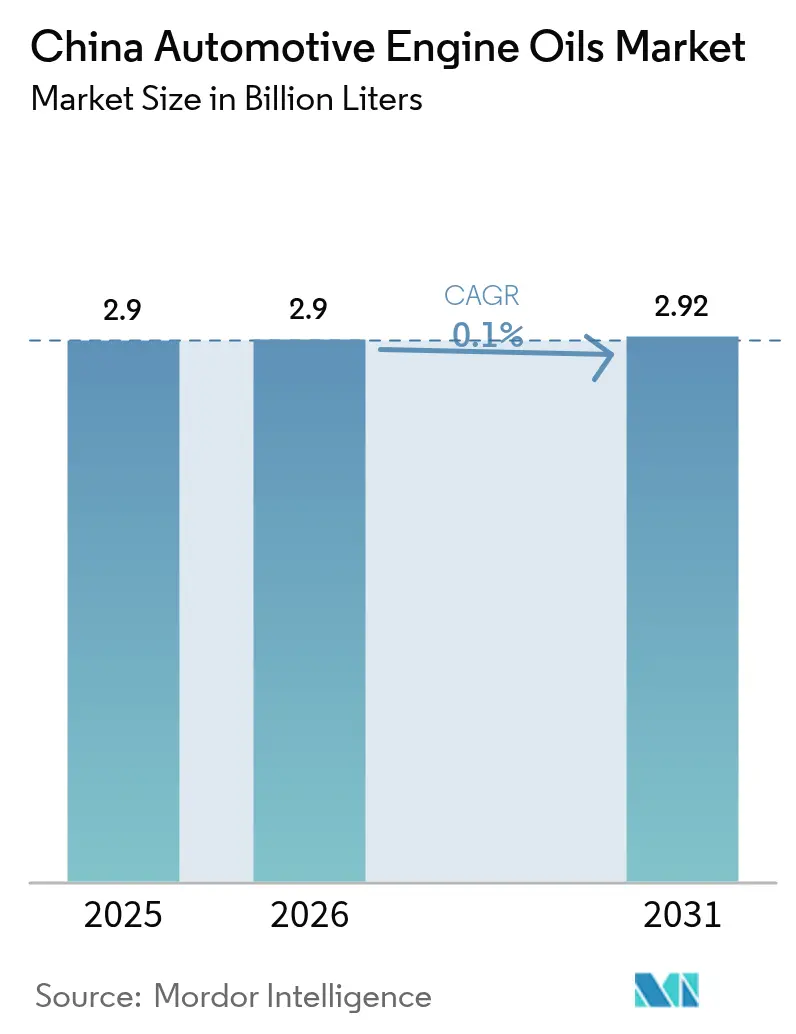
The China Automotive Engine Oils Market size in 2026 is estimated at 2.9 billion liters, growing from 2025 value of 2.90 billion liters with 2031 projections showing 2.92 billion liters, growing at 0.10% CAGR over 2026-2031. This flat trajectory reflects the structural headwinds posed by rapid electrification, modest mileage growth, and longer drain intervals that collectively mute volumetric expansion. At the same time, regulatory upgrades such as China VI-b and the March 2025 roll-out of API SQ/ILSAC GF-7 continue to nudge the product slate toward low-viscosity, low-SAPS synthetics, lifting the average blend value even as liters stagnate. Competitive conduct remains disciplined because five leading suppliers already control most premium channels, allowing them to pass through the higher formulation cost tied to advanced additive chemistries without eroding margins. Still, regional and private brands are intensifying price competition in price-sensitive tiers in inland provinces, a dynamic that keeps retail prices from outpacing disposable incomes.
Key Report Takeaways
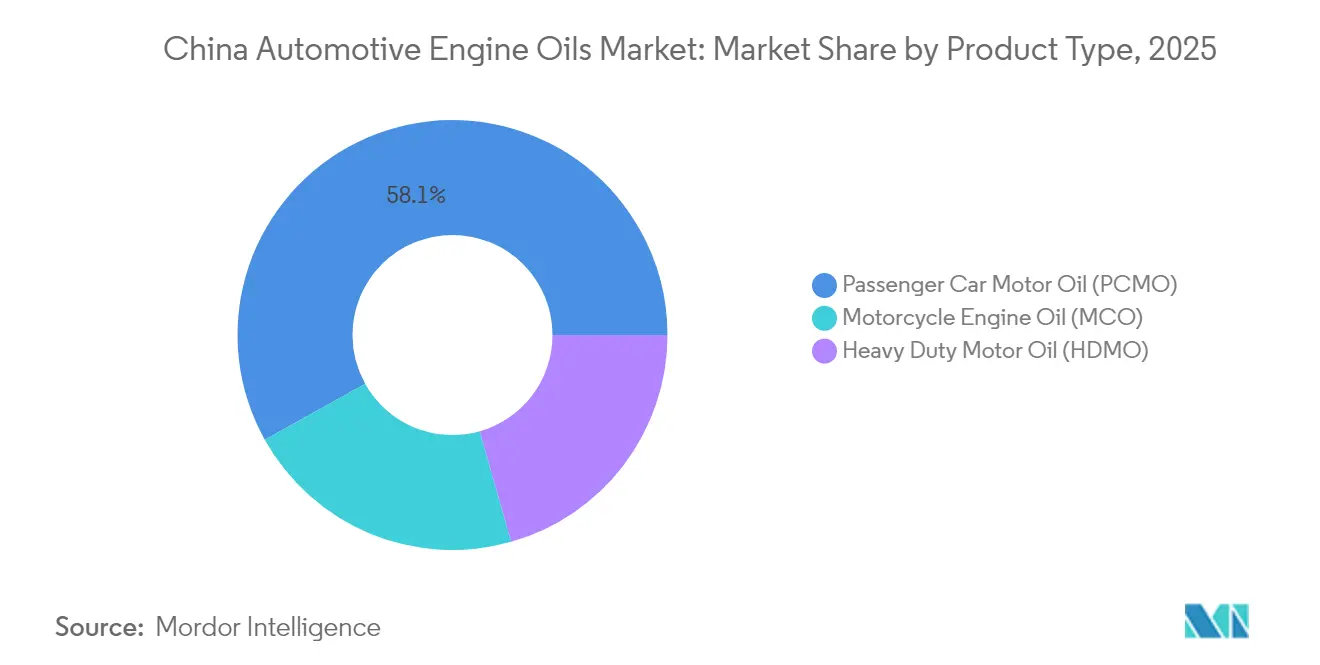
- By product type, passenger car motor oil led with a 58.10% revenue share in 2025, while motorcycle engine oil is projected to register the fastest growth of 0.15% CAGR through 2031.
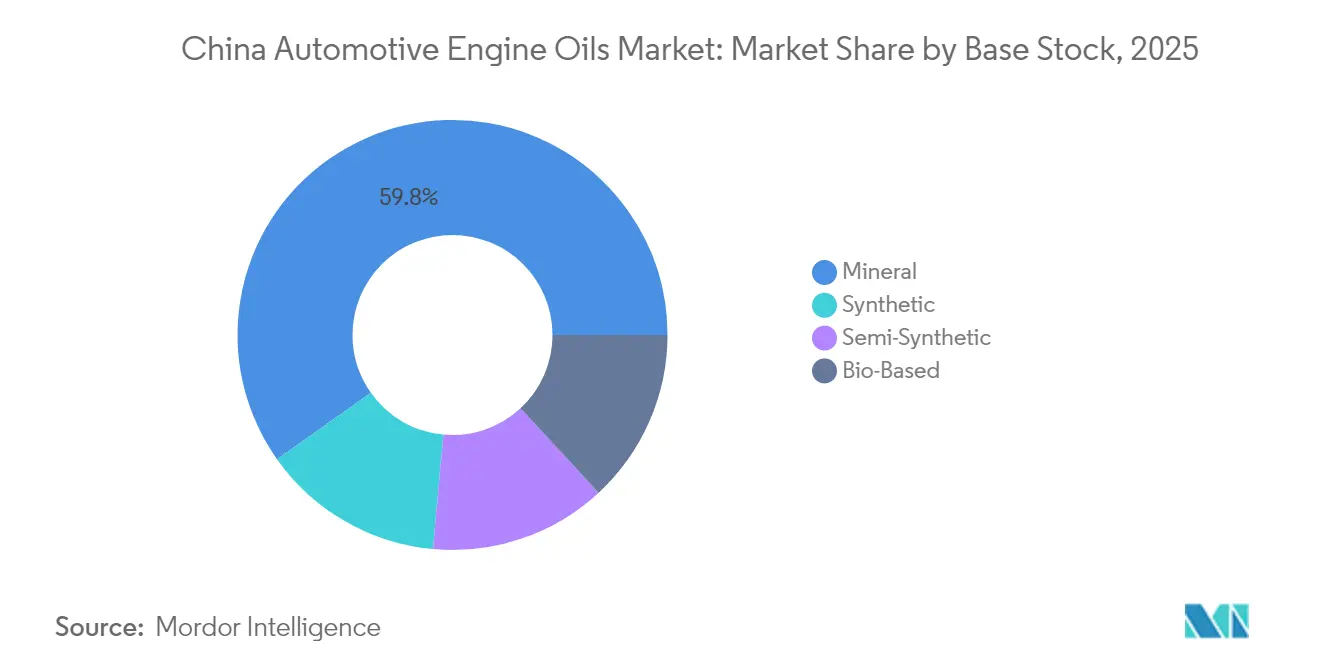
- By base stock, mineral formulations accounted for 59.80% of the China automotive engine oils market share in 2025, whereas synthetics are anticipated to grow at a 0.28% CAGR during 2026-2031.
Note: Market size and forecast figures in this report are generated using Mordor Intelligence’s proprietary estimation framework, updated with the latest available data and insights as of 2026.
Market Trends and Insights
Drivers Impact Analysis of China Automotive Engine Oils Market*
| Driver | (~) % Impact on CAGR Forecast | Geographic Relevance | Impact Timeline |
|---|---|---|---|
| Rising vehicle parc and ageing fleet | +0.05% | National, strongest in Tier 2-3 cities | Medium term (2-4 years) |
| China VI-b emission norms | +0.03% | National, early adoption in metropolitan areas | Short term (≤ 2 years) |
| Turbo-GDI adoption in passenger cars | +0.02% | Coastal regions and Tier 1 cities | Medium term (2-4 years) |
| Expansion of IAM workshops and e-commerce | +0.02% | National, accelerated in rural markets | Long term (≥ 4 years) |
| Hybrid range-extender trucks | +0.01% | Industrial corridors and logistics hubs | Long term (≥ 4 years) |
| Source: Mordor Intelligence | |||
Rising Vehicle Parc & Ageing Fleet
The passenger-car parc continued to expand in 2025, adding a modest but steady flow of replacement demand despite the headline EV surge. Older ICE models dominate Tier 2-3 cities, where households postpone EV upgrades, translating into higher per-vehicle oil consumption and more frequent top-ups. Inland provinces, therefore, offer a multi-year buffer that slows the nationwide volume decline. Scrappage incentives and tighter inspection programs in coastal hubs, however, foreshadow a gradual shift that will ultimately cap this driver’s contribution to the China automotive engine oils market.
Stringent China VI-b Emission Norms Driving High-Performance Lubricants
China VI-b standards oblige formulators to cut SAPS levels and deliver fuel-economy-oriented viscosities such as 0W-20 while still protecting after-treatment hardware. Over 1,800 products were relicensed under API SQ/ILSAC GF-7 in the first nine months after the March 2025 start date. Tier 1 cities moved first, triggering a ripple of demand for fully-synthetic and high Group III blends that continues to widen inland. Compliance costs have squeezed small blenders and are accelerating mergers or supply agreements with base-oil majors, a trend reinforcing the concentrated character of the China automotive engine oils market.
Turbo GDI Adoption in Passenger Cars Boosting Synthetic Demand
Turbocharged gasoline direct-injection engines create higher thermal loads and fuel-dilution stress, forcing OEMs to mandate full synthetics to control LSPI and prevent turbo coking. Domestic brands have mainstreamed 1.5-to-2.0-liter turbo engines across C-segment sedans and compact SUVs, lifting 0W-20/5W-30 sales in coastal showrooms where such models dominate. As the technology diffuses inland, synthetic penetration climbs, underpinning the value resilience of the China automotive engine oils market even when unit volumes stall.
Expansion of IAM Workshops & E-Commerce Retail
Independent aftermarket chains and pure-play online stores are eroding the dealer channel’s share, particularly in secondary towns where price sensitivity is acute. E-commerce enables small workshops to source directly, shrinking procurement layers and lowering retail prices by 8-10% versus offline averages. While the model widens product access, it also invites counterfeit listings, prompting regulators to expand QR-code traceability mandates. The channel shake-up intensifies brand-positioning battles yet keeps the China automotive engine oils market competitive on shelf despite its volume plateau.
Restraints Impact Analysis of China Automotive Engine Oils Market*
| Restraint | (~) % Impact on CAGR Forecast | Geographic Relevance | Impact Timeline |
|---|---|---|---|
| Surging EV penetration | −0.08% | National, fastest in Tier 1 and coastal cities | Short term (≤ 2 years) |
| Longer OEM drain intervals & monitoring | −0.03% | National, premium vehicle segments first | Medium term (2-4 years) |
| Crack-down on counterfeit oils | −0.02% | National, concentrated in rural and secondary markets | Short term (≤ 2 years) |
| Source: Mordor Intelligence | |||
Longer OEM Drain Intervals & Oil-Life Monitoring
Mainstream OEMs now quote service intervals at 7,500-8,000 km with fully synthetic 0W-20 and 5W-30 oils, and many premium marques pair that with in-vehicle algorithms that push drains out when operating conditions are mild. Although each sump fill is larger, annual per-car lubricant consumption falls roughly 20% compared with 2020 practices, pressuring the China automotive engine oils market size even as unit prices rise.
Crack-Down on Counterfeit Oils Causes Grey-Channel Destocking
Sweeps by provincial quality bureaus have shuttered dozens of small refilling plants and pushed distributors to purge unlicensed stock. Legitimate players win share, but the near-term destock phase removes low-price liters from the trade, trimming apparent demand. Rural outlets feel the effect most acutely, explaining the sharper short-term volume contraction in those provinces.
*Our forecasts treat driver/restraint impacts as directional, not additive. The impact forecasts reflect baseline growth, mix effects, and variable interactions.
China Automotive Engine Oils Market Segment Analysis
By Product Type:
PCMO Dominance Faces Gradual ErosionPassenger car motor oil contributed 58.10% of 2025 volume, confirming its historical role at the center of the China automotive engine oils market. A broad viscosity spread—from legacy 10W-40 for older compact cars to modern 0W-20 for turbo GDI models—keeps the category diverse. The Chinese ride-hailing fleet still relies on ICE sedans and therefore underpins baseline PCMO demand in urban cores. Nonetheless, battery-electric sedans and crossovers account for an ever-larger share of new registrations, chipping away at the internal-combustion aftermarket. Motorcycle engine oil, by contrast, posts a 0.15% CAGR through 2031 thanks to the resilience of two-wheelers in parcel-delivery and rural transport duty cycles.
The heavy-duty motor-oil segment faces twin forces: emission norms that necessitate CK-4 level performance and pilot electrification projects in urban distribution. Range-extender trucks temporarily cushion volumes because they still carry small diesel generators, but pure-electric drayage initiatives in the Pearl River Delta foreshadow future shrinkage. Overall, passenger-car oil will remain the single largest bucket, yet its share will ebb as electrification accelerates and two-wheeler delivery fleets find new momentum in inland regions.

By Base Stock:
Mineral Oils Retain Volume Leadership Despite Synthetic GrowthMineral oils held 59.80% share in 2025, reflecting legacy vehicle mix and price sensitivity in inland provinces. Still, synthetics are growing at 0.28% CAGR—nearly triple the overall China automotive engine oils market growth—driven by mandatory low-viscosity requirements tied to emission rules and OEM warranty conditions. Group III capacity additions by Sinopec and CNOOC have narrowed the cost delta between mineral and high-grade base oils, supporting a further shift toward synthetics. Semi-synthetics bridge the two extremes, giving value-conscious consumers a credible step-up path. Bio-based alternatives remain niche because finished oil prices would need to rise another 25% to offset feedstock cost and supply tightness.
Looking ahead, large blenders are pivoting toward higher Group III+ barrels to future-proof their portfolio, while regional independents cling to mineral offerings to maintain entry-level price points. The resulting stratification means mineral liters will fall steadily but not collapse, ensuring supply continuity for the ageing parc even as the premium tier claims incremental revenue.
Geography Analysis
China’s coastal conurbations, such as Shanghai, Shenzhen, and Guangzhou, account for a disproportionate share of synthetic sales, driven by stricter emission enforcement and higher premium-car density. Penetration of 0W-20 PCMO already exceeds 60% of engine oil changes in these cities. Tier 1 EV adoption further compresses volume, yet the wallet share per liter sold rises because service outlets upsell OEM-approved synthetics.
Inland Tier 2-3 cities like Chengdu, Wuhan and Zhengzhou display a different profile. The balance of price sensitivity and slower EV pick-up keeps mineral 10W-30 and 15W-40 grades relevant. Independent workshops dominate service occasions, and e-commerce platforms close the supply gap by offering two-day delivery of branded products at factory-store prices. This combination ensures that the China automotive engine oils market continues to record a measurable flow of mineral liters even when national statistics appear stagnant.
Northern provinces face large seasonal swings. Sub-zero winters in Heilongjiang force multi-grade selections, while Xinjiang’s desert freight corridors favor robust 15W-40 diesel oils for off-road and mining rigs. Southern regions, blessed with milder temperatures, are rapidly standardizing 5W-30 as a year-round grade. Collectively, these regional nuances keep the blend slate fragmented and provide natural hedges that soften nationwide downturns in any one application.
Regulatory Landscape
China automotive engine oils are shaped by emissions requirements and product standards overseen by the State Administration for Market Regulation (SAMR) and the National Standardization Administration. In June 2025, China issued updated national standards GB 11121-2025 (gasoline engine oils) and GB 11122-2025 (diesel engine oils) to replace the 2006 versions, and both standards entered into force on July 1, 2026. The update tightens performance and test requirements around durability and deposit control, reinforcing the shift to low-viscosity, low-SAPS formulations aligned with China VI-b vehicle needs.
Broader industrial policy also affects compliance and investment priorities across the lubricant ecosystem. The Petrochemical and Chemical Industry Steady Growth Work Plan (2025-2026), jointly released by ministries including MIIT and MEE, emphasizes high-quality development and digital empowerment, intersecting with lubricant traceability efforts and the move toward higher-end, more standardized product slates. Blenders and marketers therefore face higher documentation, testing, and product-qualification expectations, while policy signals support domestic capability build-out for advanced lubricants and base oils.
Value Chain Analysis
The value chain starts with upstream crude-to-base-oil refining and additive supply, then moves into midstream blending, packaging, and quality and licensing activities, and finally into downstream channels, including OEM factory fill, dealer service networks, independent aftermarket workshops, and e-commerce retail. Sinopec and PetroChina benefit from vertically integrated refining and logistics to secure base oil availability and manage costs, while international majors such as Shell, ExxonMobil, BP (Castrol), and TotalEnergies compete using premium synthetic formulations, OEM approvals, and brand-led distribution. Input economics remain heavily weighted toward raw materials, with base oils and additive packages accounting for most production cost, so access to high-quality Group III and modern additive chemistries is a key determinant of competitiveness.
Downstream, channel mix continues to split between OEM-linked service and independent workshops, while online procurement helps workshops in inland provinces buy branded oils more directly and reduces reliance on traditional distributor layers. At the same time, tighter quality enforcement and traceability requirements raise the value of authenticated supply, training, and warranty-aligned products, which favors suppliers with licensed formulations, stable output, and digital tools for workshop partners. These conditions support high concentration at the premium end, while entry tiers face sharper price competition and compliance-driven consolidation among smaller blenders.
Competitive Landscape
The China automotive engine oils market is consolidated. International majors Shell, ExxonMobil, and Castrol anchor the premium channel, each running multiyear OEM fill programs and offering warranty-linked aftersales ranges. Shell renewed its global contract with BMW in January 2024, extending exclusivity across 150 countries, including China[1]. Domestic oil champions CNPC and Sinopec leverage integrated refining chains to secure roughly half of mainstream PCMO and heavy-duty market turnover. Their national station networks provide unrivaled last-mile reach into rural markets.
Regional independents such as Longpan Technology compete through private-label partnerships with fast-fit chains and by offering bespoke formulations for two-wheelers and agricultural machines. Several have become acquisition targets as larger players look for localized brands to complement flagship labels. The arrival of API SQ/ILSAC GF-7 prompted a surge in licensing; the top five suppliers already list more than 900 formulations, underlining their technical depth and setting a hurdle for smaller entrants.
Capital expenditure focuses on high-grade base stocks. CNOOC is investing CNY 5 billion to revamp its Taizhou unit, raising high-end lubricant capacity from 600,000 t/y to 1.4 million t/y by 2027[2]. The new lines will integrate Fischer-Tropsch base oils, enabling domestic substitution of imports. Partnerships between additive houses and local blenders are also tightening so as to share R&D costs for e-drive fluids and hybrid-compatible diesel oils.
China Automotive Engine Oils Industry Leaders
-
BP p.l.c.
-
China National Petroleum Corporation
-
China Petrochemical Corporation
-
Shell plc
-
TotalEnergies
- *Disclaimer: Major Players sorted in no particular order
China Automotive Engine Oils Market Companies Covered in this Report
- BP p.l.c.
- Chevron Corporation
- China National Petroleum Corporation
- China Petrochemical Corporation
- ExxonMobil Corporation
- FUCHS
- HF Sinclair Corporation
- Idemitsu Kosan Co., Ltd.
- Jiangsu Lopal Tech Co., Ltd.
- JX Nippon Oil & Energy Corp. (ENEOS)
- Lubrizol Corp. (Additive Vendor)
- Qingdao COPTON Technology Co., Ltd.
- Saudi Arabian Oil Co.
- Shell plc
- SK ZIC
- Tongyi Petrochemical Co., Ltd.
- TotalEnergies
Market Opportunities and Future Outlook
The July 1, 2026 implementation of GB 11121-2025 and GB 11122-2025 creates an upgrade cycle for both gasoline and diesel engine oil portfolios. It opens room for suppliers to refresh product lines, expand licensed SKUs, and support workshops through specification changes. Diesel-focused product development is also shaped by the newer D1-oriented direction embedded in the updated framework, where extended-drain performance and deposit control become more central to fleet operating economics, particularly in heavy-duty applications. Compliance costs likewise raise barriers for smaller blenders that lack in-house testing or additive-development depth, which supports partnership models with additive companies and larger base-oil suppliers.
Electrification reduces legacy crankcase-oil demand but increases adjacent fluid needs in hybrids and range-extender architectures, where moisture management, thermal stability, and compatibility with modern after-treatment systems are still central. Evidence of this pivot includes multiple OEM-linked co-development initiatives for hybrid-oriented lubricants and localized R&D programs in China, reflecting demand for products tailored to local duty cycles and China VI-b-era requirements. Supply risk management is also becoming more visible in purchasing and formulation priorities when base-oil tightness appears, highlighted by the American Petroleum Institute extending its emergency temporary licensing program for Group III shortages into 2026. This supports ongoing interest in multi-source procurement and domestic high-grade base-oil capacity to keep premium engine-oil slates consistent under evolving standards.
Recent Industry Developments in China Automotive Engine Oils Market
- July 2026: Lubrizol partnered with Tongyi Petrochemical to launch AI-developed low-ash synthetic diesel engine oils, including Titan King AI Low-Ash Synthetic Diesel Engine Oil and Titan King Three-in-One Ultra-Low-Ash Synthetic Engine Oil. The launch indicates faster formulation cycles and a stronger push toward low-SAPS heavy-duty products aligned with tighter emissions and durability requirements, lifting the performance baseline in premium HDMO lines.
- June 2026: TotalEnergies and Great Wall Motor inaugurated the third phase of their joint laboratory program in Baoding, expanding collaborative development around advanced lubricants and localized supply cooperation. The move deepens OEM-linked product validation in China and supports localized development for newer powertrain architectures, strengthening the connection between automaker requirements and lubricant portfolios.
- January 2024: Shell renewed its partnership with the BMW Group for Asia and the Rest of World, extending exclusivity for BMW aftersales engine oils through 2027 across more than 150 countries, including China. The renewal reinforces Shell's position in premium OEM-backed channels and sustains demand for OEM-approved synthetic grades within authorized service networks.
China Automotive Engine Oils Market Report Scope and Research Methodology
Market Definition and Coverage
This market covers engine oils consumed by on-road vehicles in China, counted at the point of sale into OEM fill and the in-service replacement demand, and expressed as market value for a defined calendar year.
Scope exclusions: Industrial engine oils used in stationary equipment and marine engines are excluded, and greases and non-engine automotive fluids are also not counted.
Segments Covered in This Report
- By Product Type
- Passenger Car Motor Oil (PCMO)
- 0W-XX
- 5W-XX
- 10W-XX
- 15W-XX
- Monogrades
- Other Grades
- Heavy Duty Motor Oil (HDMO)
- 0W-XX
- 5W-XX
- 10W-XX
- 15W-XX
- Monogrades
- Other Grades
- Motorcycle Engine Oil (MCO)
- 0W-XX
- 5W-XX
- 10W-XX
- 15W-XX
- Monogrades
- Other Grades
- Passenger Car Motor Oil (PCMO)
- By Base Stock
- Mineral
- Synthetic
- Semi-Synthetic
- Bio-Based
Data Sources, Market Sizing, and Validation
Desk Research
Desk work starts by fixing the demand pool for China, and then building around available public datapoints. We refer to sources such as China Association of Automobile Manufacturers releases, National Bureau of Statistics series, China Customs trade statistics for base oils and additives, and technical publications from API and SAE that reflect specification shifts.
To translate those signals into a usable model, we also review company annual reports, investor decks, and reputable press coverage on lubricant capacity, pricing moves, and channel strategy. Where needed, paid subscriptions for company financials and news, patents, and shipment-level import-export data are used to cross-check volumes and timing, especially when public series have delays. These examples are not exhaustive, and many other sources are reviewed to fill gaps, validate numbers, and clarify assumptions.
Primary Interviews and Surveys
Primary calls and surveys are used to pressure-test what the desk signals imply for real consumption, and to tighten assumptions that vary by province and service channel. We speak with lubricant blenders, base oil distributors, workshop and quick-lube operators, OEM-linked service networks, and fleet maintenance teams, and then reconcile differences across coastal hubs and inland markets where product mix and pricing can diverge.
Distribution of primary research fieldwork respondents
| Company type | Respondent position |
|---|---|
| Top tier: 30% | CXOs: 20% |
| Mid tier: 49% | Functional/Unit leaders: 22% |
| Smaller Players: 21% | Managers: 58% |
Market-Sizing & Forecasting
Sizing is built using a top-down and bottom-up mix, where the main build starts from the on-road vehicle parc and annual oil drain patterns, and then the totals are checked against supply and channel realities. In practice, we reconstruct demand by vehicle parc and average oil change intervals, and then apply sump fill sizes and typical top-up rates to arrive at liters, which are converted to value using channel-level average selling prices.
Inputs that matter in China include the mix shift toward low-viscosity grades, the penetration of synthetic and semi-synthetic oils, the share of servicing done through OEM-linked outlets versus independent workshops, and changes in freight and feedstock costs that impact pricing. When information is missing for smaller provinces or informal outlets, the gap is handled using proxy relationships, such as parc density, commercial activity, and observed price bands from interviews.
For the forecast, scenario analysis is used so near-term uncertainty is handled cleanly, and the drivers are adjusted with expert consensus. Variables typically stress-tested include internal combustion vehicle parc growth, new energy vehicle penetration reducing drain events, average drain interval elongation, and expected price progression by base stock category.
Data Validation & Update Cycle
Validation is done through step-by-step checks that compare model outputs with independent signals, and then we revisit assumptions when the spread is not explainable. Cross-checks include implied liters per vehicle, plausible price bands by channel, and whether the resulting demand trend matches reported service activity and trade flows.
Before sign-off, the work goes through multi-step analyst reviews, and anomalies trigger follow-up outreach to sources or a rebuild of the specific input causing the variance. Reports refresh annually, with interim updates when there are material events like major specification changes, sharp feedstock price moves, or policy shifts affecting vehicle activity. Right before delivery, a fresh pass is completed so clients receive the latest updated view.
Mordor Intelligence's China Automotive Engine Oils Market Size Compared Against Other Published Estimates
Published market values for China automotive engine oils often differ because the scope and the unit of measure are not treated the same way, and pricing assumptions vary by channel. Another common reason is timing, since some figures use older feedstock-linked price points or do not refresh drain interval assumptions when vehicle technology changes.
The largest gaps usually come from whether the estimate mixes in broader automotive lubricants, counts industrial engine oils, or inflates value using retail list prices instead of realized workshop pricing. Some publications also apply aggressive growth cases tied to vehicle sales, even though the replacement market depends more on the in-use parc, drain interval extension, and the pace of new energy vehicle adoption.
Benchmark comparison
| Source | Market Size | Gaps in Research Methodology |
|---|---|---|
| Mordor Intelligence | USD 14.50 B (2025) | |
| Trade Journal A | USD 12.10 B (2024) | Often reported as value at broad automotive lubricant level and then apportioned to engine oils using fixed shares, which can miss the faster shift toward synthetics and longer drain intervals in newer vehicle parc. |
| Industry Association B | USD 16.80 B (2025) | Commonly uses retail shelf pricing and assumes uniform service behavior across channels, which can overstate realized pricing and understate the impact of OEM service programs and fleet negotiated rates. |
The spread in the table is mainly explained by what is included, how prices are translated into an average selling price, and how quickly the drain event assumptions are updated, and those choices are applied with a strict engine-oil-only scope and workshop-anchored price logic in the market size build by Mordor Intelligence.
Key Questions Answered in the Report
What is the current demand level for engine oils in China?
Demand stands at 2.9 billion liters in 2026, with only a marginal increase projected to 2.92 billion liters by 2031, reflecting a 0.10% CAGR.
How does electric-vehicle growth affect lubricant volumes?
EVs remove crankcase-oil demand entirely and, in coastal Tier 1 cities, already cut the conventional market by several percentage points per year.
Which base-stock category is gaining share fastest?
Fully synthetic formulations grow at 0.28% CAGR, the quickest rate among all base stocks thanks to emission-standards compliance.
Where do premium synthetics sell most strongly in China?
Coastal metros such as Shanghai and Shenzhen, where high luxury-car density and stricter emission rules drive 0W-20 and 5W-30 adoption.
What role do e-commerce platforms play in lubricant distribution?
Online channels lower acquisition costs for workshops and consumers, widen product choice, and intensify price competition nationwide.