
Market Overview
| Study Period | 2020 - 2031 |
|---|---|
| Forecast Data Period | 2026 - 2031 |
| Base Year Market Size (2025) | 3.48 Billion Liters |
| Market Volume (2026) | 3.49 Billion Liters |
| Market Volume (2031) | 3.52 Billion Liters |
| Growth Rate (2026 - 2031) | 0.17 % |
| Market Concentration | Medium |
Major Players *Disclaimer: Major Players sorted in no particular order Image © Mordor Intelligence. Reuse requires attribution under CC BY 4.0. | |
China Automotive Lubricants Market Analysis by Mordor Intelligence
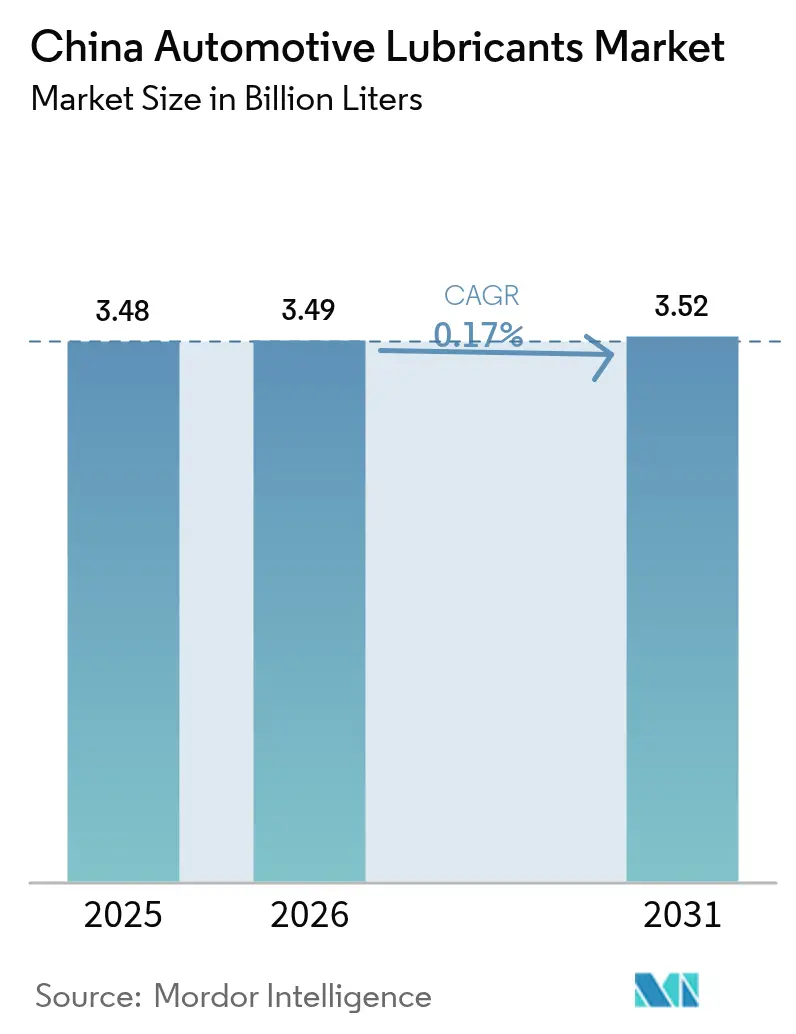
The China Automotive Lubricants Market size is expected to grow from 3.48 Billion Liters in 2025 to 3.49 Billion Liters in 2026 and is forecast to reach 3.52 Billion Liters by 2031 at 0.17% CAGR over 2026-2031. Behind that fractional growth lie far-reaching shifts driven by electric vehicle penetration above 50%, the nationwide roll-out of China VI-B emission standards, and an accelerating pivot toward premium synthetic formulations. Engine oils still underpin demand, but wider adoption of continuously variable and dual-clutch transmissions is lifting specialist automatic transmission fluid volumes. Commercial vehicle electrification, the uptake of natural gas trucks, and the tightening of logistics footprints are reshaping lubricant viscosity preferences, while e-commerce channels are extending premium brands into Tier-3 cities. Suppliers are responding with localized factory-fill partnerships, RMB-scale capacity additions, and anti-counterfeit initiatives that together reposition value capture from simple volume to chemistry, service, and data-enabled solutions.
Key Report Takeaways
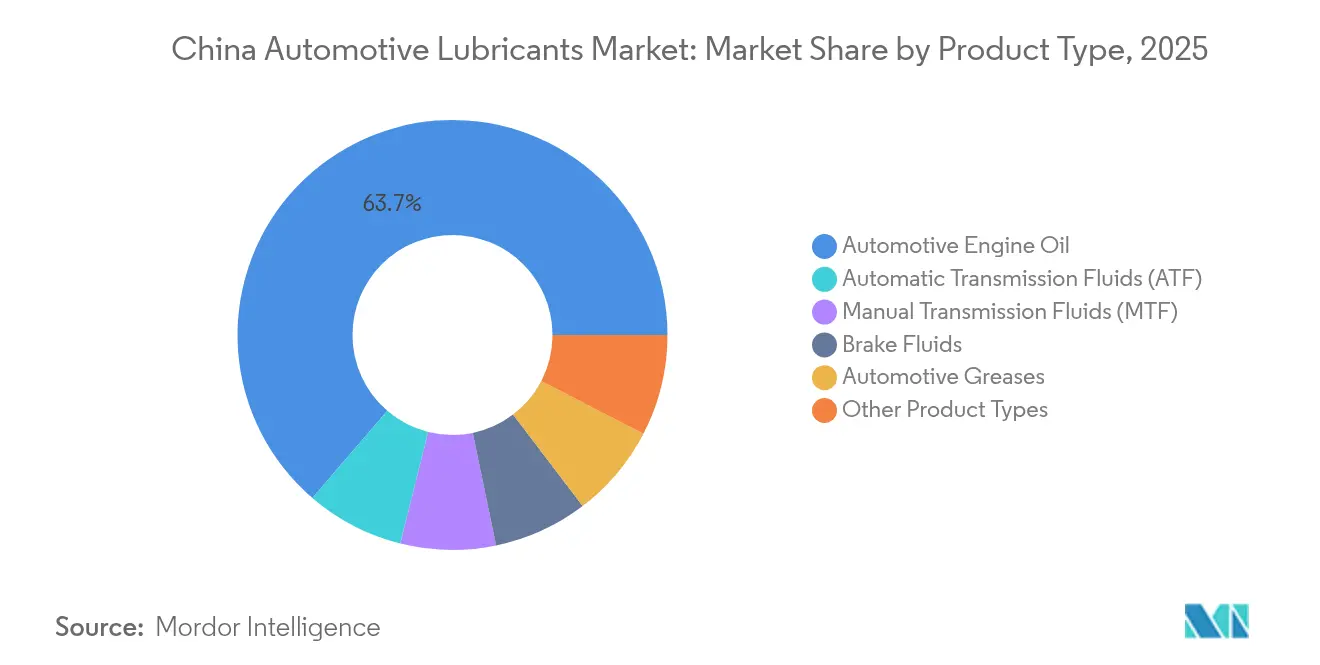
- By product type, automotive engine oil held 63.70% of the China automotive lubricants market share in 2025, while automatic transmission fluids are projected to clock the fastest 0.23% CAGR through 2031.
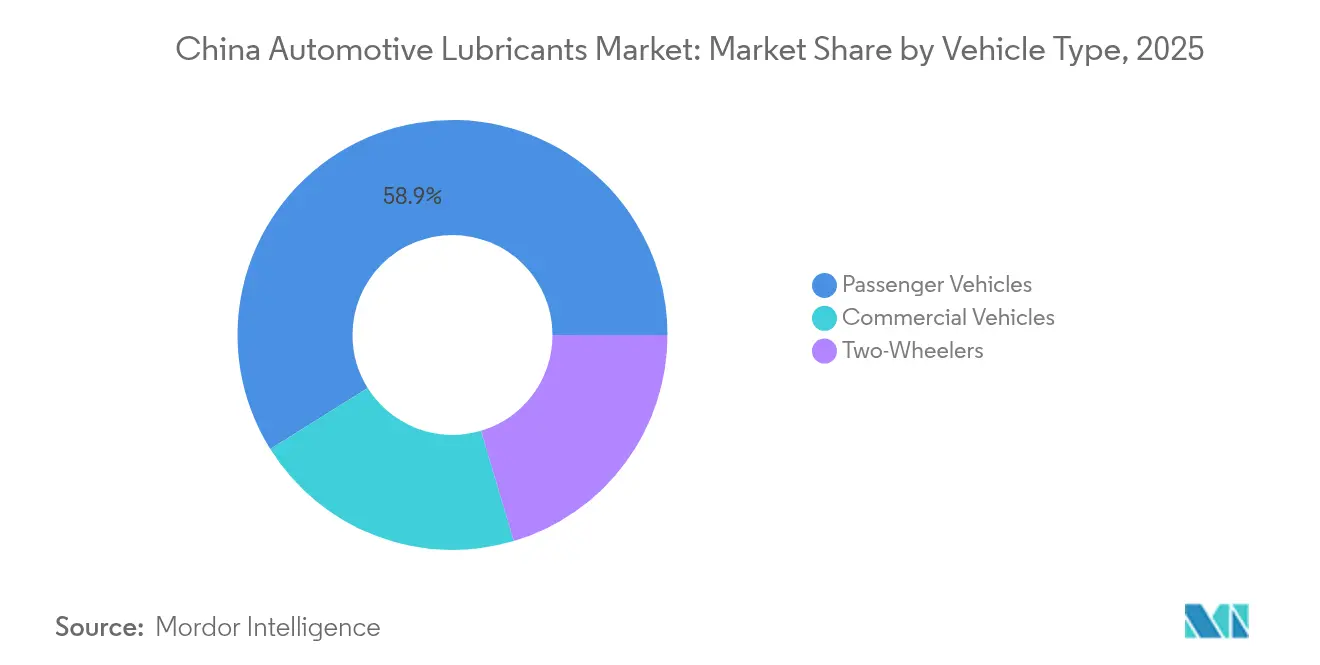
- By vehicle type, passenger vehicles accounted for 58.90% of 2025 demand, whereas commercial vehicles are expected to expand at a 0.35% CAGR through 2031.
Note: Market size and forecast figures in this report are generated using Mordor Intelligence’s proprietary estimation framework, updated with the latest available data and insights as of 2026.
China Automotive Lubricants Market Trends and Insights
Drivers Impact Analysis*
| Driver | (~) % Impact on CAGR Forecast | Geographic Relevance | Impact Timeline |
|---|---|---|---|
| Preference shift to OEM-approved synthetics | +0.8% | National, concentrated in Tier-1 cities | Medium term (2-4 years) |
| Electrified-powertrain lubricant reformulations | +0.4% | National, early adoption in Beijing, Shanghai, Shenzhen | Long term (≥ 4 years) |
| E-commerce aftermarket reach to Tier-3 cities | +0.3% | Tier-3 cities, rural markets | Short term (≤ 2 years) |
| Stricter China VI-B emission limits | +0.6% | National implementation | Medium term (2-4 years) |
| Localized OEM factory-fill partnerships | +0.5% | Manufacturing hubs: Guangdong, Jiangsu, Shanghai | Medium term (2-4 years) |
| Source: Mordor Intelligence | |||
Preference Shift to OEM-Approved Synthetics
Automakers now specify low-ash API SP or ILSAC GF-7 oils that protect gasoline particulate filters and mitigate low-speed pre-ignition. The new ILSAC standard, effective March 2025, requires suppliers to reformulate with higher-purity synthetic basestocks and advanced antioxidant packages[1]. Consumers in Tier-1 cities value extended drain intervals and fuel-economy benefits, driving rapid penetration of 0W-20 and 5W-30 grades. Higher certification costs raise barriers to entry, favoring incumbents with robust research and development (R&D) capacities. As warranty compliance becomes a key purchase trigger, premium synthetics command pricing power that offsets the volume softness caused by electrification.
Electrified-powertrain lubricant reformulations
Hybrid and electric platforms impose intermittent combustion cycles, elevated thermal loads, and coolant contamination risks that legacy oils cannot manage. Suppliers are developing ester-rich synthetics with modified additive chemistries to stabilize viscosity during repeat start-stop events and maintain dielectric strength near high-voltage components. A 2025 white paper from Lubrizol identifies viscosity shear control, copper corrosion resistance, and multi-fuel compatibility as key research priorities[2]. These demands reward companies that can invest in tribology modeling and battery-coolant interaction studies, tilting the competitive advantage toward technology-led multinationals and well-capitalized domestic innovators.
E-commerce aftermarket reach to Tier-3 cities
Digital marketplaces now integrate short-video demonstrations, live-stream commerce, and click-to-install services, letting premium brands bypass fragmented wholesaler networks. Partnerships, such as Shell-JD and ExxonMobil-JD, pair algorithmic targeting with storefront visibility, pushing synthetic offerings into price-sensitive regions without incurring heavy bricks-and-mortar outlays. Tier-3 consumers gain access to authentic lubricants backed by online authenticity codes, shrinking the counterfeit trade and lifting average transaction values. Early data from the 2024-2026 China Lubricants White Paper shows double-digit online volume gains in smaller prefectures, evidence that channel innovation is a measurable demand lever.
Stricter China VI-B emission limits
The nationwide roll-out of China VI-B during 2025-2026 obliges low-SAPS chemistries to safeguard after-treatment devices. Meeting the tighter sulfur and phosphorus caps necessitates Group III or GTL basestocks plus boosted detergent and dispersant systems. Compliance testing stretches development cycles to more than 12 months and locks in OEM approval fees, discouraging opportunistic new entrants. Established majors leverage refined additive know-how and engine bench access, consolidating share as smaller blenders retreat. The regulation, therefore, elevates average price points and accelerates the shift toward the higher-margin synthetic tier.
Restraints Impact Analysis*
| Restraint | (~) % Impact on CAGR Forecast | Geographic Relevance | Impact Timeline |
|---|---|---|---|
| Rising EV parc cannibalizing ICE oil demand | -2.1% | National, concentrated in Tier-1 cities | Long term (≥ 4 years) |
| Counterfeit lubricant proliferation | -0.4% | Tier-2 and Tier-3 cities, rural markets | Short term (≤ 2 years) |
| Extended oil-change intervals via IoT sensors | -0.8% | Commercial fleets, premium passenger vehicles | Medium term (2-4 years) |
| Source: Mordor Intelligence | |||
Rising EV parc cannibalizing ICE oil demand
With fully electric cars expected to reach a 50% sales share in 2024, engine oil volumes in metropolitan centers are declining. E-scooters already hold a 25% share of two-wheel mobility, and forecasts indicate a near doubling by 2029, potentially sidelining small-engine lubricants. Logistics operators are piloting battery-electric vans that eliminate the need for crankcase oil, although they introduce a minor demand for gear-reducer fluids and dielectric coolants. Regional charging-infrastructure density correlates strongly with engine oil declines, forcing suppliers to hedge with EV-specific SKUs and service bundles that preserve wallet share even as liters fall.
Counterfeit lubricant proliferation
Seizures of more than 160 barrels of fake premium oil in single raids underline the scale of illicit blending operations. Counterfeiters mirror labels, QR codes, and even tamper-evident closures, eroding consumer trust and compressing legitimate price bands. The risk peaks in rural areas, where technical literacy is lower and seller verification is less effective. In response, major trials of blockchain-based traceability and mobile verification apps increase overheads that weigh on smaller legitimate brands. While enforcement campaigns create temporary supply disruptions, the long-term resolution hinges on systemic improvements in supply-chain transparency.
*Our forecasts treat driver/restraint impacts as directional, not additive. The impact forecasts reflect baseline growth, mix effects, and variable interactions.
Segment Analysis
By Product Type: Engine-oil leadership counter-balanced by transmission-fluid momentum
Automotive engine oil retained 63.70% of 2025 demand, underscoring its centrality to the China automotive lubricants market. The segment’s resilience stems from China VI-B regulations that favor low-viscosity synthetics, lifting premium mix and price realization even as volume inches down. Semi-synthetic conversion is largely complete in Tier 1 workshops, but Tier 3 penetration remains an upside lever. On the other hand, automatic transmission fluids (ATF) claim only mid-single-digit volumes yet lead growth at a 0.23% CAGR through 2031, thanks to the uptake of CVT and dual-clutch technology in hybrids. Brake fluids and greases occupy niche but technology-intensive roles, with EV motor-bearing greases and DOT 4-plus brake fluids showing incremental upside. Power-steering fluids trend lower as electric systems proliferate, partially offset by the nascent demand for dielectric coolants in high-voltage battery packs, which fall outside traditional lubricant categories. Suppliers that package engine oils with ATF and emerging EV fluids stand to deepen wallet share while buffering against volume erosion in legacy lines.
The competitive hierarchy by product favors players with both API / ACEA certifications and local OEM endorsements. Synthetic formulations employing Group III+ or GTL basestocks enjoy an expanding proportion of the China automotive lubricants market share due to better oxidative stability and fuel-economy edge. Technical service, used-oil analysis, and drain-interval advisory increasingly differentiate offers in workshops and fleet depots, steering the market away from commodity barrels toward integrated aftersales ecosystems. This pivot stresses the importance of investment in additive science, bench testing, and field validation—capabilities concentrated among multinationals and the largest domestic refiners.

By Vehicle Type: Commercial-fleet outperformance amid passenger-car plateau
Passenger cars accounted for 58.90% of the 2025 lubricant volume, cementing their market share lead within the China automotive lubricants market. Yet the segment sits at a turning point: rising hybrid and battery-electric adoption clips growth, while stricter emissions shorten OEM-specified oil-change intervals via higher-grade synthetics, paring liters per service. Consequently, the China automotive lubricants market size attributed to passenger vehicles is expected to hover just above 2.05 billion liters through 2031. Commercial vehicles, meanwhile, post a modest but market-leading 0.35% CAGR. Long-haul trucking upgrades to LNG and CNG powertrains, each demanding specialized low-ash diesel oils with reinforced nitration control. Last-mile e-commerce fleets increase runtime hours, raising lubricant stress and frequency, even where mild electrification is implemented. Two-wheelers slide steadily as city bans on ICE mopeds and incentives for e-scooters bite into gasoline-engine usage.
Distinct duty cycles create divergent technical needs. Fleets value high-TBN, extended-drain diesel formulations paired with IoT monitoring, whereas passenger-car owners prioritize fuel economy and warranty compliance. These contrasts shape channel strategy: fleet supply gravitates toward direct contracts and on-site service trucks, while consumer sales lean on e-commerce and branded fast-fit chains. Suppliers straddling both arenas must tailor viscosity ladders, package sizes, and digital-service wraps, leveraging shared R&D yet customizing delivery models.
Geography Analysis
The eastern coastal provinces dominate the Chinese automotive lubricants market due to a confluence of vehicle assembly plants, petrochemical feedstock, and extensive after-sales networks. Guangdong, Jiangsu, and Shanghai collectively process more than 40% of lubricant blending output and host flagship OEM factory-fill contracts. Proximity to refineries enables cost-efficient supply of Group III basestocks, helping local blenders pivot swiftly to China VI-B compliant synthetics. In absolute terms, the coastal cluster contributed an estimated 1.45 billion liters in 2025, accounting for approximately 41.67% of the national total. Workshop density and higher consumer purchasing power in Tier-1 cities accelerate synthetic penetration, buttressing the premium mix even as EV adoption cannibalizes engine oil liters.
Moving inland, central provinces such as Hubei, Henan, and Sichuan represent expanding consumption corridors tied to rising car ownership and logistics investments. Tier-2 urban centers are linked to Belt and Road rail freight routes, which stimulate commercial-fleet lubricant demand. E-commerce-enabled reach propels premium brand availability beyond provincial capitals, narrowing historical quality gaps. Market-share analysis indicates that the adoption rates of ATF and low-viscosity engine oil in these locales now sit only two to three years behind coastal benchmarks, a lag that continues to shrink.
The western region, though smaller in absolute volume, registers the fastest relative growth. Government infrastructure outlays and energy-commodity projects lift heavy-duty equipment lubricant needs, while state incentives encourage domestic automakers to site plants in Chongqing and Guizhou. EV infrastructure trails the east, extending the life of ICE-centric demand. Supply-chain challenges linger, including counterfeit risks and limited cold-chain lubricant storage in high-altitude areas. Still, the rise of digital procurement portals is easing access to OEM-approved fluids, improving lubricant quality and expanding service-interval compliance.
Regulatory Landscape
China’s automotive lubricants market operates under tightening national product-quality and emissions-related requirements, with the State Administration for Market Regulation (SAMR) and the Standardization Administration of China (SAC) anchoring the standards system and enforcement. A key regulatory reset came in June 2025 with the issuance of updated mandatory national standards GB 11121-2025 (gasoline engine oils) and GB 11122-2025 (diesel engine oils), which replace the 2006 versions and embed higher performance specifications aligned with modern engine and after-treatment needs.
Compliance pressure increased further as the mandatory implementation date for GB 11121-2025 and GB 11122-2025 arrived on July 1, 2026. Formulation, labeling, and quality-control conformity became non-optional for suppliers selling in China. In parallel, the 2024 implementation rules for product-quality supervision spot-checks for motor-vehicle engine lubricating oils explicitly tie market access to meeting mandatory GB requirements, with SAMR and municipal market-regulation bureaus executing supervision and sampling programs that raise the cost of non-compliance and favor producers with robust testing and documentation systems.
Value Chain Analysis
The value chain starts with base stocks (Group I/II/III and higher-performance synthetics) and additive packages, moving through blending, packaging, and quality assurance to OEM factory-fill and the aftermarket. Recent moves emphasize localization and resilience at the upstream and intermediate layers: ExxonMobil appointed EMB (Shanghai) Petrochemical Co. Ltd in April 2024 as an official base stocks distributor for South China to improve access to EHC Group II base stocks, while Shandong Yitai Bocheng Chemical Technology broke ground in November 2025 on a 250,000-tonne-per-year base oil refinery in Zibo, Shandong, aimed at closing domestic supply gaps for higher-quality base oils.
Downstream, OEM alignment and channel control increasingly determine value capture. Strategic cooperation such as the October 2025 SAIC-GM-Wuling and FUCHS agreement to customize integrated automotive oil product-chain solutions highlights how factory-fill, co-development, and service packages pull demand toward approved, higher-margin formulations. Industry coordination is also strengthening: the Lubricant Professional Committee under the All-China Federation of Industry and Commerce was established in January 2025, reinforcing standardization, self-discipline, and government-to-enterprise communication, while suppliers invest in traceability and tighter distributor management to reduce counterfeit exposure, particularly in Tier-2 and Tier-3 markets and e-commerce channels.
Competitive Landscape
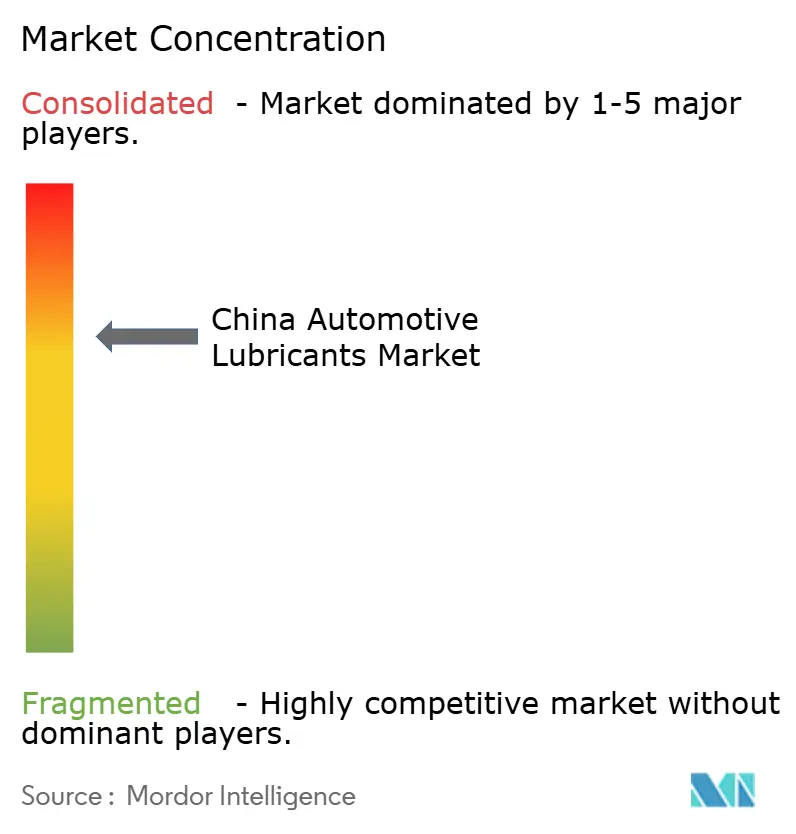
The China Automotive Lubricants Market is consolidated. Their refinery-to-retail reach, government fleet contracts, and robust dealer footprints establish formidable economies of scale. International majors—Shell, ExxonMobil, and TotalEnergies—control about one-quarter of demand by leveraging premium positioning, global OEM endorsements, and strong R&D pipelines. Smaller blenders lacking digital budgets face margin erosion or exit. Regulatory scrutiny on VOC emissions and waste-oil recycling further separates players: firms with closed-loop regeneration systems and compliance audit trails strengthen corporate procurement appeal.
China Automotive Lubricants Industry Leaders
-
BP p.l.c.
-
Exxon Mobil Corporation
-
Shell plc
-
China Petrochemical Corporation
-
PetroChina Company Limited
- *Disclaimer: Major Players sorted in no particular order
Market Opportunities and Future Outlook
A near-term opportunity is tied to compliance-driven upgrades and re-qualification cycles created by the July 1, 2026 implementation of GB 11121-2025 and GB 11122-2025. It pushes lubricant marketers and blenders to refresh gasoline and diesel engine-oil portfolios, expand lab validation, and strengthen audit-ready quality systems. The standards shift is consistent with the report’s observed pivot toward premium synthetics and OEM-approved formulations, creating whitespace for suppliers that can quickly deliver low-SAPS, low-viscosity products and secure workshop and fleet acceptance through documented performance claims and authenticity assurance in digital channels.
Investment activity in additives, greases, and manufacturing capability also offers headroom for higher-value automotive lubricant and adjacent fluid categories as powertrains diversify. For example, China Petroleum Lubricants Company (Kunlun Lubrication) broke ground in January 2026 on a 660 million yuan lubricant additive project in Huizhou (Anhui Province), Sinomine (Tianjin) Lubrication Technology signed a March 2026 Taizhou project with 1.68 billion yuan total investment for large-scale lubricating oil and grease capacity, and Quaker Houghton opened a new manufacturing facility in Zhangjiagang with an expanded Shanghai laboratory in June 2026. These moves concentrate capability in the Yangtze River Delta supply ecosystem and support faster formulation iteration for hybrid-focused engine oils, ATF for CVT/DCT applications, and higher-performance greases that are gaining importance alongside electrified and hybrid vehicle architectures.
Recent Industry Developments
- June 2026: Quaker Houghton announced the opening of a new manufacturing facility in Zhangjiagang, China, along with an expanded laboratory in Shanghai. The additional local production and testing capacity strengthens in-country formulation support and shortens lead times for higher-spec fluids and greases demanded by OEMs and industrial customers in China.
- December 2025: BYD and ExxonMobil introduced the co-branded BYD Mobil Hybrid Dedicated engine oil line tailored for BYD’s DM-i plug-in hybrid platform. Co-development and branding with a leading NEV OEM elevates the role of hybrid-specific engine oils and supports tighter factory-fill and aftersales linkage versus commodity aftermarket products.
- October 2024: Beijing Bluestar announced its automotive lubricant series passed American Petroleum Institute (API) and European Automobile Manufacturers Association (ACEA) certifications. The dual certifications strengthen credibility in the premium segment and raise competitive pressure on smaller blenders that lack the testing infrastructure and documentation needed for international approvals.
Research Methodology Framework and Report Scope
Market Definition and Coverage
This market covers lubricants used in on-road vehicles in China, counted when they are sold for factory-fill or replacement use across passenger vehicles, commercial vehicles, and two-wheelers, and across common automotive lubricant products.
Scope exclusions: Industrial lubricants and marine, rail, aviation, and off-road construction or mining lubricant demand are excluded from this sizing.
Segmentation Overview
- By Product Type
- Automotive Engine Oil
- 0W-XX
- 5W-XX
- 10W-XX
- 15W-XX
- Monogrades
- Other Grades
- Manual Transmission Fluids (MTF)
- Automatic Transmission Fluids (ATF)
- Brake Fluids
- Automotive Greases
- Other Product Types (Power Steering Fluid etc.)
- Automotive Engine Oil
- By Vehicle Type
- Passenger Vehicles
- Commercial Vehicles
- Two-Wheelers
Data Sources, Market Sizing, and Validation
Desk Research
Desk research was used to set the basic demand pool and to keep the model tied to real-world vehicle activity in China. We reviewed public statistics and technical references such as vehicle production and sales releases from national statistics agencies, customs trade summaries for base oils and additives, and standard-setting references that influence lubricant grades and drain intervals.
To turn those inputs into usable modeling assumptions, we also relied on sources such as industry association publications, peer-reviewed technical papers on lubricant performance and service intervals, and publicly available company annual reports and investor decks that discuss automotive lubricants exposure and pricing direction. In addition, a paid subscription that aggregates company financials and another that supports import and export shipment-level checks were used selectively to validate ranges. The desk sources mentioned above are illustrative and not exhaustive, and many other public references were used for data collection, validation, and clarification during the work.
Primary Interviews and Surveys
Primary work focused on confirming how lubricant demand behaves across factory-fill and aftermarket, and how product mix is shifting across passenger vehicles, commercial vehicles, and two-wheelers. We spoke with a spread of participants such as blenders and distributors, service and workshop channel stakeholders, fleet and maintenance managers, and technical specialists who track drain intervals, viscosity-grade trends, and pricing movements across major provinces.
Distribution of primary research fieldwork respondents
| Company type | Respondent position |
|---|---|
| Top tier: 36% | CXOs: 12% |
| Mid tier: 49% | Functional/Unit leaders: 34% |
| Smaller Players: 15% | Managers: 54% |
Market-Sizing & Forecasting
Sizing starts with a top-down build where the in-use vehicle parc, annual mileage or utilization patterns, and typical oil-drain intervals are used to reconstruct replacement demand, which is then combined with factory-fill needs linked to vehicle production. That demand pool is split into key lubricant families used in vehicles, and then translated into market totals using realistic average pricing by product type and viscosity grade, before being checked against channel and workshop feedback.
Selective bottom-up approximations were used to corroborate the totals, including sampled volume and price checks from distributors and service networks, and supplier-side rollups where disclosure and interview inputs allowed it. When gaps showed up, they were handled by applying conservative ranges for untracked pockets (for example, informal workshop demand) and then narrowing them using interview evidence on share of organized versus unorganized purchases.
For forecasting, we leaned on scenario analysis supported by a simple multivariate regression layer, because demand is shaped by a small set of observable drivers. Inputs tracked included the size and age mix of the vehicle parc, new vehicle production, share of two-wheelers versus passenger vehicles, average drain interval movement (including longer intervals from higher quality oils), and pricing direction influenced by base-oil and additive costs. Expert feedback was used to keep assumptions realistic, especially where electrification changes fluid needs and where premiumization lifts price even when liters stay flat.
Data Validation & Update Cycle
Outputs were validated through a set of consistency checks, where model volumes and values were compared against independent signals such as vehicle parc changes, production trends, and trade movements for lubricant-related inputs. Outliers were flagged early, and the assumptions behind them were re-tested through additional desk checks and follow-up calls, and then reviewed again during an internal analyst sign-off step.
The report is refreshed annually so that changes in vehicle production, service behavior, and lubricant pricing are reflected in the market totals. If a material event affects demand or pricing between refresh cycles, interim adjustments are made, and a final pre-delivery pass is completed so clients receive an up-to-date view.
Mordor Intelligence's China Automotive Lubricants Market Size Versus Other Published Estimates
Published market sizes for China automotive lubricants can differ even when the topic name looks similar, because authors may count different product buckets, use different measurement units, and apply different pricing logic to turn liters into dollars. Differences also come from how factory-fill is treated versus replacement demand, and from whether drain interval change is built in as a real volume limiter.
By tracking drain interval shifts and then refreshing the price-per-liter assumptions by product type and viscosity grade, Mordor Intelligence keeps the value build aligned to a defined set of automotive fluids in China (engine oils, transmission fluids, brake fluids, and greases) rather than mixing in broader industrial lubricants or unrelated chemical fluids.
Benchmark comparison
| Source | Market Size | Gaps in Research Methodology |
|---|---|---|
| Mordor Intelligence | USD 3.48 B (2025) | |
| Industry Association A | USD 3.10 B (2025) | Often built from reported lubricant shipments and a narrow definition that leans toward engine oils, and it can undercount greases and transmission-related fluids sold through fragmented workshop channels. |
| Global Consultancy B | USD 3.85 B (2025) | Tends to apply higher blended pricing and faster premium-mix uplift, and some versions fold in adjacent automotive chemical fluids, which inflates value when liters are mostly flat. |
The spread in the table is mainly explained by what is counted as automotive lubricants, and by how liter-level demand is converted into value using product mix and pricing progression. Our approach stays transparent because the totals can be traced back to vehicle parc activity, service intervals, and realistic price bands that can be rechecked each refresh cycle.
Key Questions Answered in the Report
How large is China’s automotive lubricants consumption in 2026?
Total demand equals 3.49 billion liters in 2026 and is projected to edge up to 3.52 billion liters by 2031.
What share of demand comes from engine oil versus transmission fluids?
Engine oil accounts for 63.70% of national volume, whereas automatic transmission fluids are smaller but rising the fastest at a 0.23% CAGR through 2031.
How does surging electric-vehicle adoption affect lubricant suppliers?
EV penetration above 50% trims traditional engine-oil liters, yet it creates new need for specialized coolants, gear-reducer oils, and dielectric fluids, prompting suppliers to diversify their chemistry portfolios.
Which vehicle class will post the strongest lubricant volume growth to 2031?
Commercial vehicles lead with a 0.35% CAGR, helped by e-commerce logistics expansion and wider use of LNG/CNG trucks that need higher-performance low-ash oils.
Why are synthetic formulations gaining momentum in Tier-1 cities?
Stricter China VI-B standards, OEM warranty mandates, and consumer preference for longer drain intervals push Tier-1 workshops toward low-viscosity API SP or GF-7 synthetics.