
Market Overview
| Study Period | 2020 - 2031 |
|---|---|
| Forecast Data Period | 2026 - 2031 |
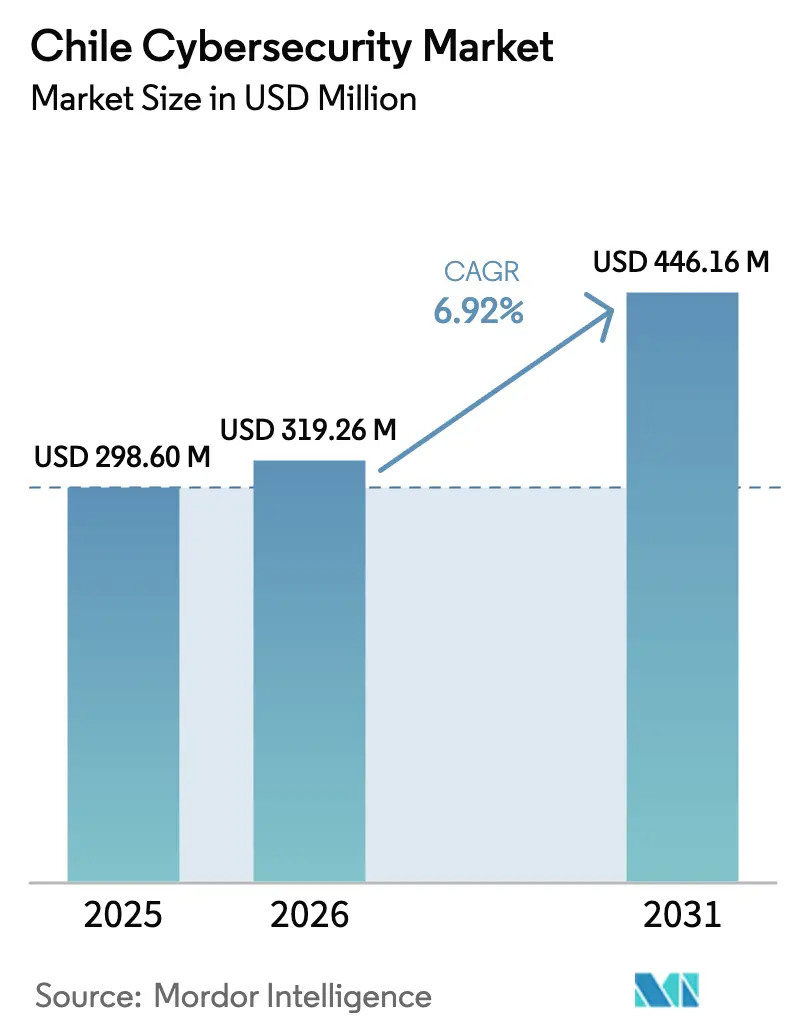
| Base Year Market Size (2025) | USD 298.6 Million |
| Market Size (2026) | USD 319.26 Million |
| Market Size (2031) | USD 446.16 Million |
| Growth Rate (2026 - 2031) | 6.92 % |
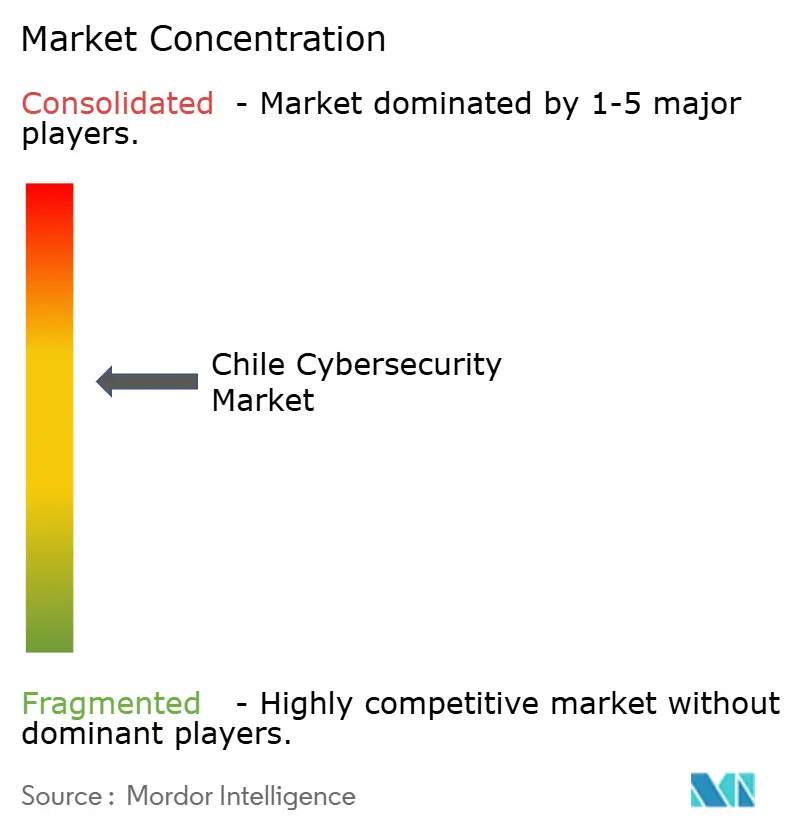
| Market Concentration | Medium |
Major Players *Disclaimer: Major Players sorted in no particular order Image © Mordor Intelligence. Reuse requires attribution under CC BY 4.0. | |
Chile Cybersecurity Market Analysis by Mordor Intelligence
The Chile cybersecurity market size was valued at USD 298.6 million in 2025 and estimated to grow from USD 319.26 million in 2026 to reach USD 446.16 million by 2031, at a CAGR of 6.92% during the forecast period (2026-2031). Local demand benefits from the Framework Law on Cybersecurity, effective January 2025, which created the National Cybersecurity Agency (ANCI) and introduced binding incident-reporting rules for critical infrastructure operators. Ongoing capital inflows—most visibly Amazon Web Services’ USD 4 billion cloud build-out scheduled for completion in 2026—are widening the threat surface yet simultaneously catalyzing greater spending on advanced controls. Enterprises are shifting from reactive endpoint tools toward platform-based, zero-trust architectures that integrate identity, network, and cloud security components. At the same time, skills shortages—Chile needs more than 15,000 trained practitioners by the end of 2025—are elevating the role of managed security services and driving vendor competition for automation-rich offerings. Collectively, these factors position the Chile cybersecurity market as the most structured and regulation-anchored ecosystem in Latin America.
Key Report Takeaways
- By offering, solutions retained 55.12% Chile cybersecurity market share in 2025, while the services segment is projected to grow 9.05% CAGR through 2031.
- By deployment mode, on-premise platforms commanded 55.20% of the Chile cybersecurity market size in 2025; cloud-based controls are forecast to post the fastest 8.62% CAGR to 2031.
- By end-user industry, BFSI led with a 28.20% revenue share in 2025, whereas healthcare is expected to exhibit the strongest 9.78% CAGR over the outlook period.
- By end-user enterprise size, large enterprises accounted for 62.85% of 2025 spending, but SMEs represent the quickest-expanding cohort at 9.35% CAGR through 2031.
Note: Market size and forecast figures in this report are generated using Mordor Intelligence’s proprietary estimation framework, updated with the latest available data and insights as of 2026.
Chile Cybersecurity Market Trends and Insights
Drivers Impact Analysis*
| Driver | (~) % Impact on CAGR Forecast | Geographic Relevance | Impact Timeline |
|---|---|---|---|
| Sustained Ransomware Surges Targeting Chilean BFSI and Retail Networks | +1.2% | National, with concentration in Santiago financial district | Short term (≤ 2 years) |
| 5G Roll-out and IoT Expansion Elevating Mobile and Edge-Node Attack Surfaces | +0.9% | National, with early deployment in Santiago, Valparaíso, Concepción | Medium term (2-4 years) |
| Digitization of Copper-Mining OT Environments Requiring ICS Protection | +0.8% | Northern regions (Antofagasta, Atacama), with spillover to central Chile | Medium term (2-4 years) |
| CORFO Cloud-Migration Subsidies Fueling SaaS Security Spend by Start-ups | +0.7% | National, with concentration in Santiago startup ecosystem | Short term (≤ 2 years) |
| AI Integration in Cybersecurity Solutions Driving Advanced Threat Detection | +0.6% | National, with early adoption in large enterprises | Long term (≥ 4 years) |
| New Data Protection Law Compliance Requirements Mandating Enhanced Security | +0.5% | National, affecting all sectors handling personal data | Medium term (2-4 years) |
| Source: Mordor Intelligence | |||
Sustained Ransomware Surges Targeting Chilean BFSI and Retail Networks
Repeated ransomware incidents—highlighted by Banco Santander’s 2024 breach that exposed customer data in three countries—are reprioritizing spending toward automated detection and continuous response mechanisms. Financial institutions are consolidating siloed controls into unified security-information-and-event-management (SIEM) platforms that align with ANCI reporting windows. Retailers, whose omnichannel models gather vast payment records, now integrate threat-intelligence feeds directly into point-of-sale and e-commerce back-end systems to limit dwell time. Contract language is shifting toward outcome-based SLAs that benchmark incident-containment minutes rather than product features, creating a service-centric revenue lift across the Chile cybersecurity market. Taken together, ransomware forces organizations to treat zero-trust segmentation and immutable back-up architectures as board-level imperatives, accelerating the Chile cybersecurity market trajectory.
5G Roll-out and IoT Expansion Elevating Mobile and Edge-Node Attack Surfaces
Movistar Empresas’ LTE-M launch and other operator initiatives have multiplied connected endpoints across fleet-management and smart-city pilots. Private 5G deployments at Antofagasta’s mining sites illustrate how ultra-low-latency connectivity links OT sensors once kept offline, thereby extending adversaries’ reach into production environments. Security teams must now protect network slices, edge-compute clusters, and massive streaming datasets. Demand is shifting toward micro-segmentation gateways capable of inspecting machine-to-machine traffic at line speed. Vendors offering lightweight, container-based security agents capable of updating over-the-air are gaining adoption, especially where field crews operate hundreds of kilometres from network cores. Consequently, 5G’s rapid adoption contributes materially to Chile cybersecurity market growth in mid-term years.
Digitization of Copper-Mining OT Environments Requiring ICS Protection
Codelco’s alliance with ABB to cut emissions by integrating digital twins and autonomous hauling systems typifies mining’s rapid Industry 4.0 uptake. Because proprietary industrial protocols are now routable over IP networks, attackers can manipulate process-control logic to halt production. The Mining Cybersecurity Corporation—founded 2024 by Antofagasta and peers—shares threat telemetry to pre-empt such sabotage. Spending tilts toward anomaly-detection sensors that baseline vibration or voltage signatures rather than traditional file-centric antivirus software. Integration partners capable of certifying IEC 62443 compliance see heightened demand, adding volume to the Chile cybersecurity market, particularly for long-lifecycle contracts exceeding five years.
CORFO Cloud-Migration Subsidies Fueling SaaS Security Spend by Start-ups
Chile’s CORFO agency reimburses up to 50% of migration costs for early-stage companies that shift workloads to accredited domestic data centers [1]United Nations UNCTAD, “Chile National Data Centres Plan,” investmentpolicy.unctad.org. Subsidies free capital that start-ups channel into secure access service edge (SASE) subscriptions and cloud-native application-protection platforms. Because these firms are born-in-cloud, they sidestep legacy perimeter tools altogether, contributing to the fastest services growth slice in the Chile cybersecurity market. Yet compliance obligations introduced by the forthcoming Personal Data Protection Law task founders with embedding encryption-at-rest, data loss prevention, and continuous auditing from day one, expanding total addressable security spend.
Restraints Impact Analysis*
| Restraint | (~) % Impact on CAGR Forecast | Geographic Relevance | Impact Timeline |
|---|---|---|---|
| Budget Constraints Among Chilean SMEs Limiting Advanced Tool Uptake | -1.1% | National, with higher impact in regions outside Santiago | Short term (≤ 2 years) |
| Fragmented Legacy IT in Public Administration Slowing Zero-Trust Initiatives | -0.8% | National, affecting all government levels | Long term (≥ 4 years) |
| Low Cyber-Awareness Outside Santiago Hindering Nationwide Adoption | -0.6% | Regional, primarily affecting northern and southern provinces | Medium term (2-4 years) |
| Fragmented Vendor Landscape Increasing Implementation Complexity | -0.4% | National, affecting all organization sizes | Medium term (2-4 years) |
| Source: Mordor Intelligence | |||
Budget Constraints Among Chilean SMEs Limiting Advanced-Tool Uptake
Smaller enterprises generate 32% of national GDP yet rarely allocate more than 3% of IT budgets to security controls, leaving many reliant on open-source or freemium products [2]PLOS ONE Research Group, “Adoption of Open-Source Security in Latin-American SMEs,” plos.org. Limited in-house staff means patch cycles lag, raising exposure windows. Although CORFO credits defray some costs, license renewals and 24/7 monitoring remain prohibitive. MSSPs are responding with bundled offerings comprising endpoint, email, and cloud-gateway protection priced per user, but uptake is slowed where credit access is tight. The resulting protection gap suppresses overall Chile cybersecurity market CAGR in the near term.
Fragmented Legacy IT in Public Administration Slowing Zero-Trust Initiatives
Numerous municipal bodies still operate siloed data centers running decade-old applications developed under divergent standards. Integrating these into ANCI’s mandated zero-trust reference model requires asset discovery, identity federation, and extensive re-platforming. Budget allocations approved in 2025 earmark upgrades, yet procurement cycles spanning up to 18 months postpone meaningful deployments. Persistent heterogeneity therefore tempers Chile cybersecurity market velocity for the government vertical despite strong policy momentum.
*Our forecasts treat driver/restraint impacts as directional, not additive. The impact forecasts reflect baseline growth, mix effects, and variable interactions.
Segment Analysis
By Offering: Services Accelerate Despite Solutions Dominance
Solutions commanded 55.12% of 2025 spending, underpinning perimeter firewalls, endpoint detection, and identity governance that large institutions deem non-negotiable. This foundation anchors the Chile cybersecurity market, yet tightening compliance timelines and continuous-monitoring demands are pushing service revenues higher. Consulting and incident-response engagements surged after the Santander breach, with many banks signing multiyear retainer contracts that guarantee one-hour remote support. Managed detection-and-response (MDR) adoption is also rising as enterprises seek 24/7 coverage while grappling with analyst shortages.
Professional-service providers are benefiting from new regulatory clauses that compel external audits at least annually. Demand for architecture reviews that align zero-trust and ISO 27001 requirements is notable among utilities and healthcare networks adopting electronic health records. Meanwhile, solution providers are embedding AI-driven analytics that reduce false positives, a capability often cited by buyers during request-for-proposal (RFP) scoring. The interplay of platform consolidation and service wraparounds sustains double-digit growth for the Chile cybersecurity market services layer.




By Deployment Mode: Cloud Gains Momentum Despite On-Premise Leadership
On-premise deployments kept 55.20% share in 2025, anchored by BFSI and mining customers that favor direct hardware control. These sectors routinely install redundant data halls in Santiago’s east side to ensure latency under 2 milliseconds to trading systems. Even so, hybrid architectures are proliferating: core banking systems remain on-site, while behavioral-analytics engines run in Amazon’s forthcoming local zones, a pattern reshaping the Chile cybersecurity market.
Cloud spending grows fastest where SaaS procurement sidesteps capex constraints. Subscription models permit SMEs to scale licenses monthly, and developers building fintech or telehealth applications now default to containerized workloads secured by cloud-native application-protection platforms. The new Personal Data Protection Law obliges data controllers to document encryption keys and audit trails; cloud dashboards simplify that evidence gathering. Hence cloud’s 8.62% CAGR is expected to lift its slice of the Chile cybersecurity market size to nearly parity with on-premise by decade’s end.
By End-User Industry: Healthcare Emerges as Growth Leader
BFSI retained 28.20% of 2025 outlays, a figure representing the largest Chile cybersecurity market share among verticals as banks comply with Basel III and ANCI’s 24-hour incident-reporting threshold. Spending priorities include real-time payment-fraud analytics and secure-access service edge for branch networks.
Healthcare, however, advances at the quickest 9.78% CAGR, fueled by telemedicine growth from 1.3 million virtual consults in 2024 to a projected 2.2 million in 2026. Hospitals now encrypt imaging archives and deploy identity federation across electronic record portals, channeling fresh budget into zero-trust shadow-IT discovery. Industrial firms follow, focusing on intrusion detection within supervisory control and data acquisition environments that manage copper-ore throughput, neutralizing threats that can halt conveyer belts.

By End-User Enterprise Size: SMEs Drive Future Growth
Large corporations consumed 62.85% of 2025 revenue, frequently operating multi-segment portfolios that include cloud, OT, and mobile assets. Their requirements stimulate demand for integrated extended-detection-and-response (XDR) platforms capable of correlating telemetry across thousands of endpoints.
Conversely, SMEs’ 9.35% CAGR springs from escalating ransomware incidents that threaten business continuity. Subsidized migration vouchers encourage cloud-native security stacks pre-integrated with identity, data-loss-prevention, and email scanning. MSSPs report a 34% jump in Chilean SME customers since the start of 2024, signalling durable tailwinds for the Chile cybersecurity market.
Geography Analysis
The Santiago Metropolitan Region anchors more than two-thirds of national revenues, leveraging 94.1% household internet penetration and fixed broadband speeds above 280 Mbps. Major banks, telcos, and government ministries cluster within a 10-kilometre radius, generating sustained demand for enterprise-grade SOC services that underpin the Chile cybersecurity market. Local universities, including the University of Chile, supply graduates to an expanding ecosystem of consulting firms, and a newly formed Cyber-Range at ANCI headquarters offers joint drills for public-private teams.
Northern regions such as Antofagasta and Atacama contribute an outsized share of OT security spending because copper-mining firms digitize haulage, smelting, and predictive-maintenance functions. Private 5G spectrum auctions facilitate remote-operation centers in Santiago that control mining trucks 1,200 kilometres away, necessitating encrypted back-haul and anomaly-detection gateways. These projects illustrate how industrial transformation sustains localized spikes in Chile cybersecurity market demand despite smaller overall population bases.
Southern provinces and smaller urban centers display lower uptake, impeded by fewer certified professionals and limited local reseller networks. The National Data Centers Plan pledges USD 2.5 billion to extend edge-compute facilities and close latency gaps, but until deployments complete after 2027, organizations outside the capital rely heavily on cloud services hosted in Santiago. ANCI has launched a mobile-training caravan that targets 50 municipalities per year, aiming to elevate baseline hygiene and thereby unlock further Chile cybersecurity market expansion in outlying areas.
Regulatory Landscape
Chile is moving from principles-based guidance to enforceable cybersecurity obligations under Law 21.663, published on April 8, 2024, which created the National Cybersecurity Agency (ANCI) and established the National CSIRT as the coordinating incident-response body. ANCI began operations on January 1, 2025, and key enforcement provisions entered into force on March 1, 2025, tightening the compliance cadence for entities deemed essential to national continuity.
Complementary rules reinforce mandatory reporting and governance controls. Supreme Decree 295 (2024) sets binding incident-reporting duties to the National CSIRT for public and private providers of essential services. The regime also introduces heightened requirements for Operators of Vital Importance (OVI), including appointing a Cybersecurity Officer, maintaining an Information Security Management System (ISMS), and reporting certain incidents within three hours of detection. ANCI Resolution 024/2025 initiated the first OVI qualification process in May 2025, making OVI designation a practical trigger for new audit, readiness, and reporting workflows across regulated sectors.
Value Chain Analysis
The Chile cybersecurity value chain is anchored by governance and coordination bodies on the demand side and control-setting side, with ANCI acting as the central authority coordinating the National CSIRT and interfacing with sectoral CSIRTs and regulated operators. This institutional layer shapes buyer requirements around incident reporting, minimum controls, and auditability, which in turn steers procurement toward capabilities that can evidence compliance, such as ISMS delivery, logging and monitoring, and repeatable incident-response playbooks.
On the supply side, global cybersecurity OEMs and cloud providers typically sell through local channels, combining distributors, system integrators, and managed security service providers (MSSPs) that implement, integrate, and operate tools for end users. Industry associations and non-profits including CHILETEC, Alianza Chilena Ciberseguridad, ISSA Chile, and Fundacion Sochisi provide connective tissue through training, peer exchange, and policy dialogue, supporting talent development and practical adoption of new reporting protocols. Across both layers, the emphasis is increasingly on services execution, including assessment, MDR/SOC operations, incident response, and compliance advisory, alongside technology platforms as organizations respond to tighter regulatory timelines and skills constraints.
Competitive Landscape
Global vendors account for a growing portion of contract value as enterprises consolidate toward one-stop platforms. Cisco’s security revenue climbed 117% year-on-year in FY2025 Q2, buoyed by uptake of its Secure Firewall 4200 line and AI-enriched Talos threat-intelligence feeds. Palo Alto Networks reported next-generation-security ARR of USD 4.8 billion, marking 37% growth and underscoring rising preference for platform bundles over point solutions [4]Palo Alto Networks, “Q2 FY2025 Investor Presentation,” paloaltonetworks.com. These results illustrate how scale players capture share across the Chile cybersecurity market.
Local specialists maintain strategic relevance through regulatory fluency and faster support cycles. NovaRed’s Chilean SOC handles more than 15,000 monthly alerts, with median triage time under five minutes according to the firm’s 2025 transparency report. iSentinel offers threat-hunting services mapped to ANCI notification forms, shortening compliance workloads for mid-tier banks. Such localization advantages ensure domestic firms remain credible alternatives, especially for public-sector tenders that favour local value creation.
Cloud-native entrants such as Cut Security exploit the pivot toward SaaS by offering agentless posture-management across AWS, Azure, and the newly announced Microsoft Chile Region. Their pay-as-you-grow models resonate with fintech and healthtech start-ups, intensifying price competition. As platformization progresses, acquisitions are likely; Stefanini Group already earmarked USD 100 million for Latin American cyber and AI targets to deepen its Chilean footprint. Overall, moderate consolidation juxtaposed with niche innovation defines the Chile cybersecurity market’s competitive dynamic.
Chile Cybersecurity Industry Leaders
Cisco Systems Inc.
Fortinet Inc.
Check Point Software Technologies Ltd.
Palo Alto Networks Inc.
IBM Corporation
- *Disclaimer: Major Players sorted in no particular order

Market Opportunities and Future Outlook
The phased activation of Law 21.663 is creating a defined compliance-driven buying cycle, with the OVI qualification process initiated by ANCI in May 2025 acting as a catalyst for readiness assessments, ISMS implementation, control gap remediation, and independent evaluation services. Organizations aligning to three-hour incident notification and more formal cyber governance also create whitespace for tools and services that reduce reporting friction, including managed detection and response (MDR), centralized logging, incident-case management, and integrations that map operational telemetry into regulator-aligned notification workflows.
A parallel opportunity is forming on the supplier side around enablement and local execution capacity. CHILETEC and practitioner communities such as ISSA Chile and Fundacion Sochisi are expanding training and certification activity tied to new regulatory requirements, supporting a broader pool of implementers for zero-trust programs, cloud security, and OT/ICS security in regulated environments. With enterprises shifting toward platform-based architectures that unify identity, network, and cloud controls, vendors and MSSPs that can bundle implementation, automation, and ongoing compliance evidence collection can stand out in large regulated accounts while also packaging right-sized offerings for cost-sensitive SMEs.
Recent Industry Developments
- June 2026: Check Point Software Technologies Ltd. expands its strategic partnership with Illumio to provide integrated security from perimeter to network interior for Chilean companies, including direct acquisition of Illumio solutions through Check Point. The expansion strengthens Chile-specific security platform integration. It advances a unified Zero Trust approach, increasing enterprise demand for integrated SOC and MDR solutions in Chile.
- April 2026: Fortinet Inc. expands its Chilean partner ecosystem with emphasis on professional services certification. The move strengthens local deployment capabilities and the talent pipeline. It improves service delivery and local market competitiveness for Fortinet in Chile.
- February 2026: Wazuh and eBD partner to deploy open-source SIEM and XDR cybersecurity services in Chile. The partnership introduces open-source, scalable security monitoring options for Chilean enterprises. It expands choice for mid-market and public sector, supporting broader threat detection capabilities in Chile.


Research Methodology Framework and Report Scope
Market Definition and Coverage
This market covers spending in Chile on cybersecurity solutions and services that help prevent, detect, and respond to digital threats across networks, endpoints, applications, and data in cloud and on-premise setups.
Scope exclusions: This sizing excludes general IT hardware refresh, non-security consulting that is not tied to security delivery, and internal in-house labor costs that are not billed as cybersecurity revenue.
Segmentation Overview
- By Offering
- Solutions
- Application Security
- Cloud Security
- Data Security
- Identity and Access Management
- Infrastructure Protection
- Integrated Risk Management
- Network Security
- End-point Security
- Services
- Professional Services
- Managed Services
- Solutions
- By Deployment Mode
- Cloud
- On-Premise
- By End-user Industry
- BFSI
- Healthcare
- IT and Telecom
- Industrial and Defense
- Retail and E-commerce
- Energy and Utilities
- Manufacturing
- Others
- By End-user Enterprise Size
- Large Enterprises
- Small and Medium Enterprises (SMEs)
Data Sources, Market Sizing, and Validation
Desk Research
Desk research was used to map the demand context in Chile and to anchor the model inputs that are observable outside company systems. We relied on public and official sources such as Chilean government cyber and digital policy publications, national statistics releases, central bank macro series, telecom and internet indicators, and international datasets from bodies such as the ITU, OECD, and World Bank.
We also reviewed company annual reports and investor presentations, reputable press coverage of breaches and regulatory changes, and association websites that discuss security readiness and skills gaps. Where needed, paid subscriptions for company financials, news and financials, and patent databases were used to cross-check revenue exposure, product focus, and security investment signals. This desk research list is illustrative, and many other public sources were also reviewed to collect, validate, and clarify data points.
Primary Interviews and Surveys
Primary work was done to pressure-test the desk assumptions and to fill gaps that are common in security spend data, especially around managed security, cloud security adoption, and pricing movement. We spoke with a mix of security buyers and channel-side experts (IT heads, security managers, and service leaders) across regulated and digital-heavy end users in Chile so the final model reflects how purchasing decisions are actually made.
Because spend patterns can vary by enterprise size, the interviews also helped calibrate mid-market adoption curves, typical contract lengths, and how budgets are split between tools and services, before the final totals were signed off.
Distribution of primary research fieldwork respondents
| Company type | Respondent position |
|---|---|
| Top tier: 30% | CXOs: 13% |
| Mid tier: 52% | Functional/Unit leaders: 29% |
| Smaller Players: 18% | Managers: 58% |
Market-Sizing & Forecasting
Sizing starts from a top-down build where the Chile demand pool is reconstructed using IT and digitalization indicators, and then security allocation rates are applied to estimate cybersecurity spend by type of buyer. To keep this realistic, the totals are corroborated with selective bottom-up checks such as sampling vendor and partner revenue exposure to Chile, channel feedback on run-rate bookings, and ASP-by-seat or ASP-by-workload approximations where those are commonly quoted in buying.
Inputs used in the model include the mix shift toward cloud versus on-premise deployments, the share of spend moving into managed security and incident response, enterprise size distribution of buyers, compliance-driven uplift tied to new cyber and data obligations, and observed changes in attack frequency and breach reporting that often trigger unplanned projects. When a bottom-up signal is incomplete, gaps are handled through conservative penetration ranges that are validated in interviews and then applied consistently across similar buyer cohorts.
Forecasts are built using scenario analysis supported by short time-series smoothing of key drivers (for example, cloud adoption and the share of service-led deployments), followed by expert validation so the trajectory aligns with how procurement cycles and budget timing typically play out.
Data Validation & Update Cycle
Validation is done through multiple checks so the final number stays tied to real-world spend behavior. We compare outputs against independent signals such as IT spend direction, reported security hiring intent, cloud migration pace, and the typical split between tools and services discussed by practitioners, and then investigate anomalies until the story and the math line up.
A second analyst reviews the assumptions, input ranges, and year-over-year movements, followed by a final pass that focuses on outliers by end user group and deployment mix. Reports are refreshed annually, and interim updates are triggered when a material event occurs, such as major regulation changes, large breach cycles, or a sharp currency swing that impacts USD reporting. Before delivery, the model is re-checked so clients receive the most current view available.
Mordor Intelligence's Chile Cybersecurity Market Size Versus Other Published Estimates
Published market values for Chile cybersecurity often do not match because the scope is defined differently and because the conversion from "security activity" into "security spend" is handled in different ways. Variations usually come from what is counted as cybersecurity (tools only versus tools plus services), what year is treated as the base, and how quickly assumptions are refreshed after policy and threat changes.
The main gap comes from mixing broad IT services and SOC outsourcing into the same bucket as cybersecurity software, where Mordor Intelligence counts only security-specific solutions and services that are purchased to prevent, detect, or respond to cyber threats in Chile. Differences can also appear when estimates use aggressive adoption jumps for cloud security without validating contract timing, or when they apply global ASP trends directly to Chile without checking local deal sizes and currency timing.
Benchmark comparison
| Source | Market Size | Gaps in Research Methodology |
|---|---|---|
| Mordor Intelligence | USD 298.6 M (2025) | |
| Industry Promotion Body A | USD 658.0 M (2025) | Uses a broader "cybersecurity ecosystem" view that can blend adjacent digital services and skills investments, which inflates the spend captured versus a security-revenue-only definition. |
| Regional Media Outlet B | USD 348.0 M (2024) | Reported as a single-year headline with limited visibility on base-year choice, USD conversion timing, and whether managed services and incident response are treated consistently across buyers. |
The spread in the table is mainly explained by what each source includes in "cybersecurity" and how it treats services that sit close to IT operations. By keeping the inputs tied to observable demand indicators, buyer mix, and repeatable allocation logic, the final estimate stays transparent and easier to reproduce during updates.


Key Questions Answered in the Report
What is the current value of the Chile cybersecurity market?
The Chile cybersecurity market size is USD 319.26 million in 2026.
How fast is the market expected to grow through 2031?
Revenue is projected to rise at a 6.92% CAGR, reaching USD 446.16 million by 2031.
Which segment grows fastest within the market?
Cloud-deployed security solutions post the quickest 8.62% CAGR as organizations embrace hybrid and SaaS architectures.
Why is healthcare the fastest-expanding industry vertical?
Rapid telemedicine adoption and data-privacy mandates propel healthcare spending at a 9.78% CAGR.
Page last updated on:


 Your data is secure and never sold or shared.


