
Market Overview
| Study Period | 2021 - 2031 |
|---|---|
| Forecast Data Period | 2026 - 2031 |
| Historical Data Period | 2021 - 2024 |
| Growth Rate | 0.18 % |
| Market Concentration | High |
Major Players *Disclaimer: Major Players sorted in no particular order Image © Mordor Intelligence. Reuse requires attribution under CC BY 4.0. | |

Chad Oil And Gas Upstream Market Analysis by Mordor Intelligence
The Chad Oil and Gas Upstream Market size is expected to grow from USD 5.83 billion in 2025 to USD 5.84 billion in 2026 and is forecast to reach USD 5.89 billion by 2031 at 0.18% CAGR over 2026-2031.
- Oil is the most important export commodity in the country. The production of natural gas in the country is meager, and most of the export in the country is accounted for by the export of oil. The oil is expected to keep dominating the market in the forecast period.
- Increased governmental and private push into investment in the sector may lead to an increase in the production of oil and create an opportunity for companies in the industry.
- Decreasing oil production in the country is expected to restrain the market in the forecast period. Many oil fields in the country have reached maturity, and production is expected to gradually decline from these oil fields.
Note: Market size and forecast figures in this report are generated using Mordor Intelligence’s proprietary estimation framework, updated with the latest available data and insights as of 2026.
Chad Oil And Gas Upstream Market Trends and Insights
Oil to Dominate the Market
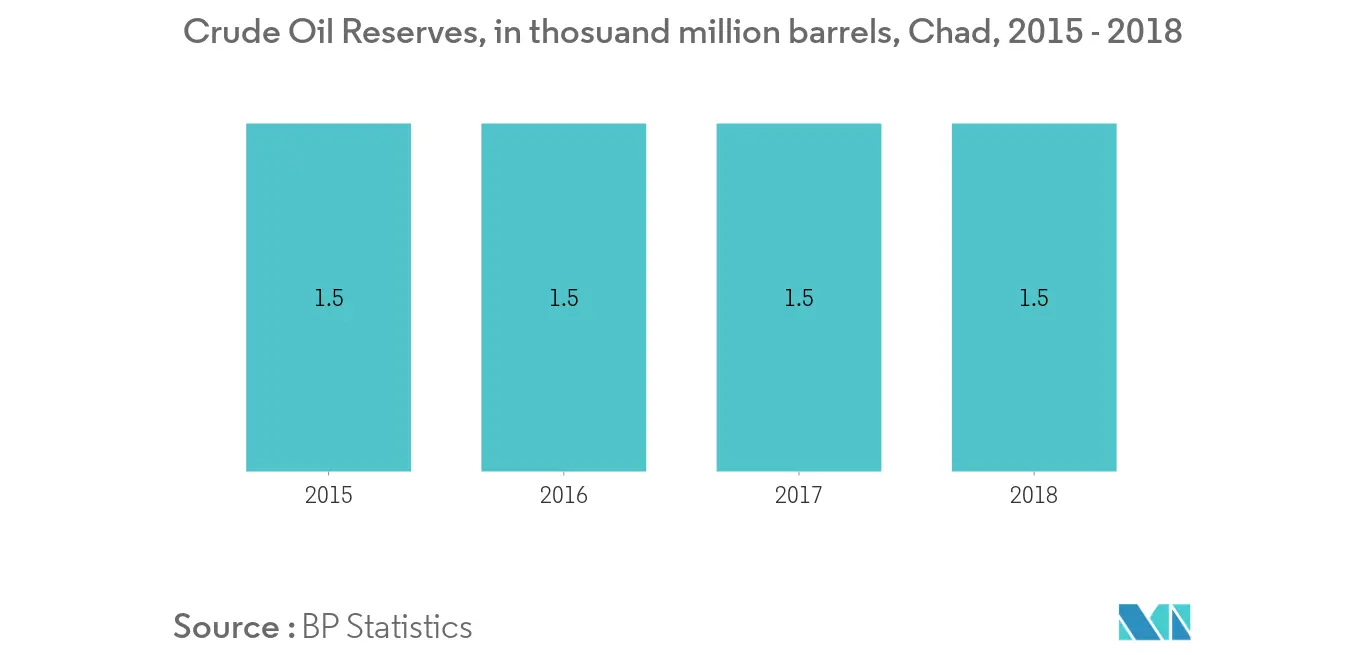
- As of 2018, Chad held an estimated 1.5 thousand million barrels of proved crude oil reserves. All of the country's proved oil reserves are held onshore because Chad is a landlocked country.
- Chad oil fields produce Doba type crude oil that has an average API of 25.3 with very low sulfur content. The quality of oil increases the demand for the oil as it does not require specific refinery to refine the oil.
- In 2018, the country has negligible production of natural gas owing to small reserves of natural gas in the country.
- Hence, oil is expected to dominate the market due to being present more in quantity than natural gas.


Decreasing Oil Production to Restraint the Market
- As of 2019, Chad's largest oil fields are mature. Field expansions and recovery techniques have kept the country's old fields at a steady rate of production; however, without additional upstream investment, decline rates are likely to grow, resulting in lower production.
- Glencore, a large upstream corporation in the country, lost its license for exploration in the country. The government and the corporation could not finalize a deal for a new license. As the finances of the corporation have reduced it seems even less likely that a deal would be finalized in the forecast period.
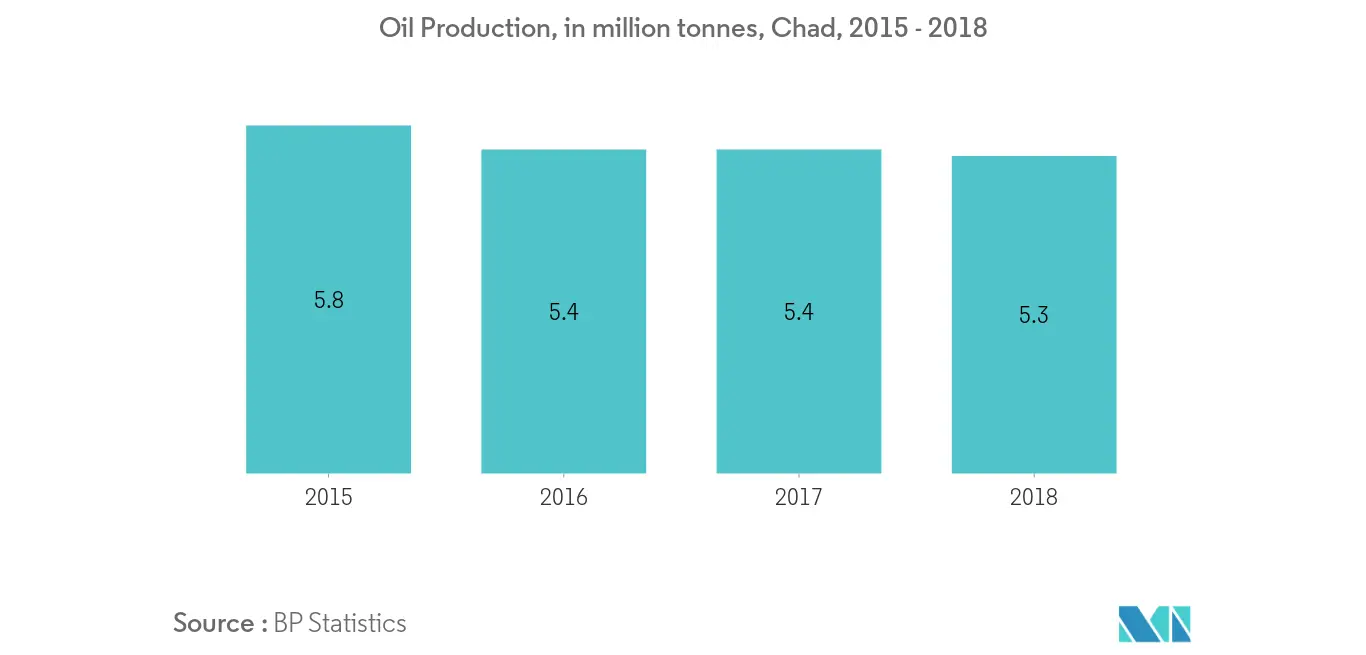
- There has been a decrease in oil production by 1.85%, decreasing to 5.3 million tons of oil equivalent (Mtoe) in 2018 from 5.4 Mtoe in 2017. The decrease in production is due to oil fields getting matured.
- The Chad oil and gas upstream industry is expected to remain stagnant in the forecast period due to a decrease in oil production in the region.
Regulatory Landscape
Chad's upstream petroleum activities are overseen by the Ministry of Petroleum and Energy alongside the national oil company, Societe des Hydrocarbures du Tchad (SHT). The core upstream framework is based on Law n 006/PR/2007 (as amended through later ordinances and decrees), under which petroleum rights can be awarded by tender or mutual agreement, and contracts are subject to National Assembly ratification. This creates a formal approval chain for licenses and fiscal terms.
Upstream governance is anchored in the hydrocarbons law and PSC practice, while broader sector regulation has also evolved on the downstream side through Ordonnance n 008/PR/2025. This ordonnance regulates refining, import/export, transport, storage, and distribution and established the Autorite de Regulation du Secteur Petrolier Aval (ARSAT) for norms, safety, and compliance. For upstream operators and partners, these structures operate alongside transparency and disclosure expectations referenced by EITI-related reporting and contract publication practices, shaping how projects are documented and governed across the petroleum value chain.
Value Chain Analysis
Chad's upstream value chain is dominated by onshore crude oil in the Doba basin and other mature producing areas, with operator activity centered on maintaining and improving recovery. Field development and production operations rely on drilling and well services, water handling and disposal, and surface facilities. PetroChad Mangara (Perenco) illustrates this approach, after completing a 12-well program at Badila (including horizontal development wells and water-disposal wells) and lifting combined Badila and Mangara output to over 18,000 bopd following the campaign.
Midstream evacuation is the key constraint for monetization because export logistics concentrate around the Chad-Cameroon pipeline system and associated export infrastructure, creating single-route dependence for crude exports. The pipeline is cited at roughly 225,000 bpd capacity and is a central bottleneck for the sector. Policy and sector coordination sit primarily with the Ministry of Petroleum and Energy and SHT, while discussions on alternative routes, including a potential Niger-Chad-Cameroon corridor discussed in mid-2024, show how infrastructure availability, security, and cross-border coordination affect the upstream-to-export chain for operators in Chad.
Competitive Landscape
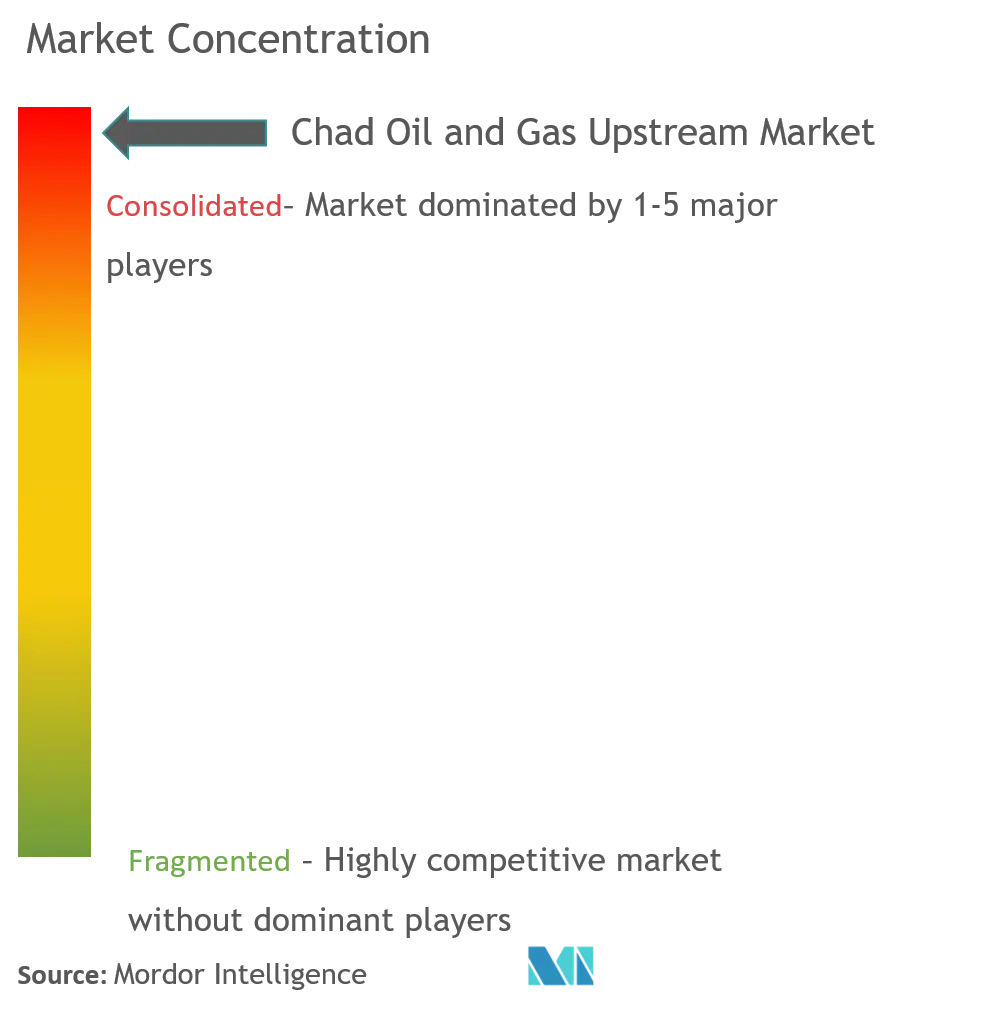
The Chad oil and gas upstream market is consolidated. The major companies include Glencore PLC, Delonex Energy Limited, Petroliam Nasional Berhad, Exxon Mobil Corporation, and Societé des Hydrocarbures du Tchad.
Chad Oil And Gas Upstream Industry Leaders
Glencore PLC
Delonex Energy Limited
Exxon Mobil Corporation
Societé des Hydrocarbures du Tchad
Petroliam Nasional Berhad
- *Disclaimer: Major Players sorted in no particular order

Market Opportunities and Future Outlook
Incremental production upside in Chad is tied to brownfield optimization and well delivery in producing basins, where operators have shown the impact of targeted drilling and water management. Perenco's Badila campaign, completed in December 2025, added new horizontal development wells and disposal capacity and was associated with combined Badila and Mangara production exceeding 18,000 bopd. This points to continuing opportunities for infill drilling, workovers, and other recovery techniques in mature assets.
Export and processing infrastructure is another area where concrete actions are visible. In May 2026, the State of Chad initiated efforts to replace the ageing Kribi export platform, which has been flagged as potentially non-operational or uninsurable by April 2028. The government has also articulated a 2025-2030 strategy focused on raising national output to 250,000 bpd and issuing new licenses to support that goal. Alongside export reliability, domestic capacity buildouts and partnerships, including the April 2026 Chad-Algeria framework agreement for a new refinery, indicate potential for integrated development plans that link upstream investment with evacuation and local offtake.
Recent Industry Developments
- May 2026: The State of Chad initiated work to replace the ageing Kribi oil export platform, a critical piece of the Chad-Cameroon export system, as it has been described as at risk of becoming non-operational or uninsurable by April 2028. The initiative elevates near-term focus on export continuity and integrity for upstream producers whose realized volumes depend on this route. It also increases the strategic weight of midstream procurement, project management, and financing decisions tied to crude evacuation.
- January 2026: Sonatrach and Societe des Hydrocarbures du Tchad (SHT) signed a memorandum of understanding covering cooperation across exploration, production, and hydrocarbon transport. The agreement expands the pool of potential technical and commercial partners around Chad's upstream and associated logistics. It also supports the government's push to widen participation and capabilities beyond existing operators in a highly concentrated market.
- July 2024: Chadian government representatives held discussions on relaunching the Niger-Chad-Cameroon pipeline concept as a regional crude transportation route. These talks highlighted the strategic priority of diversifying export options beyond the existing corridor and reducing single-route dependence. For upstream project developers, an alternative evacuation pathway can change development sequencing, commercial terms, and the attractiveness of frontier blocks.


Research Methodology Framework and Report Scope
Market Definition and Coverage
For this study, the Chad oil and gas upstream market is defined as the value generated from exploration, field development, and production activities tied to crude oil and natural gas within Chad.
Scope exclusions: Midstream transportation, refining, retail fuel marketing, and most downstream petrochemicals are excluded from this upstream sizing.
Segmentation Overview
- Resource Type
- Oil
- Natural Gas
Data Sources, Market Sizing, and Validation
Desk Research
Desk work starts with building a fact base on Chad production and field activity, so the market model is anchored to what is physically produced and developed. We rely on public and official sources such as OPEC statistical releases, IEA country and oil market balances, the World Bank macro indicators, the UN Comtrade trade database, and US EIA country notes for production and liquids context.
After that, supporting information is pulled from operator and partner filings, investor presentations, reputable press coverage, and regulator or ministry updates where available, so timing of projects and maintenance cycles is not missed. When needed, paid subscriptions are used only for company financials and intelligence, news and financials, and selective import and export shipment-level checks to sanity-test export-linked volumes and price timing. The desk sources listed here are illustrative only, and many other public documents were also consulted for data collection, cross-checking, and clarification.
Primary Interviews and Surveys
Interviews and surveys with operators, field service providers, regulators, and energy finance professionals in Chad help clarify production trends, field restart timing, development spending, realized prices, and gaps in public records. These inputs are used to adjust secondary series and triangulate the final market model for Chad.
Distribution of primary research fieldwork respondents
| Company type | Respondent position |
|---|---|
| Top tier: 27% | CXOs: 15% |
| Mid tier: 48% | Functional/Unit leaders: 30% |
| Smaller Players: 25% | Managers: 55% |
Market-Sizing & Forecasting
Sizing is built using both top-down and bottom-up logic, so the final number stays tied to real upstream activity while still being explainable. On the top-down side, production and development indicators were used to reconstruct a realistic upstream value pool for Chad, and then the totals were split across oil and gas based on observed output mix and project emphasis.
To keep the model grounded, a few practical inputs were treated as core drivers, such as crude and gas production levels, active field development and workover cadence, drilling and completion intensity where it is disclosed, export-linked lifting patterns, and Brent-linked price assumptions converted to local realized values. Because some line items are not consistently reported, selective bottom-up approximations were used as a check, including sampled cost-per-barrel style benchmarks, activity-to-spend ratios from similar assets, and supplier and channel checks, and then gaps were handled by applying conservative ranges that were validated in interviews.
For the forecast, scenario analysis was used rather than a single straight-line extrapolation, since upstream spend can swing with price signals, partner budgets, and project approvals. Assumptions on production outlook, development timing, and price path were aligned to expert consensus from primary discussions, and the final trajectory was adjusted only when the variables moved together in a plausible way.
Data Validation & Update Cycle
Before sign-off, outputs are triangulated against independent signals such as production trends, public project announcements, and macro constraints that typically show up in budgets and exports. If a number looks out of range, it is traced back to the driver level, and we re-check the input, conversion timing, and any implied spend per unit of activity.
A second analyst review is completed to verify assumptions, math flow, and year-to-year step changes, and follow-up outreach is triggered when there is a material variance versus interview feedback. Reports are refreshed annually, and interim updates are made when major events occur, such as new project sanctions, large shutdowns, or policy changes. Right before delivery, a fresh pass is done so clients receive the latest updated view.
Mordor Intelligence's Chad Oil and Gas Upstream Market Sizing Compared With Other Published Estimates
Published market values for Chad upstream can vary a lot, even when the same country name is used, because the underlying definitions and counting rules are not always the same. Differences usually come from what gets counted as upstream value, the year and price deck used, and how project timing is treated when activity is lumpy.
The main gap comes from whether spending and value outside Chad is blended into the number through multi-region templates, where Mordor Intelligence keeps the scope limited to Chad-only upstream activity and then ties it back to production and development signals before converting prices into USD for the base year.
Benchmark comparison
| Source | Market Size | Gaps in Research Methodology |
|---|---|---|
| Mordor Intelligence | USD 5.83 B (2025) | |
| Global Consultancy A | USD 3.31 B (2025) | Often uses a narrower upstream value definition that leans heavily on contracted project spend and may exclude parts of operator-led production value that are not disclosed as separate program budgets, which can pull the total down. |
| Industry Publisher B | USD 3.24 B (2024) | Uses a different base year and tends to apply higher-level segment templates (including broader regional splits and generalized CAGR paths), which can shift the USD conversion timing and smooth out field-level stop-start development cycles. |
Taken together, the spread is mainly explained by scope tightness, base-year choice, and how activity-to-value is converted when disclosures are uneven. Our approach stays traceable to a few repeatable drivers and validation checks, which makes it easier for buyers to understand what is included and to update assumptions when market conditions change.


Key Questions Answered in the Report
What is the current Chad Oil and Gas Upstream Market size?
The Chad Oil and Gas Upstream Market is projected to register a CAGR of 0.18% during the forecast period (2026-2031)
Who are the key players in Chad Oil and Gas Upstream Market?
Glencore PLC, Delonex Energy Limited, Exxon Mobil Corporation, Societé des Hydrocarbures du Tchad and Petroliam Nasional Berhad are the major companies operating in the Chad Oil and Gas Upstream Market.
What years does this Chad Oil and Gas Upstream Market cover?
The report covers the Chad Oil and Gas Upstream Market historical market size for years: 2020, 2021, 2022, 2023, 2024 and 2025. The report also forecasts the Chad Oil and Gas Upstream Market size for years: 2026, 2027, 2028, 2029, 2030 and 2031.
Page last updated on:





