
Cellulose Derivative Excipient Market Size and Share
Market Overview
| Study Period | 2021 - 2031 |
|---|---|
| Market Size (2026) | USD 2.38 Billion |
| Market Size (2031) | USD 3.68 Billion |
| Growth Rate (2026 - 2031) | 9.13 % |
| Fastest Growing Market | Asia-Pacific |
| Largest Market | Asia-Pacific |
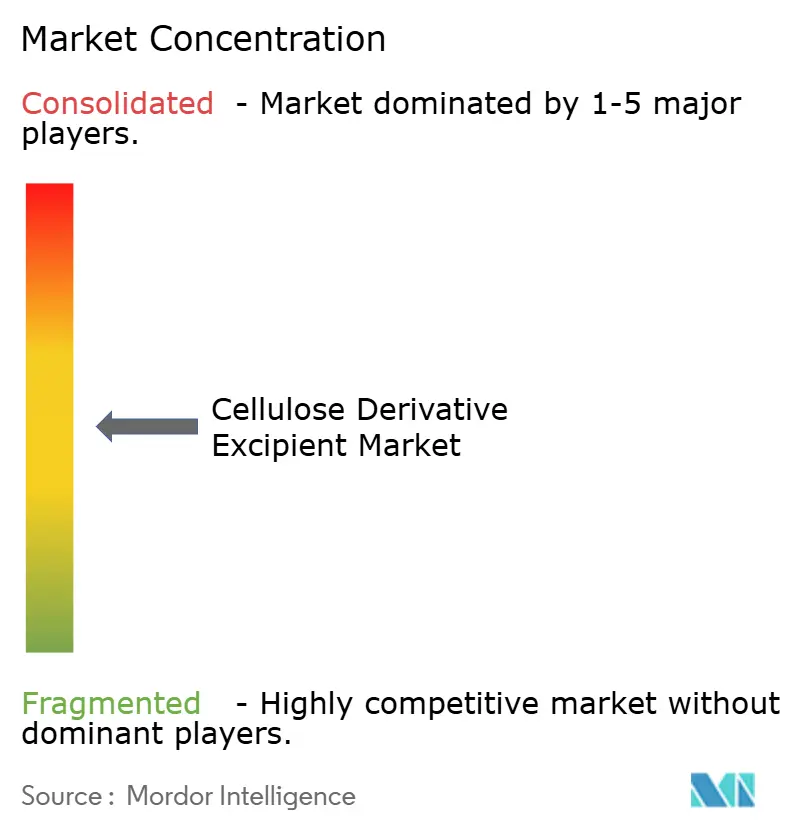
| Market Concentration | Medium |
Major Players *Disclaimer: Major Players sorted in no particular order Image © Mordor Intelligence. Reuse requires attribution under CC BY 4.0. | |
Cellulose Derivative Excipient Market Analysis by Mordor Intelligence
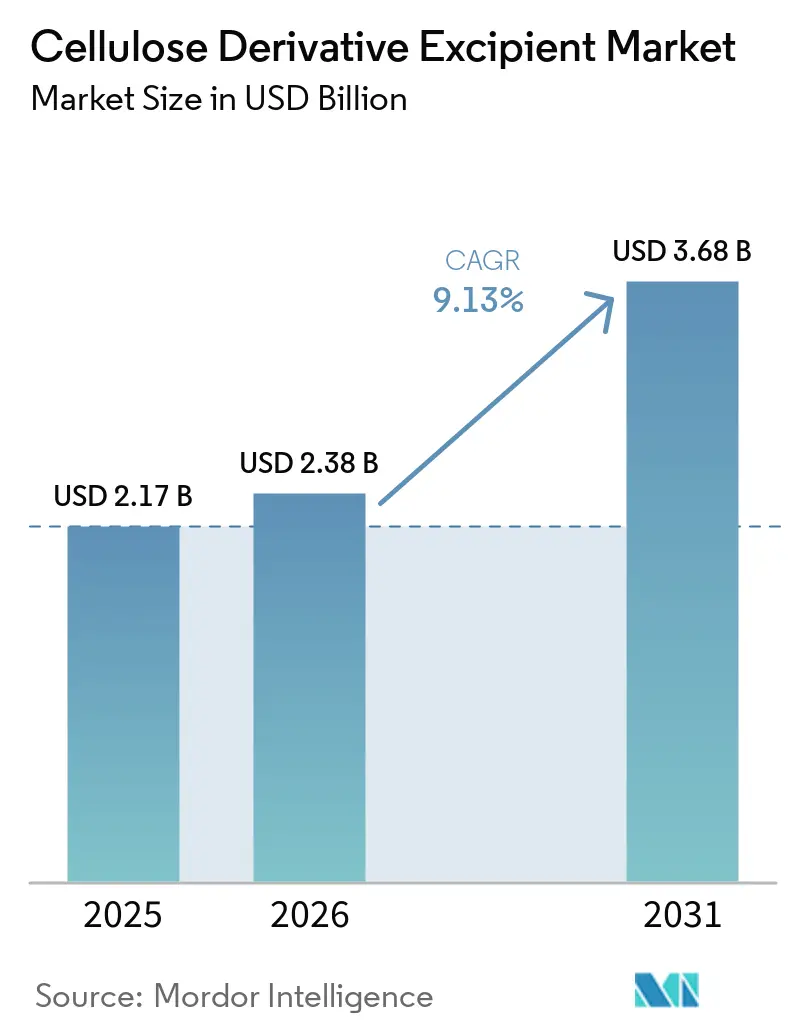
The cellulose derivative excipient market size was valued at USD 2.17 billion in 2025 and is estimated to grow from USD 2.38 billion in 2026 to USD 3.68 billion by 2031, at a CAGR of 9.13% during the forecast period (2026-2031). The cellulose derivative excipient market is supported by growing production of complex oral solid dosage forms and increasingly demanding modified-release drug designs. Drug manufacturers require validated microcrystalline cellulose and hypromellose grades for binding, release control, and enteric coating. Cosmetic and personal care formulators are also using cellulose polymers for film formation and rheology control, with performance requirements that increasingly resemble pharmaceutical formulation standards. Expansion in tableting and coating capacity provides suppliers with more opportunities to offer high-grade materials, while stricter quality expectations favor suppliers with established pharmacopeia positions and dependable manufacturing networks. The market also faces feedstock exposure, as wood and cotton pulp supply is concentrated, making continuity planning important for both buyers and producers.
Key Report Takeaways
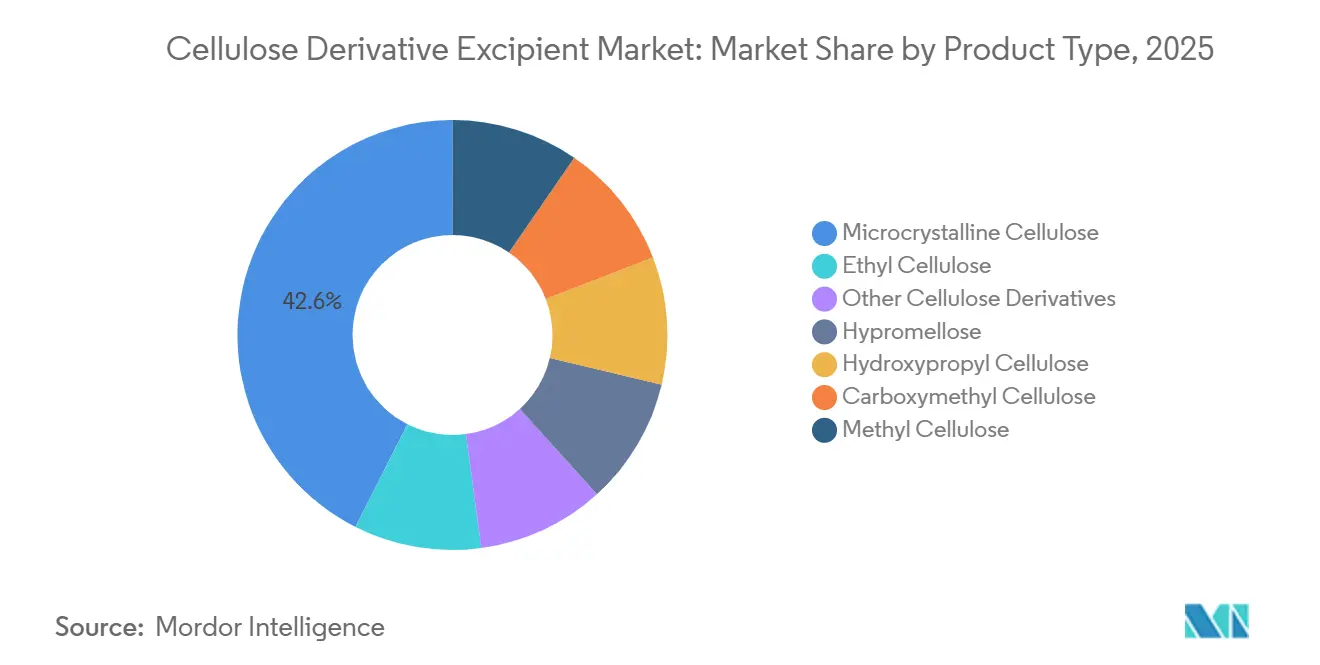
- By product type, microcrystalline cellulose held 42.56% of the cellulose derivative excipient market share in 2025, while hydroxypropyl cellulose is forecast to grow at a 9.86% CAGR through 2031.
- By function, binders accounted for 38.11% of the cellulose derivative excipient market share in 2025, while film-coating agents are forecast to advance at a 9.91% CAGR through 2031.
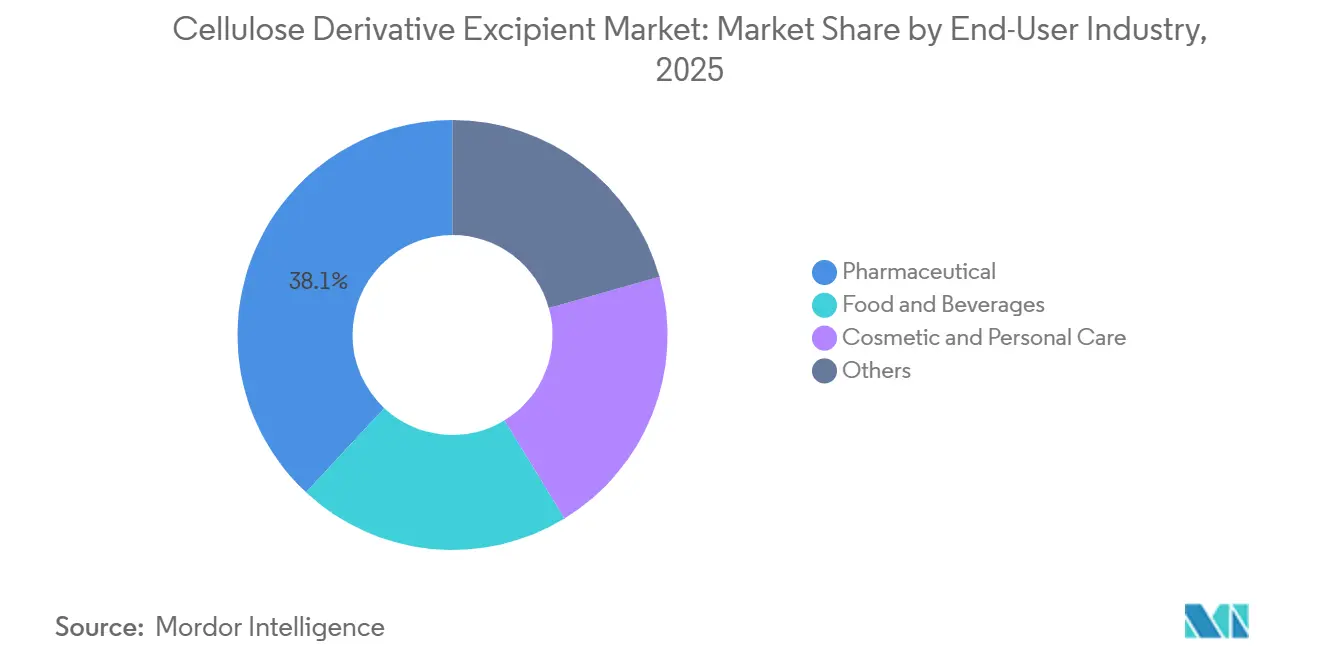
- By end-user industry, pharmaceuticals held 38.07% of the cellulose derivative excipient market share in 2025, while cosmetic and personal care is forecast to expand at a 10.23% CAGR through 2031.
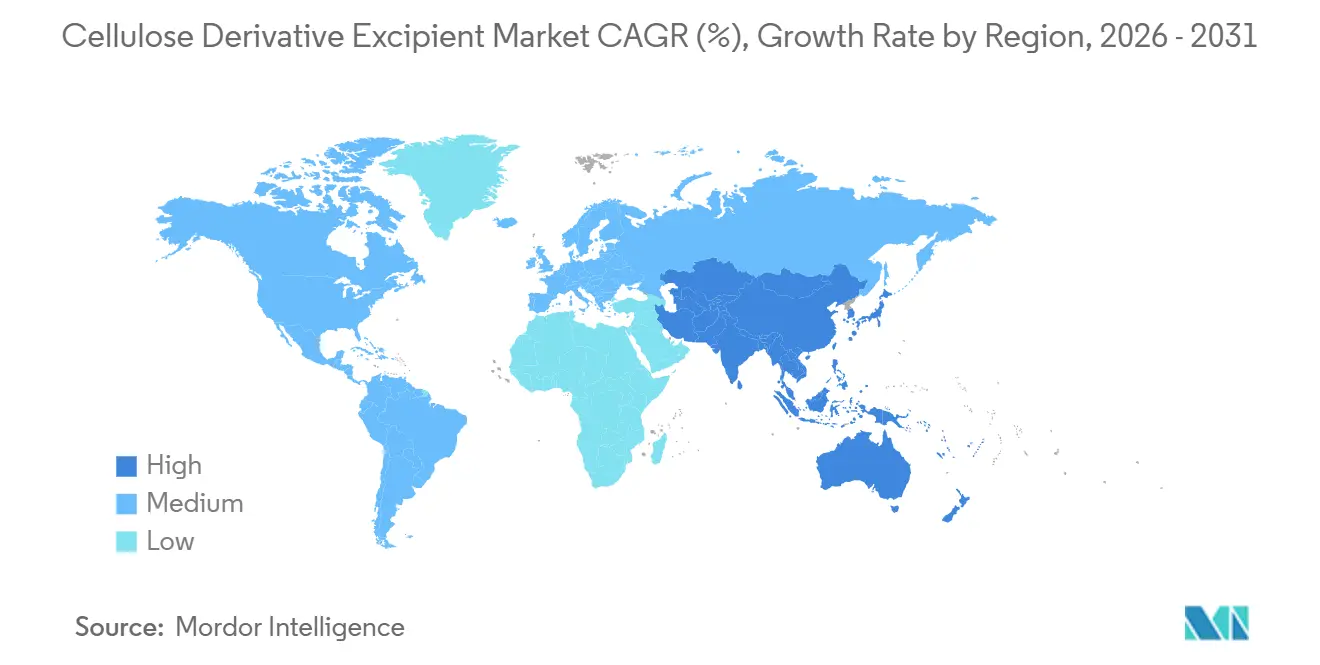
- By geography, Asia-Pacific held 33.48% of the cellulose derivative excipient market share in 2025 and is forecast to grow at a 10.05% CAGR through 2031.
Note: Market size and forecast figures in this report are generated using Mordor Intelligence’s proprietary estimation framework, updated with the latest available data and insights as of January 2026.
Global Cellulose Derivative Excipient Market Trends and Insights
Drivers Impact Analysis*
| Drivers | (~) % Impact on CAGR Forecast | Geographic Relevance | Impact Timeline |
|---|---|---|---|
| Expansion of Oral Solid Dosage Manufacturing | +2.8% | Global, concentrated in Asia-Pacific, including India and China, and Europe | Short term (≤ 2 years) |
| Adoption of Modified-Release and Controlled-Release Formulations | +2.1% | North America and Europe, with spillover to the Asia-Pacific | Medium term (2-4 years) |
| Rising Demand for Direct-Compression and Continuous Manufacturing Grades | +1.5% | Global, with early adoption in North America and Germany | Medium term (2-4 years) |
| Shift Toward Renewable and Biodegradable Excipients | +1% | EU and North America initially, expanding to Asia-Pacific | Long term (≥ 4 years) |
| Growth of Nutraceutical and Functional Formulations | +0.9% | North America, Asia-Pacific, and Europe | Short term (≤ 2 years) |
| Source: Mordor Intelligence | |||
Expansion of Oral Solid Dosage Manufacturing Pulls Through Cellulose Demand
Tablets remain the dominant finished dosage form, and direct compression is gaining share over wet granulation in 2025. This method relies heavily on high-performance Microcrystalline Cellulose (MCC) and co-processed cellulose excipients, as material flow and compaction consistency directly affect tablet production. Generic drug production in India and China is particularly important to the cellulose derivative excipient market, as it broadens the customer base for these materials and increases demand for qualified grades. Oral solid dosage investments are increasingly located near excipient production, shortening lead times and reducing supply chain costs for integrated manufacturers. This location pattern also gives buyers a clearer connection between planned tableting capacity and future requirements for binders, fillers, disintegrants, and coating materials. Hovione completed a EUR 40 million (USD 46.40 million) expansion at its Loures tablet manufacturing center in August 2026, adding 25% more commercial-scale batch tableting capacity and strengthening demand for high-grade MCC and Hydroxypropyl Methylcellulose (HPMC) binders[1]Hovione, “Hovione Completes €40 Million Expansion of Loures Tablet Manufacturing Center Adding Commercial-Scale Batch Tableting Capacity,” Hovione Press Release, hovione.com..
Adoption of Modified-Release and Controlled-Release Formulations
Hypromellose (HPMC) is widely used as a matrix-forming polymer in hydrophilic controlled-release tablets. Its pharmacopeia listings in the United States, Europe, and Japan provide a familiar regulatory route for formulation teams, particularly when a drug product requires a recognized excipient. HPMC swells in gastrointestinal fluid, forming a gel barrier that controls diffusion and matrix erosion. Formulators can select viscosity grades ranging from K4M to K100M to tailor release profiles from 4 to 24 hours, providing flexibility for chronic-disease products where dose regularity matters. FDA guidance on nitrosamine drug substance-related impurities has increased reformulation work on marketed controlled-release products, including decisions involving lower-nitrite-risk excipient grades. Ethyl cellulose and cellulose acetate broaden the material set by providing diffusion-barrier coatings for multiparticulate modified-release systems.
Rising Demand for Direct-Compression and Continuous Manufacturing Grades
Continuous manufacturing removes wet-granulation steps and raises the importance of tight material attributes. Under this approach, loss-in-weight feeding consistency, narrow particle-size distribution, and predictable compaction behavior become formal specifications rather than secondary preferences during formulation work. Co-processed MCC and colloidal silicon dioxide combinations are designed for continuous direct compression, where steady material flow is essential for repeatable output. These grades command an 8-12% premium over standard grades, reflecting their specialized performance requirements. A 2025 review found that co-processed excipients can improve flowability, compressibility, and compactibility compared with their individual components. The cellulose derivative excipient market benefits when purpose-built grades enter validated processes, as excipient changes can require qualification cycles lasting 6-18 months and can interrupt established production plans.
Shift Toward Renewable and Biodegradable Excipients
Cellulose derivatives have a plant-derived origin that aligns with demand for renewable excipients. Work on alternative feedstocks is expanding beyond wood and cotton pulp, with attention focused on materials that can meet pharmaceutical performance requirements after processing. A 2026 study found that MCC from banana pseudostem and peduncle met directly compressible excipient performance thresholds. A separate 2026 review identified cassava, millets, sorghum, agave, and other lignocellulosic residues as potential sources when properly processed. BIOGRUND and Seprify introduced SilvaAlba in May 2026 as a renewable MCC-based tablet-whitening ingredient to replace titanium dioxide in nutraceutical coatings. The product responded to the EU food-use ban on titanium dioxide and demonstrated how adjacent regulatory changes can increase interest in purified cellulose grades for coating applications.
Restraints Impact Analysis*
| Restraints | (~) % Impact on CAGR Forecast | Geographic Relevance | Impact Timeline |
|---|---|---|---|
| Raw-Material Supply and Price Volatility | -1.4% | Global, with acute exposure in the Asia-Pacific supply chains | Short term (≤ 2 years) |
| Batch-to-Batch Variability in Natural Feedstocks | -0.9% | Global | Medium term (2-4 years) |
| Nitrite and Nitrosamine Risk in Excipients | -0.7% | Global, with regulatory pressure concentrated in the EU and North America | Short term (≤ 2 years) |
| Source: Mordor Intelligence | |||
Raw-Material Supply and Price Volatility
Pharmaceutical-grade wood pulp and cotton linters are the primary cellulose feedstocks, and their availability does not follow pharmaceutical demand cycles. Forestry cycles, crop failures, logistics disruptions, and currency fluctuations can affect delivered material costs and influence procurement decisions across the cellulose derivative excipient market. Supply concentration means that a single plant outage can affect multiple downstream cellulose categories simultaneously. Propylene oxide adds a petrochemical cost layer for hydroxypropyl cellulose and HPMC production, exposing some grades to both pulp and refinery market conditions. Buyers are increasingly using multi-year supply agreements to limit exposure, but smaller formulators can still face spot-price pressure. This can reduce margins, limit inventory flexibility, and delay product launches when suitable materials are not readily available.
Nitrite and Nitrosamine Risk in Excipients
Trace nitrites in cellulose excipients can react with secondary or tertiary amines in active pharmaceutical ingredients or their fragments during production or storage. The FDA treats nitrosamine impurities as a significant safety concern and published final guidance on September 5, 2024. The guidance set an August 1, 2025, deadline for confirmatory Nitrosamine Drug Substance Related Impurities (NDSRI) testing and related submissions for affected approved applications. EMA reported in July 2025 that reformulation, including the replacement or reduction of high-nitrite grades, remains an effective response when limits are exceeded[2]European Medicines Agency, “Nitrosamine Impurities,” European Medicines Agency, ema.europa.eu.. MEGGLE stated in February 2026 that agencies allow flexibility for complex reformulations, while updates on corrective and preventive action progress remain required. These requirements give suppliers with established testing programs and Drug Master Files a qualification advantage and can narrow approved supplier lists in the cellulose derivative excipient market.
*Our forecasts treat driver/restraint impacts as directional, not additive. The impact forecasts reflect baseline growth, mix effects, and variable interactions.
Segment Analysis
By Product Type: MCC Commands the Core, Hydroxypropyl cellulose (HPC) Widens the Application Base
Microcrystalline cellulose held 42.56% of the cellulose derivative excipient market share in 2025. Its roles as a binder, disintegrant, and filler support its use in direct-compression and wet-granulation tablet formulations. MCC delivers compressibility and tabletability performance at an industrial scale. Its plastic deformation behavior helps maintain tablet integrity across different compression speeds. This performance supports specification continuity among large generic manufacturers in India, China, and Southeast Asia.
Hypromellose was the second-largest product type, used in controlled-release tablet matrices and film-coating systems. Its listings in the USP, European Pharmacopeia 11, and Japanese Pharmacopeia support regulatory confidence in product filings. Carboxymethyl cellulose (CMC) and methyl cellulose are used primarily as suspending agents and stabilizers in liquid and semi-solid dosage forms. Ethyl cellulose provides hydrophobic diffusion barriers in multiparticulate sustained-release systems. Hydroxypropyl cellulose is the fastest-growing product type, with the cellulose derivative excipient market size for this category projected to grow at a 9.86% CAGR from 2026 through 2031. In March 2025, Shin-Etsu announced a JPY 10 billion (USD 0.06 billion) investment in its SE Tylose facility in Germany and its Naoetsu Plant in Japan to support the production of low-substituted hydroxypropyl cellulose (L-HPC) for tablet disintegration and strength enhancement. A 2026 study also reported carboxylated cellulose nanocrystals achieving tablet hardness above 29 N and disintegration times near 3 seconds.



By Function: Binders Account for the Largest Share, Film Coatings Record the Fastest Growth
Binders held 38.11% of the cellulose derivative excipient market share in 2025. Tablet production remains the principal source of demand for binder-grade MCC. Its inert chemistry, low residual-solvent risk, and broad compatibility with active pharmaceutical ingredients (APIs) support its role as a default filler-binder. Stabilizers and suspending agents primarily consist of CMC and HPMC, which are used in liquid formulations, oral suspensions, and ophthalmic preparations. Supplier and viscosity-grade choices are often embedded in regulatory filings, which raises switching barriers.
Bio-adhesives and gelling agents represent smaller but high-value applications. HPMC K4M and CMC are used in mucoadhesive and hydrogel drug delivery applications for poorly permeable APIs. Film-coating agents are the fastest-growing functional category, with the cellulose derivative excipient market size projected to grow at a 9.91% CAGR from 2026 through 2031. Taste masking, moisture protection, the EU E171 ban on food and nutraceutical coatings, and the expansion of aqueous coating lines in India and China all support demand. In June 2026, Ashland began construction of a fourth Aquarius tablet-coatings manufacturing facility in Ambernath, Maharashtra. Co-processed HPMC coating systems can combine pigment dispersion, adhesion, and moisture resistance in a premix, reducing development and documentation work.
By End-User Industry: Pharmaceuticals Set the Demand Foundation, Cosmetics Accelerate
Pharmaceuticals accounted for 38.07% of the cellulose derivative excipient market share in 2025. Pharmacopeia listings and FDA GRAS status for key cellulose derivatives reduce the risk of substitution in validated products. Generic drug manufacturing accounts for most of the pharmaceutical output, particularly in direct-compression MCC applications. Biosimilar and specialty generic formulators are seeking lower nitrite levels and narrower particle-size distributions, creating demand for premium cellulose grades with greater pricing power than commodity material.
Food and beverage applications use CMC and MCC as texture modifiers, fat replacers, and stabilizers. Plant-based meat and dairy alternatives are driving demand for grades with water-binding capacity in high-protein formulations. Cosmetics and personal care are the fastest-growing end-user categories, projected to expand at a 10.23% CAGR from 2026 through 2031. HPC supports film formation and rheology control in hair styling gels, toners, and essence waters, where formulators prefer plant-derived cellulose ethers over synthetic polymers. The EU Cosmetics Regulation (EC) No. 1223/2009 and comparable national regulations are increasing requests for natural-origin certification, biodegradability information, and supply chain documentation. Veterinary pharmaceuticals, nutraceuticals, and contract manufacturing organizations also use cellulose grades as fillers and flow aids in complex tablet formulations.
Geography Analysis
Asia-Pacific held 33.48% of the cellulose derivative excipient market share in 2025 and is forecast to grow at a 10.05% CAGR through 2031. The region combines oral solid dosage manufacturing capacity with pharmaceutical raw-material processing. China is a regional producer and consumer of cellulose derivatives. Its position as a major exporter means that production and pricing decisions can affect supply conditions in other markets. India plays a different role, with growing domestic capacity aimed at reducing reliance on imported polymer excipients.
North America is a mature demand center led by the United States. The region is characterized by high excipient prices, rigorous supplier qualification periods of 6-18 months, and a shift from batch processes to continuous direct compression. These changes increase the need for consistent microcrystalline cellulose (MCC) and co-processed cellulose grades. Canada and Mexico are primarily downstream generic-drug markets that follow U.S. pharmacopeia standards. Mexico's growing contract development and manufacturing organization (CDMO) activity supports demand for mid-tier excipient grades. Europe's demand base is shaped by European Medicines Agency (EMA) quality requirements and growing interest in renewable-feedstock variants and plant-based tablet-coating systems.
South America has a smaller but notable role in the cellulose derivative excipient market. Brazil is the leading regional demand center, and Argentina supports regular consumption for generic oral solid dosage products. The Middle East and Africa represent the smallest regional groupings in the cellulose derivative excipient market. Saudi Arabia is a demand driver, driven by its domestic pharmaceutical manufacturing ambitions. South Africa functions as both a consumer and a small-scale regional production base for generic drug excipients. Both regions may see demand increase as CDMOs establish production closer to cost-sensitive emerging markets and require internationally approved cellulose grades.

Competitive Landscape
The cellulose derivative excipient market is moderately fragmented at the upstream cellulose production level, while the formulated excipient tier comprises more regional specialists and application-focused suppliers. IFF holds the broadest cellulose excipient portfolio, including the METHOCEL and ETHOCEL brands across HPMC, methyl cellulose, and ethyl cellulose. Shin-Etsu Chemical, Ashland, and JRS are other tier-one suppliers with manufacturing operations across multiple countries. Their Drug Master File portfolios and pharmacopeia monograph positions make supplier changes difficult for formulators. Indian producers, including Sigachi Industries, are shifting from commodity materials to specification-grade supply for regulated generic drug applications.
Shin-Etsu's March 2025 investment announcement for its L-HPC business demonstrated the value of process expertise and listings across Japanese, U.S., and European pharmacopeias. The market is also seeing wider use of distribution partnerships that expand reach without requiring new sales organizations. Colorcon entered an exclusive partnership with ASHA Cellulose in May 2025 for organo-soluble ethyl cellulose across EMEA, Northeast Asia, and Southeast Asia. Ashland entered into an exclusive distribution agreement with Univar Solutions in January 2026 for cellulose ethers for food and beverage applications across EMEA. These arrangements allow specialty brands to expand regional availability while retaining direct focus on pharmaceutical customers.
Few suppliers offer pre-validated, continuous-manufacturing-optimized cellulose grades with sufficient supply coverage for multiregional procurement. This gap supports differentiation for companies that can meet process and quality requirements at scale. Cellulose nanocrystal producers and developers of agricultural-waste-derived microcrystalline cellulose (MCC) are emerging participants. Their technology remains pre-commercial at scale, but academic results are generating interest in direct-compression applications. The cellulose derivative excipient market is shaped by established suppliers, growing regional producers, and specialized material developers. Competitive positions depend on product performance, regulatory documentation, manufacturing coverage, and reliable access to qualified feedstocks.
Cellulose Derivative Excipient Industry Leaders
International Flavors & Fragrances Inc.
Ashland
Shin-Etsu Chemical Co., Ltd.
Roquette Frères
J. RETTENMAIER & SÖHNE GmbH + Co KG
- *Disclaimer: Major Players sorted in no particular order

Recent Industry Developments
- August 2026: Hovione completed a EUR 40 million (USD 46.40 million) investment at its Loures, Portugal tablet manufacturing center, adding 25% more commercial-scale batch tableting capacity with a mirrored second line across dispensing, granulation, tableting, and film coating. This expansion strengthens integrated amorphous solid dispersion and tablet manufacturing at a single site, increasing demand for cellulose-based film-coating and binding excipients. The site serves 19 of the world's 20 largest pharmaceutical companies.
- July 2026: Lotte Fine Chemical (South Korea) began commercial production from its expanded food and pharmaceutical cellulose line, reaching 18,000 tons per year capacity. Since 2020, the company has invested more than KRW 350 billion (approximately USD 254 million) in cellulose, with 2025 capital expenditure of KRW 263.6 billion (approximately USD 191 million).


Global Cellulose Derivative Excipient Market Report Scope
A cellulose derivative excipient is an inactive, plant-based substance derived from natural cellulose that is added to medications to support the safe and effective delivery of the active drug. These excipients serve multiple functional roles in pharmaceutical formulations, including acting as binders, fillers, disintegrants, and controlled-release agents.
The cellulose derivative excipient market is segmented by product type, function, end-user industry, and geography. By product type, the market is segmented into microcrystalline cellulose, hypromellose, hydroxypropyl cellulose, carboxymethyl cellulose, methyl cellulose, ethyl cellulose, and other cellulose derivatives. By function, the market is segmented into binders, film-coating agents, stabilizers and suspending agents, bio-adhesives, gelling agents, and others. By end-user industry, the market is segmented into pharmaceutical, food and beverages, cosmetic and personal care, and others. The report also covers market size and forecasts for cellulose derivative excipients across 15 countries in major regions. The market sizes and forecasts are provided in terms of value (USD).
| Microcrystalline Cellulose |
| Hypromellose |
| Hydroxypropyl Cellulose |
| Carboxymethyl Cellulose |
| Methyl Cellulose |
| Ethyl Cellulose |
| Other Cellulose Derivatives |
| Binders |
| Film-Coating Agents |
| Stabilizers and Suspending Agents |
| Bio-Adhesives |
| Gelling Agents |
| Others |
| Pharmaceutical |
| Food and Beverages |
| Cosmetic and Personal Care |
| Others |
| Asia-Pacific | China |
| India | |
| Japan | |
| South Korea | |
| Rest of Asia-Pacific | |
| North America | United States |
| Canada | |
| Mexico | |
| Europe | Germany |
| United Kingdom | |
| France | |
| Italy | |
| Rest of Europe | |
| South America | Brazil |
| Argentina | |
| Rest of South America | |
| Middle East and Africa | Saudi Arabia |
| South Africa | |
| Rest of Middle East and Africa |
| By Product Type | Microcrystalline Cellulose | |
| Hypromellose | ||
| Hydroxypropyl Cellulose | ||
| Carboxymethyl Cellulose | ||
| Methyl Cellulose | ||
| Ethyl Cellulose | ||
| Other Cellulose Derivatives | ||
| By Function | Binders | |
| Film-Coating Agents | ||
| Stabilizers and Suspending Agents | ||
| Bio-Adhesives | ||
| Gelling Agents | ||
| Others | ||
| By End-User Industry | Pharmaceutical | |
| Food and Beverages | ||
| Cosmetic and Personal Care | ||
| Others | ||
| By Geography | Asia-Pacific | China |
| India | ||
| Japan | ||
| South Korea | ||
| Rest of Asia-Pacific | ||
| North America | United States | |
| Canada | ||
| Mexico | ||
| Europe | Germany | |
| United Kingdom | ||
| France | ||
| Italy | ||
| Rest of Europe | ||
| South America | Brazil | |
| Argentina | ||
| Rest of South America | ||
| Middle East and Africa | Saudi Arabia | |
| South Africa | ||
| Rest of Middle East and Africa | ||


Key Questions Answered in the Report
What is current market size of Cellulose Derivative Excipient Market?
The cellulose derivative excipient market size was valued at USD 2.17 billion in 2025 and is estimated to grow from USD 2.38 billion in 2026 to USD 3.68 billion by 2031, at a CAGR of 9.13% during the forecast period (2026-2031).
Which product category leads cellulose derivative excipients?
Microcrystalline cellulose led product demand with a 42.56% share in 2025, owing to its roles as a binder, disintegrant, and filler. Its performance supports both direct-compression and wet-granulation tablet formulations.
Which functional use is growing fastest through 2031?
Film-coating agents are forecast to grow at a 9.91% CAGR through 2031. Demand is supported by taste masking, moisture protection, the replacement of titanium dioxide in relevant applications, and additional capacity for aqueous coating.
Why are nitrosamines relevant to excipient selection?
Trace amounts of nitrite can contribute to nitrosamine risk when they interact with susceptible active ingredients. Manufacturers are assessing lower-nitrite grades, maintaining testing records, and preparing reformulations where risk assessments identify a need.
Page last updated on:





