
Canned Wines Market Size and Share
Market Overview
| Study Period | 2021 - 2031 |
|---|---|
| Market Size (2026) | USD 605.42 Million |
| Market Size (2031) | USD 923.41 Million |
| Growth Rate (2026 - 2031) | 8.81 % |
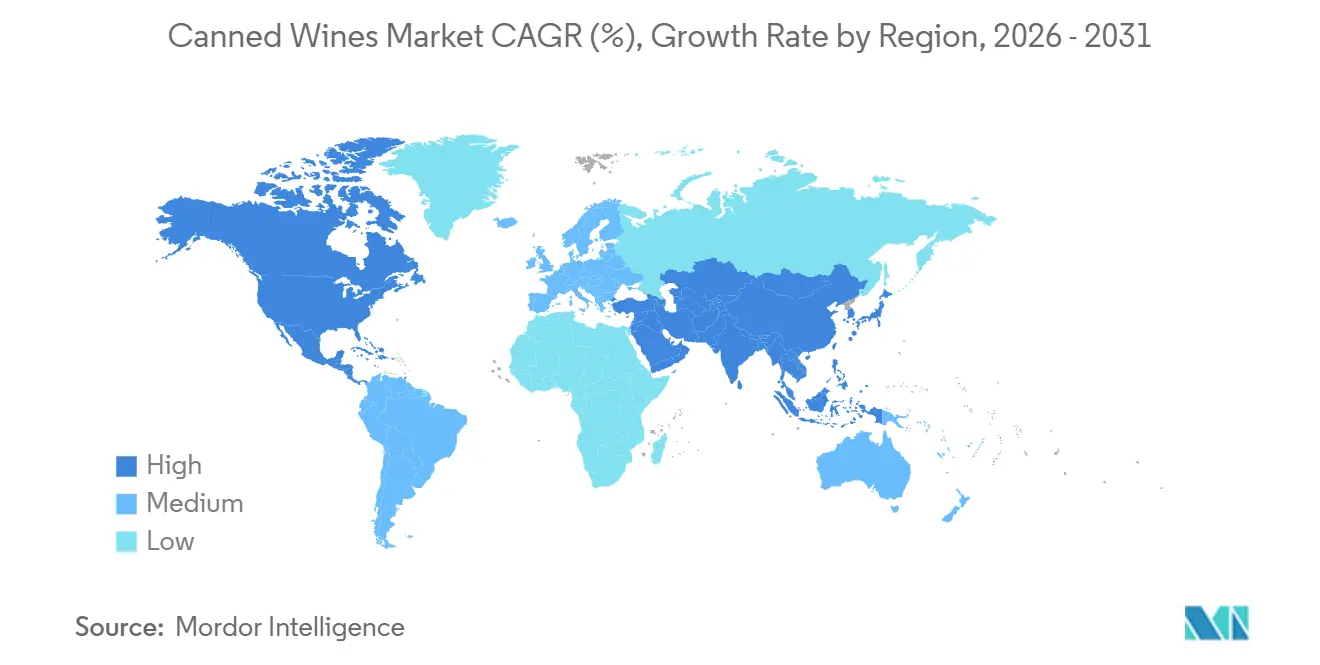
| Fastest Growing Market | Asia-Pacific |
| Largest Market | North America |
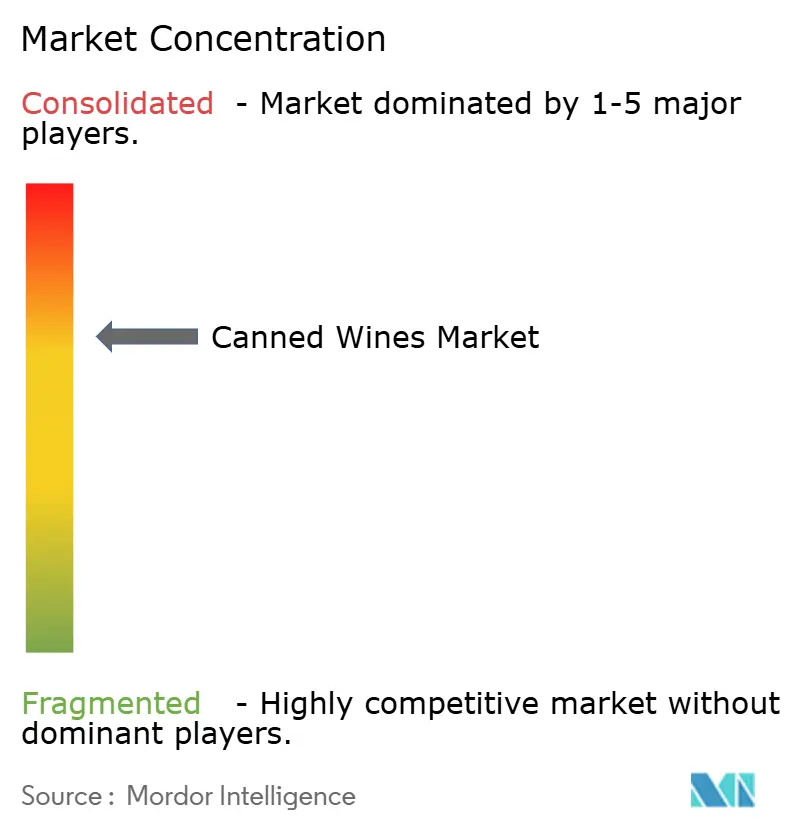
| Market Concentration | Medium |
Major Players *Disclaimer: Major Players sorted in no particular order Image © Mordor Intelligence. Reuse requires attribution under CC BY 4.0. | |
Canned Wines Market Analysis by Mordor Intelligence
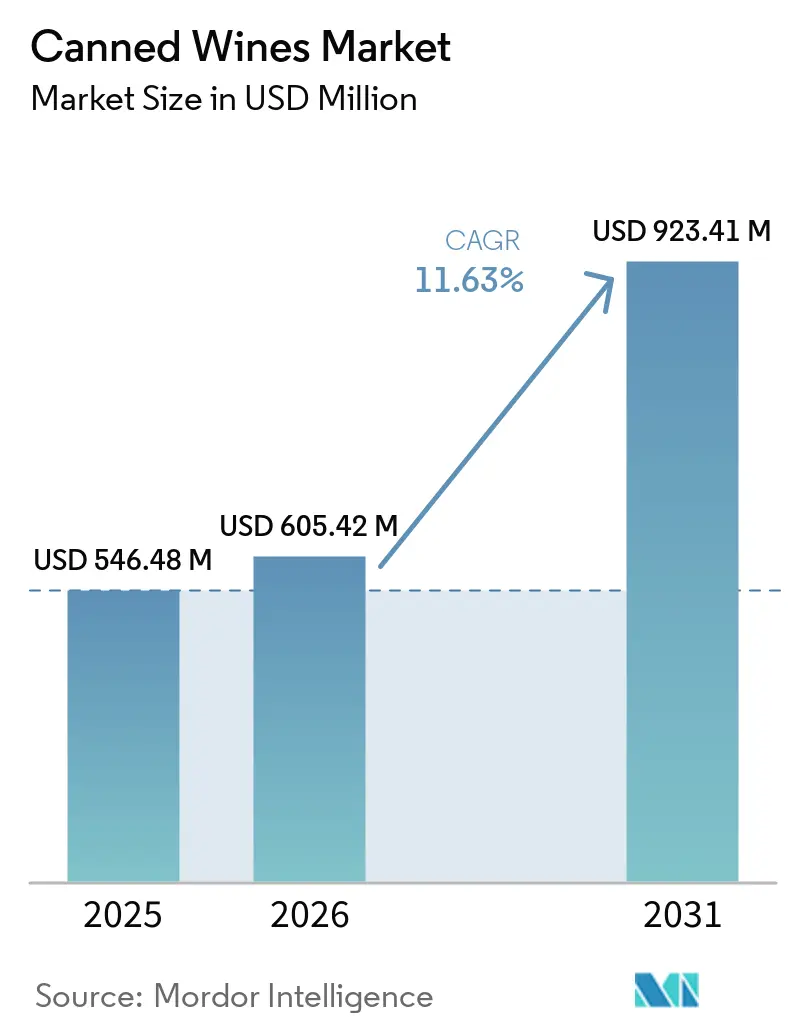
The canned wines market size was valued at USD 546.48 million in 2025 and estimated to grow from USD 605.42 million in 2026 to reach USD 923.41 million by 2031, at a CAGR of 8.81% during the forecast period (2026-2031). The format is moving beyond novelty purchases because it fits single-serve, travel, and glass-restricted occasions. It also gives wine producers a route into occasions that have been served mainly by canned cocktails and other ready-to-drink beverages. Premium formats are gaining attention where brands can demonstrate provenance, quality, and product stability. Larger wine companies are concentrating on higher-priced brands, which can create room for specialist canned wine labels in retail and hospitality. Consumer confidence in taste and quality remains important, especially in established wine regions where packaging can influence expectations.
Key Report Takeaways
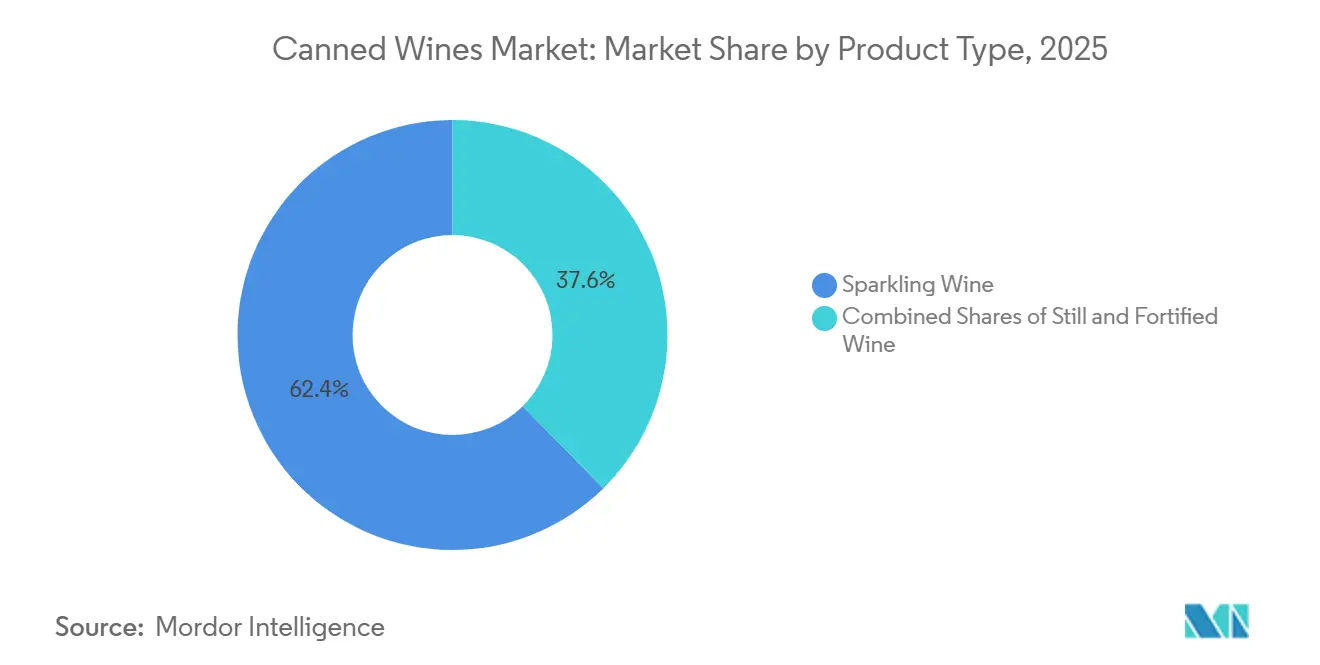
- By product type, sparkling wine held 62.38% of the canned wines market share in 2025, while fortified wine is set to record the highest projected CAGR at 13.45% through 2031.
- By form, white wine held 72.36% of the category share in 2025, while red wine is expected to reach a CAGR of 13.52% through 2031.
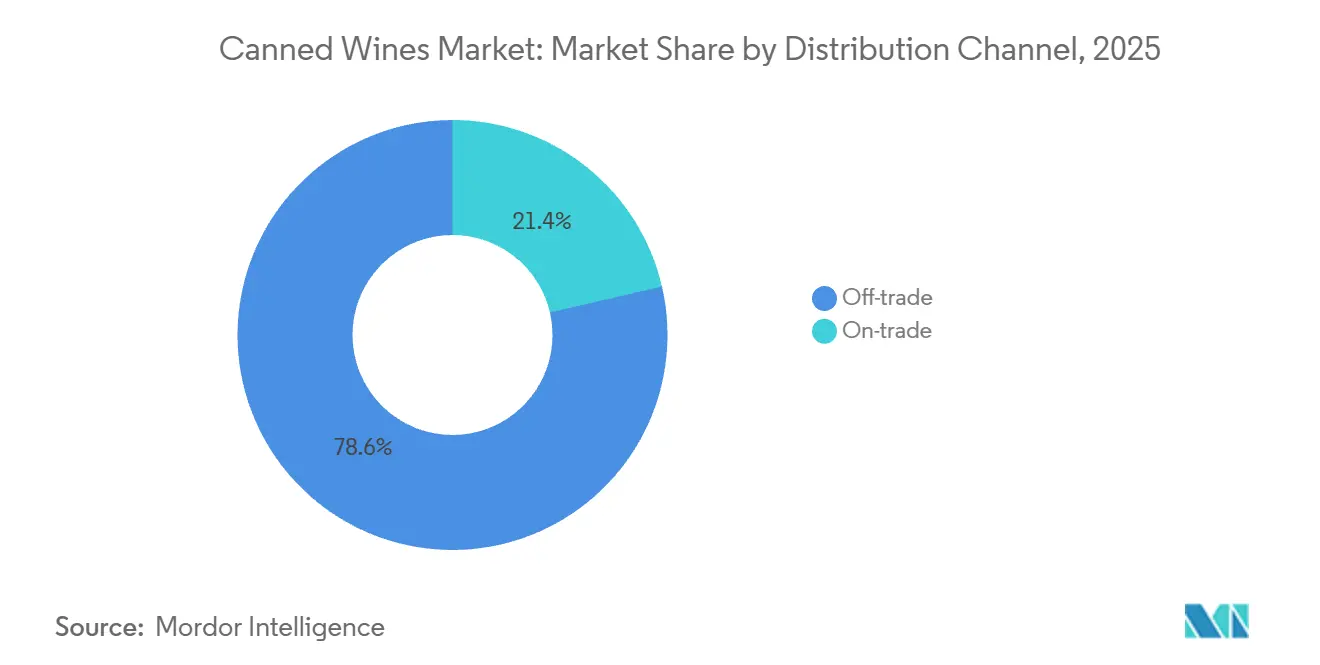
- By distribution channel, off-trade held 78.62% of the category share in 2025, while on-trade is expected to reach a CAGR of 13.21% through 2031.
- By geography, North America held 52.38% of the canned wines market share in 2025, while Asia-Pacific is expected to reach a CAGR of 12.67% through 2031.
Note: Market size and forecast figures in this report are generated using Mordor Intelligence’s proprietary estimation framework, updated with the latest available data and insights as of January 2026.
Market Trends and Insights
Drivers Impact Analysis of Canned Wines Market*
| Driver | (~) % Impact on CAGR Forecasts | Geographic Relevance | Impact Timeline |
|---|---|---|---|
| Growing demand for convenient drinks packaging | +2.8% | Global, concentrated in North America and Western Europe | Short term (≤ 2 years) |
| Rising premiumization of ready-to-drink alcoholic beverages | +2.4% | North America and Europe, with spillover to Asia-Pacific | Medium term (2-4 years) |
| Rising outdoor, festival, travel, and event consumption | +1.9% | Global, especially North America, Asia-Pacific, and South America | Short term (≤ 2 years) |
| Sustainability advantages of lightweight aluminum packaging | +1.6% | Core European Union markets, with spillover to North America | Medium term (2-4 years) |
| E-commerce and direct-to-consumer brand discovery | +1.2% | North America and Asia-Pacific digital commerce leaders | Medium term (2-4 years) |
| Increasing product innovation and flavor diversification | +1.4% | Global, particularly North America and Asia-Pacific | Long term (≥ 4 years) |
| Source: Mordor Intelligence | |||
Growing Demand for Convenient Drinks Packaging
Convenient packaging is expanding wine consumption into outdoor events, cinemas, flights, stadiums, and other venues where glass bottles are less practical. Single-serve cans reduce breakage, handling, waste, and portion-control challenges while offering consumers a lower-commitment way to try wine. Strong demand in entertainment settings, such as Archer Roose Wines supplying 2,400 cases to Regal Cinemas within six months, demonstrates the potential of these occasions. Cans also benefit from retail placement alongside ready-to-drink beverages, helping brands reach younger and occasion-driven consumers. The format complements rather than replaces bottled wine, serving individual consumption, travel, picnics, and casual gatherings. As distribution expands across retail, hospitality, travel, and entertainment, convenience-led consumption is expected to support the growth of the canned wines market.
Rising Premiumization of Ready-to-Drink Alcoholic Beverages
Premiumization is expanding the role of cans in wine, with producers using single-vineyard sourcing, vintage information, organic credentials, and lower-additive claims to justify higher price points. Archer Roose Wines’ launch of an Australian Pinot Noir at USD 19 per 4-pack demonstrates how premium wine attributes can be communicated through canned formats. Fortified products such as Sogrape’s Offley Clink Portonic Rosé further show how cans can introduce established wine styles to new leisure and social occasions. Provenance, transparent labeling, recognizable varietals, and consistent quality are essential for building consumer trust and sustaining premium pricing. Four-packs also combine premium positioning with single-serve convenience, creating opportunities across retail, hospitality, and outdoor consumption occasions. As wine companies increasingly focus on differentiated, higher-margin products, premium canned wines can benefit from stronger branding and clearer quality credentials.
Sustainability Advantages of Lightweight Aluminum Packaging
Aluminum packaging gives wine brands a measurable sustainability message. The Aluminum Association and Can Manufacturers Institute reported that the average U.S. aluminum beverage can contained 71% recycled content in 2024, compared with 23% for glass and 3% to 10% for PET plastic[1]Source: Aluminum Association and Can Manufacturers Institute, “The Aluminum Can Advantage: Sustainability Key Performance Indicators,” Aluminum Association, aluminum.org. The same report found that using recycled aluminum saves 80% of the energy required for primary aluminum production. These figures give producers a specific basis for packaging communication. The canned wines market can use this advantage when consumers and retailers assess packaging materials. Environmental claims should remain precise and supported by credible evidence. The report also recorded a 96.7% circularity rate for recycled aluminum content returning to beverage containers. This supports the case for aluminum as a material that can return to the same application. Lightweight packaging may also reduce breakage risk during transport. That practical benefit can matter to online retailers and direct-to-consumer brands. It may reduce the need for protective shipping materials. The effect on total environmental performance still depends on collection systems, transport distances, and consumer disposal behavior.
E-Commerce and Direct-to-Consumer Brand Discovery
Digital selling gives smaller wine brands a route to consumers without immediate access to broad retail distribution. Cans are well suited to parcel delivery because they do not present the same breakage risk as glass. This can reduce fulfillment complexity for direct-to-consumer orders. Online product pages can also explain varietal, serving occasion, pack size, and recycling information in more detail than a shelf label. The canned wines market can use this channel to build awareness before expanding into physical retail. A direct relationship also gives brands more information on repeat purchases and product preferences. Online discovery is particularly useful for products that need explanation. Consumers may understand a familiar Sauvignon Blanc or Pinot Noir but still be uncertain about a can format. Brand videos, tasting notes, and clear product descriptions can reduce that uncertainty. Digital channels allow a producer to test messages and packs with a defined audience. They also support subscription and mixed-case formats. This can help a smaller company manage demand before taking on wider distribution commitments.
Restraints Impact Analysis of Canned Wines Market*
| Restraint | (~) % Impact on CAGR Forecasts | Geographic Relevance | Impact Timeline |
|---|---|---|---|
| Strict alcohol packaging and labeling regulations | -1.0% | North America, European Union, and Asia-Pacific | Medium term (2-4 years) |
| High competition from other ready-to-drink alcoholic beverages | -0.8% | Global | Short term (≤ 2 years) |
| Taste stability and product compatibility challenges | -0.6% | Global | Medium term (2-4 years) |
| Limited shelf space in traditional wine sections | -0.5% | North America and Europe | Short term (≤ 2 years) |
| Source: Mordor Intelligence | |||
Strict Alcohol Packaging and Labeling Regulations
Alcohol regulation creates costs for canned wine producers, especially when they sell across several countries. The U.S. Alcohol and Tobacco Tax and Trade Bureau proposed mandatory Alcohol Facts statements for wines and other regulated alcohol products on January 17, 2025[2]Source: “Alcohol Facts Statements in the Labeling of Wines, Distilled Spirits, and Malt Beverages,” Federal Register, federalregister.gov. The proposal covers per-serving calorie, alcohol, and nutrient disclosures. Smaller companies may find it harder to manage label updates and approvals. The canned wines market can face longer launch timelines when packaging requirements change. Producers need compliance planning before they commit to design and inventory. TTB added 13 standards of fill for wine in its January 2025 final rule. The approved sizes include 330 ml, 360 ml, 473 ml, and 568 ml formats that are relevant to canned wine. The change gives producers more flexibility in pack design. It also requires companies to consider new Certificate of Label Approval filings when they adopt a new size. This means flexibility comes with an administrative requirement. Brands with established compliance teams may respond more easily than small entrants.
Taste Stability and Product Compatibility Challenges
Taste stability remains a technical issue for wine in aluminum cans. Cornell University researchers identified BPA epoxy, ValPure V70 BPA-NI epoxy, and aTULC laminated polyester as acceptable liner materials for sulfited beverages. The research found that these liners kept hydrogen sulfide formation below 10 µg/L after 6 months. This is close to the 1 µg/L sensory threshold cited by the researchers. The findings show that product performance depends on the liner specification, not simply on the use of a can. Canned wine producers need detailed contracts with packaging suppliers. The Cornell research also warned that unsuitable acrylic liners created noticeable off-aromas within 1 week. A documented 2024 incident involved a supplier substituting an acrylic liner for the contracted ValPure V70 material. The substitute produced 10 times the hydrogen sulfide output in accelerated testing. This shows why supplier transparency is critical. Brands should require approval before any liner substitution is made.
*Our forecasts treat driver/restraint impacts as directional, not additive. The impact forecasts reflect baseline growth, mix effects, and variable interactions.
Canned Wines Market Segment Analysis
By Product Type:
Sparkling Wine Leads While Fortified Wine Grows FastestSparkling wine held 62.38% of the category share in 2025. Its position reflects a close fit with individual servings at outdoor events, gifting occasions, and entertainment venues. The container can prevent an opened bottle from losing effervescence when only 1 serving is needed. Still Wine remained the secondary product type and supported a broad range of price points. It gives producers a route to everyday consumption across different geographies. Sparkling products are likely to retain an advantage where the occasion requires portable, chilled, and simple service.
Fortified wine is forecast to grow at a 13.45% CAGR through 2031, the highest among product types. The canned wines market size for fortified formats can expand as Port and sherry-based drinks are positioned for leisure rather than formal dining. Sogrape’s Offley Clink Portonic Rosé offers an example through its canned Port and tonic format. The product addresses consumers who may not choose a conventional bottle of fortified wine. Premium sourcing and clear product stories remain important across all product types. Cans can extend the reach of wine without requiring producers to compromise on recognizable styles.



By Form:
White Wine Leads While Red Wine Builds Technical ConfidenceWhite wine accounted for 72.36% of the category share by form in 2025. Chilled consumption occasions such as picnics, beaches, and outdoor events align closely with white wine. Sauvignon Blanc and Pinot Grigio are familiar styles that can make the format easier to understand. White wines also have lower tannin levels and simpler phenolic structures than many reds. These characteristics can make packaging selection more straightforward. Producers can use this position to build broad retail availability while maintaining clear wine-style communication.
Red wine is projected to grow at a 13.52% CAGR through 2031. Archer Roose Wines launched an Australian Pinot Noir in March 2025 as its first new red varietal in 5 years. The 2025 ACS study supports the feasibility of suitable canned red wines over a 6-month storage period. Cornell’s liner guidance gives producers a framework for specifying appropriate packaging. These developments can reduce concern among buyers when products are tested and supplied under controlled specifications. Red wine growth will depend on proven quality, not on format claims alone.
By Distribution Channel:
Off-Trade Leads While On-Trade Expands FasterOff-trade channels held 78.62% of the category share in 2025. Supermarkets and hypermarkets provide the main volume base because they offer broad shelf reach. Specialty stores can introduce premium and single-vineyard labels to consumers seeking differentiated products. Online retail adds a channel for products discovered through digital content. The sturdy format can reduce breakage risk in delivery. Off-trade remains central to scale because consumers can buy cans for home, outdoor, and travel occasions.
On-trade is forecast to grow at a 13.21% CAGR through 2031. Bars, restaurants, stadiums, theaters, airlines, and hotels can use cans where glass creates operational limits. Archer Roose Wines expanded its presence across Dave & Buster’s locations, Regal Cinemas, Vail Resort Group properties, and Atrium Hospitality hotels. These venues show that active and casual settings can support wine service outside traditional dining. Canned Wine Group also launched 20-liter wine kegs for United Kingdom on-trade service in early 2025, targeting freshness and waste in wine-by-the-glass programs. The channel can grow where format choice solves a genuine service problem.
Geography Analysis
North America Canned Wines Market
North America held 52.38% of the category share in 2025. The United States has established ready-to-drink distribution and a retail environment where single-serve alcohol is a familiar category. TTB’s 2025 standards of fill rule added 330 ml, 360 ml, 473 ml, and 568 ml options for wine[3]Source: Alcohol and Tobacco Tax and Trade Bureau, “TTB Adds New Standards of Fill for Wine and Distilled Spirits,” Alcohol and Tobacco Tax and Trade Bureau, ttb.gov. These sizes can give brands more flexibility in packaging and service design. Canada’s outdoor and ski-tourism occasions also fit the product. Mexico’s urban middle class can add to regional demand as availability broadens.
APAC Canned Wines Market
Asia-Pacific is forecast to grow at a 12.67% CAGR through 2031. India has a developing premium canned wine opportunity. Sula Vineyards reported that premium canned wines outsold bottled wine at SulaFest 2025 and expanded its canned offering to IndiGo international business-class flights in March 2025. The flight placement introduced Indian canned wine to international aviation distribution. Japan has strong consumer familiarity with single-serve packaged beverages. China’s Tier 1 and Tier 2 cities offer a longer-term opportunity among consumers interested in lifestyle beverages.
EMEA and South America Canned Wines Market
Europe has differentiated demand across its wine markets. In the United Kingdom, Ocado Retail reported that Canned Wine Co. Gamay sales rose 212% year over year and M&S California Rosé tins rose 541% in the 12 months to July 2025. Germany, France, and the Benelux countries have stronger bottle-based wine traditions. South America has production assets that can support domestic canned formats, especially in Argentina and Chile. The Middle East and Africa remain early-stage markets because alcohol regulations constrain access in many Gulf Cooperation Council markets. South Africa and selected North African markets may offer future demand as licensed hospitality infrastructure expands.

Competitive Landscape
The canned wines market includes established wine companies and specialist brands. Established companies bring distribution networks, portfolio depth, and regulatory resources. Specialist brands tend to focus on format-specific occasions, direct consumer communication, and packaging quality. This creates a competitive environment with different strengths rather than a single business model. Constellation Brands completed the sale of Woodbridge, Meiomi, Robert Mondavi Private Selection, Cook’s, SIMI, and J. Rogét to The Wine Group in June 2025. The company retained brands generally priced at USD 15 and above. This can create openings for challenger brands seeking retail and distributor attention.
Technical capability is becoming a competitive requirement. Archer Roose Wines worked with Cornell University and the New York Wine and Grape Foundation on can-liner specifications for freshness. This type of work can help brands provide evidence for product quality. It can also make a supply relationship more defensible when specifications are tightly managed. Larger companies can apply centralized compliance and purchasing resources to similar problems. Smaller brands must focus their investment where it creates a clear consumer or operating advantage.
Companies are also using acquisitions and portfolio changes to increase capability. Terold Invest acquired Off-Piste Wines in April 2026, bringing Most Wanted into a group with Argentine production and wider sourcing resources. The transaction joined U.K. brand-development capability with larger wine supply capacity. White-space opportunities remain in regional styles such as Albariño, Vinho Verde, and Torrontés, as well as lower-alcohol wine products. These opportunities require credible wine quality and a clear occasion.
Canned Wines Industry Leaders
Union Wine Company
Treasury Wine Estates Ltd.
Constellation Brands, Inc.
The Family Coppola
The Wine Group LLC
- *Disclaimer: Major Players sorted in no particular order
Canned Wines Market Companies Covered in this Report
- Union Wine Company
- Treasury Wine Estates Ltd.
- Constellation Brands, Inc.
- The Wine Group LLC
- The Family Coppola
- Integrated Beverage Group LLC
- Sula Vineyards Pvt. Ltd.
- Accolade Wines
- Suntory Holdings Limited
- Pernod Ricard
- Diageo plc
- Brown-Forman Corporation
- Anheuser-Busch InBev
- Molson Coors Beverage Company
- Canned Wine Co.
- SANS Wine Co.
- Maker Wine Company
- Archer Roose Wines
- Nomadica
- The Infinite Monkey Theorem

Recent Industry Developments in Canned Wines Market
- June 2025: Constellation Brands completed the sale of mainstream wine brands including Woodbridge, Meiomi, Robert Mondavi Private Selection, Cook’s, SIMI, and J. Rogét to The Wine Group, retaining exclusively brands priced predominantly at USD 15 and above. The associated organizational restructuring is expected to deliver net annualized savings exceeding USD 200 million by fiscal year 2028.
- April 2025: Villa Maria launched its award-winning Marlborough Private Bin Sauvignon Blanc in a 200ml can across major UK retailers, marking the brand’s first move into canned wine. The launch targets growing demand for premium, portable wine formats, particularly for outdoor occasions such as picnics and barbecues.
- March 2025: Sula Vineyards partnered with IndiGo, India’s largest carrier, to offer Sula Chenin Blanc and Red Zinfandel premium canned wines on its newly launched international business-class routes, marking the first deployment of Indian canned wine in international aviation.


Global Canned Wines Market Report Scope
Canned wine is packaged in sealed aluminum cans rather than traditional glass bottles. It is designed for young, fresh consumption within 12 to 18 months and offers a lightweight, portable option for outdoor events.
The canned wines market report is segmented by product type (still wine, sparkling wine, and fortified wine), form (red wine and white wine), distribution channel (on-trade and off-trade), and geography (North America, Europe, Asia-Pacific, South America, and Middle East and Africa). The market forecasts are provided in terms of value (USD).
| Still Wine |
| Sparkling Wine |
| Fortified Wine |
| Red Wine |
| White Wine |
| On-Trade | |
| Off-Trade | Supermarkets/Hypermarkets |
| Specialty Stores | |
| Online Retail Channels | |
| Other Distribution Channels |
| North America | United States |
| Canada | |
| Mexico | |
| Rest of North America | |
| Europe | Germany |
| United Kingdom | |
| France | |
| Italy | |
| Spain | |
| Netherlands | |
| Sweden | |
| Poland | |
| Belgium | |
| Rest of Europe | |
| Asia-Pacific | China |
| India | |
| Japan | |
| Australia | |
| South Korea | |
| Vietnam | |
| Indonesia | |
| Thailand | |
| Singapore | |
| Rest of Asia-Pacific | |
| South America | Brazil |
| Argentina | |
| Chile | |
| Peru | |
| Colombia | |
| Rest of South America | |
| Middle East and Africa | United Arab Emirates |
| Saudi Arabia | |
| South Africa | |
| Nigeria | |
| Egypt | |
| Morocco | |
| Turkey | |
| Rest of Middle East and Africa |
| Product Type | Still Wine | |
| Sparkling Wine | ||
| Fortified Wine | ||
| Form | Red Wine | |
| White Wine | ||
| Distribution Channels | On-Trade | |
| Off-Trade | Supermarkets/Hypermarkets | |
| Specialty Stores | ||
| Online Retail Channels | ||
| Other Distribution Channels | ||
| By Geography | North America | United States |
| Canada | ||
| Mexico | ||
| Rest of North America | ||
| Europe | Germany | |
| United Kingdom | ||
| France | ||
| Italy | ||
| Spain | ||
| Netherlands | ||
| Sweden | ||
| Poland | ||
| Belgium | ||
| Rest of Europe | ||
| Asia-Pacific | China | |
| India | ||
| Japan | ||
| Australia | ||
| South Korea | ||
| Vietnam | ||
| Indonesia | ||
| Thailand | ||
| Singapore | ||
| Rest of Asia-Pacific | ||
| South America | Brazil | |
| Argentina | ||
| Chile | ||
| Peru | ||
| Colombia | ||
| Rest of South America | ||
| Middle East and Africa | United Arab Emirates | |
| Saudi Arabia | ||
| South Africa | ||
| Nigeria | ||
| Egypt | ||
| Morocco | ||
| Turkey | ||
| Rest of Middle East and Africa | ||


Key Questions Answered in the Report
What is the forecast growth rate for canned wines?
The canned wines market is forecast to grow at a CAGR of 8.81% from 2026 to 2031.
What will canned wines be worth by 2031?
The category is forecast to reach USD 923.41 million by 2031.
Which canned wine product type is the largest?
Sparkling wine held the leading 62.38% share in 2025.
Which form of canned wine is growing fastest?
Red wine is projected to grow at a 13.52% CAGR through 2031.
Page last updated on:


 Your data is secure and never sold or shared.


