
Market Overview
| Study Period | 2020 - 2031 |
|---|---|
| Forecast Data Period | 2026 - 2031 |
| Base Year Market Size (2025) | USD 3.12 Billion |
| Market Size (2026) | USD 3.29 Billion |
| Market Size (2031) | USD 4.12 Billion |
| Growth Rate (2026 - 2031) | 4.58 % |
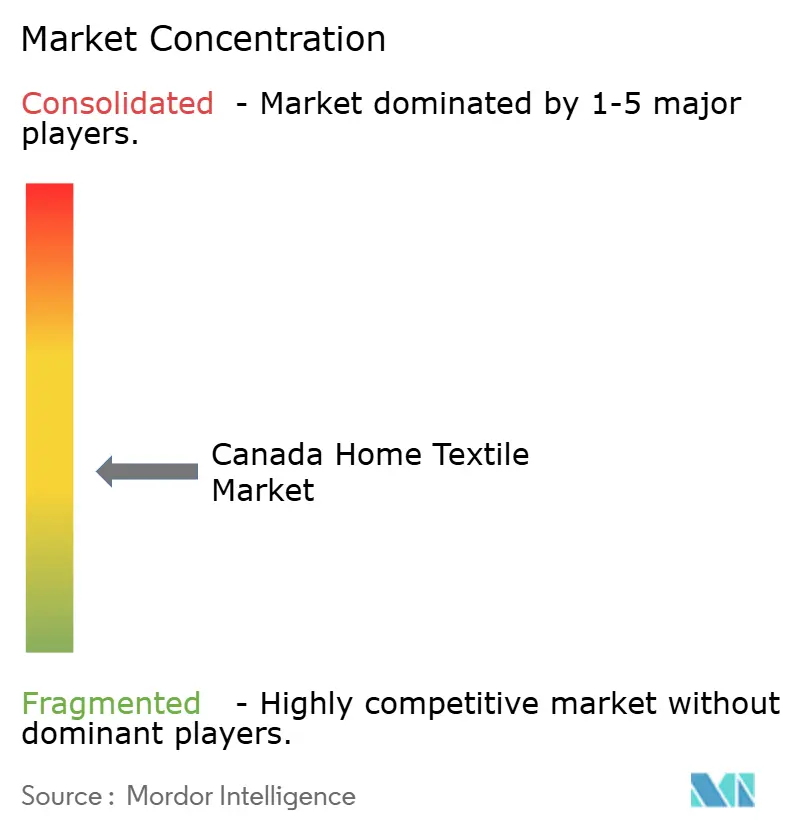
| Market Concentration | Medium |
Major Players *Disclaimer: Major Players sorted in no particular order Image © Mordor Intelligence. Reuse requires attribution under CC BY 4.0. | |
Canada Home Textile Market Analysis by Mordor Intelligence
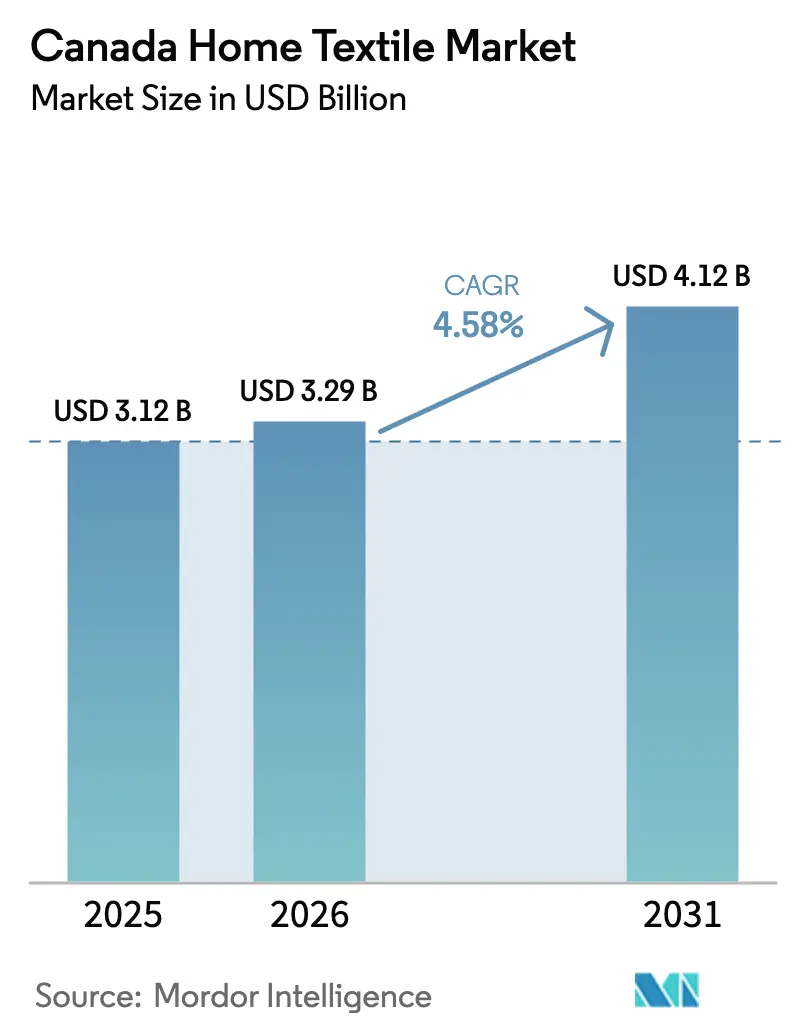
The Canada Home Textile Market size is projected to expand from USD 3.12 billion in 2025 and USD 3.29 billion in 2026 to USD 4.12 billion by 2031, registering a CAGR of 4.58% between 2026 to 2031.
Procurement reforms such as the Buy Canadian Policy are shifting federal demand toward domestic suppliers while moderating import reliance in public projects. Residential building activity is stable at a national level, although monthly data show volatility that influences near-term order flows for bed, bath, and window textiles. E-commerce scale advantages improve selection and speed, yet offline stores remain the dominant channel for tactile discovery and assisted selling in the Canada home textile market. Hospitality performance is mixed across months, and commodity costs for cotton and synthetics add margin pressure that favors wrinkle-resistant, antimicrobial, and quick-dry fabrics in institutional settings[1]Source: Public Services and Procurement Canada, “Government of Canada implements Buy Canadian Policy to strengthen Canada’s economy and support homegrown industries,” Government of Canada, canada.ca.
Key Report Takeaways
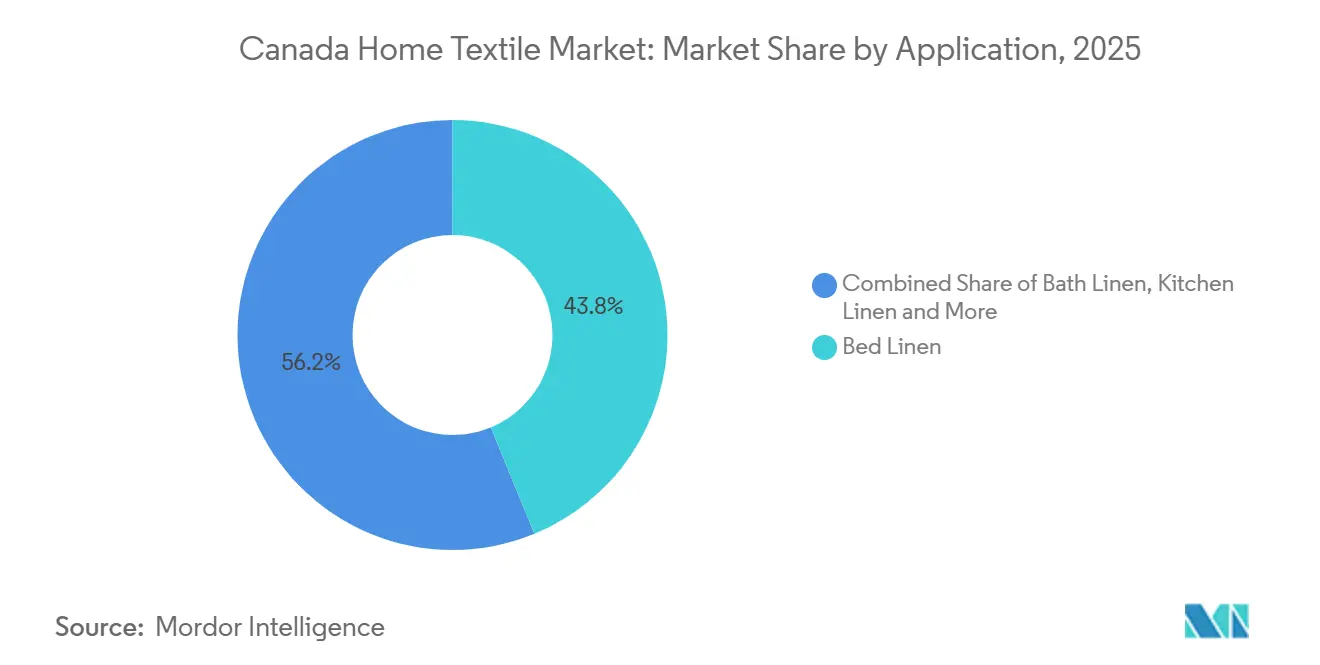
- By application, bed linen led with 43.77% share in 2025 in the Canada home textile market, while upholstery is forecast to grow at 5.61% CAGR through 2031.
- By material, cotton held a 56.25% share in 2025 in the Canada home textile market, while synthetic fibers are projected to rise at a 4.93% CAGR through 2031.
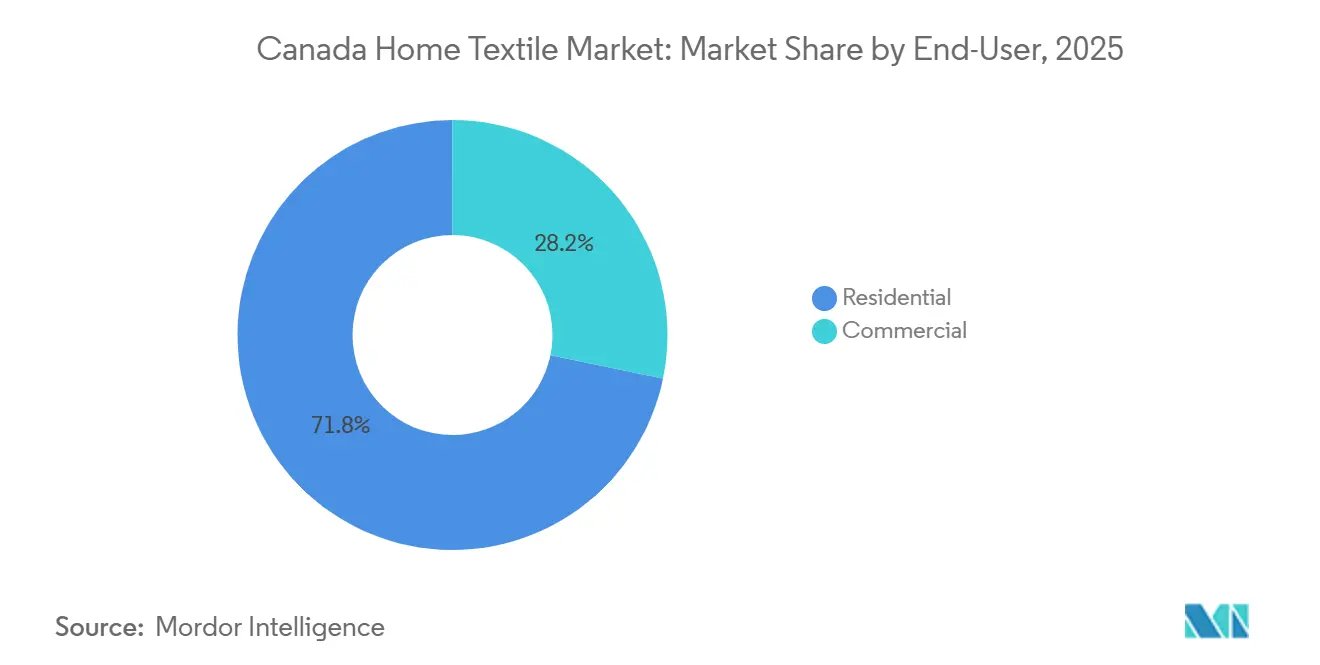
- By end-user, residential accounted for a 71.75% share in 2025 in the Canada home textile market, while commercial is set to expand at a 4.62% CAGR through 2031.
- By distribution channel, offline captured 76.13% share in 2025 in the Canada home textile market, while online is expected to grow at 6.15% CAGR through 2031.
- By geography, Ontario held a 35.31% share in 2025 in the Canada home textile market, while British Columbia is projected to grow fastest at a 6.41% CAGR through 2031.
Note: Market size and forecast figures in this report are generated using Mordor Intelligence’s proprietary estimation framework, updated with the latest available data and insights as of January 2026.
Canada Home Textile Market Trends and Insights
Drivers Impact Analysis*
| Driver | (~) % Impact on CAGR Forecast | Geographic Relevance | Impact Timeline |
|---|---|---|---|
| Rising Demand for Sustainable Home Textiles | + 0.8% | Global, with early gains in Ontario, British Columbia, and Quebec | Medium term (2-4 years) |
| Growth in Residential Construction & Renovations | +1.2% | National, strongest in Quebec, Atlantic, and Prairie provinces | Short term (≤ 2 years) |
| Expansion of E-commerce Home Décor Platforms | +0.9% | National, urban concentration in Toronto, Montreal, and Vancouver | Medium term (2-4 years) |
| Hospitality Sector Recovery Post-COVID-19 | +0.6% | National, strongest in Newfoundland/Labrador, Nova Scotia | Short term (≤ 2 years) |
| Government Incentives for Domestic Textile Manufacturing | +0.5% | National, regulatory compliance through ISO, CSA, and federal procurement | Long term (≥ 4 years) |
| Indigenous Design Collaborations Driving Local Appeal | +0.4% | Regional, highest in Quebec, British Columbia, Prairie provinces | Medium term (2-4 years) |
| Source: Mordor Intelligence | |||
Rising Demand for Sustainable Home Textiles
Environment and Climate Change Canada funded Fashion Takes Action in March 2025 to advance the Canadian Circular Textiles Consortium, which mobilizes stakeholders to pilot fabric-scrap collection and align circularity standards in the Greater Toronto Area[2]Source: Environment and Climate Change Canada, “Government of Canada invests in Canadian innovators to reduce textile and plastic waste and promote circular economy,” Government of Canada, canada.ca. Quebec’s regional planning targets a higher textile recovery rate by 2031, supported by municipal drop-off coordination and écocentre acceptance that together set a clearer policy path for diversion from landfills. Retailers and brands are responding with greener materials and verified claims, including Naia-based blends and certified down or rug-pad components promoted at retail, which cater to buyers willing to pay a premium for validated sustainability attributes. Grassroots supply-chain initiatives such as Fibreshed Québec’s research and events seek to formalize standards for local wool and facilitate farm-to-finished product linkages that cut transport emissions. Export capacity and scale remain uneven, which constrains domestic labels that still source greige textiles offshore when local mills lack throughput, as reflected in provincial trade profiles.
Growth in Residential Construction & Renovations
Total housing starts reached 245,367 units in 2024 at a national level, while multi-unit activity sustained completions that underpin recurring demand for bed and bath basics in the Canada home textile market[3]Source: Statistics Canada, “Canada Mortgage and Housing Corporation, housing starts, under construction and completions, all areas, annual,” Statistics Canada, statcan.gc.ca. Through November 2025, year-to-date starts were higher than the prior year, although the monthly trend softened, which underlines the near-term variability in purchase planning for retailers and suppliers. Quebec outperformed on several housing indicators in late 2025, and that momentum supports broader assortment planning for bed linen, window coverings, and rugs. In this environment, modern smaller-format concepts such as IKEA’s Plan and Order Points deepen category engagement in bedrooms and living rooms, supported by a network expansion and an investment program to reduce prices across key SKUs. These shifts combine structural and channel effects that sustain the Canada home textile market as households plan staged upgrades for bedrooms, bathrooms, and living spaces.
Expansion of E-commerce Home Décor Platforms
E-commerce reach has scaled with large platforms that add SKUs and accelerate fulfillment, which widens the consideration set for textiles and décor purchases in the Canada home textile market. Wayfair’s investor communication highlights the breadth of its North American addressable home category and the influence of its fulfillment assets for two-day delivery on best sellers, which underpins its bedding and related textile lines. Offline retail still commands the majority of transactions for home textiles, yet omni services and digital merchandising increase conversion in urban cores where high-intent shoppers seek in-stock options. Duty assessments and compliance checks add cost and complexity to cross-border e-commerce models, as reflected in Wayfair’s reported CBSA-related charges, which vendors must factor into pricing and inventory turnover. The channel landscape, therefore, blends in-store curation with digital convenience in the Canada home textile market, especially in bedding, terry, and window categories.
Hospitality Sector Recovery Post-COVID-19
Hotel performance strengthened in October 2025 with occupancy and RevPAR growth that supports higher linen turnover at full-service properties, followed by a softer November that showed the sector’s sensitivity to event-driven comparisons across key cities. Tourism’s macro contribution rose in 2024, with increased arrivals and trips reflected in employment levels, which reinforces room-night demand and replacement cycles for bed and bath textiles[4]Source: Statistics Canada, “Tourism among the fastest growing sectors in 2024, setting the stage for 2025,” Statistics Canada, statcan.gc.ca. Hospitality procurement trends favor durable blends and antimicrobial options, as shown in buyer guides and supplier programs linked to recognized environmental and building standards relevant for institutional buyers. These specifications support consistent performance in high-laundry environments while helping operators manage energy, water, and compliance requirements. The result is a steady institutional baseline for the Canada home textile market that ebbs and flows with occupancy patterns.
Restraints Impact Analysis*
| Restraint | (~) % Impact on CAGR Forecast | Geographic Relevance | Impact Timeline |
|---|---|---|---|
| Volatile Cotton & Poly-fiber Prices | -0.7% | Global commodity markets, import costs amplified by CAD weakness | Short term (≤ 2 years) |
| Import Competition from Low-Cost Asian Producers | -0.9% | National, acute in value retail channels and online marketplaces | Long term (≥ 4 years) |
| Retail Footprint Contraction of Big-Box Stores | -0.5% | Ontario, Manitoba, Alberta - former HBC strongholds | Short term (≤ 2 years) |
| Skilled Labor Shortage in Canadian Textile Mills | -0.3% | Quebec, Ontario - legacy manufacturing hubs | Long term (≥ 4 years) |
| Source: Mordor Intelligence | |||
Volatile Cotton & Poly-fiber Prices
Cotton price and availability dynamics influence sourcing costs for mills and retailers, with industry updates in early 2025 signaling tighter ending stocks and shifting price floors that affect budget planning and replenishment decisions. Hospitality procurement guidance emphasizes fiber blends and durability to extend wash cycles and manage per-unit costs, which shapes specifications for sheets and terry lines used in hotels and institutions. Retailers respond with price guarantees, targeted promotions, and multi-SKU price investments to defend value perception across core bedding and bath assortments. These moves help offset commodity headwinds in the Canada home textile market and limit inventory risk tied to long ocean lead times. The outcome favors blends that deliver consistent performance across laundering and daily use.
Import Competition from Low-Cost Asian Producers
The majority of home textile imports originate from established supply hubs in Asia, and tariff treatment and trade controls shape how goods enter Canada under relevant customs and trade frameworks. Compliance and duty reviews can add cost to cross-border e-commerce participants, as shown in Wayfair’s reported liabilities related to CBSA assessment for 2021–2023 imports. Domestic players respond by emphasizing curation, inventory visibility, and omnichannel service as differentiators when unit-price competition is intense. Premium brick-and-mortar expansions support this approach by offering tactile discovery and integrated pickup and delivery options. These adjustments moderate but do not eliminate the price gap that motivates imports in the Canada home textile market.
*Our forecasts treat driver/restraint impacts as directional, not additive. The impact forecasts reflect baseline growth, mix effects, and variable interactions.
Segment Analysis
By Application: Upholstery Gains as Remote Work Fuels Home-Office Retrofits
Bed linen commanded 43.77% of the Canada home textile market share in 2025, while upholstery is projected to expand at a 5.61% CAGR through 2031. Households continue to refresh bedrooms and living rooms at a steady pace as new builds deliver occupancy and as existing units undergo staged updates. The Canada home textile market benefits from displays and consultative selling in stores that simplify material selection for bed, sofa, and window categories. IKEA’s growing Plan and Order Point network complements large-store coverage by putting bedroom and living-room planning services closer to customers in metro and growth corridors. Bedding and drapery innovation aligns with practical needs such as blackout, thermal insulation, and hypoallergenic attributes, which support premium trading in the Canada home textile market.
Canada's home textile market size for upholstery is projected to expand at a 5.61% CAGR through 2031, alongside rising at-home work and entertainment needs. Hospitality procurement trends also reinforce performance fabrics in the wider ecosystem, with durable blends designed for frequent washing cycles. Specialty assortments and curated online experiences help shoppers navigate thread counts, finishes, and weave types without overpaying for features that do not align with usage. Retailers balance core bed-linen price points with seasonal color and texture updates in throws and accent pillows. These dynamics lift the category mix and keep the Canada home textile market responsive to evolving room configurations.


By Material: Synthetic Fibers Close the Gap on Cotton Dominance
Cotton held a 56.25% share in 2025, while synthetic fibers are projected to rise at a 4.93% CAGR through 2031. Product development emphasizes performance aspects such as wrinkle resistance and quick-drying properties that reduce energy use and turnaround time for laundering. In institutional settings, blended constructions support longevity and colorfastness across hundreds of wash cycles, which sustains predictable replacement calendars. Consumer-facing assortments integrate new cellulosic blends and sustainably sourced inputs to enrich hand feel without sacrificing durability. The Canada home textile market shifts toward verified materials and traceability that reinforce quality claims.
Canada's home textile market size for synthetic fibers is projected to expand at a 4.93% CAGR through 2031 as procurement and consumer preferences converge on easy-care benefits. Industry updates indicate tighter cotton supply conditions in 2025 that influence pricing floors and mix decisions, which support blended-fiber growth trajectories. Premium linen and wool retain a distinct niche in bedding, throws, and décor where natural aesthetics and thermoregulation matter, supported by regional fiber initiatives and artisan communities. The overall material mix remains diversified and responsive to use-case requirements across residential and commercial end markets in the Canada home textile market.
By End-User: Commercial Segment Lags Despite Hospitality Recovery
Residential accounted for a 71.75% share in 2025, and steady household formation underpins baseline demand for bedding, towels, drapery, and accent textiles. Hotel performance in 2025 contributed to higher textile turnover in strong months, though comparisons later in the year showed variability across provinces. Procurement guidelines continue to specify durable blends for industrial laundering, which shifts the commercial mix toward performance constructions. The Canada home textile market sees incremental institutional gains, although residential still drives the majority of sales through the forecast window.
Canada home textile market size for the commercial segment is expected to grow at 4.62% CAGR through 2031 based on updated budgets, facility refresh cycles, and compliance-driven product specifications. Supplier networks for institutional categories integrate sustainability standards in towels and sheets, which adds value beyond basic cost per unit. Residential channels emphasize seasonal themes and comfort features that support both aesthetics and wellness. The result is a balanced but residential-led demand profile in the Canada home textile market.
By Distribution Channel: E-Commerce Gains Share Despite Offline Dominance
Offline channels captured 76.13% of sales in 2025 and continue to anchor tactile discovery, bundled room planning, and same-day pickup in most urban centers. Flagship expansions and localized formats extend reach in growth corridors, which stabilizes foot traffic in bedding and bath categories where material touch and drape are important. Branded collaborations and licensed collections add distinctiveness to shelf sets and online storefronts in the Canada home textile market.
Online channels are expected to grow at a 6.15% CAGR through 2031 as merchandising depth, reviews, and delivery improve conversion in bed linen, towels, and window coverings. Wayfair’s category strategy and logistics capabilities position it to capture repeat purchases in bedding and décor, with two-day fulfillment on best sellers that align with customer expectations. Cross-border duty assessments add friction for some platforms, as reported in statutory filings, which vendors must anticipate in pricing models. The channel mix remains omnichannel in the Canada home textile market, and it benefits from integrated rewards and localized fulfillment.
Geography Analysis
Ontario retained leadership with a 35.31% share in 2025, supported by the province’s large installed base and deep retail coverage. The province experienced housing-start variability in late 2025, which influenced short-term traffic and replenishment patterns for home textile categories. Canada home textile market size in British Columbia is projected to rise at 6.41% CAGR through 2031, and the region’s hotel and multi-family dynamics continue to support linen and décor demand in 2026. Quebec’s performance in 2025 housing metrics and its textile mill employment gains add depth to the provincial ecosystem as mills align with public procurement and trade provisions under CUSMA.
The rest of Canada consolidates a diversified base across Alberta, Saskatchewan, Manitoba, and the Atlantic provinces. Markets with strong resource and tourism exposure sustain hotel demand and linen turnover when events and travel patterns stabilize. National housing activity in 2024 and 2025 supports core bedroom and bath categories, with multi-unit completions underpinning move-in bundles in the Canada home textile market. Retail expansions tailored to local catchments, including small-format planning studios, help maintain access and service levels in smaller metros.
Policy frameworks now include domestic-content prioritization for eligible procurements, which aligns with mills that document traceability and meet ISO and CSA standards for public projects. Quebec’s municipal valorization targets for textiles further encourage post-consumer collection and reuse initiatives, which can influence local assortment and sourcing practices over time. Ontario’s scale, British Columbia’s growth trajectory, and Quebec’s industrial base together frame the demand and supply context for the Canada home textile market into 2031.
Regulatory Landscape
Canada's home textile market is shaped by consumer safety and mandatory disclosure rules. Health Canada administers the Canada Consumer Product Safety Act (CCPSA) and oversees flammability requirements under the Textile Flammability Regulations (SOR/2016-194), which are commonly assessed using the CAN/CGSB-4.2 No. 27.5 test method for applicable textile products.
Labeling and marketing claims are regulated under the Textile Labelling Act and the Textile Labelling and Advertising Regulations, with enforcement by the Competition Bureau (ISED). Prescribed textile articles must disclose fiber content (by percentage by mass) and dealer identity, including use of a CA Identification Number where applicable. The framework also covers import compliance, including processes for relabeling in Canada when goods arrive improperly labeled, which affects cross-border supply chains and marketplace sellers.
Value Chain Analysis
The Canada home textile value chain starts with upstream fibers and yarns, where cotton and synthetics are prominent, then moves into fabric formation and finishing before conversion into home textile categories such as bed linen, bath linen, window textiles, and upholstery components. Domestic value-add is concentrated in Quebec and Ontario across selected manufacturing and converting activities, while a significant share of finished goods are imported and then distributed through mass merchants, specialty retailers, and e-commerce platforms. Compliance steps, including fiber-content labeling, dealer identification, and flammability where applicable, create process requirements at importing, packaging, and retail-ready stages. The Competition Bureau also provides pathways for domestic relabeling under specified conditions.
Downstream, distribution relies on national retailer networks, online fulfillment, and business-to-business channels serving hospitality and institutions. Laundry and linen processing operators support commercial replacement cycles and standardized specifications, including K-Bro Linen Inc., which operates 11 processing facilities and two distribution centres across Canada. Industry coordination and standards are supported through entities such as the Canadian Textile Industry Association (CTIA) and the Canadian General Standards Board (CGSB), which influence sourcing practices, certification, and product requirements across the chain.
Competitive Landscape
The Canada home textile market is moderately fragmented, with mass merchants, specialty retailers, and large e-commerce platforms competing on price, curation, and convenience. Companies use licensing and exclusive collections to differentiate and capture displaced demand from legacy banners. Canadian Tire’s licensed Hudson’s Bay Stripes Collection extends brand equity across a national footprint and leverages a large loyalty base for bedding and bath sell-through. IKEA continues to expand planning studios for bedrooms and living rooms to grow ticket and conversion with consultative selling. Specialty banners invest in urban markets to enhance in-person experiences and fast fulfillment in the Canada home textile market.
Platform players scale selection and speed while navigating compliance and duty considerations. Wayfair’s investor materials outline scale, traffic, and logistics infrastructure, while statutory filings detail CBSA-related charges that inform pricing and inventory planning for imported goods. Procurement partners in hospitality align product lines with environmental and building standards that matter to institutional buyers, which influences blend ratios and finishing chemistries in terry and sheets. These strategic moves support agility across price tiers and end markets in the Canada home textile market.
Distinctive design sources remain a lever for premium positioning. Indigenous collaborations add unique prints and storytelling value across décor and bedding collections, supported by wholesalers and artisan brands that have built national awareness since 2024. Sustainability-oriented material innovations, including Naia-based blends, present another path to differentiation that third-party certifications at retail can validate. Together, these approaches strengthen brand equity and reinforce the value proposition in the Canada home textile market across both residential and commercial demand.
Canada Home Textile Industry Leaders
IKEA Group
Hudson’s Bay Company
Canadian Tire Corporation
Sleep Country Canada Holdings Inc.
Simons
- *Disclaimer: Major Players sorted in no particular order

Market Opportunities and Future Outlook
Eco-friendly and locally positioned textiles face clearer commercialization pathways when buyers can verify claims and suppliers can document traceability for procurement. CTIA's Canadian Green Textile Label provides a structured route for manufacturers and brands to differentiate lower-carbon products, and it builds on earlier comparative work, including a 2022 pilot study referenced by CTIA, that benchmarks carbon footprints across North American facilities versus international hubs. Federal procurement direction, such as the Buy Canadian Policy, also creates a practical demand lever for qualified domestic suppliers that can meet documentation and standards expectations.
Opportunities also appear in programs and product lines designed to reduce import exposure and improve supply continuity, given the scale of imported home textiles. Trade reporting cited in industry coverage indicates Canada's home textile imports reached CAD 2,135.42 million between January and November 2025, with China at a 36.15% share, which supports the addressable substitution opportunity for select categories and private-label programs. Government-facing decarbonization efforts such as the Net-Zero Challenge, targeting net-zero emissions by 2050, create additional incentives for mills, converters, and brands to invest in lower-carbon processes and measurable product attributes that can be promoted through retail and institutional channels.
Recent Industry Developments
- April 2026: Canadian Tire Corporation announced the Hudson's Bay Stripes Summer 2026 Collection, a 32-piece assortment that includes outdoor textiles such as toss cushions and blankets, timed to launch May 1, 2026. It broadened the Stripes offer beyond core indoor bedding and bath into seasonal use-cases that support repeat purchases and higher visibility across peak shopping periods.
- December 2025: IKEA Canada opened a Plan and Order Point in Abbotsford, British Columbia, with inspirations spanning bedroom, bathroom, and living room categories alongside on-site consultation services. The format supports localized planning for textile-heavy rooms and helps capture demand where a full-size store is not the primary touchpoint.
- April 2024: K-Bro Linen Inc. expanded its international operations by acquiring Shortridge, a laundry provider based in the United Kingdom. The acquisition strengthened scale and operational capability in linen processing, supporting institutional textile demand through more diversified processing capacity and procurement reach.


Research Methodology Framework and Report Scope
Market Definition and Coverage
For this study, the market covers the value of home textile products sold for household use in Canada, across major categories like bedding, bath textiles, kitchen textiles, curtains, and upholstery fabrics.
Scope exclusions: We exclude apparel textiles, industrial and technical textiles, and non-textile home decor items such as furniture, lighting, and hard flooring.
Segmentation Overview
- By Application
- Bed Linen
- Bath Linen
- Kitchen Linen
- Upholstery
- Others
- By Material
- Cotton
- Linen
- Synthetic Fibers
- Other Materials (Wool, Hemp, Silk, Jute, Bamboo)
- By End-User
- Residential
- Commercial
- By Distribution Channel
- Offline
- Mass Merchandisers (Hypermarkets/Supermarkets)
- Home Centers
- Specialty Stores
- Other Offline Channels
- Online
- Offline
- By Geography
- Ontario
- Quebec
- British Columbia
- Rest of Canada
Data Sources, Market Sizing, and Validation
Desk Research
Desk research was used to build the starting demand picture for Canada, and to confirm how the category moves with housing activity and consumer spending. Public sources that helped anchor these inputs included Statistics Canada tables on household spending and retail trade, the Canada Border Services Agency and customs trade statistics for textile imports, the Bank of Canada for inflation context, and the Government of Canada tariff schedules and product definitions.
We also reviewed company annual reports, investor presentations, and retailer updates to understand pricing direction and category mix, for example how bedding and bath items shift versus decorative segments. Patent databases were checked to spot material and finishing trends that can affect premiumization, and an import and export shipment-level database was used selectively to sanity-check the direction of inbound volumes. These sources are not exhaustive, and additional public references were used for data collection, validation, and clarification during the study.
Primary Interviews and Surveys
Primary work was used to stress-test the desk assumptions on category mix, pricing, and the role of promotions versus regular pricing. We spoke with respondents across suppliers, brand owners, distributors, and retail and online channel participants, and the discussion covered Canada-wide demand patterns and differences by province-level buying behavior where relevant. Where gaps showed up in trade data or retailer reporting, follow-up questions were used to align the volume trend with realistic price movement.
Distribution of primary research fieldwork respondents
| Company type | Respondent position |
|---|---|
| Top tier: 29% | CXOs: 15% |
| Mid tier: 51% | Functional/Unit leaders: 37% |
| Smaller Players: 20% | Managers: 48% |
Market-Sizing & Forecasting
The sizing starts with a top-down build that reconstructs Canada demand using household consumption signals and retail-category mapping, which is then reconciled against import intensity for major textile lines. Once the demand pool is set, it is split using practical indicators like household count and new household formation, housing turnover and renovation activity, online share of home goods, and observed price inflation for textile-heavy baskets.
To keep totals realistic, we then corroborate the output with selective bottom-up checks, such as sampled average selling price bands multiplied by plausible unit volumes for key categories, and channel checks on promotion depth and replenishment cycles. Where product lines have weaker public visibility, including private label and smaller importers, we fill gaps by using trade-code direction, retailer assortment breadth, and interview-based mix assumptions, and then adjust back to the total demand pool.
For forecasting, scenario analysis is used around housing and discretionary spending, followed by a smoothing step so year-to-year results do not jump without a clear driver. The final trajectory is refined after aligning the key inputs to what industry participants expect for pricing, replacement cycles, and online penetration in Canada.
Data Validation & Update Cycle
Outputs are checked against independent signals like import value direction, retail sales momentum, and inflation for home-related categories, and then reviewed for outliers at category and channel level. If a variable moves in a way that breaks the story, the assumptions are revisited and, where needed, respondents are re-contacted to confirm what changed.
Before sign-off, the model and written narrative go through multiple analyst review steps so definitions, math, and logic stay consistent. Reports are refreshed annually, and interim updates are made when material events occur, such as sharp tariff shifts, major inflation swings, or sudden demand shocks. Right before delivery, a final pass is completed so the view reflects the latest available data.
Mordor Intelligence's Canada Home Textile Market Size Compared Against Other Published Estimates
Published market values for home textiles in Canada can look far apart because the scope boundary is drawn differently, and because pricing is treated in different ways when inflation and promotions change quickly. Year labeling also matters, since some sources quote a calendar year, while others use a base year and then show a current year that is already adjusted.
The benchmark table shows a spread that is mostly explained by what each source counts as home textiles and how it handles adjacent categories. In Mordor Intelligence's model, only textile-based home products are counted, while items like hard flooring and broader home decor bundles are left out, and price movement is normalized using observed inflation and interview checks instead of a single flat uplift.
Benchmark comparison
| Source | Market Size | Gaps in Research Methodology |
|---|---|---|
| Mordor Intelligence | USD 3.29 B (2026) | |
| Trade Journal A | USD 3.90 B (2026) | Uses a wider basket that can fold in rugs, carpet-like coverings, and non-textile decor add-ons, and it often tracks retail sales at ticket value without consistently separating promotions from underlying price. |
| Regional Consultancy B | USD 2.75 B (2026) | Leans heavily on import-only signals and applies conservative capture rates, which can undercount locally distributed inventory and domestically made or finished items, especially for private label lines. |
Taken together, the differences point back to three practical choices, what products sit inside the boundary, how pricing is adjusted in an inflationary period, and whether trade flows are treated as a full proxy for consumption. By tying the model to repeatable demand indicators and then cross-checking with channel reality, the estimate stays traceable and easier to defend in planning discussions.


Key Questions Answered in the Report
What is the current size and growth outlook for the Canada home textile market?
The Canada home textile market size is USD 3.29 billion in 2026 and is projected to reach USD 4.12 billion by 2031 at a 4.58% CAGR.
Which application category leads demand in Canada?
Bed linen leads with 43.77% share in 2025, while upholstery is the fastest growing segment at a 5.61% CAGR to 2031.
How are materials shifting in the Canada home textile market?
Cotton remains the largest material at 56.25% share, while synthetic fibers are the fastest growing with a 4.93% CAGR through 2031, driven by durability and easy-care benefits.
Which channels will see the most growth through 2031?
Offline remains dominant at 76.13% share in 2025, while online is expected to grow at a 6.15% CAGR through 2031 supported by scale logistics and expanding assortments.
Which province is the largest buyer of home textiles?
Ontario holds a 35.31% share, while British Columbia is projected to post the fastest growth at a 6.41% CAGR through 2031.
What policy changes are most relevant to domestic suppliers?
The Buy Canadian Policy prioritizes domestic content in eligible federal procurements, aligning with CSA and ISO standards and supporting qualified mills and converters.
Page last updated on:





