
Market Overview
| Study Period | 2021 - 2031 |
|---|---|
| Forecast Data Period | 2026 - 2031 |
| Base Year Market Size (2025) | USD 9.8 Billion |
| Market Size (2026) | USD 10.17 Billion |
| Market Size (2031) | USD 12.27 Billion |
| Growth Rate (2026 - 2031) | 3.81 % |
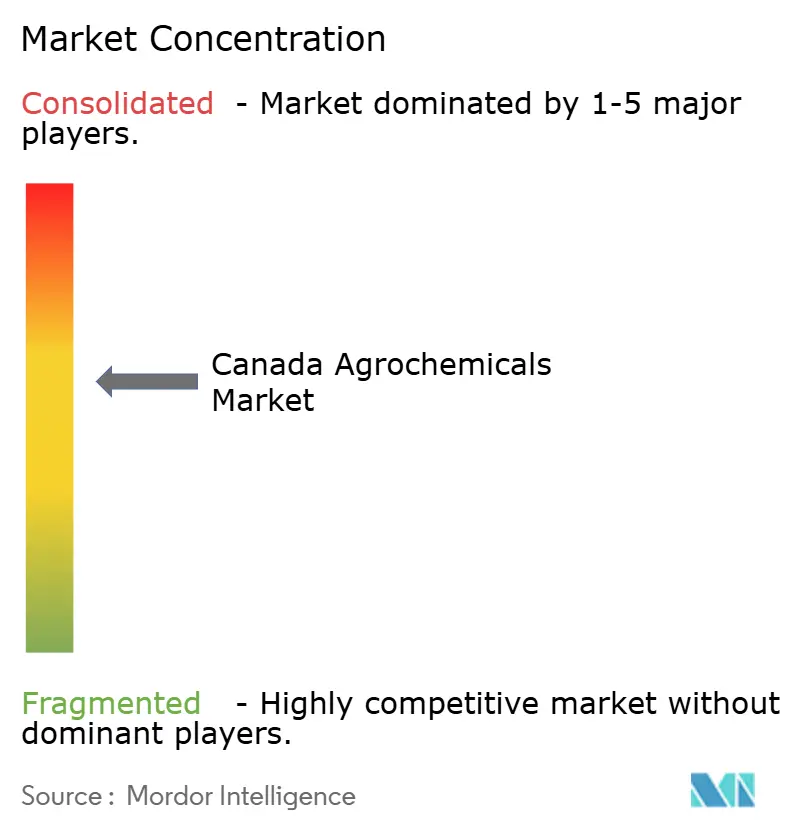
| Market Concentration | Medium |
Major Players *Disclaimer: Major Players sorted in no particular order Image © Mordor Intelligence. Reuse requires attribution under CC BY 4.0. | |
Canada Agrochemicals Market Analysis by Mordor Intelligence
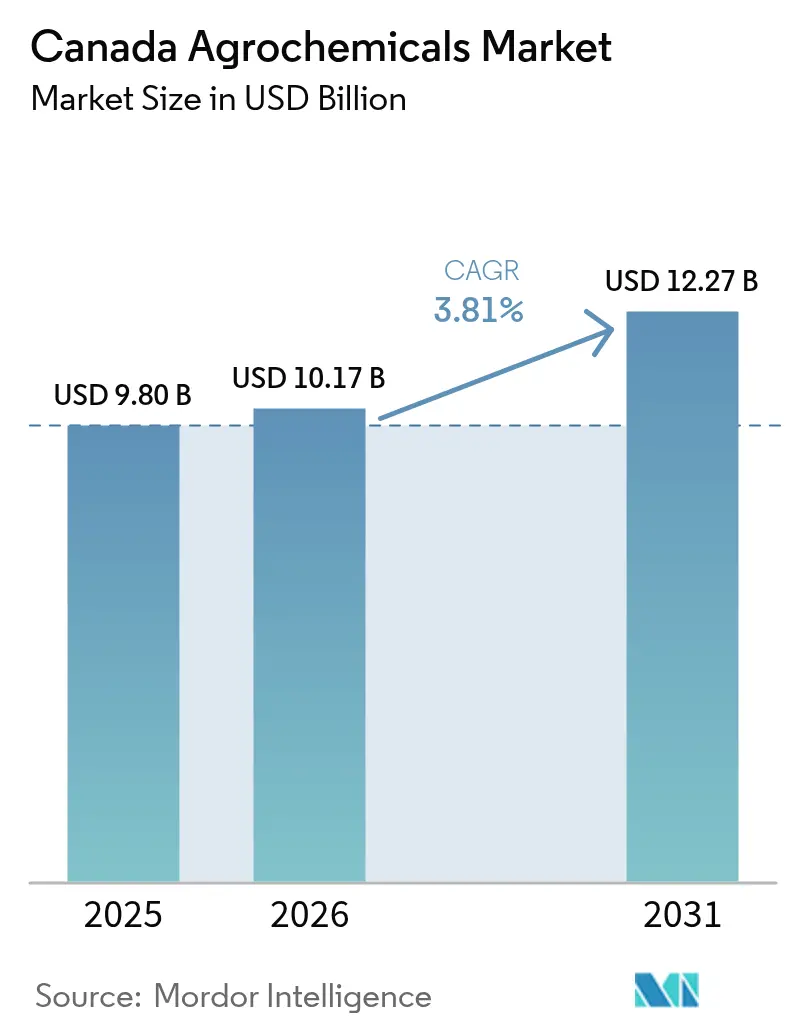
The Canadian agrochemicals market size in 2026 is estimated at USD 10.17 billion, growing from 2025 value of USD 9.8 billion with 2031 projections showing USD 12.27 billion, growing at 3.81% CAGR over 2026-2031. Agricultural demand changes, regulatory updates, and improvements in input distribution infrastructure nationwide support market growth. In June 2025, the expansion of downstream processing facilities, such as Cargill's Regina facility and Richardson International's Yorkton plant, doubled canola crushing capacity, driving the demand for agricultural inputs to meet Asian export requirements. Federal emissions reduction targets, which mandate a 45-50% decrease in greenhouse gas emissions from 2005 levels by 2035, are influencing market dynamics. These targets are prompting fertilizer manufacturers to adopt low-carbon technologies while managing the limitations of rail and port infrastructure that impact potash exports. The competitive landscape is evolving as established companies integrate analytical services with chemical products, while regional players focus on local field trials to attract farmers.
Key Report Takeaways
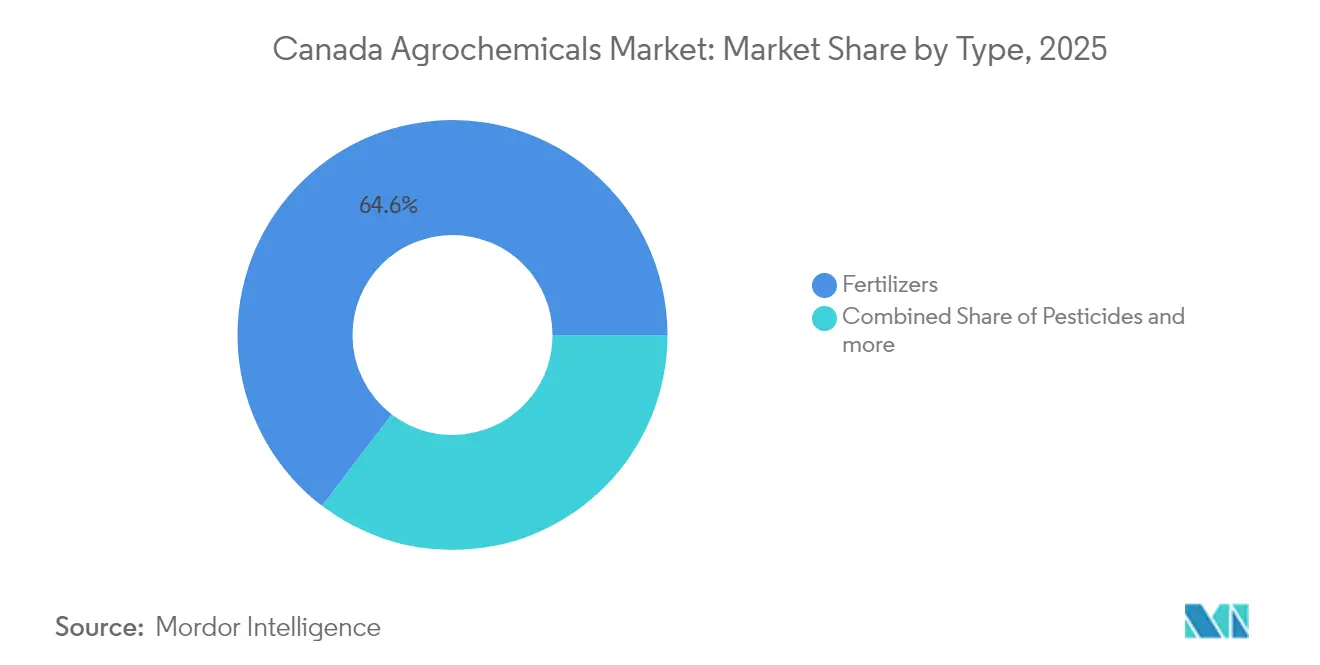
- By type, fertilizers commanded 64.62% of the Canada agrochemicals market share in 2025, whereas plant growth regulators are set to grow the fastest at a 6.54% CAGR through 2031.
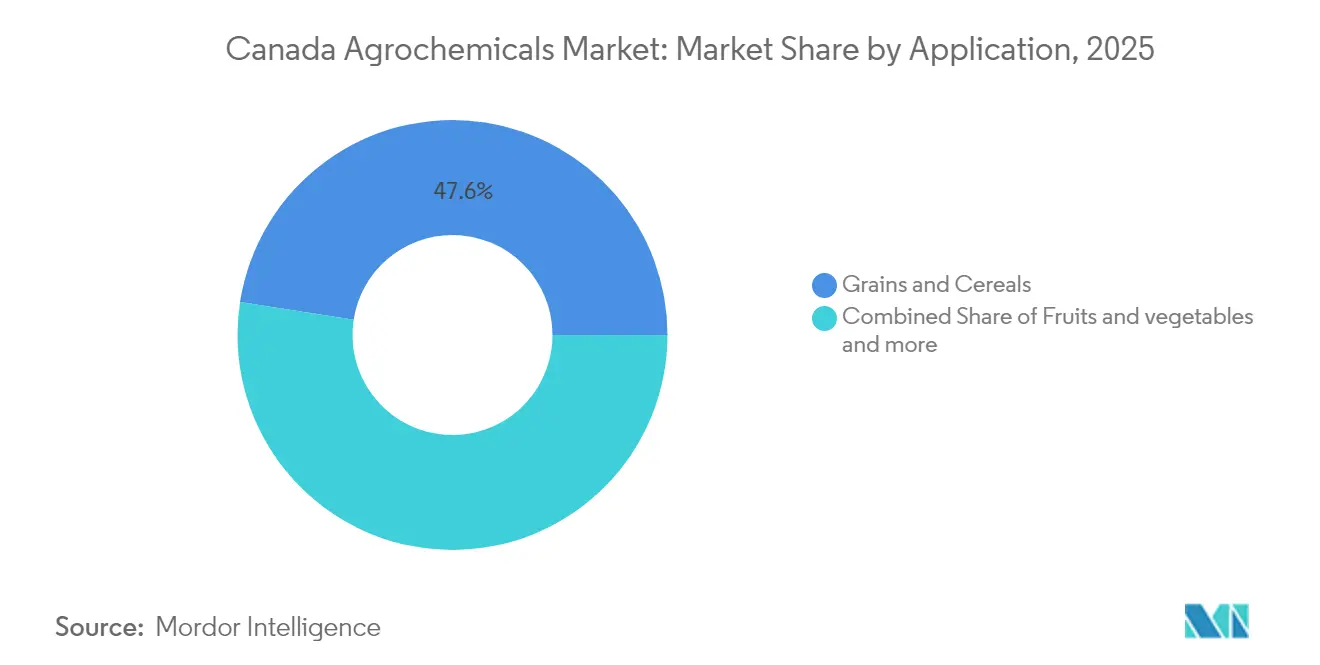
- By application, grains and cereals captured 47.55% of the Canada agrochemicals market size in 2025,fruits and vegetables are forecast to expand at a 5.51% CAGR to 2031.
- Nutrien, Bayer AG, Syngenta Group Group, BASF SE, and Corteva Agriscience together held 62.85% of total revenue in 2025, keeping the Canada agrochemicals market moderately concentrated.
Note: Market size and forecast figures in this report are generated using Mordor Intelligence’s proprietary estimation framework, updated with the latest available data and insights as of 2026.
Canada Agrochemicals Market Trends and Insights
Drivers Impact Analysis*
| Driver | (~) % Impact on CAGR Forecast | Geographic Relevance | Impact Timeline |
|---|---|---|---|
| Growing agricultural acreage shift toward oilseeds | +0.8% | Prairie Provinces | Medium term (2–4 years) |
| Expansion of the canola-crushing ecosystem | +0.6% | Saskatchewan and Alberta | Short term (≤2 years) |
| Rising food-export demand to Asia | +0.5% | National, strongest in Western Canada | Long term (≥4 years) |
| Wider adoption of precision-ag services | +0.4% | Ontario and the Prairies are expanding eastward | Medium term (2–4 years) |
| 4R nutrient-stewardship incentives by provincial governments | +0.3% | Alberta, Saskatchewan, and Ontario | Long term (≥4 years) |
| Climate-resilient crop genetics that require higher micronutrient inputs | +0.2% | Prairies and Ontario | Long term (≥4 years) |
| Source: Mordor Intelligence | |||
Growing Agricultural Acreage shifts Toward Oilseeds
Farmers across the Prairie provinces are allocating more land to canola and soybean production, changing nutrient and herbicide usage patterns in Western Canada's agriculture sector. According to Statistics Canada, canola production reached 19.5 million metric tons in 2024, a 1.6% increase despite challenging growing conditions, while soybean production grew 2.4% to 7.1 million metric tons[1]. This shift in crop rotation increases the need for broadleaf weed control herbicides, particularly for managing kochia resistance, and creates demand for specialized micronutrient blends to maintain oil content and yield. The transition to oilseeds requires more precise nutrient application timing and placement compared to cereal crops, driving the adoption of precision application technologies. Health Canada's Pest Management Regulatory Agency supports this agricultural transition through streamlined registration processes for oilseed-specific formulations to ensure adequate input supply for expanded production.
Expansion Of The Canola-Crushing Ecosystem
Canada's canola processing infrastructure is expanding significantly, with five major facilities adding approximately 7 million metric tons of annual crushing capacity. This expansion is creating consistent local demand for agrochemical inputs and reshaping regional supply chains. Cargill's USD 350 million Regina facility, which is more than 50% complete and scheduled to begin operations in December 2025, will process 1 million metric tons annually [2]. In 2024, Richardson International doubled its Yorkton plant capacity to 2.5 million metric tons of seed annually, making it the world's largest canola crushing facility. This infrastructure development ensures stable domestic demand for canola production inputs, reducing export dependency and establishing more predictable pricing for herbicides, fungicides, and specialty fertilizers used in canola cultivation. The increased crushing capacity also increases demand for post-harvest storage and handling chemicals, as higher processing volumes require improved grain preservation technologies.
Rising Food-Export Demand to Asia
Canadian agricultural exports to Asia continue to grow, with canola shipments to China increasing by 80% in 2024-25 to 3.84 million metric tons. This growth is reshaping agricultural input demand as farmers adjust their production methods to meet export market requirements. According to Agriculture and Agri-Food Canada, total agricultural exports reached USD 67.2 billion (CAD 91.6 billion) in 2024, with Asia-Pacific markets representing 42% of total export value, an increase from 38% in 2020 . The expansion into diverse export markets has increased demand for specialized agricultural inputs, including fungicides for storage stability, nutrient formulations for protein optimization, and post-harvest treatments that comply with importing country residue standards. The 2024 Canada-Indonesia Comprehensive Economic Partnership Agreement creates additional market access opportunities, which may further expand production and increase input demand.
Wider Adoption Of Precision-Ag Services
Precision agriculture technology adoption is increasing across Canadian farms, with variable-rate application systems and AI-driven crop monitoring platforms improving input efficiency and specialty product consumption through targeted applications. Agriculture and Agri-Food Canada's Agricultural Clean Technology Program has allocated USD 238 million (CAD 325 million) to support the adoption of precision agriculture, with over 2,400 projects approved since the program began[3]. The technology shift has enabled more targeted applications of premium-priced specialty inputs while reducing overall chemical volumes, creating opportunities for manufacturers who develop precision-compatible formulations. Health Canada's regulatory framework supports precision agriculture by facilitating expedited reviews for products that demonstrate reduced environmental risks when used in conjunction with precision application technology.
Restraints Impact Analysis*
| Restraint | (~) % Impact on CAGR Forecast | Geographic Relevance | Impact Timeline |
|---|---|---|---|
| Stringent federal pesticide-re-evaluation timelines | -0.7% | National, specialty-crop belt most exposed | Short term (≤2 years) |
| Accelerating consumer preference for organic produce | -0.5% | Ontario, Quebec and British Columbia | Medium term (2–4 years) |
| Fertilizer carbon-pricing and nitrous-oxide-reduction targets | -0.4% | National, focus on Prairies | Long term (≥4 years) |
| Rail and port bottlenecks for potash and bulk chemicals | -0.3% | Western export corridors | Short term (≤2 years) |
| Source: Mordor Intelligence | |||
Stringent Federal Pesticide-Re-Evaluation Timelines
Health Canada's Pest Management Regulatory Agency has intensified pesticide re-evaluation processes, creating market uncertainty as active ingredients face extended review periods. These reviews can remove established products while delaying new registrations critical for resistance management strategies. The agency's REV2024-01 work plan for 2024-2029 outlines comprehensive re-evaluations that prioritize environmental sustainability and human health protection, potentially restricting access to conventional chemistry options [4]. Statistics Canada data indicate pesticide active ingredient registrations declined 12% from 2020 to 2024, while re-evaluation completion times increased by an average of 8 months, demonstrating the regulatory constraints' measurable impact on market dynamics [5].
Accelerating Consumer Preference For Organic Produce
Canadian retailers are implementing increasingly stringent pesticide residue thresholds in response to consumer demand for organic and reduced-chemical food products, constraining conventional agrochemical applications while creating premium market opportunities for specialty formulations. Statistics Canada reported organic farmland increased 3.8% to 1.36 million hectares in 2024, representing 2.9% of total agricultural land, with organic sales reaching USD 4.2 billion (CAD 5.7 billion) annually.The preference evolution also creates market segmentation opportunities, as premium pricing for organic and reduced-chemical products can offset volume declines in conventional segments.
*Our forecasts treat driver/restraint impacts as directional, not additive. The impact forecasts reflect baseline growth, mix effects, and variable interactions.
Segment Analysis
By Type: Specialty Formulations Drive Premium Growth
Fertilizers hold a 64.62% market share in 2025, driven by precision nutrition and specialty formulation strategies. According to Statistics Canada, nitrogen fertilizer consumption reached 2.8 million metric tons in 2024, accounting for 58% of total fertilizer usage. Phosphate consumption was 1.1 million metric tons, while potash consumption reached 0.9 million metric tons. Pesticides constitute the second-largest category, with herbicide demand focused on broadleaf weed resistance management, particularly in canola systems where kochia and wild oat control necessitates multiple modes of action. Adjuvants show strong growth due to precision application technologies requiring enhanced active ingredient performance. Micronutrient blends are gaining importance as climate-resilient crop genetics show increased zinc and boron requirements.
Micronutrient fertilizers are growing at an 7.74% CAGR, emerging as the fastest-growing fertilizer subsegment. This growth stems from precision agriculture, enabling targeted application of zinc, boron, and manganese formulations to optimize crop quality and yield stability. The segment's evolution indicates that specialty formulations provide differentiation opportunities in commoditized chemical markets, though adoption varies by crop type and regional farming practices.

By Application: Specialty crops accelerate demand
Grains and cereals hold a 47.55% market share in 2025, as specialty crop expansion and precision horticulture adoption reshape input demand patterns across Canadian agriculture. This dominance reflects Canada's position as a major wheat and canola exporter, requiring intensive herbicide use for weed resistance management and fungicide applications for storage quality optimization. Statistics Canada reports that grain and oilseed production accounts for 78% of total pesticide applications in 2024, with herbicides comprising 65% of total active ingredient usage across these crops.
Pulses and oilseeds constitute the second-largest application segment, driven by crop rotation benefits and export market premiums that support higher per-acre input investments. Turf and ornamental grass applications, despite lower volumes, generate premium pricing through specialized formulations that meet urban and recreational environmental standards. The fruits and vegetables segment shows the highest growth rate at 5.51% CAGR through 2031. This growth is driven by greenhouse expansion and precision horticulture adoption, particularly in Ontario and British Columbia, where controlled environment agriculture enables intensive input applications with precise monitoring. The evolution of application segments reflects agricultural diversification as farmers transition to higher-value crops that support premium input investments while meeting market quality requirements.
Geography Analysis
Western Canada accounts for approximately two-thirds of agrochemical expenditure. Saskatchewan's contribution stems from 18 million metric tons of planned potash production by 2025 and extensive canola acreage requiring multiple herbicide applications. Alberta shows increased adoption of split-application nitrogen practices and maintains the country's largest area under 4R certification. Manitoba benefits from diverse crop rotations and strategic warehouse locations that facilitate the delivery of spring inputs.
Ontario's greenhouse complexes near the United States border require high-purity foliar nutrients and specialized plant growth regulators. The province leads in variable-rate technology implementation, with 42% of farmers utilizing zone maps. Quebec's strict drift buffer regulations and language-specific labeling requirements extend product launch timelines but create opportunities for specialty formulations that address environmental concerns.
British Columbia's year-round climate-controlled environment supports the growth of produce exports, while Atlantic potato production relies on soil fumigants and nematicides. The Prince Rupert corridor expansion aims to double container capacity, though rail congestion affects potash and bulk glyphosate shipments to Asia-Pacific markets. These regional variations influence inventory management strategies for wholesalers in the Canadian agrochemicals market.
Regulatory Landscape
The Canadian agrochemicals regulatory framework is administered by Health Canada's Pest Management Regulatory Agency (PMRA), which oversees pesticide registration, re-evaluation, and compliance under the Pest Control Products Act and its regulations. The process requires risk assessments for human health and the environment and links market access to maximum residue limits (MRLs) set through Health Canada processes for domestic use and imported foods.
In 2024, the Government tightened transparency and administrative rules. In June 2024, proposed amendments to the Pest Control Products Regulations were published to strengthen transparency and access to test data, and to refine MRL processes for imported foods. In December 2024, amendments to the Pest Control Products Fees and Charges Regulations introduced a tiered, risk-based annual fee model, which alters ongoing compliance costs for registrants and can affect portfolio prioritization during PMRA re-evaluations.
Competitive Landscape
The Canadian agrochemicals market maintains a moderate concentration, with five major players, including Nutrien Ltd, Bayer AG, Syngenta Group, BASF SE, and Corteva Agriscience are dominating through their extensive R&D capabilities and nationwide retail networks. These companies focus their investments on research and development to expand product portfolios, particularly in sustainable and bio-based solutions. They compete through product innovation, regularly introducing new formulations for specific crops and pest management needs. The industry has seen an increase in strategic partnerships, particularly in distribution and technology development. Companies have expanded into digital agriculture, offering integrated solutions that combine traditional products with precision farming tools and data-driven advisory services. To improve supply chain control and market responsiveness, significant investments have been made in local manufacturing and formulation facilities.
Companies differentiate themselves through the deployment of technology, investing in precision agriculture platforms, specialty chemical integration, and digital distribution channels. Regulatory compliance capabilities provide competitive advantages, particularly for companies that successfully navigate Health Canada's pesticide re-evaluation processes while maintaining product registrations that address farmer resistance management needs.
The market structure remains moderate concentration, with multinational corporations maintaining market power through established brands and distribution networks. These global entities use their international research capabilities and technological expertise to maintain market advantages. Local players operate primarily in niche segments or serve as distributors for global manufacturers. High entry barriers, including strict regulatory requirements and substantial R&D investment needs, strengthen the position of established companies.
The market has experienced strategic mergers and acquisitions focused on portfolio expansion and market consolidation. These transactions target complementary product lines, regional presence enhancement, and access to new technologies, particularly in biological products. Companies pursue vertical integration to control value chain components from manufacturing to distribution, while developing specialized capabilities in precision agriculture and digital farming solutions.
Canada Agrochemicals Industry Leaders
-
Nutrien Ltd
-
Bayer AG
-
BASF SE
-
Syngenta Group
-
Corteva Agriscience
- *Disclaimer: Major Players sorted in no particular order
Market Opportunities and Future Outlook
In Canada, agrochemical opportunities are centered more on localized innovation, precision-use enablement, and sustainability-linked input packages than on volume growth alone in conventional chemistry. In 2026, major crop input players expanded both R&D and controlled-environment capacity in the core oilseed corridor, including Bayer's CAD 45 million canola research and development facility investment in Winnipeg and BASF's CAD 27 million expansion of its Canola Breeding Centre of Innovation in Saskatoon, both supporting demand for differentiated seed- and crop-protection programs aligned with Prairie canola acreage and processor pull.
Fertilizer decarbonization and efficiency programs also create whitespace for low-carbon nitrogen and performance-enhancing formulations that align with carbon-accounting and stewardship incentives. Canada Growth Fund participation in a clean-technology fertilizer capacity expansion in Quebec (CAD 20 million investment in Solugen, March 2026) is a specific example of capital moving into lower-carbon production pathways. At the farm level, adoption of precision tools is supported by Agriculture and Agri-Food Canada's Agricultural Clean Technology Program (CAD 325 million allocated, with over 2,400 projects approved). Together, these shifts support supplier offerings that combine specialty fertilizers, adjuvants, and reduced-risk crop protection with AI, UAV, and variable-rate workflows being trialed and deployed across Canadian ag-tech ecosystems.
Recent Industry Developments
- April 2026: BASF and Nutrien announced a strategic collaboration to scale the deployment of integrated crop input programs and data-driven agronomy services across major Canadian row crops. The effort supports portfolio reach and sustainability outcomes while improving supply-chain coordination across Prairie provinces.
- January 2026: Corteva Agriscience introduced Telbek PRO, a Group 21 fungicide for cereals in Canada featuring the Adavelt active, positioned for Fusarium head blight management in wheat. The launch adds a new mode of action option for disease programs, supporting resistance management strategies and premium product placement in key grain-growing provinces.
- December 2024: Nutrien awarded Stamicarbon a contract for a replacement high-pressure urea stripper at its Fort Saskatchewan Nitrogen Operations in Alberta. The project strengthens reliability and operational continuity at a major domestic nitrogen facility, underpinning upstream supply security ahead of seasonal demand peaks.
Research Methodology Framework and Report Scope
Market Definition and Coverage
For this study, the Canada agrochemicals market is defined as the sales value of inputs used to improve crop yield and protection, covering fertilizers and crop protection chemistries used across Canadian farming and turf uses.
Scope exclusions: Farm machinery, seeds, biologicals sold as living organisms, and crop advisory services are excluded from the market value unless they are bundled and priced as an agrochemical product.
Segmentation Overview
- By Type
- Fertilizers
- Nitrogenous
- Phosphatic
- Potassic
- Micronutrient Blends
- Other Fertilizers
- Pesticides
- Herbicides
- Insecticides
- Fungicides
- Other Pesticides
- Plant Growth Regulators
- Adjuvants
- Fertilizers
- By Application
- Grains and Cereals
- Pulses and Oilseeds
- Fruits and Vegetables
- Turf and Ornamental Grass
Data Sources, Market Sizing, and Validation
Desk Research
Desk work was used to set the market structure and anchor Canada specific demand signals before any modeling assumptions were locked. We leaned on public sources such as Statistics Canada for farm area and crop mix, Agriculture and Agri-Food Canada for sector indicators, and the Pest Management Regulatory Agency (Health Canada) for product registrations and policy context that affects product availability.
To keep the numbers realistic, we also reviewed sources such as the FAOSTAT database for longer run fertilizer context, UN Comtrade for import and export direction checks, and open academic or extension publications that discuss application practices and resistance trends. On top of this, company filings, investor presentations, association websites, and reputed agriculture press were reviewed to understand pricing movement and channel shifts, and a paid subscription for company financials, news, and patent intelligence was used when disclosures were limited. These examples are illustrative only, and many other public and paid sources were also referred to for data collection, validation, and research clarification.
Primary Interviews and Surveys
Primary interviews and structured surveys were used to pressure test demand drivers and pricing logic across the main crop belts, and to clarify what is counted as product revenue versus service or rebate adjustments. We spoke with participants across manufacturers, distributors, and large farm input advisors, so the model reflects real purchasing patterns by crop season and province.
Distribution of primary research fieldwork respondents
| Company type | Respondent position |
|---|---|
| Top tier: 33% | CXOs: 21% |
| Mid tier: 46% | Functional/Unit leaders: 36% |
| Smaller Players: 21% | Managers: 43% |
Market-Sizing & Forecasting
Sizing was first built using a top-down demand pool approach where crop area and crop mix, typical application intensity, and reported import and production signals are used to reconstruct the addressable spend for agrochemicals in Canada. Once that view was formed, it was corroborated with selective bottom-up approximations, such as rolling up sampled supplier and channel revenues, and then checking implied average selling prices against traded values and season timing.
A few practical inputs that shaped the model included seeded and harvested acreage for grains, oilseeds, and specialty crops, nutrient application rates and blends, pesticide use patterns by major crop groups, seasonal buying windows that shift pre-seed versus in-season demand, and price movement assumptions tied to energy and feedstock sensitivity. For forecasting, we used scenario analysis with a light multivariate regression layer so changes in planted area, crop prices, and input cost indicators could be translated into expected value growth, and then confirmed with what industry experts see in upcoming seasons. Where direct data was thin for smaller categories, ratios were bridged from better-covered product groups and adjusted using interview guidance, followed by a final reasonableness check versus total farm input spend.
Data Validation & Update Cycle
Validation is done by triangulating the modeled totals against independent signals, including trade flows, regulatory and product availability shifts, and the implied per-hectare spend that growers and channels report. Outliers are flagged early, then reviewed across multiple analyst checks so one unusual assumption does not quietly inflate the total.
We refresh the model annually, and interim adjustments are triggered when material events occur, such as major regulatory decisions, sharp feedstock driven price swings, or sudden acreage changes after a weather cycle. Before delivery, a final pass is completed to incorporate the latest public releases and any follow-up clarifications from primary respondents, so clients receive an updated view.
Mordor Intelligence's Canada Agrochemicals Market Estimate Compared With Other Published Estimates
Published market values for Canada agrochemicals often do not match because the included product buckets and timing assumptions vary across sources, and the base year can also shift the starting point. Differences also show up when some studies emphasize a crop protection only view, while others combine fertilizers, additives, and growth regulators under one headline number.
The main gap comes from whether fertilizers and related adjuvants are counted alongside pesticides, where Mordor Intelligence treats the scope as a combined agrochemicals basket and then ties growth to seeded acreage, application intensity, and price progression by crop season. In addition, some estimates rely on a single base year revenue snapshot with limited visibility on channel rebates and currency timing, which can compress or inflate the stated value when converted to USD.
Benchmark comparison
| Source | Market Size | Gaps in Research Methodology |
|---|---|---|
| Mordor Intelligence | USD 10.17 B (2026) | |
| Global Databook A | USD 7.18 B (2023) | Uses a 2023 revenue base and a 2024 to 2030 forecast window, which can understate later-cycle fertilizer price normalization and acreage shifts when compared against a 2026 starting point. |
| Industry Publisher B | USD 3.20 B (2023) | Limited scope detail is disclosed, and the much smaller total suggests partial coverage (often crop protection only or select provinces), plus base-year currency and channel adjustment treatment is not clearly stated. |
The spread across the three figures is mainly explained by scope composition and the choice of year used to anchor pricing and demand. By keeping the inputs tied to observable acreage, application behavior, and season-linked pricing checks, the estimate remains traceable to clear steps that can be repeated and reviewed.
Key Questions Answered in the Report
What is the current value of the Canada agrochemicals market?
The market was valued at USD 10.17 billion in 2026 and is forecast to hit USD 12.27 billion by 2031.
Which segment is growing fastest in Canada's agrochemical mix?
Plant growth regulators are projected to grow at a 6.54% CAGR through 2031, the highest among all product types.
How dominant are fertilizers in Canadian input spending?
Fertilizers captured 64.62% of 2025 revenue and remain the backbone of crop input budgets.
What is the biggest regulatory headwind for agrochemical suppliers?
Health Canada intensified re-evaluation schedule creates uncertainty and potential delisting risk for several legacy actives.