
Market Overview
| Study Period | 2020 - 2031 |
|---|---|
| Forecast Data Period | 2026 - 2031 |
| Base Year Market Size (2025) | USD 6.8 Billion |
| Market Size (2026) | USD 7.42 Billion |
| Market Size (2031) | USD 11.48 Billion |
| Growth Rate (2026 - 2031) | 9.13 % |
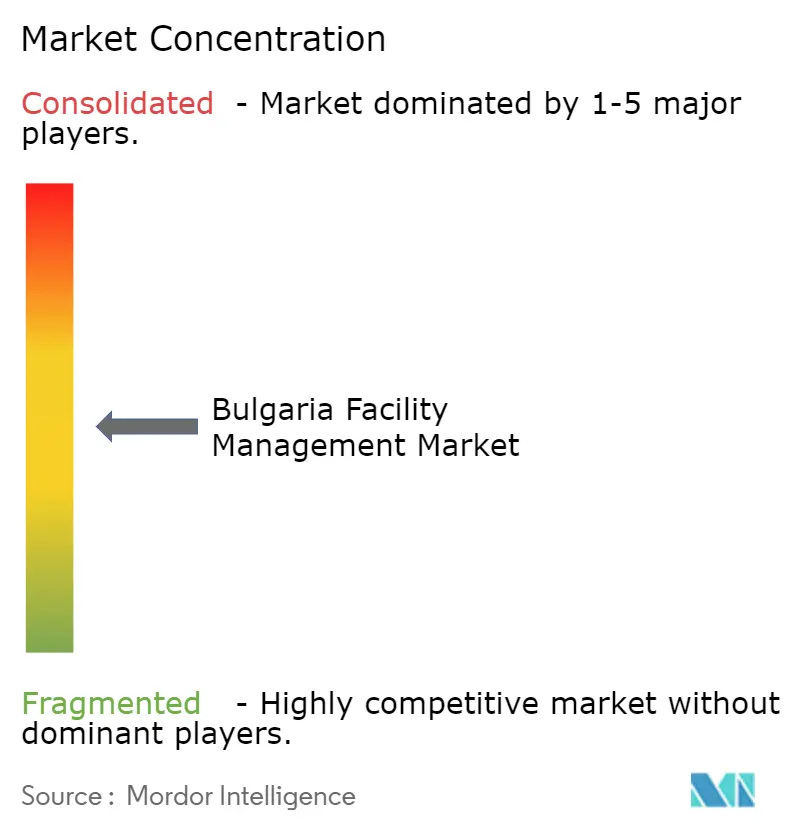
| Market Concentration | Medium |
Major Players *Disclaimer: Major Players sorted in no particular order Image © Mordor Intelligence. Reuse requires attribution under CC BY 4.0. | |
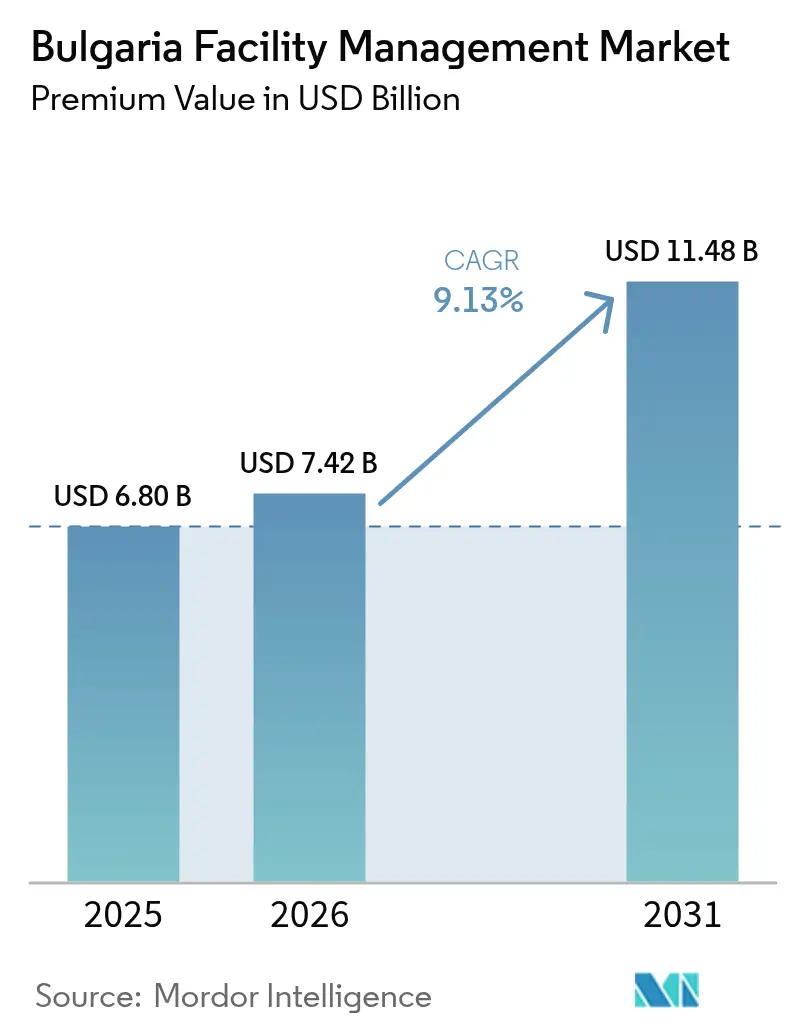
Bulgaria Facility Management Market Analysis by Mordor Intelligence
The Bulgaria facility management market size was valued at USD 6.8 billion in 2025 and estimated to grow from USD 7.42 billion in 2026 to reach USD 11.48 billion by 2031, at a CAGR of 9.13% during the forecast period (2026-2031). This strong momentum is supported by accelerating commercial real-estate development in Sofia and secondary cities, government-backed infrastructure renewal, and the country’s planned eurozone accession in 2026, which is boosting foreign direct investment. Growing technology hubs, logistics corridors, and energy-efficiency mandates have translated into steady demand for hard services such as HVAC, MEP, and fire-safety maintenance. Enterprises are increasingly shifting toward outsourced integrated contracts to unlock operational efficiency and cost savings. At the same time, rising adoption of smart-building and IoT solutions is enabling predictive maintenance and real-time asset monitoring, deepening the value proposition for service providers. Persistent labor shortages and wage inflation remain the chief margin headwinds, while currency-transition risks complicate long-term contract pricing.
Key Report Takeaways
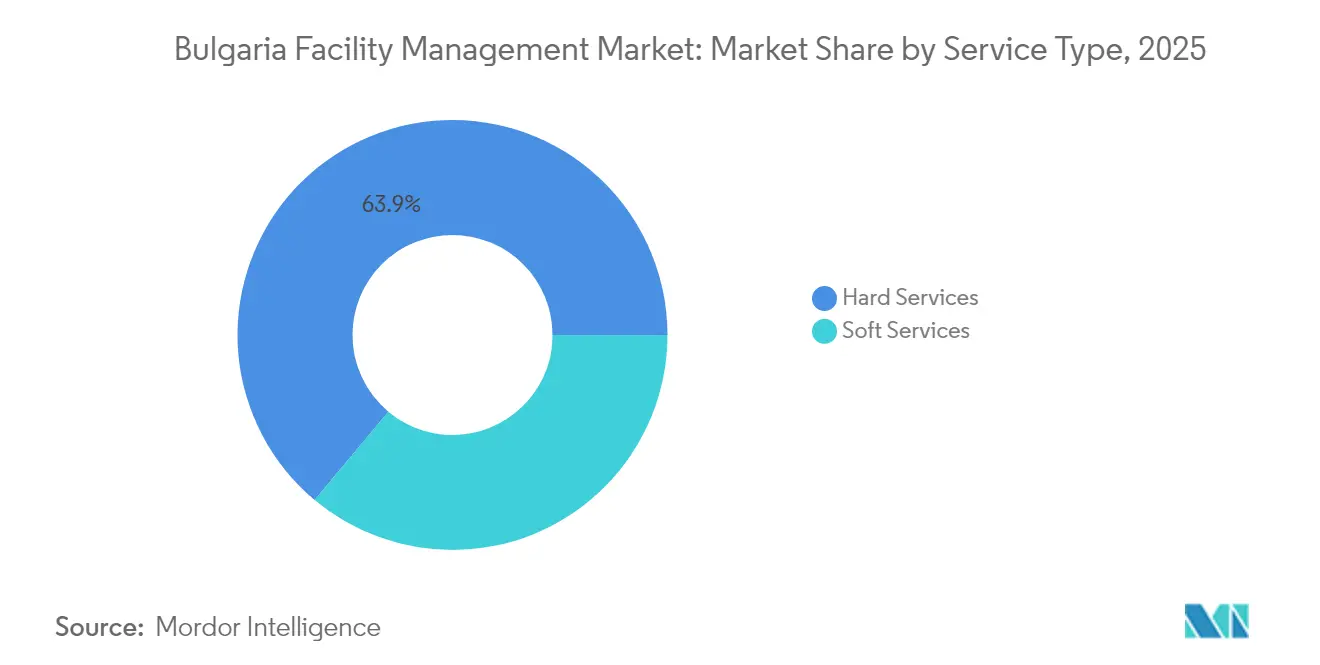
- By service type, hard services led with 63.92% of Bulgaria facility management market share in 2025. By service type, soft services are projected to expand at a 9.39% CAGR through 2031.
- By offering type, the outsourced model held 66.78% of the Bulgaria facility management market size in 2025. By offering type, outsourced contracts are forecast to grow at 9.24% CAGR over the period.
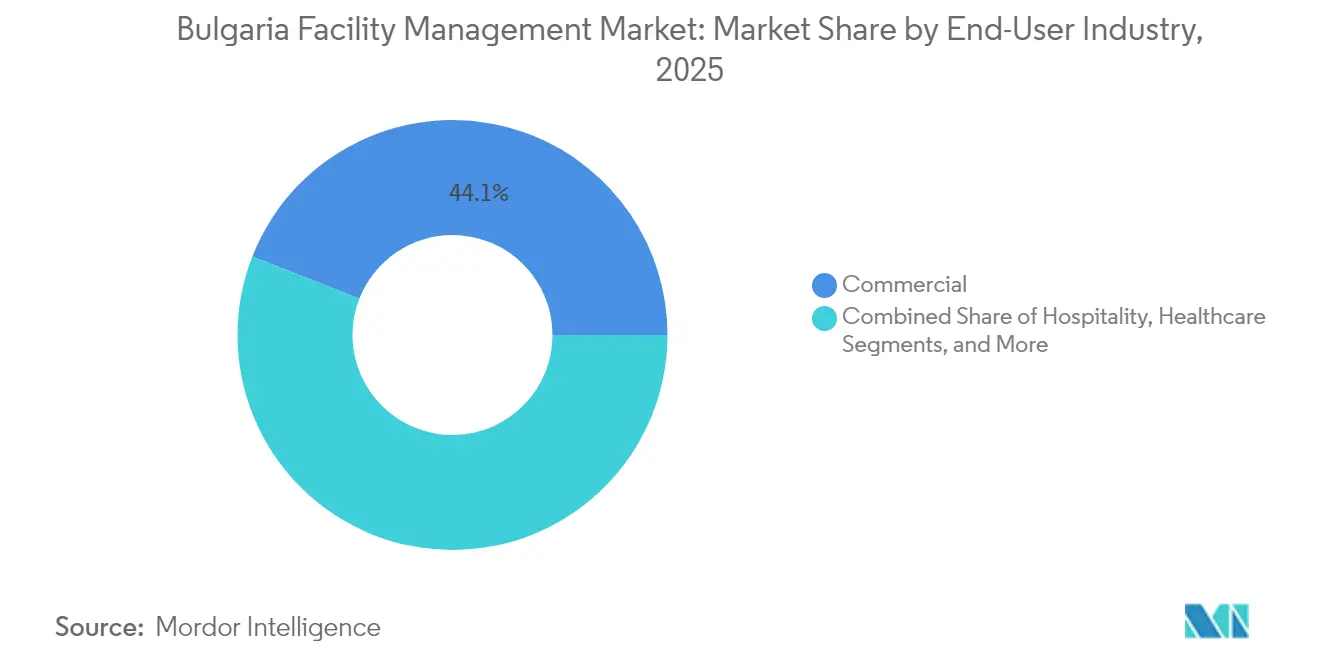
- By end-user, the commercial segment accounted for 44.05% share of the Bulgaria facility management market size in 2025. By end-user, institutional and public infrastructure posts the highest CAGR of 9.44% to 2031.
Note: Market size and forecast figures in this report are generated using Mordor Intelligence’s proprietary estimation framework, updated with the latest available data and insights as of 2026.
Bulgaria Facility Management Market Trends and Insights
Drivers Impact Analysis*
| Driver | (~) % Impact on CAGR Forecast | Geographic Relevance | Impact Timeline |
|---|---|---|---|
| Expansion of Commercial Real Estate Development | +2.1% | Sofia, Plovdiv, Varna, Burgas | Medium term (2-4 years) |
| Increasing Focus on Operational Efficiency and Cost Reduction | +1.8% | National, concentrated in urban centers | Short term (≤ 2 years) |
| Integration of Smart Building Technologies and IoT | +1.5% | Sofia, major business districts | Medium term (2-4 years) |
| Infrastructure-Investment Priorities: Renewable Assets Expand FM Needs | +1.3% | National, rural renewable sites | Long term (≥ 4 years) |
| Government Incentives for Energy-Efficient Building Renovations | +1.0% | National, public sector priority | Medium term (2-4 years) |
| Expansion of Logistics and Industrial Parks Boosting FM Outsourcing | +0.8% | Sofia, Plovdiv, Burgas corridors | Long term (≥ 4 years) |
| Source: Mordor Intelligence | |||
Expansion of Commercial Real-Estate Development
Record transaction values of BGN 12 billion in 2024 and a pipeline of AAA-class offices such as Crystal Business Center underscore the sector’s continuing growth. [1] New builds require sophisticated facility-management solutions that integrate MEP, energy-monitoring, and security systems from day one. Developers now tender for multi-year bundled contracts, giving providers recurring revenue visibility. Certification schemes like BREEAM incentivize higher-spec services, while the arrival of regional technology tenants accelerates service complexity. Heightened real-estate activity in secondary cities replicates this dynamic, widening the addressable base for the Bulgaria facility management market.
Increasing Focus on Operational Efficiency and Cost Reduction
Pressures from moderating GDP growth and lingering inflation are prompting enterprises to deploy outcome-based FM contracts that guarantee measurable savings. The Military Medical Academy achieved a 26% expense reduction while improving healthcare quality through revamped FM processes. Manufacturers such as Melexis equipped new Sofia lines with automated storage and demand predictive maintenance, contracting specialized asset-management teams. Domestic software innovators offer cloud platforms like StackFM to visualize asset health and labor allocation, further embedding data-driven decision-making. Together, these shifts strengthen the case for professional outsourcing within the Bulgaria facility management market.
Integration of Smart-Building Technologies and IoT
Government funding enshrined within the National Recovery and Resilience Plan prioritizes connected LED retrofits and building automation, targeting annual energy savings of 485 GWh. Proptech solutions such as Siemens’ Building X platform aggregate HVAC, security, and lighting data on a single cloud layer, enabling remote diagnostics and cybersecurity safeguards. [2]Utilities have begun rolling out LPWAN-enabled water-meter monitoring in Sofia, setting a precedent for wider IoT adoption in commercial assets. FM providers able to interpret real-time analytics and implement predictive workflows gain a competitive edge and lock-in longer-term contracts.
Infrastructure-Investment Priorities: Renewable Assets Expand FM Needs
An 88 MW solar park under PPC Group headlines a pipeline of utility-scale projects requiring ongoing panel cleaning, inverter testing, and security patrolling. [3] SUNOTEC’s stake in Adex Energy aligns EPC work with post-commissioning FM service streams, while Kozloduy’s nuclear expansion introduces highly specialized asset-integrity demands. Renewable facilities, often in remote areas, rely on digital twin modeling and drone inspections, creating new revenue niches for the Bulgaria facility management market.
Restraints Impact Analysis*
| Restraint | % Impact on CAGR Forecast | Geographic Relevance | Impact Timeline |
|---|---|---|---|
| Labor Shortages and Rising Wage Pressures | -1.7% | National, acute in Sofia and major cities | Short term (≤ 2 years) |
| Economic Fluctuations and Inflation Concerns | -1.2% | National, currency transition effects | Medium term (2-4 years) |
| Fragmented FM Supply Chain Limiting Service Quality Standardization | -0.8% | National, rural areas most affected | Long term (≥ 4 years) |
| Low Penetration of Integrated FM Contracts Among SMEs | -0.6% | National, concentrated in smaller cities | Medium term (2-4 years) |
| Source: Mordor Intelligence | |||
Labor Shortages and Rising Wage Pressures
Demographic decline and emigration shrink Bulgaria’s working-age population, while the 2025 minimum-wage hike to BGN 1,077 raises payroll costs for labor-intensive cleaning and security tasks. Skilled HVAC and automation technicians often migrate to Western Europe, forcing FM firms to offer salary uplifts and continuous training. Providers are accelerating robotics deployment for floor-cleaning and leveraging remote monitoring to offset manpower gaps, but near-term margin compression persists.
Economic Fluctuations and Inflation Concerns
Inflation of 2.3% in May 2024 and property price volatility challenge long-term budget planning for multi-year FM contracts [NSI.BG]. Euro-adoption in 2026 introduces currency-conversion risks that complicate indexation clauses. Public-sector clients face constrained budgets amid a 1.9% fiscal deficit, tempering tender volumes in institutional segments. Providers increasingly build escalation formulas and energy-cost pass-through mechanisms into agreements to safeguard profitability within the Bulgaria facility management market.
*Our forecasts treat driver/restraint impacts as directional, not additive. The impact forecasts reflect baseline growth, mix effects, and variable interactions.
Segment Analysis
By Service Type: Hard Services Underpin Compliance and Reliability
Hard services captured 63.92% of Bulgaria facility management market share in 2025, anchored by mandatory fire-safety, MEP, and HVAC compliance. The Bulgaria facility management market size attributable to hard services is projected to rise alongside new-build occupancy mandates and energy-efficiency retrofits. Growth is reinforced by manufacturing expansions that depend on uninterrupted utilities and specialist maintenance. Asset-management sub-services are benefiting from predictive-maintenance platforms that minimize downtime.
Soft services, while smaller, outpace hard services with a 9.39% CAGR to 2031. Cleaning volumes expand in tandem with newer glass-and-composite facades that require specialized techniques. Workplace services such as reception, catering, and mailroom support are bundled into integrated packages to help employers differentiate talent offerings in Sofia’s competitive labour pool. Security contracts increasingly integrate electronic access control with on-site guards, blurring lines between hard and soft deliverables across the Bulgaria facility management market.

By Offering Type: Outsourcing Consolidates Around Integrated Models
Outsourced delivery commanded 66.78% of Bulgaria facility management market size in 2025, reflecting corporate preference for specialist expertise and cost flexibility. Enterprises shifting to single-provider integrated agreements benefit from harmonized service-level indicators and reduced administration overhead. Manufacturing groups like Videoton Holding outsource industrial-property upkeep and workforce safety checks to focus on core electronics assembly.
In-house models remain prevalent in smaller organizations that view FM as a fixed employment pool, but wage inflation and technology complexity erode this stance. Hybrid arrangements often see critical-asset technicians retained internally, while peripheral services migrate to bundled contracts. Outsourcing momentum is expected to continue as smart-building analytics prove difficult to internalize without scale, supporting future revenue expansion within the Bulgaria facility management market.
By End-User Industry: Commercial Dominance, Institutional Catch-Up
The commercial segment contributed 44.05% of Bulgaria facility management market size in 2025, led by ICT offices, retail malls, and last-mile warehouses clustered around Sofia Ring Road. Developers stipulate integrated FM from ground-breaking to ensure energy-rating compliance and tenant satisfaction. Large retailers adopt centralized facilities command centers to monitor multi-site energy consumption.
Institutional and public-infrastructure assets register the fastest CAGR of 9.44%, propelled by EU-funded hospital, school, and municipal renovation schemes. The Military Medical Academy’s performance-based contract highlights efficiency gains achievable through skilled FM adoption. Transport-network modernization and smart-street-lighting programs multiply opportunities for public-sector FM specialists. The industrial and process segment remains robust thanks to renewable-energy roll-outs and automotive supply-chain investment, further diversifying demand across the Bulgaria facility management market.
Geography Analysis
Sofia anchors more than 40% of national economic output and is the single largest draw for facility-management spend, hosting technology parks, AAA offices, and headquarters complexes that demand sophisticated services. Lease absorption in newly completed towers such as Sofia Office Center sustains high service intensity. The city’s educated workforce and 10% flat corporate-tax rate attract multinationals whose global procurement frameworks favor integrated FM contracts.
Plovdiv, Varna, and Burgas constitute the next echelon of opportunity. Plovdiv’s logistics cluster along Trakia Highway attracts warehousing projects requiring large-scale utilities maintenance and fleet-yard security. Burgas’ BGN 20 million armored-vehicle plant broadens industrial FM demand while port operations generate specialized cleaning and safety needs. Varna’s tourism and maritime heritage fuels hotel housekeeping, catering, and ship-terminal services.
Rural corridors host Bulgaria’s fastest-growing renewable-energy footprint, including solar, wind, and forthcoming nuclear builds. These dispersed assets rely on drone inspections, SCADA monitoring, and rapid-response maintenance hubs. Eurozone entry is anticipated to harmonize economic conditions across regions, reducing wage differentials and enlarging the labor pool for FM providers seeking nationwide coverage within the Bulgaria facility management market.
Regulatory Landscape
Bulgaria's facility management (FM) operating requirements are shaped by building-energy, building-maintenance, labor-safety, and public-sector digital standards administered by multiple bodies rather than a single FM regulator. Energy and retrofit-linked FM scope is influenced by the Energy Efficiency Act and related implementing rules, including a January 2024 ordinance that sets requirements for Energy Service Company (ESCO) contracting in state and municipal buildings. This affects how energy-performance services, measurement, and verification are structured in public tenders.
For public service buildings, the Ministry of Regional Development and Public Works framework includes Ordinance No. RD-02-20-3 (2015), which governs design, execution, and maintenance requirements for buildings in education, healthcare, culture, and science. It reinforces compliance-driven demand for hard services (MEP, HVAC, fire and safety). For digital and automation layers in public assets, the State e-Government Agency (SEGA) sets mandatory technical specifications for public administration information systems and interoperability via the National Interoperability Framework, shaping FM providers' requirements when integrating BMS, CAFM, or IoT monitoring into government-linked facilities and procurements.
Value Chain Analysis
Inputs into Bulgaria's FM value chain start with asset owners and developers (commercial offices, malls, logistics parks, and public authorities) defining compliance and performance requirements. This is followed by procurement of labor-intensive services (cleaning, security, landscaping) and technical services (HVAC, MEP, fire safety, lifts), supported by spare parts, consumables, and subcontract specialist trades. A growing upstream layer is building-technology and automation, where global BMS/controls platforms and local integrators supply sensors, controllers, and connectivity. This enables services such as remote diagnostics and 24/7 emergency response that are increasingly embedded into technical FM scopes.
Service delivery is executed by international multi-service providers and local specialists that assemble on-site teams, mobile technicians, and subcontractors, with CAFM/CMMS tooling linking work orders, SLAs, and asset histories. Integrated FM acts as the coordinating hub, bundling soft and hard services, energy management, and technology operations into single governance and reporting structures for clients. Downstream, performance assurance and renewal depend on service-level reporting, audit readiness for safety and energy requirements, and continuous improvement programs. Contract extensions in major commercial assets (for example, First Facility's continued technical FM involvement at Mall Markovo Tepe in Plovdiv) show how long-term relationships and demonstrated uptime and energy performance feed back into repeat business and wider portfolio wins.
Competitive Landscape
International majors-ISS Facility Services Bulgaria, Sodexo Bulgaria, and Veolia Bulgaria-leverage standardized processes, global supply chains, and proprietary technology platforms. Their economies of scale support full-service offerings spanning engineering, energy management, catering, and workplace experience, appealing to multinationals demanding single-vendor accountability.
Local specialists such as GI Enterprise Ltd., KEY Facilities Management, and First Facility Bulgaria EOOD win contracts through granular knowledge of regulatory requirements, agility in tailoring scope, and competitive pricing. Partnerships with proptech firms enhance their digital capabilities; for example, BGO Software’s StackFM platform offers real-time asset dashboards and mobile work-order routing.
Consolidation is increasing: dormakaba’s 2024 service-center launch demonstrates strategic moves to secure engineering talent and expand access control portfolios. Providers are differentiating via ESG-aligned offerings, renewable-asset servicing, and outcome-based remuneration. Companies able to marry compliance expertise with IoT-driven analytics are best placed to capture share in the evolving Bulgaria facility management market.
Bulgaria Facility Management Industry Leaders
-
GI Enterprise Ltd.
-
KEY Facilities Management
-
First Facility Bulgaria EOOD
-
Mundus Services AD
-
Landmark Property Management Jsc
- *Disclaimer: Major Players sorted in no particular order
Market Opportunities and Future Outlook
A visible whitespace area is the formalization of multi-family and residential property management into more standardized, professional service delivery. In 2026, the Ministry of Regional Development and Public Works introduced the Unified Information System for Condominium Property (EISES) and a mandatory public registry for professional condominium managers under Ordinance No. RD-02-20-1. This creates clearer compliance and traceability expectations that can accelerate outsourcing and consolidation among qualified providers across residential and mixed-use portfolios.
In commercial and enterprise segments, opportunities are anchored in scaling integrated technical FM and nationwide multi-site contracts where uptime, security, and energy performance are managed under centralized governance. Examples include Mundus Services launching integrated facility management for Postbank's nationwide network (June 2026) and First Facility taking on technical maintenance with 24/7 emergency assistance for a large Sofia office complex (Office X Business Garden, around 70,000 square meters, February 2026). These wins highlight demand for providers that combine hard-services depth with digital monitoring, standardized SLAs across dispersed sites, and the ability to manage complex assets under bundled or integrated contracts, while also creating a pathway to attach energy and automation upgrades as part of ongoing operations rather than one-off projects.
Recent Industry Developments
- June 2026: Mundus Services launched integrated facility management services for Postbank, covering the bank's nationwide branch network and administrative facilities. The move broadens IFM penetration beyond single-building mandates into multi-site, standardized delivery with centralized governance. It also raises competitive pressure on providers to offer consistent SLAs, reporting, and technical coverage across dispersed locations.
- July 2025: Citi acts as exclusive coordinator for financing the Kozloduy NPP expansion, enabling a major national infrastructure program that supports multi-year operation and maintenance upgrades and shapes FM demand in high-security environments. The arrangement unlocks funding for multi-year O&M and safety-system modernization and signals demand growth for integrated FM services across dispersed sites.
- May 2024: National statistical reporting showed inflation at 2.3% in May 2024, reinforcing the need for indexation and energy-cost pass-through mechanisms in multi-year FM contracts. Contract structures increasingly incorporate escalation formulas to protect service continuity amid input-cost volatility. This has pushed providers to strengthen cost-to-serve analytics and procurement discipline across labor and consumables.
Research Methodology Framework and Report Scope
Market Definition and Coverage
For this study, the Bulgaria facility management market is defined as the spending on outsourced and in-house services that keep buildings and sites running, safe, and compliant, covering day-to-day operations, maintenance, and support functions across major end users.
Scope exclusions: We exclude new building construction work, major renovations treated as capital projects, and pure equipment manufacturing sales that are not delivered as part of a facility service contract.
Segmentation Overview
- By Service Type
- Hard Services
- Asset Management
- MEP and HVAC Services
- Fire Systems and Safety
- Other Hard FM Services
- Soft Services
- Office Support and Security
- Cleaning Services
- Catering Services
- Other Soft FM Services
- Hard Services
- By Offering Type
- In-house
- Outsourced
- Single FM
- Bundled FM
- Integrated FM
- By End-user Industry
- Commercial (IT and Telecom, Retail and Warehouses, etc.)
- Hospitality (Hotels, Eateries, Large-scale Restaurants)
- Institutional and Public Infrastructure (Govt, Education, Transportation)
- Healthcare (Public and Private Facilities)
- Industrial and Process (Manufacturing, Energy, Mining)
- Other End-user Industries (Multi-housing, Entertainment, Sports and Leisure)
Data Sources, Market Sizing, and Validation
Desk Research
Desk research helped us set the demand pool and keep assumptions realistic before interviews began. We referenced public and official sources such as the National Statistical Institute of Bulgaria (services output, employment, and wage series), Eurostat (business economy and price indicators), the European Commission and EU Public Procurement portals (tender activity and award notices), and the European Patent Office database (filings linked to building operations and maintenance technologies). We also used association releases and reputable press to understand outsourcing adoption and service intensity by facility type.
To translate activity signals into spend, we cross checked company filings, annual reports, and investor presentations for firms active in Bulgaria, and we used paid databases for company financials and news screening. Where equipment-linked maintenance cycles were relevant, we also used import and export shipment level data. These inputs were used to set the initial service mix, typical contract duration, and the likely share of outsourced delivery across sectors. The sources listed here are illustrative, and many other public documents and datasets were used for collection, validation, and clarification.
Primary Interviews and Surveys
We conduct interviews and surveys in Bulgaria with facility directors, service providers, procurement leaders, operations managers, and public-estate contacts. Their input helps quantify outsourced shares, labor and energy cost movements, contract renewals, service rates, and gaps in NACE reporting. These discussions are used to adjust secondary inputs and reconcile differences between reported activity and the operating mix seen in Bulgaria.
Distribution of primary research fieldwork respondents
| Company type | Respondent position |
|---|---|
| Top tier: 27% | CXOs: 15% |
| Mid tier: 48% | Functional/Unit leaders: 35% |
| Smaller Players: 25% | Managers: 50% |
Market-Sizing & Forecasting
Sizing starts from a top-down view, using national service economy indicators and procurement signals to reconstruct the facility services spend attributable to hard and soft FM activities in Bulgaria. The totals are then checked through selective bottom-up work, such as rolling up sampled contract values, applying observed price per square meter bands to a tested area base, and using provider revenue splits to sanity check the service mix.
A few practical variables were treated as core inputs, including the split of hard versus soft services, outsourced versus in-house delivery, labor cost inflation for cleaning and security roles, energy cost direction that affects maintenance intensity, and the share of facilities moving toward bundled or integrated contracts. Where direct values were missing for smaller providers or informal subcontracting, gaps were handled using interview-based ranges and conservative normalization to sector employment and facility count signals.
For forecasting, scenario analysis was used because near-term demand is sensitive to public procurement cycles and wage movements, which can change faster than long-run building stock growth. Assumptions on outsourcing penetration, contract renewals, and service repricing were reviewed with market participants so the forecast stays tied to how contracts are renewed and billed in Bulgaria.
Data Validation & Update Cycle
Validation was done through multiple checks so that outliers do not slip into the final number. We compared the modeled totals against independent signals such as procurement award volumes, reported services output trends, and provider level revenue direction, and then investigated any material variance before sign-off. If a key input moved outside expected bands, such as labor cost changes or a step change in public tenders, respondents were re-contacted to confirm whether the shift was temporary or structural.
Each report is refreshed annually, and interim updates are triggered when there are material events that can move contract pricing or outsourcing decisions. Before delivery, an analyst performs a final pass to incorporate the latest public releases and to ensure assumptions and calculations remain consistent across the time series.
Mordor Intelligence's Bulgaria Facility Management Market Size Compared With Other Published Estimates
It is normal to see different market size figures for Bulgaria facility management, since publishers do not always count the same services, contract structures, or pricing layers. Differences also show up when one study uses older public turnover references, while another uses newer contract pricing and mix assumptions.
Some estimates fold in adjacent property services or broader building maintenance turnover that is not consistently tied to recurring FM contracts. In the Mordor Intelligence approach, values are counted only for the defined hard and soft facility services delivered to end users, and large one-time capital renovation work is kept out. This tightens the number around repeatable contract spend for Bulgaria end-user operations.
Benchmark comparison
| Source | Market Size | Gaps in Research Methodology |
|---|---|---|
| Mordor Intelligence | USD 6.80 B (2025) | |
| Trade Journal A | USD 0.66 B (2011) | Uses an older turnover reference reported in local currency and does not separate recurring FM services from broader building upkeep spend, and then currency conversion timing can also shift the USD result. |
| Global Consultancy B | USD 2.57 B (2026) | Uses a different base year and a narrower spend frame that can undercount in-house delivery and some bundled contracts, and service mix and repricing assumptions are not clearly tied back to Bulgaria-specific contract norms. |
Overall, the spread is mainly explained by year alignment and what gets counted as facility management versus adjacent building upkeep. Our approach keeps the sizing tied to clear service lines, observable pricing behavior, and cross checks from both procurement signals and provider revenue direction, so clients can trace the total back to practical inputs.
Key Questions Answered in the Report
What is the current value of the Bulgaria facility management market?
The market is valued at USD 7.42 billion in 2026.
How fast is the Bulgaria facility management market expected to grow?
It is projected to register a CAGR of 9.13% between 2026 and 2031.
Which service type holds the largest share in the Bulgaria facility management market?
Hard services lead with 63.92% market share in 2025.
Why are Bulgarian companies increasingly outsourcing facility management?
Outsourcing unlocks operational efficiency, cost savings, and access to specialized smart-building expertise, driving the outsourced model to 66.78% share in 2025.
Which end-user segment is expanding the quickest?
Institutional & public-infrastructure assets show the fastest CAGR at 9.44% during the forecast period.
What are the main challenges facing facility-management providers in Bulgaria?
Acute labor shortages, rising wage pressures, and inflation-linked pricing risks are the principal constraints limiting margin expansion.