
Built To Rent Residential Market Size and Share
Market Overview
| Study Period | 2020 - 2031 |
|---|---|
| Market Size (2026) | USD 26.58 Billion |
| Market Size (2031) | USD 38.73 Billion |
| Growth Rate (2026 - 2031) | 7.82 % |
| Fastest Growing Market | Middle East and Africa |
| Largest Market | North America |
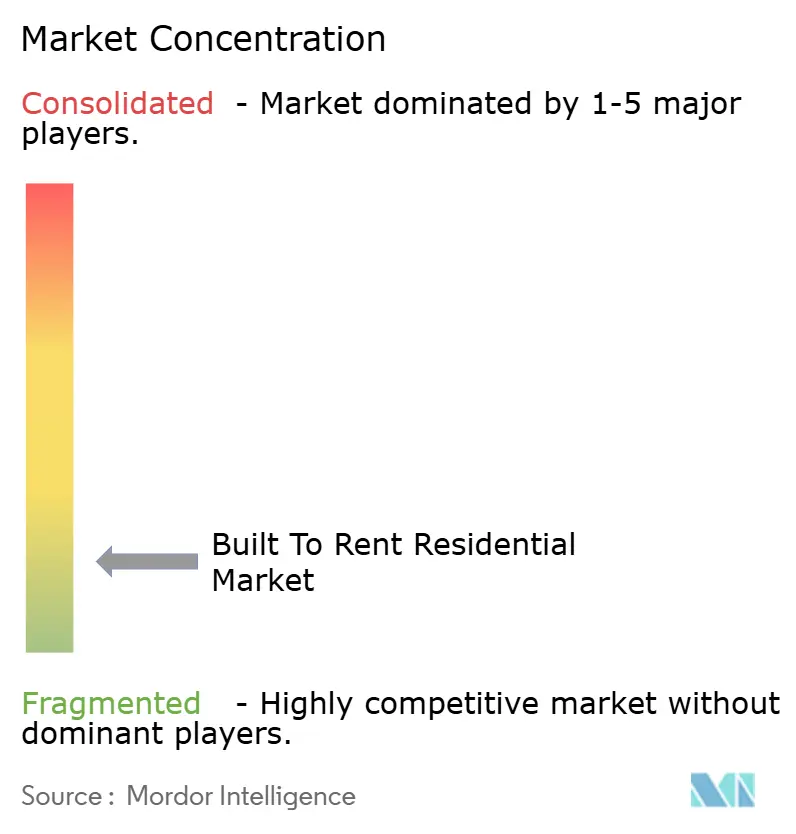
| Market Concentration | Low |
Major Players *Disclaimer: Major Players sorted in no particular order Image © Mordor Intelligence. Reuse requires attribution under CC BY 4.0. | |
Built To Rent Residential Market Analysis by Mordor Intelligence
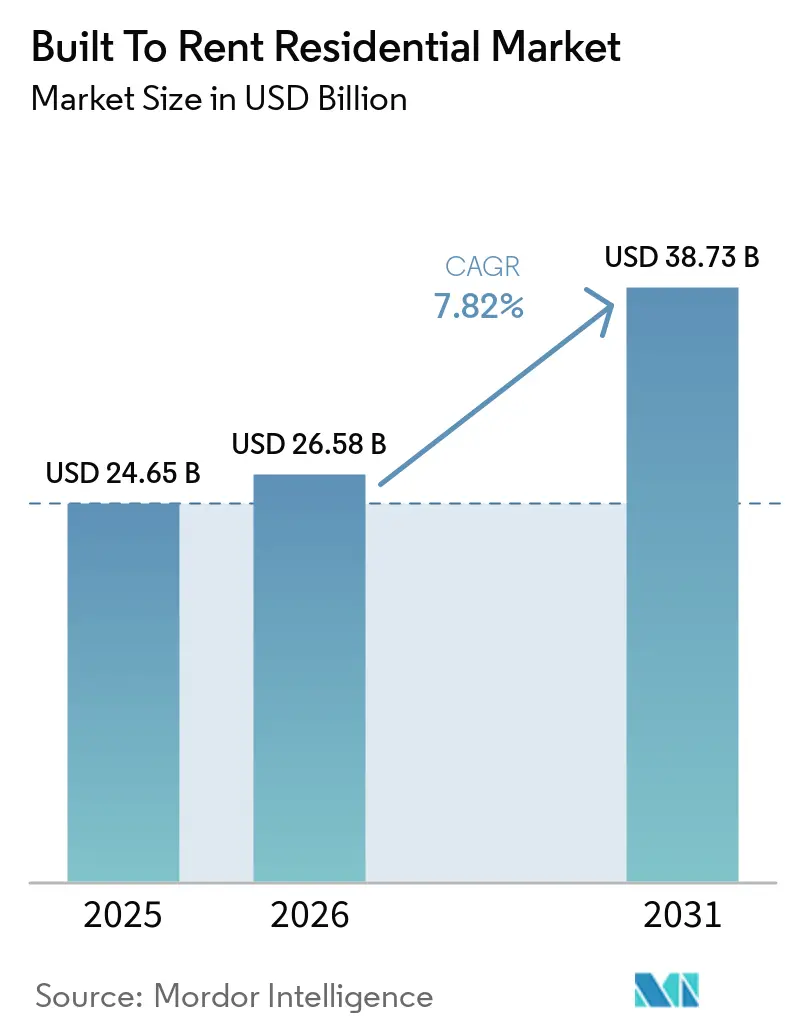
The Built To Rent Residential Market size is expected to grow from USD 24.65 billion in 2025 to USD 26.58 billion in 2026 and is forecast to reach USD 38.73 billion by 2031 at 7.82% CAGR over 2026-2031.
The built-to-rent residential market is supported by a persistent gap between housing costs and household incomes in major cities. In England, the median home cost 7.6 times median annual full-time earnings in 2025, while private renters spent 34% of household income on rent in 2025[1]Office for National Statistics, “Housing Affordability in England and Wales: 2025,” Office for National Statistics, ons.gov.uk. The built-to-rent residential market benefits when professionally managed rental homes offer longer-term tenure, predictable service, and more space than many conventional apartments. Financing costs and construction expenses remain material constraints, especially for smaller developers that cannot access institutional capital on favorable terms. The built-to-rent residential market also faces uneven local conditions, because supply additions in Phoenix, Dallas, and London can affect occupancy and rent growth even while the broader demand case remains intact.
Key Report Takeaways
- By type, multifamily built-to-rent held a 41.8% share in 2025, while single-family built-to-rent and BTR Communities are forecast to grow at a 9.5% CAGR through 2031.
- By management model, third-party operator arrangements accounted for 61.5% of the built-to-rent market size in 2025, while hybrid management is projected to expand at a 9.1% CAGR through 2031.
- By price segment, mid-market rental held a 48.7% of the built-to-rent market share in 2025, while affordable and workforce housing is expected to record a 9.8% CAGR through 2031.
- By geography, North America commanded a 45.2% of the built-to-rent market size in 2025, while the Middle East and Africa is forecast to grow at a 14.3% CAGR through 2031.
Note: Market size and forecast figures in this report are generated using Mordor Intelligence’s proprietary estimation framework, updated with the latest available data and insights as of January 2026.
Global Built To Rent Residential Market Trends and Insights
Drivers Impact Analysis*
| Drivers | (~) % Impact on CAGR Forecast | Geographic Relevance | Impact Timeline |
|---|---|---|---|
| Housing Affordability Challenges Extend Rental Demand | +2.1% | Global, most acute in North America, Western Europe, and APAC urban centers | Long term (≥ 4 years) |
| Institutional Capital Expands Purpose-Built Rental Supply | +1.7% | North America, United Kingdom, Australia, and Germany | Medium term (2-4 years) |
| Preference for Spacious and Amenity-Rich Rentals Boosts Demand | +1% | North America, Western Europe, and APAC | Long term (≥ 4 years) |
| Professional Property Management Enhances Resident Retention | +0.7% | Global, strongest in North America and the United Kingdom | Medium term (2-4 years) |
| Affordable Housing Partnerships Increase Build-to-Rent Development | +0.6% | North America, Western Europe, and the Middle East and Africa | Short term (≤ 2 years) |
| Townhouse and Attached Build-to-Rent Formats Improve Project Viability | +0.5% | North America, the United Kingdom, and Australia | Medium term (2-4 years) |
| Source: Mordor Intelligence | |||
Housing Affordability Challenges Extend Rental Demand
Housing affordability remains a long-term demand driver for the built-to-rent residential market. High purchase prices can extend rental tenure for households that would otherwise move into owner-occupied homes. England’s 2025 affordability ratio of 7.6 confirms the pressure on household access to ownership. The English Housing Survey also reported that private renters spent an average of 34% of their household income on rent in 2025. In the United States, the housing shortfall exceeded 4 million units in 2025, which reinforced the need for additional rental supply. These conditions give operators a wider pool of households that need stable rental options rather than short-term accommodation.
Institutional Capital Expands Purpose-Built Rental Supply
Institutional capital supports the built-to-rent residential market because purpose-built communities can be designed and operated to consistent standards. Capital is increasingly directed toward new communities rather than dispersed homes that require separate acquisition and operational processes. The British Property Federation reported that 146,700 BTR homes had been completed in the United Kingdom by Q4 2025. This level of delivery shows that institutional ownership has moved beyond a small number of pilot projects. Long-term investors can match rental income with long-duration liabilities when developments are completed and stabilized. Capital availability can still vary significantly by country, interest-rate conditions, and planning frameworks. Operators with land access, development expertise, and reliable property management systems are more likely to secure funding for new communities.
Preference for Spacious and Amenity-Rich Rentals Boosts Demand
Many renters seek private outdoor space, garage access, and shared amenities that are more common in single-family and attached BTR communities. This preference supports formats that sit between a conventional apartment and homeownership. Community facilities can include pools, co-working areas, pet amenities, landscaped open space, and shared meeting rooms. These features can make a rental community more suitable for households seeking longer stays. They can also help operators create a consistent resident experience across a portfolio. The built to rent residential market can therefore compete for residents who previously viewed a starter home as their only practical route to additional space.
Professional Property Management Enhances Resident Retention
Professional property management supports the built-to-rent residential market by delivering consistent leasing, maintenance, and resident service across a community. Clear communication and timely maintenance can make rental homes more suitable for households seeking longer tenures. Centralized operating processes also help owners apply the same service standards across multiple locations. This consistency can strengthen resident satisfaction and reduce disruption during the lease term. Strong property management is particularly important for institutional owners because stable occupancy supports predictable rental income. Operators that combine responsive local teams with centralized systems can better manage resident needs as portfolios expand.
Restraints Impact Analysis*
| Restraints | (~) % Impact on CAGR Forecast | Geographic Relevance | Impact Timeline |
|---|---|---|---|
| Higher Financing Costs Reduce Project Feasibility | -0.9% | Global, most acute in North America and the United Kingdom | Medium term (2-4 years) |
| Construction Cost Inflation and Skilled Labor Shortages Delay Project Delivery | -0.8% | Global, acute in North America, the United Kingdom, and Australia | Medium term (2-4 years) |
| Concentrated New Supply Pressures Occupancy and Rental Growth | -0.6% | North America, especially the Sun Belt, and the United Kingdom | Short term (≤ 2 years) |
| Fragmented Planning, Building Safety, and Tenant Regulations Increase Compliance Complexity | -0.5% | The United Kingdom, Europe, Australia, and parts of APAC , the Middle East , and Africa | Long term (≥ 4 years) |
| Source: Mordor Intelligence | |||
Higher Financing Costs Reduce Project Feasibility
Higher debt service costs can delay or cancel projects within the built-to-rent residential market. This pressure is most severe for mid-sized developers with limited balance-sheet capacity. U.S. single-family BTR starts fell to 14,000 in Q1 2026 from 19,000 in Q1 2025, a decline of 26%. The British Property Federation and industry reporting also showed a sharp fall in London starts during 2025 as finance costs weakened project economics. Financing constraints can consolidate development activity among platforms that have diversified funding sources. They can also delay supply in locations where rental demand remains strong.
Concentrated New Supply Pressures Occupancy and Rental Growth
Concentrated new supply can limit occupancy and rental growth when several build-to-rent communities open in the same local market. This risk is most evident in high-development locations where operators target similar renter groups. New communities may offer leasing incentives, upgraded amenities, or flexible terms to attract residents during the initial stabilization period. Existing properties may then face slower leasing activity or need to moderate rent increases to remain competitive. The effect can be temporary when household growth and job creation absorb new homes over time. Developers and operators need to monitor planned deliveries, local affordability, and competing rental stock before committing capital to additional projects.
*Our forecasts treat driver/restraint impacts as directional, not additive. The impact forecasts reflect baseline growth, mix effects, and variable interactions.
Segment Analysis
By Type: Multifamily Density Leads, Single-Family Communities Capture Growth Premium
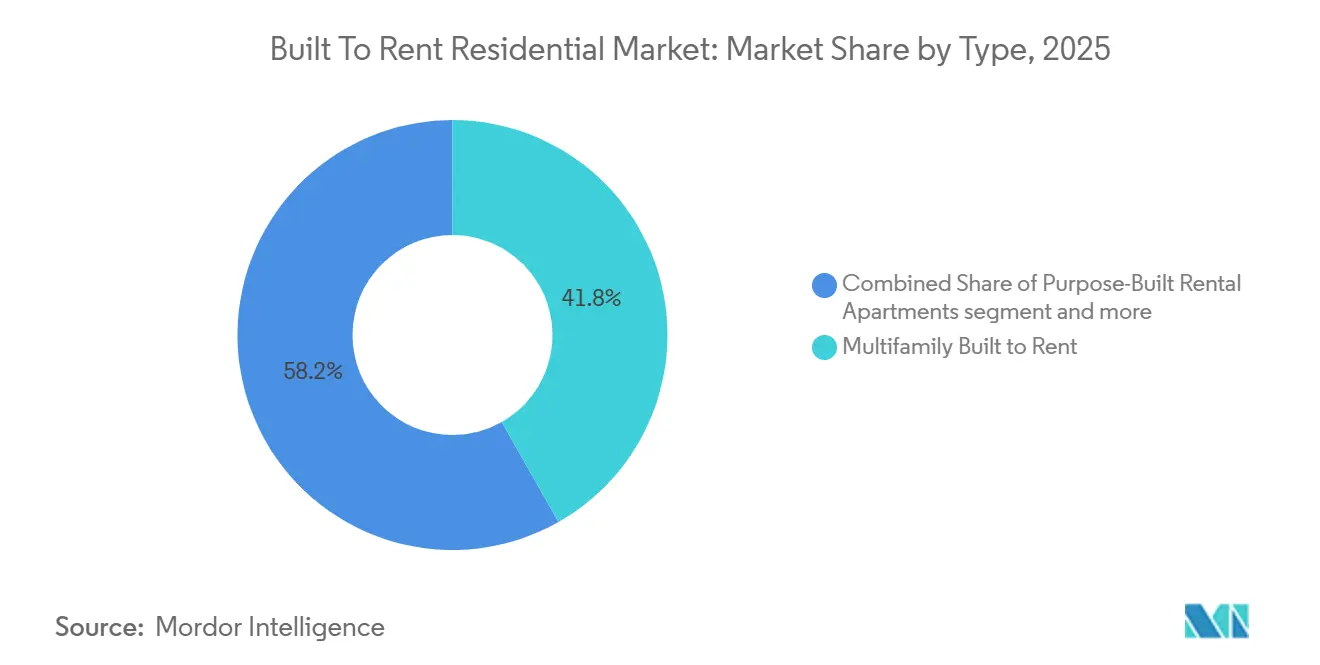
Multifamily Built to Rent held 41.8% of the built-to-rent residential market share in 2025. It uses land efficiently and supports centralized leasing, maintenance, security, and amenity operations. The format remains well-suited to urban renters seeking access to employment, transit, and local services, although permitting, building safety requirements, and construction costs can affect delivery.
Single-Family Built to Rent and BTR Communities are forecast to grow at a 9.5% CAGR through 2031. Private space, community amenities, and standardized home designs support demand and project efficiency. Townhomes and attached homes can improve land use, while community-scale delivery gives owners greater control over resident services and maintenance.


By Management Model: Third-Party Operators Anchor Scale, Hybrid Models Gain Institutional Favor
Third-party Operator arrangements accounted for 61.5% in 2025. The model lets institutional owners use specialized managers while keeping asset ownership separate from daily operations. It supports portfolio expansion through established leasing, maintenance, and resident-service capabilities. AMH’s in-house development program accounted for 92% of its new home acquisitions in Q3 2025, showing why some larger operators retain greater control over operations and development.
Hybrid Management is forecast to grow at a 9.1% CAGR through 2031. It combines centralized systems and standards with local service delivery. Digital platforms can support leasing, maintenance, billing, and resident communication across multiple communities. Clear accountability between owners, platforms, and on-site teams remains necessary to protect service quality.
By Price Segment: Mid-Market Retains Volume, Affordable Segment Accelerates on Policy Tailwinds
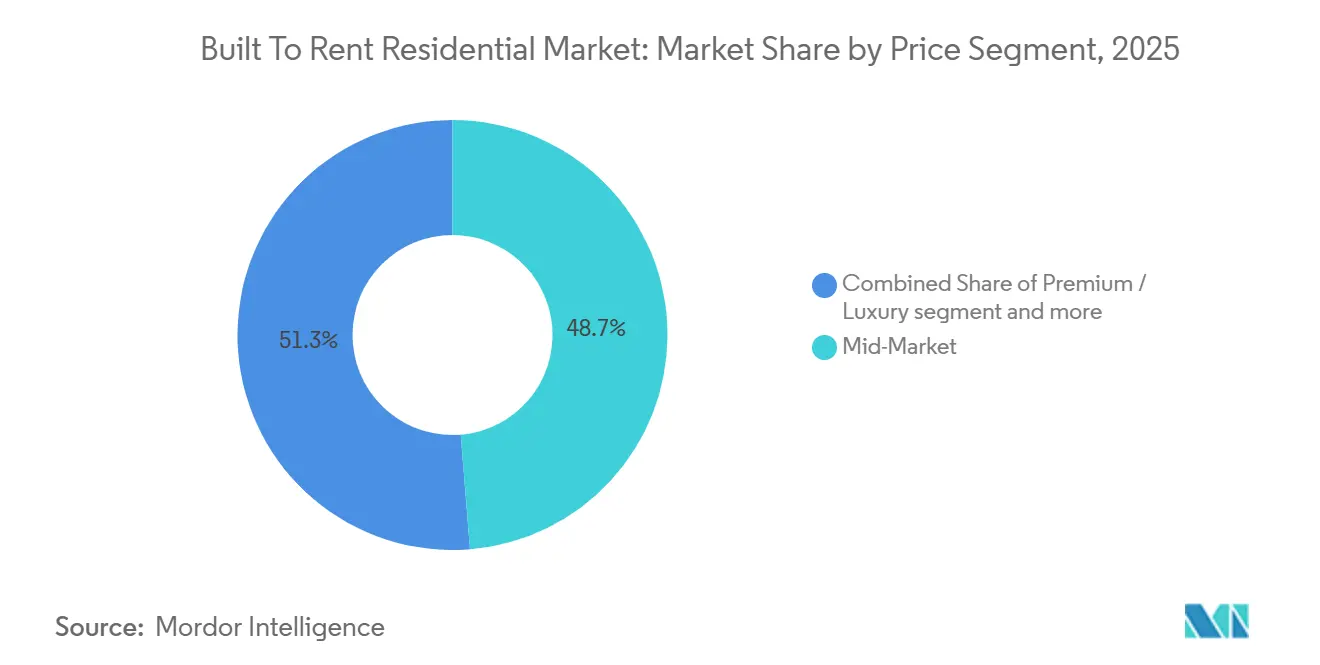
Mid-Market Rental held a 48.7% share in 2025. It serves households that can afford professionally managed homes but remain unable to buy. Its broad renter base supports demand, while premium projects face greater pressure where high-end supply is concentrated. Operators must align rents, home mix, and amenities with local incomes and competing supply.
Affordable and Workforce Housing is forecast to grow at a 9.8% CAGR through 2031. Public land, concessions, and tax arrangements can improve project feasibility. However, affordability rules and planning requirements increase development complexity and favor experienced operators.
Geography Analysis
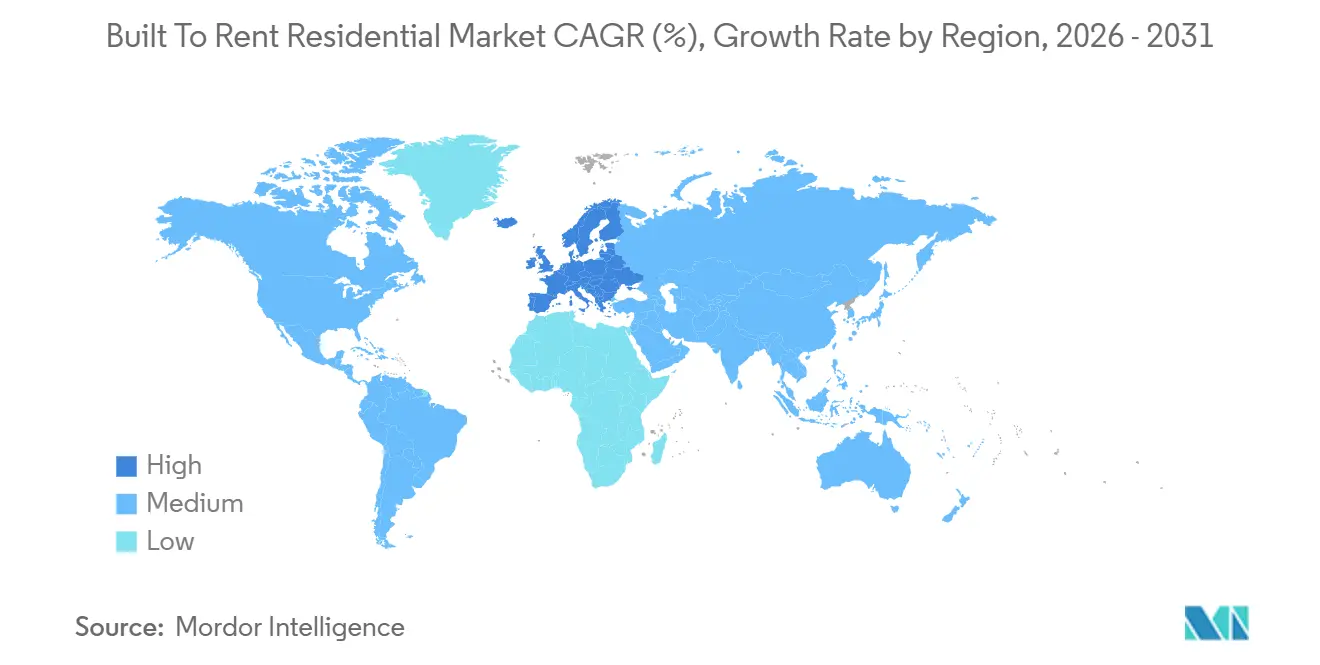
North America held 45.2% of the built-to-rent residential market share in 2025. The region benefits from a mature single-family rental culture, institutional capital, and strong demand in Sun Belt metros. The United States offers developers several options across single-family, townhome, and multifamily communities. Canada remains an emerging BTR location in major urban centers, while Mexico presents an early-stage opportunity in manufacturing cities. Local supply additions can pressure occupancy and rents, making detailed market knowledge important for operators.
Europe and the Asia-Pacific are at different stages of development within the built-to-rent residential market. The British Property Federation reported 146,700 completed BTR homes in the United Kingdom in Q4 2025, up 13% year over year. Australia is building a managed rental housing base, although funding conditions and construction costs continue to affect project viability. Germany and France have established rental cultures, but local rules and development economics vary. Investors must adapt their strategy to country-specific tenancy laws, approvals, tax treatment, and renter preferences.
The Middle East and Africa is forecast to grow at a 14.3% CAGR through 2031. Saudi Arabia’s housing program and the UAE’s population growth support interest in professionally managed rental homes. South America remains at an earlier stage, with Brazil and Argentina offering potential because of urban rental demand and limited mortgage access. Developers in these regions must consider affordability, land availability, construction capacity, and regulatory requirements before committing capital.

Competitive Landscape
The built-to-rent residential market is led by a limited group of scaled platforms, while much of the sector remains fragmented by geography and asset type. Greystar has development activity in the United States, Europe, and Australia. AMH has continued to use an in-house development approach, with 92% of new home acquisitions in Q3 2025 coming from its own development program. Invitation Homes expanded its development capacity by acquiring ResiBuilt for USD 89 million in January 2026, with up to USD 7.5 million in performance-based earn-outs[2]Invitation Homes Inc., “Invitation Homes Acquires ResiBuilt to Enhance Development Capabilities and Deliver More Housing Solutions for American Families,” Business Wire, businesswire.com. The transaction added an in-house development and general contracting platform for growth in high-demand Southeastern U.S. markets. This move reflects the value that large operators place on control of development pipelines. It may also raise the barrier to entry for smaller companies without comparable construction capabilities. Control of the development process can improve the alignment between home design, construction timing, and long-term operating needs. It can also reduce dependence on an external pipeline when demand strengthens. However, in-house capability requires capital, experienced staff, and sustained development volume. Operators without those resources may continue to rely on third-party managers and development partners. The difference between these approaches adds to the diversity of competitive strategies.
Blackstone’s Tricon Residential opened Tricon Viridian, a 46-home BTR community in Arlington, Texas, in July 2025 through a USD 15 million investment with HHS Residential and Johnson Development[3]Tricon Residential, “Tricon Residential Opens New Community in Arlington, Texas,” Tricon Residential, triconhomes.com. The company’s activity illustrates continued concentration on Texas and other Sun Belt locations. In the United Kingdom, Legal & General, Grainger plc, and Watkin Jones have distinct positions in institutional development, portfolio management, and forward-funded delivery. Mirvac and Lendlease operate scaled BTR platforms in Melbourne and Sydney. These companies compete through funding access, development knowledge, operating capabilities, and local relationships. Operators also seek to distinguish their communities through maintenance responsiveness, amenity offerings, and digital resident services. The built to rent residential market is therefore shaped by both capital scale and the ability to provide reliable day-to-day operations. The company also demonstrates how a partnership can combine capital, local development experience, and resident operations. Such arrangements can be useful where a national owner needs local market knowledge. They can reduce the execution risk that comes from entering a new metropolitan area. The approach still depends on disciplined construction and leasing performance. A strong local project does not remove wider financing constraints.
Technology is becoming more important to competitive positioning in the built to rent residential market. Integrated systems can help operators manage leasing, maintenance, accounting, and resident communication across large portfolios. These tools may help operators standardize service across different communities. They may also make advanced operating capabilities more accessible to smaller managers. Secondary cities with diversified employment and lower institutional penetration remain relevant for new projects. Affordable and workforce housing also remains a strategic area where public concessions can improve development viability. Portfolio scale can lower the unit cost of technology, procurement, and resident support. It can also spread specialist skills across a larger number of homes. Smaller companies can respond through local service knowledge and focused operating models. Investors will compare operating performance as closely as location and rental growth. This makes dependable execution central to platform value.
Built To Rent Residential Industry Leaders
Greystar Real Estate Partners, LLC
Blackstone Inc.
Invitation Homes Inc.
AMH (formerly American Homes 4 Rent)
Tricon Residential Inc.
- *Disclaimer: Major Players sorted in no particular order

Recent Industry Developments
- January 2026: Invitation Homes acquired Atlanta-based build-to-rent developer ResiBuilt for USD 89 million plus up to USD 7.5 million in performance-based earn-outs, gaining an in-house development and general contracting platform to scale its BTR community construction strategy across Southeast high-growth markets.
- July 2025: Blackstone’s Tricon Residential opened Tricon Viridian, a 46-home BTR community in Arlington, Texas, with a USD 15 million investment in partnership with HHS Residential and Johnson Development


Global Built To Rent Residential Market Report Scope
| Multifamily Built to Rent |
| Single-Family Built to Rent / Built to Rent Communities |
| Purpose-Built Rental Apartments |
| Purpose-Built Rental Houses / Townhomes |
| In-house Operator |
| Third-party Operator |
| Hybrid Management |
| Premium / Luxury |
| Mid-Market |
| Affordable & Workforce Housing |
| North America | United States |
| Canada | |
| Mexico | |
| Europe | United Kingdom |
| Germany | |
| France | |
| Italy | |
| Spain | |
| Russia | |
| Rest of Europe | |
| Asia-Pacific | China |
| India | |
| Japan | |
| Australia | |
| South Korea | |
| SouthEast Asia (Singapore, Malaysia, Thailand, Indonesia, Vietnam, and Philippines) | |
| Rest of Asia-Pacific | |
| South America | Brazil |
| Argentina | |
| Rest of South America | |
| Middle East and Africa | Saudi Arabia |
| United Arab Emirates | |
| Turkey | |
| South Africa | |
| Nigeria | |
| Rest of Middle East and Africa |
| By Type | Multifamily Built to Rent | |
| Single-Family Built to Rent / Built to Rent Communities | ||
| Purpose-Built Rental Apartments | ||
| Purpose-Built Rental Houses / Townhomes | ||
| By Management Model | In-house Operator | |
| Third-party Operator | ||
| Hybrid Management | ||
| By Price Segment | Premium / Luxury | |
| Mid-Market | ||
| Affordable & Workforce Housing | ||
| By Geography | North America | United States |
| Canada | ||
| Mexico | ||
| Europe | United Kingdom | |
| Germany | ||
| France | ||
| Italy | ||
| Spain | ||
| Russia | ||
| Rest of Europe | ||
| Asia-Pacific | China | |
| India | ||
| Japan | ||
| Australia | ||
| South Korea | ||
| SouthEast Asia (Singapore, Malaysia, Thailand, Indonesia, Vietnam, and Philippines) | ||
| Rest of Asia-Pacific | ||
| South America | Brazil | |
| Argentina | ||
| Rest of South America | ||
| Middle East and Africa | Saudi Arabia | |
| United Arab Emirates | ||
| Turkey | ||
| South Africa | ||
| Nigeria | ||
| Rest of Middle East and Africa | ||


Key Questions Answered in the Report
What is the projected value of the built to rent residential market by 2031?
The built to rent residential market is forecast to reach USD 38.7 billion by 2031, rising from USD 26.6 billion in 2026 at a 7.8% CAGR.
Which property type is growing fastest in build-to-rent housing?
Single-Family Built to Rent and BTR Communities are forecast to grow at a 9.5% CAGR through 2031.
Which management model has the largest share?
Third-party Operator arrangements held 61.5% of the sector in 2025, while Hybrid Management is forecast to grow at a 9.1% CAGR.
Why is affordable and workforce rental housing expanding?
Affordable and Workforce Housing is expected to grow at a 9.8% CAGR, supported by public partnerships, affordability requirements, and housing demand.
Page last updated on:





