
Brewing Ingredient Market Size and Share
Market Overview
| Study Period | 2021 - 2031 |
|---|---|
| Market Size (2026) | USD 21.55 Billion |
| Market Size (2031) | USD 28.63 Billion |
| Growth Rate (2026 - 2031) | 5.85 % |
| Fastest Growing Market | Asia-Pacific |
| Largest Market | Asia-Pacific |
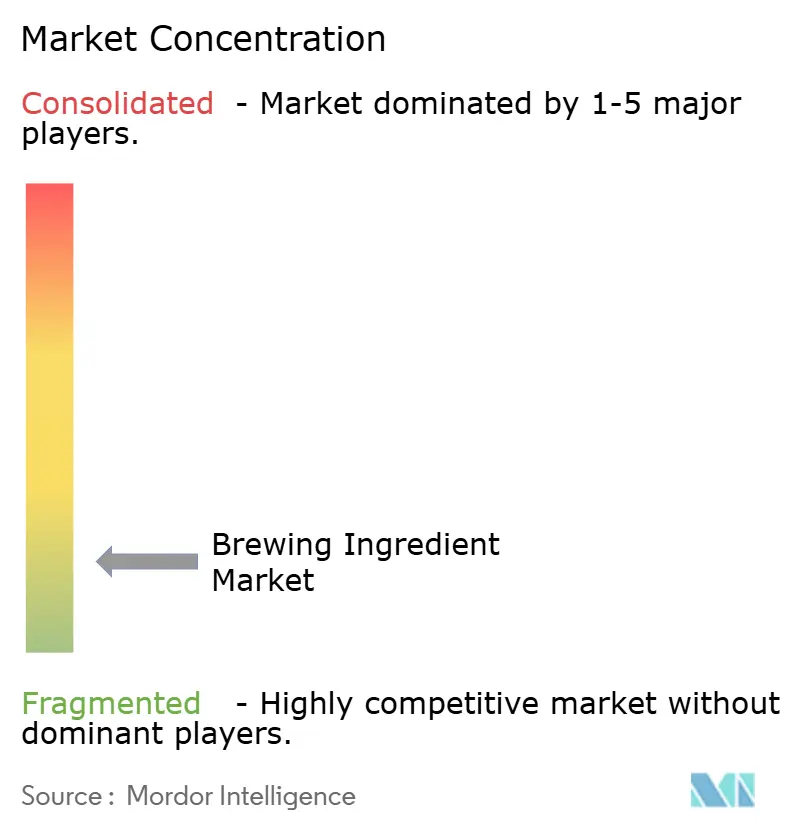
| Market Concentration | Low |
Major Players
*Disclaimer: Major Players sorted in no particular order Image © Mordor Intelligence. Reuse requires attribution under CC BY 4.0. |
|
Brewing Ingredient Market Analysis by Mordor Intelligence
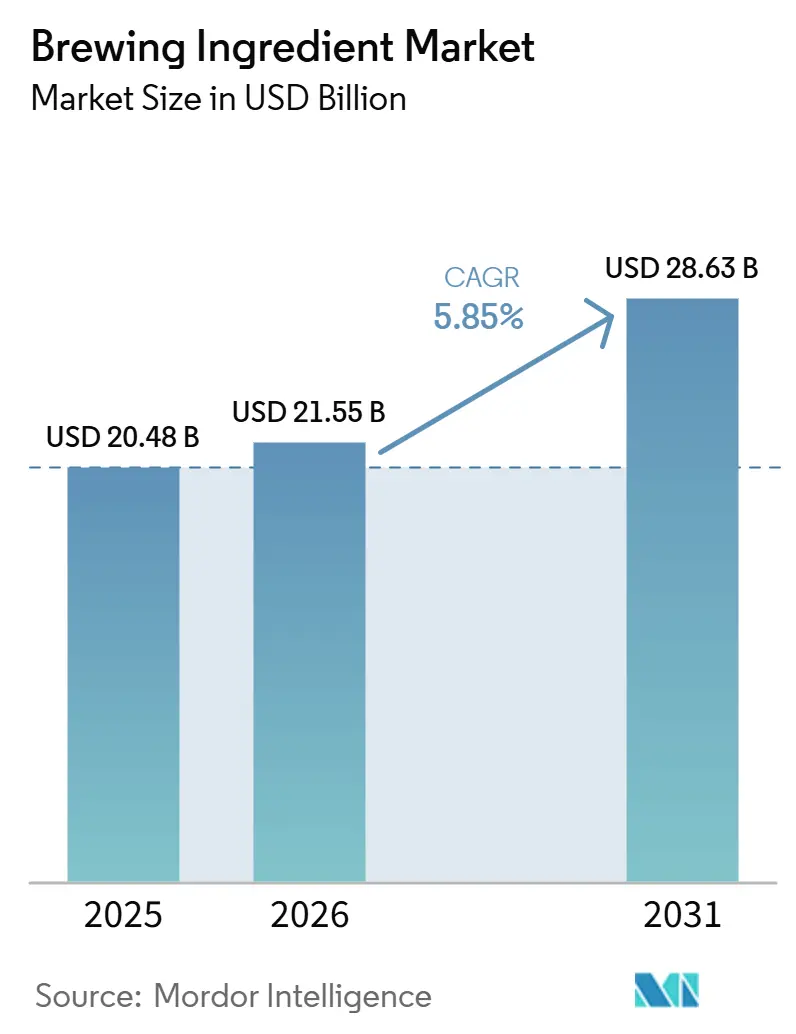
The brewing ingredient market size was valued at USD 20.48 billion in 2025 to USD 21.55 billion in 2026, and is forecast to reach USD 28.63 billion by 2031 at a 5.85% CAGR over 2026-2031. Product portfolios increasingly feature premium, craft, and nonalcoholic beer, which require more specialized fermentation, flavoring, and processing inputs per hectoliter. Consequently, the brewing ingredient market benefits from these portfolio shifts even when beer volumes remain flat or decline, as supplier revenue depends on the value and complexity of inputs rather than beer volume alone. Suppliers are balancing resilient demand for commodity inputs with growing demand for specialty ingredients.
Key Report Takeaways
- By ingredient type, malt led the brewing ingredient market with a share of 42.65% in 2025, while hops are anticipated to register the fastest CAGR of 7.05% during 2026-2031.
- By form, dry retained 62.18% share in 2025, whereas liquid is forecast to expand at a 6.65% CAGR through 2031.
- By brewery type, macro breweries led the market with a share of 52.78% in 2025, while craft breweries are anticipated to register the fastest CAGR of 6.92% during 2026-2031.
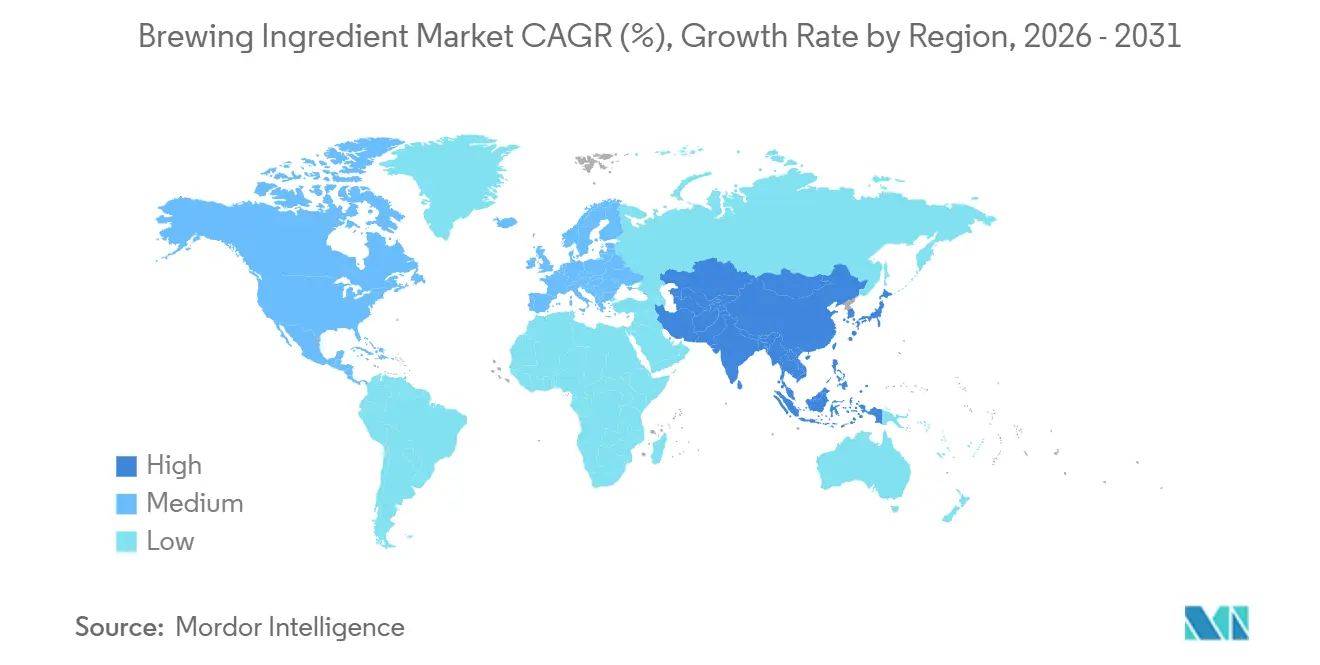
- By geography, Asia-Pacific led the brewing ingredient market in 2025 with a 38.78% share and is projected to advance at a 7.21% CAGR through 2031.
Note: Market size and forecast figures in this report are generated using Mordor Intelligence’s proprietary estimation framework, updated with the latest available data and insights as of January 2026.
Global Brewing Ingredient Market Trends and Insights
Drivers Impact Analysis*
| Driver | (~) % Impact on CAGR Forecast | Geographic Relevance | Impact Timeline |
|---|---|---|---|
| Expansion of global beer production volumes | +0.5% | Global, with the highest concentration in Asia-Pacific, South America, and Africa | Short term (≤ 2 years) |
| Proliferation of craft and microbreweries worldwide | +1.1% | Global, including North America, Western Europe, China, Japan, and Australia | Medium term (2-4 years) |
| Rising consumer preference for premium beer | +0.9% | Global, led by Europe and North America and accelerating in India and South Africa | Medium term (2-4 years) |
| Increasing adoption of alternative brewing grains | +0.4% | Asia-Pacific, Africa, Latin America, and the Middle East and Africa | Long term (≥ 4 years) |
| Advancements in yeast and fermentation technologies | +0.3% | Global | Medium term (2-4 years) |
| Expanding beer consumption across emerging economies | +0.8% | India, Southeast Asia, Sub-Saharan Africa, Brazil, and Mexico | Long term (≥ 4 years) |
| Source: Mordor Intelligence | |||
Expansion of Global Beer Production Volumes
The expansion of global beer production is driving demand for brewing ingredients, as higher brewing volumes directly increase the consumption of malt, hops, yeast, adjuncts, and enzymes. Large commercial breweries continue to operate and expand capacity, sustaining bulk demand for core ingredients across established beer markets. Meanwhile, growing brewing activity among regional and independent producers is broadening ingredient demand beyond multinational brewers. Emerging beer markets also contribute to this trend, as evolving consumption patterns and expanding distribution networks support increased domestic beer production. As global beer output continues to grow, increased raw material consumption is expected to remain a key demand driver for the brewing ingredients market.
Proliferation of Craft and Microbreweries Worldwide
According to the Brewers Association, the United States had 9,578 operating craft breweries in 2025[1]Source: Brewers Association, " A Year of Correction for Craft Beer," brewersassociation.org. Craft brewers use specialty malts, proprietary aroma hops, and nonconventional yeast more extensively than macro breweries. This activity supports the brewing ingredient market, as craft producers place greater emphasis on differentiated ingredients and flexible supply arrangements. They require inputs that enable distinctive recipes, seasonal releases, and local product identities. This demand encourages ingredient suppliers to develop customized malt profiles, specialty hop varieties, and brewing cultures tailored to smaller production batches. As craft brewing continues to evolve, ingredient suppliers benefit from closer engagement with smaller producers seeking flexibility, product variety, and recipe-specific solutions.
Increasing Adoption of Alternative Brewing Grains
Sorghum, rice, and cassava are becoming increasingly important brewing adjuncts in Asia-Pacific and Africa. These crops are locally available and can reduce brewers’ exposure to imported malting barley. A 2025 scientific study published in npj Sustainable Agriculture found that rice can achieve yields two to three times higher per hectare than barley while providing suitable malting quality [2]Source: npj Sustainable Agriculture, " Evaluating the costs of alternative malting grains for market adaptation," nature.com. The study also reported comparable costs for long-grain rice varieties and a neutral flavor profile. Sorghum remains strategically important in Sub-Saharan Africa, as it supports established brewing traditions and lower-cost commercial production. A 2025 review identified sorghum and buckwheat as attractive alternatives due to their availability and lower production costs. The use of alternative grains can also increase demand for enzymes and processing aids that improve extract efficiency from non-barley substrates.
Advancements in Yeast and Fermentation Technologies
Advancements in yeast and fermentation technologies are expanding the functional capabilities of brewing ingredients and improving control over beer production. Breweries increasingly adopt specialized yeast strains to influence fermentation performance, flavor development, alcohol content, and overall product consistency. Innovations in yeast selection and propagation enable brewers to achieve more predictable fermentation outcomes across different beer styles. Improved fermentation technologies also support the development of low- and non-alcoholic beers while maintaining desirable flavor and mouthfeel characteristics. These developments are particularly relevant for craft breweries, which often experiment with yeast characteristics to create differentiated products. As brewing technology continues to evolve, demand for specialized yeast and fermentation solutions is expected to increase across the global brewing ingredients market.
Restraints Impact Analysis*
| Restraint | (~) % Impact on CAGR Forecast | Geographic Relevance | Impact Timeline |
|---|---|---|---|
| Climate change disrupting agricultural ingredient supplies | -0.7% | Global, especially Germany, Czech Republic, the United Kingdom, and the United States Pacific Northwest | Long term (≥ 4 years) |
| Limited availability of high-quality brewing ingredients | -0.4% | Global, especially aroma-hop regions in the United States and Germany and premium malting-barley regions | Medium term (2-4 years) |
| Stringent regulations governing brewing ingredients globally | -0.3% | Europe and global markets using Codex Alimentarius standards | Medium term (2-4 years) |
| High costs of specialty brewing ingredients | -0.5% | North America, Europe, and Asia-Pacific, with greater pressure on small and medium breweries | Short term (≤ 2 years) |
| Source: Mordor Intelligence | |||
Climate Change Disrupting Agricultural Ingredient Supplies
A 2023 Nature Communications study projected that, under the stated climate conditions, hop yields declined by 4% to 18% and alpha acid content decreased by 20% to 31% by 2050 [3]Source: National Library of Medicine, " Climate-induced decline in the quality and quantity of European hops calls for immediate adaptation measures," pmc.ncbi.nlm.nih.gov. The brewing ingredient market faces significant quality risks, particularly for noble aroma hops, whose characteristics are highly sensitive to harvest timing. Brewers may not be able to readily substitute these varieties with standard alternatives. Consequently, suppliers must manage quality changes alongside potential yield declines. In addition, climate risk documentation may increase procurement and compliance requirements across the ingredient supply chain. These factors may affect the consistent availability of barley and hops, contributing to higher ingredient costs and increased procurement volatility for breweries.
Limited Availability of High-Quality Brewing Ingredients
Limited availability of high-quality brewing ingredients can constrain production consistency and create procurement challenges for breweries. Premium barley, specialty malts, aroma hops, and specialized yeast strains often depend on specific agricultural conditions and controlled production processes, which limits their availability in certain markets. As breweries expand their specialty and premium beer portfolios, demand for distinctive, high-performance ingredients continues to increase. However, suppliers may struggle to maintain consistent quality and supply volumes, particularly for ingredients sourced from narrow cultivation regions or requiring specialized processing. Consequently, limited availability can increase sourcing costs, extend procurement lead times, and prompt breweries to qualify alternative suppliers or use substitute ingredients. These constraints can ultimately affect recipe consistency, production planning, and the broader adoption of specialized brewing ingredients.
*Our forecasts treat driver/restraint impacts as directional, not additive. The impact forecasts reflect baseline growth, mix effects, and variable interactions.
Segment Analysis
By Ingredient Type: Malt Anchors Volume While Hops Lead Value Growth
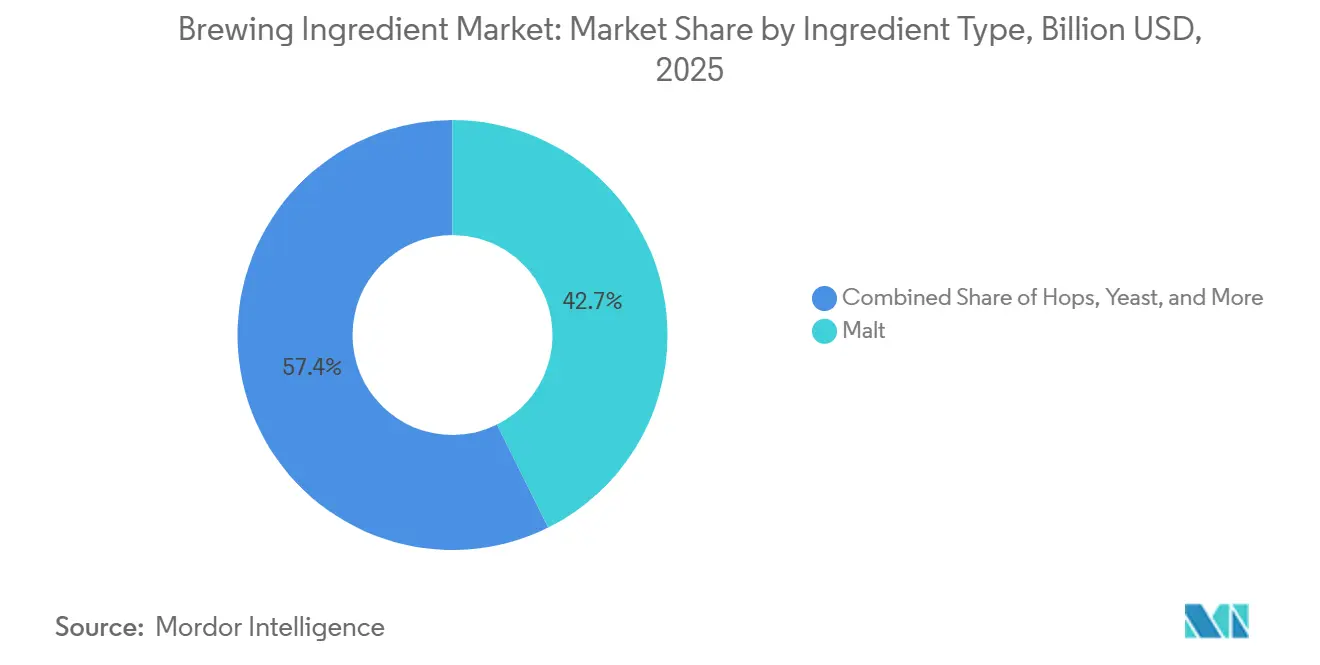
Malt holds a 42.65% share of the brewing ingredient market in 2025, as it remains essential to nearly every beer style. Malted barley provides the fermentable material, color, and body required at the scale of macro breweries, where recipe consistency and predictable processing are critical across large, geographically dispersed production networks. Rice adjuncts and flavor compounds cannot replace these core functions in industrial beer production. Malt remains the largest ingredient category in the brewing ingredient market because production volumes are concentrated in mainstream beer styles. Germany’s purity law permits only water, barley malt, hops, and yeast in beer, limiting the use of adjuncts in the country.
Hops forecast to register a CAGR of 7.05% from 2026 to 2031, the fastest growth rate among ingredient categories. This growth is driven by aroma varieties that create distinctive flavor and aroma profiles. Brewing additives include enzymes, coloring agents, clarifiers, and flavor extracts used across a broad range of beer styles. These inputs are gaining importance in nonalcoholic beer production, as brewers may require post-fermentation additions to restore flavor. Yeast is also benefiting from the use of nonconventional strains, such as Torulaspora delbrueckii, in low- and no-alcohol products. Innovation in malt, hops, yeast, and additives continues to support product development focused on both performance and flavor.



By Form: Dry Dominant, Liquid Gaining Ground in Premium Applications
Dry ingredients account for 62.18% of the brewing ingredient market in 2025. Their leading share reflects their long shelf life, limited reliance on cold-chain logistics, and cost efficiency for large breweries, which often require inputs that can move through established distribution networks and remain usable across extended production schedules. Dry malt, hop pellets, and active dry yeast align with procurement systems designed for high-volume production. Macro breweries also prefer dry formats because they are easier to manage across global supply chains, reducing the operational burden associated with temperature-sensitive transportation, storage, inventory control, and standardized handling procedures.
Liquid ingredients are forecast to grow at a CAGR of 6.65% from 2026 to 2031. Craft and premium breweries value these ingredients for their freshness and flexibility in on-site formulation, particularly when recipe development requires frequent adjustments to flavor, fermentation behavior, or the timing of additions during production. Liquid yeast can provide high cell viability and flavor-producing enzyme activity during pitching. This distinction is important for beers that depend on precise ester or phenolic characteristics. The transition toward liquid ingredients will progress unevenly across ingredient categories and brewery types, as format selection depends on production scale, storage conditions, desired flavor outcomes, and the operational requirements of individual brewing facilities.
By Brewery Type: Macro Scale Anchors Revenue, Craft Directs Innovation
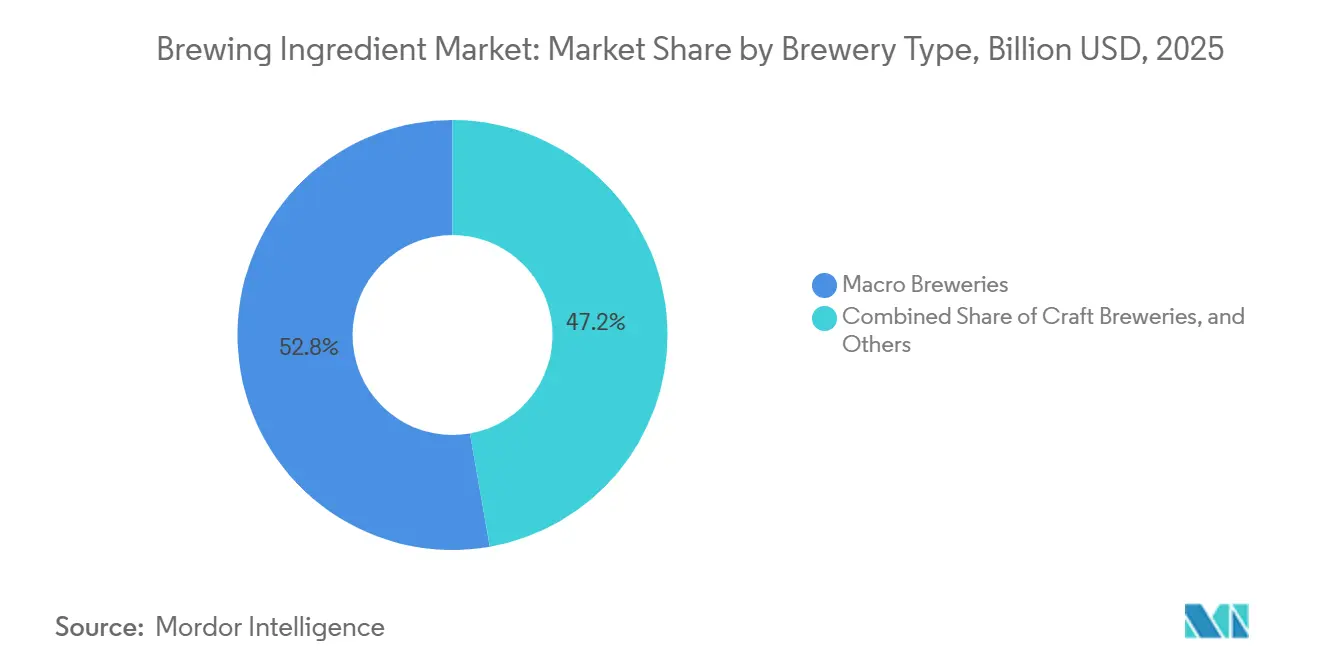
Macro breweries account for 52.78% of brewing ingredient demand in 2025. Although craft brewers may pay more per barrel, a large brewery can purchase a greater total volume of inputs than multiple small craft producers. Macro breweries typically procure malt through bulk contracts, bittering hops through long-term agreements, and dried yeast, enabling procurement teams to manage predictable volumes and maintain consistent specifications across recurring production runs for established beer brands. These purchasing patterns support demand for standardized ingredients at an industrial scale. Macro breweries are also responding to consumer demand for more diverse flavor profiles and higher product quality.
Craft breweries are forecast to grow at a CAGR of 6.92% from 2026 to 2031. Growth opportunities are stronger in Asia-Pacific and Latin America, where the specialty beer market remains less mature. Craft breweries use small-batch production to test new combinations of malt, hops, yeast, and flavors. These operations can introduce product concepts before they scale to wider commercial production. The brewing ingredient market benefits from craft breweries' higher spending on differentiated inputs per unit of beer produced, even though individual craft breweries purchase smaller volumes than macro breweries.
Geography Analysis
Asia-Pacific holds a 38.78% share of the brewing ingredient market in 2025 and is projected to grow at a CAGR of 7.21% through 2031. The region’s extensive brewing production base drives demand for malt, hops, yeast, and processing inputs, as even modest changes in ingredient usage per hectoliter can significantly affect requirements across this large brewing base. India increased beer production in 2025, while Japan, Australia, and Southeast Asia are expected to generate additional demand for specialty hops and yeast. Growing investments in local brewing capacity are also strengthening regional demand for diversified ingredient portfolios.
North America maintains a substantial specialty ingredient base, supported by its mature craft beer sector. Although Europe is experiencing weaker beer output, it retains a critical supply role for malt and hops. Boortmalt, Malteurop, Weyermann, and BarthHaas remain key suppliers and traders in the region. Food safety requirements for flavorings and enzyme preparations increase the need for robust compliance capabilities. Mexico and Brazil increased beer production in 2025, supporting brewing ingredient demand in South America. The expansion of specialty and premium beer offerings is further driving demand for differentiated brewing inputs across these markets.
Africa is the only continent to record higher beer production in 2025. Sorghum brewing supports demand for alternative grains across Sub-Saharan Africa. Commercial brewers are also investing in local barley and adjunct sourcing to reduce exposure to imports. South Africa, Egypt, and Turkey are becoming increasingly important locations for ingredient sourcing. Gulf markets offer opportunities for nonalcoholic beer inputs, including specialized yeast, natural flavorings, and process enzymes. Improvements in regional grain infrastructure could reduce reliance on imported barley over the medium term. Further development of domestic ingredient supply networks could enhance sourcing flexibility and regional market participation.

Competitive Landscape
The brewing ingredient market has a fragmented supplier structure, as companies often specialize in a single ingredient category. Their competitive positions depend on category-specific expertise, supply access, technical capabilities, and established relationships with breweries. In malt processing, Boortmalt, Malteurop, Cargill, Rahr Corporation, and Viking Malt collectively serve large breweries and a broad range of smaller beer producers. These companies maintain substantial malt-processing capacity and supply breweries at an industrial scale. BarthHaas Ingredients, Yakima Chief Hops, Steiner Hops, and Crosby Hops are established players in the hops category. Lesaffre, through Fermentis, Angel Yeast, AB Mauri, Lallemand, and Alltech compete in yeast and fermentation inputs.
Across the brewing ingredient market, sustainability is becoming an increasingly important commercial differentiator for malt suppliers, particularly as brewery customers seek barley sourcing practices that align directly with their brands and procurement commitments. These arrangements connect ingredient sourcing with brewers’ product and supply chain commitments and can differentiate suppliers from sellers of undifferentiated commodity inputs. No participant holds a clear dominant position across malt, hops, yeast, and brewing additives. This fragmented structure creates opportunities for suppliers that can combine multiple specialty ingredient categories, particularly where craft and regional brewers prefer coordinated procurement, technical support, and smaller order quantities from fewer partners.
Within the brewing ingredient market, hop suppliers are expanding proprietary aroma-variety breeding programs and establishing forward supply arrangements, reflecting the commercial value of differentiated cultivars for craft and premium beer producers. Yeast suppliers also compete through fermentation efficiency and flavor capabilities. The Scottish Whisky Research Institute confirmed an identical flavor profile to conventionally peated malt. This example demonstrates that suppliers are developing process technologies alongside ingredients. Integrated platforms that combine malt, hops, yeast, and enzyme solutions remain a potential route for suppliers serving craft breweries.
Brewing Ingredient Industry Leaders
-
Cargill, Incorporated
-
Boortmalt
-
AngelYeast Co., Ltd.
-
Rahr Corporation
-
Viking Malt
- *Disclaimer: Major Players sorted in no particular order

Recent Industry Developments
- March 2026: Hopsteiner introduced Nobella, a new noble hop variety developed to address the brewing industry's growing need for climate-resilient raw materials. Nobella combines traditional noble-hop flavor characteristics with improved agronomic stability under changing weather conditions.
- March 2026: RahrBSG and Yakima Chief Hops (YCH) announced a strategic partnership to expand brewers’ access to specialty hop varieties and processed hop products across North America. Both companies will remain independent, family-owned, and separately operated.
- February 2026: Hop Products Australia introduced Luna, a new flavor hop variety, through its long-running hop breeding program. Luna offers mango, dark berry, and spicy citrus characteristics, along with high polyphenol content that enhances flavor and mouthfeel in beer styles ranging from Pilsners to IPAs.


Global Brewing Ingredient Market Report Scope
Brewing ingredients are raw materials and functional inputs used in beer production, including malt, hops, yeast, adjunct grains, enzymes, and brewing additives. They influence fermentation, flavor, aroma, color, texture, alcohol content, and overall beer quality.
The brewing ingredients market is segmented by ingredient type, form, brewery type, and geography. By ingredient type, the market is segmented into malt, hops, yeast, and brewing additives. By form, the market is segmented into dry and liquid. By brewery type, the market is segmented into macro breweries, craft breweries, and others. Based on geography, the market is classified into North America, Europe, South America, Asia-Pacific, and the Middle East and Africa. The Market Forecasts are Provided in Terms of Value (USD).
| Malt |
| Hops |
| Yeast |
| Brewing Additives |
| Dry |
| Liquid |
| Macro Breweries |
| Craft Breweries |
| Others |
| North America | United States |
| Canada | |
| Mexico | |
| Rest of North America | |
| Europe | Germany |
| United Kingdom | |
| Italy | |
| France | |
| Belgium | |
| Rest of Europe | |
| Asia-Pacific | China |
| India | |
| Japan | |
| Australia | |
| Rest of Asia-Pacific | |
| South America | Brazil |
| Argentina | |
| Rest of South America | |
| Middle East and Africa | South Africa |
| Saudi Arabia | |
| United Arab Emirates | |
| Egypt | |
| Turkey | |
| Rest of Middle East and Africa |
| By Ingredient Type | Malt | |
| Hops | ||
| Yeast | ||
| Brewing Additives | ||
| By Form | Dry | |
| Liquid | ||
| By Brewery Type | Macro Breweries | |
| Craft Breweries | ||
| Others | ||
| By Geography | North America | United States |
| Canada | ||
| Mexico | ||
| Rest of North America | ||
| Europe | Germany | |
| United Kingdom | ||
| Italy | ||
| France | ||
| Belgium | ||
| Rest of Europe | ||
| Asia-Pacific | China | |
| India | ||
| Japan | ||
| Australia | ||
| Rest of Asia-Pacific | ||
| South America | Brazil | |
| Argentina | ||
| Rest of South America | ||
| Middle East and Africa | South Africa | |
| Saudi Arabia | ||
| United Arab Emirates | ||
| Egypt | ||
| Turkey | ||
| Rest of Middle East and Africa | ||


Key Questions Answered in the Report
What is the current and projected size of the brewing ingredient market, and what growth rate is expected during the forecast period?
The brewing ingredient market was valued at USD 20.48 billion in 2025 and is estimated to reach USD 21.55 billion in 2026. The market is further projected to grow to USD 28.63 billion by 2031, registering a CAGR of 5.85% during 2026-2031.
Which ingredient type held the largest market share in 2025?
Malt was the largest ingredient type segment, accounting for 42.65% of the market in 2025.
Which form segment dominated the brewing ingredient market in 2025?
The dry form segment dominated the market with a 62.18% share in 2025.
Which brewery type accounted for the largest share of the market in 2025?
Macro breweries held the largest market share, representing 52.78% of the brewing ingredient market in 2025.
Which region led the brewing ingredient market in 2025?
Asia-Pacific was the leading regional market, accounting for 38.78% of revenue in 2025.
Page last updated on:





