
Market Overview
| Study Period | 2020 - 2031 |
|---|---|
| Forecast Data Period | 2026 - 2031 |
| Base Year Market Size (2025) | USD 1.42 Billion |
| Market Size (2026) | USD 1.47 Billion |
| Market Size (2031) | USD 1.76 Billion |
| Growth Rate (2026 - 2031) | 3.69 % |
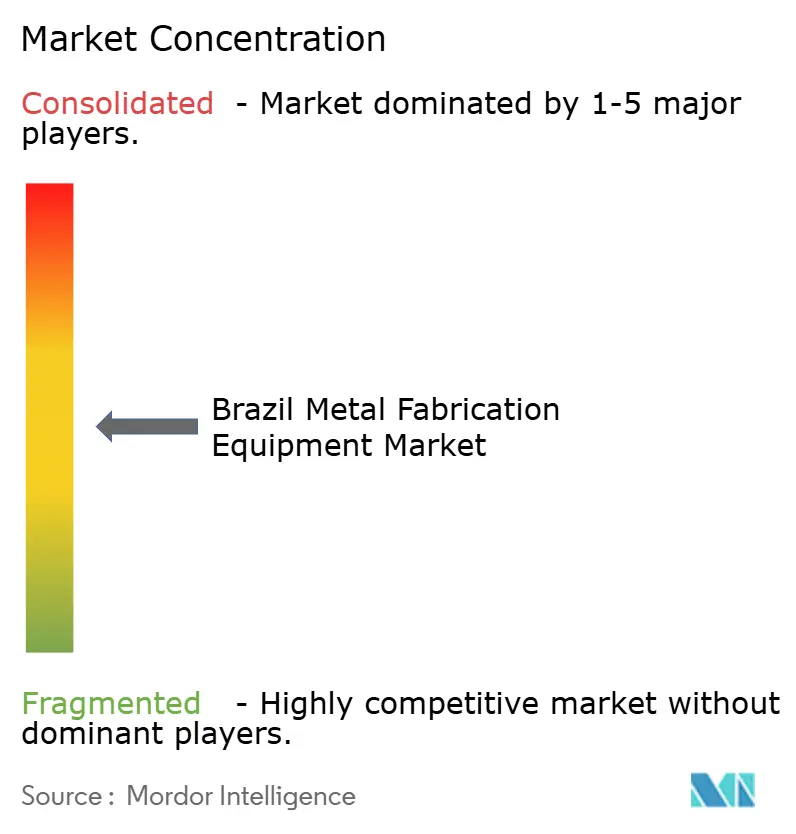
| Market Concentration | Medium |
Major Players *Disclaimer: Major Players sorted in no particular order Image © Mordor Intelligence. Reuse requires attribution under CC BY 4.0. | |
Brazil Metal Fabrication Equipment Market Analysis by Mordor Intelligence
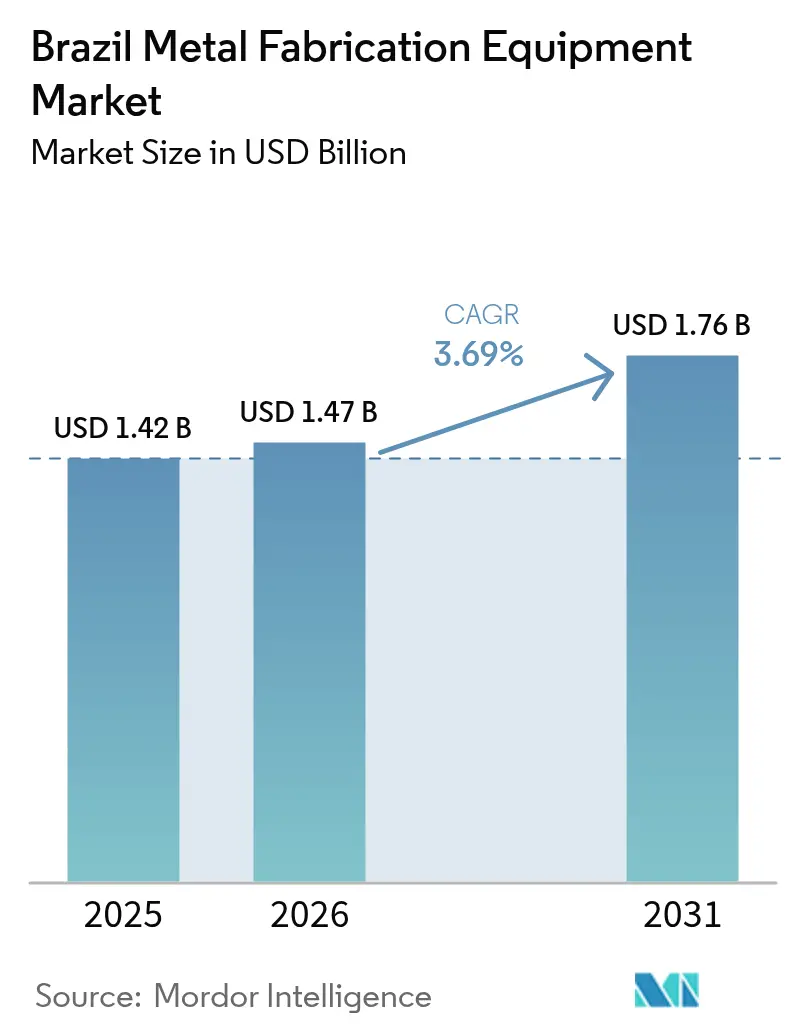
The Brazil Metal Fabrication Equipment Market size is expected to grow from USD 1.42 billion in 2025 to USD 1.47 billion in 2026 and is forecast to reach USD 1.76 billion by 2031 at 3.69% CAGR over 2026-2031. Rising infrastructure spending, robust vehicle production plans focused on electric and hybrid models, and intensive pre-salt oil and gas developments are combining to lift demand for precision machining, cutting, and welding systems. Public-sector programs such as PAC 2024-27 and Lei do Bem are widening access to modernization capital, while import tariffs of 14%–20% protect local manufacturers and give domestically produced equipment a pricing edge. Supply growth remains brisk in automatic systems as producers move toward connected, sensor-driven operations that reduce scrap and energy use. Conversely, volatile steel input prices, constrained grid reliability in the North and Northeast, and a persistent shortage of skilled CNC operators temper the short-term spending outlook.
Key Report Takeaways
- By automation level, automatic systems commanded 52.10% of the Brazil metal fabrication equipment market size in 2025 and are expanding at a 4.55% CAGR through 2031.
- By equipment type, machining equipment led with 41.88% of the Brazil metal fabrication equipment market share in 2025; welding equipment is projected to grow at the fastest 5.05% CAGR to 2031.
- By end-user, construction and infrastructure accounted for a 37.10% share of the Brazil metal fabrication equipment market size in 2025, while the diverse “others (electronics, General manufacturing, marine, railways, etc.)” category is set for the highest 4.66% CAGR to 2031.
- By region, Southeast captured 46.30% revenue share in 2025; Northeast is forecast to post a 4.61% CAGR through 2031.
Note: Market size and forecast figures in this report are generated using Mordor Intelligence’s proprietary estimation framework, updated with the latest available data and insights as of 2026.
Brazil Metal Fabrication Equipment Market Trends and Insights
Drivers Impact Analysis*
| Driver | (~) % Impact on CAGR Forecast | Geographic Relevance | Impact Timeline |
|---|---|---|---|
| Accelerated pre-salt O&G field development boosting high-spec equipment demand | +0.8% | Southeast, South plus offshore zones | Medium term (2-4 years) |
| Expansion of Brazilian EV/automotive clusters spurring CNC adoption | +0.6% | Southeast, South | Short term (≤ 2 years) |
| PAC 2024-27 infrastructure pipeline driving large-scale steel fabrication | +0.5% | National, early gains in Northeast, North | Medium term (2-4 years) |
| Lei do Bem tax incentives catalyzing Industry 4.0 investments | +0.4% | Southeast, South, selective Northeast | Long term (≥ 4 years) |
| FINAME local-content mandates favoring domestic equipment purchases | +0.3% | National | Short term (≤ 2 years) |
| Rising Mercosur module exports requiring capacity upgrades | +0.2% | Southeast, South | Medium term (2-4 years) |
| Source: Mordor Intelligence | |||
Accelerated Pre-Salt O&G Field Development Boosting High-Spec Equipment Demand
Petrobras plans to drill 280 new wells by 2028 under a USD 102 billion spending program, driving unprecedented demand for ultra-high-tolerance cutting and welding systems that handle corrosion-resistant alloys for subsea pipelines and floating production units[1]. Constellation Oil Services reports rig day rates nearing USD 500,000, evidence of premium equipment needs. Tenaris and Equinor recently delivered 83,000 tons of steel pipe for the Raia project, underscoring sustained Southeast demand for sophisticated fabrication.
Expansion of Brazilian EV/Automotive Clusters Spurring CNC Adoption
Automakers have announced more than USD 6 billion in fresh plant upgrades to build electric models. General Motors alone is committing USD 1.4 billion through 2029, while Toyota earmarked USD 2.22 billion, which includes USD 1 billion by 2026, for locally tailored vehicles. Precision CNC machines are central to new battery-pack frames and lightweight chassis components, lifting orders across São Paulo and Paraná.
PAC 2024-27 Infrastructure Pipeline Driving Large-Scale Steel Fabrication
The Growth Acceleration Program set aside BRL 186.6 billion(USD 35.45 billion) for nationwide industrial digitalization and allocated R$816 million(USD 155.04 million) from the Northeast Investment Fund toward the long-delayed Transnordestina railway[2]. Massive bridge girders, rail cars, and station structures demand thick-plate forming lines and multi-torch gantry cutting cells, boosting equipment suppliers with heavy-duty portfolios.
Lei do Bem Tax Incentives Catalyzing Industry 4.0 Investments
Companies that claim the Lei do Bem deduction recover up to 34% of qualifying R&D outlays, sharply lowering net costs for automation, sensor integration, and data-analytics upgrades. Academic studies show participants materially out-innovate peers, yet only 0.7% of eligible firms have used the benefit so far. Wider uptake would unlock a broad modernization wave, especially among mid-sized machining shops.
Restraints Impact Analysis*
| Restraint | (~) % Impact on CAGR Forecast | Geographic Relevance | Impact Timeline |
|---|---|---|---|
| Volatile steel input prices compressing capex budgets | -0.7% | National, acute in Southeast, South | Short term (≤ 2 years) |
| Grid instability in North/Northeast limiting high-power machine uptime | -0.4% | North, Northeast | Medium term (2-4 years) |
| CNC skilled-labour shortage restraining automation ROI | -0.3% | National, concentrated in Southeast, South | Long term (≥ 4 years) |
| Import tariffs inflating advanced equipment costs | -0.2% | National | Short term (≤ 2 years) |
| Source: Mordor Intelligence | |||
Volatile Steel Input Prices Compressing Capex Budgets
Fluctuating coil prices and antidumping policy shifts are creating budgeting uncertainty for plants planning new lines. Gerdau cut its five-year outlay target to R$9.2 billion(USD 1.75 billion), blaming squeezed margins tied to cheap Asian imports. ArcelorMittal similarly paused its João Monlevade expansion, stalling orders for heavy presses and automated roll grinders.
Grid Instability in North/Northeast Limiting High-Power Machine Uptime
Voltage sags in Pará and Maranhão trigger average shutdown costs of USD 7,364 per incident for high-load laser cutters and induction-heating weld stations. Firms delay purchases of multi-kilowatt fiber-laser machines until reliability improves.
*Our forecasts treat driver/restraint impacts as directional, not additive. The impact forecasts reflect baseline growth, mix effects, and variable interactions.
Segment Analysis
By Automation Level: Automatic Equipment Drives Digital Transformation
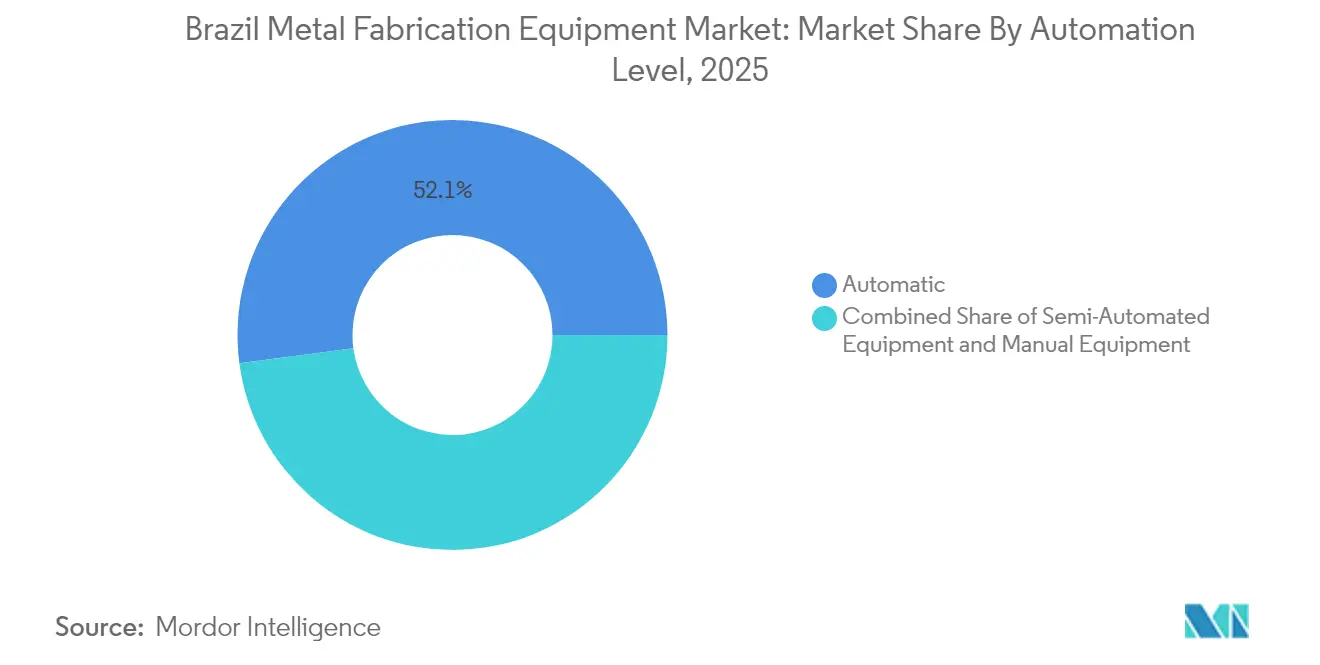
Automatic systems held 52.10% of the Brazil metal fabrication equipment market in 2025, and revenue is rising at a 4.55% CAGR to 2031. Factory owners see paybacks under three years when integrated robotics cuts rework and scrap. Semi-automated machines remain popular among medium enterprises taking a modular upgrade route, whereas fully manual benches survive in artisan workshops and for intricate stainless-steel finishes.
Government digitalization funding of BRL 186.6 billion(USD 35.45 billion) and the Brasil Mais Produtivo program’s BRL 560 million(USD 106.4 million) allocation for small manufacturers are accelerating control retrofits and sensor deployments. Nonetheless, surveys in the Sorocaba region found only 46% of firms familiar with core Industry 4.0 concepts. The gap suggests a long runway for automatic-equipment adoption as awareness programs expand.

By Equipment Type: Machining Dominance Amid Welding Innovation
Machining equipment captured 41.88% of the Brazil metal fabrication equipment market in 2025, reflecting the country’s deep heritage in turning, milling, and drilling for engines, gearboxes, and agricultural machinery. The machining Brazil metal fabrication equipment market size for this segment is projected to climb alongside EV-related lightweight components. Meanwhile, welding equipment revenue is increasing at a 5.05% CAGR, led by multiprocess power sources tailored to offshore alloy steels.
Exhibitors at FEIMEC 2024 highlighted integrated cells combining CNC mills with inline robotic welders and AI-driven inspection, moving the sector toward end-to-end digital lines. Cutting and forming machines continue to parallel overall market growth as construction orders for plate shears and press brakes track rail and port upgrades.
By End-User Industry: Construction Leadership Amid Diversification
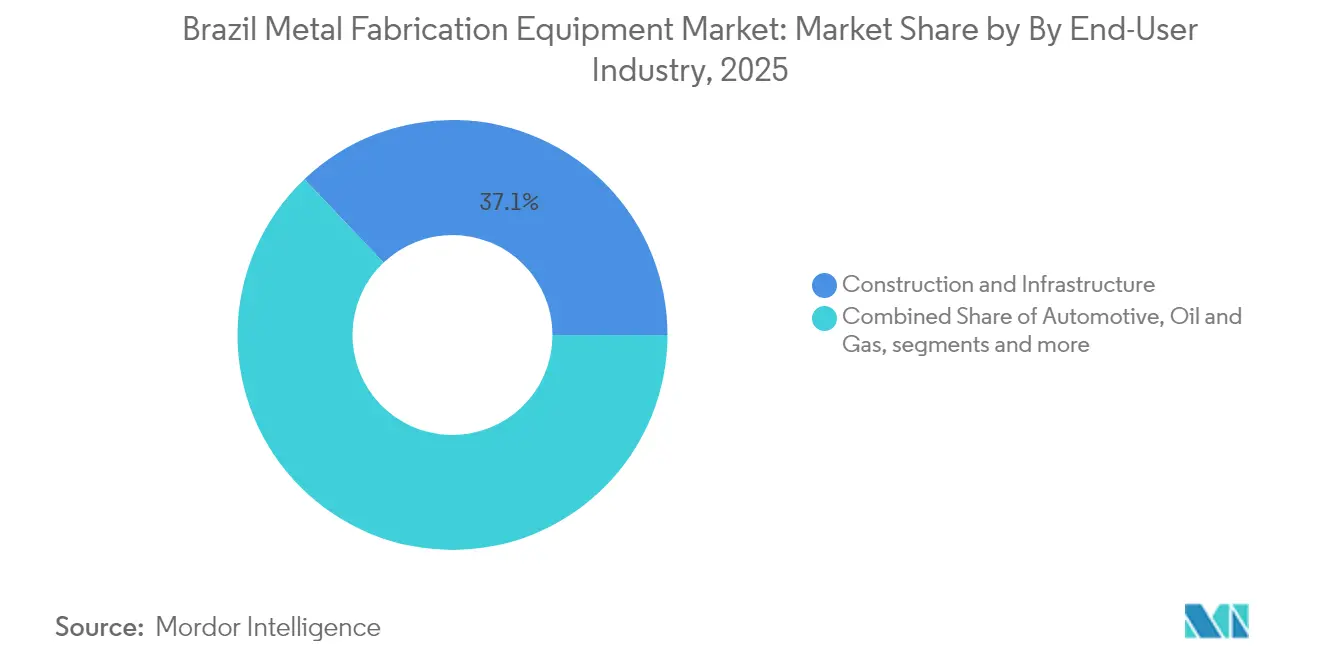
Construction and infrastructure represented 37.10% of demand in 2025, underpinned by PAC 2024-27 outlays for highways, metros, and irrigation canals. The segment accounted for half of public procurement transactions for heavy press brakes and submerged-arc gantries last year. Automotive and transportation remains the second-largest buyer group, fueled by USD 6 billion earmarked for new electrified vehicle lines across existing clusters.
The diversified “others” segment electronics, general manufacturing, marine, railways shows the fastest 4.66% CAGR as Brazil pursues semiconductor self-sufficiency under the Brazil Semicon Act and coastal shipyards refit for offshore wind component fabrication. Heavy machinery suppliers serving agribusiness also drive consistent orders for large-capacity vertical lathes.
By Region: Southeast Dominance Amid Northeast Emergence
Southeast housed 46.30% of Brazil's metal fabrication equipment market revenue in 2025, thanks to dense automotive, steel, and capital-goods corridors in São Paulo and Minas Gerais. Gerdau’s R$5 billion(USD 950 million) modernization of flat-steel lines in Minas supports continuing demand for coil-processing equipment. The South keeps traction via Curitiba’s automotive base and diversified machinery exports.
Northeast is on track for a 4.61% CAGR to 2031 as the Transnordestina railway revives structural-steel demand and new logistics hubs court manufacturing relocations. Incentives tied to port-zone free-trade regimes in Ceará and Pernambuco lower the landed costs of imported subassemblies, thereby boosting equipment investments for module final assembly. Central-West benefits from grain-harvester fabrication growth, while the North taps mining-related cutting-edge crushers despite lingering grid hurdles.
Geography Analysis
The Brazil metal fabrication equipment market displays a clear industrial heartland, yet is gradually diffusing northward. Southeast remains the epicenter with a 46.30% share in 2025 because of integrated supply chains and skilled labor pools. ArcelorMittal’s USD 1.8 billion program to lift flat-product capability and quality underscores continued capex magnetism in the belt linking Belo Horizonte and Santos.
The South retains second-place status through vehicle and white-goods clusters in Rio Grande do Sul and Santa Catarina. Central-West’s Mato Grosso and Goiás show steady purchases of plate-rolling and laser-tube lines that feed farm-implement hubs serving an expanding soy and corn frontier.
Northeast’s growth arc stands out. Recent R$816 million(USD 155.04 million) disbursement from the Northeast Investment Fund to advance the 1,200 km Transnordestina railway has unlocked orders for beam drill lines, CNC plasma tables, and heavy profile benders. Steel fabricators in Pernambuco and Bahia are also bidding on wind-tower sections as offshore wind leasing blocks open.
The North’s Pará mines are scaling capacity for bauxite and copper, prompting procurement of wear-plate plasma cutters and robot-assisted gouging stations. Still, power-quality and logistics hold back broader adoption of multi-kilowatt fiber lasers, leading some buyers to specify redundant UPS systems or diesel back-up generation.
Regulatory Landscape
Brazil’s regulatory environment for metal fabrication equipment is built around national conformity assessment and technical standards, along with mandatory workplace safety rules for operating industrial machinery. Inmetro (Instituto Nacional de Metrologia, Qualidade e Tecnologia) supports measurement and product conformity assessment frameworks, while ABNT (Associacao Brasileira de Normas Tecnicas) publishes ABNT NBR standards used across fabricated steel and manufacturing applications (for example, ABNT NBR 8800 for steel structure design). On the safety side, the Ministry of Labour and Employment enforces mandatory Normas Regulamentadoras, including NR-13 for boilers, pressure vessels, piping, and metallic storage tanks used in industrial plants, shaping equipment specification, inspection routines, and documentation needs.
Trade and industrial policy also feeds directly into equipment pricing and sourcing decisions. In February 2026, Gecex-Camex approved a broad import tax hike on capital goods and IT equipment, with rates for some categories rising up to 25%, strengthening protectionist incentives that can benefit domestically produced machines in price-sensitive tenders. In April 2026, MDIC advanced trade defense actions with preliminary anti-dumping duties on specific Chinese hydraulic presses, and in June 2026 trade talks referenced potential tariff reductions on US machinery, underscoring an active tariff backdrop that affects landed costs of advanced CNC, laser, and forming imports.
Value Chain Analysis
The Brazil metal fabrication equipment value chain begins with upstream raw-material and component inputs, then moves through OEM design and assembly, system integration, and downstream sales, installation, and lifecycle support. Upstream, mining and steelmaking feed long and flat products into metal processors and fabricators, while downstream, a large base of steel processing and transformation firms underpins demand for cutting, forming, machining, and welding systems used in construction modules, automotive parts, energy components, and industrial machinery. The equipment layer combines globally sourced CNC and laser control systems, drives, motors, bearings, and power electronics with locally made frames, guarding, and accessories, and it then relies on integrators to deliver turnkey cells, robotics, and software connectivity for large buyers.
Distribution and service remain key differentiators because uptime, spare parts, and application engineering influence total cost of ownership for high-value assets such as multi-kilowatt laser cutters and automated welding cells. Industry associations such as ABIMAQ monitor sector health and highlight capacity utilization and import pressure, while major industrial users with extensive machining footprints (for example, Tupy operating hundreds of machining centers) show how the installed base sustains aftermarket revenue (maintenance, retrofits, training, tooling, and consumables). Bottlenecks also center on skilled labor for CNC programming and on how capex decisions react to steel price volatility and trade policy shifts, which can accelerate substitution toward locally eligible equipment under subsidized lines or delay purchases of imported, high-spec systems when tariffs move.
Competitive Landscape
Competitive Landscape
Competition remains moderately fragmented. Global majors such as DMG Mori, Trumpf, Amada, Lincoln Electric, ESAB, Hypertherm, and Bystronic lead in premium CNC, laser, and multi-process welding lines. Domestic firms, including BMA Brasil Equipamentos and Romi, leverage FINAME scoring advantages to supply cost-sensitive buyers of press brakes and manual lathes. Equipment tenders increasingly demand integrated IoT dashboards, nudging all vendors to embed edge analytics and OPC UA connectivity.
Strategic moves illustrate adaptation to local policy. Trumpf entered a joint venture with a São Paulo integrator to raise local content on 2D laser cutters and access subsidized credit. DMG Mori inaugurated a parts-and-training hub in Curitiba to shorten lead times for spindle rebuilds, while ESAB opened a robotics demonstration cell in Contagem to cross-sell cutting torches with collaborative welding arms.
White-space opportunities cluster around offshore alloy welding, in-situ pipe-buckle cladding, and additive repair of drilling components. Few suppliers combine 100+ kW power sources with automated seam tracking suitable for subsea spoolbases, giving first movers room to capture lucrative service contracts. Implementation of the new Tax on Goods and Services in 2026 is expected to compress effective import costs on software relative to hardware, favoring suppliers with strong digital toolboxes.
Brazil Metal Fabrication Equipment Industry Leaders
-
BMA Brazil
-
Colfax
-
DMG Mori
-
Trumpf GmbH
-
Amada Co. Ltd.
- *Disclaimer: Major Players sorted in no particular order
Market Opportunities and Future Outlook
An opportunity set is developing around localized, high-throughput component manufacturing for electrified vehicles, alongside modernization of fabrication lines using integrated automation. In June 2026, Gestamp inaugurated a new metal body and chassis components plant in Piracicaba (Sao Paulo) with a reported R$200 million investment, which adds demand for stamping support equipment, welding automation, precision machining, and inline inspection systems close to established automotive clusters. This near-OEM localization increases the addressable market for suppliers that can bundle press-line peripherals, robotic welding, laser cutting, and digital traceability into integrated cells that aim to reduce rework and scrap.
A second track is tied to heavy industry and energy-driven capex that requires high-spec materials processing and large-format fabrication. In March 2026, NOV announced a USD 200 million plan to double capacity at its subsea flexible pipe manufacturing facility in Acu, reinforcing demand for specialized welding, cutting, and forming capability for offshore-grade materials and strict QA requirements. On the policy side, the New Industry Brazil (NIB) framework and dedicated financing, including an August 2025 BNDES and Finep credit line of R$12 billion for diffusion of Industry 4.0 equipment, expands the pool of buyers that can fund robotics, sensors, and connected machine upgrades, particularly among mid-sized shops that have leaned more on manual or modular semi-automation.
Recent Industry Developments
- June 2026: Gestamp inaugurated a new metal body and chassis components plant in Piracicaba, Sao Paulo, reported as its seventh such factory in Brazil and backed by a R$200 million investment. The added footprint increases localized demand for stamping-adjacent fabrication equipment, robotic welding, and machining capacity near automotive hubs, supporting faster supplier response times and tighter quality control.
- July 2025: Metalurgica Nakayone ordered a 1,600-ton modular Triton transfer press system from ANDRITZ Schuler to expand its press shop, with delivery targeted for late 2025 and commissioning referenced for mid-2026. The project signals continued investment in higher-productivity forming capability and typically pulls through complementary equipment such as dies, feeding systems, automation, and downstream welding and inspection cells.
- November 2024: Tenaris and Equinor completed fabrication of 83,000 tons of pipe for the Raia offshore gas project in Sao Paulo. The scale of the pipe package highlights sustained requirements for high-tolerance cutting, welding, and inspection systems used in offshore-grade component fabrication and reinforces Southeast Brazil as a premium-demand center for advanced metalworking equipment.
Research Methodology Framework and Report Scope
Market Definition and Coverage
For this report, the market is defined as the value of metal fabrication equipment sold in Brazil for cutting, machining, forming, and welding work carried out in fabrication shops and captive plants.
Scope exclusions: We exclude rentals, remanufactured or used equipment, and units used only for additive manufacturing.
Segmentation Overview
- By Automation Level
- Automatic
- Semi-Automated Equipment
- Manual Equipment
- By Equipment Type
- Cutting (Laser, Plasma, Waterjet, Oxy-fuel, etc.)
- Machining (Lathes, Milling, Drilling, etc.)
- Forming (Press Brakes, Bending Machines, etc.)
- Welding (Arc Welding, Laser Welding, etc.)
- Other Equipment Types (Finishing, Handling, Tooling, etc.)
- By End-User Industry
- Automotive & Transportation
- Construction & Infrastructure
- Oil & Gas / Energy
- Aerospace & Defense
- Heavy Machinery & Industrial Equipment
- Others (Electronics, General Manufacturing, Marine, Railways, etc.)
- By Region
- Southeast (Sudeste)
- South (Sul)
- Northeast (Nordeste)
- North (Norte)
- Central-West (Centro-Oeste)
Data Sources, Market Sizing, and Validation
Desk Research
Desk research was used to map the Brazil demand environment and to set clean boundaries on what qualifies as metal fabrication equipment sales. We mainly relied on public, non-paywalled sources such as Brazil government statistics (including IBGE industrial production series), Central Bank of Brazil releases, Brazil customs trade data, and international trade classifications for machine tools.
To keep assumptions grounded, we also reviewed sources such as manufacturing and welding association publications, technical standards and safety notes that affect machine adoption, peer-reviewed engineering journals that discuss technology shifts (for example CNC and laser use), and company filings and investor presentations for activity signals. Where needed, paid subscriptions for company financials and intelligence, news and financials, and patent databases were used to cross-check supplier presence and product positioning. The desk sources listed are illustrative only and many other public references were also used for data collection, validation, and clarification.
Primary Interviews and Surveys
Primary work focused on interviews and structured surveys with equipment suppliers, distributors, integrators, and large end users that buy machines for in-house fabrication. We used these conversations to confirm what is actually shipped and installed in Brazil, to validate pricing movement, and to pressure-test adoption trends across key industrial hubs and customer types.
Distribution of primary research fieldwork respondents
| Company type | Respondent position |
|---|---|
| Top tier: 35% | CXOs: 13% |
| Mid tier: 49% | Functional/Unit leaders: 28% |
| Smaller Players: 16% | Managers: 59% |
Market-Sizing & Forecasting
Sizing started with a top-down reconstruction that links Brazil metalworking activity to equipment demand, and then applies equipment penetration and replacement cycles to reach an annual sales value. To keep the model realistic, selective bottom-up checks were added using sampled price-by-volume math from channel checks and supplier revenue splits, which were then used to adjust totals where gaps appeared.
Key inputs included industrial production momentum in metalworking-heavy sectors, machinery import and export trends for relevant categories, installed base refresh behavior, average selling price movement by equipment class (including CNC, laser, and plasma add-ons), capacity utilization signals from manufacturers, and major project cycles that typically pull fabrication demand forward. For the forecast, scenario analysis was used so that macro conditions, investment timing, and price progression could be flexed, and then aligned with what primary respondents considered a realistic order pipeline. When bottom-up visibility was weaker for smaller channels, we filled gaps using conservative share assumptions that were tied back to trade flows and distributor feedback.
Data Validation & Update Cycle
Outputs were triangulated against independent signals such as trade value direction, industrial output trend lines, and interview-based checks on order intake and lead times. Outliers were reviewed in steps, first by checking unit and currency consistency, next by revisiting the underlying assumption, and then by re-contacting sources if the variance stayed large.
Before sign-off, the model and narrative go through a multi-analyst review so arithmetic, definitions, and logic remain consistent from the historical period to the forecast. Reports are refreshed annually, with interim updates when material events change demand, pricing, or supply availability. Right before delivery, we run a final pass so clients receive the latest updated view.
Mordor Intelligence's Brazil Metal Fabrication Equipment Market Size Compared With Other Published Estimates
Different published market sizes for Brazil metal fabrication equipment often do not match because the boundaries of what gets counted are not the same, and the year used as the base can also shift the number. The most common differences come from whether used machines and rentals are included, and whether the value is measured at ex-factory, distributor, or installed price.
Import and export value direction, combined with primary confirmations on what equipment is installed locally, are the checks that keep Mordor Intelligence aligned to new equipment sales in Brazil, which also explains why some broader scopes produce a higher total. Price progression choices also matter here, since some sources push aggressive ASP inflation through the whole forecast, even when channel feedback points to discounting in certain machine categories.
Benchmark comparison
| Source | Market Size | Gaps in Research Methodology |
|---|---|---|
| Mordor Intelligence | USD 1.42 B (2025) | |
| Industry Publisher A | USD 1.87 B (2024) | Uses an earlier base year and appears to apply a wider equipment bucket, which can pull in adjacent workshop tools and services that are not limited to new machine sales. |
| Industry Publisher B | USD 1.30 B (2025) | Uses a narrower demand pool and different price progression, which can undercount higher-value CNC, laser, and plasma modules that are often sold as part of the machine package. |
Seen together, the spread is mainly explained by scope edges and how pricing is carried through the model. Our approach keeps the total traceable to clear activity signals, repeatable conversion steps, and interview-based checks that confirm what is being sold and deployed in Brazil.
Key Questions Answered in the Report
What is the current value of the Brazil metal fabrication equipment market?
The market stands at USD 1.47 billion in 2026 and is forecast to reach USD 1.76 billion by 2031.
Which equipment segment leads the Brazil metal fabrication equipment market?
Machining equipment holds the largest 41.88% share, while welding equipment is the fastest-growing segment with a 5.05% CAGR to 2031
How important is automation in Brazil’s metal fabrication sector?
Automatic systems already account for 52.10% of revenue and are expanding at a 4.55% CAGR, reflecting strong movement toward Industry 4.0 adoption.
Which region shows the fastest growth for metal fabrication equipment demand?
The Northeast is projected to grow at 4.61% annually through 2031, driven by major rail and port projects.
What government incentives support equipment modernization?
Lei do Bem offers tax deductions for R&D and technology spending, while FINAME provides subsidized financing for high-local-content machines.
What are the main challenges facing equipment buyers?
Steel price volatility, skilled-labor shortages, import tariffs on advanced machinery, and power-supply instability in northern regions are key obstacles to near-term investment.