
Market Overview
| Study Period | 2020 - 2031 |
|---|---|
| Forecast Data Period | 2026 - 2031 |
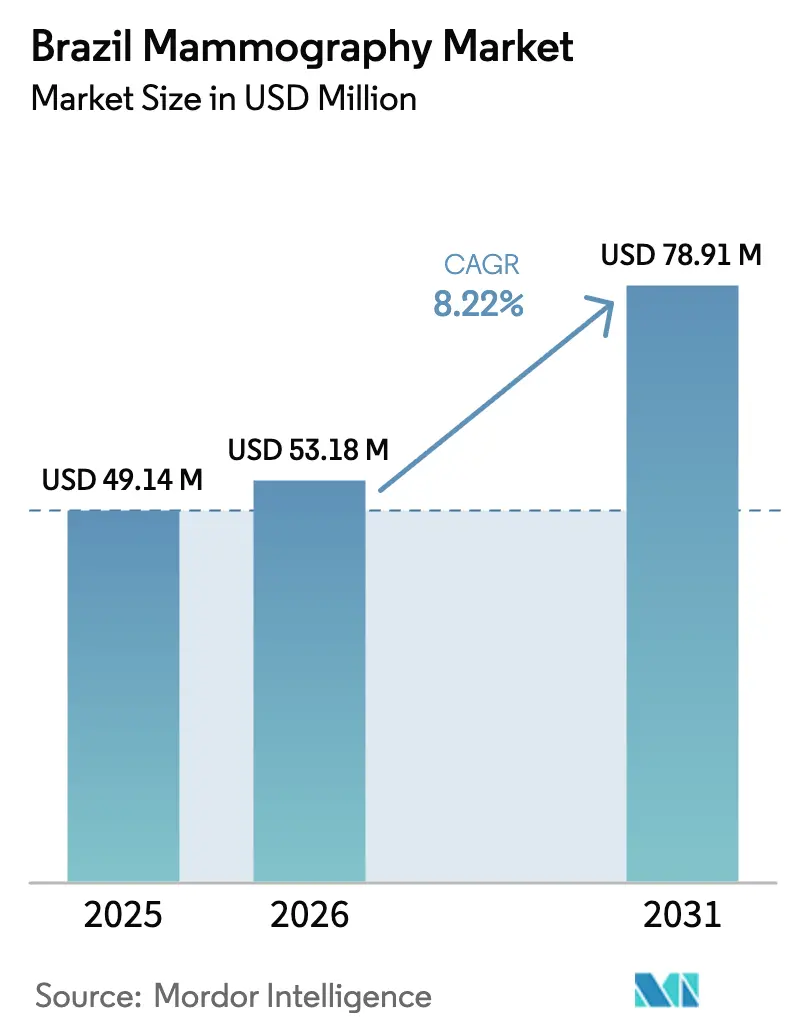
| Base Year Market Size (2025) | USD 49.14 Million |
| Market Size (2026) | USD 53.18 Million |
| Market Size (2031) | USD 78.91 Million |
| Growth Rate (2026 - 2031) | 8.22 % |
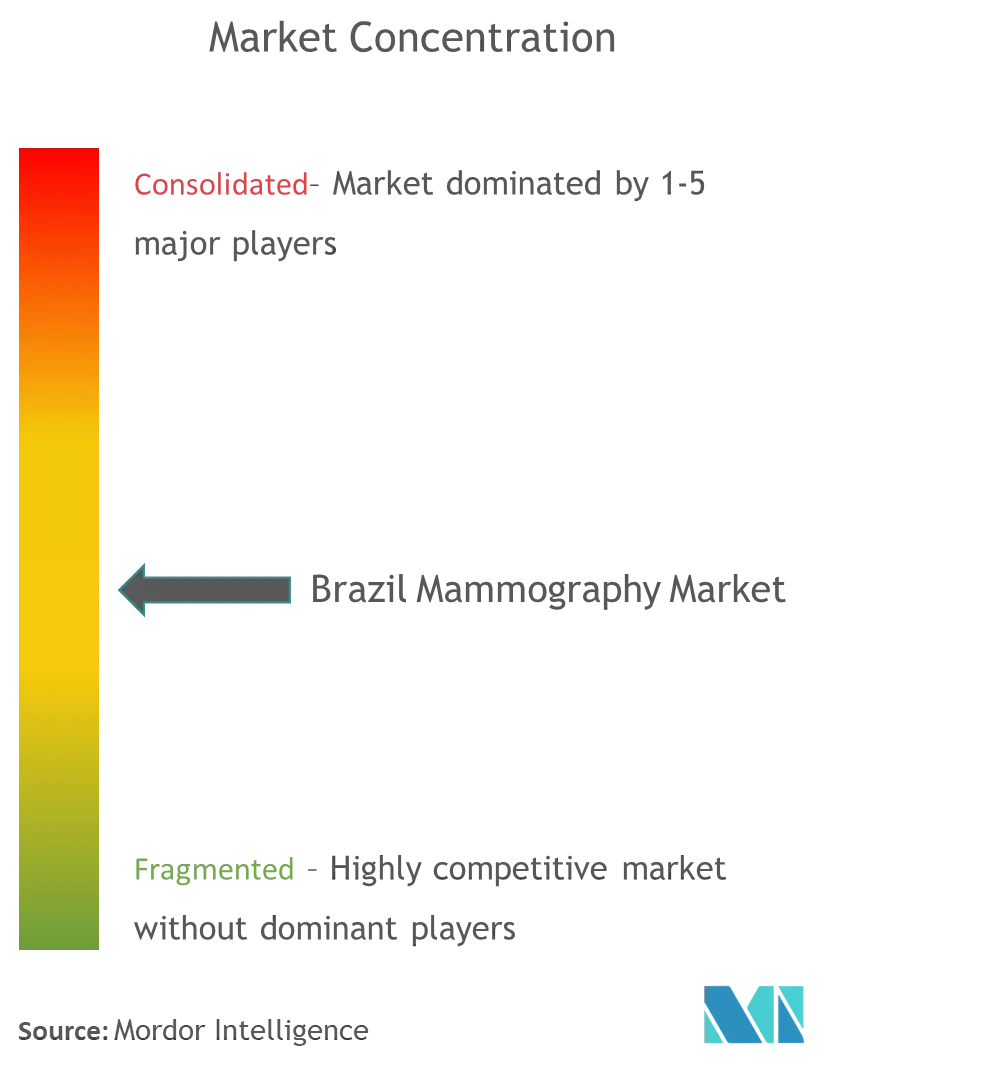
| Market Concentration | Medium |
Major Players *Disclaimer: Major Players sorted in no particular order Image © Mordor Intelligence. Reuse requires attribution under CC BY 4.0. | |
Brazil Mammography Market Analysis by Mordor Intelligence
The Brazil mammography market size is expected to grow from USD 49.14 million in 2025 to USD 53.18 million in 2026 and is forecast to reach USD 78.91 million by 2031 at 8.22% CAGR over 2026-2031. The near-double-digit growth reflects the government’s multi-year investment program in the domestic health industrial complex, the rapid conversion of analog equipment to digital and tomosynthesis platforms, and the steady roll-out of nationwide screening initiatives under the Unified Health System (SUS). Accelerated product approvals under ANVISA’s RDC 751/2022 are shortening time-to-market for imported systems, enabling global vendors to release new models tailored for local clinical workflows. Private-sector reimbursement for 3-D breast tomosynthesis and AI-assisted reporting is catalyzing an upgrade cycle among high-volume diagnostic chains, while mobile screening programs are closing access gaps in remote municipalities. These intertwined factors create a scalable, technology-centered growth trajectory for the Brazil mammography market.
Key Report Takeaways
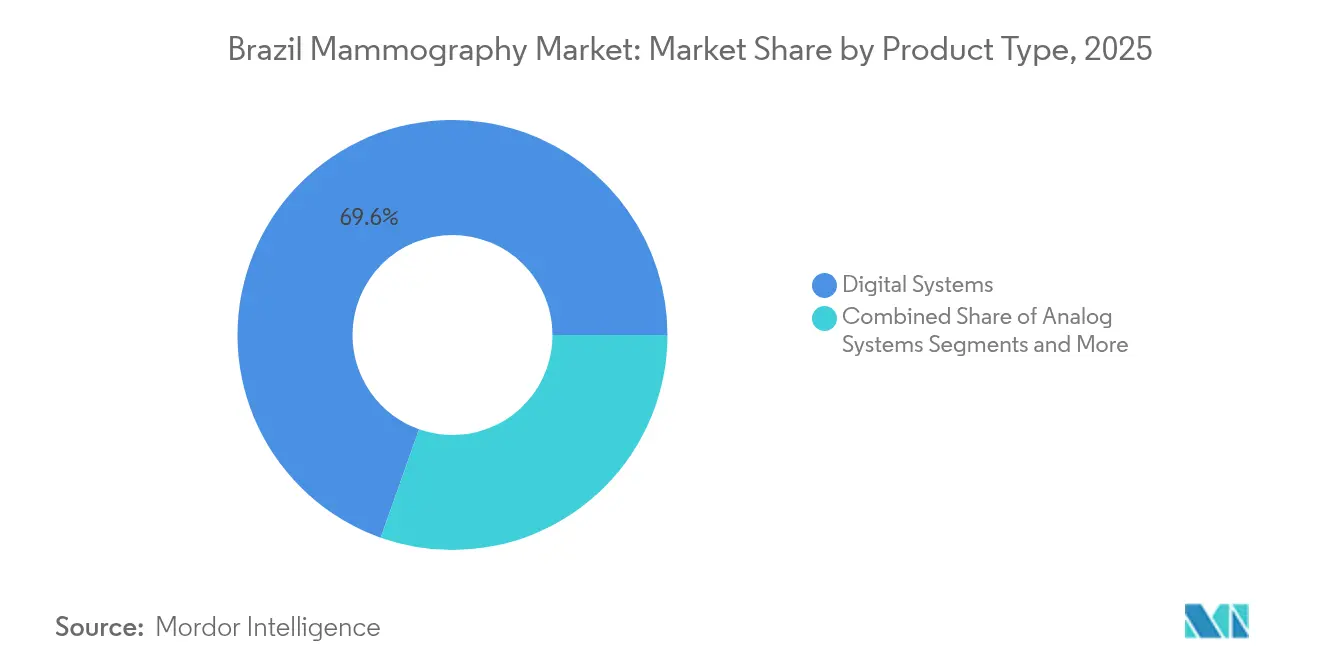
- By product type, digital systems led with a 69.58% Brazil mammography market share in 2025, while breast tomosynthesis is forecast to advance at a 9.31% CAGR through 2031.
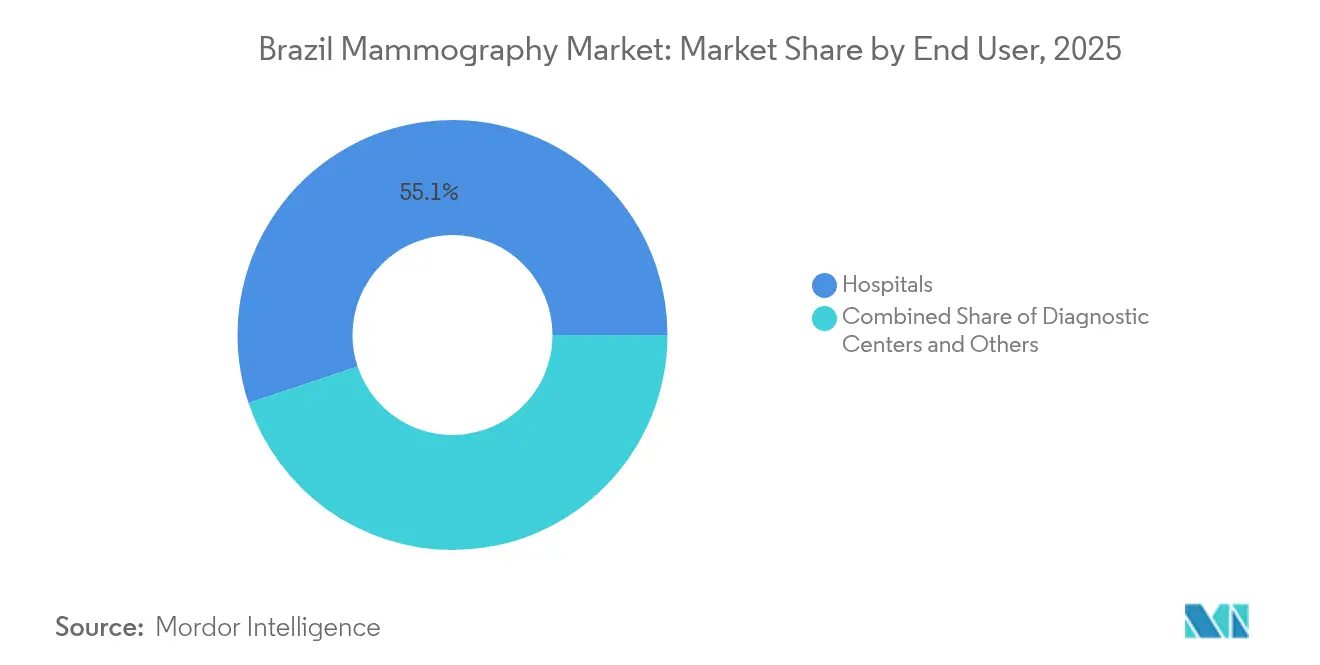
- By end user, hospitals accounted for 55.12% of the Brazil mammography market size in 2025; diagnostic centers are projected to post the fastest 9.58% CAGR to 2031.
Note: Market size and forecast figures in this report are generated using Mordor Intelligence’s proprietary estimation framework, updated with the latest available data and insights as of 2026.
Brazil Mammography Market Trends and Insights
Drivers Impact Analysis*
| Driver | (~) Impact on CAGR Forecast | Geographic Relevance | Impact Timeline |
|---|---|---|---|
| Growing burden of breast cancer | +2.1% | National, with higher impact in Southeast and South regions | Long term (≥ 4 years) |
| Roll-out of government-funded nationwide screening programs | +1.8% | National, prioritizing North and Northeast regions | Medium term (2-4 years) |
| Rapid private-sector conversion from analog to digital/tomosynthesis | +2.3% | Southeast and South regions, expanding to Northeast | Short term (≤ 2 years) |
| Reimbursement expansion for 3-D tomosynthesis | +1.2% | National, with early adoption in private healthcare | Medium term (2-4 years) |
| AI-powered CAD tools improving radiologist productivity | +1.4% | Major urban centers, expanding to regional hubs | Short term (≤ 2 years) |
| Mobile screening units reaching underserved regions | +0.5% | North and Northeast regions, rural areas nationwide | Long term (≥ 4 years) |
| Source: Mordor Intelligence | |||
Growing burden of breast cancer
The annual incidence of 73,610 new female breast cancer cases in 2023 and the notification that 1 in 3 diagnoses occurs in women under 50 are expanding the target cohort for routine imaging[1]. Clinical societies now recommend lowering the SUS screening entry age to 40, potentially enlarging the eligible population by 40%. Higher late-stage detection in SUS-dependent regions is sharpening the political focus on earlier diagnosis, pushing capital spending on imaging infrastructure. Together, these epidemiological and policy forces lift baseline demand across all product classes within the Brazil mammography market.
Roll-out of government-funded nationwide screening programs
PAC Saúde 2025 assigns USD 1.8 billion for 180,000 new health-equipment units, earmarking mammography systems for basic clinics in underserved zones. São Paulo’s “Mulheres de Peito” allows women aged 50-69 to self-schedule exams, and its mobile fleet conducted more than 24,000 screenings across 47 towns in 2023. The new oncology navigation rule (Portaria 6,592/2025) mandates rapid routing from suspicion to treatment, indirectly lifting imaging throughput. These central and state programs institutionalize volume and underpin the future base of the Brazil mammography market.
Rapid private-sector conversion from analog to digital/tomosynthesis
Private chains like Beneficência Portuguesa and Hospital da Baleia spent over USD 1.2 million per site to install digital units, lifting monthly capacity by 177% and raising diagnostic referrals by 16%. With analog systems nearing obsolescence, replacement purchasing is front-loaded into 2025-2027 budgets. Competitive positioning, higher patient throughput, and synergy with AI workflows accelerate capital cycles, sustaining premium equipment demand inside the Brazil mammography market.
Reimbursement expansion for 3-D tomosynthesis
ANS coparticipation rules cap patient out-of-pocket costs at 40%, moderating price sensitivity for advanced imaging. Peer-reviewed economic studies confirm tomosynthesis plus synthetic views is cost-effective under Brazilian practice patterns, strengthening payer acceptance. However, sustained underwriting losses of USD 18 billion at health plans between 2021-2023 necessitate selective benefit expansion, confining early tomosynthesis adoption to higher-tier products. Even so, reimbursement clarity continues to reinforce the upgrade pipeline of the Brazil mammography market.
Restraints Impact Analysis*
| Restraint | (~) Impact on CAGR Forecast | Geographic Relevance | Impact Timeline |
|---|---|---|---|
| Radiologist shortage outside Tier-1 metros | -1.1% | North and Northeast regions, interior municipalities | Long term (≥ 4 years) |
| Capital-equipment budget freeze in public hospitals | -0.8% | National, particularly affecting SUS-dependent regions | Medium term (2-4 years) |
| Concerns over cumulative radiation dose in repeat screening | -0.4% | National, affecting screening frequency recommendations | Medium term (2-4 years) |
| Logistical barriers for mobile units in North & Northeast | -0.3% | North and Northeast regions, remote rural areas | Long term (≥ 4 years) |
| Source: Mordor Intelligence | |||
Radiologist shortage outside tier-1 metros
Only 15% of board-certified breast imagers practice in the North and Northeast, constraining throughput despite rising equipment availability. Federal incentives totaling USD 86 million under the “Agora Tem Especialistas” program aim to relocate physicians, yet take-up remains slow [2]. The mismatch between technology deployment and specialist distribution tempers capacity expansion and slows adoption curves in remote markets within the Brazil mammography market.
Capital-equipment budget freeze in public hospitals
Municipal hospitals faced a 12-month freeze on discretionary purchases in 2024, delaying planned replacements and lengthening analog equipment life cycles. PAC Saúde 2025 reallocates federal funds to bypass local constraints, but procurement cycles remain elongated, creating drag in the public slice of the Brazil mammography market.
*Our forecasts treat driver/restraint impacts as directional, not additive. The impact forecasts reflect baseline growth, mix effects, and variable interactions.
Segment Analysis
By Product Type: Digital Transformation Accelerates Tomosynthesis Adoption
Digital systems controlled 69.58% of the Brazil mammography market in 2025 owing to superior image quality, PACS integration, and lower radiation exposure. The Brazil mammography market size for breast tomosynthesis is expected to expand at a 9.31% CAGR, propelled by false-positive reductions of up to 40% and enhanced lesion visibility in dense breasts . Analog units linger mainly in lower-income municipalities but are slated for replacement under federal équipement grants. Contrast-enhanced mammography and molecular breast imaging occupy nascent, high-margin niches in premium private hospitals.
Growing AI adoption multiplies the clinical value of digital platforms. Implementations at Beneficência Portuguesa achieved 97% diagnostic accuracy, illustrating how software upgrades leverage installed hardware to lift clinical performance and reimbursement potential. ANVISA’s RDC 611/2022 quality-assurance mandates favor facilities that invest in compliant digital technology, locking in further share gains for the digital segment within the Brazil mammography market.

By End User: Diagnostic Centers Drive Market Expansion
Hospitals captured 55.12% of the Brazil mammography market share in 2025, anchored by integrated oncology services and established referral pipelines. Yet diagnostic centers are slated to grow at 9.58% CAGR through 2031, buoyed by outpatient convenience, lower procedure costs, and quicker appointment cycles. The Brazil mammography market size attributable to diagnostic centers could double over the forecast period as chains scale nationwide and leverage AI to offset radiologist shortages.
Investments such as dr.consulta’s USD 4.0 million partnership with Canon Medical spotlight the sector’s appetite for cutting-edge imaging. Rede D'Or’s network of 1,000 outpatient units further merges hospital and diagnostic settings, creating hybrid models that sustain volume and diversify payer exposure. Mobile screening vans, aggregated under the “Others” category, extend reach to rural populations and amplify the total addressable base for the Brazil mammography market.
Geography Analysis
Regional contrasts define market opportunity. The Southeast performed 1.86 million SUS screening mammograms in 2022 versus 141,000 in the North, a 13-fold gap illustrating infrastructure concentration. São Paulo routinely pilots new service-delivery models, such as self-scheduled screening and AI-enabled reading, creating demonstration effects adopted by neighboring states. The South boasts the highest per-capita screening, reflecting higher household incomes and dense private-insurance coverage, factors that underpin premium system sales in the Brazil mammography market.
The North and Northeast embody latent growth. PAC Saúde 2025 directs USD 22 million to Amazonas and USD 21 million to Maranhão for equipment roll-outs, laying the hardware foundation where patient travel distances average 448 km for oncology care. FNE development funding of USD 8.7 billion for small businesses in 2024 catalyzes private imaging startups in secondary cities, further diversifying service supply. These policy and financing levers collectively prime the Brazil mammography market for outsized regional catch-up.
Regulatory Landscape
Medical devices in Brazil are regulated by ANVISA, and mammography systems require compliance across device registration and service-level radiation safety controls. For market entry, vendors follow ANVISA pathways shaped by RDC 751/2022 for risk-based classification and marketing authorization. For faster onboarding of imported systems, ANVISA has also recognized reliance mechanisms such as acceptance of FDA and Health Canada approvals via IN 290/2024, which can shorten time-to-market for refreshed digital and tomosynthesis platforms.
On the use-site side, mammography providers must operate under sanitary and radiation-protection requirements for radiology services under RDC 330/2019. Modality-specific technical and quality-control requirements are defined by IN 92/2021 for mammography. Class III and IV devices require ANVISA GMP certification, and electromedical equipment must also meet mandatory INMETRO certification, reinforcing demand for compliant installation, calibration, and periodic quality-assurance services alongside equipment sales.
Value Chain Analysis
Brazil’s mammography value chain starts with global OEMs and their local subsidiaries or distributors, including service and applications support. It then moves through procurement at hospitals and diagnostic centers, installation, physicist-led acceptance testing, and ongoing preventive maintenance, before image acquisition, reporting, and referral into oncology pathways. Access and demand generation are tied to SUS screening entry and referral flows, while private diagnostic chains tend to upgrade faster to digital and tomosynthesis and increasingly bundle AI and workflow software into service delivery.
Supplier competition is shaped by procurement and distribution dynamics. In the public sector, acquisition commonly runs through electronic reverse auctions (pregao eletronico) on platforms such as Compras.gov.br, where price competitiveness and compliance documentation are decisive. Tenders may also include Margem de Preferencia of 8% to 25% for locally manufactured devices, affecting localization, assembly, and local content strategies. The installed base and service capacity remain geographically concentrated, with equipment distribution skewed toward the Southeast (47.4% of units) versus the North (6%), which increases the need for regional service coverage, uptime guarantees, and mobile-program workflows in underserved areas.
Competitive Landscape
The Brazil mammography market exhibits moderate concentration. Global manufacturers—Hologic, GE Healthcare, Siemens Healthineers—collectively hold the lion’s share of installed capacity, leveraging broad portfolios and in-country service networks. ANVISA’s RDC 751/2022 plus IN 290/2024 acceptance of FDA and Health Canada approvals trims lead times and encourages rapid model refreshes, as displayed by GE’s Pristina Via™ and Hologic’s Genius AI Detection PRO launches in 2025.
Competitive intensity is shifting from hardware to integrated AI ecosystems. Lunit’s CAD platform now screens 1 million mammograms annually across more than 200 U.S. sites and is being localized for Portuguese workflows, highlighting software-driven expansion strategies.
Domestic innovators like Huna target non-imaging biomarkers, widening the diagnostic funnel and redefining market boundaries. Service differentiation through turnkey cloud reporting, zero-click acquisition, and mobile workflows is fast becoming the principal battleground in the Brazil mammography market.
Brazil Mammography Industry Leaders
-
GE Healthcare
-
Siemens AG
-
Planmed OY
-
Hologic Inc.
-
Fujifilm Holdings Corporation
- *Disclaimer: Major Players sorted in no particular order
Market Opportunities and Future Outlook
Policy-driven expansion of the eligible screening cohort creates a clear operational whitespace, especially where providers need to turn that demand into sustained execution across uneven infrastructure. Lei 15.284/2025 expands public access to mammography within SUS for women starting at age 40, while professional bodies including CBR, SBM, and FEBRASGO advocate annual screening for women aged 40 to 74 alongside adoption of digital mammography and breast tomosynthesis. These changes increase the pull for throughput-focused solutions that fit both SUS workflows and private-chain productivity needs, including faster acquisition, standardized QC, and AI-assisted triage and reporting.
Regional access gaps and procurement mechanics narrow the near-term opportunity set for vendors and service providers. The evidence of concentration (Southeast at 47.4% of units versus 6% in the North) points to an equipment and service coverage gap that favors portable configurations, mobile-screening enablement, and cloud-connected image management to extend specialist reading capacity beyond tier-1 metros. For SUS demand, vendors need readiness for Compras.gov.br tender processes, reverse-auction competition, and documentation covering ANVISA and INMETRO compliance, including the ability to compete under Margem de Preferencia rules. In the private sector, upgrade cycles favor vendors that can package digital or tomosynthesis systems with workflow software, training, and lifecycle service contracts to sustain utilization and uptime.
Recent Industry Developments
- April 2026: GE HealthCare expanded global collaboration with DeepHealth (RadNet) to integrate AI powered mammography tools and breast cancer screening workflow solutions into GE HealthCare mammography systems. The integration broadens AI enabled screening across devices and networks in Brazil, strengthening the market's move toward digital and AI driven workflows.
- September 2025: GE HealthCare entered into a strategic partnership with Hapvida to equip the Unidade Avancada Brigadeiro facility in Sao Paulo as exclusive medical technology partner, featuring Pristina mammography systems. The deployment marks a flagship diagnostic hub in Brazil, expanding GE’s installed base and AI enabled workflow appeal in high volume private networks.
- February 2025: GE HealthCare donated a Senographe Crystal Nova digital mammography unit to Hospital de Esperanca in Sao Paulo, increasing exam throughput. This public sector contribution enlarges GE’s footprint in Brazil and provides measurable throughput improvements in a key market.
Research Methodology Framework and Report Scope
Market Definition and Coverage
For this methodology, the Brazil mammography market is defined as revenue earned from mammography systems and related hardware placed and used in Brazil for breast imaging in screening and diagnostic settings, across public and private care sites.
Scope exclusions: We exclude broader diagnostic imaging modalities, general radiography systems, and downstream clinical services that are billed as imaging procedures rather than equipment revenue.
Segmentation Overview
- By Product Type
- Digital Systems
- Analog Systems
- Breast Tomosynthesis
- Other Product Types
- By End User
- Hospitals
- Diagnostic Centers
- Others
Data Sources, Market Sizing, and Validation
Desk Research
Desk research was used to set the demand context and to anchor assumptions that can be checked independently. We relied on public health and screening references from sources such as Brazil Ministry of Health publications, INCA cancer statistics, DATASUS procedure and facility activity tables, and ANVISA device registration and regulatory updates.
To translate context into a workable sizing model, we also reviewed broader healthcare spending and facility base indicators from sources such as IBGE and World Bank health indicators, along with peer-reviewed radiology and oncology journals that discuss screening rates and adoption barriers. Company filings, investor presentations, press releases, and association websites were reviewed to track product mix shifts like digital conversion and tomosynthesis uptake. In a few places, paid subscriptions supporting company financials and news helped validate shipment timing and pricing direction, and then the assumptions were kept aligned with what interviewees confirmed. The sources listed here are illustrative, and many additional public documents and references were used for cross-checks and clarification.
Primary Interviews and Surveys
Primary work focused on validating what is actually being purchased and used across Brazil, then stress testing desk assumptions. We spoke with a mix of imaging center operators, hospital radiology leaders, procurement and biomedical teams, distributors, and service partners. Coverage was balanced across major states and smaller cities, where access constraints can affect utilization.
Distribution of primary research fieldwork respondents
| Company type | Respondent position |
|---|---|
| Top tier: 32% | CXOs: 17% |
| Mid tier: 51% | Functional/Unit leaders: 32% |
| Smaller Players: 17% | Managers: 51% |
Market-Sizing & Forecasting
Sizing started with a top-down demand pool build that uses Brazil specific screening intensity and installed base needs to reconstruct yearly equipment revenue, and then it was cross-checked using selective bottom-up approximations like sampled system ASPs multiplied by observed replacement and new install volumes. The model separates analog, digital, and tomosynthesis value by applying adoption shares and upgrade timing that were validated in interviews, and then totals are adjusted when the implied utilization pattern does not match facility-level reality.
Key inputs included the eligible screening age cohort, reported mammography exam volumes and backlog signals, public versus private mix of imaging delivery, typical replacement cycles for fixed systems, and the share of sites upgrading to digital and 3D. For forecasting, scenario analysis was used so we could test how faster public tender cycles, currency driven import pricing, and changing reimbursement for advanced imaging could shift purchase timing. When bottom-up inputs were incomplete for smaller providers, gaps were handled using regional facility counts and average system intensity per site, then rechecked through distributor channel feedback.
Data Validation & Update Cycle
Outputs were validated through multiple checks so the final numbers are not driven by one data stream. We compared implied equipment revenue against independent signals like procedure volumes, facility counts, and realistic replacement math, and any large variance triggered a rework of assumptions and follow-up questions to interviewees.
Before sign off, another analyst reviews the model logic, unit consistency, and year over year jumps, and then anomalies are documented and resolved. Reports are refreshed annually, with interim updates when material events occur such as major regulatory changes, sharp currency moves, or unusually large public procurement rounds. Right before delivery, the latest public releases and news are re-scanned so clients receive an updated view.
Mordor Intelligence's Brazil Mammography Market Sizing Compared With Other Published Estimates
Published market values can differ because the counted revenue line is not always the same, and because the assumed replacement and upgrade pace can vary a lot by data source. Differences also show up when one estimate leans more on procedure volumes and another leans more on equipment shipments, which can move in different directions in a given year.
Some external figures appear to fold in a wider breast imaging equipment basket or add adjacent imaging spend beyond system sales, which pushes totals up quickly. In our build, Mordor Intelligence counts only mammography systems revenue in Brazil and keeps service and procedure billing outside the market, so the total is tied to purchase and replacement behavior that can be validated.
Benchmark comparison
| Source | Market Size | Gaps in Research Methodology |
|---|---|---|
| Mordor Intelligence | USD 49.14 M (2025) | |
| Trade Publisher A | USD 44.97 M (2024) | Uses a different base year and appears to treat the value as a single point estimate without clearly separating analog, digital, and tomosynthesis pricing shifts, which can understate upgrade led value growth. |
| Industry Blog B | USD 51.00 M (2025) | Signals a broader scope and a longer forecast window, and the value level implies either added adjacent breast imaging categories or higher assumed average selling prices without visible checks against replacement cycles and facility mix. |
Taken together, the spread is mainly explained by scope edges and the way pricing and upgrade timing are handled year to year. By keeping inputs traceable to screening demand, facility activity, and realistic replacement math, the estimate stays repeatable and easier to pressure test when assumptions change.
Key Questions Answered in the Report
How big is the Brazil Mammography Market?
The Brazil Mammography Market size is expected to reach USD 53.18 million in 2026 and grow at a CAGR of 8.22% to reach USD 78.91 million by 2031.
How fast are mammography equipment revenues expected to expand in Brazil?
Sales are projected to grow at a 8.22% CAGR between 2026 and 2031.
Who are the key players in Brazil Mammography Market?
GE Healthcare, Siemens AG, Planmed OY, Hologic Inc. and Fujifilm Holdings Corporation are the major companies operating in the Brazil Mammography Market.
Where is the fastest end-user growth coming from?
Diagnostic centers are on track for a 9.58% CAGR through 2031.