
Market Overview
| Study Period | 2020 - 2031 |
|---|---|
| Forecast Data Period | 2026 - 2031 |
| Base Year Market Size (2025) | USD 340.31 Million |
| Market Size (2026) | USD 357.5 Million |
| Market Size (2031) | USD 457.35 Million |
| Growth Rate (2026 - 2031) | 5.05 % |
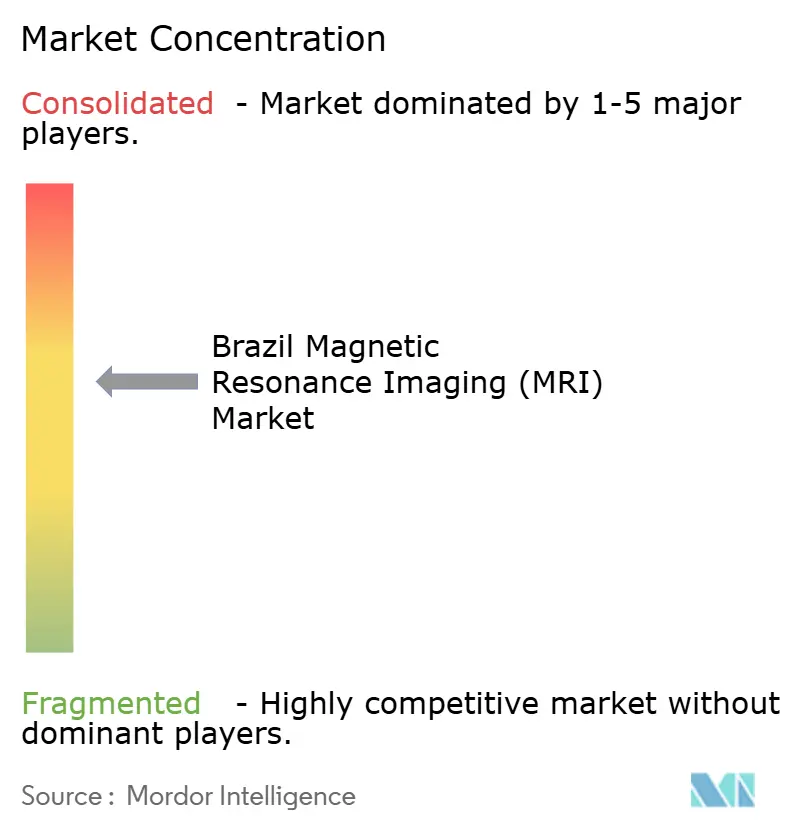
| Market Concentration | Medium |
Major Players
*Disclaimer: Major Players sorted in no particular order Image © Mordor Intelligence. Reuse requires attribution under CC BY 4.0. |
|
Brazil Magnetic Resonance Imaging (MRI) Market Analysis by Mordor Intelligence
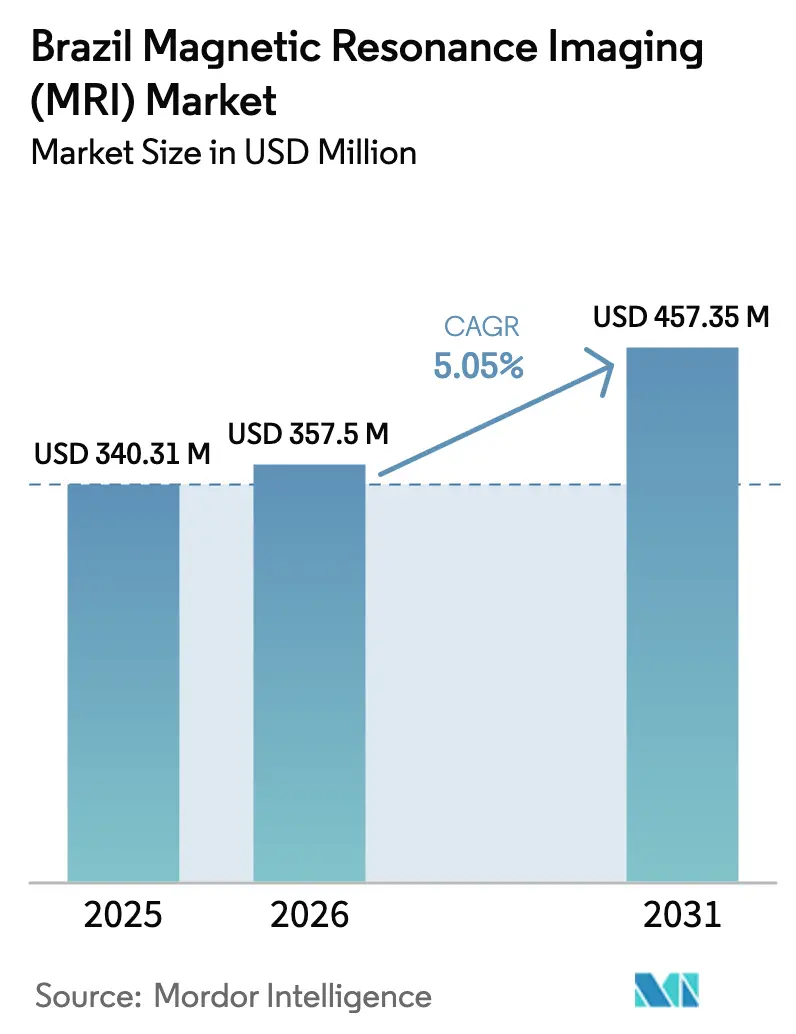
The Brazil Magnetic Resonance Imaging Market size was valued at USD 340.31 million in 2025 and is estimated to grow from USD 357.5 million in 2026 to reach USD 457.35 million by 2031, at a CAGR of 5.05% during the forecast period (2026-2031).
Private diagnostic chains are increasingly absorbing capital costs that public Sistema Único de Saúde (SUS) facilities often cannot justify, making private investment a critical driver of growth over technology availability. Rising demand, fueled by the prevalence of chronic diseases and academic hospitals' focus on ultra-high-field research, contrasts with limited public-sector upgrades due to low reimbursement rates. Structural challenges, including helium price volatility and an uneven distribution of radiologists, have concentrated capacity in the Southeast. However, larger providers are mitigating margin pressures through import-tax incentives and AI-driven workflow efficiencies. Competitive strategies now prioritize software bundles designed to reduce exam times and lower per-scan costs, positioning advanced 3.0 Tesla systems as a cost-effective solution for high-volume sites, despite the constraints of SUS fee structures.
Key Report Takeaways
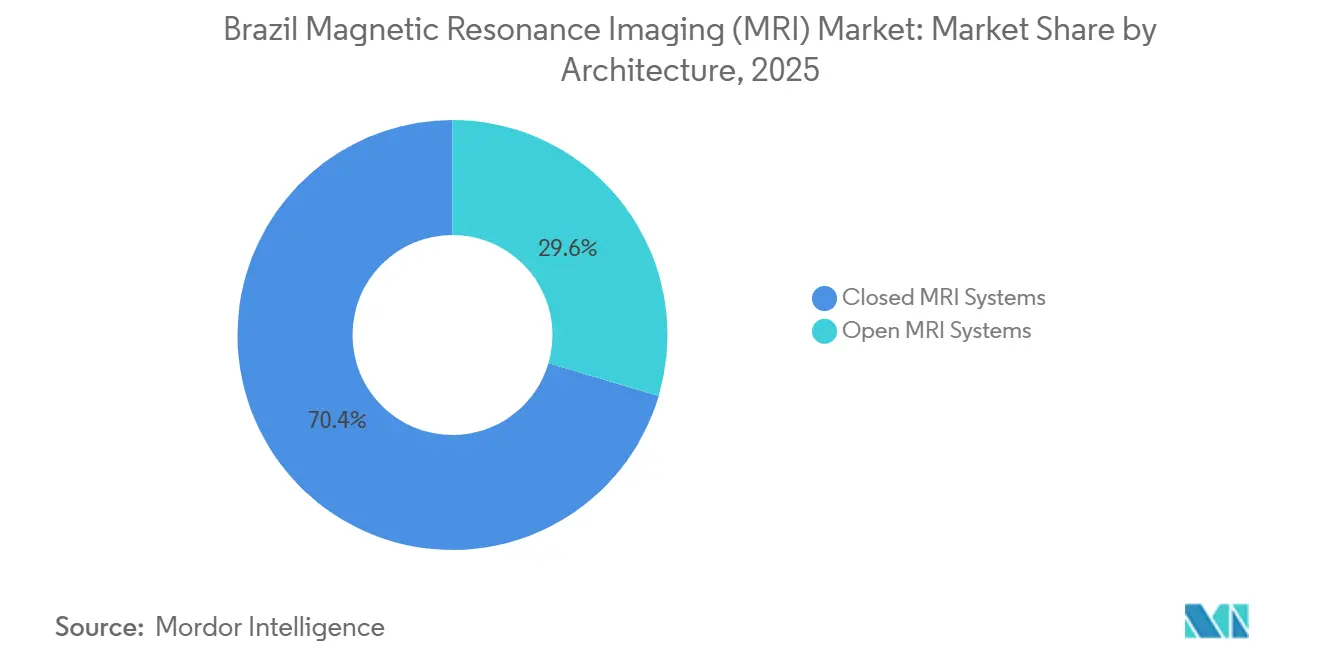
- By architecture, closed systems led with 70.43% of Brazil Magnetic Resonance Imaging (MRI) market share in 2025, while open systems record the fastest projected CAGR at 7.54% through 2031.
- By field strength, 1.0–3.0 Tesla units accounted for 57.43% share of the Brazil Magnetic Resonance Imaging (MRI) market size in 2025; platforms above 3.0 Tesla are projected to expand at a 7.12% CAGR to 2031.
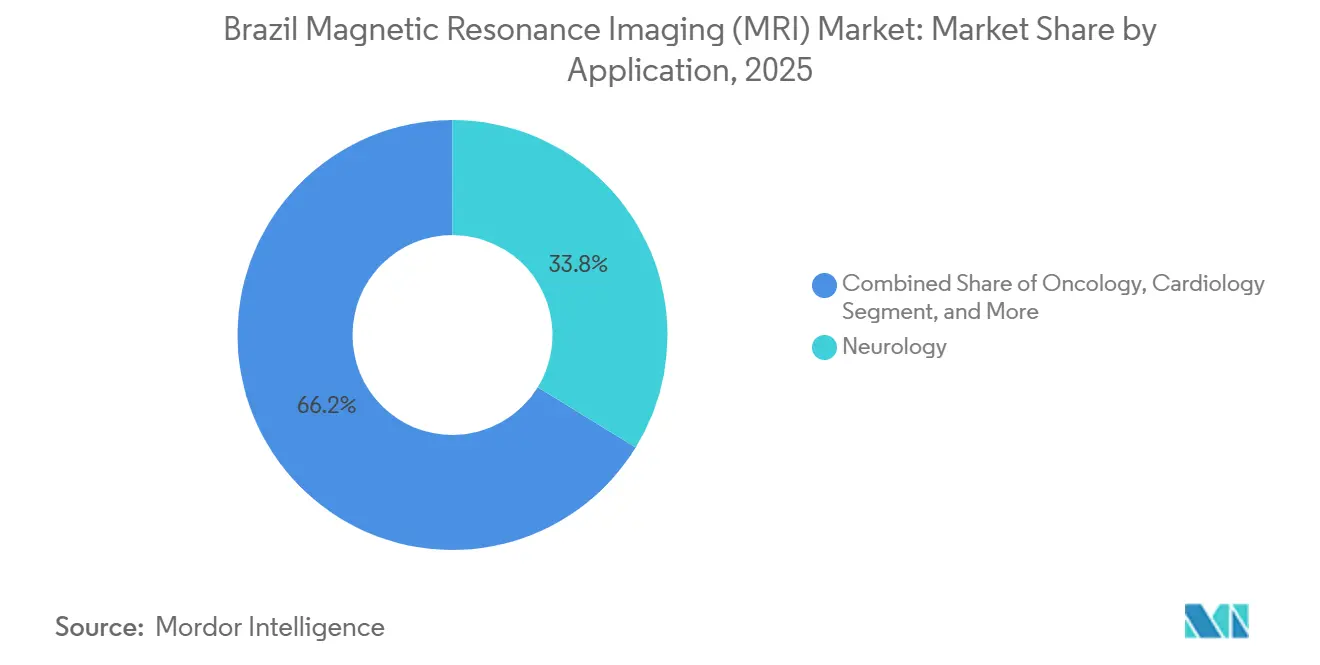
- By application, neurology commanded 33.76% of 2025 revenue, and oncology is advancing at a 7.89% CAGR through 2031.
- By end user, hospitals held 66.74% share in 2025, while diagnostic imaging centers are projected to grow the fastest at 6.54% through 2031.
Note: Market size and forecast figures in this report are generated using Mordor Intelligence’s proprietary estimation framework, updated with the latest available data and insights as of 2026.
Brazil Magnetic Resonance Imaging (MRI) Market Trends and Insights
Drivers Impact Analysis*
| Driver | (~) % Impact on CAGR Forecast | Geographic Relevance | Impact Timeline |
|---|---|---|---|
| Rising Burden of Chronic Diseases | +1.2% | National, concentrated in Southeast and South regions | Medium term (2-4 years) |
| Expanding Private Health Insurance Coverage | +0.8% | Southeast (São Paulo, Rio de Janeiro), South (Porto Alegre, Curitiba) | Short term (≤ 2 years) |
| Technological Advancements in High-Field and Helium-Free MRI | +1.0% | National, early adoption in São Paulo, Brasília, Rio de Janeiro | Long term (≥ 4 years) |
| Government Investments in Public Hospital Infrastructure | +0.7% | North and Northeast regions, secondary cities nationwide | Long term (≥ 4 years) |
| Growing Adoption of AI-Based Imaging Workflows | +0.6% | Southeast private hospital networks, tertiary academic centers | Medium term (2-4 years) |
| Import Tax Incentives for Local Assembly | +0.4% | National, manufacturing hubs in São Paulo, Santa Catarina | Medium term (2-4 years) |
| Source: Mordor Intelligence | |||
Rising Burden of Chronic Diseases
Stroke, dementia, and cancer cases are mounting as Brazil’s population ages, so serial MRI for staging, follow-up, and treatment response is routine. Neurology already accounts for one-third of Brazil Magnetic Resonance Imaging (MRI) market demand, and oncology needs are accelerating as breast and prostate protocols expand in private centers. Cardiology imaging adds incremental volume because tertiary clinics now request functional data beyond angiography. The shift from episodic care toward chronic disease management keeps repeat-scan volumes high, reinforcing closed high-field systems for lesion detection and multiparametric exams. As chronic diseases cluster in the Southeast’s dense urban areas, diagnostic chains prioritize sites near oncology and neurology reference hospitals[1]GE HealthCare Investor Relations, “GE HealthCare and AWS to Accelerate Imaging AI,” gehealthcare.com.
Expanding Private Health Insurance Coverage
Roughly 25% of Brazilians hold private health plans, and those beneficiaries undergo 179 MRI exams per 1,000 covered lives each year, more than double OECD norms. Rede D'Or, Fleury, and DASA extend their branches into secondary cities to capture this demand, creating a two-tier model in which advanced modalities remain in private hands. ANS rules mandate baseline MRI reimbursement for specified indications, providing providers with predictable revenue streams, yet premium caps constrain insurers’ margins and may curb equipment replacement cycles if membership growth plateaus. Still, large chains leverage volume contracts to negotiate discounts, enabling faster payback on new 3.0 Tesla or AI-enabled units[2]Brazilian Ministry of Science & Technology, “Telehealth Outcomes in Primary Care: UBS+Digital,” jmir.org.
Technological Advancements in High-Field and Helium-Free MRI
High-field (1.0–3.0 Tesla) units remain the workhorse, but Philips BlueSeal and Fujifilm ECHELON Smart eliminate liquid helium, addressing price spikes that doubled global costs between 2022 and 2024. Each conventional scanner needs roughly 2,000 liters of helium, so sealed magnets shield budgets from refill risk. AI reconstruction such as GE AIR Recon DL cuts exam times by about 36% at Rede D'Or, raising daily throughput and lowering cost per study. These gains justify premium pricing in high-volume private sites while making 3.0 Tesla platforms financially feasible even with static SUS fees. Early adopters in São Paulo and Brasília showcase the productivity case to mid-tier hospitals evaluating new purchases.
Government Investments in Public Hospital Infrastructure
A November 2025 decree earmarks R$1.7 billion (USD 340 million) for smart hospital upgrades starting 2026, aiming to add AI, 5G connectivity, and robotic surgery capacity. MRI replacements could benefit underserved North and Northeast sites if allocation favors equity, yet procurement rules and CBS/IBS tax reforms create timing risk. SUS reimbursement covers only 11-16% of actual MRI costs, so public facilities still hesitate to expand unless capital grants offset operating losses. Duty-reduction programs shorten import lead times, but tariff uncertainties complicate bids. How quickly funds translate into installed scanners will influence regional access over the next five years.
Restraints Impact Analysis*
| Restraint | (~) % Impact on CAGR Forecast | Geographic Relevance | Impact Timeline |
|---|---|---|---|
| High Capital and Maintenance Costs of MRI Systems | -0.9% | National, acute in North and Northeast public facilities | Short term (≤ 2 years) |
| Low Public Reimbursement Rates Under SUS | -1.1% | National, most severe in secondary and tertiary SUS hospitals | Long term (≥ 4 years) |
| Shortage of Skilled Radiologists and Technologists | -0.5% | North and Northeast regions, rural municipalities | Medium term (2-4 years) |
| Supply Chain Constraints for Helium and Spare Parts | -0.6% | National, exacerbated by import dependencies | Medium term (2-4 years) |
| Source: Mordor Intelligence | |||
High Capital and Maintenance Costs of MRI Systems
A new 1.5 Tesla scanner costs USD 1.0–1.5 million, and 3.0 Tesla models reach USD 3.0 million. Annual service contracts consume up to 12% of the purchase price, while helium refills can add USD 40,000 per year. Import taxes can lift landed prices 30-50%, even after partial relief from the ex-tarifário regime. Private groups dilute costs across large patient volumes, but public hospitals with lower throughput find return-on-investment unattractive, reinforcing the urban-private concentration of equipment[3].
Low Public Reimbursement Rates Under SUS
SUS fee tables reimburse only a fraction of real imaging costs, so facilities ration access and long queues persist. Judicialization compels municipalities to buy private studies at market prices, stressing budgets. Unless reimbursement aligns with operating expense, new scanners in public sites will remain scarce, widening gaps in access. CONITEC reviews new technologies cautiously, and budget limits slow protocol updates that would otherwise stimulate volume. As a result, the Brazil Magnetic Resonance Imaging (MRI) market continues to lean on private capacity for growth.
*Our forecasts treat driver/restraint impacts as directional, not additive. The impact forecasts reflect baseline growth, mix effects, and variable interactions.
Segment Analysis
By Architecture: Closed Systems Dominate, Open Platforms Gain Patient-Centric Traction
Closed units held 70.43% of 2025 revenue, underpinning the largest slice of the Brazil Magnetic Resonance Imaging (MRI) market. Image quality remains non-negotiable for neurology and oncology exams, keeping closed 1.5 Tesla and 3.0 Tesla models central to routine practice. Open designs, generally at 1.0 Tesla, expand at 7.54% annually because orthopedic, bariatric, and pediatric scans benefit from wider bores that reduce anxiety and accommodate larger body types. Diagnostic groups in São Paulo mix fleet types, pairing a 3.0 Tesla closed system with an open unit to balance throughput and comfort. Manufacturers respond by offering wide-bore hybrids such as Siemens Free.Max that merge patient access with field strength, blurring historical quality gaps.
Open units rarely match the spatial resolution of closed magnets, yet clinical protocols like musculoskeletal extremity imaging tolerate lower signal noise in exchange for positioning flexibility. Ambulatory centers exploit this trade-off to differentiate service lines while maintaining acceptable reimbursement levels. As AI accelerates reconstruction speed, the performance gulf narrows, further lifting open-system appeal for non-critical exams. Procurement choices therefore hinge on local case-mix and space constraints rather than on a simple quality hierarchy.



By Field Strength: High-Field Workhorse, Ultra-High-Field Research Frontier
High-field 1.0–3.0 Tesla equipment captured 57.43% of 2025 spending and anchors day-to-day clinical throughput, accounting for the core of the Brazil Magnetic Resonance Imaging (MRI) market size. Lower-field portable devices remain niche, serving ICU and rural outreach. Ultra-high-field scanners above 3.0 Tesla expand 7.12% each year, driven by São Paulo universities that pursue advanced neuroimaging and spectroscopy. Sealed magnets limit helium needs and make 3.0 Tesla adoption feasible even in midsize private hospitals. Hyperfine’s 0.064 Tesla Swoop targets intensive-care beds, but uptake depends on SUS reimbursement inclusion.
Academic hospitals embrace 7.0 Tesla units for research, yet budgets and infrastructure requirements cap volumes. The 1.5 Tesla band persists as the default choice for public tenders, balancing cost and coverage of approved protocols. As AI upgrades shorten scan times, 3.0 Tesla productivity rises, unlocking economic justification in centers with heavy oncology or cardiac caseloads. Equipment suppliers therefore segment offerings: workhorse 1.5 Tesla for public bids, productivity-driven 3.0 Tesla for high-volume private hubs, and 7.0 Tesla flagship systems for prestige research programs.
By Application: Neurology Leads, Oncology Accelerates
Neurology contributed 33.76% of 2025 revenue, reflecting stroke and dementia protocol growth, and anchors the largest slice of the Brazil Magnetic Resonance Imaging (MRI) market. Oncology leads growth at 7.89% through 2031 as breast, prostate, and whole-body diffusion imaging spread in private oncology networks. Cardiac MRI gains incremental ground where non-invasive viability studies replace some catheter work-ups, although training gaps slow broader uptake. Musculoskeletal and hepatobiliary imaging maintain steady but smaller contributions.
Private cancer centers deploy dedicated breast coils and, in rare cases, PET-MRI hybrids to guide biopsy and therapy monitoring. Public hospitals focus on stroke pathway mandates, sustaining neuroimaging dominance. The divergent paces leave neurology holding volume leadership but oncology adding the most incremental scanners, shaping vendor marketing and coil package bundling decisions.
By End User: Hospitals Anchor Demand, Diagnostic Centers Grow Faster
In 2025, hospitals accounted for 66.74% of expenditures, driven by their focus on emergency stroke and surgical planning services that require on-site access, thereby maintaining a dominant position in Brazil's Magnetic Resonance Imaging (MRI) market. Diagnostic imaging centers are expanding at an annual growth rate of 6.54%, supported by Rede D'Or, Fleury, and DASA's strategic penetration into secondary cities, leveraging extended operational hours and AI-driven efficiency. Ambulatory surgery centers are emerging as a niche segment by adopting open magnets for intraoperative orthopedic guidance.
High utilization of private health plans, with 179 exams per 1,000 enrollees, underpins investment strategies in diagnostic centers. However, hospitals, particularly within the SUS network, face budgetary constraints, with many scanners exceeding a decade in service. This dynamic is gradually shifting the market toward outpatient chains, which capitalize on rapid reporting capabilities and flexible scheduling, further strengthening the private sector's role in driving overall market growth.
Regulatory Landscape
MRI systems are regulated in Brazil as medical devices under ANVISA, with risk classification, labeling, and registration/notificacao regimes anchored by RDC 751/2022. For higher-risk devices (Class III/IV), market authorization requirements include compliance evidence and Good Manufacturing Practices (GMP) expectations, with ANVISA oversight extending across the product lifecycle.
Beyond product authorization, MRI site safety, quality assurance, and operational controls are governed by ANVISA Normative Instruction IN 97/2021. It sets requirements across controlled-zone practices and technical conditions such as acoustic isolation and cryogenic gas management, alongside permanent education programs for clinical staff. Conformity assessment for electro-medical equipment through INMETRO-accredited bodies adds another compliance layer that can shape supplier documentation, installation readiness, and procurement timelines for hospitals and diagnostic imaging centers.
Value Chain Analysis
Brazil's MRI value chain begins with global OEMs (GE HealthCare, Siemens Healthineers, Philips, Canon Medical, and Fujifilm) and extends to local entities handling importation, distribution, and in-country regulatory stewardship. This includes ANVISA submissions, post-market vigilance, and field corrective actions when required. Local players also use ANVISA compliance and local assembly positioning in bids, particularly where public tenders evaluate total cost of ownership and service continuity.
Downstream, specialized logistics and site preparation feed into acceptance testing, ongoing quality control activities aligned with IN 97/2021, and long-term service contracts for uptime and coil and parts availability. Clinical operations and reporting complete the chain, with radiologist availability and workflow software (including AI reconstruction and modality connectivity) increasingly shaping value capture. Differentiation shifts from magnet hardware alone toward lifecycle services, compliance support, and throughput optimization.
Competitive Landscape
The competitive field is moderately consolidated. GE HealthCare, Siemens Healthineers, and Philips together control most of the installed base via long-term service contracts and AI reconstruction exclusives. Canon Medical and Fujifilm rank as challengers, bringing helium-free and cost-efficient systems that appeal to budget-sensitive buyers. Domestic supplier Imex Medical Group leverages ANVISA regulatory compliance and local assembly to undercut imports by 20-30%, targeting SUS tenders for 1.5 Tesla equipment.
Strategic focus has shifted from hardware power to lifecycle economics. Siemens Value Partnerships bundle equipment, software, and managed services into multiyear deals tied to uptime guarantees. GE’s Imaging 360 platform wraps AI, analytics, and financing around scanner fleets, securing loyalty from diagnostic chains. Portable players such as Hyperfine offer point-of-care solutions for rural outreach, but adoption depends on reimbursement inclusion. Chinese entrants United Imaging and Neusoft secure ANVISA clearances yet must prove after-sales reach. Vendors lacking AI or helium-free value propositions risk marginalization in high-volume tenders where throughput and operating expense drive decisions.
Brazil Magnetic Resonance Imaging (MRI) Industry Leaders
-
Koninklijke Philips NV
-
Fujifilm Holdings Corporation
-
Siemens Healthcare GmbH
-
Canon Inc. (Canon Medical Systems Corporation)
-
GE HealthCare
- *Disclaimer: Major Players sorted in no particular order

Market Opportunities and Future Outlook
Compliance-driven modernization creates whitespace for turnkey MRI deployment and ongoing upkeep services. IN 97/2021 explicitly raises expectations around controlled-zone safety, acoustic isolation, and cryogenic gas handling, which supports demand for engineering design, installation qualification, periodic quality control, and structured staff training that smaller hospitals and municipal networks often outsource.
Workflow integration is another near-term opportunity. As large providers look to shorten exam times and raise asset utilization under constrained reimbursement, vendors are investing in productivity software that can be layered onto existing fleets. Philips actions in Brazil, including reinforcement of its Integrated Diagnostics approach (linking MRI with other modalities and informatics) and introducing AI-based reconstruction (SmartSpeed Precise) during JPR 2026, point to continued focus on productivity features. Helium price volatility and import dependencies also keep attention on technologies and service models that reduce helium exposure and improve parts availability, benefiting suppliers and partners with strong local support and regulatory execution.
Recent Industry Developments
- June 2026: Philips opens a manufacturing facility in Varginha, Minas Gerais, producing MRI scanners for export across Latin America. The expansion improves regional supply conditions and reduces lead times for LATAM markets.
- April 2026: Philips reinforces Integrated Diagnostics strategy in Brazil, connecting MRI, CT, and Ultrasound modalities with clinical informatics platforms. The integration streamlines diagnostic workflows and can improve utilization of Brazilian MRI assets.
- April 2026: Philips launches SmartSpeed Precise in Brazil during JPR 2026, an AI based MRI reconstruction solution to increase imaging productivity and reduce scan times. The AI driven acceleration supports higher-volume sites and strengthens competitive positioning in the Brazilian MRI market.


Research Methodology Framework and Report Scope
Market Definition and Coverage
For this methodology, the Brazil magnetic resonance imaging (MRI) market is defined as revenue generated from MRI systems sold and installed in Brazil, including related upgrades and replacements that are directly tied to MRI scanning capacity.
Scope exclusions: We exclude other imaging modalities (such as CT, ultrasound, and X-ray) and non-MRI consumables that are not specific to MRI use.
Segmentation Overview
-
By Architecture
- Closed MRI Systems
- Open MRI Systems
-
By Field Strength
- Low-Field (< 1.0 T)
- High-Field (1.0 – 3.0 T)
- Very High / Ultra-High (> 3.0 T)
-
By Application
- Oncology
- Neurology
- Cardiology
- Gastroenterology
- Musculoskeletal
- Other Applications
-
By End User
- Hospitals
- Diagnostic Imaging Centers
- Ambulatory Surgical Centers
Data Sources, Market Sizing, and Validation
Desk Research
Desk work starts with mapping the MRI demand base in Brazil and the practical buying cycle of hospitals and imaging centers, so that later assumptions have a real-world anchor. We leaned on public health statistics and system signals from sources such as Brazil Ministry of Health publications, ANVISA regulatory and device information, IBGE demographic and macro series, and OECD health indicators, followed by triangulation with peer-reviewed radiology journals and updates from hospital associations.
To make the numbers usable for modeling, the desk phase also pulls structured context from company filings, investor presentations, and reported contract announcements, which helps frame pricing direction and replacement timing. In addition, we used paid subscriptions for company financials and intelligence, news and financials, and patent databases to cross-check product cycles and shipment commentary when public detail was thin. The desk sources listed here are illustrative, and we also referenced many other public documents for data collection, clarification, and validation.
Primary Interviews and Surveys
Primary work was used to pressure-test the desk assumptions and convert broad signals into workable inputs for Brazil, especially where installation timing and pricing vary by customer type. We spoke with a mix of OEM-side experts, distributors and service partners, imaging center operators, hospital radiology leaders, and procurement stakeholders, so the final model reflects how MRI budgets are typically approved and deployed. Responses were balanced across the main buying hubs in Brazil, and then checked against differences between public and private care settings and between new installations and replacements.
Distribution of primary research fieldwork respondents
| Company type | Respondent position |
|---|---|
| Top tier: 31% | CXOs: 13% |
| Mid tier: 54% | Functional/Unit leaders: 27% |
| Smaller Players: 15% | Managers: 60% |
Market-Sizing & Forecasting
Sizing begins with a top-down reconstruction of Brazil MRI spend, where healthcare capital equipment allocation is translated into MRI demand using imaging procedure growth signals and replacement-cycle patterns. Those totals are then corroborated with selective bottom-up approximations, including a sampled install-base build (installed units by field strength), channel checks on typical average selling prices, and sanity checks using expected annual placements and upgrades.
A few inputs that matter in this market were tracked carefully because they move value even when unit volumes look stable. These include the shift between closed and open systems, the mix change by field strength (including the 1.5T and 3T tilt in large centers), replacement timing for older magnets, service and upgrade attachment behavior, and currency conversion timing for imported equipment. For forecasting, we used scenario analysis supported by expert views on funding availability, private diagnostic expansion, and expected lead times, and then applied a smoothing pass to avoid one-off procurement spikes distorting the trend. When a bottom-up signal was missing for a smaller sub-segment, we filled the gap using proportional splits anchored on the nearest observable install-base or end user pattern, and then rechecked it in follow-up calls.
Data Validation & Update Cycle
Model outputs are checked against independent signals so results do not drift away from what the market can realistically absorb, including procedure growth direction, observed procurement cycles, and known replacement pressure from aging systems. Variance checks are run at multiple levels (total market, key end users, and major technology mixes), and outliers are flagged and reviewed before sign-off.
Where gaps appear between desk inputs and interview feedback, we re-contact respondents to confirm if the issue is timing, pricing, or scope, and the assumption is adjusted with a written rationale. Reports are refreshed annually, with interim updates triggered by material events such as policy changes, sharp FX movements, or sudden demand shifts. Before delivery, an analyst performs a final pass to align the latest public indicators with the locked model so clients receive an up-to-date view.
Mordor Intelligence's Brazil Magnetic Resonance Imaging Mri Market Size Measured Against Other Published Estimates
Published market sizes for Brazil MRI can look far apart because studies do not always count the same revenue pool or apply the same timing assumptions. Differences usually come from what is treated as in-scope value, how imported equipment is converted into USD, and whether the model emphasizes placements, installed base, or procedures.
Key gaps also show up when one estimate blends MRI with broader diagnostic imaging equipment, or when service and upgrade revenues are either fully included or mostly ignored. Forecast style matters as well, since some figures reflect an aggressive replacement wave, while others assume slow capital refresh and keep pricing flat even when the mix shifts to higher-field systems.
Benchmark comparison
| Source | Market Size | Gaps in Research Methodology |
|---|---|---|
| Mordor Intelligence | USD 340.31 M (2025) | |
| Industry Association A | USD 300.00 M (2025) | Often approximates value from a narrower equipment-only view and may undercount upgrades and post-install revenue that is directly tied to MRI systems in use, which reduces the reported total in years with heavy retrofit activity. |
| Regional Consultancy B | USD 390.00 M (2025) | Commonly inflates totals by blending MRI with adjacent imaging purchases or by assuming a faster ASP rise across all field strengths, which can overstate value when buying is concentrated in replacements and negotiated tenders. |
The table shows a meaningful spread around the same year, and in Mordor Intelligence's model the value is tied to MRI system-related revenue in Brazil, with upgrades and replacements counted when they translate into scanning capacity and paid system activity. Once scope, currency timing, and replacement assumptions are aligned to observable demand signals, the resulting estimate becomes easier to trace and repeat, which helps decision-makers compare options without mixing unlike revenue pools.


Key Questions Answered in the Report
What is the projected value of Brazil’s MRI market by 2031?
The Brazil Magnetic Resonance Imaging (MRI) market is expected to reach USD 457.35 million by 2031, reflecting a 5.05% CAGR from 2026.
Which MRI architecture is growing the fastest in Brazil?
Open MRI systems are forecast to expand at 7.54% annually through 2031 due to demand for patient-friendly orthopedic and bariatric imaging.
How will helium-free technology impact MRI ownership costs?
Helium-free magnets such as Philips BlueSeal can remove up to USD 40,000 per year in refill expenses, significantly lowering total cost of ownership for private and public facilities.
Why are diagnostic imaging centers outpacing hospitals in new MRI installs?
Private chains leverage high utilization rates and AI-driven throughput to achieve faster payback, allowing them to invest despite stagnant SUS reimbursements.
Which applications drive MRI demand growth in Brazil?
Oncology shows the fastest growth at 7.89% CAGR through 2031, while neurology maintains the largest revenue share due to stroke and dementia protocols.
Page last updated on:





