
Market Overview
| Study Period | 2021 - 2031 |
|---|---|
| Forecast Data Period | 2026 - 2031 |
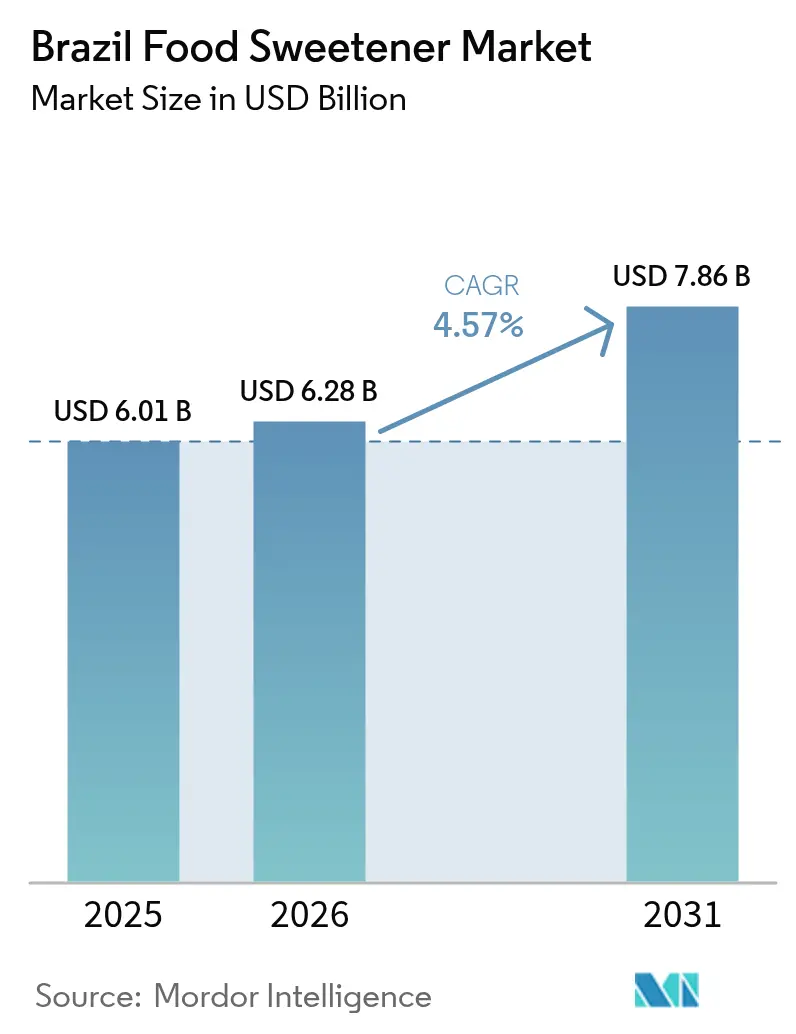
| Base Year Market Size (2025) | USD 6.01 Billion |
| Market Size (2026) | USD 6.28 Billion |
| Market Size (2031) | USD 7.86 Billion |
| Growth Rate (2026 - 2031) | 4.57 % |
| Market Concentration | Medium |
Major Players *Disclaimer: Major Players sorted in no particular order Image © Mordor Intelligence. Reuse requires attribution under CC BY 4.0. | |
Brazil Food Sweetener Market Analysis by Mordor Intelligence
The Brazil food sweetener market size was valued at USD 6.01 billion in 2025 and estimated to grow from USD 6.28 billion in 2026 to reach USD 7.86 billion by 2031, at a CAGR of 4.57% during the forecast period (2026-2031). This growth is driven by Brazil's role as the world's largest sugar exporter and the increasing demand for zero-calorie and natural sweetener alternatives. Factors such as regulatory efforts to reduce added sugar consumption, growing health awareness among urban consumers, and the ethanol-sugar price arbitrage influencing sucrose pricing are contributing to the market's development. High-intensity and value-added sweeteners are gaining popularity in this environment. Global ingredient companies are expanding fermentation-based stevia production to overcome agricultural constraints, while local processors are utilizing cane juice derivatives to mitigate sugar price volatility. These trends indicate that the Brazil food sweetener market will continue to evolve toward diversified ingredient offerings, cost-effective bulk sweeteners, and premium natural solutions catering to health-conscious consumers.
Key Report Takeaways
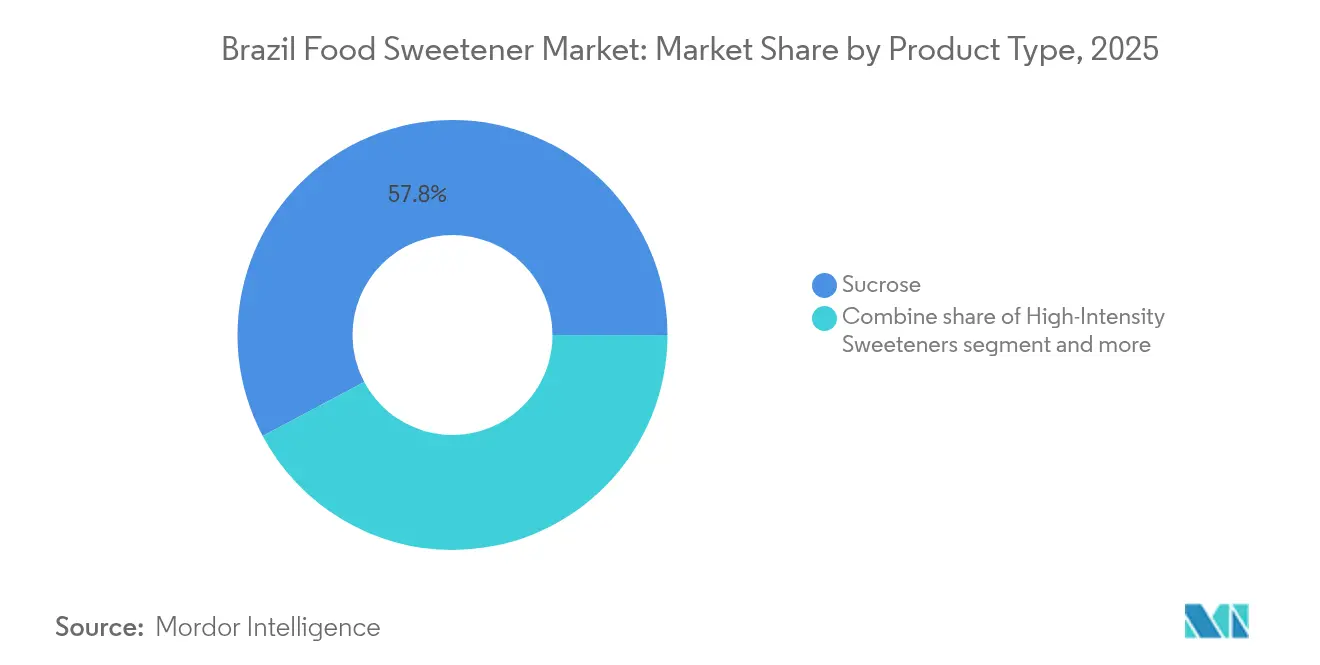
- By product type, sucrose led with 57.78% of the Brazil food sweetener market share in 2025; high-intensity sweeteners are growing at the fastest 5.66% CAGR through 2031.
- By application, beverages held 43.85% of the Brazil food sweetener market size in 2025, while dairy and desserts record the highest 5.31% CAGR to 2031.
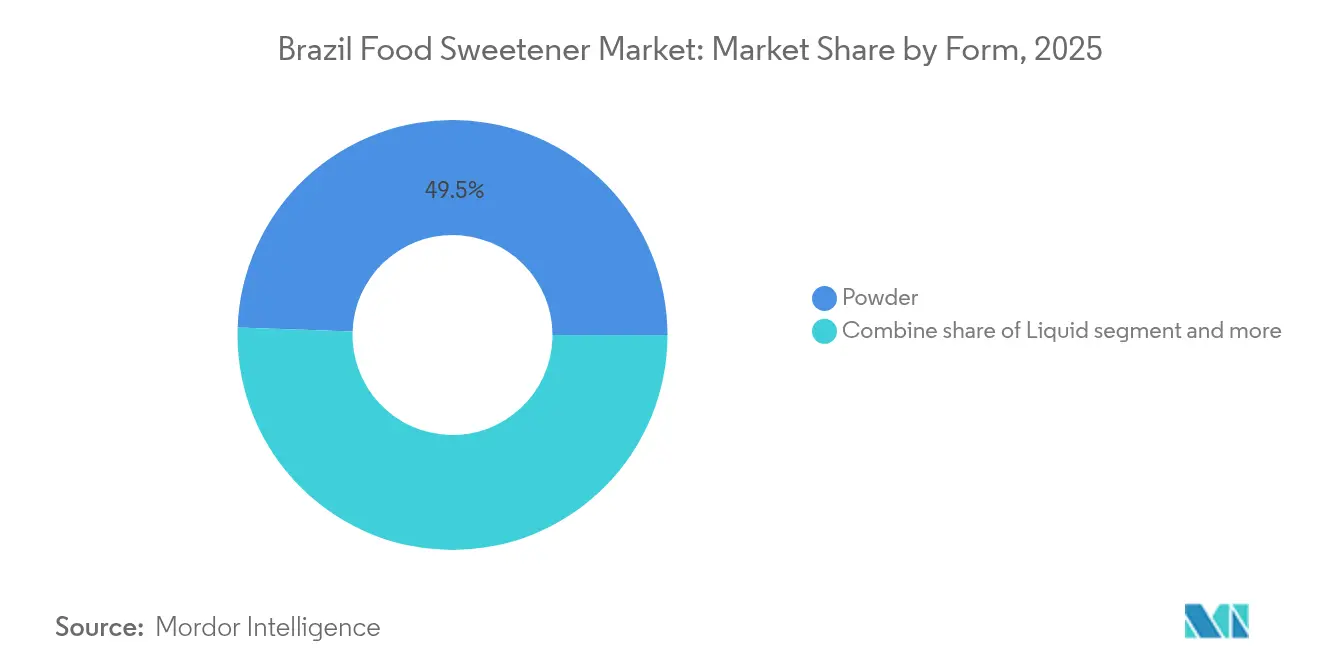
- By form, powder formats accounted for 49.45% of the Brazil food sweetener market size in 2025; liquid formats expand at a 5.75% CAGR through 2031.
- By category, conventional products dominated with 80.25% share in 2025, whereas organic variants advance at a 5.52% CAGR through 2031.
Note: Market size and forecast figures in this report are generated using Mordor Intelligence’s proprietary estimation framework, updated with the latest available data and insights as of 2026.
Brazil Food Sweetener Market Trends and Insights
Drivers Impact Analysis*
| Driver | (~)% Impact on CAGR Forecast | Geographic Relevance | Impact Timeline |
|---|---|---|---|
| Rising consumption of convenience and packaged food and beverage | +0.9% | National, concentrated in São Paulo, Rio de Janeiro, and southern states | Medium term (2-4 years) |
| Increasing demand for zero-glycemic sweeteners among low-carb consumers | +0.7% | National, with early adoption in urban centers (São Paulo, Brasília, Curitiba) | Short term (≤ 2 years) |
| Regulatory expansion of permitted natural sweeteners | +0.6% | National (ANVISA jurisdiction) | Long term (≥ 4 years) |
| Consumer preference for natural and plant-based sweeteners | +0.8% | National, strongest in Southeast and South regions | Medium term (2-4 years) |
| Sweeteners with added benefits driving demand for health-focused products | +0.5% | National, premium segments in metropolitan areas | Long term (≥ 4 years) |
| Microencapsulation and coating technologies improve stability and minimize aftertaste | +0.4% | National, adoption led by multinational ingredient suppliers | Long term (≥ 4 years) |
| Source: Mordor Intelligence | |||
Rising consumption of convenience and packaged food and beverage
In 2024, Brazil's processed food sector generated USD 233 billion, contributing 10.8% to the country's Gross Domestic Product (GDP). At the same time, the non-alcoholic beverage market is expected to grow significantly, rising from EUR 31.2 billion in 2024 to EUR 52.4 billion by 2034. This growth rate exceeds GDP growth and reflects changes in consumption patterns driven by urbanization [1]. Since 2020, retail e-commerce penetration in food and beverage categories has doubled, leading to shorter product lifecycles and benefiting manufacturers who can quickly adapt to clean-label demands while maintaining shelf stability. The combination of convenience and health consciousness creates a dual opportunity. While traditional sugar-sweetened categories face challenges, ready-to-drink functional beverages and portion-controlled dairy desserts are gaining market share. Nestlé has announced an investment of BRL 500 million (USD 100 million) through 2028, focusing on expanding Nescafé Dolce Gusto production and coffee innovation, which demonstrates multinational confidence in Brazil's potential for premiumization. This investment follows a previous commitment of BRL 1.5 billion in 2024, highlighting sustained capital allocation to categories where sweetener choices significantly influence consumer preferences.
Increasing demand for zero-glycemic sweeteners among low-carb consumers
Survey data from the Brazilian Longitudinal Study of Adult Health (ELSA-Brasil) cohort indicates that 25.7% of adults regularly consume non-nutritive sweeteners, while the median table sugar intake remains at 14.3 grams per day. This suggests partial substitution rather than complete replacement. Coffee, consumed by 87% of Brazilians, is the primary medium for sweetener use. Among coffee drinkers, 80% add sugar (averaging 8 to 10 grams per serving), while only 8.6% choose non-caloric alternatives. This preference for sugar presents an opportunity for zero-glycemic sweeteners that replicate sucrose's mouthfeel and dissolve efficiently in hot beverages. Erythritol and tagatose demonstrate superior performance in these attributes compared to first-generation stevia extracts. The proposed selective tax on sugar-sweetened beverages, currently facing opposition from industry groups, could create a price differential that encourages substitution, particularly in cost-sensitive categories such as carbonated soft drinks and powdered drink mixes. Additionally, 89% of Brazilian consumers now view sugary drinks negatively, and 38% express an intention to reduce consumption. However, actual behavior does not yet align with these stated preferences. This gap presents an opportunity for zero-glycemic sweeteners to gain traction, provided their sensory characteristics improve to meet consumer expectations.
Regulatory expansion of permitted natural sweeteners
ANVISA's (Agência Nacional de Vigilância Sanitária) regulatory updates have advanced significantly: Resolução RDC 843 and Instrução Normativa 281, both issued in 2024, revised the list of permitted sweeteners and introduced stricter standards for purity and labeling. Additionally, Resolução RDC 839/2023 and Instrução Normativa 380/2025 aligned Brazil's regulatory framework with Codex Alimentarius standards for steviol glycosides and monk fruit extracts [2]. These developments differ from the European Food Safety Authority's (EFSA) ongoing reassessments of artificial sweeteners. EFSA completed evaluations of acesulfame-K in April 2025 and neotame in July 2025, resulting in tighter acceptable daily intake recommendations for specific populations. This difference creates a regulatory opportunity for natural sweetener alternatives among Brazilian food manufacturers targeting export markets. Furthermore, the approval of enzymatically produced steviol glycosides (E960c) and glucosylated variants (E960d) in various jurisdictions highlights the potential of biosynthetic production methods to overcome Brazil's agronomic challenges for stevia cultivation, such as photoperiod sensitivity and seed multiplication limitations, as documented in peer-reviewed agronomic studies.
Consumer preference for natural and plant-based sweeteners
A compliance analysis of front-of-package labeling conducted 12 months after the implementation of ANVISA's (Agência Nacional de Vigilância Sanitária) Instrução Normativa 75/2020 revealed significant reformulation efforts by manufacturers. These efforts included reducing added sugars to avoid "high in" warning labels. This trend has particularly benefited natural high-intensity sweeteners, which are often marketed as clean-label solutions. Stevia, approved in Brazil since 1988, has faced challenges in scaling production domestically. Brands such as Zero-Cal and Color Andina Foods have struggled due to agronomic limitations and competition from imported extracts. Monk fruit, which provides sweetness 250 to 300 times that of sucrose through mogrosides, encounters even greater supply constraints. Its cultivation requires specific conditions, including altitudes of 200 to 800 meters and temperatures between 18 degrees Celsius and 32 degrees Celsius, primarily found in China's Guangxi province. Additionally, biosynthetic production remains commercially unfeasible, as demonstrated by Wang et al., who achieved only 9.1 micrograms per liter of mogrol through yeast fermentation, which is far below the thresholds required by the food industry.
Restraints Impact Analysis*
| Restraint | (~)% Impact on CAGR Forecast | Geographic Relevance | Impact Timeline |
|---|---|---|---|
| Consumer skepticism toward artificial sweeteners | -0.5% | National, heightened in health-conscious urban demographics | Short term (≤ 2 years) |
| Higher costs and price sensitivity for natural sweeteners | -0.6% | National, most acute in price-sensitive Northeast and North regions | Medium term (2-4 years) |
| Taste and aftertaste issues with some sweeteners | -0.4% | National, critical in coffee and dairy applications | Short term (≤ 2 years) |
| Formulation challenges in dairy and confectionery applications | -0.3% | National, concentrated in industrial bakery and ice cream segments | Medium term (2-4 years) |
| Source: Mordor Intelligence | |||
Consumer skepticism toward artificial sweeteners
The World Health Organization's 2023 guideline advising against the use of non-sugar sweeteners for weight control, along with prominent cohort studies linking artificially sweetened beverages to cardiovascular events and stroke, has heightened public concern. The NutriNet-Santé cohort and several systematic reviews published in the BMJ between 2022 and 2024 have reported associations between artificial sweetener consumption and glucose intolerance, potentially mediated by gut microbiome alterations, though causality remains debated. In Brazil, where 89% of consumers view sugary drinks negatively but median sugar intake remains high, this skepticism has created a demand gap that neither artificial nor natural sweeteners fully address. Formulators face the challenge of balancing cost, taste, and health perceptions. ANVISA's intake monitoring studies, including Takehara et al.'s 2022 database on declared high-intensity sweeteners in commercial products, have revealed varied exposure patterns, complicating risk communication and contributing to consumer uncertainty regarding safe consumption levels.
Higher costs and price sensitivity for natural sweeteners
The World Health Organization's (WHO) 2023 guideline advising against the use of non-sugar sweeteners for weight control, along with prominent cohort studies linking artificially sweetened beverages to cardiovascular events and stroke, has heightened public concern [3]. The NutriNet-Santé cohort and several systematic reviews published in the British Medical Journal (BMJ) between 2022 and 2024 have reported associations between artificial sweetener consumption and glucose intolerance, potentially mediated by gut microbiome alterations, though causality remains debated. In Brazil, where 89% of consumers view sugary drinks negatively but median sugar intake remains high, this skepticism has created a demand gap that neither artificial nor natural sweeteners fully address. Formulators face the challenge of balancing cost, taste, and health perceptions. The National Health Surveillance Agency's (ANVISA) intake monitoring studies, including Takehara et al.'s database on declared high-intensity sweeteners in commercial products, have revealed varied exposure patterns, complicating risk communication and contributing to consumer uncertainty regarding safe consumption levels.
*Our forecasts treat driver/restraint impacts as directional, not additive. The impact forecasts reflect baseline growth, mix effects, and variable interactions.
Segment Analysis
By Product Type: Sucrose Anchors, High-Intensity Sweeteners Accelerate
Brazil accounts for 23% of global sugar production and 50% of international sugar trade, supporting sucrose's projected 57.78% market share in 2025. However, the segment's reliance on ethanol co-production introduces volatility, creating opportunities for high-intensity sweeteners. High-intensity sweeteners are expected to grow at a CAGR of 5.66% through 2031, driven by regulatory support and advancements in formulation. Within this category, natural sweeteners, such as steviol glycosides and monk fruit extracts, are gaining market share from artificial alternatives. This shift is supported by ANVISA's approval of enzymatically produced and glucosylated steviol glycosides (E960c and E960d), which enhance formulation flexibility. Additionally, the Avansya joint venture between Cargill and DSM-Firmenich received approval in January 2024 from the European Union and the United Kingdom for fermentation-derived EverSweet stevia, highlighting the potential of biosynthetic production to overcome Brazil's agronomic limitations and cater to premium export-oriented food manufacturers.
Starch sweeteners and sugar alcohols, including dextrose, high-fructose corn syrup, maltodextrin, sorbitol, xylitol, and erythritol, function as bulking agents that restore mouthfeel and texture in reduced-sugar formulations. Erythritol, produced through the fermentation of corn-derived glucose, offers zero-calorie properties and freezing-point depression, which enhances the scoopability of ice cream. These attributes have driven its adoption in dairy desserts and frozen novelties.

By Application: Beverages Lead, Dairy and Desserts Surge
Beverages accounted for 43.85% of the market share in 2025. However, the segment is facing structural challenges, as 89% of Brazilian consumers have a negative perception of sugary drinks, and 38% have expressed an intention to reduce their consumption. In 2024, Brazil sold 13.4 billion liters of soft drinks, but the proposed selective tax on sugar-sweetened beverages, if implemented, could significantly impact profit margins. This potential tax is also expected to accelerate the reformulation of products toward the use of non-nutritive sweeteners, as companies adapt to changing consumer preferences and regulatory pressures.
Coffee, which is consumed by 87% of Brazilians, continues to be a critical area of focus for the market. Among coffee drinkers, 80% add sugar, typically between 8 to 10 grams per serving, while only 8.6% opt for non-caloric alternatives. This indicates a latent opportunity for substitution if non-caloric sweeteners achieve sensory equivalence with sugar. Additionally, functional beverages and ready-to-drink formats are steadily gaining market share. PepsiCo's investment of 1.2 billion Brazilian Reais (USD 240 million) in 2023, which includes the establishment of eight factories and a research and development center employing over 100 scientists, demonstrates multinational confidence in the growing trend of premiumization within the beverage industry.
By Form: Powder Dominates, Liquid Gains in Beverages
Powder forms accounted for a 49.45% market share in 2025, primarily due to their suitability for dry-mix applications such as powdered drink mixes, bakery premixes, and tabletop sweeteners. These formats are widely preferred because they offer ease of handling, an extended shelf life, and cost efficiency, making them a practical choice for various industries. Their solid format ensures convenience in storage and transportation, further enhancing their appeal in the market. The ability to maintain product stability over time has also contributed to their widespread adoption in applications where long-term usability is critical.
Liquid sweeteners are expected to grow at a compound annual growth rate (CAGR) of 5.75% through 2031, driven by the increasing preference of beverage manufacturers for solutions that simplify blending processes, ensure uniformity, and minimize dust exposure in production environments. High-fructose corn syrup and liquid stevia extracts are the leading products in this segment. Suppliers such as Tate & Lyle are focusing on improving solubility with innovations like Tasteva Sol stevia technology. This technology offers over 200 times the solubility of Rebaudioside M and D, effectively addressing challenges such as precipitation and haze in fruit preparations and syrups. These advancements are particularly beneficial in formulations aimed at achieving significant sugar reduction without compromising product quality.
By Category: Conventional Retains Dominance, Organic Carves Premium Niche
Conventional sweeteners accounted for a substantial 80.25% of the market share in 2025, driven by their cost advantages and the presence of well-established supply chains. On the other hand, organic sweeteners are witnessing significant growth, with a compound annual growth rate (CAGR) of 5.52% projected through 2031. This growth is primarily fueled by urban consumers in cities such as São Paulo, Rio de Janeiro, and the southern states of Brazil, who are increasingly seeking products with certified-organic claims. Key contributors to this trend include organic cane sugar, stevia, and agave syrup. For example, Global Organics' blue agave syrup, sourced from Mexico and marketed as a low-glycemic option, is gaining popularity in premium product categories such as yogurt, ice cream, and flavored milk.
Organic certification, which complies with both Brazilian and international standards such as the United States Department of Agriculture (USDA) and European Union (EU) regulations, involves stringent processes including traceability, third-party audits, and adherence to premium pricing structures. These requirements often restrict the availability of organic products beyond metropolitan retail channels. The future growth of the organic segment will depend on the development of more efficient supply chains and consumers' willingness to pay price premiums that can exceed 50% compared to conventional alternatives. Additionally, Lesaffre's acquisition of a 70% stake in Biorigin/Zilor in October 2024 highlights the growing interest of multinational ingredient companies in organic and natural-origin inputs. This acquisition focuses on yeast derivatives and fermentation substrates, which are increasingly valued for their role in supporting clean-label positioning in the market.
Geography Analysis
Brazil's food sweetener market reflects regional differences shaped by income levels, agricultural infrastructure, and consumption patterns. The Southeast region, led by São Paulo and Rio de Janeiro, accounts for over 50% of the national demand. This is driven by higher per-capita income, extensive retail networks, and early adoption of health-conscious consumption trends. Compliance with the Brazilian Health Regulatory Agency's (ANVISA) Instrução Normativa 75/2020 on front-of-package labeling has encouraged reformulation efforts in this region. Manufacturers are reducing added sugars to avoid "high in" warning labels and are increasingly using natural high-intensity sweeteners as clean-label alternatives.
The South region, which includes Paraná, Santa Catarina, and Rio Grande do Sul, demonstrates strong demand for organic and premium sweeteners. This demand is supported by higher education levels and the influence of European immigrant communities with established preferences for artisanal and natural products. Nestlé's investment of R$500 million (USD 100 million) through 2028 to expand Nescafé Dolce Gusto production highlights the confidence of multinational companies in the region's potential for premiumization. These factors collectively position the South as a key area for growth in the premium sweetener segment.
In comparison, the Northeast and North regions, where per-capita income is over 40% lower than in the Southeast, show limited demand for premium natural sweeteners. This income disparity sustains the dominance of sucrose in cost-sensitive applications such as powdered drink mixes and economy-tier confectionery. However, rising urbanization and retail modernization in cities like Recife, Fortaleza, and Manaus are gradually improving access to reformulated products. Regional beverage bottlers are increasingly adopting hybrid sweetener systems that combine residual sugar (5 to 7 percent) with stevia or aspartame to balance cost efficiency and sensory quality, making these products more accessible to consumers in these regions.
Regulatory Landscape
Food sweeteners and other food additives in Brazil are regulated by ANVISA (Agencia Nacional de Vigilancia Sanitaria) under the framework of Law No. 9,782/1999, using a positive-list approach for authorized substances, maximum limits, and conditions of use. The current backbone for additives includes RDC No. 778/2023 (general principles), together with IN No. 211/2023, which sets the authorized lists and technical conditions, and is periodically updated through new Normative Instructions published in the Diario Oficial da Uniao, including IN No. 395/2025 (August 2025) and IN No. 407/2025 (November 2025) that incorporated updates and Mercosur resolutions into the national lists.
On labeling and product-specific controls, RDC No. 818/2023 sets sanitary requirements for tabletop and dietetic sweeteners, while ANVISA labeling rules require specific warnings for certain sweetener classes, including polyols (a laxative-effect warning when daily intake exceeds defined thresholds) and aspartame (a phenylalanine statement). RDC No. 843/2024 streamlined administration by exempting additives and processing aids from mandatory ANVISA registration when companies file the required start-of-manufacturing communication with local health authorities, shifting emphasis toward internal compliance systems and local surveillance enforcement.
Competitive Landscape
The Brazil food sweetener market shows moderate concentration, with sugar-ethanol companies such as Raízen, Tereos, and Bunge managing sucrose supply, while multinational ingredient companies like Cargill, Ingredion, Archer Daniels Midland (ADM), Tate & Lyle, DuPont, and DSM-Firmenich lead in high-intensity and specialty sweeteners. Raízen's launch of the world's largest second-generation ethanol plant in May 2024, a facility costing BRL1.2 billion (USD 240 million) and producing 82 million liters annually, demonstrates how sugar-ethanol producers are diversifying into advanced biofuels to address the long-term decline in sucrose demand. This strategy positions sweetener production as a secondary product rather than a primary focus. Such diversification helps maintain pricing stability in the sucrose market, as producers can shift crushing capacity toward ethanol production when sugar margins decrease, creating a structural cost floor that natural high-intensity sweeteners find difficult to compete with in cost-sensitive applications.
Bunge's acquisition of full control of Usina Moema in January 2025 for approximately USD 896 million consolidates its crushing capacity at 15.4 million tonnes. This move enables the company to optimize sugar-ethanol spreads and supply starch-sweetener feedstocks. The market is also seeing opportunities in fermentation-derived natural sweeteners and multifunctional blends that address cost, taste, and regulatory challenges. These innovations are gaining traction as they cater to evolving consumer preferences and regulatory requirements. Companies are increasingly focusing on solutions that balance affordability with functionality, ensuring they meet the demands of both domestic and international markets.
The Avansya joint venture between Cargill and DSM-Firmenich, which received approval from the European Union and the United Kingdom for fermentation-derived EverSweet stevia in January 2024, highlights how biosynthetic production methods can overcome Brazil's limitations in stevia cultivation. This development allows manufacturers to cater to premium export-oriented markets. By leveraging biosynthetic routes, companies can bypass agronomic constraints and provide high-quality sweeteners that meet global standards. This approach not only enhances product offerings but also strengthens the competitive positioning of Brazilian manufacturers in the international market.
Brazil Food Sweetener Industry Leaders
-
Cargill, Incorporation
-
Ingredion Incorporated
-
Archer Daniels Midland Company
-
Raízen S.A.
-
Tereos SCA
- *Disclaimer: Major Players sorted in no particular order

Market Opportunities and Future Outlook
Ongoing reformulation linked to nutrition labeling compliance continues to create room for higher-value sweetener systems that balance sweetness, mouthfeel, and label acceptability. With ANVISA running a positive-list regime (IN No. 211/2023) and maintaining specific requirements for tabletop and dietetic sweeteners (RDC No. 818/2023), manufacturers are focusing on ingredient solutions that fit permitted-use conditions while reducing added sugars to avoid front-of-pack warnings. This direction supports demand for natural high-intensity sweeteners and for bulking agents such as polyols that help replace sucrose functionality in beverages, dairy and desserts, bakery, and tabletop applications.
Localization of supply is a key opportunity in starch-based sweeteners and sugar alcohols, supported by Brazil's domestic corn-processing base and industrial corridors in Sao Paulo state. In March 2026, Ingredion announced an expansion at its Mogi Guacu (SP) site that increases total capacity by about 100%, including a 67% rise in liquid sorbitol capacity and the start-up of liquid maltitol production targeted at Latin America, pointing to investment aimed at import substitution and regional export supply. As formulation work shifts toward multi-ingredient approaches (stevia/other HIS plus polyols and texturizers), application labs and co-creation platforms are becoming more relevant routes to adoption, particularly in sensory-sensitive categories such as coffee, flavored dairy, and reduced-sugar confectionery.
Recent Industry Developments
- May 2026: Ingredion announced the closure of its Cabo, Brazil, manufacturing facility, with cessation of operations scheduled for June 30, 2026. The move reshapes its local manufacturing footprint and can shift regional sourcing patterns for customers that previously relied on that site.
- May 2025: Ingredion and Amyris dissolved their RealSweet joint venture, with Amyris taking full ownership of the Barra Bonita (Brazil) fermentation plant while Ingredion retained exclusive rights to the fermentation technology for producing fermented Reb M sweetener. The separation clarifies control of fermentation assets versus technology access, influencing how next-generation stevia supply can be scaled and commercialized.
- October 2024: Lesaffre acquired a 70% stake in Biorigin/Zilor, a Brazilian producer of yeast derivatives and fermentation substrates. The deal strengthens access to fermentation inputs and know-how that support clean-label ingredient development, which is relevant as food manufacturers reformulate to meet ANVISA-driven labeling and composition requirements.
Research Methodology Framework and Report Scope
Market Definition and Coverage
This market covers the value of food-grade sweeteners consumed by food and beverage manufacturers in Brazil, including caloric sweeteners and high-intensity options, across common formats used in formulation.
Scope exclusions: This sizing excludes retail table-top sweetener packs sold directly to households and also excludes non-food uses such as pharma and personal care.
Segmentation Overview
- By Product Type
- Sucrose
- Starch Sweeteners and Sugar Alcohols
- Dextrose
- High Fructose Corn Syrup (HFCS)
- Maltodextrin
- Sorbitol
- Xylitol
- Other Starch Sweeteners and Sugar Alcohols
- High-Intensity Sweeteners
- Artificial High-Intensity Sweeteners
- Sucralose
- Aspartame
- Saccharin
- Neotame
- Cyclamate
- Acesulfame Potassium (Ace-K)
- Other Artificial HIS
- Natural High-Intensity Sweeteners
- Stevia Extract
- Monk Fruit Extract
- Other Natural HIS
- Artificial High-Intensity Sweeteners
- Other Sweeteners
- By Application
- Bakery and Confectionery
- Dairy and Desserts
- Beverages
- Soups, Sauces, and Dressings
- Other Applications
- By Form
- Powder
- Liquid
- Crystal
- By Category
- Conventional
- Organic
Data Sources, Market Sizing, and Validation
Desk Research
Desk work starts by setting the demand pool and the rules for what counts as a food sweetener sale in Brazil, and then matching that to measurable signals. We refer to public statistics and technical notes that explain sugar production and pricing, sweetener imports, and food industry output, which helps keep assumptions realistic when primary inputs are limited.
Typical sources used include official agriculture and trade publications (such as CONAB and Brazil trade statistics portals), customs and tariff classification references, ingredient and food processing association websites, and peer-reviewed journals that discuss sweetener use and reformulation. We also review company filings, investor presentations, and reputable press to understand product mix shifts between sucrose, starch sweeteners, sugar alcohols, and high-intensity sweeteners. Where needed, paid subscriptions for company financials and shipment-level import or export checks are used to validate directionally sensitive inputs such as unit values and supplier presence. These examples are not exhaustive, and many other references were used to compile the dataset, validate assumptions, and clarify open questions.
Primary Interviews and Surveys
Primary interviews and surveys were used to validate how sweeteners move through Brazil's food and beverage supply chain and how pricing is negotiated across large manufacturers, blenders, and importers. We spoke with a mix of ingredient suppliers, distributors, and end users across packaged foods and beverages so gaps from public data, such as application-level usage and substitution behavior, could be closed before finalizing the model.
Distribution of primary research fieldwork respondents
| Company type | Respondent position |
|---|---|
| Top tier: 28% | CXOs: 20% |
| Mid tier: 50% | Functional/Unit leaders: 22% |
| Smaller Players: 22% | Managers: 58% |
Market-Sizing & Forecasting
Sizing is anchored using a top-down build where Brazil food sweetener demand is reconstructed from food and beverage output indicators, trade flows for key sweetener inputs, and a practical consumption allocation across main applications. Once that total is formed, it is checked using selective bottom-up approximations like sampled supplier revenues by sweetener family, channel checks on import volumes and average unit values, and an ASP x volume sanity pass for high-intensity sweeteners where volumes are small but values are high.
Inputs that matter most include sugarcane-derived sucrose availability and pricing, relative spreads between sugar and alternative sweeteners, import dependence for specific high-intensity sweeteners, changes in beverage and dairy production volumes, and reformulation activity linked to sugar-reduction targets. Forecasting is done through scenario analysis supported by simple time-series smoothing on the most stable variables, and then adjusted with what primary experts expect for substitution rates and price pass-through. When data gaps appear in smaller sweetener types, those pockets are filled using conservative share assumptions that are later stress-tested against application demand and trade signals.
Data Validation & Update Cycle
Outputs are validated by comparing implied consumption and pricing against independent signals such as trade unit values, sugar and ethanol price movements, and reported shifts in packaged food production. Large variances trigger a step-back review of the most sensitive drivers, which are usually application shares, conversion factors, and realized pricing by sweetener type.
Before sign-off, the model is reviewed in multiple steps so arithmetic, scope, and assumptions line up with the stated market definition. The report is refreshed annually, and interim updates are made when a material event can change demand or pricing, such as a major policy move on sugar intake or a sharp swing in sugarcane economics. Right before delivery, an analyst does a final pass to ensure the latest public releases and interview feedback are reflected.
Mordor Intelligence's Brazil Food Sweetener Market Sizing Compared With Other Published Estimates
Published market sizes for Brazil food sweeteners often look different because each publisher draws the market edge in a slightly different place and then applies its own price and conversion logic. The biggest drivers are what gets counted as food-grade sweeteners versus broader sweeteners, how imports and local production are netted out, and whether numbers are presented as manufacturer sales or end-use consumption value.
The main gap comes from whether sucrose and other bulk sweeteners are fully included at food-industry selling prices, where Mordor Intelligence counts sucrose, starch sweeteners, sugar alcohols, and high-intensity sweeteners used by food manufacturers and keeps retail table-top packs and non-food demand outside scope.
Benchmark comparison
| Source | Market Size | Gaps in Research Methodology |
|---|---|---|
| Mordor Intelligence | USD 6.01 B (2025) | |
| Industry Publisher A | USD 1.60 B (2024) | Often reflects a narrower basket centered on high-intensity sweeteners and selected substitutes, which can undercount the large sucrose and bulk sweetener value that dominates food formulations in Brazil. |
| Global Publisher B | USD 4.10 B (2024) | May use a different valuation point and price basis for bulk sweeteners, and the base-year and slow-growth setup suggests conservative substitution and ASP progression assumptions versus what channel checks and application signals imply. |
The table shows that the spread is mostly explained by scope and valuation choices, rather than one single growth assumption. By keeping inclusions tied to food manufacturing use, cross-checking pricing with trade and supplier signals, and then validating application shares through interviews, the estimate stays traceable to clear drivers that can be repeated and updated over time.
Key Questions Answered in the Report
What is the current value of the Brazil food sweetener market?
The market is valued at USD 6.28 billion in 2026 and is forecast to reach USD 7.86 billion by 2031.
Which segment is growing fastest within Brazilian sweeteners?
High-intensity sweeteners lead with a projected 5.66% CAGR through 2031, boosted by regulatory approvals and demand for zero-calorie products.
How will proposed beverage taxes affect sweetener demand?
A selective tax on sugar-sweetened beverages would likely accelerate reformulation toward non-nutritive sweeteners, especially in carbonated soft drinks.
Why are fermentation-derived stevia products important for Brazil?
Fermentation sidesteps agronomic limits and supplies premium Rebaudioside M and D, enabling clean-label claims and export compliance.