
Market Overview
| Study Period | 2020 - 2031 |
|---|---|
| Forecast Data Period | 2026 - 2031 |
| Base Year Market Size (2025) | USD 6.08 Billion |
| Market Size (2026) | USD 6.49 Billion |
| Market Size (2031) | USD 9.02 Billion |
| Growth Rate (2026 - 2031) | 6.79 % |
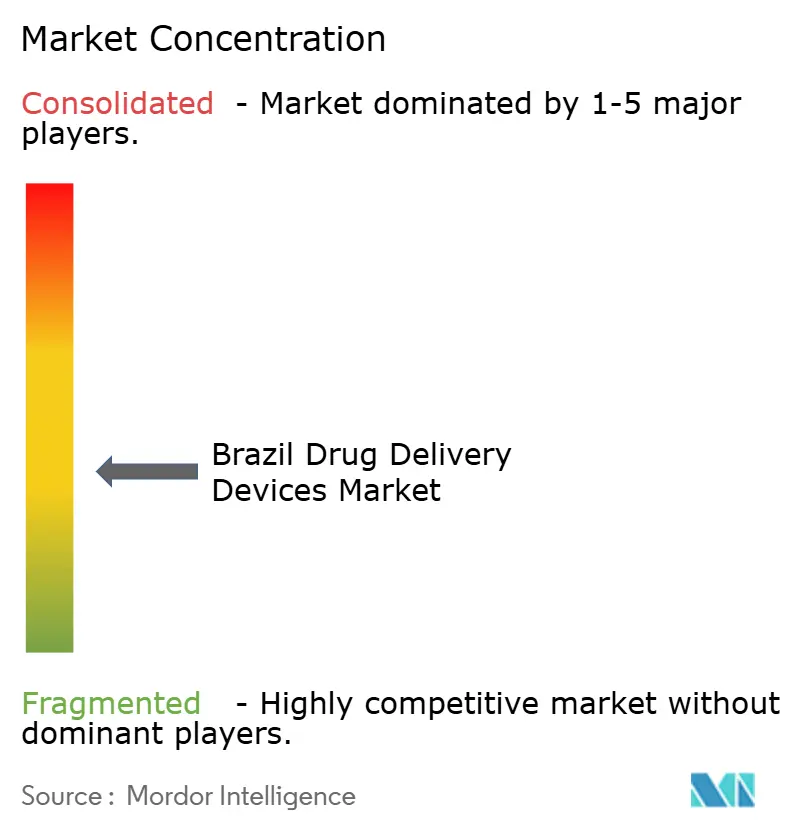
| Market Concentration | Medium |
Major Players *Disclaimer: Major Players sorted in no particular order Image © Mordor Intelligence. Reuse requires attribution under CC BY 4.0. | |
Brazil Drug Delivery Devices Market Analysis by Mordor Intelligence
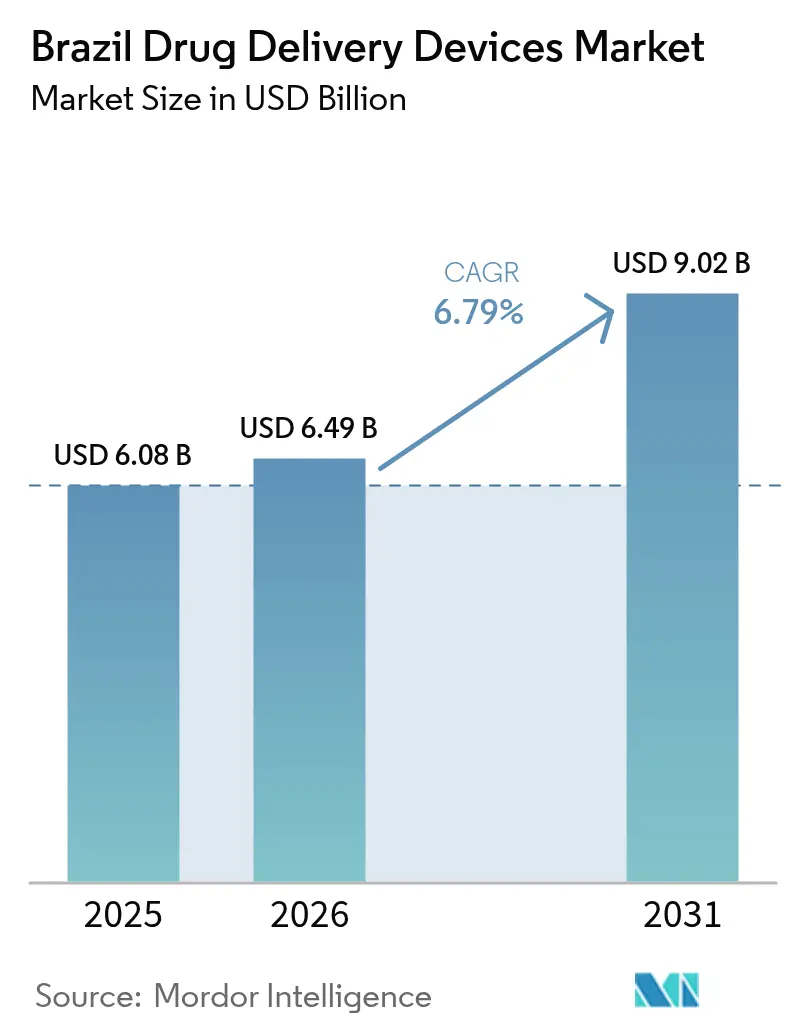
The Brazil drug delivery devices market size was valued at USD 6.08 billion in 2025 and estimated to grow from USD 6.49 billion in 2026 to reach USD 9.02 billion by 2031, at a CAGR of 6.79% during the forecast period (2026-2031). Expansion is underpinned by a large chronic-disease population, rapid adoption of connected care technologies, and a supportive industrial policy that targets 70% domestic supply of medical devices by 2033. Demand is strongest for injectable formats used in diabetes and biosimilar therapies, while implantable systems are gaining traction thanks to oncology advances and sustained-release convenience. A parallel boom in home-care and telehealth services is widening access to self-administered devices, even as tariffs and approval timelines lengthen time-to-market for sophisticated electronics. Multinationals still dominate innovation, yet local firms are scaling up under the Nova Indústria Brasil program, improving cost competitiveness and resilience
Key Report Takeaways
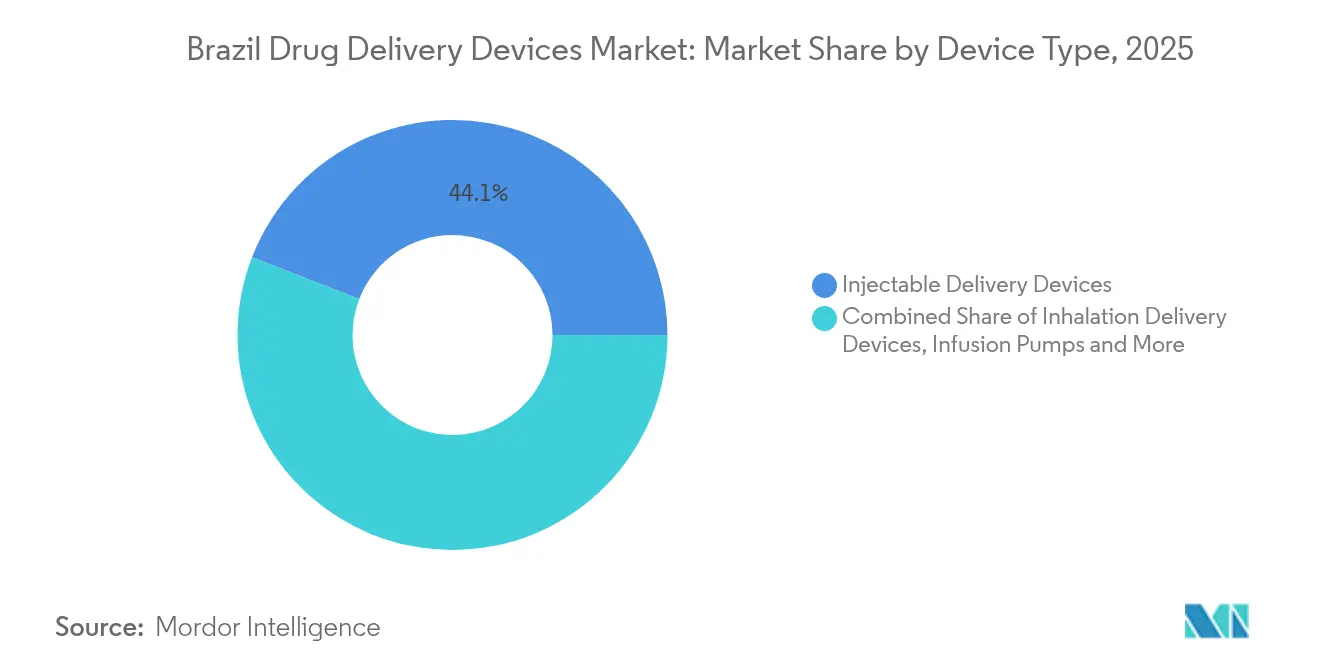
- By device type, injectable delivery devices led with 44.12% revenue share in 2025; implantables are projected to expand at a 9.09% CAGR through 2031.
- By route of administration, injectables accounted for 53.98% of the Brazil drug delivery devices market share in 2025, while oral-mucosal pathways are forecast to grow at an 8.42% CAGR to 2031.
- By application, diabetes captured 30.74% of the Brazil drug delivery devices market size in 2025, whereas oncology is set to register a 9.28% CAGR between 2026-2031.
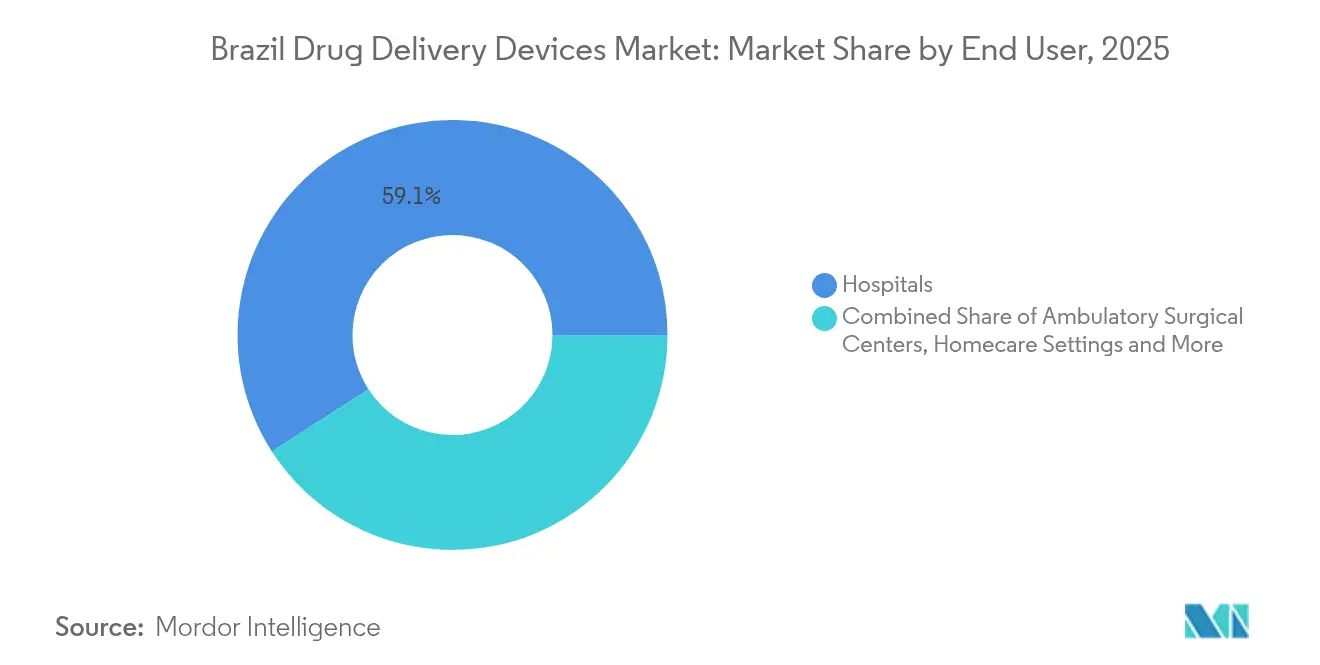
- By end user, hospitals held 59.12% revenue share in 2025; home-healthcare settings will post the fastest growth at an 8.55% CAGR to 2031.
Note: Market size and forecast figures in this report are generated using Mordor Intelligence’s proprietary estimation framework, updated with the latest available data and insights as of 2026.
Brazil Drug Delivery Devices Market Trends and Insights
Drivers Impact Analysis*
| Driver | (~) % Impact on CAGR Forecast | Geographic Relevance | Impact Timeline |
|---|---|---|---|
| Biosimilar self-injection programs | +1.8% | Urban centers nationwide | Medium term (2-4 years) |
| Domestic manufacturing incentives | +1.5% | São Paulo & Rio de Janeiro hubs | Long term (≥ 4 years) |
| Expanding health-insurance coverage | +1.3% | Southeast & South regions | Medium term (2-4 years) |
| Chronic disease & ageing burden | +1.1% | Major metropolitan areas | Long term (≥ 4 years) |
| Tele-pharmacy & IoT adherence uptake | +0.9% | Large cities; moving inland | Short term (≤ 2 years) |
| Home healthcare & smart device demand | +0.8% | Nationwide, faster in metros | Medium term (2-4 years) |
| Source: Mordor Intelligence | |||
Government Programs Popularizing Adoption of Biosimilar Self-Injection Therapies
National Biosimilar Drug Day, instituted for 16 December 2024, spotlights lower-cost biologics and boosts confidence among prescribers and payers. Sales jumped 43% in 2023 to 892,000 units, reinforcing patient familiarity with pen-style injectors. The Brazilian Society of Rheumatology’s interchangeability consensus further validates switching, encouraging procurement bodies to specify self-injectable formats that facilitate out-of-hospital care and improve adherence.
Government Support for Domestic Manufacturing
Nova Indústria Brasil channels BRL 300 billion in soft financing to help local firms meet 70% of national device demand by 2033.[1]Brazilian Government, “Brazil Launches New Industrial Policy with Development Goals and Measures up to 2033,” gov.br Medical-device exports surpassed USD 1 billion in early 2024, confirming capacity gains. ANVISA’s June 2024 Reliance Programme fast-tracks registration of devices already cleared abroad, shrinking approval lags for innovators who assemble or finish products on Brazilian soil, and lowering currency risk for hospital buyers.
Rapid Expansion of Health-Insurance Coverage
New funding models, such as pay-as-you-go micro-plans for gig-economy workers, raise enrollment and diversify payer mix. Electronic health-record mandates streamline claims and prescription reconciliation, making it easier to document outcomes linked to connected delivery devices. Yet plan switches by older members signal pressure to keep premiums affordable, spurring insurers to favor technologies that cut inpatient costs.
High Burden of Chronic Disease and Ageing Population
Roughly 70% of Brazilians over 60 live with at least one chronic condition, intensifying demand for sustained-release implants and smart injectors that limit clinic visits. Machine-learning mortality prediction tools piloted by public hospitals highlight opportunities to embed adherence data from connected devices into broader population-health analytics.[2]Mateus Delpino et al., “Machine Learning Model for Predicting All-Cause Mortality Among Brazilians Aged 50 and Over,” Nature Aging, nature.com
Restraints Impact Analysis*
| Restraint | (~) % Impact on CAGR Forecast | Geographic Relevance | Impact Timeline |
|---|---|---|---|
| Tariffs on electronic delivery devices | -1.1% | National, higher on imports | Medium term (2-4 years) |
| Complex import regulations | -0.7% | Nationwide | Short term (≤ 2 years) |
| Needlestick injury litigation | -0.5% | Hospital settings countrywide | Long term (≥ 4 years) |
| Raw-material & cold-chain gaps | -0.4% | Remote and interior regions | Medium term (2-4 years) |
| Source: Mordor Intelligence | |||
High Tariffs on Advanced Electronic Delivery Devices Elevating End-User Prices
The post-pandemic restoration of an 11.2% import duty raises landed costs for smart insulin pumps and IoT-enabled adherence tools, with industry association Abimo warning that tariff disputes threaten sector inflation. While domestic assembly offers relief, key electronic sub-components still cross borders, dampening immediate price reductions for patients.
Complex Regulatory Environment and Barriers in Import
ANVISA expects about 500 retirements by end-2024, stretching review queues and forcing firms to budget longer launch lead-times. New import procedures effective August 2024 require additional licensing checkpoints[3]ANVISA, “ANVISA Informa Sobre Alteração nos Tratamentos Administrativos para Importação,” gov.br, raising compliance spend for smaller overseas entrants and reinforcing the advantage of local subsidiaries that can navigate paperwork in Portuguese.
*Our forecasts treat driver/restraint impacts as directional, not additive. The impact forecasts reflect baseline growth, mix effects, and variable interactions.
Segment Analysis
By Device Type: Implantables Disrupt Traditional Delivery Paradigms
Injectable devices command 44.12% of the Brazil drug delivery devices market, propelled by widespread diabetes self-management programs and fast adoption of biosimilar pens. Government-backed education and free-at-point-of-care distribution inside SUS keep volumes high. However, persistent price gaps between branded pens and potential generics limit uptake in lower-income municipalities. Implantables, though smaller, are accelerating at a 9.09% CAGR as oncologists and ophthalmologists adopt biodegradable reservoirs that maintain therapeutic levels for months, cutting clinic load and boosting patient satisfaction. Optical-segment breakthroughs such as the DDS-25G insert validated safety in Phase I, positioning ocular implants as credible treatment options. Transdermal patches and infusion pumps appeal to elderly cohorts wary of needles, while nasal devices gain niche traction for rescue therapies.
Brazil drug delivery devices market size for implantables is on course to widen its revenue share as hospital formularies recognise long-acting value, and domestic startups exploit policy incentives to scale polymer extrusion lines. Conversely, syringes and conventional pens face commoditisation pressure as local assemblers enter tenders with lower bids.



By Route of Administration: Oral-Mucosal Pathways Gain Momentum
Injectables remain dominant with 53.98% share due to entrenched physician habits and fast systemic absorption. The Brazil drug delivery devices market share for injectables benefits from 52 approved biosimilars and 30 more under ANVISA review, keeping pipeline richness visible to investors. Novo Nordisk’s GLP-1 franchise, supplied via pens and weekly autoinjectors, continues to set therapy benchmarks.
Oral-mucosal routes, projected at an 8.42% CAGR, circumvent hepatic first-pass metabolism and suit paediatric and geriatric populations who struggle with swallowing. Buccal films that release antihypertensive or migraine drugs in minutes attract formulators seeking differentiation. Transdermal patches carry anti-anginal or hormone molecules steadily, while intranasal sprays appeal for seizure clusters. Ocular routes, though niche, gain credibility from domestic R&D alliances that pair biodegradable polymers with anti-VEGF agents for macular diseases.
By Application: Oncology Innovations Drive Market Expansion
Diabetes applications occupy 30.74% of 2025 revenues, anchored by subsidised insulin pens and widening GLP-1 coverage inside health plans. Still, humanitarian groups note affordability gaps for pens in poorer states, signalling room for low-cost alternatives. Oncology is poised for the fastest lift at 9.28% CAGR as Brazil records over 704,000 new cases annually. Nano-structured chemotherapeutic implants and targeted re-leasable wafers enhance local potency and reduce systemic side-effects. Cardiac and infectious-disease segments remain sizeable, leveraging infusion pumps for long-term antibiotics or biologic cardiology injectables, while chronic pain and hormone therapies broaden the base for controlled-release patches.
With oncology trials designating Brazil as a priority enrolment hub, the Brazil drug delivery devices market size for cancer indications may eclipse diabetes spend in high-complexity hospitals by decade-end, provided reimbursement keeps pace with device-drug combination innovation.

By End User: Home Settings Reshape Care Delivery Models
Hospitals hold 59.12% of 2025 spending, benefiting from bundled procurement contracts, operating-room disposables and nurse-supervised dosing. Digital transformation funds worth R$ 464 million target interoperability and telemonitoring, bolstering traceability of high-risk injectables. Yet demographic ageing and urban congestion intensify demand for at-home options.
Home-healthcare is growing at 8.55% CAGR, powered by 4.6 million teleconsultations logged in 2023-2024 and controlled pilot programmes proving equivalence of virtual diabetes management to in-person care. Connected inhalers, Bluetooth pens and dose-tracking dispensers sync to physician dashboards, enabling value-based contracts that reward adherence. Ambulatory surgical centres exploit implantables for day-procedures, and long-term-care facilities adopt transdermal analgesic patches to minimise staff workload.
Geography Analysis
The Brazil drug delivery devices market spans a diverse healthcare landscape shaped by economic concentration, federal policy and regional infrastructure. São Paulo and Rio de Janeiro in the Southeast anchor 60% of private clinics and 70% of device factories, giving the corridor a decisive edge in early adoption of high-end implants. Northern and Northeastern states rely more heavily on SUS procurement cycles, slowing roll-out of premium smart pumps yet presenting large volume opportunities once lower-cost variants emerge. The Unified Health System covers 75% of residents and channels 9.87% of GDP into health, underpinning steady baseline demand even during macro-economic swings.
Federal telehealth grants are narrowing access gaps: the UBS+Digital project logged 6,312 remote sessions and trained 342 professionals across remote municipalities in 2023. Municipal leaders, however, warn that unclear guidelines risk inconsistent adoption. The Brazil drug delivery devices market size in interior regions could accelerate if low-bandwidth monitoring platforms prove reliable under patchy connectivity.
Regulation also varies by region in practice. While ANVISA sets national norms, state health secretariats interpret compliance timelines differently, prompting multinationals to maintain regional regulatory affairs teams. The new procurement law encourages “efficiency contracts”, allowing winning bidders to recoup payment only after performance targets—such as reduced hospital readmissions—are verified, favouring device-therapy combinations with robust real-world evidence.
Continued growth hinges on harmonising reimbursement between SUS and private insurers, expanding cold-chain routes into Amazonia for temperature-sensitive biologics, and ensuring skilled workforce availability in secondary cities. If Nova Indústria Brasil meets its 70% localisation goal, the Brazil drug delivery devices market could mitigate currency volatility and improve lead-times for northern states currently dependent on ports thousands of kilometres away.
Regulatory Landscape
Brazil regulates drug delivery devices primarily through ANVISA, with combination-product requirements embedded within the medical device framework rather than a single standalone combination-product law. RDC No. 751/2022 governs risk classification and technical dossier expectations, including explicit requirements to identify any active pharmaceutical ingredient (API), its source, justification, and the primary mode of action when a device incorporates a drug substance as an integral part. As a result, documentation and testing demands increase for prefilled injectors, drug-coated systems, and other device-drug combinations.
Regulatory and trade policy changes are also shaping time-to-market and cost. ANVISA issued RDC No. 848/2024, reinforcing evaluation of safety and performance when a device includes an auxiliary substance, and it also tightened administrative controls around imports (with procedures that became effective in August 2024 per ANVISA communications). On the cost side, import duty adjustments under Resolucoes from the GECEX agenda were debated in Congress, including an April 14, 2026 public hearing in the Camara dos Deputados on the impact of increased duties on medical devices and health inputs. This added pricing pressure for advanced electronics-heavy delivery platforms that still rely on imported components.
Value Chain Analysis
The value chain spans (1) raw materials and critical components (medical-grade polymers, elastomers, glass, needles, and electronics for connected devices), (2) design and engineering of delivery systems, (3) manufacturing and assembly, (4) regulatory clearance and quality compliance, and (5) distribution to hospitals, retail pharmacies, and homecare channels linked to telehealth. Brazil remains dependent on imports for advanced subsystems and electronics, while domestic activity commonly concentrates on assembly, secondary packaging, labeling, and kitting. This serves as an important lever for localization under industrial policy and for reducing lead times in major urban hubs such as Sao Paulo and Rio de Janeiro.
Regulatory compliance is a core gate across the chain. ANVISA classifies devices into Risk Classes I to IV, with higher-risk products requiring more stringent controls and, for Class III and IV devices, ANVISA-issued Good Manufacturing Practices certification. Manufacturers also need ANVISA federal authorization and local sanitary licensing. For drug-device combinations, applicants typically navigate both device and pharmaceutical information requirements within the technical dossier (as reinforced by RDC No. 751/2022 and RDC No. 848/2024), increasing reliance on local regulatory affairs, authorized importers, and qualified distributors that can manage Portuguese-language documentation and import procedures.
Competitive Landscape
Competition is moderate, with the top five suppliers accounting for major revenue. Global leaders—Becton Dickinson, Baxter and Medtronic—leverage deep R&D pipelines and service networks, while regional champions Eurofarma and Cristália expand via government-backed credit lines. Nova Indústria Brasil’s localisation incentives prompt partnerships: Baxter recently licensed parenteral-nutrition pump casing manufacture to a São Paulo plastics cluster, and Medtronic is exploring electrode-assembly outsourcing to Minas Gerais electronics firms.
Technology integration dominates strategic agendas. Becton Dickinson pilots cloud-connected insulin pen needles transmitting date-/time-stamp data to endocrinologists. Eurofarma co-develops biodegradable ocular inserts with Brazilian universities, aiming for first-in-country Good Manufacturing Practice approval by 2026. Cost is a differentiator too; 27% growth in device exports to the United States in 2024 signals rising quality confidence in Brazilian manufacturing.
Regulatory transparency initiatives alter engagement models. The Brazilian Medical Association’s Rule #2386 mandates public reporting of any value transfer above BRL 100 to physicians. Firms therefore pivot to peer-reviewed data dissemination rather than speaker-bureau payments. White-space remains in oncology-specific implants and geriatric-friendly home-care kits. Market entrants that bundle telemonitoring dashboards with hardware stand to capture share as insurers adopt outcome-based payment.
Brazil Drug Delivery Devices Industry Leaders
Sanofi
Pfizer Inc.
Novartis AG
Johnson & Johnson
Becton, Dickinson and Company
- *Disclaimer: Major Players sorted in no particular order

Market Opportunities and Future Outlook
Localization and capability build-out in high-value device categories is a visible whitespace, supported by Nova Industria Brasil and reinforced by near-term cost sensitivity tied to import duty debate in 2026. Corporate investments show momentum in expanding Brazilian manufacturing footprints: Medartis, after taking control of NeoOrtho, inaugurated a new 7,700 square meter factory in Curitiba, Parana in June 2026 with a reported R$ 120 million investment and stated capacity of 7 million pieces per year. This points to scaling production in Brazil for complex implantable categories where supply reliability and lead-time control are operational priorities.
A second opportunity sits at the intersection of regulated combination-product documentation and hospital and homecare digitization, where firms that can package strong technical dossiers with locally supported quality systems can gain execution advantages. ANVISA requirements under RDC No. 751/2022 and RDC No. 848/2024 formalize expectations around integrated safety and performance evidence when a device incorporates a substance, which favors manufacturers that can combine device engineering, pharmaceutical-quality documentation, and post-market traceability. As telehealth and connected care expand in Brazil, this creates scope for device suppliers to pair self-administration formats (pens, autoinjectors, pumps, inhalers, and adherence tools) with compliant data workflows that fit payer documentation and hospital interoperability initiatives, particularly in diabetes and oncology pathways where long-acting and self-managed delivery formats are already shifting care settings.
Recent Industry Developments
- April 2026: The Camara dos Deputados held a public hearing to debate the impacts of higher import duties on medical devices and health inputs under the GECEX agenda. The discussion kept tariffs and exemptions in focus for hospitals and suppliers, adding urgency to local assembly and supplier qualification for electronics-heavy delivery platforms.
- April 2025: Novo Nordisk expanded production in Brazil to support rising demand in diabetes and obesity therapies supplied through pen and injector formats. The expansion strengthened local supply availability for chronic self-administration regimens and supported broader adoption of injectable delivery devices across both private and public channels.
- March 2024: ANVISA introduced streamlined import procedures scheduled to take effect on August 1, 2024 for products under sanitary control. The change tightened administrative checkpoints while clarifying process steps, elevating the value of experienced local regulatory and import partners for device makers bringing drug delivery systems into Brazil.


Research Methodology Framework and Report Scope
Market Definition and Coverage
This market covers revenues from drug delivery devices sold in Brazil that are used to administer medicines safely and in a controlled way across common routes, such as injectable, inhalation, transdermal, ocular, nasal, and infusion-based delivery.
Scope exclusions: We exclude the value of the drug or biologic itself, veterinary-only delivery tools, and general medical supplies that do not have a primary drug delivery function.
Segmentation Overview
- By Device Type
- Injectable Delivery Devices
- Inhalation Delivery Devices
- Infusion Pumps
- Transdermal Patches
- Implantable Drug Delivery Systems
- Ocular Inserts & Delivery Implants
- Nasal & Buccal Delivery Devices
- By Route of Administration
- Injectable
- Inhalation
- Transdermal
- Oral
- Mucosal (Buccal & Sublingual)
- Ocular
- Nasal
- By Application
- Cancer
- Cardiovascular
- Diabetes
- Infectious Diseases
- Other Applications
- By End User
- Hospitals
- Ambulatory Surgical Centers
- Homecare Settings
- Other End Users
Data Sources, Market Sizing, and Validation
Desk Research
Desk research was used to build the starting structure of the model and to keep the assumptions tied to public signals that can be checked. We mainly reviewed Brazil health statistics and treatment patterns from sources such as the Ministry of Health (DATASUS), ANVISA publications, OECD health indicators where available for Brazil comparisons, and PAHO epidemiology updates.
On the market side, we cross-checked device demand cues using sources such as UN Comtrade for trade flows, public procurement and tender disclosures, peer reviewed clinical journals that describe device usage in care pathways, and company annual reports and investor presentations that discuss Brazil or Latin America exposure. For pricing and product mix sanity checks, we also used paid subscriptions for company financials and intelligence, news and financials, and selective import and export shipment level views. These desk sources are not exhaustive, and we reviewed additional public documents and articles to collect, validate, and clarify individual data points.
Primary Interviews and Surveys
Primary work focused on confirming what is actually used and purchased in Brazil, since device mix can shift quickly by care setting and reimbursement. We spoke with a mix of manufacturers, distributors, hospital and clinic procurement teams, and practicing healthcare professionals to validate volume proxies, typical price ranges, and adoption changes for injectable devices, infusion delivery, and self administration formats. When gaps appeared in desk inputs, we returned to respondents to pressure test assumptions before finalizing the model outputs.
Distribution of primary research fieldwork respondents
| Company type | Respondent position |
|---|---|
| Top tier: 28% | CXOs: 13% |
| Mid tier: 57% | Functional/Unit leaders: 43% |
| Smaller Players: 15% | Managers: 44% |
Market-Sizing & Forecasting
Sizing starts with a top-down build where treated patient pools and procedure volumes are translated into device demand, and then reconciled with Brazil specific supply signals like trade flows and tender activity. Once that demand pool is formed, it is converted to value using route specific usage rates and typical replacement cycles (for example, injection frequency for chronic therapies and utilization patterns for infusion delivery).
To keep the model practical, we rely on a short list of high impact inputs that can be updated every year, such as diabetes and oncology prevalence, injectable therapy penetration in outpatient care, hospital admissions that correlate with infusion use, device reuse versus single use practices, and price movement driven by mix shifts toward self administration. Where only partial bottom-up information is available, selective roll ups are done using sampled average selling prices times estimated volumes for a few device clusters, followed by distributor channel checks to adjust the totals.
Forecasts are built using scenario analysis, where the key drivers are projected under a base case and then flexed for reimbursement sensitivity, import pricing pressure, and care setting shift toward home use. The final trajectory is accepted only after primary feedback confirms that the driver direction and the pace of adoption feel realistic for Brazil.
Data Validation & Update Cycle
Outputs are validated through multiple checks so the totals do not drift away from real world signals. We compare implied device volumes and implied average prices against independent indicators like trade movement, public procurement visibility, and therapy utilization patterns, and then we rework assumptions when the math creates unusual jumps or conflicting trends.
Before sign-off, the model and written insights are reviewed in steps by another analyst to catch calculation errors and inconsistent definitions. The report is refreshed annually, and interim updates are triggered when major regulatory changes, reimbursement actions, or sharp currency moves can meaningfully alter pricing and demand. Right before delivery, a final pass is completed to ensure the latest data points and market events are reflected.
Mordor Intelligence's Brazil Drug Delivery Devices Market Estimate Compared With Other Published Estimates
Published market numbers for Brazil drug delivery devices often do not line up, even when the market name looks the same. Differences usually come from what is counted as a device, whether values are reported at manufacturer level or include downstream markups, and which year and currency approach is used for conversion.
In this market, the largest gaps tend to come from scope and unit handling, where some estimates mix drug value with device value, or include broad hospital consumables that are not dedicated delivery systems. Another common driver is the way pricing is projected, since constant-currency methods and aggressive price escalation assumptions can push totals higher without matching observed procurement behavior.
Benchmark comparison
| Source | Market Size | Gaps in Research Methodology |
|---|---|---|
| Mordor Intelligence | USD 6.08 B (2025) | |
| Industry Publisher A | USD 0.77 B (2025) | Uses a narrower basket that appears to emphasize selected device categories and may omit high-value infusion and broader injectable delivery formats, which pulls the total down. |
| Research Group B | USD 59.73 B (2024) | Value looks inflated for this device-only scope, which suggests drug revenue and/or wide medical consumables may be included, with year and currency handling that is not fully traceable. |
The table shows that the spread is mostly explained by what gets counted and how prices are carried forward, not by a sudden change in Brazil demand. By keeping the value tied to device revenues only and cross-checking against therapy usage signals and trade and procurement cues, the estimate stays anchored to repeatable steps, a modeling choice applied by Mordor Intelligence.


Key Questions Answered in the Report
What is the current size of the Brazil drug delivery devices market?
The market is valued at USD 6.49 billion in 2026 and is projected to reach USD 9.02 billion by 2031.
Which device type leads the Brazil drug delivery devices market?
Injectable devices dominate with 44.12% of 2025 revenue, driven by diabetes care and expanding biosimilar use.
Why are implantable drug delivery systems growing rapidly?
They offer sustained-release benefits for oncology and chronic diseases, yielding a forecast 9.09% CAGR between 2026-2031.
How is telemedicine influencing demand for drug delivery devices in Brazil?
Over 4.6 million teleconsultations in 2023-2024 validate home-based care models, boosting uptake of connected self-administration devices.
What government policy supports domestic production of drug delivery devices?
Nova Indústria Brasil targets 70% local manufacturing by 2033, backed by BRL 300 billion in financing, encouraging companies to localise production.
Which application segment is expected to grow fastest through 2031?
Oncology devices lead growth at a 9.28% CAGR, reflecting rising cancer incidence and novel implantable chemotherapy platforms.
Page last updated on:





