
Blockchain In Gaming Market Size and Share
Market Overview
| Study Period | 2020 - 2031 |
|---|---|
| Market Size (2026) | USD 5.48 Billion |
| Market Size (2031) | USD 41.02 Billion |
| Growth Rate (2026 - 2031) | 49.57 % |
| Fastest Growing Market | Asia-Pacific |
| Largest Market | North America |
| Market Concentration | Low |
Major Players *Disclaimer: Major Players sorted in no particular order Image © Mordor Intelligence. Reuse requires attribution under CC BY 4.0. | |
Blockchain In Gaming Market Analysis by Mordor Intelligence
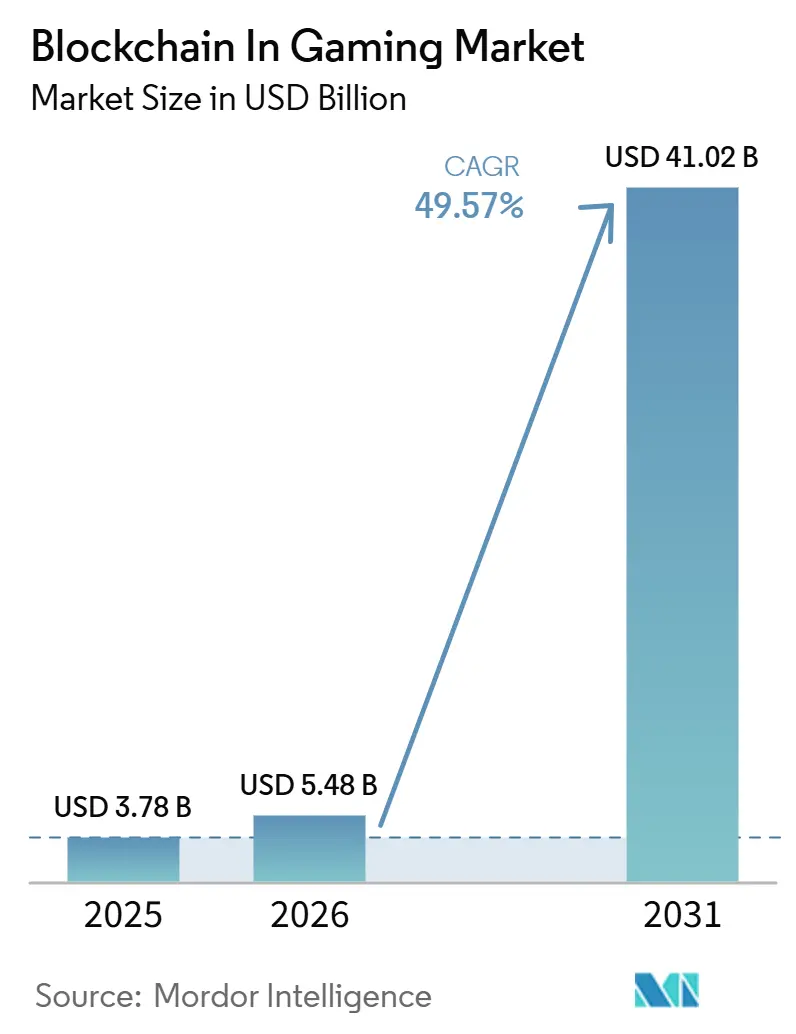
The blockchain in gaming market size is expected to grow from USD 3.78 billion in 2025 to USD 5.48 billion in 2026 and is forecast to reach USD 41.02 billion by 2031 at 49.57% CAGR over 2026-2031. Growth is being supported by gaming-focused Layer-2 networks that have lowered transaction costs to levels suitable for frequent in-game activity. Regulatory clarity in the United States also improved in 2026, which reduced a major legal hurdle that had delayed participation from larger studios and institutional backers. The GENIUS Act of 2025 further improved the operating backdrop by giving stablecoins a clearer role as payment tools inside digital economies. Competition is rising across dedicated gaming chains, general-purpose Layer-2 ecosystems, and traditional publishers that are now participating more directly in blockchain infrastructure. This combination is creating better conditions for free-to-play design, stablecoin settlement, and AI-assisted game systems.
Key Report Takeaways
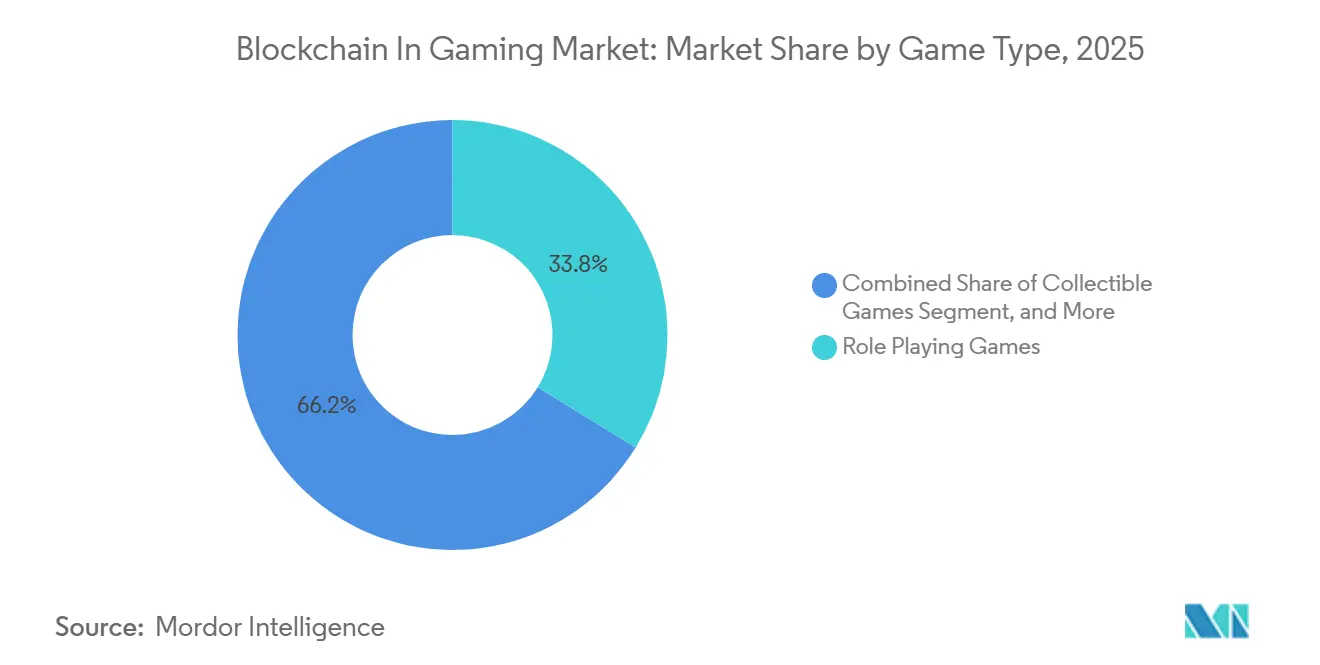
- By game type, role-playing games held 33.76% of revenue of the blockchain in gaming market in 2025, while collectible games are projected to expand at a 50.14% CAGR through 2031.
- By platform, BNB Chain held 35.87% share of the blockchain in the gaming market in 2025, while Polygon is projected to expand at a 50.88% CAGR through 2031 in the blockchain in gaming market.
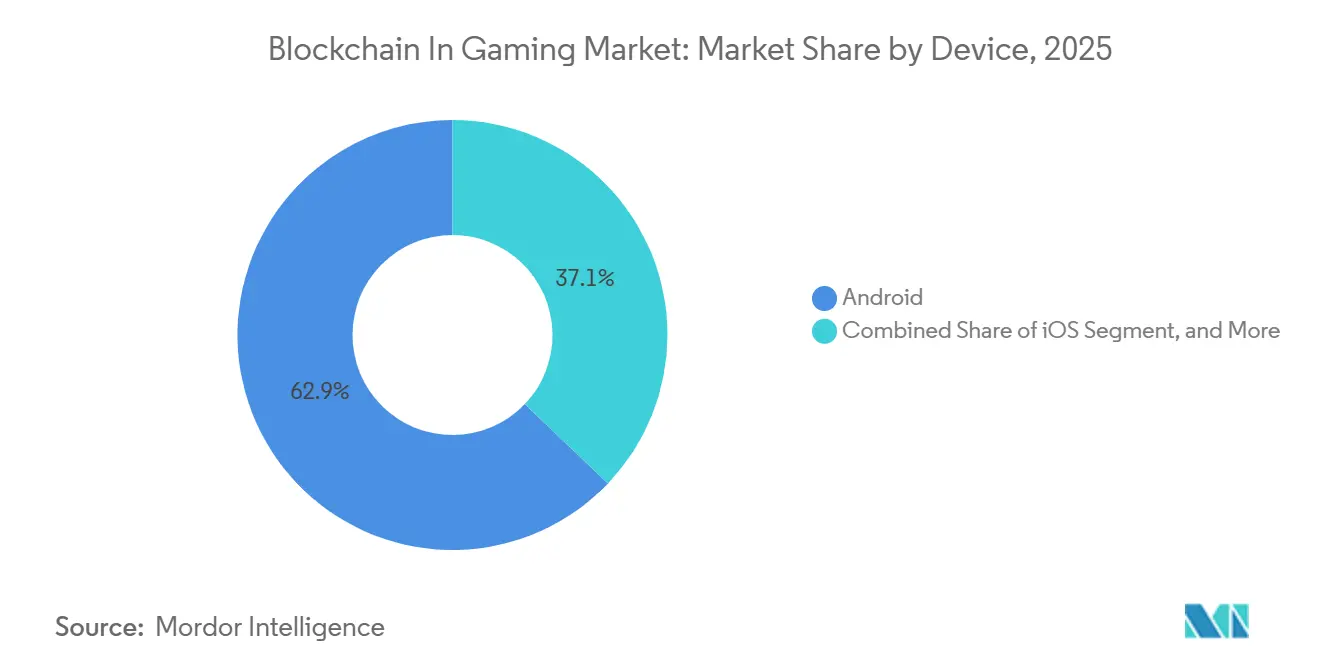
- By device, mobile devices accounted for 62.86% of revenue of the blockchain in the gaming market in 2025 and are projected to expand at a 51.67% CAGR through 2031.
- By revenue model, play-to-earn held 39.99% of revenue of the blockchain in gaming market in 2025, while free-to-play with on-chain asset ownership is projected to expand at a 51.32% CAGR through 2031.
- By geography, North America held 46.22% of the revenue of the blockchain in gaming market in 2025, while Asia-Pacific is projected to expand at a 51.98% CAGR through 2031.
Note: Market size and forecast figures in this report are generated using Mordor Intelligence’s proprietary estimation framework, updated with the latest available data and insights as of January 2026.
Market Trends and Insights
Drivers Impact Analysis of Blockchain In Gaming Market*
| Driver | (~) % Impact on CAGR Forecast | Geographic Relevance | Impact Timeline |
|---|---|---|---|
| Player-Owned Digital Asset Economies | +12.0% | Global | Short term (≤ 2 years) |
| Layer-2 Scaling and Gasless Wallet Infrastructure | +9.5% | Global, especially APAC and North America | Short term (≤ 2 years) |
| Traditional Publisher Entry and AAA Content Pipelines | +7% | North America and Europe | Medium term (2-4 years) |
| Growth of Creator-Led and Community-Governed Game Loops | +6.5% | Global, core in APAC and South America | Medium term (2-4 years) |
| Stablecoin Settlement Reducing Reward-Cashout Friction | +5.5% | Global, especially Southeast Asia and South America | Short term (≤ 2 years) |
| Convergence of AI Agents With On-Chain Game Economies | +4% | Global, early adoption in North America | Long term (≥ 4 years) |
| Source: Mordor Intelligence | |||
Player-Owned Digital Asset Economies
Player-owned assets remain the clearest demand driver in the blockchain in gaming market because they let users hold, trade, and monetize items outside a closed publisher system. This matters most in games where players invest long periods in characters, land, weapons, or collectible items that retain value after gameplay. The Blockchain Game Alliance reported that high-quality launches and sustainable revenue models ranked as the top growth factors for the sector, and both depend on credible ownership mechanics that feel useful inside the game loop. The market moved away from pure speculative trading and toward ownership tied to gameplay utility, which makes secondary trading more durable and gives studios recurring royalty income from smart-contract resale logic. The same report noted that deflationary token structures were more stable than uncapped reward issuance models, which supports longer-lived asset economies in the blockchain in gaming market.
Layer-2 Scaling And Gasless Wallet Infrastructure
Layer-2 scaling and gasless wallet tools changed the operating model of the blockchain in gaming market by cutting costs to levels that support frequent in-game actions. That shift makes real-time gameplay, microtransactions, and high-volume item movement more viable than they were in earlier blockchain game cycles. Gasless wallet design also reduces friction because players can start with social logins and session keys instead of seed phrases and manual network management. The Blockchain Game Alliance reported that delaying wallet setup until after initial gameplay lifted onboarding completion by 30%, which shows how invisible infrastructure can widen the addressable audience. Account abstraction also gives developers more control over compliance checkpoints, since higher-value actions can trigger identity checks without slowing every casual user interaction.
Traditional Publisher Entry And AAA Content Pipelines
Traditional publisher entry became a stronger signal for the blockchain in gaming market once established companies moved beyond investment and began supporting live blockchain infrastructure. Square Enix began operating as a Tezos baker in March 2026, which showed a shift from passive capital allocation to direct transaction validation.[1]Trilitech, “Gaming Giant Square Enix Becomes Node Validator on the Tezos Blockchain,” Tezos, tezos.com Tezos reported 440,000 unique gaming users and 31 million gaming transactions in 2025, which gave publishers evidence that sustained on-chain activity can support production pipelines rather than one-off NFT campaigns. This matters because first-party content owners can now choose direct chain partnerships and avoid relying only on pure-play blockchain studios as intermediaries. As more major publishers validate infrastructure choices in public, the blockchain in gaming market gains credibility with developers, investors, and distribution partners.
Growth Of Creator-Led And Community-Governed Game Loops
Creator-led and community-governed game loops are changing the cost and revenue structure of the blockchain in the gaming market by shifting part of content creation outside the studio. Nexon's NEXPACE division announced the MSU 2 initiative in May 2026 and allocated a USD 50 million ecosystem fund to let external developers build with MapleStory intellectual property through AI-assisted tools and on-chain licensing. This model lets the IP owner provide the rails while third parties expand the content base, which keeps royalty capture in place and reduces internal development burden. The same announcement stated that the MapleStory Universe economy consumed more NXPC in utility functions than it issued in rewards in Q1 2026, which pointed to a more balanced in-game economy. MapleStory Universe also reached 150 million cumulative on-chain transactions and 850,000 active wallets, showing that community-led expansion can scale beyond a niche pilot inside the blockchain in gaming market.
Restraints Impact Analysis of Blockchain In Gaming Market*
| Restraint | (~) % Impact on CAGR Forecast | Geographic Relevance | Impact Timeline |
|---|---|---|---|
| Regulatory Uncertainty Around Tokens and NFTs | -8% | Global, most acute in EU and APAC | Short term (≤ 2 years) |
| Wallet Onboarding and Mainstream UX Friction | -5.5% | Global, especially developing markets | Short term (≤ 2 years) |
| Bot Farming and Token Extraction Pressuring Game Economies | -3.5% | Global, especially APAC P2E hubs | Short term (≤ 2 years) |
| App-Store and Platform Distribution Constraints | -3.0% | North America, Europe, and APAC mobile | Medium term (2-4 years) |
| Source: Mordor Intelligence | |||
Regulatory Uncertainty Around Tokens And NFTs
Regulatory divergence still slows the blockchain in gaming market even after U.S. policy became more defined in 2026. The SEC and CFTC stated in March 2026 that certain in-game NFTs and digital collectibles are non-securities, which reduced a major legal barrier for U.S. developers and investors.[2]Securities and Exchange Commission and Commodity Futures Trading Commission, “Application of the Federal Securities Laws to Certain Types of Crypto Assets,” Federal Register, govinfo.gov The problem is that studios serving multiple regions still face different disclosure, AML, and token-treatment requirements, especially after MiCA became fully effective in the European Union in December 2024. That creates dual compliance structures for mid-size publishers that want European reach but operate from outside the bloc. South Korea's continued restriction on play-to-earn formats also forces some publishers to maintain separate launch plans and economic models across markets, which keeps the blockchain in the gaming market less standardized than mainstream gaming.
Wallet Onboarding And Mainstream UX Friction
Wallet onboarding remains one of the most persistent conversion barriers in the blockchain in gaming market because mainstream players are not used to seed phrases, gas settings, or signature prompts. Unlike legal risk, this problem repeats with every new user cohort and cannot be solved only through entity restructuring or policy work. The Blockchain Game Alliance found that onboarding completion improved by 30% when wallet setup was delayed until after early gameplay, confirming that front-loaded wallet creation is the main drop-off point. Immutable said its Passport product had reached 6 million sign-ups by February 2026, which shows that social-login wallets can reduce friction at scale even if they do not remove every downstream pain point. Friction still returns when players need to trade on secondary marketplaces or move earnings into fiat, so onboarding remains a design constraint across the blockchain in the gaming market.
*Our forecasts treat driver/restraint impacts as directional, not additive. The impact forecasts reflect baseline growth, mix effects, and variable interactions.
Blockchain In Gaming Market Segment Analysis
By Game Type:
Role-Playing Games Anchor Token-Utility EcosystemsRole-playing games held 33.76% of the blockchain in gaming market share in 2025, the highest among game types, because persistent progression systems fit asset ownership more naturally than disposable play loops. Players in role-playing titles are more willing to link wallets and manage inventories when characters, land, and weapons carry long-lived value outside a single server environment. Action RPG and open-world formats set a higher benchmark for blockchain-native integration because deep progression gives ownership mechanics a clear gameplay purpose rather than a speculative one. The Blockchain Game Alliance said high-quality launches were the sector's top stated growth driver in 2025, which supports the genre's lead because role-playing releases depend heavily on retention, utility, and durable economies.
Collectible games are projected to grow at a 50.14% CAGR through 2031, the fastest pace among game types in the blockchain in gaming market. The strongest use case is tokenized trading card design, where collection, rarity, and trading already shape user behavior before any blockchain layer is added. Courtyard's ecosystem on Polygon generated more than USD 582 million in cumulative gacha spending by early 2026, showing how physical and digital collectibles can converge in one trading loop. Parallel TCG reached global app-store distribution in 2025 after an extended NFT-first buildout, and Splinterlands showed that collectible play can remain durable without leaning entirely on speculative token issuance. Multiplayer and open-world games still hold long-term upside in the blockchain in gaming industry, but their longer development cycles and heavier economy-balancing requirements keep current share below the leading genre profile.



By Platform:
BNB Chain Leads As Polygon Builds Its OvertakeBNB Chain commanded 35.87% of platform revenue in 2025, the largest share in the blockchain in gaming market, because low fees and exchange-linked liquidity suited cost-sensitive player bases in Southeast Asia. That structure shortened the path between in-game rewards and liquid markets, which mattered in regions where users had historically treated play-to-earn as supplemental income. Ethereum no longer led gaming volume, but it remained strategically important as the settlement base for high-value NFT activity and for several gaming-focused Layer-2 environments. Other chains, including Solana, Kaia, and Avalanche, served more specialized roles around high-frequency play, messenger-linked ecosystems, or IP-specific deployments.
Polygon is projected to expand at a 50.88% CAGR through 2031, making it the fastest-growing platform in the blockchain in gaming market. Its growth has been supported by Ethereum compatibility, gas-free transactions, and brand-friendly tooling that reduced protocol friction for developers and collectors. The Blockchain Game Alliance said the Courtyard ecosystem generated cumulative trading volumes above USD 952 million, which reinforced Polygon's ability to attract collectible-led activity at scale. Polygon's 2025 acquisition of Sequence also strengthened its developer stack and made tooling quality a bigger competitive factor than raw throughput alone. That shift suggests the platform race in the blockchain in gaming market is moving toward wallet abstraction, EVM compatibility, and studio support rather than token subsidies.
By Device:
Mobile Architecture Defines The Competitive MapMobile devices accounted for 62.86% of blockchain in gaming market revenue in 2025 and are projected to expand at a 51.67% CAGR through 2031. The dominance of smartphones reflects the mobile-first user base across Southeast Asia, South America, and India, where access is wider than on consoles or gaming PCs. Android held the larger within-mobile position because it matched the hardware profile of emerging markets and allowed more flexible distribution. iOS remained attractive for higher-value collectible titles in North America and Europe, but its rules kept token-driven design more constrained than on other channels.[3]Apple Inc., “App Review Guidelines,” Apple Developer, developers.apple.com
PC and Mac retained a strategically important cohort in the blockchain in gaming market because these users tended to transact more actively and engage more often with secondary marketplaces. Web browsers remained the easiest access point for crypto-native users who wanted open, composable, and fully on-chain play environments. Cartridge acquired Playmint in January 2026 and brought Playerchain architecture into its Dojo engine, which advanced browser-based multiplayer design without relying on centralized servers. Consoles remained the smallest device segment because Sony and Microsoft had not integrated custodial wallet tools into their platform software, leaving blockchain in gaming industry access centered on phones and PCs.
By Revenue Model:
Play-To-Earn Matures As Free-To-Play ScalesPlay-to-earn models held 39.99% of the blockchain in gaming market share in 2025, the largest share among revenue models, because they reached users early in Southeast Asia and South America. The model still mattered, but its structure changed after the 2021-2022 cycle as scholarship systems gave way to designs where earning became a bonus for committed players rather than the main reason to join. That shift improved sustainability because it reduced dependence on continuous token issuance and narrowed the gap between gameplay value and financial expectation. Nexon's MapleStory Universe illustrated this move in Q1 2026 when token consumption in utility functions exceeded reward issuance for the first time, showing a more balanced economic loop.
Free-to-play with on-chain asset ownership is projected to grow at a 51.32% CAGR through 2031, making it the fastest-growing revenue model in the blockchain in gaming market. This format keeps gameplay open at the start and adds NFTs or tradable items as an optional ownership layer, which brings blockchain design closer to familiar Web2 monetization patterns. Mythical Games used its Pulse marketplace for FIFA Rivals to support stablecoin-denominated NFT trading, which showed how settlement can stay functional without tying all value to a volatile native token.[4]World, “Mythical Games and World Usher in a New Era for In-Game Economies,” World, world.org Hybrid and subscription-led formats are also emerging because they give studios more predictable income while preserving collectible demand and secondary-market activity.
Geography Analysis
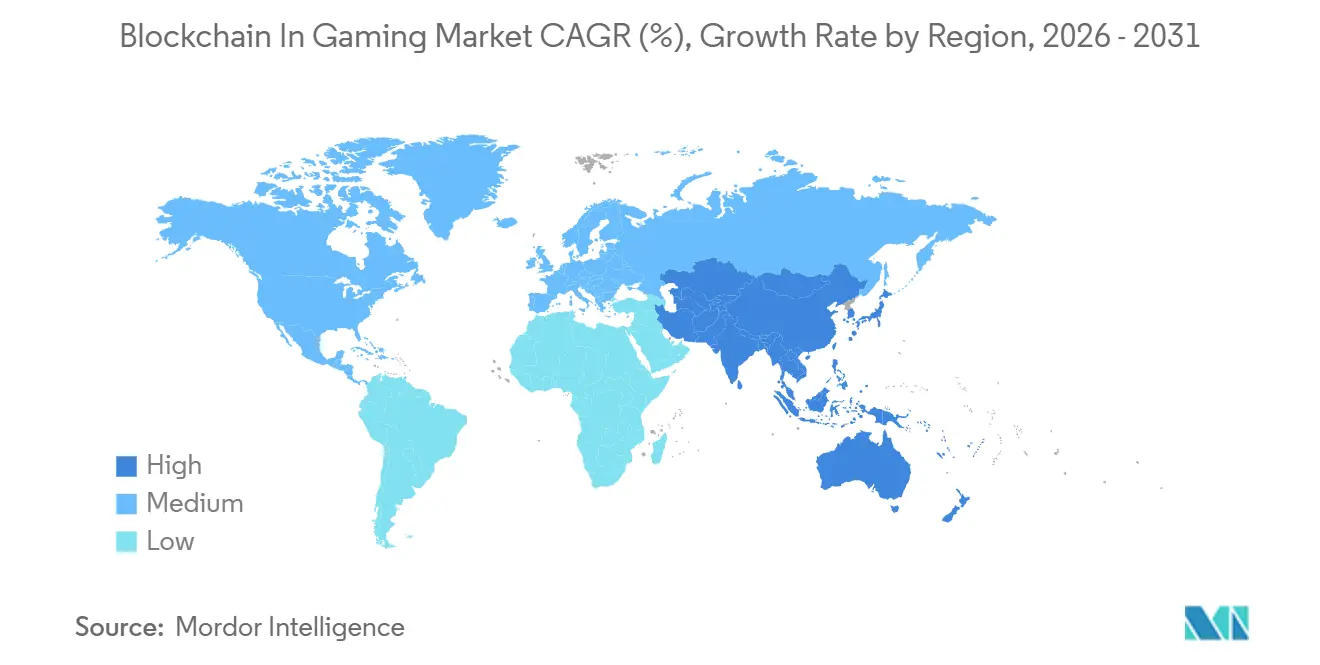
North America and Europe Blockchain in Gaming Market
North America held 46.22% of the blockchain in gaming market share in 2025, which made it the largest regional revenue base. The region benefited from venture capital density, high-value NFT participation, and better regulatory clarity than most competing jurisdictions. The March 2026 SEC and CFTC interpretive release classified certain in-game NFTs and digital collectibles as non-securities under U.S. federal law, which reduced one of the biggest barriers for mainstream studios and institutional participants. The GENIUS Act of 2025 also supported the use of dollar-pegged settlement inside games by treating stablecoins as payment instruments rather than securities. Europe remained the second major operating region, where MiCA increased compliance costs but also gave publishers a more predictable rulebook across multiple markets.
APAC Blockchain in Gaming Market
Asia-Pacific is projected to expand at a 51.98% CAGR through 2031, the fastest regional pace in the blockchain in gaming market size outlook. The region combines the world's deepest mobile gaming pools with strong play-to-earn familiarity and active blockchain infrastructure development. Southeast Asia remained the operational center of guild-led and mobile-first participation, especially in the Philippines, Vietnam, and Thailand. South Korea continued to produce globally relevant blockchain game intellectual property even while domestic rules limited play-to-earn deployment, and MapleStory Universe reached 150 million cumulative on-chain transactions with 850,000 active wallets in 2026. Japan offered one of the more predictable regional environments for stablecoin-linked game payments, while India and China remained large long-term demand reserves because of mobile scale and cross-border development capacity.
South America and MEA Blockchain in Gaming Market
South America and Middle East and Africa remained less penetrated in the blockchain in gaming market, but both regions showed strong activity where mobile access and income incentives aligned. Brazil, Argentina, and Mexico continued to matter for user growth because mobile play, crypto familiarity, and international publishing partnerships supported adoption across different title types. In the Middle East and Africa, the UAE strengthened its role as a regulated hub after Animoca Brands secured a VASP licence from VARA in February 2026. Nigeria and South Africa also mirrored parts of Southeast Asia's pattern, where mobile penetration and the appeal of supplementary digital income supported consumer participation.

Competitive Landscape
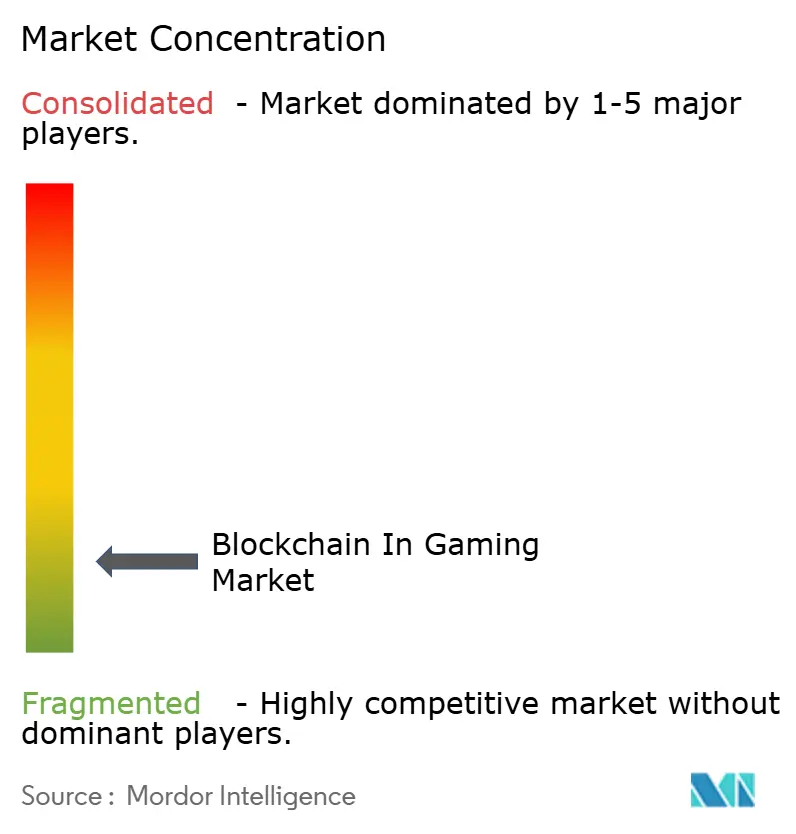
The blockchain in gaming market remained fragmented at the studio level, but it was consolidating faster at the infrastructure layer. Immutable zkEVM, BNB Chain, Polygon, and Ronin stood out as the main platforms competing for developer onboarding, transaction flow, and ecosystem relevance. Strategic behavior in 2025 and 2026 will be split between full-stack players building publishing, infrastructure, and services together, and content studios using game quality or known intellectual property as their main edge. Early 2026 deal activity, including Polygon's Sequence acquisition, Cartridge's Playmint acquisition, and Animoca Brands' SOMO acquisition, suggested that infrastructure consolidation was moving faster than content consolidation. That pattern matters because the platforms that secure developer loyalty now are likely to capture a larger share of future title launches in the blockchain in gaming market.
Infrastructure providers also pushed upward into distribution and community tools to reduce studio dependence on third-party channels. Immutable said Passport had reached 6 million sign-ups, and the company paired that wallet base with Mintory to support community onboarding and launch activity. Traditional publishers added credibility by participating in the rails themselves, and Square Enix's move to operate as a Tezos baker showed that this involvement now goes beyond one-off NFT experiments. The clearest white space sits in mobile-first design paired with account abstraction, where studios that hide wallets, fees, and seed phrases can reach mainstream gamers who still abandon setup too early. Messenger-linked casual distribution and low-friction login flows are therefore becoming as important as chain speed or token incentives in the blockchain in the gaming market.
AI-linked game economies also started to attract capital, which showed that competition is widening beyond chains and studios into agent infrastructure, payment rails, and automation tools. Animoca Brands launched a program of up to USD 10 million for developers building on Minds, while ZBD raised USD 40 million to expand Bitcoin-native payment rails for games. Scrypted's acquisition of Chibi Clash also pointed to interest in AI agents that can hold, trade, or act inside game economies. Even with these moves, no single company was shown to hold a controlling share of the blockchain in gaming market, which keeps rivalry broad across publishers, infrastructure providers, wallets, and content studios.
Blockchain In Gaming Industry Leaders
Animoca Brands Corporation Limited
Sky Mavis Pte. Ltd.
Immutable Pty Ltd
Mythical, Inc.
Dapper Labs Inc.
- *Disclaimer: Major Players sorted in no particular order
Blockchain In Gaming Market Companies Covered in this Report
- Animoca Brands Corporation Limited
- Sky Mavis Pte. Ltd.
- Immutable Pty Ltd
- Mythical, Inc.
- Dapper Labs Inc.
- Enjin Pte. Ltd.
- Wemade Co., Ltd.
- double jump.tokyo Inc.
- Steem Monsters Corp.
- Uplandme, Inc.
- Illuvium Labs FZCO
- Decentraland Foundation
- Autonomous Worlds Ltd.
- Nine Corporation
- PlayDapp Limited
- Sorare, SAS
- Time and Space Ltd.
- Worldwide Asset eXchange
- Yuga Labs
- Parallel Studios

Recent Industry Developments in Blockchain In Gaming Market
- May 2026: Nexon's NEXPACE division announced the MSU 2 initiative, allocating a USD 50 million ecosystem fund to enable external developers to build on MapleStory IP using AI-assisted coding tools and on-chain licensing with automated royalty settlement. The platform reached 150 million cumulative on-chain transactions and approximately 850,000 active wallets in 2026, marking a structural pivot from publisher-as-content-creator to publisher-as-infrastructure-provider.
- May 2026: Animoca Brands launched an investment program of up to USD 10 million for early-stage developers building on its Minds AI agent platform, targeting gaming, finance, and social verticals. The initiative, announced May 5, 2026, positions Minds as foundational infrastructure for Animoca's thesis that autonomous AI agents will transact within blockchain game economies as first-class participants.
- March 2026: AlphaTON Capital acquired a 60% controlling interest in Animoca Brands subsidiary GAMEE at a USD 18 million enterprise valuation, making GAMEE the first Nasdaq-listed Web3 gaming company, announced on March 19, 2026. GAMEE's 119 million registered users, 61 million of them within the Telegram ecosystem, added a mass-market messenger-native distribution channel to the institutional profile of blockchain gaming.
- March 2026: Square Enix began operating as a Tezos baker, node validator, on March 12, 2026, following prior capital investments in Soccerverse, HyperPlay, and The Sandbox. The move represents one of the first instances of a major legacy publisher committing to blockchain infrastructure participation rather than purely financial investment, a qualitatively different signal than publisher-as-capital-allocator positioning.


Global Blockchain In Gaming Market Report Scope
The Blockchain in Gaming Market includes gaming platforms, infrastructure, and services that use blockchain to enable asset ownership, in-game economies, play-to-earn models, NFTs, tokenized rewards, and decentralized game governance.
The Blockchain in Gaming Market Report is Segmented by Game Type (Role-Playing Games, Open World Games, Collectible Games, and Multiplayer Games), Platform (Ethereum, BNB Chain, and Polygon), Device (Web Browser, Android, iOS, PC and Mac, and Console), Revenue Model (Play-to-Earn, Free-to-Play With On-Chain Assets, Pay-to-Play, and Hybrid and Subscription-Led Models), and Geography (North America, South America, Europe, Asia-Pacific, and Middle East and Africa). The Market Forecasts are Provided in Terms of Value (USD).
| Role-Playing Games | Action RPGs |
| Strategy RPGs | |
| Open-World RPGs | |
| Open World Games | Metaverse Sandboxes |
| Survival and Exploration Games | |
| Collectible Games | Trading Card Games |
| Creature and Item Collectibles | |
| Multiplayer Games | MMORPGs |
| Battle Royale and Extraction Games | |
| Sports and Fantasy Games |
| Ethereum |
| BNB Chain |
| Polygon |
| Other Blockchain Platforms |
| Web Browser |
| Android |
| iOS |
| PC and Mac |
| Console |
| Play-to-Earn |
| Free-to-Play With On-Chain Asset Ownership |
| Pay-to-Play |
| Hybrid and Subscription-Led Models |
| North America | United States |
| Canada | |
| Mexico | |
| South America | Brazil |
| Argentina | |
| Rest of South America | |
| Europe | Germany |
| United Kingdom | |
| France | |
| Italy | |
| Rest of Europe | |
| Asia-Pacific | China |
| Japan | |
| South Korea | |
| India | |
| Southeast Asia | |
| Rest of Asia-Pacific | |
| Middle East and Africa | Saudi Arabia |
| United Arab Emirates | |
| South Africa | |
| Nigeria | |
| Rest of Middle East and Africa |
| By Game Type | Role-Playing Games | Action RPGs |
| Strategy RPGs | ||
| Open-World RPGs | ||
| Open World Games | Metaverse Sandboxes | |
| Survival and Exploration Games | ||
| Collectible Games | Trading Card Games | |
| Creature and Item Collectibles | ||
| Multiplayer Games | MMORPGs | |
| Battle Royale and Extraction Games | ||
| Sports and Fantasy Games | ||
| By Platform | Ethereum | |
| BNB Chain | ||
| Polygon | ||
| Other Blockchain Platforms | ||
| By Device | Web Browser | |
| Android | ||
| iOS | ||
| PC and Mac | ||
| Console | ||
| By Revenue Model | Play-to-Earn | |
| Free-to-Play With On-Chain Asset Ownership | ||
| Pay-to-Play | ||
| Hybrid and Subscription-Led Models | ||
| By Geography | North America | United States |
| Canada | ||
| Mexico | ||
| South America | Brazil | |
| Argentina | ||
| Rest of South America | ||
| Europe | Germany | |
| United Kingdom | ||
| France | ||
| Italy | ||
| Rest of Europe | ||
| Asia-Pacific | China | |
| Japan | ||
| South Korea | ||
| India | ||
| Southeast Asia | ||
| Rest of Asia-Pacific | ||
| Middle East and Africa | Saudi Arabia | |
| United Arab Emirates | ||
| South Africa | ||
| Nigeria | ||
| Rest of Middle East and Africa | ||


Key Questions Answered in the Report
What is the current and forecast blockchain in gaming market size?
The blockchain in gaming market size was USD 3.78 billion in 2025, is expected to reach USD 5.48 billion in 2026, and is forecast to reach USD 41.02 billion by 2031 at a 49.57% CAGR.
What is driving growth in blockchain-based gaming through 2031?
The main growth factors are lower Layer-2 transaction costs, better wallet abstraction, clearer U.S. regulatory treatment for in-game digital assets, and wider use of stablecoin settlement.
Which region currently leads revenue generation?
North America led with 46.22% of revenue in 2025, supported by venture capital depth, regulatory clarity gains, and higher-value NFT participation.
Which region is expected to grow the fastest?
Asia-Pacific is projected to expand at a 51.98% CAGR through 2031, driven by mobile-first gaming, strong play-to-earn familiarity, and active blockchain infrastructure development.
Which game formats and revenue models stand out the most?
Role-playing games led game type share at 33.76% in 2025, collectible games are growing fastest at 50.14% CAGR, play-to-earn led revenue models at 39.99%, and free-to-play with on-chain assets is growing fastest at 51.32% CAGR.
Why is mobile so important to this space?
Mobile devices accounted for 62.86% of revenue in 2025 and are projected to grow at 51.67% CAGR, reflecting the mobile-first player base across Southeast Asia, South America, and India.
Page last updated on:





