
Benzalkonium Chloride Market Size and Share
Market Overview
| Study Period | 2021 - 2031 |
|---|---|
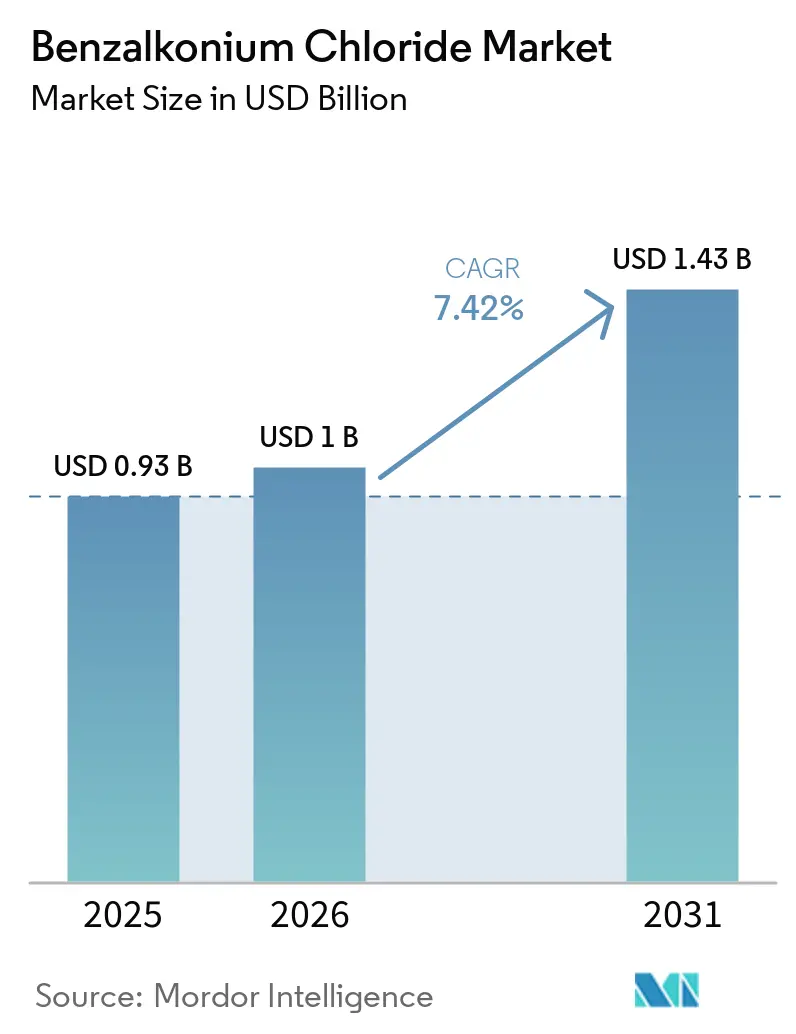
| Market Size (2026) | USD 1 Billion |
| Market Size (2031) | USD 1.43 Billion |
| Growth Rate (2026 - 2031) | 7.42 % |
| Fastest Growing Market | Asia-Pacific |
| Largest Market | North America |
| Market Concentration | Medium |
Major Players *Disclaimer: Major Players sorted in no particular order Image © Mordor Intelligence. Reuse requires attribution under CC BY 4.0. | |
Benzalkonium Chloride Market Analysis by Mordor Intelligence
Forecasts indicate the benzoalkonium chloride market, valued at USD 0.93 billion in 2025, will inch up to USD 1.00 billion in 2026, with projections reaching USD 1.43 billion by 2031, marking a CAGR of 7.42% from 2026 to 2031. Demand remains steady as healthcare facilities uphold quaternary ammonium disinfection protocols. At the same time, cosmetics formulators are leaning towards low-dose preservative systems, aligning with EU Regulation 1223/2009. While regulatory agencies tread cautiously with consumer hand-hygiene products, the FDA's 2026 Emergency Use Authorization for a veterinary wound spray reflects confidence in specific applications. Competitive strategies are increasingly focusing on pharmaceutical-grade supply agreements, which not only command a 40-60% price premium but also shield margins from fluctuations in raw material costs. As environmental policies tighten, the EPA's 2025 revision of the Aquatic Life Benchmark has set lower discharge thresholds. This shift is guiding the industry towards hybrid alcohol-quat blends, which promise reduced standalone loading.
Key Report Takeaways
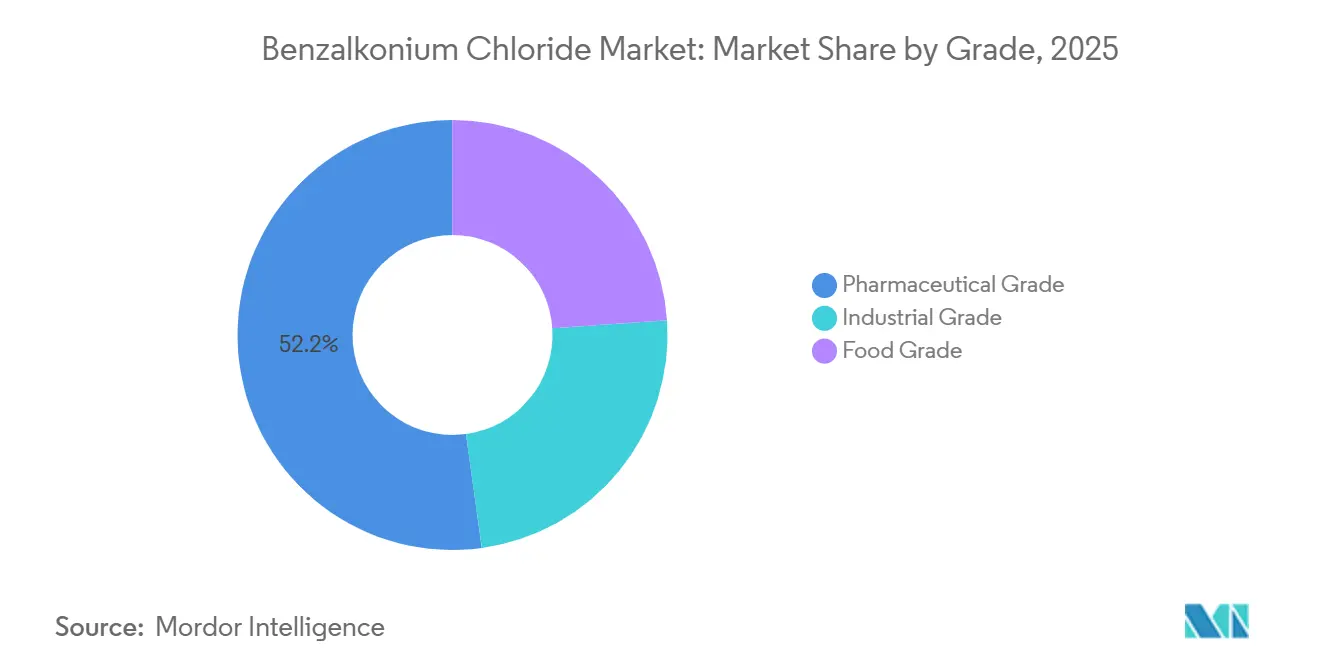
- By grade, industrial grade captured 52.17% of the benzalkonium chloride market share in 2025, while the cosmetic grade is poised to expand at a 8.32% CAGR from 2026 to 2031.
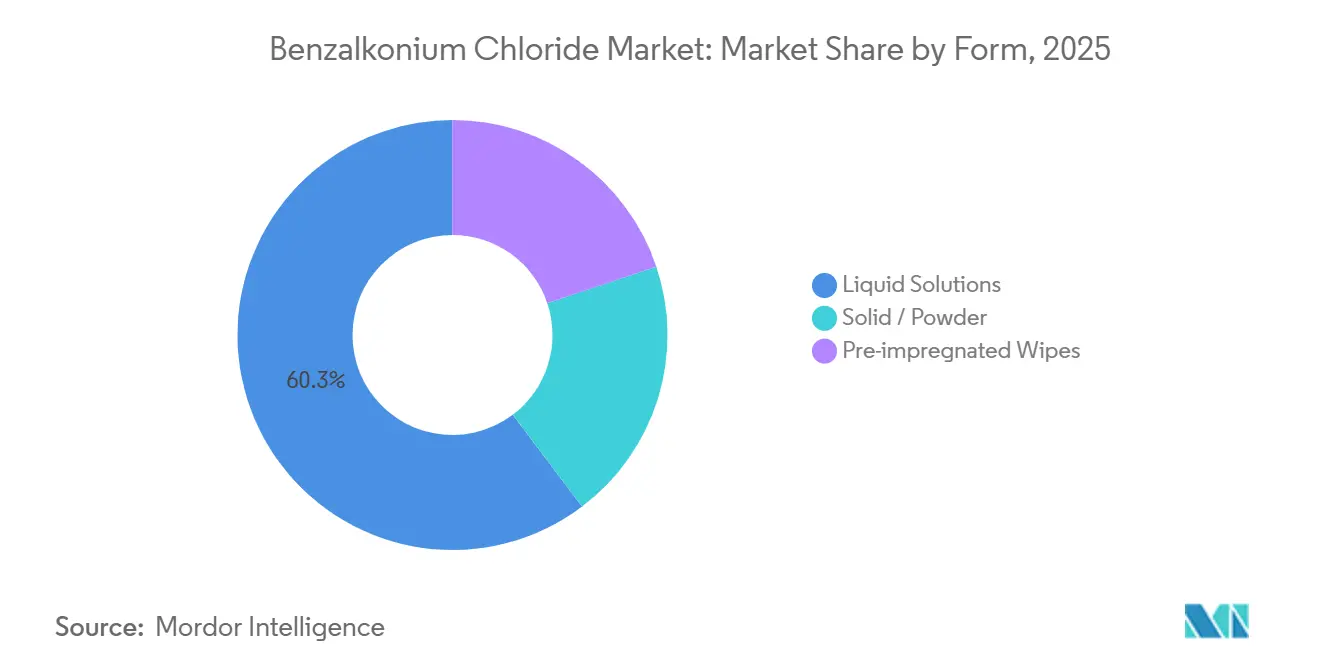
- By form, liquid solutions accounted for 60.29% share of the benzalkonium chloride market size in 2025; pre-impregnated wipes lead growth at a 8.53% CAGR from 2026 to 2031.
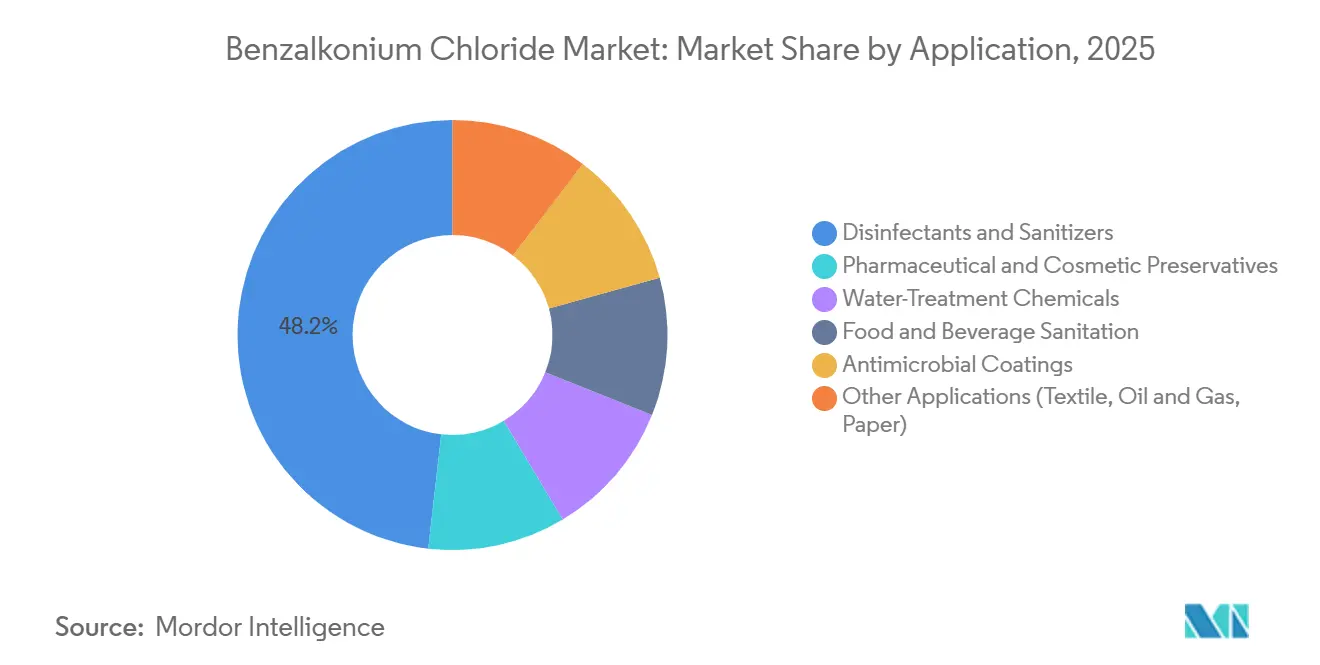
- By application, disinfectants and sanitizers led with 48.21% revenue share in 2025; pharmaceutical and cosmetic preservatives are projected to climb at an 8.41% CAGR from 2026 to 2031.
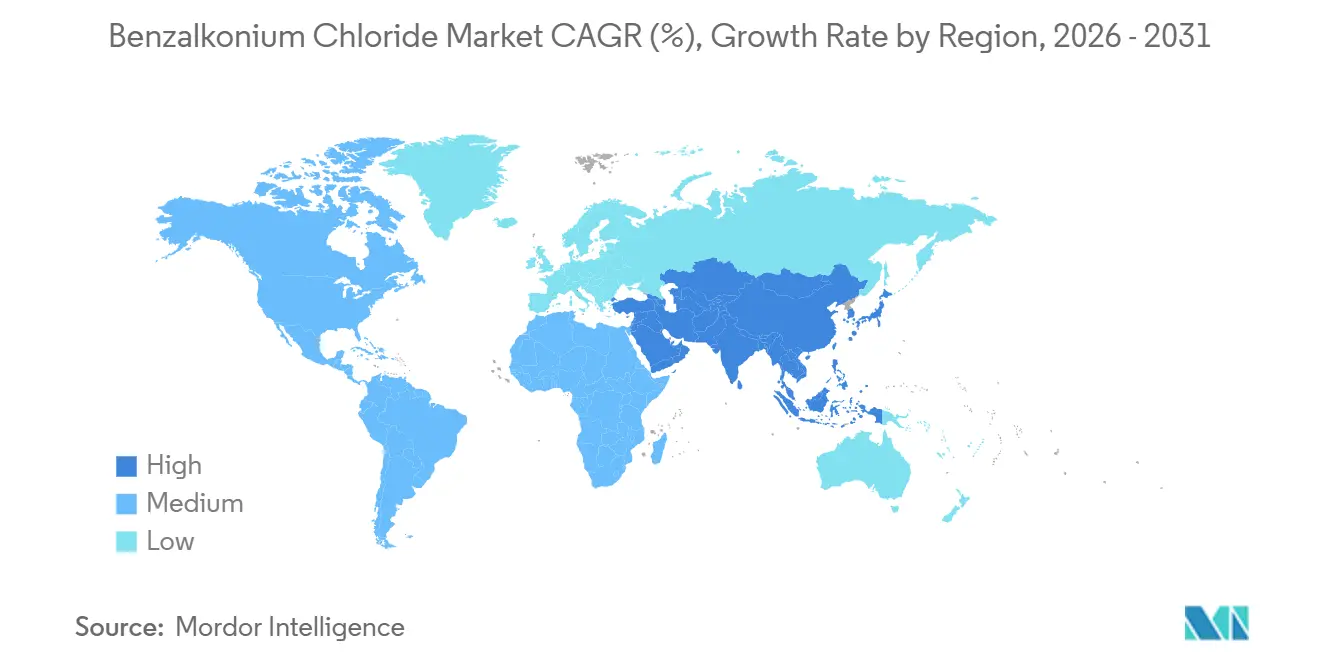
- By geography, North America held 38.44% of the benzalkonium chloride market in 2025, whereas Asia-Pacific is forecast to expand at an 8.67% CAGR from 2026 to 2031.
Note: Market size and forecast figures in this report are generated using Mordor Intelligence’s proprietary estimation framework, updated with the latest available data and insights as of January 2026.
Market Trends and Insights
Drivers Impact Analysis of Benzalkonium Chloride Market*
| Driver | (~) % Impact on CAGR Forecast | Geographic Relevance | Impact Timeline |
|---|---|---|---|
| Growing demand for surface disinfectants and hand sanitizers | +1.8% | North America, Europe, urban Asia-Pacific | Short term (≤ 2 years) |
| Expansion in pharmaceutical and personal-care preservative usage | +2.1% | North America, Europe, India | Medium term (2-4 years) |
| Growth of industrial and municipal water-treatment applications | +1.3% | China, India, ASEAN, Middle East | Medium term (2-4 years) |
| Biosecurity focus in livestock and aquaculture hygiene | +1.0% | China, Southeast Asia, Latin America | Long term (≥ 4 years) |
| Rising use of high-purity BKC in ophthalmic drug pipelines | +0.9% | North America, Europe, Japan | Long term (≥ 4 years) |
| Source: Mordor Intelligence | |||
Growing Demand for Surface Disinfectants and Hand-Sanitisers
Hospital infection-control teams are sticking to established quaternary ammonium concentrations, ensuring steady institutional volumes. This comes even as consumer brands shift toward ethanol-heavy blends, all in response to regulatory uncertainties. Pre-impregnated wipes, delivering a precise 0.1-0.2% dosing, not only eliminate dilution errors but also meet the infection-reduction standards set by accreditation bodies. Meanwhile, the EPA's tightened aquatic toxicity standards are pushing formulators to lower active concentrations. Yet, they must still achieve a swift 3-log bacterial reduction in just 30 seconds[1]. These environmental considerations weigh heavily on healthcare purchasers when they decide on multi-year tenders. As a result, suppliers are now including discharge compliance documentation in their bid packages. In this landscape, the benzoalkonium chloride market is incorporating narratives of greener chemistry, all while maintaining its efficacy standards.
Expansion in Pharmaceutical and Personal-Care Preservative Usage
Ophthalmic drugs utilize 0.001-0.01% benzoalkonium chloride to ensure microbial control without compromising corneal safety. This practice highlights the demand for benzoalkonium chloride grades with ≥99.5% purity, aligning with stringent pharmacopeial standards. In response to this demand, Novo Nordisk Pharmatech has expanded its cGMP site by 35%, emphasizing its commitment to this high-specification tier. The company highlights its ability to maintain batch-to-batch assay consistency within a tight ±0.5% margin. Meanwhile, cosmetic formulators are capitalizing on the EU's 0.1% leave-on limit[2]. This regulation allows them to streamline their formulations, moving away from complex multi-preservative combinations to a singular, dual-function surfactant-antimicrobial. This shift not only simplifies ingredient lists but also aligns with the growing trend of minimalism in cosmetics. As the industry pivots towards patient-centric drug design, suppliers offering Drug Master Files and Certificates of Suitability are building stronger ties with innovative drug developers. These regulatory dossiers, taking 18-24 months to replicate, increase switching costs and stabilize the premium segment of the benzoalkonium chloride market.
Growth of Industrial and Municipal Water-Treatment Applications
In Asia, municipal utilities are turning to benzoalkonium chloride biocides to combat biofilm issues in distribution lines, especially those with intermittent flow. In China, the 2025 standardization of veterinary labeling templates, recommending a 1:200-400 dilution, is having a ripple effect, subtly steering municipal procurement practices. These practices often align with bulk supply contracts in agriculture. Meanwhile, in the U.S., stricter EPA discharge limits are pushing plants to incorporate advanced oxidation or activated-carbon steps. This adjustment is not without its costs, leading to an 8-12% hike in operating budgets. Vendors specializing in field analytics and residue optimization are finding opportunities by reducing compliance costs. While environmental scrutiny may limit volume growth, the demand for higher technical services is increasing average selling prices in the benzoalkonium chloride market.
Biosecurity Focus in Livestock and Aquaculture Hygiene
As African swine fever looms and shrimp-pathogen surveillance intensifies, farms are increasingly turning to centralized disinfection methods. These methods rely on the stability of quaternary ammonium, especially in organic-rich environments. Following aquaculture guidelines, hatcheries are applying 500 mg/L of the disinfectant during turnarounds, effectively curbing disease incidence across cycles. The FDA's green light for a veterinary wound spray in 2026 underscores a growing regulatory acceptance of topical treatments in animal health. Yet, ecotoxicological studies sound an alarm, showing detrimental effects on fish at just 0.03 mg/L. This finding has prompted regulators to enforce stringent effluent monitoring in vulnerable water bodies. In response, suppliers are now offering bundled traceability documentation, streamlining customs clearance for farms focused on exports. This move not only accelerates the process but also strengthens customer loyalty, particularly in Latin America and Southeast Asia.
Restraints Impact Analysis of Benzalkonium Chloride Market*
| Restraint | (~) % Impact on CAGR Forecast | Geographic Relevance | Impact Timeline |
|---|---|---|---|
| Dermatological and ocular irritation concerns | −0.7% | Global, stronger in North America and EU | Short term (≤ 2 years) |
| Tightening residue and disposal regulations on quats | −0.5% | North America, EU, Japan | Medium term (2-4 years) |
| Regulatory push for alcohol-quat blends reducing standalone BKC | −0.4% | North America, Europe | Short term (≤ 2 years) |
| Source: Mordor Intelligence | |||
Dermatological and Ocular Irritation Concerns
Patch-test clinics have linked quaternary ammonium compounds to hypersensitivity episodes. In response, premium personal-care brands are pivoting to phenoxyethanol or organic acids, despite EU regulations allowing levels up to 0.1%. After studies revealed corneal-cell stress at a mere 0.00005% exposure, ophthalmologists are now favoring preservative-free drops for chronic therapies. Senju Pharmaceutical’s planned reformulation in 2025 underscores the trend: patient comfort is increasingly steering market share in high-value eye treatments. Such medical insights are shaping consumer perceptions, leading to a decline in the use of standalone benzoalkonium chloride in leave-on products. In a bid to allay concerns, suppliers are providing technical dossiers that detail impurity profiles and irritation thresholds, aiming to reassure both regulators and brand safety assessors.
Tightening Residue and Disposal Regulations on Quats
In 2025, the EPA tightened chronic toxicity benchmarks, leading U.S. wastewater facilities to shell out as much as USD 2 million on advanced tertiary treatment equipment. Meanwhile, the European Chemicals Agency, under REACH, is assessing aquatic persistence, which could result in mandatory risk-management measures, subsequently increasing compliance costs for industrial cleaning clients. Monitoring in Japan reveals municipal plants achieving a 70-85% removal rate, yet residual concentrations linger, hinting at potential future permit restrictions. Rising disposal costs are driving interest towards biodegradable quaternary ammonium alternatives. However, a dearth of efficacy data is hindering this transition. As a result, the benzoalkonium chloride market finds itself navigating regulatory challenges while also weighing the proven performance of established active ingredients.
*Our forecasts treat driver/restraint impacts as directional, not additive. The impact forecasts reflect baseline growth, mix effects, and variable interactions.
Benzalkonium Chloride Market Segment Analysis
By Grade:
Pharmaceutical Dominance Amid Cosmetic AccelerationIn 2025, pharmaceutical-grade products commanded a 52.17% share, supported by stringent purity standards of ≥99.5%, aligning with global pharmacopeia benchmarks. This segment of the benzoalkonium chloride market, typically fetching a 40-60% premium, reflects the costs associated with validated analytical controls and comprehensive regulatory dossiers. Demand for cosmetic-grade products is projected to grow at an 8.32% CAGR, outpacing all other grades. This is largely because formulators can incorporate up to 0.1% in leave-on products, enabling a single ingredient to serve dual roles as both a surfactant and a preservative.
Industrial-grade materials, primarily competing on price, experience quarterly fluctuations averaging 5%. This volatility often squeezes undifferentiated suppliers into narrow profit margins. While food-grade volumes remain modest, they enjoy stability under FDA tolerance exemptions, which permit equipment sanitation at levels ≤200 ppm. Companies like Novo Nordisk Pharmatech are making strategic moves, exemplified by their 35% capacity increase, to attract pharmaceutical clients. These clients, with switching costs exceeding 18 months, highlight the market's tilt towards established players who prioritize both production quality and regulatory compliance.

By Form:
Liquid Solutions Lead, Wipes SurgeLiquid Solutions commanded 60.29% of the benzalkonium chloride market share in 2025, benefiting from dosage flexibility across janitorial concentrates, hospital disinfectants, and industrial batch formulations. Suppliers are increasing investments in bulk storage and automated tanker loading facilities, driven by the anticipated growth of the benzalkonium chloride market for liquids. Pre-Impregnated Wipes, forecast to grow at 8.53% CAGR, capitalise on convenience and exact-dose delivery that minimises application error in critical care suites and aircraft cabins.
Solid/Powder forms cater to agricultural operators and remote mining sites that require light, transport-efficient packaging. While niche, powders exhibit resilience during supply chain disruptions because they avoid freight restrictions placed on liquid biocides. Packaging innovators are experimenting with water-soluble sachets to bridge solid-form portability with liquid-form ease of dilution, a hybrid model expected to broaden market access in developing regions.
By Application:
Disinfectants Lead, Preservatives AccelerateIn 2025, disinfectants and sanitizers accounted for 48.21% of total revenue, due to their effectiveness against both Gram-positive and Gram-negative bacteria in sectors like healthcare and food processing. Meanwhile, preservatives used in pharmaceuticals and cosmetics are projected to grow at an 8.41% CAGR, driven by advancements in ophthalmic treatments and the cosmetic industry's adoption of 0.1% low-dose systems.
Water-treatment biocides grapple with compliance costs due to tightening effluent regulations. While these costs might hinder volume growth, they present an opportunity for suppliers to boost service revenue through analytical support. Antimicrobial coatings, particularly those integrating benzoalkonium chloride with polymers, are witnessing an annual growth of 10-15%. However, the overall tonnage remains limited as the industry awaits results from long-term biocompatibility studies. In the evolving benzoalkonium chloride market, supply agreements that combine technical services with regulatory guidance allow established players to safeguard their profit margins.
Geography Analysis
North America Benzalkonium Chloride Market
In 2025, North America commanded a 38.44% share of global revenue, supported by rigorous infection-control standards and a robust pharmaceutical manufacturing landscape. Responding to the EPA’s revised aquatic benchmarks for 2025, wastewater authorities are tightening discharge permits. This shift urges formulators to reduce active concentrations while maintaining effective log-reduction performance. Steady demand, aligned with national sanitation codes, is evident in Canada’s Quebec-based pharmaceutical cluster and Mexico’s food-processing facilities.
APAC Benzalkonium Chloride Market
Asia-Pacific is driven by a surge in pharmaceutical outsourcing and proactive livestock biosecurity initiatives. In 2025, China introduced standardized veterinary dilution ratios, establishing uniform protocols that facilitate bulk procurement. Following a 2025 reformulation by Senju Pharmaceutical, Japan’s ophthalmic market is pivoting towards BAC-free alternatives. Countries like Indonesia, Thailand, and Vietnam are channeling investments into aquaculture systems, emphasizing biosecure hatchery disinfection, which in turn bolsters regional tonnage growth.
Europe Benzalkonium Chloride Market
Europe, with pharmaceutical-grade consumption predominantly led by Germany, the UK, France, and Italy, all adhering to EMA's excipient guidelines. Despite NGO advocacy for plant-based alternatives, the EU's reaffirmation of the 0.1% limit on leave-on cosmetics in 2024 has buoyed demand. While ongoing REACH evaluations hint at potential new risk-management protocols, suppliers boasting diverse preservative portfolios are proactively crafting reformulation strategies to ensure uninterrupted customer service.
Competitive Landscape
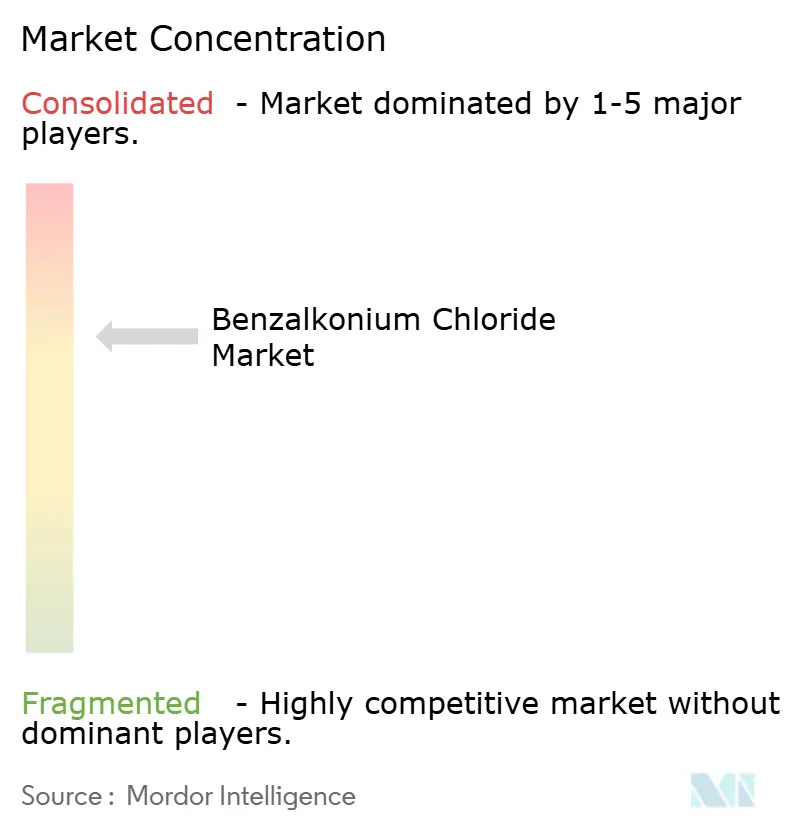
The benzoalkonium chloride market shows signs of partial consolidation. The pharmaceutical-grade segment is notably more consolidated. This is due to regulatory requirements, such as Drug Master Files and Certificates of Suitability, which can delay any supplier transition by 18-24 months, creating inherent barriers. In 2024, Actylis and Novo Nordisk Pharmatech expanded their distribution partnership to cover five Western European nations.
Industrial-grade segments experience price fluctuations averaging 5% each quarter. These swings are largely influenced by competition among major producers in East Asia. Suppliers set themselves apart by offering field support services, including dilution training, residue analytics, and discharge-compliance consulting. Such services elevate switching costs, making it harder for clients to move solely based on commodity pricing. Innovations are emerging in areas like antimicrobial coatings and controlled-release conjugates, which ensure sub-inhibitory concentrations remain effective for longer durations. Additionally, patent filings related to electrospun nanofibers and hydrogel matrices highlight a research and development pivot towards device integration.
Environmental regulations present both challenges and opportunities. The EPA's stringent benchmarks make disposal compliance a key purchasing factor. This shift benefits producers who can provide biodegradable or less toxic alternatives without sacrificing performance. While bio-based quaternary ammonium compounds, sourced from coconut or palm oil, are making their way to pilot scales, they currently come at a 20-30% premium and lack extensive clinical-efficacy documentation. As a result, market dominance will depend on a dual strategy: ensuring a cost-effective commodity supply while simultaneously introducing higher-value innovations backed by comprehensive dossiers.
Benzalkonium Chloride Industry Leaders
-
Lonza
-
Stepan Company
-
Merck KGaA
-
Dishman Carbogen Amcis Ltd
-
Novo Nordisk Pharmatech A/S
- *Disclaimer: Major Players sorted in no particular order
Benzalkonium Chloride Market Companies Covered in this Report
- Aarti Industries Ltd
- Actylis
- Alpha Chemicals
- BASF SE
- Boke Water Treatment
- Dishman Carbogen Amcis Ltd
- Evonik Industries AG
- Haihang Industry
- Hyma Synthesis Pvt Ltd
- Iwaki Seiyaku Co., Ltd
- Jinshan Jingwei Chemical
- Kao Corporation
- Lonza
- MANUS AKTTEVA BIOPHARMA LLP
- Merck KGaA
- Neogen Corporation
- Nouryon
- Novo Nordisk Pharmatech A/S
- Pilot Chemical Company
- Quat-Chem Ltd
- Solvay S.A.
- Stepan Company
- TCI Chemicals (India) Pvt Ltd
- Thomas Swan & Co. Ltd
- Thor GmbH
Recent Industry Developments in Benzalkonium Chloride Market
- March 2026: FDA issued an Emergency Use Authorization for a veterinary wound spray containing benzoalkonium chloride.
- April 2025: China’s Ministry of Agriculture standardized veterinary dilution ratios and efficacy claims for benzoalkonium chloride in livestock disinfection.
Global Benzalkonium Chloride Market Report Scope
Benzalkonium chloride (BAC) is a quaternary ammonium cationic surfactant widely used as an antimicrobial preservative in medicines (eye/nasal drops) and a disinfectant (hand sanitizers, surface cleaners). It acts by disrupting cell membranes, killing bacteria and viruses. While effective, it is a known skin/eye irritant, highly toxic to aquatic life, and can cause allergic reactions.
The market is segmented by grade, form, and application. By grade, the market is segmented into pharmaceutical grade, industrial grade, and food grade. By form, the market is segmented into liquid solutions, solid/powder, and pre-impregnated wipes. By application, the market is segmented into disinfectants and sanitizers, pharmaceutical and cosmetic preservatives, water-treatment chemicals, food and beverage sanitation, antimicrobial coatings, and other applications (including textile, oil and gas, and paper). The report also covers the market size and forecasts for Benzoalkonium Chloride in 17 countries across the world. For each segemnt market sizing and forecasts are provided in terms of value (USD).
| Pharmaceutical Grade |
| Industrial Grade |
| Food Grade |
| Liquid Solutions |
| Solid / Powder |
| Pre-impregnated Wipes |
| Disinfectants and Sanitizers |
| Pharmaceutical and Cosmetic Preservatives |
| Water-Treatment Chemicals |
| Food and Beverage Sanitation |
| Antimicrobial Coatings |
| Other Applications (Textile, Oil and Gas, Paper) |
| APAC | China |
| Japan | |
| India | |
| South Korea | |
| ASEAN Countries | |
| Rest of APAC | |
| North America | United States |
| Canada | |
| Mexico | |
| Europe | Germany |
| United Kingdom | |
| France | |
| Italy | |
| Spain | |
| Russia | |
| NORDIC Countries | |
| Rest of Europe | |
| South America | Brazil |
| Argentina | |
| Rest of South America | |
| Middle-East and Africa | Saudi Arabia |
| South Africa | |
| Rest of Middle-East and Africa |
| By Grade | Pharmaceutical Grade | |
| Industrial Grade | ||
| Food Grade | ||
| By Form | Liquid Solutions | |
| Solid / Powder | ||
| Pre-impregnated Wipes | ||
| By Application | Disinfectants and Sanitizers | |
| Pharmaceutical and Cosmetic Preservatives | ||
| Water-Treatment Chemicals | ||
| Food and Beverage Sanitation | ||
| Antimicrobial Coatings | ||
| Other Applications (Textile, Oil and Gas, Paper) | ||
| By Geography | APAC | China |
| Japan | ||
| India | ||
| South Korea | ||
| ASEAN Countries | ||
| Rest of APAC | ||
| North America | United States | |
| Canada | ||
| Mexico | ||
| Europe | Germany | |
| United Kingdom | ||
| France | ||
| Italy | ||
| Spain | ||
| Russia | ||
| NORDIC Countries | ||
| Rest of Europe | ||
| South America | Brazil | |
| Argentina | ||
| Rest of South America | ||
| Middle-East and Africa | Saudi Arabia | |
| South Africa | ||
| Rest of Middle-East and Africa | ||
Key Questions Answered in the Report
What is the current value of the benzalkonium chloride market?
The benzalkonium chloride market was valued at USD 0.93 billion in 2025.
What is the projected value of the benzoalkonium chloride market in 2031?
The market is forecast to reach USD 1.43 billion by 2031, advancing at a 7.42% CAGR from 2026 to 2031.
Which grade leads demand today?
Pharmaceutical-grade material maintained leadership with 52.17% revenue share in 2025 due to strict purity needs in drug and ophthalmic products.
Why are pre-impregnated wipes growing faster than liquid concentrates?
Wipes deliver consistent 0.1-0.2% dosing, cut dilution errors, and align with infection-control policies that favor single-use formats.
How will EPA aquatic-toxicity rules influence industrial buyers?
Lower discharge limits will push utilities and factories toward blended or lower-concentration products and elevate demand for suppliers that provide compliance consulting.