
Belgium Electric Vehicle Charging Equipment Market Size and Share
| Study Period | 2019 - 2030 |
| Forecast Data Period | 2025 - 2030 |
| Historical Data Period | 2019 - 2023 |
| Market Volume (2025) | 55.67 Thousand units |
| Market Volume (2030) | 180.47 Thousand units |
| CAGR (2025 - 2030) | 26.52% |
| Market Concentration | Low |
Major Players *Disclaimer: Major Players sorted in no particular order |
Belgium Electric Vehicle Charging Equipment Market Analysis by Mordor Intelligence
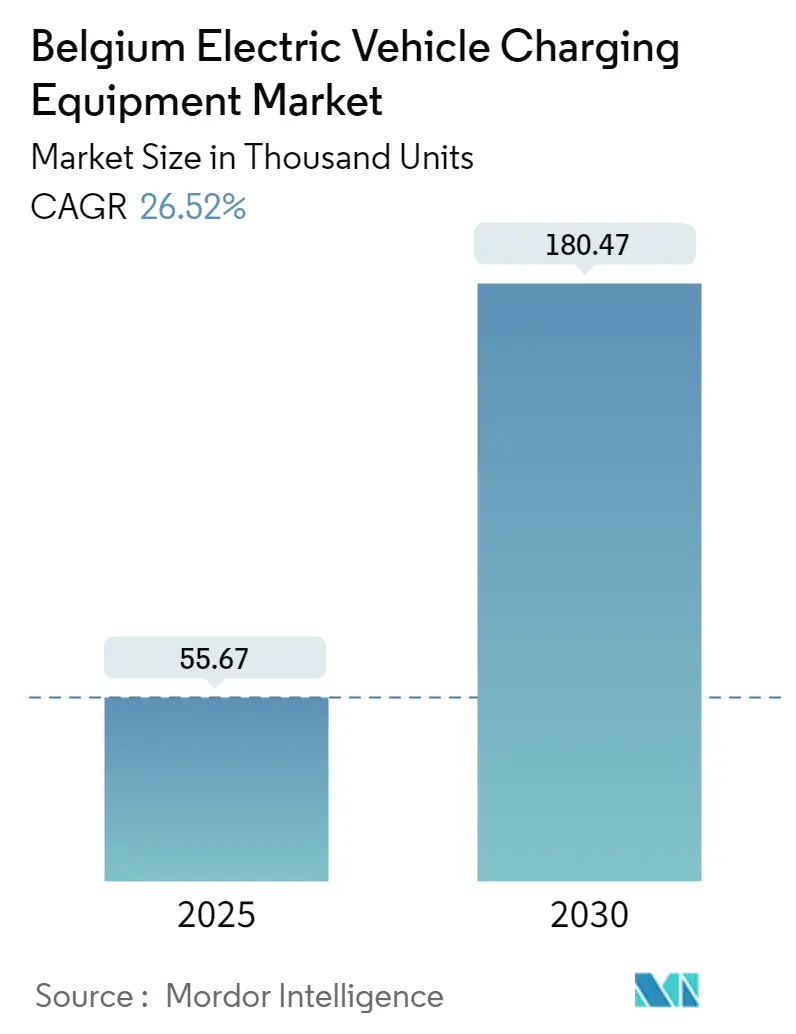
The Belgium Electric Vehicle Charging Equipment Market size is estimated at 55.67 thousand units in 2025, and is expected to reach 180.47 thousand units by 2030, at a CAGR of 26.52% during the forecast period (2025-2030).
- Over the medium term, factors such as the growing adoption of electric vehicles and the efforts to expand EV charging infrastructure supported by government initiatives are expected to drive the electric vehicle charging equipment market during the forecast period.
- On the other hand, high installation costs associated with setting up charging stations and maintenance costs are expected to hinder the market's growth during the forecast period.
- Nevertheless, the need for an expansion of fast-charging EV infrastructure and the technological advancements in EV charging Equipment are likely to create opportunities for the Belgium electric vehicle charging equipment market.
Belgium holds a defined position within a broader international distribution. The electric vehicle charging equipment market share data by Mordor Intelligence maps that allocation across all contributing countries and regions, globally.
Belgium Electric Vehicle Charging Equipment Market Trends and Insights
Public Charging Segment to Dominate the Market
- Several factors are driving significant growth in the public charging segment during the forecast period. The rising adoption of EVs in Belgium, fueled by environmental concerns and government incentives for clean transportation, is leading to a notable expansion of public charging infrastructure and related equipment. Furthermore, technological advancements, such as fast-charging capabilities and enhanced efficiency, are set to bolster this expansion.
- Data from the International Energy Agency (IEA) indicates that Belgium had approximately 44,000 publicly available charging points (both slow and fast) in 2023, marking an impressive 82% increase from about 24,100 in 2022. This growth trend, bolstered by ambitious government targets, is expected to persist. Notably, the Flemish Region aims for 100,000 charging points by 2030. Additionally, Belgium's federal government acknowledges the necessity of boosting charging points to facilitate fleet electrification.
- In March 2024, TotalEnergies marked a milestone by installing its 600th charging point in Antwerp. The energy giant, entrusted with expanding Belgium's charging network, had previously inked a concession contract with Antwerp in September 2021. TotalEnergies' inaugural five charging stations debuted in February 2022, with a strategic spread of three in Ekeren and two in Deurne. Fast forward two years, and the city boasts 600 charging points, with TotalEnergies overseeing their technical and commercial operations until 2034.
- Moreover, in September 2022, TotalEnergies clinched a deal to set up to 4,400 public charge points in West Flanders and Flemish Brabant over two years. This contract, awarded by the Flemish government and endorsed by the Department of Mobility and Public Works, mandates TotalEnergies to manage the installation and operation of these charging services. The new 22 kVA stations, branded under TotalEnergies for 12 years, will exclusively use 100% clean electricity sourced from offshore wind power in the North Sea.
- In June 2024, Dutch energy tech firm Alfen secured a lucrative contract with TEC, Belgium's public transport operator in the Walloon Region, to bolster its electric bus charging infrastructure. Operating nearly 2,500 buses and trams across 800 lines, TEC's electrification efforts will be supported by custom medium voltage walk-in substations delivered to around 50 fast charging locations across Wallonia. Alfen's Belgian branch will oversee the project, ensuring reliable electricity supply for TEC's electric bus charging systems.
- Given these developments, Belgium's public charging segment is on a trajectory of significant growth, underscored by concerted efforts to bolster its charging infrastructure.

Increasing Adoption of Electric Vehicles to Drive the Market
- As electric vehicle (EV) adoption surges in Belgium, the demand for EV charging equipment is set to rise in the coming years. Recent data from the International Energy Agency (IEA) highlights this trend: battery electric vehicle (BEV) sales jumped from approximately 38,000 units in 2022 to around 93,000 units in 2023. Additionally, plug-in electric vehicles (PEV) car sales reached about 100,000 units in 2023. This growing EV adoption signals a burgeoning need for EV charging networks, positioning Belgium as a lucrative market for EV charging equipment.
- In 2023, BEV stocks in Belgium soared to roughly 190,000 units, marking a significant 111% increase from the previous year's 90,000 units. Meanwhile, PEV car stocks climbed to about 280,000 units, reflecting a 55% uptick from 2022. Industry association EV Belgium projects that Belgium will host nearly 2 million electric vehicles by 2030, necessitating an annual addition of 20,000 to 30,000 new charging points. Such projections underscore the anticipated surge in demand for EV charging equipment.
- Belgium's government has rolled out enticing policies to bolster EV adoption. For instance, in February 2024, the Flemish government unveiled its latest EV incentives, albeit only for the year 2024. Earlier, the government hinted at extending these incentives from 2024 to 2026. After discontinuing the incentive in 2020, the Flanders region's government made a comeback announcement in September 2023, setting the scheme's application date to February 12, 2024.
- Targeting the Flanders region, which houses 60% of Belgium's populace, the government's incentive offers a maximum bonus of EUR 5,000 for new BEVs priced under EUR 40,000. Secondhand vehicles aged three to eight years can avail a EUR 3,000 bonus, contingent on the original price being below EUR 60,000. With an allocation of EUR 20 million for the scheme, concerns arise from Flanders' state council about potential challenges if the incentive doesn't align with the surging EV demand.
- On a broader scale, Belgium's federal government presents a significant 35% deduction for investments in new Battery Electric Vehicles (BEVs) and their related charging infrastructure. This open-ended incentive ensures ongoing benefits for EV stakeholders, likely amplifying the establishment of EV charging networks and bolstering the EV charging equipment market.
- In a strategic move, Volvo Car AB began relocating its Chinese-made electric vehicle production to Belgium in June 2024, anticipating EU tariffs on Chinese EVs. Beyond shifting production of its EX30 and EX90 models, Volvo is considering relocating assembly for certain models destined for the UK. This pivot in EV manufacturing towards Belgium is poised to foster a favorable environment for EV adoption and bolster the EV charging equipment market.
- In summary, with the confluence of rising EV adoption, proactive government policies, and the shifting landscape of EV manufacturing, Belgium's EV charging equipment market is set for significant growth in the coming years.

Mordor Intelligence delivers a comprehensive view of the electric vehicle charging equipment market across all major regions such as Europe, Europe, and North America, alongside country-level analysis for Italy, Sweden, Norway, Australia, South Korea, and Germany, each offering a view of the local market realities.
Competitive Landscape
Belgium electric vehicle charging equipment market is semi-fragmented. Some of the key players in the market (not in any particular order) include ABB Ltd, Tesla Inc., Wallbox Chargers, S.L., Enphase Energy, Inc. and Alfen N.V.
Belgium Electric Vehicle Charging Equipment Industry Leaders
-
ABB Ltd
-
Tesla Inc.
-
Wallbox Chargers, S.L.
-
Enphase Energy, Inc.
-
Alfen N.V.
- *Disclaimer: Major Players sorted in no particular order

Recent Industry Developments
- February 2024: Blink Charging has begun installing 11 new fast chargers in Antwerp, with the first one already operational. The company states that these 11 new 'DC' fast chargers, each boasting a capacity of 50 kW, can charge a vehicle enough for a 100 km journey in just half an hour. Additionally, these new chargers will take the place of outdated models that were installed between 2017 and 2019. This initiative is a direct response to the surging electric car ownership in Belgium, a trend that's expected to continue in the foreseeable future.
- December 2023: Shell Belgium, Carrefour, and real estate company Redevco began setting up a network of charging stations for hybrid and electric vehicles (EV) in July 2023 and the 100th of these sites were established in December 2023, and the companies aim to roll out almost 500 charging stations capable of simultaneously recharging almost 1,000 EVs by 2025. The companies are committed to accelerating the energy transition and improving the EV charging infrastructure for their customers. Charging stations have charging capacities ranging from 22 kW to 150 kW, enabling an EV. The three companies plan to continue developing the Shell Recharge network in Belgium, with plans to expand their network of EV charging stations in the Brussels region and Wallonia from the first quarter of 2024.
Belgium Electric Vehicle Charging Equipment Market Report Scope
Electric vehicle (EV) charging equipment refers to the equipment and infrastructure used to charge electric vehicles at home or in commercial and public spaces. The EV charging equipment plays a crucial role in the widespread adoption of electric vehicles in Belgium. The availability of robust EV charging infrastructure is essential for overcoming range anxiety, a primary concern for potential EV buyers. It helps in reducing carbon emissions and improving air quality.
The Belgium electric vehicle charging equipment market is segmented into Vehicle Type, Application, and Charging Type. By vehicle type, the market is segmented into battery electric vehicles (BEV), plug-in hybrid electric vehicles (PHEV), and hybrid electric vehicles (HEV). By application, the market is segmented into home charging, workplace charging, and public charging. By charging type, the market is segmented into AC charging (level 1 and level 2) and DC charging. The report offers the market size and forecasts for the market in units for all the above segments.
| Battery Electric Vehicle (BEV) |
| Plug-in Hybrid Electric Vehicle (PHEV) |
| Hybrid Electric Vehicle (HEV) |
| Home Charging |
| Workplace Charging |
| Public Charging |
| AC Charging (Level 1 and Level 2) |
| DC Charging |
| Vehicle Type | Battery Electric Vehicle (BEV) |
| Plug-in Hybrid Electric Vehicle (PHEV) | |
| Hybrid Electric Vehicle (HEV) | |
| Application | Home Charging |
| Workplace Charging | |
| Public Charging | |
| Charging Type | AC Charging (Level 1 and Level 2) |
| DC Charging |
Key Questions Answered in the Report
How big is the Belgium Electric Vehicle Charging Equipment Market?
The Belgium Electric Vehicle Charging Equipment Market size is expected to reach 55.67 thousand units in 2025 and grow at a CAGR of 26.52% to reach 180.47 thousand units by 2030.
What is the current Belgium Electric Vehicle Charging Equipment Market size?
In 2025, the Belgium Electric Vehicle Charging Equipment Market size is expected to reach 55.67 thousand units.
Who are the key players in Belgium Electric Vehicle Charging Equipment Market?
ABB Ltd, Tesla Inc., Wallbox Chargers, S.L., Enphase Energy, Inc. and Alfen N.V. are the major companies operating in the Belgium Electric Vehicle Charging Equipment Market.
What years does this Belgium Electric Vehicle Charging Equipment Market cover, and what was the market size in 2024?
In 2024, the Belgium Electric Vehicle Charging Equipment Market size was estimated at 40.91 thousand units. The report covers the Belgium Electric Vehicle Charging Equipment Market historical market size for years: 2019, 2020, 2021, 2022, 2023 and 2024. The report also forecasts the Belgium Electric Vehicle Charging Equipment Market size for years: 2025, 2026, 2027, 2028, 2029 and 2030.
Belgium Electric Vehicle Charging Equipment Market Report
Statistics for the 2025 Belgium Electric Vehicle Charging Equipment market share, size and revenue growth rate, created by Mordor Intelligence™ Industry Reports. Belgium Electric Vehicle Charging Equipment analysis includes a market forecast outlook for 2025 to 2030 and historical overview. Get a sample of this industry analysis as a free report PDF download.