
Eastern Europe Electric Vehicle Charging Equipment Market Size and Share
Market Overview
| Study Period | 2020 - 2031 |
|---|---|
| Forecast Data Period | 2026 - 2031 |
| Base Year Market Size (2025) | 9.38 Thousand units |
| Market Volume (2026) | 11.24 Thousand units |
| Market Volume (2031) | 27.77 Thousand units |
| Growth Rate (2026 - 2031) | 19.83 % |
| Market Concentration | Low |
Major Players *Disclaimer: Major Players sorted in no particular order Image © Mordor Intelligence. Reuse requires attribution under CC BY 4.0. | |
Eastern Europe Electric Vehicle Charging Equipment Market Analysis by Mordor Intelligence
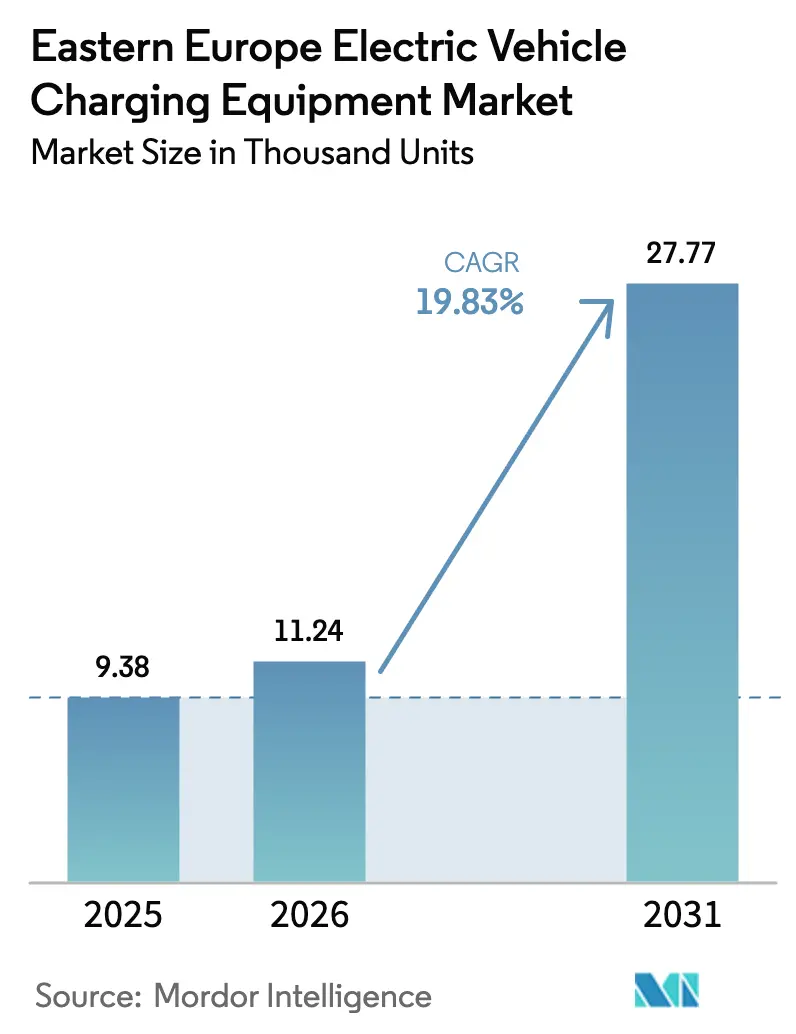
The Eastern Europe Electric Vehicle Charging Equipment Market size was valued at 9.38 Thousand units in 2025 and estimated to grow from 11.24 Thousand units in 2026 to reach 27.77 Thousand units by 2031, at a CAGR of 19.83% during the forecast period (2026-2031).
- Over the medium term, factors such as the growing adoption of electric vehicles and the efforts to Boost EV charging infrastructure supported by government initiatives are expected to drive the electric vehicle charging equipment market during the forecast period.
- On the other hand, the high installation and maintenance costs associated with setting up charging stations are expected to hinder the electric vehicle charging equipment market's growth during the forecast period.
- Nevertheless, the need for a robust EV charging network in the emerging markets and the technological advancements in EV charging Equipment are likely to offer significant opportunities for the Eastern Europe electric vehicle charging equipment market during the forecast period.
- Poland is expected to witness significant growth in the Eastern Europe electric vehicle charging equipment market during the forecast period. Owing to the increasing number of public charging points in the region.
Note: Market size and forecast figures in this report are generated using Mordor Intelligence’s proprietary estimation framework, updated with the latest available data and insights as of 2026.
South east asia operates as part of an interconnected international environment rather than as a self-contained unit. The electric vehicle charging equipment market research by Mordor Intelligence places together all major regional developments across the globe within that wider frame.
Eastern Europe Electric Vehicle Charging Equipment Market Trends and Insights
Battery Electric Vehicles Segment to Dominate the Market
- Battery electric vehicles (BEVs), commonly known as electric vehicles, utilize a sizable traction battery pack to power their electric motors. To recharge, these vehicles connect to electric vehicle supply equipment (EVSE).
- As fully electric entities, BEVs typically lack an internal combustion engine (ICE), fuel tank, or exhaust pipe, relying solely on electricity for propulsion. Their energy is sourced from a grid-recharged battery pack. Notably, BEVs are zero-emission, avoiding the harmful tailpipe emissions and air pollution associated with traditional gasoline vehicles.
- Eastern Europe's automotive landscape is undergoing a significant shift, with battery electric vehicles (BEVs) gaining traction and popularity. Driven by technological advancements, governmental backing, and heightened environmental concerns, BEVs are emerging as a viable solution to combat climate change and lessen dependence on fossil fuels.
- Data from the International Energy Agency (IEA) highlights a surge in battery electric vehicle (BEV) sales within the European Union, reaching approximately 1.6 million units in 2023, marking a 33% uptick from 2022's 1.2 million. The EU's total BEV car stock hit around 4.6 million units in 2023. Eastern European nations are making notable contributions: Poland sold about 17,000 BEVs in 2023, followed by Romania with 15,000, the Czech Republic with 6,700, and Hungary with 5,800. As BEV sales climb, the demand for charging infrastructure in Eastern Europe intensifies.
- Moreover, several regional governments are strategizing to amplify EV adoption in the years ahead. For instance, the Russian government has unveiled ambitious policies to foster the new energy electric vehicle (NEV) market and its supply chains. Central to this is a strategic blueprint aiming for NEVs to constitute 10% of total vehicle production by 2030, underscoring the government's confidence in the NEV market's potential.
- Additionally, insights from the Russian Satellite News Agency indicate that Russia's EV industry plan targets the establishment of 72,000 EV charging stations by 2030, rolled out in two phases. The initial phase aims for 9,400 stations (including 2,900 fast chargers) and an annual EV production of 25,000 units. The subsequent phase escalates the target to 72,000 stations, with 28,000 being fast chargers, signaling a burgeoning demand for EV charging equipment in Russia.
- In recent years, major Chinese automakers have eyed Europe for setting up manufacturing and assembly plants, aiming to boost sales of competitively priced cars. A case in point: BYD, the world's leading EV manufacturer, declared in 2023 its intent to establish its inaugural European EV production hub in Hungary, set to commence operations in three years.
- Hyundai Motor kicked off production of its latest KONA Electric in August 2023 at its Czech facility, Hyundai Motor Manufacturing Czech (HMMC), targeting an output of over 20,000 units in the debut year. This move aligns with Hyundai's ambition to exclusively sell zero-emission vehicles in Europe by 2035, bolstering the BEV manufacturing sector and its accompanying charging infrastructure needs.
- Given these dynamics, the BEV segment is poised to lead Eastern Europe's EV charging equipment market in the coming years.


Poland to Witness a Significant Growth
- Poland has rapidly expanded its electric vehicle (EV) charging infrastructure in recent years, mirroring the country's increasing embrace of the EV industry. For instance, the International Energy Agency (IEA) reported that by the end of 2023, Poland boasted approximately 5,900 publicly available EV charging points, comprising around 1,500 fast chargers and 4,400 slow chargers. In 2023 alone, Poland added over 400 public slow chargers and an equal number of fast chargers.
- Furthermore, projections from the Polish EV Outlook suggest that the number of publicly available EV charging points in Poland could exceed 41,900 by 2025. Such growth is poised to foster a substantial market for EV charging equipment. The Polish government's dedication to broadening the charging station network plays a pivotal role in bolstering electric vehicle adoption among both consumers and businesses.
- Poland's central location in Europe positions it as a crucial nexus for transportation, catering to both personal vehicles and commercial fleets. This geographical edge not only serves Poland's domestic market but also positions it as a transit hub for neighboring nations. With several Eastern European countries prioritizing a reduction in greenhouse gas emissions and a push for sustainable transport, Poland's leadership in EV infrastructure is set to strengthen in the foreseeable future.
- Urbanization and heightened environmental awareness among the Polish populace are fueling the demand for electric vehicles and their charging infrastructure. Major cities like Warsaw, Krakow, and Wroclaw are witnessing a notable uptick in electric vehicle numbers, underscoring the urgent need for expanded charging facilities. This urban surge aligns with national efforts to enhance air quality and diminish reliance on fossil fuels.
- Poland's robust manufacturing landscape, especially in automotive components and electronics, lays a solid groundwork for the evolution and rollout of EV charging equipment. The active involvement of both local and international entities in the EV ecosystem bolsters Poland's innovative capacity and accelerates the growth of its charging infrastructure.
- In June 2024, Eleport, a prominent player in the EV charging infrastructure domain, partnered with Carrefour, Poland's leading omnichannel network, to bolster the country's EV charging framework. Their collaboration will see the installation of 170 charging points across over 70 Carrefour-owned sites in 65 cities. This initiative not only amplifies access to sustainable transportation but also aligns with Carrefour's sustainability objectives. The partnership signifies a leap forward for Poland's EV infrastructure, catering to Carrefour's clientele and the wider community. Carrefour's vision is to provide convenient and accessible EV charging solutions, championing eco-friendly transportation.
- In February 2024, Shell made its debut in Poland's EV charging scene, launching its first fast chargers at three service stations located in Trzcianka, Sekocin Stary, and Radomsk. This initial rollout is just the beginning, as Shell plans to collaborate with the National Fund for Environmental Protection and Water Management to expand its network nationwide. With an ambitious target of 75 ultra-fast chargers, equating to 150 charging points, set for completion by the end of 2027, Shell is making strides. Customers can conveniently access these chargers via the Shell Recharge mobile app, fleet card, QR code scanning on the device, or standard payment cards. Such endeavors are poised to bolster the growth of Poland's EV charging equipment market.
- Given these developments, Poland's EV charging equipment market is on track for significant growth, paralleling the nation's increasing investments in EVs and supportive government initiatives.

Competitive Landscape
The Eastern Europe electric vehicle charging equipment market is semi-fragmented. Some of the key players in the market (not in any particular order) include ABB Ltd, Schneider Electric SE, ChargePoint Inc., GreenWay Infrastructure s.r.o., Tesla Inc., among others.
Eastern Europe Electric Vehicle Charging Equipment Industry Leaders
ABB Ltd
Schneider Electric SE
ChargePoint Inc.
Tesla Inc
GreenWay Infrastructure s.r.o.
- *Disclaimer: Major Players sorted in no particular order


Recent Industry Developments
- June 2024: Ekoenergetyka, a Polish charging infrastructure provider, has inaugurated a new production line at its headquarters in Zielona Góra. With this new line, Ekoenergetyka aims to double its production speed. The line is set to kick off by producing 50 chargers during each eight-hour shift, with projections to ramp up to 90 units by early 2025. Additionally, Ekoenergetyka has plans to further automate this production line next year, incorporating industrial robots into specific stages of the process. This new line underscores Ekoenergetyka's strategic initiative to bolster its production capacities in response to surging charger demand.
- January 2024: Orlen is ramping up its efforts to establish alternative energy infrastructure in the Czech Republic. Presently, 66 of its service stations are equipped with 267 electric vehicle (EV) charging points and two hydrogen-filling stations catering to passenger cars, buses, and trucks. The network is not only expanding its ultra-fast EV charging infrastructure but is also progressing with projects for three hydrogen filling stations located in Prague, Brno, and Ostrava. By 2030, the company envisions operating 1,800 high-speed EV charging points and 20 hydrogen filling stations.


Eastern Europe Electric Vehicle Charging Equipment Market Report Scope
- Electric vehicle (EV) charging equipment refers to the equipment and infrastructure used to charge electric vehicles at home or in commercial and public spaces. The EV charging equipment plays a crucial role in the widespread adoption of electric vehicles in the region. The availability of robust EV charging infrastructure is essential for overcoming range anxiety, a primary concern for potential EV buyers. It helps in reducing carbon emissions and improving air quality.
- The Eastern Europe electric vehicle charging equipment market is segmented into Vehicle Type, Application, Charging Type, and Geography. By Vehicle type, the market is segmented into battery electric vehicles (BEV), plug-in hybrid electric vehicles (PHEV), and Hybrid Electric Vehicle (HEV). By application type, the market is segmented into home charging, workplace charging, and public charging. By charging type, the market is segmented into AC charging (level 1 and level 2) and DC charging. The report also covers the market size and forecasts for the Eastern Europe electric vehicle charging equipment market across major countries. The report offers the market size and forecasts for the market in units for all the above segments.
| Battery Electric Vehicle (BEV) |
| Plug-in Hybrid Electric Vehicle (PHEV) |
| Hybrid Electric Vehicle (HEV) |
| Home Charging |
| Workplace Charging |
| Public Charging |
| AC Charging (Level 1 and Level 2) |
| DC Charging |
| Poland |
| Russia |
| Czech Republic |
| Hungary |
| Rest of Eastern Europe |
| Vehicle Type | Battery Electric Vehicle (BEV) |
| Plug-in Hybrid Electric Vehicle (PHEV) | |
| Hybrid Electric Vehicle (HEV) | |
| Application | Home Charging |
| Workplace Charging | |
| Public Charging | |
| Charging Type | AC Charging (Level 1 and Level 2) |
| DC Charging | |
| Geography | Poland |
| Russia | |
| Czech Republic | |
| Hungary | |
| Rest of Eastern Europe |


Key Questions Answered in the Report
How big is the Europe Electric Vehicle Charging Equipment Market?
The Europe Electric Vehicle Charging Equipment Market size is expected to reach 11.24 thousand units in 2026 and grow at a CAGR of 19.83% to reach 27.77 thousand units by 2031.
What is the current Europe Electric Vehicle Charging Equipment Market size?
In 2026, the Europe Electric Vehicle Charging Equipment Market size is expected to reach 11.24 thousand units.
Who are the key players in Europe Electric Vehicle Charging Equipment Market?
ABB Ltd, Schneider Electric SE, ChargePoint Inc., Tesla Inc and GreenWay Infrastructure s.r.o. are the major companies operating in the Europe Electric Vehicle Charging Equipment Market.
What years does this Europe Electric Vehicle Charging Equipment Market cover, and what was the market size in 2025?
In 2025, the Europe Electric Vehicle Charging Equipment Market size was estimated at 9.38 thousand units. The report covers the Europe Electric Vehicle Charging Equipment Market historical market size for years: 2019, 2020, 2021, 2022, 2023, 2024 and 2025. The report also forecasts the Europe Electric Vehicle Charging Equipment Market size for years: 2026, 2027, 2028, 2029, 2030 and 2031.
Page last updated on:





