
Baseband Unit Market Size and Share
Market Overview
| Study Period | 2020 - 2031 |
|---|---|
| Market Size (2026) | USD 22.51 Billion |
| Market Size (2031) | USD 43.11 Billion |
| Growth Rate (2026 - 2031) | 13.88 % |
| Fastest Growing Market | Asia-Pacific |
| Largest Market | Asia-Pacific |
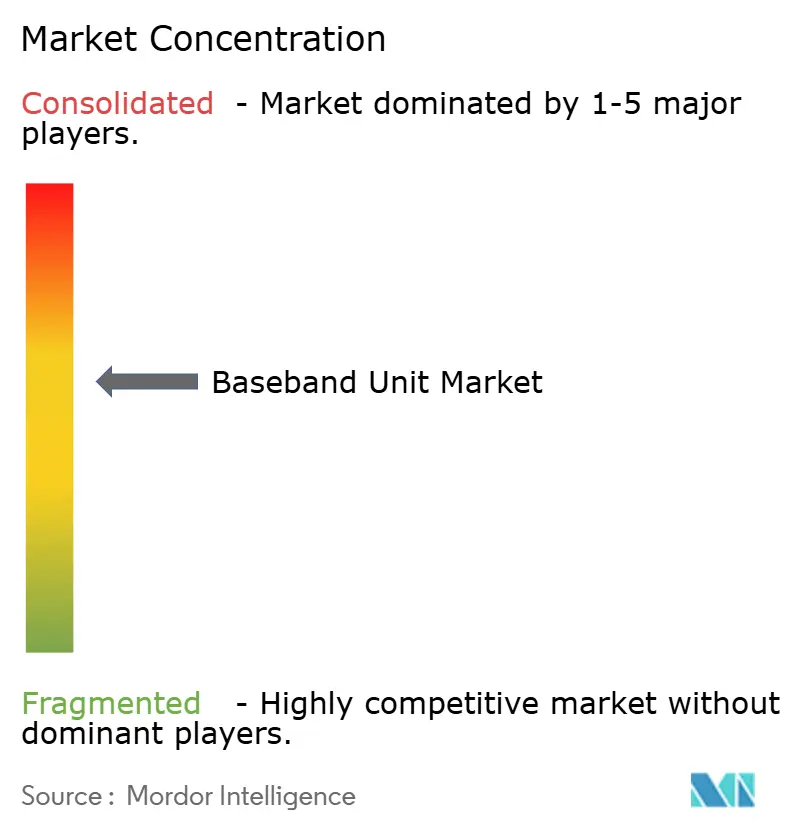
| Market Concentration | Medium |
Major Players *Disclaimer: Major Players sorted in no particular order Image © Mordor Intelligence. Reuse requires attribution under CC BY 4.0. | |
Baseband Unit Market Analysis by Mordor Intelligence
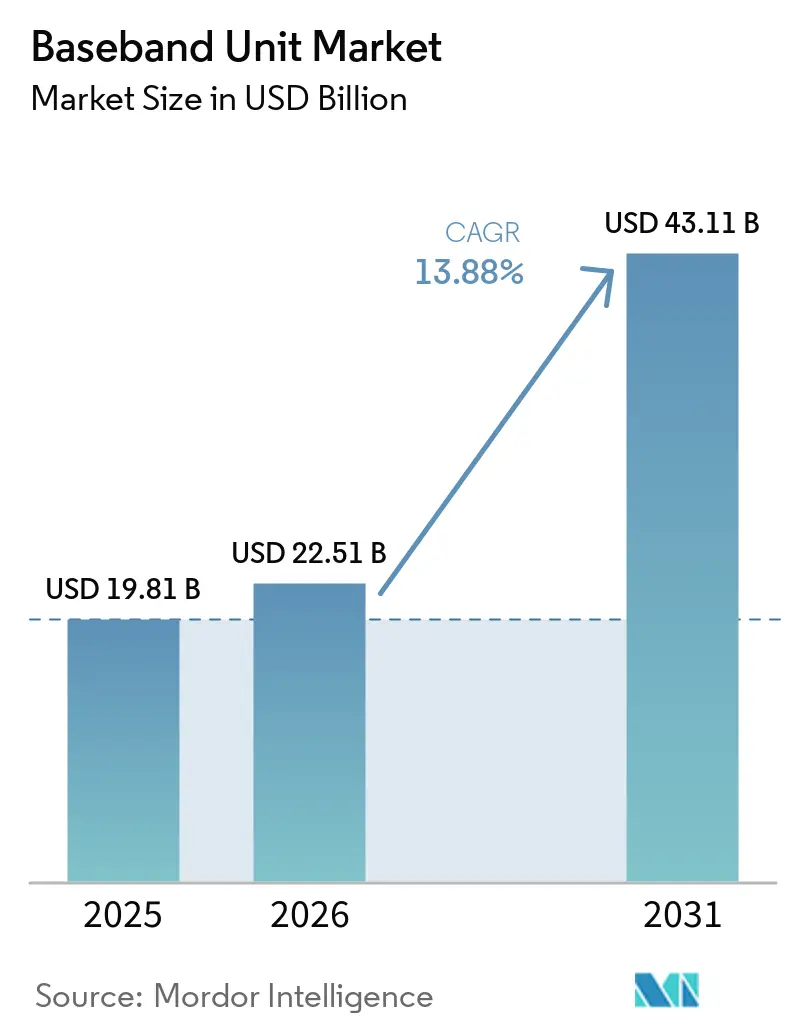
The Baseband Unit Market size is expected to grow from USD 19.81 billion in 2025 to USD 22.51 billion in 2026 and is forecast to reach USD 43.11 billion by 2031 at 13.88% CAGR over 2026-2031. The Baseband Unit Market is being shaped by the shift from non-standalone networks toward standalone 5G, which requires new core and baseband capabilities. Private 5G deployments are also driving demand beyond public network operators to factories, ports, logistics sites, and public safety settings. Hardware remains important during coverage expansion, while software and services are taking a larger role as networks become virtualized and cloud-native. Vendor strategies increasingly combine purpose-built processing, energy efficiency, software interoperability, and multi-year service contracts. These conditions create opportunities in capacity upgrades, indoor connectivity, enterprise networks, and standalone network modernization.
Key Report Takeaways
- By component, hardware held 48.76% of the Baseband Unit Market share in 2025, while software is projected to expand at a 14.77% CAGR through 2031.
- By MIMO configuration, Massive MIMO held 49.11% of revenue in 2025, while Massive Antenna Element is projected to expand at a 15.01% CAGR through 2031.
- By deployment, outdoor installations accounted for 51.22% of revenue in 2025, while indoor deployments are projected to expand at a 14.87% CAGR through 2031.
- By network architecture, standalone architecture held 39.99% of revenue in 2025, while non-standalone architecture is projected to expand at a 15.23% CAGR through 2031.
- By end user, telecom operators held 32.18% of demand in 2025, while enterprises and private networks are projected to expand at a 15.11% CAGR through 2031 in the Baseband Unit Market.
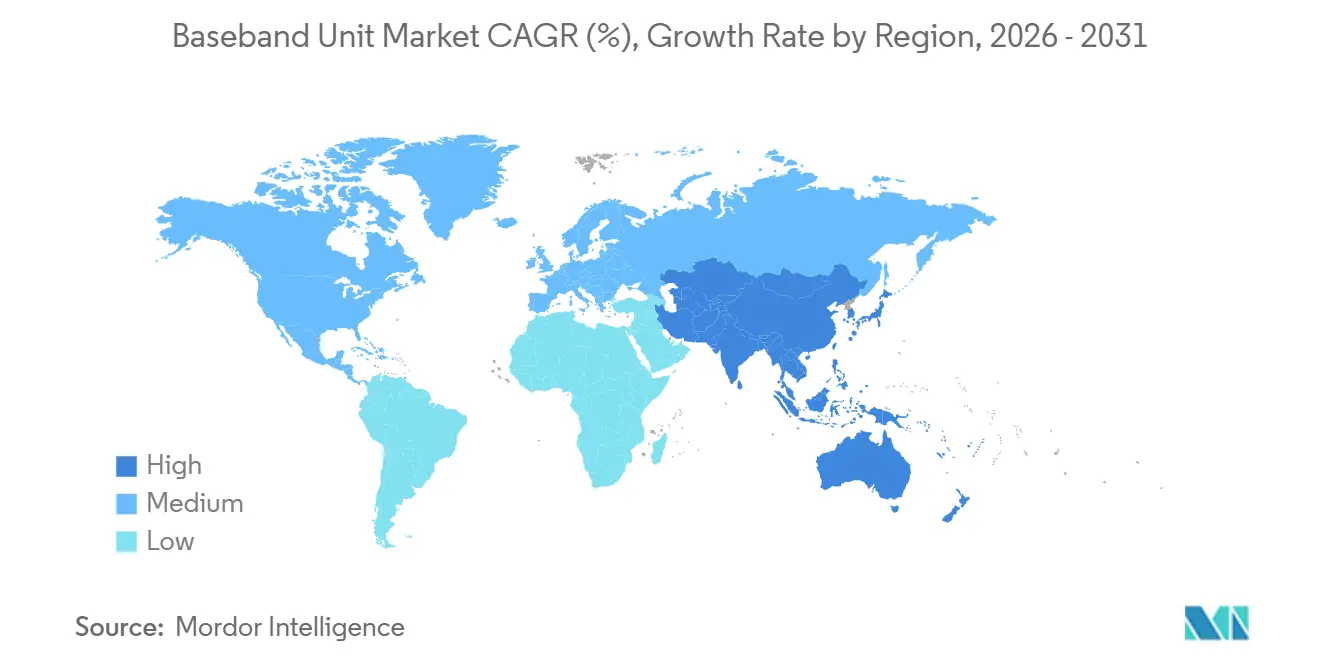
- By geography, Asia-Pacific accounted for 30.12% of revenue in 2025 and is projected to grow at a 15.87% CAGR through 2031.
Note: Market size and forecast figures in this report are generated using Mordor Intelligence’s proprietary estimation framework, updated with the latest available data and insights as of January 2026.
Global Baseband Unit Market Trends and Insights
Drivers Impact Analysis*
| DRIVER | (~) % IMPACT ON CAGR FORECAST | GEOGRAPHIC RELEVANCE | IMPACT TIMELINE |
|---|---|---|---|
| Global 5G Standalone Network Expansion | +3.2% | Global, with concentration in North America, Asia-Pacific, and the GCC | Short term (≤ 2 years) |
| Rising Demand for Network Capacity and Lower Latency | +2.8% | Global, strongest in North America, Asia-Pacific, and Europe | Medium term (2-4 years) |
| Growth of Private 5G and Industrial Networks | +2.2% | Global, led by North America, Europe, and the Asia-Pacific industrial hubs | Medium term (2-4 years) |
| Open RAN and Virtualized RAN Adoption | +1.8% | North America, Japan, and Europe | Medium term (2-4 years) |
| AI-Enabled Radio Resource Optimization | +1.4% | Global, with early concentration in North America and the Asia-Pacific | Long term (≥ 4 years) |
| Edge Computing and Cloud-Native RAN Deployment | +1.1% | North America, Europe, and the Asia-Pacific | Long term (≥ 4 years) |
| Source: Mordor Intelligence | |||
Global 5G Standalone Network Expansion
Standalone 5G deployment is a central driver for the Baseband Unit Market because it requires a 5G core and baseband functions designed for an independent 5G network. The Global Mobile Suppliers Association reported that 95 operators had launched commercial 5G standalone services by Q1 2026, a 42% increase from Q1 2025.[1]Global mobile Suppliers Association, “State of the Market Report,” Global mobile Suppliers Association, gsacom.com Standalone networks support network slicing, lower-latency services, and differentiated enterprise offerings that are difficult to deliver through legacy network arrangements. The transition often requires more than a radio upgrade because the installed baseband equipment and core integration must support the new architecture. Operators also need to maintain existing service performance while introducing standalone capabilities, which encourages phased equipment procurement. The Baseband Unit Market benefits when established coverage networks are adapted into service platforms for industrial and enterprise customers.
Rising Demand for Network Capacity and Lower Latency
Rising traffic volumes require more processing capacity at the radio access layer, supporting demand in the Baseband Unit Market. Ericsson reported that 5G accounted for 48% of global mobile data traffic at the end of 2025 and projected that share would reach 85% by 2031. The report also identified faster uplink traffic growth for some providers, linked to AI workloads, video surveillance, and industrial internet-connected sensors.[2]Ericsson, “Ericsson Mobility Report: 5G Subscriptions Top Three Billion as Uplink Gains Momentum,” Ericsson, prnewswire.com These applications require more scheduling and processing resources than conventional consumer broadband traffic does, especially when many devices transmit data simultaneously. In July 2026, NTT DOCOMO completed Japan's first commercial deployment of Ericsson's RAN Processor 6672, delivering up to 4 times higher capacity efficiency and more than 50% lower energy consumption than the earlier generation.[3]NTT DOCOMO, “DOCOMO Completes Japan's First Commercial Deployment of Ericsson's Latest High-Capacity RAN Processor 6672,” NTT DOCOMO, docomo.ne.jp The deployment shows why capacity upgrades are increasingly based on new equipment generations instead of minor software changes.
Growth of Private 5G and Industrial Networks
Private cellular deployments create a demand channel for the Baseband Unit Market that is separate from public operator spending cycles. Industrial users require dependable connectivity for automation, robotics, connected workers, visual inspection, and other data-intensive activities. In February 2026, Cargill deployed NTT DATA's private 5G network across 50 sites globally, with additional sites planned during 2026. The deployment supported robotics, automation, and connected-worker applications across manufacturing and processing facilities. Private networks need features such as dense device support, carrier aggregation, Massive MIMO, and edge integration, making their equipment requirements similar to those of advanced public networks. Enterprise customers do not have the scale advantages of national operators, which can raise equipment value per site and support more solution-led vendor offers.
Open RAN and Virtualized RAN Adoption
Adoption of Open RAN and virtualized RAN is changing how vendors address the Baseband Unit Market. Open interfaces separate selected hardware and software functions, allowing deployments to use a wider mix of processing platforms and software suppliers. Nokia's anyRAN approach supports several hardware paths, including custom basebands, commercial servers with NVIDIA graphics processing units, and AI acceleration cards. This approach can create software and service revenue even when the deployment does not use proprietary hardware. NTT DOCOMO's July 2026 deployment of Ericsson's RAN Processor 6672 complied with O-RAN Alliance specifications and supported multi-vendor interoperability. Interoperability is increasingly a procurement requirement, so suppliers must demonstrate that their platforms can work within wider, multi-vendor network designs.
Restraints Impact Analysis*
| RESTRAINT | (~) % IMPACT ON CAGR FORECAST | GEOGRAPHIC RELEVANCE | IMPACT TIMELINE |
|---|---|---|---|
| High Power Consumption and Thermal Management Requirements | -1.2% | Global, with acute impact in the Asia-Pacific dense deployments and warm-climate markets | Medium term (2-4 years) |
| Semiconductor Supply Concentration and Component Lead-Time Risk | -1% | Global, with export-control-driven severity in markets restricted from leading-edge foundries | Short term (≤ 2 years) |
| Brownfield Integration Complexity | -0.7% | Europe and North America, where incumbent 4G infrastructure density is highest | Medium term (2-4 years) |
| Geopolitical Vendor Restrictions and Supply-Chain Fragmentation | -0.8% | Global, concentrated in markets with Huawei-related restrictions in North America, Europe, and Australia | Long term (≥ 4 years) |
| Source: Mordor Intelligence | |||
High Power Consumption and Thermal Management Requirements
Power consumption and thermal management can restrain the Baseband Unit Market, especially in dense centralized-RAN deployments. Huawei documented a maximum 5G BBU power consumption of 2,000 W in centralized-RAN mode. The International Telecommunication Union identifies the liquid-cooling requirements for 5G BBU systems used in centralized RAN mode.[4]International Telecommunication Union, “Recommendation ITU-T L.1326: Requirements for Liquid Cooling and High Energy Efficiency Solutions for 5G BBU in Centralized-RAN Mode,” International Telecommunication Union, itu.int ETSI also set requirements and use cases for liquid cooling and high-energy-efficiency solutions designed for 5G BBU installations in this configuration. Warm climates and high-density indoor clusters can increase cooling costs, site infrastructure requirements, equipment installation, and operating complexity. Vendors must combine capacity improvements with lower energy consumption and cooling designs that can be deployed within each site's physical and power limits.
Semiconductor Supply Concentration and Component Lead-Time Risk
Semiconductor concentration creates supply and product roadmap risk for the Baseband Unit Market. Advanced baseband processing for Massive MIMO and AI functions relies on specialized silicon, which limits sourcing flexibility when a component supplier experiences a disruption. Export controls that restrict access to leading-edge semiconductor technology create distinct sourcing conditions for certain radio access network suppliers. Nokia's prior shift from Intel components to Broadcom and Marvell after Intel's 10-nanometer development delays showed how a silicon dependency can necessitate a lengthy product redesign. The resulting changes can affect equipment availability, engineering schedules, customer rollout plans, component qualification, and the timing of capacity additions. The risk is most immediate when operators need rapid upgrades or when vendors must validate alternative components while continuing to support systems already in the field.
*Our forecasts treat driver/restraint impacts as directional, not additive. The impact forecasts reflect baseline growth, mix effects, and variable interactions.
Segment Analysis
By Component: Software Revenue Is Increasing Alongside a Hardware-Dense Base
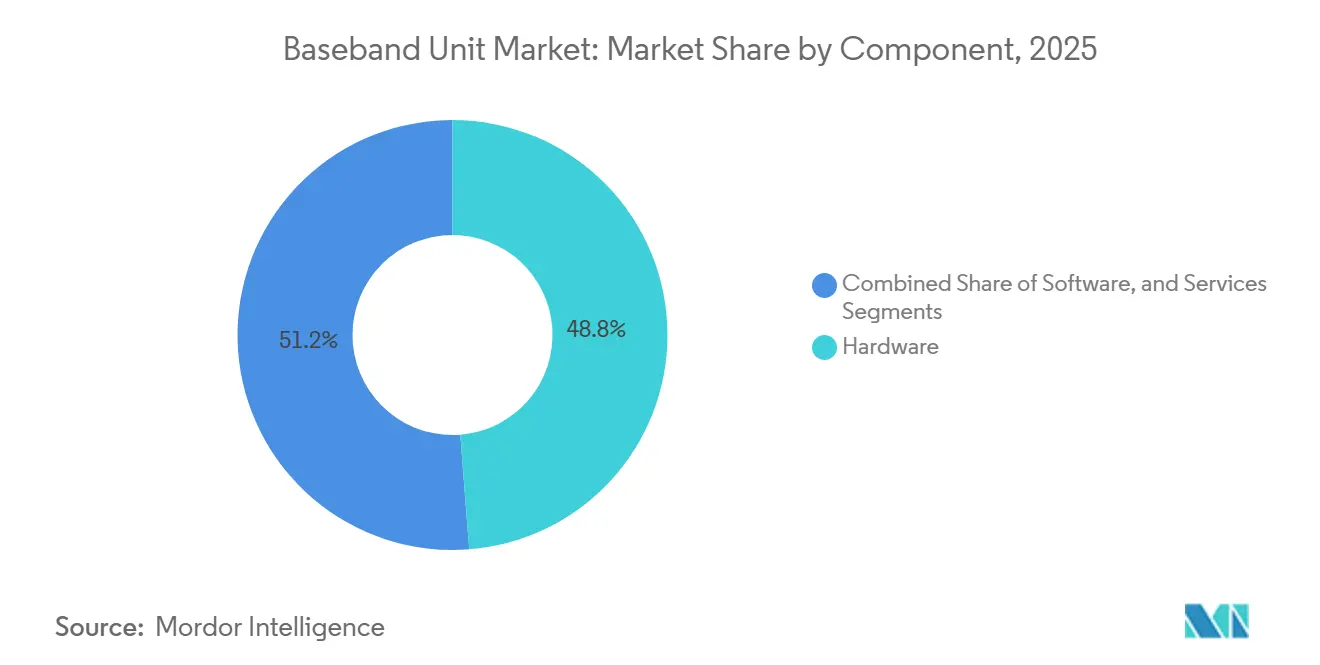
Hardware is projected to account for 48.76% of the Baseband Unit Market in 2025, reflecting the capital intensity of physical deployments during the coverage expansion phase, particularly for macro-site buildouts in Asia-Pacific and North America. Software is projected to grow at a 14.77% CAGR from 2026 to 2031 as AI-native and cloud-native RAN platforms progress from product development to commercial network deployment. Nokia is expected to launch an AI-native RAN platform in July 2026, comprising an AI-accelerated AirScale plug-in card, a GPU-powered AI-RAN node, and an anyRAN software foundation that supports 4G, 5G, and future 6G workloads. This design supports a transition from one-time equipment sales to software agreements that can remain in place across multiple network upgrade cycles. Services also represent a significant revenue stream, as enterprises often require installation, integration, lifecycle management, and operational support.
The revenue gap between hardware and software is expected to narrow during the forecast period as the Baseband Unit Market increases its adoption of virtualized functions. Ericsson’s AI in RAN software embeds AI models within baseband and radio equipment to enable real-time optimization and energy management. Samsung completed a commercial vRAN call on a Tier-1 US operator’s live network using Intel Xeon 6 hardware, demonstrating that commercial servers can support baseband compute workloads. Software licensing can therefore generate value independently of the proprietary chassis deployed at a specific site. Multi-vendor deployments also require integration and lifecycle support, increasing the role of services as network configurations become more complex.



By MIMO Configuration: Massive Antenna Element Raises Spectral Efficiency Requirements
Massive MIMO is projected to account for 49.11% of the Baseband Unit Market by configuration in 2025, supported by demand for greater spectral efficiency in dense urban areas and sub-6 GHz spectrum bands. Massive MIMO is projected to grow at a 15.01% CAGR from 2026 to 2031 as operators increase antenna counts beyond conventional 32T32R and 64T64R configurations. These systems enable higher throughput density without requiring additional spectrum purchases. Ericsson is expected to begin commercial deployment of its AIR 3255 4.5 GHz Massive MIMO radio for NTT DOCOMO in December 2025, demonstrating the commercial adoption of newer configurations. The shift toward higher antenna counts requires greater baseband processing capacity and supports demand for processors designed for matrix-intensive workloads.
Non-Massive MIMO configurations will retain relevance in rural and suburban deployments, where lower site costs are more important than maximum spectral efficiency. Operators must evaluate fronthaul and midhaul capacity, as transport constraints can prevent advanced antenna systems from achieving their designed performance. NTT DOCOMO’s RAN Processor 6672 aggregates 280 MHz of spectrum across the 3.5 GHz, 3.7 GHz, and 4.5 GHz bands and supports Massive MIMO units. The system demonstrates how the baseband platform serves as a spectrum aggregation and control layer rather than solely as a signal router. Higher radio-frequency chain counts also increase energy consumption and thermal requirements, necessitating a collective assessment of transport capacity, power availability, and cooling costs.
By Deployment: Indoor Connectivity Receives More Capital Attention
Outdoor deployment is projected to account for 51.22% of the Baseband Unit Market in 2025, consistent with spending on macro-cell densification across suburban and urban coverage areas. Indoor deployment is projected to grow at a 14.87% CAGR from 2026 to 2031 because public macro signals do not always provide reliable connectivity inside reinforced structures. Manufacturing facilities, healthcare campuses, airports, and logistics hubs require dedicated in-building connectivity to support critical activities. Cargill’s 50-site private 5G deployment supports robotics, automation, and connected-worker applications in manufacturing and processing environments. Distributed antenna systems and small-cell designs increasingly incorporate cloud-native management tools, enabling enterprises to manage indoor baseband infrastructure through established IT processes.
Industrial users require predictable latency for robotics, automated guided vehicles, and real-time quality inspection, supporting private 5G investments where Wi-Fi cannot provide the same level of operational consistency. Large campuses often require integrated indoor and outdoor coverage rather than isolated installations, creating demand for integrated equipment designs. Indoor projects may require customized baseband configurations because building materials, operational processes, traffic profiles, and required device densities vary substantially from site to site. This technical differentiation can support higher-value deployments for users that require assured performance and extended operational commitments. The Baseband Unit Market benefits from this shift because indoor customers often procure equipment, software, integration, and ongoing support as a bundled solution.
By Network Architecture: Standalone Deployment Defines the Next Capital Cycle
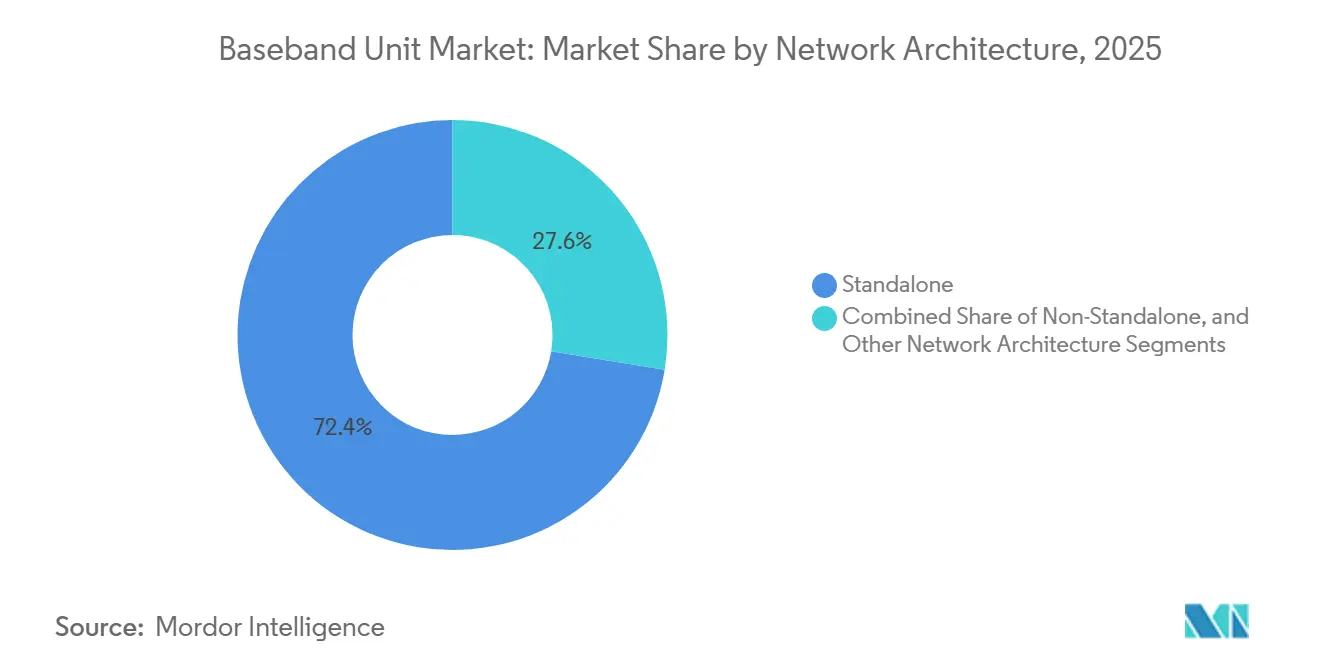
Standalone architecture is projected to account for 39.99% of the Baseband Unit Market in 2025, reflecting progress in China, North America, and the Gulf Cooperation Council. Non-standalone architecture is projected to grow at a 15.23% CAGR from 2026 to 2031, as many operators require additional capacity while preparing for a future standalone migration. The GSA is expected to report 95 commercial 5G standalone launches in Q1 2026, representing a 42% increase from Q1 2025. Standalone architecture enables a full 5G core and advanced service capabilities, such as network slicing, while non-standalone systems will continue to carry substantial traffic and support installed network demand. Other configurations, including early 6G testbeds and non-public network architectures, will remain smaller but will help suppliers establish future platform positions.
The transition from non-standalone to standalone architecture requires a 5G core rollout and compatible baseband hardware, making it more capital-intensive than a software-only upgrade. Operators are therefore expected to distribute the transition across multiple budget cycles to manage equipment replacement, core deployment, and service introduction. Ericsson is expected to become Virgin Media O2’s primary RAN partner in March 2026, when the operator’s standalone network is expected to cover 87% of the UK population. This development indicates that high coverage does not eliminate the need for investments in compatible capacity and platforms. Vendors that support both network architectures can reduce migration risk, although dual-architecture requirements increase engineering complexity for smaller suppliers.
By End User: Enterprises Are Changing the Demand Landscape
Telecom operators are projected to account for 32.18% of Baseband Unit Market demand in 2025, as public network buildouts require extensive coverage and substantial equipment volumes. Enterprises and private networks are projected to grow at a 15.11% CAGR from 2026 to 2031 as industrial, healthcare, logistics, and campus users adopt dedicated cellular infrastructure. Government and defense customers also require owned network infrastructure where spectrum policies and mission-critical requirements favor dedicated systems. Managed service providers reduce the operational burden for organizations that lack in-house radio access network teams. These factors expand the customer base beyond national and regional telecom operators.
Enterprise buyers evaluate baseband systems as operational technology investments, placing significant emphasis on total cost of ownership, integration with existing IT systems, vendor support, and service-level commitments. This approach differs from operator procurement, which focuses on network-wide capacity, coverage, and equipment standardization. Telecom operators are also entering multi-year primary-vendor agreements that reduce the number of procurement events while increasing the scope and duration of contracts. Vendors are responding by combining equipment, software, integration, and ongoing support within their commercial offerings. The Baseband Unit Market, therefore, draws demand from customers with different procurement criteria but a common need for reliable, high-capacity cellular connectivity.
Geography Analysis
Asia-Pacific is projected to hold a 30.12% share of the Baseband Unit Market in 2025 and expand at a CAGR of 15.87% during the forecast period (2026 to 2031). China’s deployment of more than 3.5 million 5G base stations by the end of 2025 is expected to support the region’s volume position. Following the initial coverage phase, the region will continue to require capital equipment for network densification and pre-commercial 5G-Advanced activities. India is expected to enter a period of rapid 5G expansion following spectrum auctions in 2024 and 2025. South Korea remains a key market for technology adoption, with its Hyper AI Network Infrastructure project testing AI-RAN and standalone 5G in industrial environments. NTT DOCOMO, SoftBank, and KDDI are expected to establish successive Ericsson RAN agreements in 2026, indicating a period of vendor consolidation in Japan.
North America and Europe have distinct yet complementary demand profiles. The United States is expected to complete nationwide standalone 5G deployments across its three Tier-1 operators, shifting near-term spending from initial coverage toward capacity densification and AI-ready upgrades. Canada and Mexico remain at earlier stages of densification and continue to develop mid-band 5G spectrum frameworks. Europe is advancing standalone 5G investment through multi-year framework agreements, including planned 2026 work involving Ericsson and Nokia with VodafoneThree and Virgin Media O2.
South America remains in a capacity-first deployment phase, with Brazil and Argentina leading regional rollouts. The region presents a longer-term opportunity as spectrum availability and network modernization budgets develop.
The Middle East and Africa have contrasting demand conditions. Gulf Cooperation Council (GCC) countries are early adopters of standalone 5G, as premium spectrum allocations and smart-city programs require high-capacity network infrastructure. Saudi Arabia’s digital infrastructure commitments and the UAE’s smart-city connectivity programs are expected to support multi-year equipment demand. Africa remains at an earlier stage of development, with South Africa and Nigeria leading deployments while much of the region continues to focus on 4G consolidation. Selective 5G investment is expected to increase as spectrum auctions and fiber backhaul programs mature. Although the Gulf is more compact than larger regional markets, high per-site demand intensity supports the Baseband Unit Market size in the region. This environment creates a high-value segment for suppliers capable of meeting performance, energy-efficiency, and service requirements.

Competitive Landscape
The Baseband Unit Market is moderately consolidated, with Huawei Technologies, Ericsson, Nokia, Samsung Electronics, and ZTE accounting for the majority of global revenue. Open RAN and virtualized RAN providers, including Mavenir, Parallel Wireless, and JMA Wireless, compete in selected market segments. Huawei’s semiconductor access constraints and ongoing export controls create opportunities for Ericsson and Nokia in markets where Huawei has historically maintained a strong position. Ericsson is expected to secure RAN agreements with NTT DOCOMO, SoftBank, and KDDI in 2026, placing all three major Japanese carriers on its custom-silicon platform. Nokia differentiates its offering through anyRAN, which supports customized AirScale basebands, commercial servers equipped with NVIDIA GPUs, and plug-in AI acceleration cards.
Competition also centers on the use of proprietary silicon versus merchant silicon combined with software. Ericsson uses AI-enabled RAN software within its baseband and radio equipment to enable real-time optimization and energy savings. NTT DOCOMO’s planned July 2026 deployment of Ericsson’s RAN Processor 6672 is expected to combine 280 MHz of spectrum with Massive MIMO and support multi-vendor interoperability. Samsung’s commercial vRAN initiatives using Intel Xeon 6 hardware demonstrate that high-performance baseband processing can operate on commercial server platforms. This approach differentiates Samsung from suppliers focused primarily on custom silicon. Suppliers without established O-RAN-compliant portfolios may face greater barriers to procurement for multi-vendor operations.
The Baseband Unit Market also reflects competition for large, multi-year framework agreements. In March 2026, Ericsson is expected to be named Virgin Media O2’s primary RAN partner under a five-year extension covering most of its UK radio network, with a focus on AI-based optimization and standalone 5G expansion. Nokia is expected to receive a separate Virgin Media O2 modernization contract for its AirScale portfolio, including modular, AI-enabled baseband platforms and Dual-Band Massive MIMO. Nokia and Ericsson are also expected to secure the VodafoneThree standalone deployment contract covering more than 10,000 sites. These contracts favor suppliers that can provide equipment, software, integration, and support throughout an extended operating period.
Baseband Unit Industry Leaders
Huawei Technologies Co., Ltd.
Ericsson AB
Nokia Corporation
Cisco Systems, Inc.
Intel Corporation
- *Disclaimer: Major Players sorted in no particular order

Recent Industry Developments
- July 2026: NTT DOCOMO completed Japan's first commercial deployment of Ericsson's RAN Processor 6672, delivering up to 4 times higher capacity efficiency and more than 50% lower energy consumption compared with the prior baseband generation. The solution uses 280 MHz of combined 3.5 GHz, 3.7 GHz, and 4.5 GHz spectrum alongside Massive MIMO units, complies with O-RAN Alliance specifications, and supports multi-vendor interoperability, advancing DOCOMO's 6G readiness.
- July 2026: Nokia launched the industry's first AI-native RAN platform, comprising an AI-accelerated AirScale plug-in card for existing basebands, a standalone GPU-powered AI-RAN node, and an anyRAN software foundation supporting 4G, 5G, and future 6G workloads on a unified platform, with commercial trials underway at T-Mobile, Indosat, and SoftBank.
- June 2026: South Korea's National Information Society Agency launched the KRW 17.2 billion (USD 11.6 million) Hyper AI Network Infrastructure project with SK Telecom and KT, piloting AI-RAN and 5G standalone architectures in industrial environments, including shipyards and manufacturing facilities, to accelerate physical AI applications.
- June 2026: TERAGO and Ericsson deployed an enterprise private 5G network at McMaster University's Manufacturing Research Institute in Canada, enabling AI-driven automation, robotics, and real-time data processing on a campus using Canadian industry-designated spectrum.


Global Baseband Unit Market Report Scope
The Baseband Unit Market Report is Segmented by Component (Hardware, Software, and Services), MIMO (Non-Massive MIMO, Massive MIMO, and Massive Antenna Element), Deployment (Indoor, Outdoor, and Other Deployments), Network Architecture (Standalone, Non-Standalone, and Other Network Architectures), End User (Telecom Operators, Enterprises and Private Networks, Government and Defense, and Managed Service Providers), and Geography (North America, South America, Europe, Asia-Pacific, and the Middle East and Africa). The Market Forecasts are Provided in Terms of Value (USD).
| Hardware |
| Software |
| Services |
| Non-Massive MIMO |
| Massive MIMO |
| Massive Antenna Element |
| Indoor |
| Outdoor |
| Other Deployments |
| Standalone |
| Non-Standalone |
| Other Network Architectures |
| Telecom Operators |
| Enterprises and Private Networks |
| Government and Defense |
| Managed Service Providers |
| North America | United States |
| Canada | |
| Mexico | |
| South America | Brazil |
| Argentina | |
| Rest of South America | |
| Europe | United Kingdom |
| Germany | |
| France | |
| Italy | |
| Spain | |
| Rest of Europe | |
| Asia-Pacific | China |
| India | |
| Japan | |
| South Korea | |
| Rest of Asia-Pacific | |
| Middle East | Saudi Arabia |
| United Arab Emirates | |
| Rest of Middle East | |
| Africa | South Africa |
| Nigeria | |
| Rest of Africa |
| By Component | Hardware | |
| Software | ||
| Services | ||
| By MIMO Configuration | Non-Massive MIMO | |
| Massive MIMO | ||
| Massive Antenna Element | ||
| By Deployment | Indoor | |
| Outdoor | ||
| Other Deployments | ||
| By Network Architecture | Standalone | |
| Non-Standalone | ||
| Other Network Architectures | ||
| By End User | Telecom Operators | |
| Enterprises and Private Networks | ||
| Government and Defense | ||
| Managed Service Providers | ||
| By Geography | North America | United States |
| Canada | ||
| Mexico | ||
| South America | Brazil | |
| Argentina | ||
| Rest of South America | ||
| Europe | United Kingdom | |
| Germany | ||
| France | ||
| Italy | ||
| Spain | ||
| Rest of Europe | ||
| Asia-Pacific | China | |
| India | ||
| Japan | ||
| South Korea | ||
| Rest of Asia-Pacific | ||
| Middle East | Saudi Arabia | |
| United Arab Emirates | ||
| Rest of Middle East | ||
| Africa | South Africa | |
| Nigeria | ||
| Rest of Africa | ||


Key Questions Answered in the Report
What is the Baseband Unit Market size?
The Baseband Unit Market is expected to increase from USD 22.5 billion in 2026 to USD 43.11 billion by 2031, at a 13.89% CAGR.
What is driving demand for baseband units?
Standalone 5G deployment, rising mobile traffic, private 5G networks, and indoor industrial connectivity are supporting equipment demand.
Which component leads baseband unit revenue?
Hardware accounted for 48.76% of revenue in 2025, while software is projected to grow at a 14.77% CAGR through 2031.
Why are private 5G networks important for baseband equipment?
Private networks support automation, robotics, and connected workers, creating demand outside public operator network expansion.
Which region leads demand for baseband units?
Asia-Pacific accounted for 30.12% of revenue in 2025 and is projected to grow at a 15.87% CAGR through 2031.
Which companies compete in baseband unit systems?
Huawei Technologies, Ericsson, Nokia, Samsung Electronics, and ZTE are the leading suppliers, with Open RAN challengers active in selected deployments.
Page last updated on:





