
Market Overview
| Study Period | 2020 - 2031 |
|---|---|
| Forecast Data Period | 2026 - 2031 |
| Base Year Market Size (2025) | USD 4.26 Billion |
| Market Size (2026) | USD 4.56 Billion |
| Market Size (2031) | USD 6.42 Billion |
| Growth Rate (2026 - 2031) | 7.08 % |
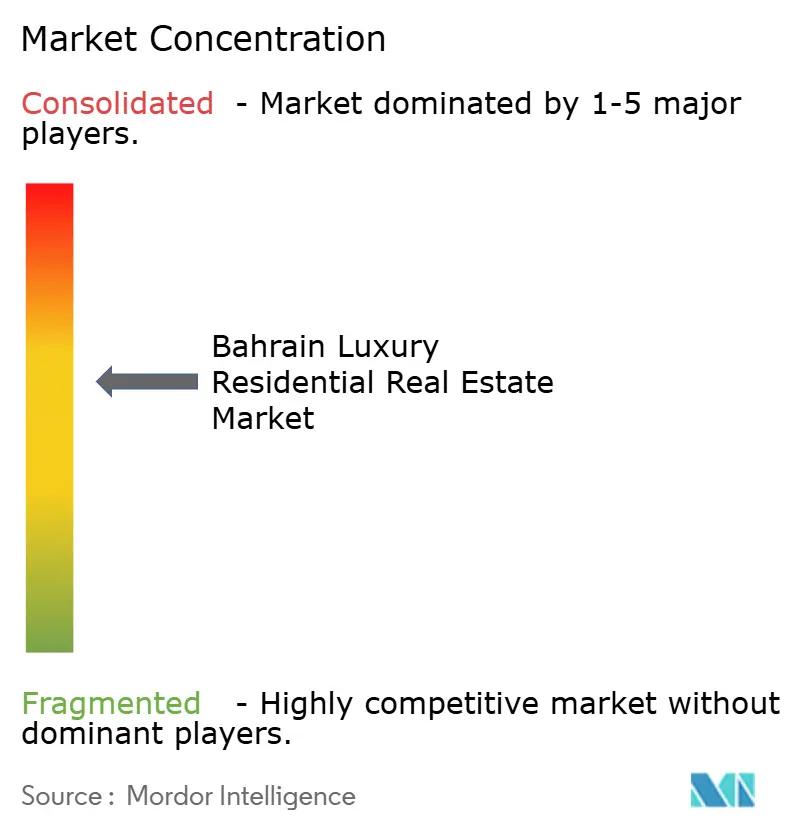
| Market Concentration | Medium |
Major Players *Disclaimer: Major Players sorted in no particular order Image © Mordor Intelligence. Reuse requires attribution under CC BY 4.0. | |
Bahrain Luxury Residential Real Estate Market Analysis by Mordor Intelligence
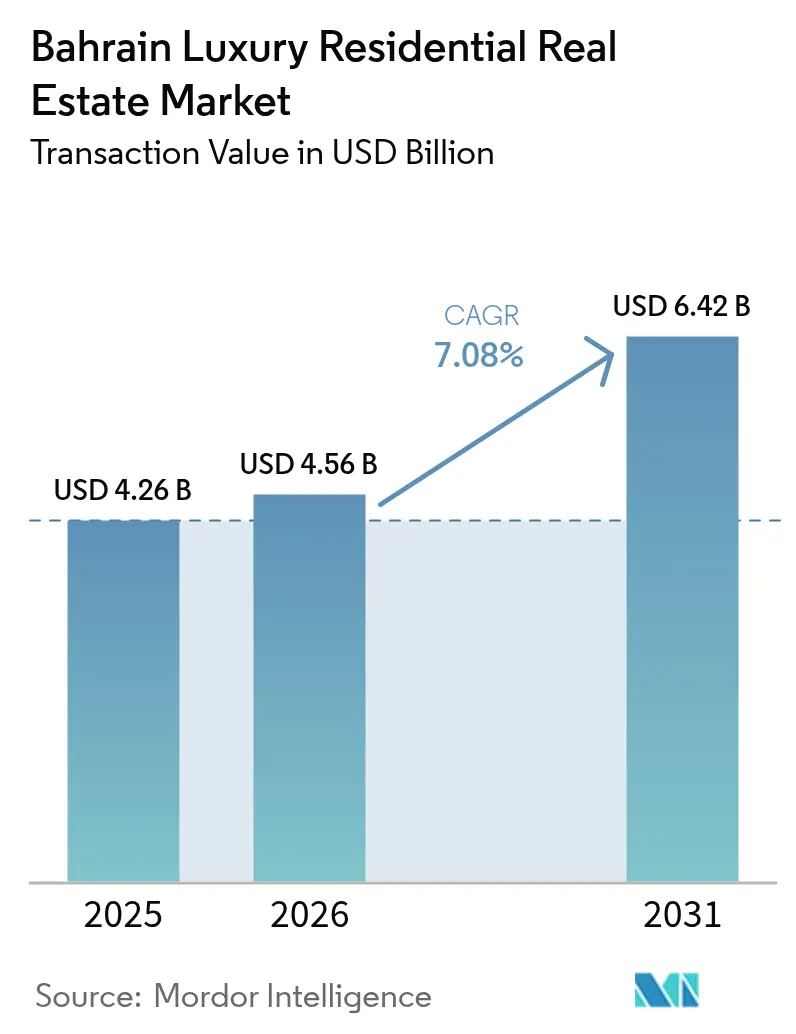
The Bahrain luxury residential real estate market size was valued at USD 4.26 billion in 2025 and estimated to grow from USD 4.56 billion in 2026 to reach USD 6.42 billion by 2031, at a CAGR of 7.08% during the forecast period (2026-2031). Rising cross-border wealth inflows, 100% foreign-ownership reforms, and a USD 30 billion national infrastructure pipeline are expanding the addressable premium-property pool and helping the Bahrain luxury residential real estate market capture investors who previously focused on neighboring hubs. Development activity now concentrates on large waterfront master plans, while banking-sector credit growth and falling borrowing costs underpin a steady pipeline of new projects. At the same time, tighter AML/KYC rules and climate-related insurance costs inject short-term friction, prompting buyers to favor reputable developers with strong compliance records. Overall, the market’s maturation is reshaping pricing power, supply strategies, and competitive positioning across districts.
Key Report Takeaways
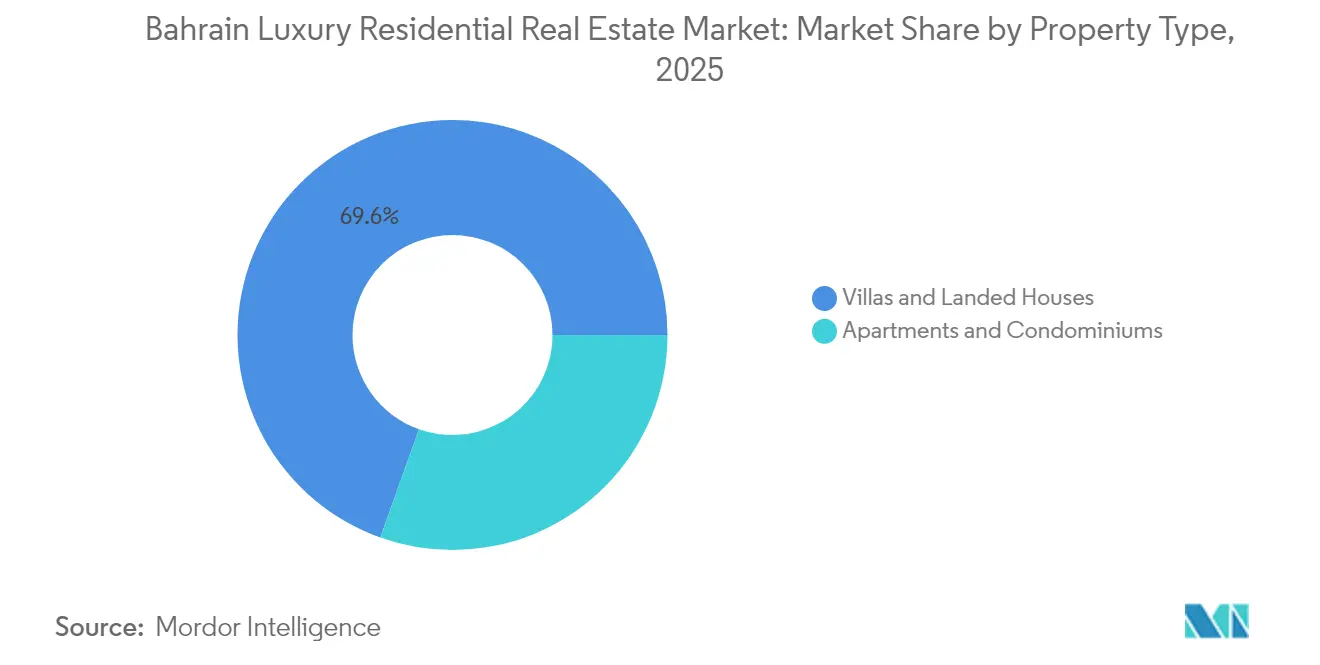
- By property type, villas and landed houses led with 69.55% of the Bahrain luxury residential real estate market share in 2025. The Bahrain luxury residential real estate market for apartments and condominiums is projected to post a 7.65% CAGR between 2026-2031.
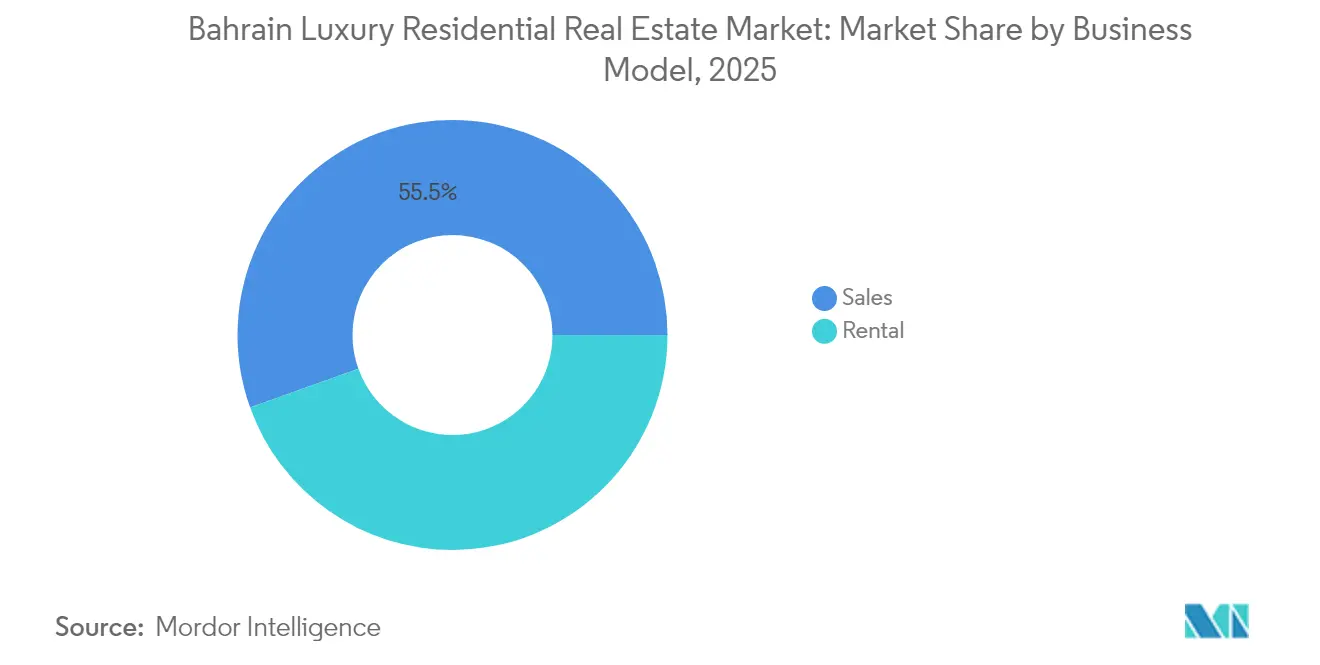
- By business model, the sales segment commanded 55.48% of the Bahrain luxury residential real estate market size in 2025. The Bahrain luxury residential real estate market for rentals is set to expand at 8.21% CAGR between 2026-2031.
- By mode of sale, secondary resale transactions captured 62.45% share of the Bahrain luxury residential real estate market size in 2025. The Bahrain luxury residential real estate market for primary new-build sales is growing at an 7.78% CAGR between 2026-2031.
- By geography, Manama accounted for 31.10% of the Bahrain luxury residential real estate market share in 2025. The Bahrain luxury residential real estate market for the Northern Governorate is projected to register the fastest 8.43% CAGR between 2026-2031.
Note: Market size and forecast figures in this report are generated using Mordor Intelligence’s proprietary estimation framework, updated with the latest available data and insights as of 2026.
Bahrain Luxury Residential Real Estate Market Trends and Insights
Drivers Impact Analysis*
| Driver | ( ~ ) % Impact on CAGR Forecast | Geographic Relevance | Impact Timeline |
|---|---|---|---|
| Rising GCC & local HNWI population and wealth creation | +1.8% | GCC-wide, concentrated in Manama and Muharraq | Medium term (2-4 years) |
| 100% foreign-ownership reforms & Golden-Visa initiatives | +1.5% | National, strongest in waterfront districts | Short term (≤ 2 years) |
| Mega waterfront master-plans unlocking premium inventory | +1.2% | Manama, Muharraq, Northern Governorate | Long term (≥ 4 years) |
| Bahrain Metro & King Hamad Causeway boosting connectivity | +0.9% | Manama to Northern Governorate corridor | Medium term (2-4 years) |
| Emergence of branded-residence projects raises price ceiling | +0.7% | Premium districts, Bahrain Bay, Juffair | Medium term (2-4 years) |
| Blockchain-enabled real-estate tokenization is widening investor pool | +0.4% | National, early adoption in luxury segments | Long term (≥ 4 years) |
| Source: Mordor Intelligence | |||
Rising GCC & Local HNWI Population Driving Premium Demand
The Middle East added 2.7% more high-net-worth individuals in 2024, and nearly 10% of them now control wealth above USD 100 million, expanding the regional buyer pool for trophy homes in Bahrain. Record inward migration of 6,700 millionaires to the UAE during 2024 triggered a spill-over effect, pushing fresh capital into nearby markets that offer geographic and regulatory diversification. Capgemini’s 2024 World Wealth Report shows 65% of HNWIs intend to raise allocations to private equity and alternative assets, a trend that directs new money toward yield-bearing luxury residences. Buyers with multigenerational wealth focus on location, privacy, and long-term value rather than price, helping waterfront villas in Bahrain Bay achieve pre-sales exceeding 80% before ground-breaking. This steady inflow of affluent households keeps premium asking prices firm, even when mid-tier segments feel rate pressure, and supports a positive outlook for the Bahrain luxury residential real estate market.
100% Foreign-Ownership Reforms Eliminating Investment Barriers
Legislation that allows 100% foreign ownership of real estate, coupled with a Golden Visa available for property investments of USD 530,000 or more, removes historic shareholding restrictions and opens Bahrain to truly global capital. The Economic Development Board calculates that operating costs are 27% lower than in rival GCC financial hubs, adding an extra incentive for overseas buyers seeking both a home and a regional business base[1]Bahrain Economic Development Board, “Cost of Doing Business in Bahrain,” edb.gov.bh. Timed alongside tighter wealth taxes in older offshore centers, the reform positions Bahrain as a safe, cost-efficient domicile for family offices looking to relocate. Early evidence shows rising enquiries from European and Asian investors who previously overlooked the Kingdom due to joint-venture requirements. As confidence builds around the new rule set, developers report faster absorption of premium waterfront launches, reinforcing near-term price resilience in the Bahrain luxury residential real estate market.
Mega Waterfront Master-Plans Creating Premium Inventory
Projects such as Bahrain Bay and Diyar Al Muharraq integrate residential towers, retail promenades, and five-star hotels, enabling developers to charge 20-30% premiums versus comparable inland sites. These master plans answer modern buyer preferences for gated security, walkable amenities, and mixed-use convenience that single-plot villas rarely provide. Waterfront scarcity further underpins pricing, since only a limited coastline meets zoning and environmental standards for high-density luxury builds[2]Middle East Institute, “Climate Risk and Coastal Development in the GCC,” mei.edu . Climate-adapted design, including elevated podiums and flood-resistant utilities, is now a selling point that attracts ESG-focused investors. Together, these large-scale schemes broaden Bahrain’s luxury supply while sustaining high values for the best-located plots.
Infrastructure Connectivity Expanding Accessible Premium Locations
Phase 1 of the USD 2 billion Bahrain Metro will add 29 kilometers of track and 20 stations, slashing travel times between the Northern Governorate and Manama’s financial center. In parallel, the USD 3.5 billion King Hamad Causeway will improve road access to Saudi Arabia, enlarging Bahrain’s commuter and investor catchment area. Better connectivity lets developers market larger waterfront homes at price points below core-district levels, stimulating an 8.85% CAGR forecast for Northern Governorate luxury sales. Walkability and reduced car dependence also resonate with younger expatriates who value sustainable mobility. These transit upgrades, therefore, extend the prime map and lift long-term demand across multiple districts.
Restraints Impact Analysis*
| Restraint | ( ~ ) % Impact on CAGR Forecast | Geographic Relevance | Impact Timeline |
|---|---|---|---|
| Sticky high mortgage rates & tighter bank lending | -0.8% | National, affecting mid-tier luxury segments | Short term (≤ 2 years) |
| Demand–supply mismatch in secondary districts | -0.6% | Secondary districts outside Manama core | Medium term (2-4 years) |
| Rising coastal-risk insurance premia on waterfront assets | -0.4% | Waterfront developments, Northern coastline | Long term (≥ 4 years) |
| Enhanced AML/KYC scrutiny limiting anonymous offshore capital | -0.3% | National, concentrated in ultra-luxury segments | Short term (≤ 2 years) |
| Source: Mordor Intelligence | |||
Mortgage Rate Volatility Constraining Financing-Dependent Buyers
Although headline borrowing costs are easing, lenders still price risk conservatively, leaving many mid-tier luxury buyers exposed to rate swings that complicate budgeting for USD 1-3 million homes. Stricter underwriting standards lengthen approval cycles, which frustrate time-sensitive purchases and occasionally lead to deal cancellations. Consolidation in GCC banking reduces the number of competitors willing to negotiate bespoke mortgage terms. Cash-rich investors remain active, but financing headwinds temporarily dampen momentum in segments where leverage often covers 60-70% of the ticket size. Developers respond with staged payment plans to bridge the gap, yet overall absorption in rate-sensitive brackets stays uneven.
Enhanced AML/KYC Compliance Extending Transaction Timelines
Regional regulators have tightened anti-money-laundering checks, pushing closing periods for cross-border deals from roughly 45 days to as much as 90 days, especially when offshore entities or crypto funds are involved. Mandatory disclosure of beneficial ownership deters buyers who value anonymity, diverting some ultra-luxury demand to other jurisdictions. Developers equipped with robust compliance teams can still process high-value deals efficiently, whereas smaller firms struggle with document backlogs. Bahrain’s OneID digital identity program will streamline future verification steps, yet temporary friction persists. Over time, stricter rules should enhance market credibility, but in the short run, they act as a speed bump for the uppermost price tiers of the Bahrain luxury residential real estate market.
*Our forecasts treat driver/restraint impacts as directional, not additive. The impact forecasts reflect baseline growth, mix effects, and variable interactions.
Segment Analysis
By Property Type: Villas Retain Primacy but Apartments Accelerate
Villas and landed houses captured 69.55% of the Bahrain luxury residential real estate market share in 2025, reflecting entrenched cultural preferences for privacy, multigenerational layouts, and outdoor space. Traditional buyers, especially GCC family offices, continue to view villa plots as a safe-haven asset that can appreciate alongside land scarcity in Manama’s core districts. Several waterfront villa clusters inside Diyar Al Muharraq recorded pre-sales above 80% in 2024, underscoring the depth of demand for large detached residences.Apartments and condominiums post the fastest 7.65% CAGR forecast through 2031, mirroring demographic shifts toward younger HNWIs, expatriate executives, and international professionals who prioritize turnkey convenience. Projects such as the 186-unit Kempinski Residences at Bahrain Harbor weave hotel-style services with branded privacy, drawing investors willing to pay premium rates for managed yields. Developers now add townhouse-style duplexes, private elevators, and rooftop terraces to high-rise offerings, thus narrowing perceived lifestyle gaps between villas and vertical living. This evolution positions the apartment segment as a viable upmarket alternative, especially where villa land is scarce or prohibitively.



By Business Model: Ownership Dominates but Rentals Gain Traction
A 55.48% share of the Bahrain luxury residential real estate market size still lies in outright sales, as legacy investors regard freehold title as both a status symbol and a hedge against regional currency fluctuations. Large family offices prefer completing block purchases in early construction phases, locking in custom specifications and transferring units across generations. The longevity of freehold demand should sustain primary revenues for integrated developers such as Eagle Hills, which often bundle marina berths or club memberships to reinforce premium positioning.Rental-oriented strategies, however, show an 8.21% CAGR through 2031, reflecting an emerging yield play by global HNWIs who aim to balance portfolio risk. Corporate tenancy demand rises as Bahrain strengthens its role as a financial-services bridge between Saudi Arabia and the wider MENA region, pushing expatriate executives toward fully serviced residences. The dual-hotel agreement signed by Indian Hotels Company to open Taj properties in Hamala and Seef will add branded inventory that can be flexibly leased, illustrating how hotel brands import hospitality skill sets into the Bahrain luxury residential real estate market. Forward-looking landlords now structure medium-term serviced-apartment leases that track corporate assignment cycles, producing steady cash flows that rival global real-estate investment trusts.
By Mode of Sale: Secondary Resale Prevails but Primary Sales Accelerate
Secondary transactions represented 62.45% of market turnover in 2025, buoyed by ready-for-occupancy inventory around Seef, Juffair, and older Manama precincts. Cash buyers favor properties with proven rental histories, especially those aligned with diplomatic enclaves and Grade-A offices that ensure constant expatriate occupancy. Resellers also capitalize on the liquidity premium afforded by transparent title records and mature community infrastructure.Primary new-build deals, projected to expand at 7.78% CAGR through 2031, reflect developer-led land-bank consolidation and disciplined phased releases. Onyx SkyView’s recent sell-out of two penthouse floors ahead of ground-breaking signals revived confidence in off-plan purchasing for technologically advanced green buildings. Many new schemes integrate smart-home systems, LEED or BREEAM certifications, and blockchain-enabled fractional ownership, which collectively widen the Bahrain luxury residential real estate market investor pool. Government net-zero goals and buyer awareness of operating-cost differentials are nudging demand toward these contemporary green developments.
Geography Analysis
Manama maintained a 31.10% share of premium transactions in 2025 because its Seef, Diplomatic Area, and Bahrain Bay sub-markets bundle financial-district access with high-end retail, dining, and marina infrastructure. Occupancy levels in flagship towers such as Harbor Heights remain above 90%, reflecting sustained demand from bankers, consultants, and multinational executives. The sales cycle is typically shorter in Manama than in outlying districts because buyers can benchmark pricing across multiple mature comparable markets.
Northern Governorate is the fastest-growing luxury corridor, clocking an 8.43% CAGR forecast through 2031. Master-planned waterfront projects such as Water Garden City appeal to cross-border Saudi professionals who commute via the King Hamad Causeway, scheduled for phased opening before 2030. Developers exploit lower land-acquisition costs to offer larger footprints and private beachfronts at price points 15-20% below central Manama, while the upcoming metro stations anchor future resale values.
Muharraq and Juffair continue to attract distinct buyer profiles. The culturally rich Muharraq Island positions luxury villas alongside UNESCO-listed heritage zones, combining lifestyle authenticity with yacht access via the expanded marinas. Juffair, located adjacent to the US Naval Support Activity base and major embassies, draws high-income expatriates who prioritize short commutes to international schools and retail malls. Both districts enjoy resilient rental streams that encourage investors seeking predictable yields within the Bahrain luxury residential real estate market.
Regulatory Landscape
Bahrain's luxury residential real estate activity is regulated primarily by the Real Estate Regulatory Authority (RERA) under Law No. 27 of 2017, covering licensing of brokers, sales agents, property managers, developers, and related professionals through government eServices. For off-plan sales, developers are required to use project guarantee (escrow) accounts, making compliance capability and banking alignment a gating factor for premium launches and cross-border closings.
At the built-environment level, zoning and construction rules are shaped by the Ministry of Housing and Urban Planning and related planning decisions, including Decision No. 93 of 2023, which sets construction regulations for various areas in Bahrain. In July 2026, the Ministry highlighted the impact of Decision No. 899 of 2024, which adjusts regulatory requirements for housing projects to enable expanded building area allowances and the regularization of certain prior construction modifications, influencing redevelopment and upgrade pathways across established communities and new master-planned districts.
Value Chain Analysis
The Bahrain luxury residential value chain starts with land identification and assembly (often in waterfront master plans), followed by master planning and zoning approvals, design and engineering, and then procurement and construction delivered through main contractors and specialist MEP and fit-out providers. Developers typically drive go-to-market through a mix of direct sales teams, broker networks licensed by RERA, and brand partners where projects are positioned as serviced or branded residences; financing and settlement are anchored by off-plan escrow requirements and mortgage underwriting, while registration and title transfer are completed via the Survey and Land Registration Bureau (SLRB).
Downstream, handover, facilities management, and common-area operations are becoming more formalized, raising the importance of professional property management and owners-association governance for luxury towers and gated waterfront communities. Infrastructure readiness is a key interdependency: the Urban Planning and Development Authority (UPDA) introduced mechanisms that require subdivision plans to have fully developed infrastructure before plots can be sold or developed, reducing late-stage bottlenecks but increasing upfront coordination between landowners, utilities, and developers. Branded and hospitality-linked models also deepen the chain by adding hotel operators and service contractors into operating-stage delivery, as seen in recent beachfront launches tied to international hospitality services.
Competitive Landscape
Competition remains moderate but intensifying as top developers assemble land banks and integrate construction, sales, and property-management functions. Diyar Al Muharraq recently consolidated two adjacent plots to create a contiguous 12 million sq ft waterfront canvas, enhancing economies of scale in utilities, landscaping, and security provisioning. Eagle Hills, for its part, partnered with local contractors to de-risk supply-chain bottlenecks and accelerate handover timelines in its Marassi Al Bahrain precinct.
Strategic alliances between real-estate firms and hospitality brands now serve as a quality signal. Kempinski’s management agreement for Bahrain Harbour residences introduces European concierge standards, compelling local developers to uplift service packages that include valet, housekeeping, and membership privileges. Similarly, Taj’s entry validates Bahrain’s ability to command ADR-linked residential premiums, nudging competing schemes to differentiate via wellness centers, private beach clubs, or Michelin-aligned dining.
Technology adoption marks another competitive divider. Several mid-size developers launched blockchain tokenization portals in 2025 that enable fractional unit purchases starting at USD 50,000 equivalents, thereby democratizing participation in the Bahrain luxury residential real estate market. Early movers leverage smart contracts for automated dividend distribution and secondary trading, while laggards still rely on manual escrow frameworks that slow settlement. Rising compliance costs further tilt the field toward capital-rich incumbents capable of absorbing AML/KYC system investments.
Bahrain Luxury Residential Real Estate Industry Leaders
Diyar Al Muharraq
Bin Faqeeh
Eagle Hills / Marassi Al Bahrain
Naseej B.S.C
Durrat Khaleej Al Bahrain
- *Disclaimer: Major Players sorted in no particular order

Market Opportunities and Future Outlook
Integrated coastal master plans and branded, service-led residential formats are creating clear whitespace within Bahrain's luxury pipeline, particularly where developers can bundle hospitality-grade operations with waterfront scarcity. North Islands land release under Al Nuzha (126 plots disclosed in April 2026) and Edamah commencing phase one construction for the Bilaj Al Jazayer coastal masterplan (April 2026), signal active capital deployment into mixed-use coastal living concepts that can support premium pricing and managed-rental propositions.
Operational and transaction-layer opportunities are also expanding around formal property management, compliance, and PropTech. RERA's continued focus on sector oversight (including board activity in 2026) and its licensing framework for shared-property common-area management (Decision No. 1 of 2025) raises demand for professionally run buildings, a differentiator for luxury apartments and branded residences where service consistency influences resale and leasing performance. On the supply side, the Government Land Development Programme (GLDP) is pulling more private-sector design, financing, and construction capacity into residential delivery, with the Madinat Khalifa tender attracting market attention in 2026 (over 2,500 units scope publicly referenced), creating adjacent opportunities for upscale subcontracting, fit-out, and community operations vendors that also serve premium developments.
Recent Industry Developments
- May 2026: Diyar Al Muharraq launched the Al Nuzha residential plots in the North Islands, offering 126 land plots targeted at end-users and investors seeking premium waterfront living. The release adds near-term sellable inventory in a master-planned waterfront setting and supports developers using phased land sales to sustain cash flow while broader infrastructure and community amenities scale.
- September 2025: Binaa Al Bahrain (Eagle Hills) expanded its Marassi Al Bahrain seaside luxury residential offering with the Marassi Views phase within the Marassi Al Bahrain precinct, reinforcing branded lifestyle and amenity-led differentiation in districts competing for cross-border GCC demand.
- November 2024: GFH partnered with Infracorp to launch the Kempinski Harbour Heights hotel and branded residences concept at Bahrain Harbour, introducing a hotel-led operating model into the residential proposition. The partnership strengthens Bahrain's branded-residence pipeline and raises service and management benchmarks that can influence pricing and buyer expectations across competing luxury towers.


Research Methodology Framework and Report Scope
Market Definition and Coverage
This market covers the value of luxury residential real estate activity in Bahrain, captured through premium home sales and rentals across high-end apartments, condominiums, villas, and landed houses in prime locations.
Scope exclusions: We exclude commercial real estate, hospitality assets, pure land transactions without a residential unit, and regular mid-market housing that does not meet luxury positioning and pricing thresholds.
Segmentation Overview
- By Property Type
- Apartments and Condominiums
- Villas and Landed Houses
- By Business Model
- Sales
- Rental
- By Mode of Sale
- Primary (New-build)
- Secondary (Resale)
- By Key District
- Manama
- Muharraq
- Juffair
- Northern Governorate
- Rest of Bahrain
Data Sources, Market Sizing, and Validation
Desk Research
Desk work was used to set the market boundaries and gather reference indicators that can be checked year after year. We relied on official and public sources such as Bahrain's Survey and Land Registration Bureau for transaction activity signals, the Central Bank of Bahrain for interest rate and credit direction, and the Bahrain Open Data Portal for macro and population context. For cross-checking supply and development momentum, we also reviewed materials from the Real Estate Regulatory Authority, the Economic Development Board, and publications from international institutions such as the IMF.
Alongside these, we used annual reports, investor presentations, and credible local press coverage to track new launches, delivered inventory, and shifts in buyer profile and preferences. Where financial disclosure was limited, paid databases for company financials and intelligence and for news and financials were used to structure developer pipelines and avoid missing material project updates. The list of desk sources shared here is illustrative only, and many other public documents and references were also reviewed for data collection, validation, and clarification.
Primary Interviews and Surveys
Primary work was done through structured interviews and short surveys with developers, brokers, property managers, valuers, and active investors to confirm luxury price bands, absorption patterns, and the split between new-build and resale. We also checked assumptions by city (such as Manama, Muharraq, and Juffair) so the model reflects where luxury supply is actually concentrated and how rental yields are moving for premium stock.
Distribution of primary research fieldwork respondents
| Company type | Respondent position |
|---|---|
| Top tier: 34% | CXOs: 16% |
| Mid tier: 47% | Functional/Unit leaders: 41% |
| Smaller Players: 19% | Managers: 43% |
Market-Sizing & Forecasting
Sizing starts with a top-down build that uses Bahrain-level demand signals and supply conversion, and then allocates value into luxury residential based on observable pricing and activity in prime districts. In practice, we connect luxury home turnover and rental stock to value by applying district price levels, typical unit sizes, and the luxury share within overall residential activity, followed by adjustments for the split between apartments and villas and the share of primary versus secondary deals.
To keep totals reasonable, we corroborated the outcome using selective bottom-up approximations, such as sampling achieved price per square meter from broker inputs, applying it to a checked set of delivered and marketed luxury units, and then comparing implied absorption to what market participants describe. Key inputs used in the model include luxury transaction momentum, premium rent movements and occupancy direction, mortgage and cash-buy mix, new project handover timing, and the pricing premium of waterfront and prime zones (illustrative, not exhaustive). Forecasting is anchored in scenario analysis, where rate direction, infrastructure-led accessibility, and foreign ownership appetite are flexed, and then the final path is chosen based on consensus from local experts and observable pipeline timing. Where direct data points were thin, gaps were handled by using bounded ranges from interviews and keeping assumptions consistent across districts before totals were rolled up.
Data Validation & Update Cycle
Model outputs are checked against independent signals, including how luxury pricing is trending in prime areas, how quickly newly handed-over units are being taken up, and whether rental yields align with investor expectations. Outliers are flagged and reworked, and the final numbers pass through a step-by-step internal review so that inputs, math, and logic match the stated scope.
We refresh the report annually, with interim updates when material changes show up, such as a major policy shift, a large project handover, or a sudden rate move that can affect affordability and investor demand. Before delivery, we do a final pass to ensure the latest public indicators and market feedback are reflected in the published view.
Mordor Intelligence's Bahrain Luxury Residential Real Estate Market Size Measured Against Other Published Estimates
Different published numbers can vary even when all sources discuss luxury housing, because the market boundary is not always consistent and the treatment of sales versus rental value is often not explained. Timing also matters, since property markets in Bahrain move with interest rates, new handovers, and shifts in foreign buyer appetite, which can change the current-year run rate.
Transaction and listing checks across prime districts, followed by re-contacts with local brokers and developers to confirm achieved pricing and absorption, are the evidence used to anchor Mordor Intelligence estimates to luxury homes that are actually being transacted or occupied in Bahrain during the base year.
Benchmark comparison
| Source | Market Size | Gaps in Research Methodology |
|---|---|---|
| Mordor Intelligence | USD 4.26 B (2025) | |
| Trade Journal A | USD 4.26 B (2025) | Uses an editorial summary that echoes a single forecast line and does not clarify whether rental value is counted as annual rent flow or as stock value, which limits repeatability when market mix shifts. |
| Regional Consultancy B | USD 4.79 B (2026) | Starts from a different year and appears to include a broader luxury definition (including ultra-premium and branded residences without a clear cutoff), which can inflate totals versus a tighter Bahrain luxury scope. |
Across the three figures, the spread is mainly explained by year selection and how luxury is defined at the boundary, especially for premium branded or ultra-prime inventory. By keeping the scope tied to observable luxury pricing and validated activity signals, the estimate stays traceable to clear inputs and can be updated in a consistent way.


Key Questions Answered in the Report
What is the current value of the Bahrain luxury residential real estate market?
The market is valued at USD 4.56 billion in 2026 and is expected to reach USD 6.42 billion by 2031.
Which property type holds the largest share?
Villas and landed houses dominate with 69.55% market share as of 2025.
Which segment is growing the fastest?
Apartments and condominiums show the highest forecast growth at a 7.65% CAGR through 2031.
Why is Northern Governorate considered an emerging hotspot?
Large waterfront master plans and improved connectivity via the upcoming metro and King Hamad Causeway underpin an 8.43% CAGR forecast in the district.
How are AML/KYC regulations affecting high-value transactions?
Stricter compliance now extends closing timelines to as much as 90 days, particularly for ultra-luxury deals involving complex offshore structures.
What role do branded residences play in the market?
Branded residences introduce hotel-level services and professional management, lifting achievable price points and attracting yield-driven global investors.
Page last updated on:


 Your data is secure and never sold or shared.


