
Back Grinding Wheels Market Size and Share
Market Overview
| Study Period | 2021 - 2031 |
|---|---|
| Market Size (2026) | USD 1.63 Billion |
| Market Size (2031) | USD 2.19 Billion |
| Growth Rate (2026 - 2031) | 6.14 % |
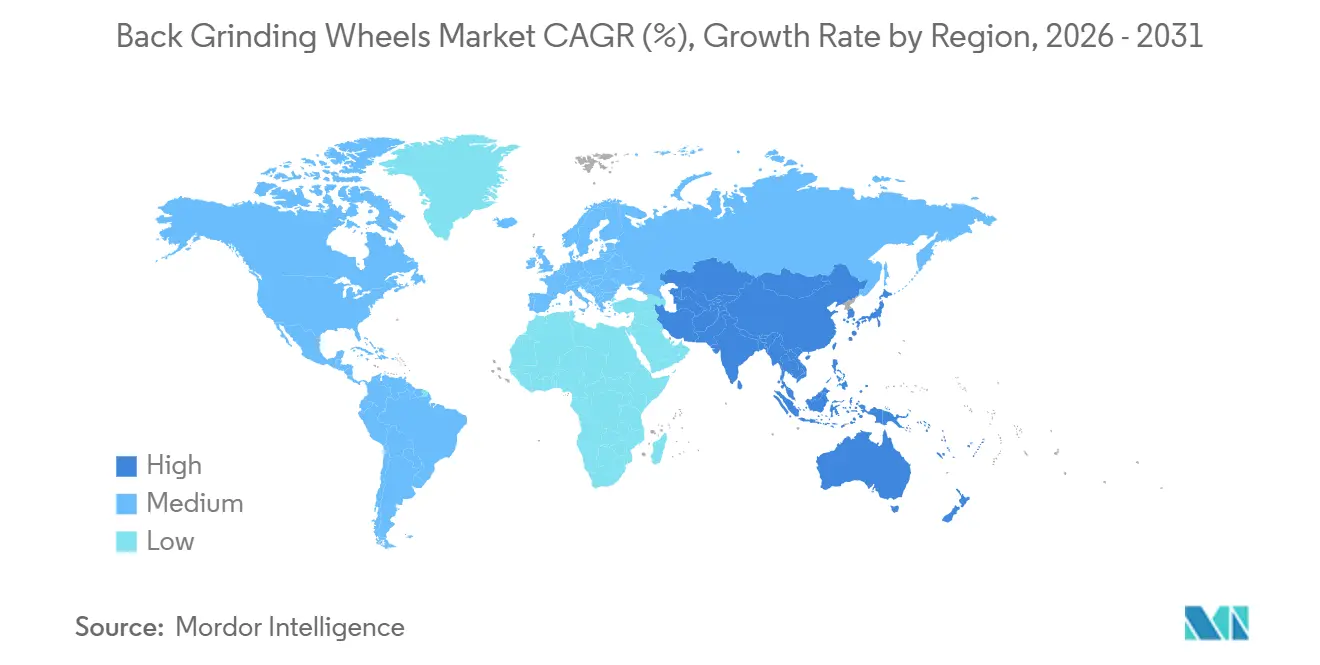
| Fastest Growing Market | Asia-Pacific |
| Largest Market | Asia-Pacific |
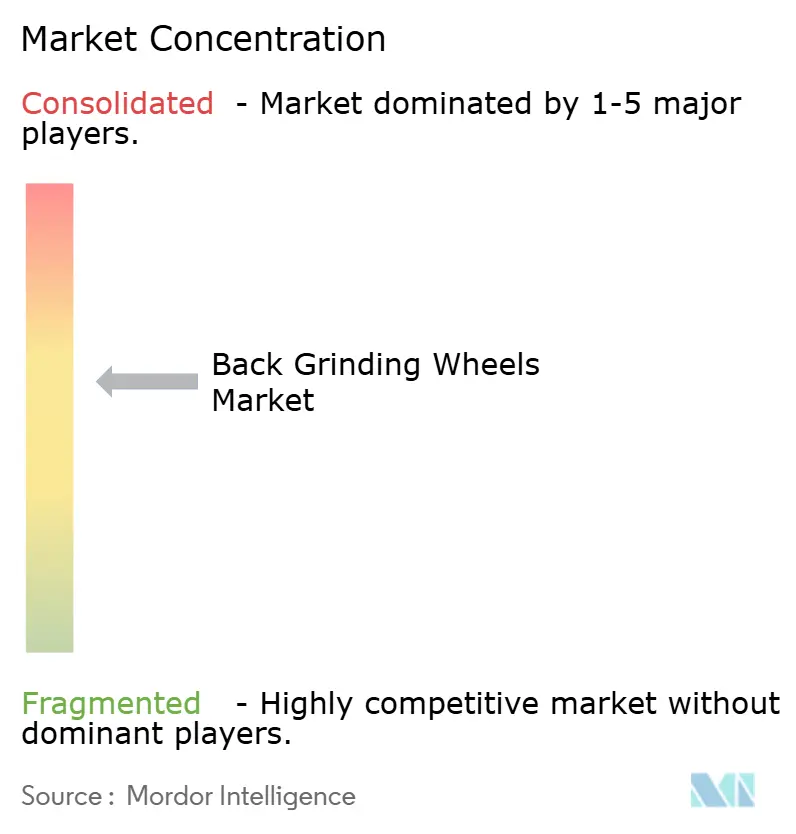
| Market Concentration | Medium |
Major Players *Disclaimer: Major Players sorted in no particular order Image © Mordor Intelligence. Reuse requires attribution under CC BY 4.0. | |
Back Grinding Wheels Market Analysis by Mordor Intelligence
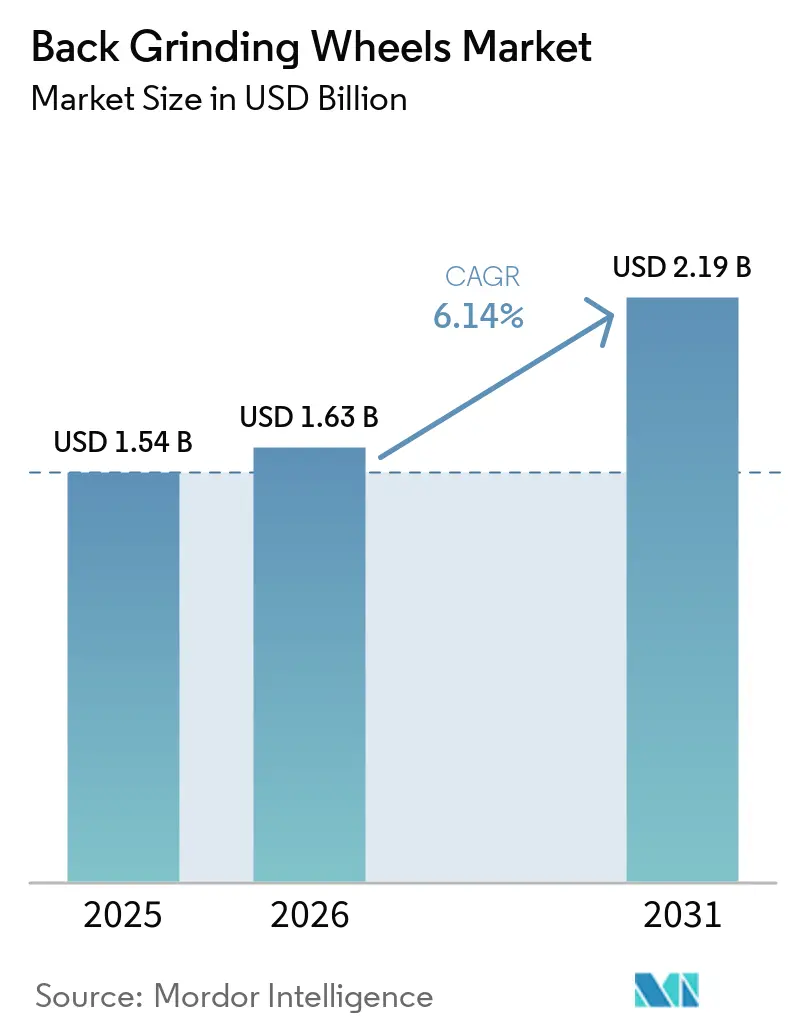
The Back grinding wheels market size was valued at USD 1.54 billion in 2025 and is estimated to grow from USD 1.63 billion in 2026 to reach USD 2.19 billion by 2031, at a CAGR of 6.14% during the forecast period (2026-2031). The back grinding wheels market is shaped by advanced packaging, where thin dies and stacked devices make total thickness variation and subsurface damage central selection criteria. Heterogeneous integration has increased the need for process control across logic, memory, and power devices within a single package. This shifts the supplier's role from selling a consumable to supporting a qualified process sequence. The market also benefits from the transition to larger wafers and harder substrate materials, which require new wheel specifications rather than direct transfers from older production lines. Demand remains tied to fab utilization, as wheel replacement follows production activity with a short lag.
Key Report Takeaways
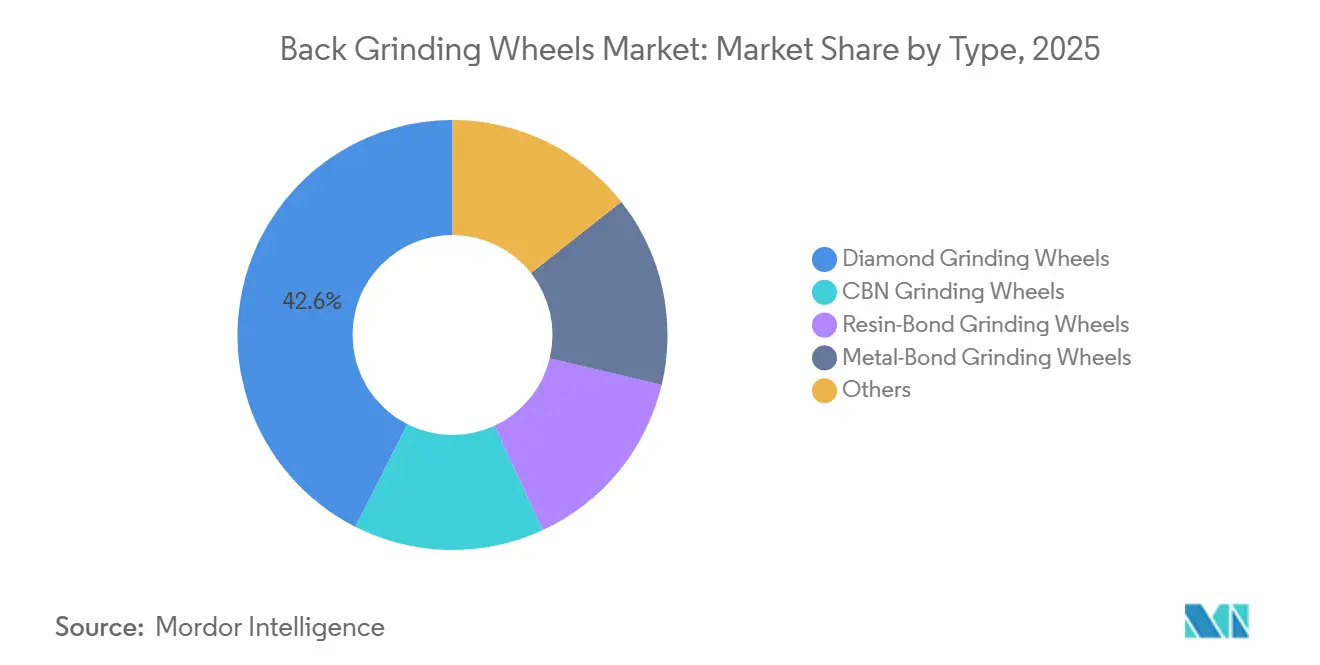
- By type, Diamond Grinding Wheels led with 42.56% revenue share in 2025, while Metal-Bond Grinding Wheels are forecast to expand at a 7.32% CAGR through 2031.
- By application, Semiconductor Wafer Grinding accounted for 35.13% of 2025 revenue, while LED and Optoelectronics are forecast to expand at a CAGR of 7.57% through 2031.
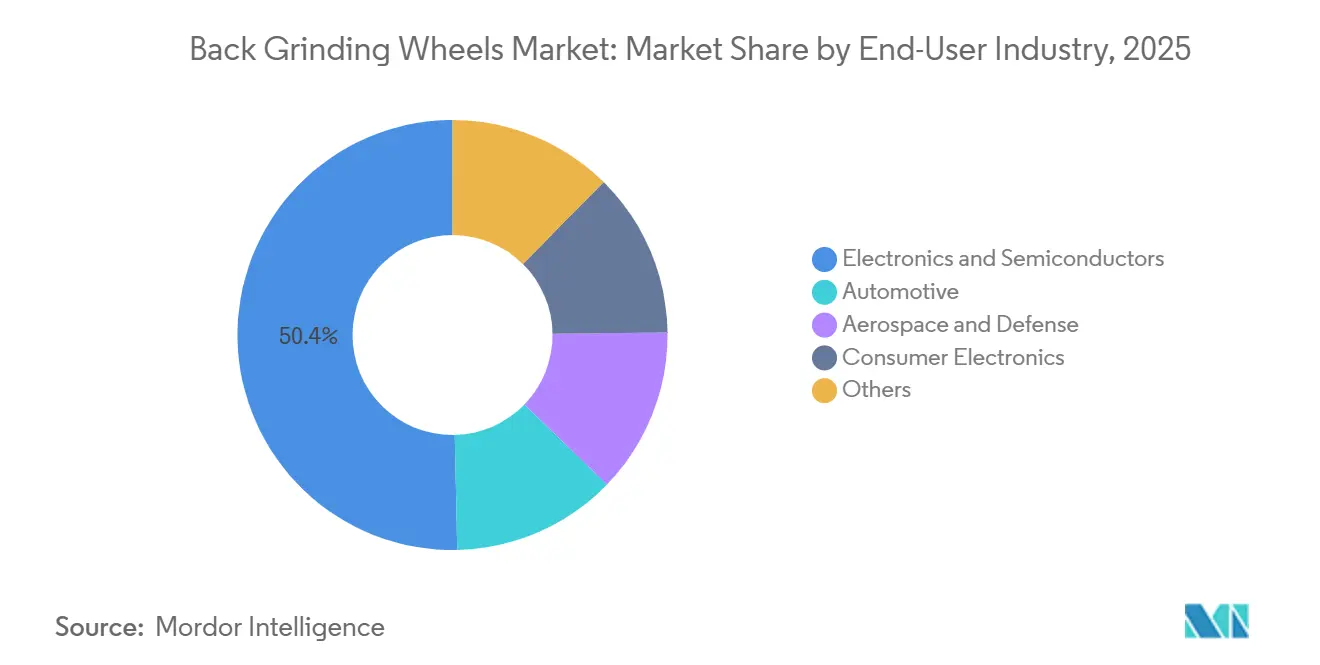
- By end-user industry, Electronics and Semiconductors accounted for 50.35% of revenue in 2025 and are forecast to expand at a CAGR of 8.13% through 2031.
- By geography, Asia-Pacific held 43.79% of revenue in 2025 and is forecast to grow at a 7.76% CAGR through 2031.
Note: Market size and forecast figures in this report are generated using Mordor Intelligence’s proprietary estimation framework, updated with the latest available data and insights as of January 2026.
Market Trends and Insights
Drivers Impact Analysis of Back Grinding Wheels Market*
| Drivers | (~) % Impact on CAGR Forecast | Geographic Relevance | Impact Timeline |
|---|---|---|---|
| Advanced Packaging and Ultra-Thin Die Adoption | +1.8% | Global, with the highest density in Taiwan, South Korea, and Japan | Short term (≤ 2 years) |
| Migration to 300 mm Wafer Processing | +1.5% | Global, with North America and Asia-Pacific as core beneficiaries | Medium term (2-4 years) |
| SiC and GaN Wafer Thinning Requirements | +1.2% | Global, with EV supply-chain hubs in Asia-Pacific and Europe | Medium term (2-4 years) |
| AI, High Bandwidth Memory (HBM), and High-Performance Computing Device Demand | +1.0% | Global, with the highest capital expenditure in Asia-Pacific and North America | Short term (≤ 2 years) |
| Automated Grinding and Predictive Process Control | +0.6% | Global, with early adoption in Japan and Taiwan | Long term (≥ 4 years) |
| Source: Mordor Intelligence | |||
Advanced Packaging and Ultra-Thin Die Adoption
The growth of 3D chip stacking and heterogeneous integration supports demand in the back grinding wheels market, as these technologies require more precise thinning than earlier bulk-silicon processes. HBM4 die stacks require that individual dies be thinned to 30-50 μm before assembly, making control of total thickness variation across 300 mm wafers a critical process requirement. DISCO documented that processing-point adjustments affect total thickness variation and are shifting specifications toward finer-grit, vitrified-bond formulations capable of delivering Chemical Mechanical Planarization (CMP)-quality surfaces without an intermediate polishing step. Ultra-thin die production uses both rough-grind and fine-grind stages, increasing wheel consumption per wafer compared with conventional thinning targets. Suppliers must therefore demonstrate repeatable surface quality in addition to material removal capability. The back grinding wheels market benefits from this shift, as packaging engineers must qualify wheel performance alongside other process parameters.
Migration to 300 mm Wafer Processing
The conversion of legacy fabrication lines to 300 mm processing also supports the back grinding wheels market. A larger wafer increases the grinding contact area and raises the material demand placed on each wheel during each process cycle. SEMI projected USD 142 billion in global 300 mm front-end equipment spending for 2026, a 25% year-over-year increase, and reported that installed 300 mm capacity was rising 7% annually through 2029. In December 2025, DISCO launched its DFG8561 fully automatic 300 mm grinder, offering 1.6 times the throughput of its predecessor for automotive Microcontroller Unit (MCU) and analog IC customers transitioning from 5-inch and 6-inch platforms. Each migration requires a new qualification, as specifications approved for 200 mm processing do not transfer directly to a 300 mm line. This creates discrete opportunities for wheel suppliers when fabrication plants upgrade their process platforms and reset approved process recipes.
SiC and GaN Wafer Thinning Requirements
The back grinding wheels market benefits from SiC and GaN processing because these substrates are harder and more brittle than silicon. Their physical properties increase wheel wear and require tighter bond management, heat control, and thickness-variation performance across repeated production runs. Infineon released its first 200 mm SiC products to customers in Q1 2025 and continued to ramp up its Kulim Module 3 operation toward high-volume production. JTEKT reported that its nanoVi grinding wheel delivered a service life 2.3 times longer than that of conventional wheels on SiC power-semiconductor wafers by modifying the abrasive grains, bond agent, and pore structure[1]JTEKT Corporation, “Development of Grinding Wheel with Extended Service Life for SiC Power-Semiconductor Wafers,” JTEKT Engineering Journal, jtekt.co.jp.. Wheel life remains an important production cost factor even when substrate yields improve. As a result, compound semiconductors contribute more to the demand for back grinding wheels than their unit counts alone would suggest.
AI, HBM, and High-Performance Computing Device Demand
The back grinding wheels market is linked to AI compute demand through both HBM die thinning and higher utilization at memory and logic fabrication plants. SEMI reported global semiconductor equipment billings of USD 135.1 billion in 2025, up 15% year over year, while assembly and packaging equipment billings rose 21%. These packaging investments require precise wafer thinning prior to high-density device assembly, thereby sustaining consumable demand as device architectures become more complex. Research published in the Journal of Intelligent Manufacturing found that machine-learning-based grinding monitoring can improve production output and labor efficiency by up to 20%. Automated grinding and predictive process control are expected to gain adoption first in Japan and Taiwan, where early uptake is already evident. The back grinding wheels market can benefit when wheel suppliers provide traceable process data alongside physical tools.
Restraints Impact Analysis of Back Grinding Wheels Market*
| Restraints | (~) % Impact on CAGR Forecast | Geographic Relevance | Impact Timeline |
|---|---|---|---|
| Semiconductor Capital-Expenditure Cyclicality | -0.8% | Global, most acute in memory-weighted markets in South Korea and China | Short term (≤ 2 years) |
| High Qualification Costs for New Wheel Specifications | -0.5% | Global, concentrated in advanced-node fabs in Taiwan and South Korea | Medium term (2-4 years) |
| Diamond, Cubic Boron Nitride (CBN), and Bond-Material Supply Constraints | -0.4% | Global, with the highest supply-chain vulnerability in Europe and North America | Medium term (2-4 years) |
| Source: Mordor Intelligence | |||
Semiconductor Capital-Expenditure Cyclicality
The back grinding wheels market follows the semiconductor equipment cycle, as fabs replace wheels less frequently when utilization declines. This can create demand contractions even when the longer-term need for thin dies and compound substrates remains intact. DISCO reported a two-speed environment in its fiscal 2026 results, with AI-driven logic and High Bandwidth Memory (HBM) demand elevated, while power semiconductor shipments were weaker due to soft EV demand. Suppliers must manage inventory and customer exposure across memory, logic, power, and display production. Supply constraints in diamond, CBN, and bond materials can further complicate planning when manufacturers need to respond quickly to utilization recovery. The back grinding wheels market remains structurally supported, but near-term demand may be uneven.
High Qualification Costs for New Wheel Specifications
New wheel specifications face a lengthy qualification process in advanced semiconductor fabs. The process requires validation of surface roughness, total thickness variation, die strength, and subsurface damage under production conditions. Research published by IOP Science in 2025 developed predictive models for surface roughness and subsurface damage depth during the grinding of semiconductor materials, illustrating the technical complexity of these assessments[2]IOP Publishing, “Predictive Models for the Surface Roughness and Subsurface Damage Depth of Semiconductor Materials in Precision Grinding,” IOP Science, iopscience.iop.org.. Qualification work can take months and require dedicated engineering resources, slowing design-ins and customer efforts to reduce dependence on a single source. KINIK stated that it was targeting double-digit revenue growth in its grinding wheel unit in 2026, following the April 2025 acquisitions of MKS in Japan and MGT in Thailand. This acquisition strategy can help the company leverage established qualifications across a broader set of production sites.
*Our forecasts treat driver/restraint impacts as directional, not additive. The impact forecasts reflect baseline growth, mix effects, and variable interactions.
Back Grinding Wheels Market Segment Analysis
By Type:
Diamond Grinding Wheels Lead by Share, While Metal-Bond Wheels Gain Traction on Compound SubstratesDiamond grinding wheels held 42.56% of the back grinding wheels market share in 2025. Their position reflects diamond abrasive hardness, predictable wear behavior, and compatibility with wheel-dressing methods already used in fab process recipes. These tools are suited to established silicon applications where customers value consistent material removal and proven process behavior. CBN grinding wheels are used in applications that require lower grinding forces on thermally sensitive substrates. Resin-bond grinding wheels remain common in fine-grinding stages where surface finish is more important than removal rate.
Metal-bond grinding wheels are projected to grow at a 7.32% CAGR through 2031, the fastest rate among type categories. Their use is rising with the production of SiC and GaN, where resin-bond alternatives may face limits in thermal management and tool life. Asahi Diamond Industrial Co., Ltd. stated that its porous M-Cloud series enables fine-grit grinding on SiC and GaN while providing stronger wear resistance than vitrified-bond wheels at an equivalent grit size. Vitrified-bond and electroplated products in the Others category address high-precision and prototype work where customized specifications matter more than share. The back grinding wheels market requires several bond types because no single wheel design covers the full compound-semiconductor process sequence.



By Application:
Semiconductor Wafer Grinding Leads While LED and Optoelectronics Expand FasterSemiconductor wafer grinding accounted for 35.13% of the back grinding wheels market in 2025. Silicon wafer output supports this application, while advanced-node thin-die and package-on-package designs increase wheel consumption per wafer. Grinding must manage thickness, surface condition, and potential damage before downstream packaging stages. The application remains the primary demand base for suppliers with qualified silicon processes. Its scale also makes production efficiency and replenishment reliability important purchasing factors.
LED and optoelectronics are expected to grow at a 7.57% CAGR through 2031, the fastest rate among applications. Sapphire and GaN substrates used in micro-LED and next-generation display products require precision beyond standard silicon thinning. An April 2026 paper in Photonics described sapphire nanometer-precision manufacturing as dependent on process control of morphology and subsurface damage. Shorter qualification cycles in micro-LED production can move new wheel specifications into use faster than in memory or logic fabs. Automotive electronics also adds demand as SiC moves to 200 mm wafers. Bosch introduced its Gen 3 SiC MOSFETs in 2026 on 200 mm wafers for premium and mass-market EV applications.
By End-User Industry:
Electronics and Semiconductors Lead by Both Share and Growth RateElectronics and semiconductors accounted for 50.35% of global revenue in 2025. Advanced-node foundry and memory customers need tight control of total thickness variation, staged grinding, and frequent process changes for new device introductions. AI silicon, high-bandwidth memory (HBM), and advanced packaging increase the number of use cases that require thin, mechanically stable dies. Consumer electronics create a separate demand pattern around ultra-thin smartphone application processors and image sensor packaging. These requirements sustain demand for fine-grind specifications even when end products have shorter refresh cycles.
Electronics and semiconductors are forecast to grow at an 8.13% CAGR through 2031, the fastest rate among end-user categories. Automotive demand is strategically important because SiC power-device content increases with the adoption of 800 V vehicle platforms. Infineon's One Virtual Fab links process optimization across Villach, Austria, and Kulim, Malaysia, supporting a multi-site SiC production approach. Aerospace and defense remain a smaller premium segment with strict qualification requirements and durable supplier relationships. Medical, industrial, and research users within the Others category require low-output, high-precision substrate processing and can accept custom specifications at higher prices.
Geography Analysis
APAC Back Grinding Wheels Market
Asia-Pacific held 43.79% of the back grinding wheels market share in 2025 and is forecast to grow at a 7.76% CAGR through 2031. Taiwan, South Korea, Japan, and China are home to wafer fabs, Outsourced Semiconductor Assembly and Test (OSAT) facilities, and LED manufacturers that require frequent consumable replacement. Taiwan's foundry and packaging base requires tight control of total thickness variation, which increases replacement frequency at advanced packaging nodes. South Korea's memory and packaging activity represents another major center of demand. Japan remains a key source of wheel technology through suppliers such as DISCO and Tokyo Diamond Tools.
APAC, North America and Europe Back Grinding Wheels Market
China is expanding capacity at mature semiconductor nodes, supporting regional demand for processing tools and consumables. Its position in the synthetic diamond supply chain also affects procurement conditions for wheel manufacturers outside China. North America and Europe have distinct demand profiles, shaped by specialty substrates, power semiconductors, and capacity onshoring. The European Commission's Critical Raw Materials Act identifies synthetic diamond and polycrystalline diamond compact as strategic materials, which could strengthen regional supply resilience.
MEA and South America Back Grinding Wheels Market
South America, the Middle East, and Africa remain early-stage markets for specialized back grinding wheel demand. Brazil supports regional activity through electronics assembly and component manufacturing. Saudi Arabia's Vision 2030 programs are generating interest in downstream semiconductor investment. Demand in these regions is primarily connected to assembly and test activities that process components made in Asia-Pacific and North America. Direct consumption of specialized wheels remains modest through 2031, keeping the back grinding wheels market centered on established fabrication and packaging hubs.

Competitive Landscape
The back grinding wheels market is moderately consolidated, with Japanese, Korean, Taiwanese, and Swiss manufacturers holding established qualification relationships at major wafer fabs. Their technical position is built on process knowledge, approved specifications, and the ability to meet demanding requirements for thin wafers and compound substrates. DISCO integrates grinding equipment with precision processing tools, which helps it secure wheel design-ins when customers select equipment. DISCO reported fiscal 2026 capital expenditure of JPY 33 billion (~USD 0.20 billion) and research and development spending of JPY 38 billion (~USD 0.23 billion), supporting this integrated approach. This model positions the wheel as part of a broader process solution rather than a stand-alone consumable.
KINIK acquired MKS in Japan and MGT in Thailand in April 2025, expanding its factory network to five sites across Taiwan, Japan, and Thailand. This expansion improves geographic coverage for fabs seeking regional supply resilience. Meister Abrasives offers self-sharpening UF DIA wheels that reduce clogging and can produce Chemical Mechanical Planarization (CMP)-capable surfaces on pre-ground SiC substrates. Asahi Diamond Industrial has focused on porous metal-bond products for fine-grit grinding of SiC and GaN.
The back grinding wheels market also includes Chinese suppliers that compete in mature-node and specialty substrate applications with lower-cost products. Established suppliers retain an advantage where compound semiconductor qualifications and advanced packaging performance are required. Real-time wheel performance monitoring is becoming increasingly relevant as customers seek data to support process-control decisions. DISCO filed a June 2026 patent application for a wafer processing apparatus that uses load-center-of-gravity adjustment and spindle tilt control. Suppliers able to support this interface are better positioned to address total thickness variation targets in HBM and advanced logic production.
Back Grinding Wheels Industry Leaders
DISCO CORPORATION
Saint-Gobain
Asahi Diamond Industrial Co.,Ltd.
KINIK COMPANY
EHWA DIAMOND
- *Disclaimer: Major Players sorted in no particular order
Back Grinding Wheels Market Companies Covered in this Report
- A.L.M.T. Corp.
- Asahi Diamond Industrial Co.,Ltd.
- DIPROTEX S.A.S.
- DISCO CORPORATION
- EHWA DIAMOND
- Henan E-Grind Abrasives Co., Ltd.
- KINIK COMPANY
- KURE GRINDING WHEEL
- Meister Abrasives AG
- More SuperHard Products Co., Ltd
- Saint-Gobain
- Shinhan Diamond Ind. Co., Ltd.
- TOKYO DIAMOND TOOLS MFG.CO.,LTD.
- TOKYO SEIMITSU CO., LTD
- Tyrolit AG

Recent Industry Developments in Back Grinding Wheels Market
- June 2026: SK Siltron ramped its new 300 mm silicon wafer plant in Gumi, South Korea, completing a KRW 2.3 trillion (~USD 1.6 billion) multi-year investment program. The facility targets high-90% utilization, supported by secured orders from anchor customers Samsung and SK Hynix.
- March 2026: Tower Semiconductor announced plans to take full ownership of the 300 mm Fab 7 facility in Uozu, Japan, under METI support, and to expand 300 mm Silicon Photonics and Silicon Germanium capacity, creating sustained consumable demand at a growing Japanese advanced-node fab.


Global Back Grinding Wheels Market Report Scope
Back grinding wheels are specialized abrasive tools used in semiconductor manufacturing to thin the backside of silicon wafers and remove surface stress after microelectronic fabrication. They grind the blank side of a wafer, opposite the circuit patterns, to achieve precise thickness, flatness, and structural strength.
The back grinding wheels market is segmented by type, application, end-user industry, and geography. By type, the market is segmented into diamond grinding wheels, CBN grinding wheels, resin-bond grinding wheels, metal-bond grinding wheels, and others. By application, the market is segmented into semiconductor wafer grinding, LED and optoelectronics, electronic component grinding, automotive electronics, and others. By end-user industry, the market is segmented into electronics and semiconductors, automotive, aerospace and defense, consumer electronics, and others. The report also covers market size and forecasts for the back grinding wheels across 15 countries in major regions. The market sizes and forecasts are provided in terms of value (USD).
| Diamond Grinding Wheels |
| CBN Grinding Wheels |
| Resin-Bond Grinding Wheels |
| Metal-Bond Grinding Wheels |
| Others |
| Semiconductor Wafer Grinding |
| LED and Optoelectronics |
| Electronic Component Grinding |
| Automotive Electronics |
| Others |
| Electronics and Semiconductors |
| Automotive |
| Aerospace and Defense |
| Consumer Electronics |
| Others |
| Asia-Pacific | China |
| India | |
| Japan | |
| South Korea | |
| ASEAN Countries | |
| Rest of Asia-Pacific | |
| North America | United States |
| Canada | |
| Mexico | |
| Europe | Germany |
| United Kingdom | |
| France | |
| Italy | |
| NORDIC Countries | |
| Rest of Europe | |
| South America | Brazil |
| Argentina | |
| Rest of South America | |
| Middle East and Africa | Saudi Arabia |
| South Africa | |
| Rest of Middle East and Africa |
| By Type | Diamond Grinding Wheels | |
| CBN Grinding Wheels | ||
| Resin-Bond Grinding Wheels | ||
| Metal-Bond Grinding Wheels | ||
| Others | ||
| By Application | Semiconductor Wafer Grinding | |
| LED and Optoelectronics | ||
| Electronic Component Grinding | ||
| Automotive Electronics | ||
| Others | ||
| By End-User Industry | Electronics and Semiconductors | |
| Automotive | ||
| Aerospace and Defense | ||
| Consumer Electronics | ||
| Others | ||
| By Geography | Asia-Pacific | China |
| India | ||
| Japan | ||
| South Korea | ||
| ASEAN Countries | ||
| Rest of Asia-Pacific | ||
| North America | United States | |
| Canada | ||
| Mexico | ||
| Europe | Germany | |
| United Kingdom | ||
| France | ||
| Italy | ||
| NORDIC Countries | ||
| Rest of Europe | ||
| South America | Brazil | |
| Argentina | ||
| Rest of South America | ||
| Middle East and Africa | Saudi Arabia | |
| South Africa | ||
| Rest of Middle East and Africa | ||


Key Questions Answered in the Report
What is current market size of Back Grinding Wheels Market?
The Back grinding wheels market size was valued at USD 1.54 billion in 2025 and is estimated to grow from USD 1.63 billion in 2026 to reach USD 2.19 billion by 2031, at a CAGR of 6.14% during the forecast period (2026-2031).
Which wheel type drives grinding wheel revenue?
Diamond Grinding Wheels led with a 42.56% revenue share in 2025 because of their hardness, predictable wear behavior, and established silicon process compatibility.
Which back grinding wheel application is growing the fastest?
LED and Optoelectronics is projected to grow at a 7.57% CAGR through 2031, supported by precision needs for sapphire and GaN substrates.
Why are SiC and GaN wafers important for wheel suppliers?
SiC and GaN are harder and more brittle than silicon, which raises the need for controlled bond design, heat management, and longer wheel life.
Page last updated on:





