
Aviation Insurance Market Size and Share
Market Overview
| Study Period | 2020 - 2031 |
|---|---|
| Market Size (2026) | USD 9.42 Billion |
| Market Size (2031) | USD 11.70 Billion |
| Growth Rate (2026 - 2031) | 4.43 % |
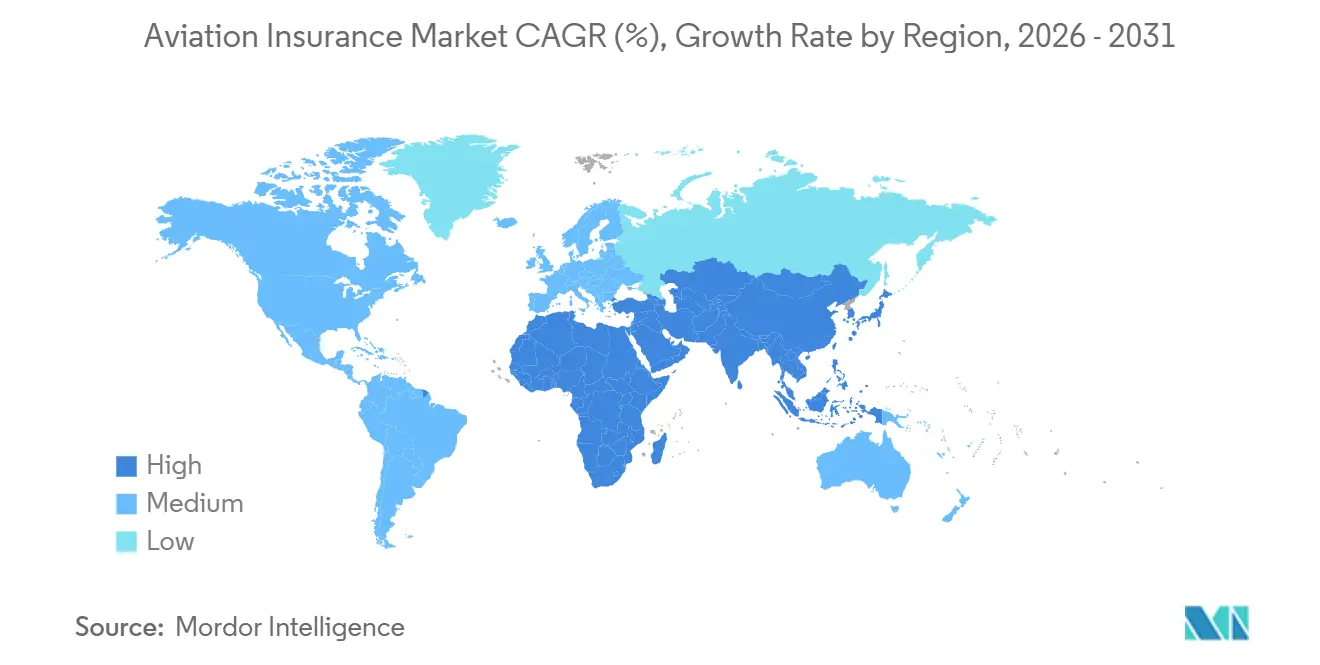
| Fastest Growing Market | Asia-Pacific |
| Largest Market | North America |
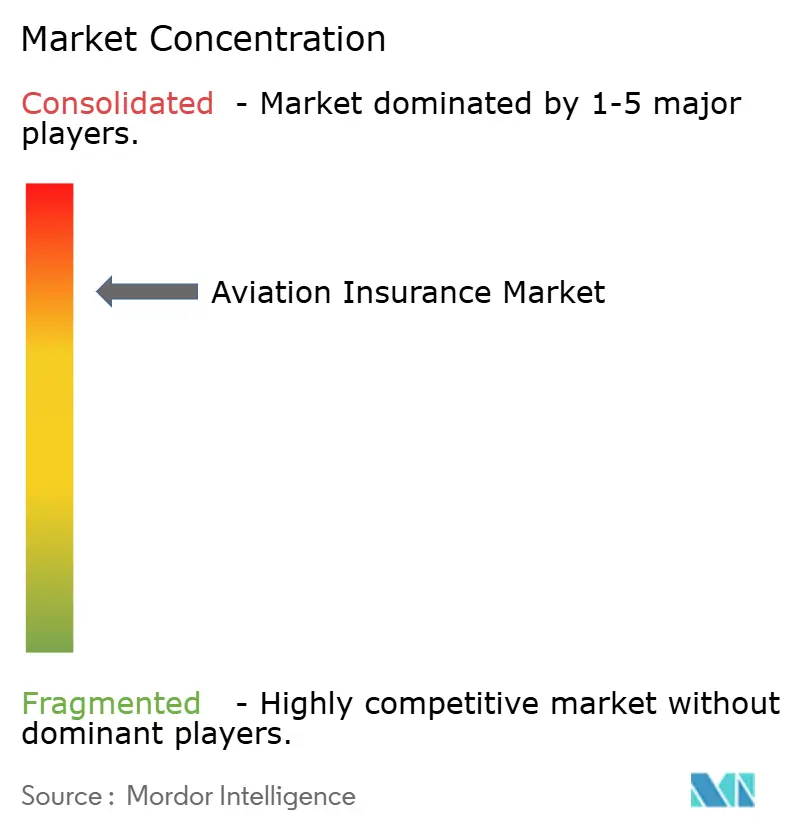
| Market Concentration | High |
Major Players *Disclaimer: Major Players sorted in no particular order Image © Mordor Intelligence. Reuse requires attribution under CC BY 4.0. | |
Aviation Insurance Market Analysis by Mordor Intelligence
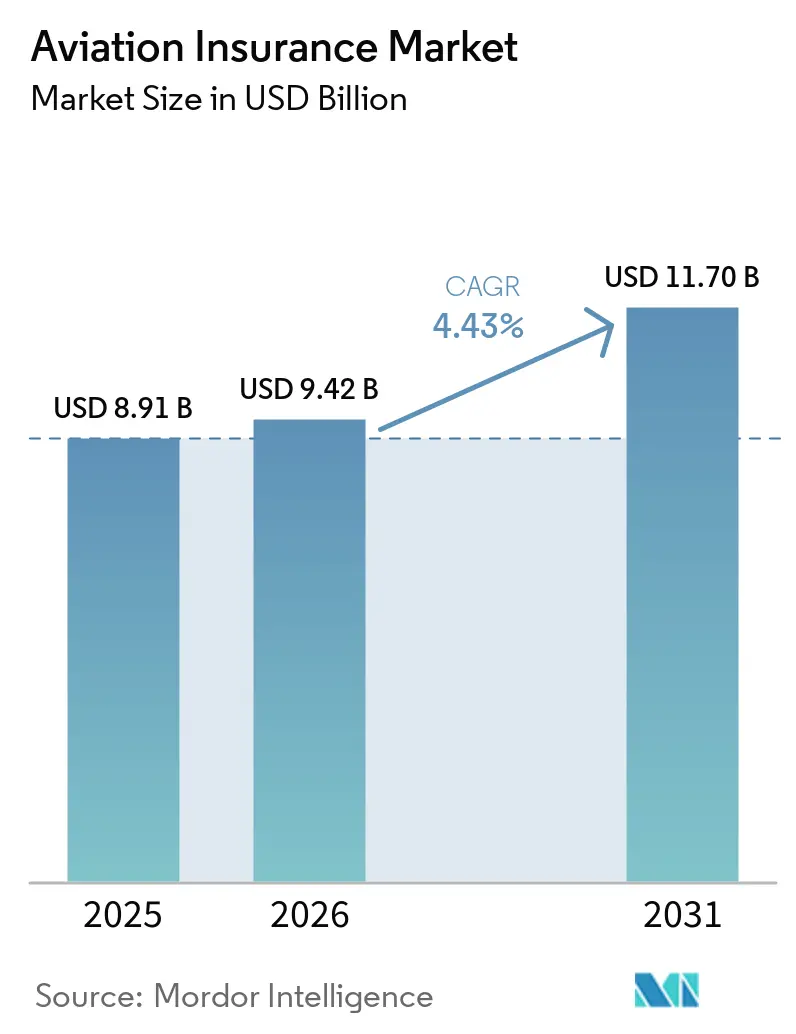
The Aviation Insurance Market size is expected to increase from USD 8.91 billion in 2025 to USD 9.42 billion in 2026 and reach USD 11.70 billion by 2031, growing at a CAGR of 4.43% over 2026-2031.
Fleet growth remains the central source of new insured exposure because each delivered aircraft requires hull and liability cover. Airbus expects 42,060 new aircraft deliveries between 2026 and 2045, while Boeing expects the global commercial fleet to exceed 50,000 aircraft over the next 2 decades. Newer aircraft also carry higher insured values, which increases premiums even when accident frequency is stable. Mandatory liability rules are widening the coverage requirement for airlines, lessors, and emerging aircraft operators. Capacity remains available, but high claims costs, geopolitical exposure, and reinsurance caution limit insurers’ ability to compete only on price.
Key Report Takeaways
- By coverage type, aviation operating and premises liability captured 34.5% of the aviation insurance market share in 2025, while aviation products liability is projected to grow at 5.3% CAGR through 2031.
- By end user, general and business aviation operators captured 43.1% of the aviation insurance market share in 2025, while aviation products liability insureds are projected to grow at 5.3% CAGR through 2031.
- By distribution channel, open-market broker placement captured 74% of the aviation insurance market share in 2025, while delegated authority is projected to grow at 7.1% CAGR through 2031.
- By geography, North America captured 53.56% of the aviation insurance market share in 2025, while Asia-Pacific is projected to grow at 6.88% CAGR through 2031.
Note: Market size and forecast figures in this report are generated using Mordor Intelligence’s proprietary estimation framework, updated with the latest available data and insights as of January 2026.
Global Aviation Insurance Market Trends and Insights
Drivers Impact Analysis*
| Driver | (~) % Impact on CAGR Forecast | Geographic Relevance | Impact Timeline |
|---|---|---|---|
| Expansion of Global Commercial Aircraft Fleet and Flight Activity | +1.2% | Global | Medium term (2-4 years) |
| Mandatory Aviation Liability and Insurance Requirements | +0.7% | Global, elevated impact in Asia-Pacific and MEA | Short term (≤ 2 years) |
| Growth in Insured Aircraft, Engines and Aviation Asset Values | +0.8% | Global, concentrated in North America and the Asia-Pacific | Medium term (2-4 years) |
| Expansion of Aircraft Leasing and Aviation Financing Activities | +0.5% | Global, Asia-Pacific core, spill-over to MEA | Medium term (2-4 years) |
| Emergence of New Insurable Risks from Drones, eVTOL and Advanced Air Mobility | +0.4% | Asia-Pacific, North America, Europe | Long term (≥ 4 years) |
| Increasing Adoption of Data-Driven Aviation Risk Assessment and Specialized Insurance Solutions | +0.3% | Global | Medium term (2-4 years) |
| Source: Mordor Intelligence | |||
Expanding Commercial Fleets Drive Structural Premium Growth
Fleet expansion creates the most consistent source of demand for the aviation insurance market because each additional aircraft needs hull and liability protection. Airbus forecasts 42,060 new aircraft deliveries over 2026 to 2045, and its global passenger fleet forecast points to a near doubling by 2045[1]Airbus, “Global Market Forecast,” Airbus, airbus.com. Boeing also expects more than 50,000 commercial aircraft to operate globally over the next 2 decades. Airlines in India, Vietnam, and Indonesia are absorbing large delivery pipelines that will require cover for many years. New aircraft such as the Airbus A321neo and Boeing 787 have higher insured hull values than many aircraft they replace. This combination of more aircraft and larger values supports premium growth even when operating safety remains strong.
Mandatory Liability Frameworks Underpin Structural Demand
Mandatory insurance rules create a baseline of demand that is not dependent on voluntary risk decisions. ICAO revised the Montreal Convention liability limits effective December 28, 2024, raising the Article 21 passenger compensation threshold from 128,821 to 151,880 Special Drawing Rights per passenger[2]https://passageiro.aac.cv/doc/le-3-38-1-ind-24-8.pdf. The United Kingdom implemented the revised limits through its 2025 order, while European Union rules set minimum insurance requirements for carriers and operators. United States direct air carriers must also carry aircraft accident liability insurance under 14 CFR Part 205. Higher statutory limits require carriers and lessors to buy larger limits across their operations. China’s 2026 low-altitude insurance directive extends this compliance logic to unmanned aircraft, with mandatory UAV liability insurance targeted by 2027.
Rising Aircraft Asset Values Amplify the Per-Policy Premium Base
Aircraft values support the aviation insurance market by increasing the insured amount on each policy. Delivery delays and shortages of serviceable aircraft and engines have supported aircraft values and lease economics. A larger operating lease base also increases the need for hull, war-risk, non-payment, and asset-recovery cover. Lessors require protection across aircraft, engines, financing arrangements, and locations where the assets operate. The result is a broader premium base, but it also raises the potential size of a major loss. Insurers therefore assess asset values with closer attention to repair costs, parts availability, and residual-value risk.
Expansion of Aircraft Leasing and Aviation Financing Activities
Aircraft leasing widens the aviation insurance market because financing structures introduce several parties with separate interests in the same aircraft. Airlines, lessors, lenders, and investors may each require evidence of cover and specific policy protections. Demand is especially relevant in high-growth markets where carriers use lease arrangements to add capacity before building larger owned fleets. The Russia-related dispute over unrecovered western-owned aircraft shows why lessors now place greater focus on hull-war and asset-recovery protection. Aviation finance products also support aircraft deliveries through protections against non-payment and related credit risks. These needs give specialist insurers a role beyond standard airline hull and liability policies.
Restraints Impact Analysis*
| Restraint | (~) % Impact on CAGR Forecast | Geographic Relevance | Impact Timeline |
|---|---|---|---|
| Rising Aviation Claim Severity and Loss Costs | -0.7% | Global, most acute in North America | Short term (≤ 2 years) |
| Limited Reinsurance Capacity for High-Severity and Catastrophic Aviation Risks | -0.4% | Global | Medium term (2-4 years) |
| Premium Volatility and Increasing Cost of Aviation Insurance Coverage | -0.5% | Global, concentrated in North America and Europe | Short term (≤ 2 years) |
| Limited Historical Loss Data for Emerging Aviation Technologies | -0.3% | Global, most acutely in Asia-Pacific and North America | Long term (≥ 4 years) |
| Source: Mordor Intelligence | |||
Structural MRO Cost Inflation Persistently Widens the Loss Gap
Maintenance, repair, and overhaul costs remain a major constraint on underwriting results in the aviation insurance market. Rising labor rates, repair costs, original equipment manufacturer charges, and aircraft-on-ground expenses raise the amount insurers must pay after a claim. The cost challenge is more structural than cyclical because supply-chain constraints and shortages of skilled labor affect several repair categories at the same time. Higher repair bills make it harder for insurers to maintain adequate pricing on older policies. The Allianz Risk Barometer 2026 identified cyber incidents as the aviation sector’s leading business risk at 45%, adding another exposure that standard hull and liability policies were not built to address[3] Allianz Commercial, “Aviation Insurance,” Allianz Commercial, allianz.com. Insurers are becoming more selective where loss costs rise faster than premiums.
Reinsurance Selectivity Constrains Capacity for Catastrophic Risks
Reinsurance capacity remains available, but its deployment is increasingly selective for very large or systemic aviation losses. Treaty reinsurers are cautious about high liability layers, geopolitical shocks, cyber events, and programs with large insured values. The unrecovered Western-owned aircraft in Russia have permanently changed how reinsurers assess geopolitical exposures. War-risk and sanctions exclusions now play a larger role in treaty wording and direct underwriting. This reduces the range of cover available where geopolitical exposure is most severe. The aviation insurance market may therefore retain nominal capacity while facing tighter terms for catastrophic risk layers.
*Our forecasts treat driver/restraint impacts as directional, not additive. The impact forecasts reflect baseline growth, mix effects, and variable interactions.
Segment Analysis
By Coverage Type: Products Liability Accelerates as Supply Chain Liability Intensifies
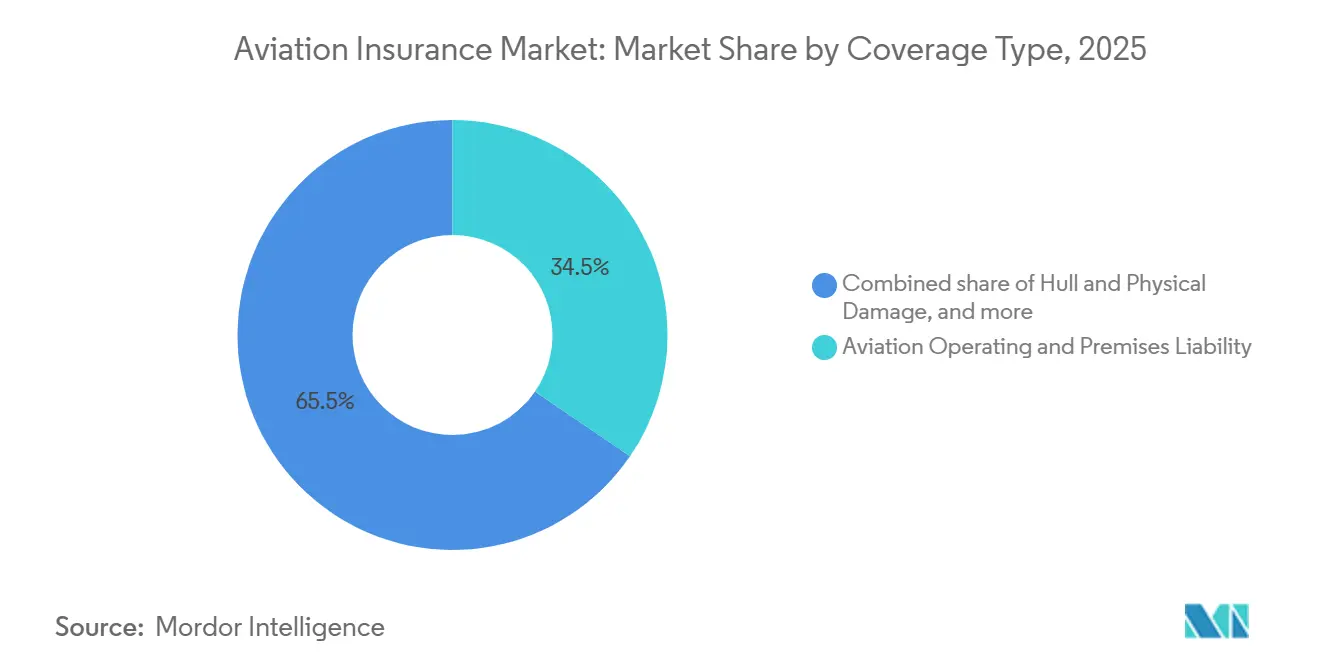
Aviation operating and premises liability held 34.5% of the aviation insurance market share in 2025. The segment covers third-party bodily injury and property damage exposures for commercial carriers, airports, and ground-handling businesses. These risks are material because a single event can involve passengers, property owners, contractors, and multiple legal jurisdictions. United States litigation exposure has increased the importance of carefully structured liability limits. Aviation products liability is projected to grow at a 5.3% CAGR from 2026 to 2031. Its growth reflects larger exposures for aircraft manufacturers, engine suppliers, and component makers operating across global supply chains.
The November 2025 UPS Flight 2976 crash in Kentucky illustrated how a major event can lead to claims involving several aerospace companies[4]. Hull and physical damage remains a visible part of the aviation insurance market size because it responds directly to aircraft loss and damage. Composite airframes and newer systems can increase insured values and repair complexity. Aviation war and allied perils experienced soft conditions during much of 2026 because capacity was available, although Middle East tensions led to more selective terms for regional exposures. Other specialty cover includes contingent liability, loss of license, and satellite risks. These products remain smaller but become more relevant as aviation businesses diversify their operations and risk transfer needs.


By End User: General Aviation Anchors Volume While Products Liability Insureds Scale Fastest
General and business aviation operators held 43.1% of the aviation insurance market share in 2025. Business jets, turboprops, helicopters, and piston aircraft require separate hull and liability policies, creating a broad base of policies. This segment contains many smaller risks, but its breadth supports consistent demand for insurers and managing general agents. Digital distribution can lower acquisition costs for standardized general aviation products. Jeppesen ForeFlight launched an aviation insurance marketplace with Old Republic Aerospace in 2026, offering daily-to-annual non-owned policies for renters and flight instructors. These offerings address users who need flexible protection rather than a conventional annual aircraft-owner policy.
Aviation products liability insureds are forecast to grow at a 5.3% CAGR between 2026 and 2031. Manufacturers and suppliers face increasing exposure as fleet complexity rises and aircraft production is distributed across global supply chains. Changes in legislation rank among the leading aviation business risks in Allianz’s 2026 assessment. Airlines and commercial operators have smaller policy counts but can create much larger loss severity when an event occurs. Aircraft lessors and financiers also require specialist protection for non-payment, hull war, and asset-recovery risks. The aviation insurance market size is supported by a broad base of general aviation risks alongside more complex commercial and manufacturer exposures.
By Distribution Channel: Open Market Anchors Complex Risk While Delegated Authority Scales
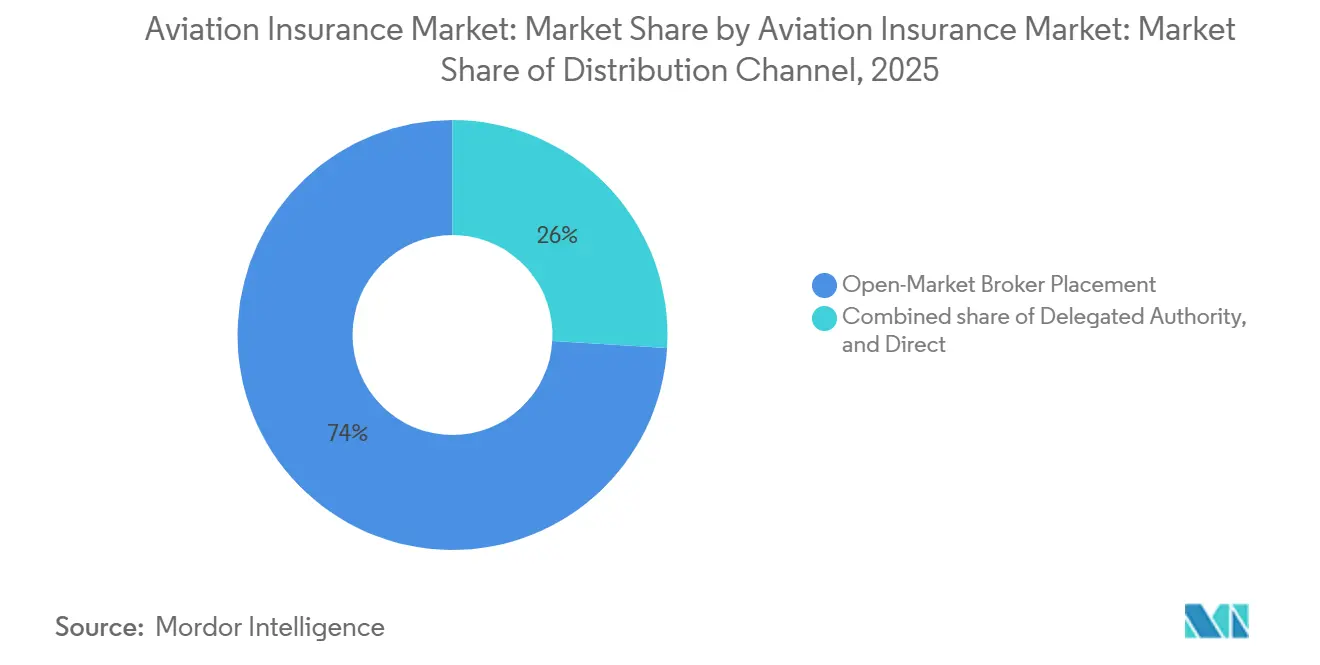
Open-market broker placement captured 74% of the global total in 2025. Large airline, aerospace manufacturer, and lessor programs often require specialist capacity from London, Bermuda, and European markets. These placements require brokers to coordinate several insurers, complex policy terms, and high liability limits. Lloyd’s of London remains a central venue for large and non-standard aviation risks. Open-market placement is likely to remain important where underwriting depends on detailed risk information and bespoke policy structures. It also gives buyers access to a broader group of international capacity providers.
Delegated authority is projected to grow at a 7.1% CAGR from 2026 to 2031. Technology-enabled managing general agents can process higher volumes of lower-complexity general aviation and drone risks than a fully negotiated open-market process. Gallagher’s Jacinth platform illustrates how live exposure data and fleet information can support this distribution model. Class A expanded physical damage capacity to USD 15 million per aircraft after analyzing around 7,000 submissions. The direct channel remains smaller because complex aviation risks still require specialist underwriting. It has more scope in standardized products where algorithms can support pricing and policy administration.
Geography Analysis
North America held 53.6% of the global total in 2025. The region combines a large aircraft fleet with a demanding liability environment and a significant base of lessors, manufacturers, airlines, and general aviation operators. United States social inflation and large court awards raise the cost of liability claims. These factors support demand for high limits but can also raise premiums for riskier accounts. Canada and Mexico add demand through low-cost carrier growth and general aviation activity. AIG issued more than 570 local aviation policies in 2025 across more than 32 territories, showing the international reach needed by multinational aviation clients.
Europe is an institutional center for the aviation insurance market, with Lloyd’s of London and major insurers such as Allianz Commercial, AXA XL, and HDI Global. European Union insurance requirements provide a common compliance framework for air carriers and aircraft operators. Asia-Pacific is projected to grow at a 6.9% CAGR from 2026 to 2031. Fleet expansion in China, India, Vietnam, Indonesia, and Malaysia supports the region’s longer-term demand profile. Allianz Jio Reinsurance Limited began underwriting in India in March 2026 after receiving IRDAI authorization, increasing domestic reinsurance capacity. China’s low-altitude policy direction also supports the development of UAV liability insurance.
South America, the Middle East, and Africa have smaller aviation insurance market size levels, but their risk profiles differ significantly. Brazil supports South American demand through domestic air travel, while several neighboring markets remain at earlier stages of insurance penetration. The Middle East and Africa are more exposed to geopolitical and war-risk volatility. The IUAI’s 2026 survey found that 79 of 106 respondents ranked geopolitical instability as their greatest threat. Middle East airline renewals faced capacity restrictions and additional war-risk premiums following the escalation of regional conflict. CG Re launched a dedicated aviation insurance and reinsurance practice for African carriers and airports in March 2026, indicating early development of domestic capacity.

Competitive Landscape
The aviation insurance market has a concentrated top tier that includes Allianz Commercial, AIG, AXA XL, Munich Re, Swiss Re Corporate Solutions, Chubb, Global Aerospace, and QBE. These firms underwrite a large share of commercial airline, aerospace manufacturer, and lessor risks. A growing managing general agent layer competes more actively in general aviation and emerging-risk products. Tokio Marine Kiln states that it is the largest writer of aviation risks in the Lloyd’s market by gross written premium. The company has strengthened its Aerospace division through targeted recruitment. This structure allows the aviation insurance market to pair large global carriers for complex risk with specialized distributors for faster and more standardized underwriting.
Consolidation increased in 2026. Zurich Insurance Group agreed to acquire Beazley for USD 10.9 billion in March 2026, and Beazley shareholders approved the transaction with a 99.9% vote in April 2026. The combination is expected to create a specialty platform with USD 15 billion in gross written premiums across aviation, cyber, marine, and space lines. Sompo International completed its USD 3.5 billion acquisition of Aspen Insurance Holdings in February 2026. Berkshire Hathaway also acquired a 2.49% stake in Tokio Marine Holdings for USD 1.8 billion in March 2026, with the parties planning collaboration in global reinsurance and strategic investments. These actions show why the aviation insurance market rewards scale, specialty underwriting capability, and capital strength.
Technology is becoming another important point of competition in the aviation insurance market. Allianz Commercial’s Insurwave selection shows the value placed on real-time accumulation management across aviation assets. China Re and Ping An Property & Casualty launched Smart Flight Insurance with dynamic IoT-based pricing for drone cover. AI was ranked as the sector’s leading opportunity for a third consecutive year in the IUAI CERSG 2026 Survey. Cyber incidents were ranked as aviation’s top business risk at 45% in Allianz’s 2026 assessment. Insurers that can support cyber, weather disruption, connected-aircraft, and eVTOL risks with reliable data may strengthen their position as these exposures become more established.
Aviation Insurance Industry Leaders
Allianz Global Corporate & Specialty
American International Group, Inc.
AXA XL
Chubb Limited
QBE Insurance Group Limited
- *Disclaimer: Major Players sorted in no particular order

Recent Industry Developments
- March 2026: Beazley shareholders approved Zurich Insurance Group’s USD 10.9 billion all-cash acquisition with a 99.9% vote, court sanction pending in H2 2026. The combined platform generates USD 15 billion in specialty gross written premiums, reshaping aviation, cyber, and space insurance competition.
- March 2026: Berkshire Hathaway acquired a 2.49% strategic stake in Tokio Marine Holdings for USD 1.8 billion through National Indemnity. Both parties are committed to collaborating on global reinsurance and strategic investments, including mergers and acquisitions.
- March 2026: Allianz Jio Reinsurance Limited received final IRDAI authorization and commenced underwriting in India. The 50:50 joint venture between Allianz Group and Jio Financial Services expands specialty and aviation reinsurance capacity in India.
- February 2026: China’s National Development and Reform Commission, National Financial Regulatory Administration, and Civil Aviation Administration of China issued the Implementation Opinion on High-Quality Development of Low-Altitude Insurance. The directive targets mandatory UAV liability insurance by 2027 and a complete low-altitude insurance policy framework by 2030.


Global Aviation Insurance Market Report Scope
| Hull and Physical Damage |
| Aviation Operating and Premises Liability |
| Aviation Products Liability |
| Aviation War and Allied Perils |
| Other Specialty |
| Airlines and Commercial Operators |
| General and Business Aviation Operators |
| Aviation Products Liability Insureds |
| Aircraft Lessors and Financiers |
| Airports and Aviation Infrastructure |
| Open-Market Broker Placement |
| Delegated Authority |
| Direct |
| North America | United States |
| Canada | |
| Mexico | |
| South America | Brazil |
| Argentina | |
| Rest of South America | |
| Europe | United Kingdom |
| Germany | |
| France | |
| Italy | |
| Spain | |
| Rest of Europe | |
| Asia-Pacific | China |
| Japan | |
| India | |
| South Korea | |
| Australia | |
| Indonesia | |
| Thailand | |
| Malaysia | |
| Singapore | |
| Vietnam | |
| Rest of Asia-Pacific | |
| Middle East and Africa | Saudi Arabia |
| United Arab Emirates | |
| Turkey | |
| South Africa | |
| Egypt | |
| Rest of Middle East and Africa |
| By Coverage Type | Hull and Physical Damage | |
| Aviation Operating and Premises Liability | ||
| Aviation Products Liability | ||
| Aviation War and Allied Perils | ||
| Other Specialty | ||
| By End User | Airlines and Commercial Operators | |
| General and Business Aviation Operators | ||
| Aviation Products Liability Insureds | ||
| Aircraft Lessors and Financiers | ||
| Airports and Aviation Infrastructure | ||
| By Distribution Channel | Open-Market Broker Placement | |
| Delegated Authority | ||
| Direct | ||
| By Geography | North America | United States |
| Canada | ||
| Mexico | ||
| South America | Brazil | |
| Argentina | ||
| Rest of South America | ||
| Europe | United Kingdom | |
| Germany | ||
| France | ||
| Italy | ||
| Spain | ||
| Rest of Europe | ||
| Asia-Pacific | China | |
| Japan | ||
| India | ||
| South Korea | ||
| Australia | ||
| Indonesia | ||
| Thailand | ||
| Malaysia | ||
| Singapore | ||
| Vietnam | ||
| Rest of Asia-Pacific | ||
| Middle East and Africa | Saudi Arabia | |
| United Arab Emirates | ||
| Turkey | ||
| South Africa | ||
| Egypt | ||
| Rest of Middle East and Africa | ||


Key Questions Answered in the Report
What is the forecast for aviation insurance through 2031?
The aviation insurance market was USD 8.91 billion in 2025 and is forecast to reach USD 11.70 billion by 2031, at a 4.4% CAGR from 2026 to 2031.
Which coverage type is growing fastest?
Aviation Products Liability is forecast to grow at a 5.3% CAGR from 2026 to 2031 as aerospace supply-chain liability exposures increase.
Why is general aviation important to insurers?
General and Business Aviation Operators held 43.1% of the 2025 end-user total because each aircraft requires separately underwritten hull and liability protection.
Which region has the strongest growth outlook?
Asia-Pacific is projected to grow at a 6.9% CAGR from 2026 to 2031, supported by fleet expansion and growing insurance requirements.
How do drone rules affect demand?
China’s 2026 low-altitude directive targets mandatory UAV liability insurance by 2027, which broadens the need for specialized drone cover.
What is changing competition among aviation insurers?
Consolidation, data-driven underwriting, and new capacity for drone and eVTOL risks are strengthening the importance of scale and specialist risk capabilities.
Page last updated on:





