
Aviation Connectors Market Size and Share
Market Overview
| Study Period | 2020 - 2031 |
|---|---|
| Market Size (2026) | USD 6.14 Billion |
| Market Size (2031) | USD 7.99 Billion |
| Growth Rate (2026 - 2031) | 5.39 % |
| Fastest Growing Market | Asia Pacific |
| Largest Market | North America |
| Market Concentration | Medium |
Major Players *Disclaimer: Major Players sorted in no particular order Image © Mordor Intelligence. Reuse requires attribution under CC BY 4.0. | |
Aviation Connectors Market Analysis by Mordor Intelligence
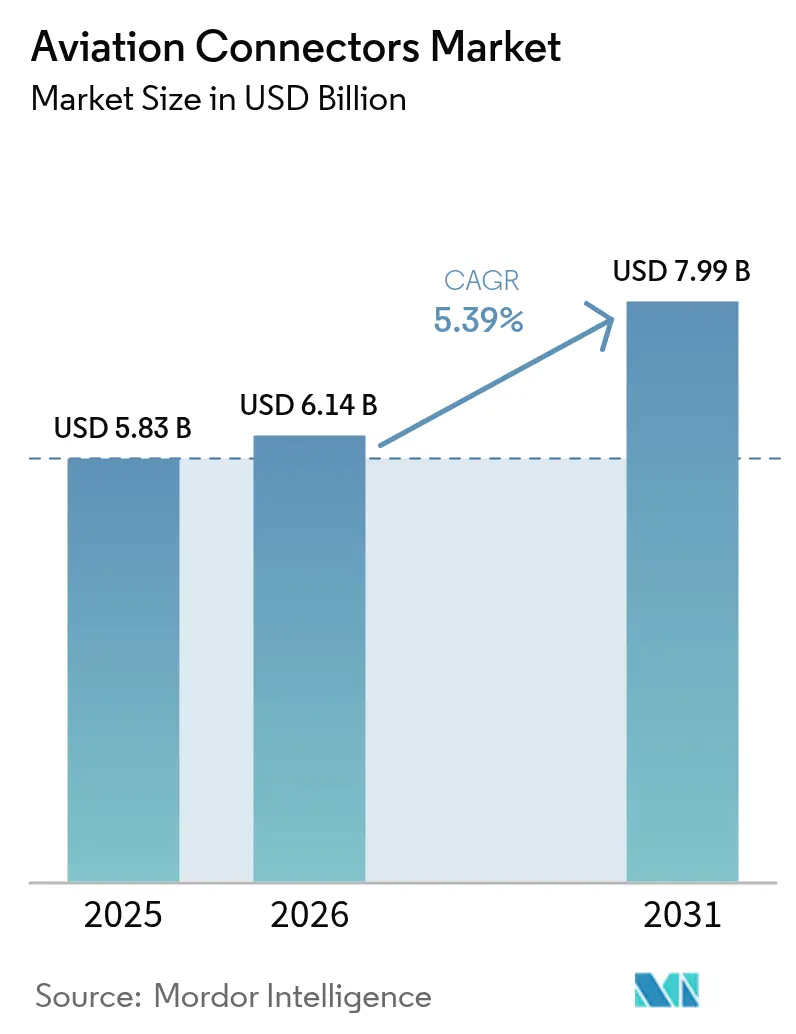
Aviation connectors market size in 2026 is estimated at USD 6.14 billion, growing from 2025 value of USD 5.83 billion with 2031 projections showing USD 7.99 billion, growing at 5.39% CAGR over 2026-2031. This steady rise springs from the industry’s tilt toward More Electric Aircraft architectures, which swap hydraulic and pneumatic subsystems for electric alternatives that multiply connector counts per airframe. Wide adoption of integrated modular avionics, electrified flight-control actuation, and in-flight connectivity keeps high-speed data transmission in focus, therefore lifting demand for fiber optic and high-current power interfaces. Production backlogs that exceed 6,000 aircraft at both Airbus and Boeing ensure multi-year baseline volume even as new Urban Air Mobility platforms add fresh connector content under FAA’s Innovate28 framework. At the same time, elevated raw-material prices and certification bottlenecks tighten supply, so tier-one suppliers with hedging strategies and deep test capabilities maintain pricing leverage.
Key Report Takeaways
- By type, RF connectors held 37.82% of aviation connectors market share in 2025 while fiber optic connectors are advancing at a 7.41% CAGR through 2031.
- By shape, circular connectors commanded 56.10% revenue in 2025 and are growing at a 6.85% CAGR to the end of the decade.
- By application, avionics led with 34.10% revenue in 2025, but in-flight entertainment and connectivity is forecast to post a 7.76% CAGR to 2031.
- By end user, original equipment manufacturers contributed 62.20% of 2025 revenue, whereas the aftermarket segment is set to grow at a 6.74% CAGR through 2031.
- By platform, commercial aircraft platforms accounted for 46.05% of 2025 spending, while unmanned aerial vehicles are projected to expand at a 7.82% CAGR over the forecast period.
- By material, aluminum alloys represented 41.05% of 2025 sales, yet composite and polymer connectors are on track for a 6.82% CAGR to 2031.
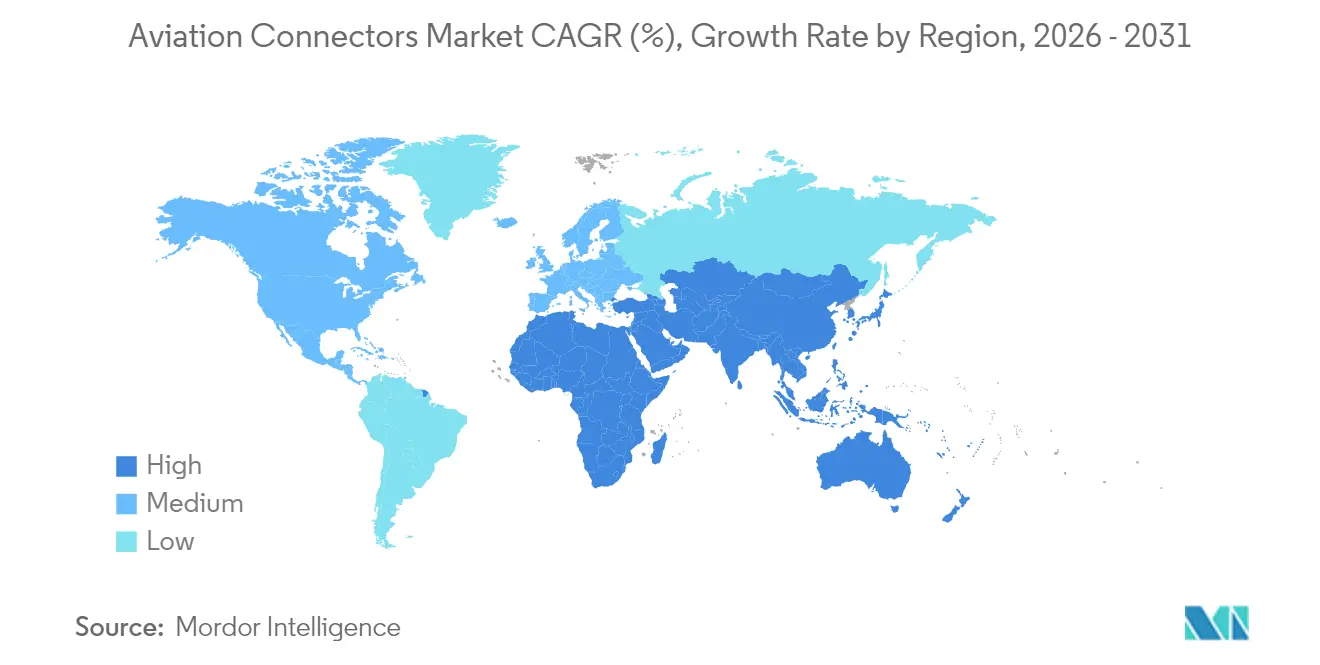
- By geography, North America led with 40.10% revenue in 2025, and Asia-Pacific is expected to register the fastest 8.52% CAGR through 2031.
Note: Market size and forecast figures in this report are generated using Mordor Intelligence’s proprietary estimation framework, updated with the latest available data and insights as of 2026.
Market Trends and Insights
Drivers Impact Analysis of Aviation Connectors Market*
| Driver | (~) % Impact on CAGR Forecast | Geographic Relevance | Impact Timeline |
|---|---|---|---|
| Growing Commercial Aircraft Fleet Expansion | +1.2% | Global, particularly Asia-Pacific and North America | Medium term (2-4 years) |
| Rising Demand for Lightweight Aircraft Electrical Systems | +0.9% | North America and Europe | Long term (≥ 4 years) |
| Proliferation of In-Flight Entertainment and Connectivity | +1.1% | Global, early adoption in North America and Middle East | Short term (≤ 2 years) |
| Increasing Adoption of More Electric Aircraft Architecture | +1.3% | Global, led by Airbus and Boeing programs | Long term (≥ 4 years) |
| Standardization of Modular Connector Interfaces by Aerospace OEMs | +0.5% | North America and Europe | Medium term (2-4 years) |
| Emergence of Urban Air Mobility Platforms Requiring High-Density Connectors | +0.7% | North America and Europe | Medium term (2-4 years) |
| Source: Mordor Intelligence | |||
Growing Commercial Aircraft Fleet Expansion
Global deliveries reached 1,180 jets through November 2024, and combined Airbus and Boeing backlogs now top 12,000 units, which locks in multi-year production visibility and secures a solid runway for the aviation connectors market. Asia-Pacific airlines absorb roughly 40% of new orders as traffic rebounds beyond 2019 levels, while single-aisle programs target sustained output rates above 60 jets per month. Each narrowbody contains about 1,200 connectors, and widebodies can exceed 2,500, so any production-rate uptick directly multiplies connector shipments. Lessors own more than half of the active fleet and increasingly specify standardized interfaces, encouraging OEMs to embed modular designs that streamline maintenance across varied operators. Cabin and cockpit retrofit programs for aging airframes further widen the installed base that needs periodic connector replacement.
Rising Demand for Lightweight Aircraft Electrical Systems
More Electric Aircraft configurations grow on the promise of 3-5% lower fuel burn and higher system reliability. Electric environmental control packs, ice-protection units, and flight-control actuators increase onboard generation from approximately 200 kVA on legacy types to over 1 MW on next-generation designs. [1] This shift increases connector counts by up to 60% per airframe and prompts suppliers to deliver housings in composite or aluminum-lithium alloys that help keep weight in check. Eaton’s power panels on the Boeing 787, for instance, integrate more than 1,500 high-power contacts rated for 270 VDC and 115 VAC, supported by advanced thermal paths that handle greater current density. [2] Research consortia in Europe have validated double-digit weight savings when aluminum is replaced with carbon-fiber-reinforced polymers, helping the case for high-performance composite shells.
Proliferation of In-Flight Entertainment and Connectivity
Satellite broadband evolved from a premium perk into an essential service. United Airlines committed to Starlink retrofits across over 1,000 aircraft in 2024, and each installation swaps roughly 900 legacy contacts for fiber optic terminations capable of multi-gigabit throughput. Panasonic’s Astrova platform runs 4K displays that require 10 Gbps fiber backbones, a ten-fold rise versus earlier copper architectures. Airlines monetize connectivity via tiered packages; sustained ancillary revenue reinforces quick retrofit payback, thereby accelerating demand. Fiber’s immunity to electromagnetic interference also harmonizes with increasingly electrified flight-control systems, reducing crosstalk risk inside densely packed cabins.
Increasing Adoption of More Electric Aircraft Architecture
High-voltage distribution on demonstrators such as NASA’s X-57 and Airbus’s earlier E-Fan initiatives has proven viable operation at 500-540 VDC, which demands arc-resistant contacts and expanded creepage distances.[3]Urban Air Mobility prototypes follow similar electrical baselines. Connectors with integrated liquid-cooling passages are transitioning from test rigs to serial production for eVTOL motor controllers, thereby creating a new premium niche. Standardization efforts under SAE AIR8484 are establishing pin-outs and data-protocol norms, which will, over time, enable OEMs to dual-source without extended requalification.
Restraints Impact Analysis of Aviation Connectors Market*
| Restraint | (~) % Impact on CAGR Forecast | Geographic Relevance | Impact Timeline |
|---|---|---|---|
| Existing Backlog of Aircraft Deliveries | -0.6% | North America and Europe | Short term (≤ 2 years) |
| Volatility in Raw Material Prices | -0.8% | Global | Short term (≤ 2 years) |
| Qualification Delays Due to Rigorous Certification Cycles | -0.4% | North America and Europe | Medium term (2-4 years) |
| Limitations of Legacy Aircraft Wiring Harness Designs in Retrofit Programs | -0.3% | Mature fleets worldwide | Long ter |
| Source: Mordor Intelligence | |||
Existing Backlog of Aircraft Deliveries
Production targets have slipped as engine supply, labor, and documentation issues restrict output. Boeing’s 737 MAX line stayed capped at 38 units per month for most of 2024, which defers connector shipments linked to later fuselage build stages. Airbus faced similar pacing on the A320neo family after powerplant inspection cycles slowed final assembly. Suppliers that built inventory against earlier rate assumptions now carry higher working capital, and their milestone-linked payments shift right, tightening near-term cash flow. Smaller tier-three firms are especially vulnerable because they lack program diversity and must wait for single-aisle ramps to recover.
Volatility in Raw Material Prices
Gold averaged USD 2,350 per ounce in 2024, up 27% year on year, raising the cost of mandatory contact plating that ensures low resistance in avionics backplane connectors. Copper touched USD 4.10 per pound, and silver remained volatile between USD 28 and USD 32, all of which erode margins when contracts lack price-adjustment clauses. Large groups use hedging to cover 60-70% of their annual exposure, but niche players often cannot offset swings, so profitability compression spurs consolidation or subcontracting to bigger brands.
*Our forecasts treat driver/restraint impacts as directional, not additive. The impact forecasts reflect baseline growth, mix effects, and variable interactions.
Aviation Connectors Market Segment Analysis
By Type:
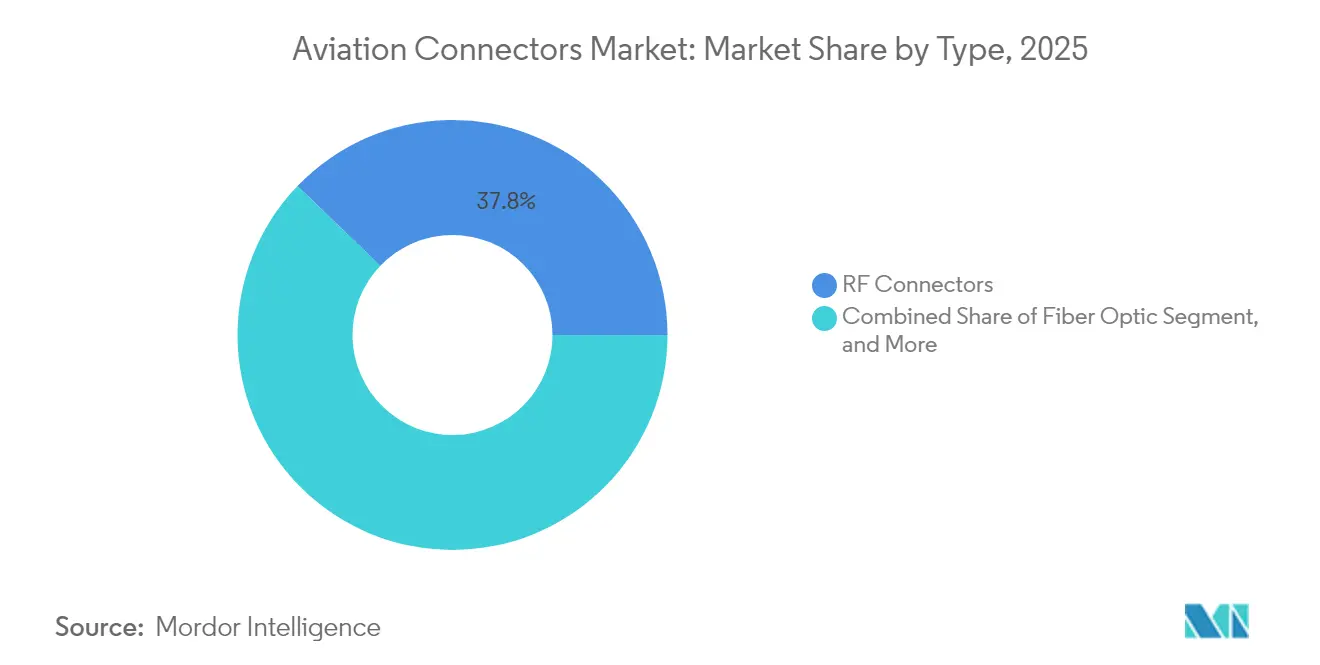
Fiber Optic Adoption Quickens as Bandwidth Demands SurgeRF interfaces account for the largest market share of 37.82% in 2025, as radar, satellite communication, and navigation systems require stable performance up to 40 GHz. Therefore, aircraft builders will continue to favor rugged coaxial lines in these applications. Printed circuit board connectors supporting AFDX and Time-Sensitive Networking within integrated modular avionics are migrating toward 1 Gbps and beyond, tightening impedance budgets that prompt suppliers to refine contact geometry. Fiber optic connectors are expanding at a 7.41% CAGR, faster than the aviation connectors market, as streaming-class entertainment, electronic flight bags, and predictive maintenance analytics move to higher bandwidth around the airframe. United’s 1,000-plus narrowbody Starlink campaign alone drives a requirement for more than 400,000 new fiber terminations by 2027.
The demand for fiber optics mirrors the shift from federated boxes to centralized network architectures. Collins Aerospace’s Pro Line Fusion utilizes optical backplanes to link processing clusters, reducing harness weight by nearly one-third while providing redundant paths that meet fail-safe mandates. RF connectors maintain their foothold in high-vibration areas, such as landing gear bays, whereas hybrid power-and-signal assemblies are gaining ground in emerging electric taxi systems. Overall, material advances and installer training are overcoming early pain points of fiber cleanliness and bend-radius control, so adoption will stay on a rising arc.

By Shape:
Circular Connectors Retain Primacy Because of Environmental SealingCircular interfaces accounted for 56.10% of the 2025 turnover and are predicted to increase by 6.85% annually through 2031. Their inherent 360-degree EMI shielding, threaded coupling, and IP67 sealing are suited for wing root zones, engine pylons, and wheel wells, where fluids, temperature swings, and vibration converge. Rectangular devices thrive in dense avionics racks where board-to-board space runs tight; still, those housings rely on secondary gasketing for moisture protection, so inspection intervals end up shorter, raising the cost of ownership.
Composite circular shells approved to AS85049 cut weight by about 35% compared with aluminum while slotting into identical panel cutouts, an attribute fleet operators prize because it avoids harness redesign. Rectangular styles win incremental use in power distribution units where blade contacts carry over 100 A per position. On Urban Air Mobility demonstrators, both shapes coexist: round cases carry motor current, and slim rectangles ferry sensor data and battery telemetry inside tight nacelles. This blended architecture should increase overall connector counts and expand revenue for suppliers that can integrate varied geometries into a single module.
By Application:
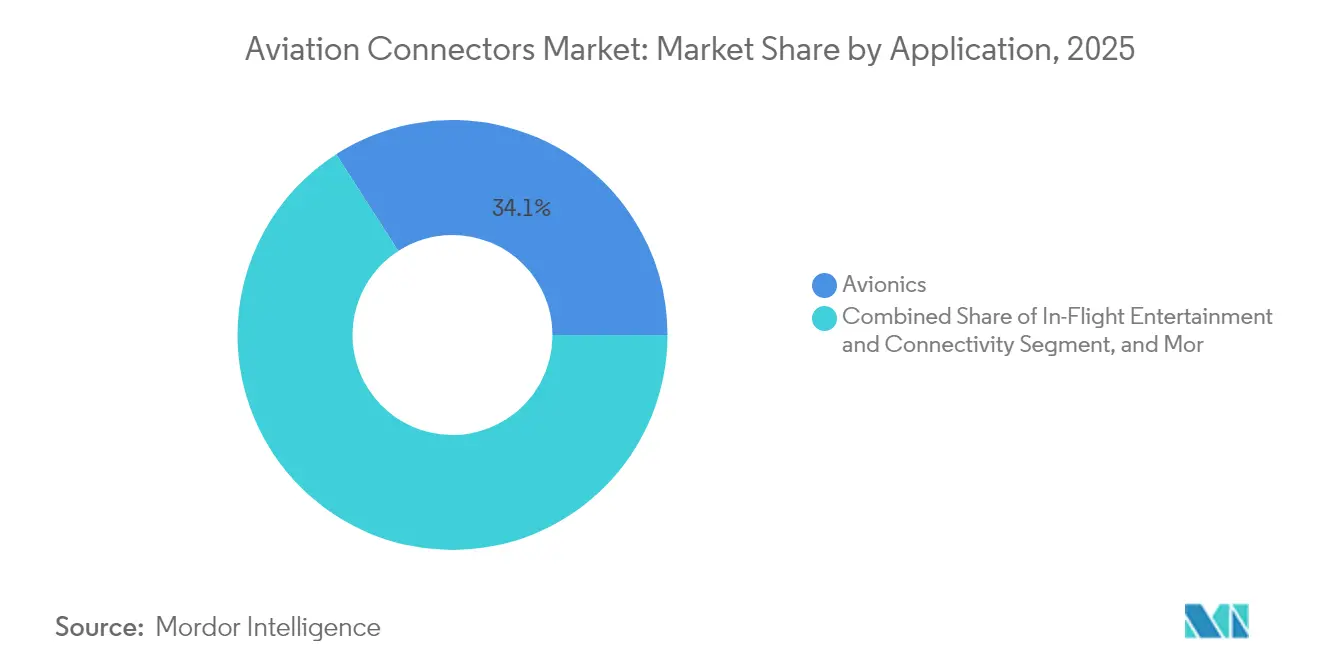
Avionics Still Lead but In-Flight Entertainment AcceleratesAvionics accounted for 34.10% of 2025 sales as flight-critical computers, navigation boxes, and surveillance radars require high-reliability multi-path wiring. Each widebody features approximately 300 avionics connectors per bay, all of which are qualified to DO-160G environmental standards. Meanwhile, in-flight entertainment and connectivity are increasing at a market-beating 7.76% CAGR, as airlines see a direct return from ancillary Wi-Fi revenue. Panasonic’s Astrova launch, featuring 4K OLED screens, establishes 10 Gbps optical links as the new baseline and extends data-grade connectors even into seat-back assemblies.
Power distribution harnesses grow as electrical loads rise beyond 1 MW on future twin-aisles. High-current circular plugs rated to 270 VDC move into proximity with integrated cooling loops to manage temperature rise, a design factor that can increase connector unit cost by 40% compared to air-cooled equivalents. Landing gear, lighting, and galley systems utilize LED drivers and brake-by-wire modules, which eliminate some legacy copper wiring but introduce digital loops to monitor health in real-time. Hence, the net effect remains an upward trajectory in connector value per aircraft despite some consolidation of sub-systems.
By End User:
OEM Channels Dominate but Aftermarket Gathers PaceOriginal equipment manufacturers generated 62.20% of 2025 revenue, driven by robust handovers from Airbus and Boeing. A single 787 or A350 integrates more than 2,500 connectors spanning avionics, cabin, and power domains. Automated assembly lines that produce 10,000 parts per day provide tier-one vendors with efficiency and help them secure long-term pricing.
The aftermarket, though smaller, is posting a 6.74% CAGR. The global fleet age for narrowbodies now averages just under 12 years, which prompts heavy checks earlier in the decade and triggers mandatory connector replacement when plating wear or insulation discoloration appears. Parts Manufacturer Approval suppliers offer 20-30% cost savings while meeting identical FAA TSO specifications. Airlines mix PMA and OEM units carefully to protect residual values, yet rising maintenance events guarantee a growing serviceable-material flow that benefits distributors stocking broad legacies.
By Platform:
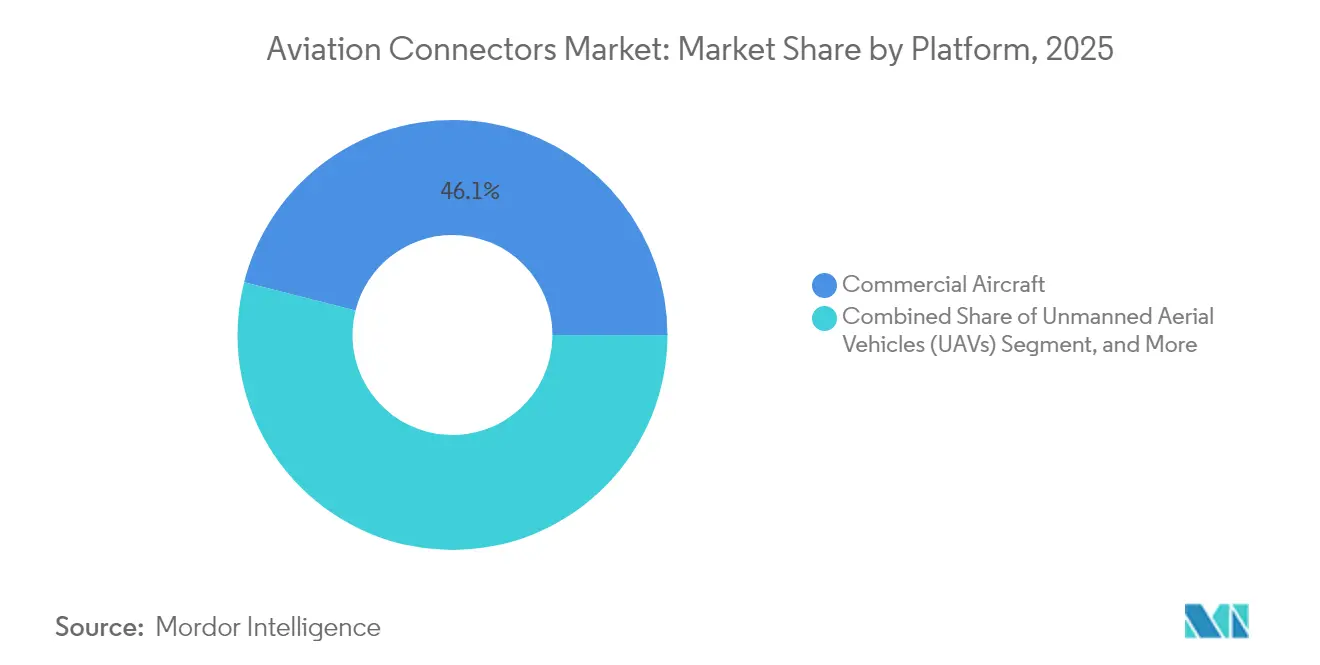
Commercial Jets Hold the Pot, UAVs Deliver Fastest GrowthCommercial aircraft platforms were responsible for 46.05% of 2025 demand, primarily driven by single-aisle programs that aim for monthly output exceeding 60 frames. Each narrowbody requires approximately 1,300 connectors across all systems, and incremental cabin options increase the bill-of-materials value. Military jets, such as the F-35, consume over 3,000 points of interconnect due to their dense electronic warfare and sensor suites, and deliveries remained above 140 units in 2024, providing a stable premium niche.
Unmanned aerial vehicles show a 7.82% CAGR as defense ministries allocate higher budgets to intelligence and strike capabilities. India’s 31-unit MQ-9B purchase in 2024 marked a shift toward long-endurance drones equipped with satellite links, utilizing rugged Micro-D and circular nano connectors. Business jets are adopting high-speed Ethernet for real-time cabin management, increasing connector content per aircraft by roughly 40% compared to earlier models. Helicopters and regional transports continue to modernize legacy wiring with AFDX upgrades, driving replacement sales even in modest production climates.
By Material:
Aluminum Alloys Still Predominate while Composites AdvanceAluminum shells kept a 41.05% foothold in 2025 thanks to their balance of machinability, strength, and cost, but composites and high-performance polymers are advancing at a 6.82% CAGR. Carbon-fiber-reinforced PEEK housings weigh a third less than equivalent aluminum units yet survive 15 Grms vibration when bonded with metallic insets. Stainless steel reserves its role in engine mounts where continuous temperatures exceed 200 °C, although its density nearly triples the airframe weight contribution per connector.
Aluminum-lithium alloys offer an additional 10% mass reduction and are already featured in A350 structures. However, connector adoption is slower due to raw ingot costs that are three to four times higher than those of standard 6061. Nevertheless, weight-critical wing sensors have begun to justify the premium. Titanium and magnesium remain niche for severe-load conditions or electromagnetic shielding, and additive manufacturing is emerging as a route to lower waste on these expensive metals, potentially unlocking future share gains.
Geography Analysis
North America Aviation Connectors Market
North America captured 40.10% of 2025 revenue, powered by Boeing’s 737 MAX and 787 lines plus Lockheed Martin’s F-35 final assembly operations. Connector majors cluster production in Mexico, taking advantage of labor costs that are approximately 60% lower than those in the domestic U.S. and leveraging near-shoring resilience under the USMCA. The region also benefits from strong defense spending that underwrites high-reliability interfaces for next-generation fighters and missile systems.
Europe Aviation Connectors Market
Europe maintains a rich aerospace ecosystem, with Airbus delivering 643 jets through November 2024 and complementing military output from Dassault and Leonardo. Regulatory harmonization under EASA simplifies multi-country sourcing, although post-Brexit dual certification adds extra lead time for U.K. facilities. Extensive wide-body fleets at European flag carriers generate recurring demand for retrofitting fiber optic upgrades inside cabins.
APAC Aviation Connectors Market
Asia-Pacific is the fastest-growing region at an 8.52% CAGR. COMAC’s C919 achieved eight deliveries in 2024 and targets 150 annually by 2028, while India’s new C295 line shipped its first transport aircraft in September 2024. Domestic supply-chain development policies in both nations drive aggressive local connector qualification programs, though high-reliability gaps still leave room for Western vendors. Fleet expansion across low-cost carriers and MRO capacity additions assure vibrant aftermarket growth, especially as cabin-connectivity retrofits scale throughout the decade.
Regulatory Landscape
Aviation connectors used in flight-critical wiring operate under tightly controlled qualification and certification regimes that emphasize environmental robustness, traceability, and repeatability. In defense and other harsh-environment aerospace applications, MIL-DTL-38999 remains a core circular-connector specification, with Qualified Products List (QPL) status and periodic re-qualification creating a high barrier to entry and shaping supplier selection, particularly for safety-critical interconnects.
On the civil side, FAA and EASA certification frameworks drive connector and harness compliance through aircraft-level requirements, including EWIS discipline and environmental testing aligned to DO-160G use cases. While harmonization efforts aim to reduce duplicate compliance work across jurisdictions, EASA issued CS-23 Amendment 6 with associated AMC and GM updates on May 5, 2026, reinforcing alignment with FAA-accepted means of compliance such as ASTM International F44 consensus standards for normal-category aeroplanes. Trade policy also became a planning variable in 2026: a July 9, 2026 US proclamation directed negotiations on imports of commercial aircraft, jet engines, and related parts, while declining to immediately impose Section 232 tariffs, which keeps a defined negotiation window on duty exposure that suppliers factor into procurement and supply-chain planning.
Value Chain Analysis
The aviation connectors value chain starts with raw and processed inputs such as copper and precious metals for contacts and plating, notably gold, alongside aluminum alloys, stainless steel, and high-performance polymers and composites for shells and insulators. Connector manufacturers then carry out precision machining or molding, plating, assembly, and qualification testing, before integrating into harnesses and subassemblies that flow to airframers, avionics and cabin-system integrators, and military platform primes. Certification-driven documentation and test capability, including environmental, vibration, EMI/HIRF, and traceability, remains a differentiator that tends to favor established suppliers and extends lead times when programs ramp.
Downstream, distribution and service channels have an outsized role in supporting the aftermarket, spares availability, and approved alternates. Consolidation and portfolio expansion are used to broaden high-reliability offerings, illustrated by Molex agreement to acquire AirBorn in November 2024 and Avnet becoming an authorized distributor for AirBorn connectors across EMEA and the Americas in September 2025. Aftermarket reach is also supported by distributor agreements, including FDH Electronics expanding its arrangement with Cinch Connectivity Solutions in June 2025 to cover assemblies used for aircraft fuel quantity indication and other support needs. Regional sourcing shifts, including increased parts sourcing from India highlighted in early 2025, and announced pricing actions by major connector suppliers effective January 2026 in response to input-cost inflation, highlight how material volatility and capacity constraints propagate through procurement and contracting.
Competitive Landscape
Competition sits at a moderate fragmentation. Amphenol’s USD 2 billion purchase of Carlisle Interconnect in May 2024 combined two leading harsh-environment portfolios, nudging the acquirer’s aerospace exposure to roughly 17% of consolidated revenue and reinforcing scale leverage across material sourcing and test labs. Eaton Aerospace posted USD 1.079 billion in Q3 2025 sales and secured a 25.9% operating margin, thanks to sole-source positions on Boeing 787 and Airbus A350 power panels, which shielded prices.
Technology rivalry centers on miniaturization, high-current density, and weight reduction. Glenair’s composite MIL-DTL-38999 shells trim mass by more than one-third while maintaining drop-in interchangeability, resulting in premium pricing on retrofit lines. Additive manufacturing specialists pursue titanium housings with internal EMI labyrinths that conventional machining cannot deliver, though certification cycles of 18-36 months still favor incumbents with established DER relationships at FAA and EASA. New entrants often carve out niches in urban air mobility prototypes, where connector specifications continue to evolve, offering a window for differentiated hybrid power and signal modules.
Regional supply strategies also shape rivalry. Amphenol, TE Connectivity, and Radiall have expanded Mexican and North African plants to diversify beyond China and align with near-shoring incentives. At the same time, Chinese and Indian policy makers push localization, but complex plating and precision machining processes keep barriers high. Overall, established brands leverage multi-decade qualification pedigree to defend share even as emerging programs open pockets of greenfield demand.
Aviation Connectors Industry Leaders
-
Amphenol Corporation
-
TE Connectivity Ltd.
-
Eaton Corporation
-
Smiths Group PLC
-
Carlisle Companies Inc.
- *Disclaimer: Major Players sorted in no particular order

Aviation Connectors Market Companies Covered in this Report
- Amphenol Corporation
- TE Connectivity Ltd
- Eaton Corporation plc (Souriau-Sunbank)
- Radiall SA
- ITT Inc
- Smiths Group plc (Smiths Interconnect)
- Rosenberger Hochfrequenztechnik GmbH and Co KG
- Carlisle Companies Inc (Carlisle Interconnect Technologies)
- Conesys Inc
- Glenair Inc
- Fischer Connectors SA
- Axon Cable SA
- Harwin plc
- Bel Fuse Inc
- JST Manufacturing Co Ltd
- PEI-Genesis Inc
- Hirose Electric Co Ltd
- Sabritec (Glenair)
- LEMO SA
- Phoenix Contact GmbH and Co KG
Market Opportunities and Future Outlook
The strongest opportunity is in high-speed, high-density interconnects that support the move toward fiber-rich cabin and avionics networks, where multi-gigabit backbones and optical terminations replace legacy copper in portions of the aircraft. Panasonic Avionics Astrova deployments using 10 Gbps optical interfaces, along with large-scale airline retrofit programs such as United Airlines Starlink installations (over 1,000 aircraft committed in 2024), reinforce demand for fiber-capable connector ecosystems, installation tooling, and contamination-control processes across OEM and MRO channels. Airbus work to future-proof connected aircraft and its SpaceRAN in-orbit demonstrator (launched in January 2026) also points to hybrid connectivity pathways, which raises the emphasis on robust RF, power, and data interfaces that can operate in high-EMI environments.
Manufacturing capacity and component-level enabling technologies offer additional whitespace for suppliers serving aerospace-qualified interconnects. Announced investments including JSTs plan for a USD 500 million automated connector manufacturing facility in Guntersville, Alabama (April 2026) show the scale of automation being added to support specialized connector demand across transportation end markets. Upstream capacity expansion also contributes, such as Furukawa Electric planning to build Ishikawa Plant 2 to increase mass production of TMT ferrules for VSFF multi-fiber connectors (June 2026), which supports the connector ecosystem needed for high-density optical interconnects. On the platform side, electrified architectures and higher-power distribution increase demand for arc-resistant, high-current connectors and thermal-management features, while distributor expansion and authorized-channel growth support serviceability for airlines and defense operators managing long qualification cycles and constrained availability.
Recent Industry Developments in Aviation Connectors Market
- April 2026: Molex completed its acquisition of Smiths Interconnect (formerly part of Smiths Group) to broaden high-reliability connectivity offerings and add complementary capabilities including semiconductor test-related connectivity. The deal strengthens Molex positioning in aerospace and defense programs that prioritize qualified interconnect portfolios and long-term supply assurance, while also increasing competitive pressure on incumbent connector groups with established MIL and avionics footprints.
- January 2026: Eaton completed the acquisition of Ultra PCS Limited from Cobham Ultra Group for USD 1.55 billion, expanding its aerospace and defense mission-systems portfolio. By bringing additional rugged electronics and subsystem capabilities in-house, Eaton gains more integration leverage across aircraft electrical architectures where connector specifications and qualification evidence are tightly coupled to system design and supportability.
- May 2024: Amphenol completed the acquisition of the Carlisle Interconnect Technologies (CIT) business from Carlisle Companies for USD 2.025 billion. The transaction consolidated two major harsh-environment interconnect portfolios, increasing scale in aerospace-grade circular and rectangular connector lines and improving purchasing and qualification-lab leverage for programs facing long certification and documentation cycles.
Aviation Connectors Market Report Scope and Research Methodology
Market Definition and Coverage
This market covers electrical and data connectors purpose-built for aircraft and aviation platforms, where reliable signal and power transfer is needed across onboard systems and wiring networks.
Scope exclusions: standalone aircraft wire and cable assemblies, and general industrial connectors sold without aviation qualification, are excluded from this sizing.
Segments Covered in This Report
- By Type
- PCB (Printed Circuit Board)
- RF Connectors
- Fiber Optic
- Other Types
- By Shape
- Circular
- Rectangular
- By Application
- Avionics
- Power Distribution
- Lighting Systems
- Cabin Management
- Landing Gear
- In-Flight Entertainment and Connectivity
- By End User
- Original Equipment Manufacturer (OEM)
- Aftermarket
- By Platform
- Commercial Aircraft
- Military Aircraft
- Business Jets
- Helicopters
- Unmanned Aerial Vehicles (UAVs)
- By Material
- Aluminum Alloys
- Stainless Steel
- Composite and Polymer
- Other Materials
- By Geography
- North America
- United States
- Canada
- Mexico
- South America
- Brazil
- Argentina
- Rest of South America
- Europe
- Germany
- United Kingdom
- France
- Spain
- Rest of Europe
- Asia-Pacific
- China
- India
- Japan
- South Korea
- ASEAN
- Rest of Asia-Pacific
- Middle East and Africa
- Middle East
- Saudi Arabia
- United Arab Emirates
- Turkey
- Rest of Middle East
- Africa
- South Africa
- Nigeria
- Kenya
- Rest of Africa
- Middle East
- North America
Data Sources, Market Sizing, and Validation
Desk Research
Desk research starts by mapping the demand base and supply structure for aviation connectors, then anchoring it to observable aviation activity. Public sources such as FAA fleet and airworthiness information, EASA publications, ICAO air transport statistics, and aircraft delivery and backlog disclosures from major airframe programs are used to set realistic volume and utilization ranges.
To avoid overcounting, connectors are tied back to aircraft electrical architecture and typical replacement cycles. We use sources such as SAE technical papers and IEEE journals, and where available, defense and civil procurement notices to cross-check how often specific connector categories show up across programs.
We also review company filings, investor presentations, and reputable trade press to validate product mix language and end-market exposure. Paid subscriptions are used selectively for company financials, patent databases, and aerospace and aviation databases that provide aircraft and program-level context. These desk sources are illustrative only, and many other public references were also used for data collection, validation, and clarification.
Primary Interviews and Surveys
Primary inputs were collected through expert interviews and structured surveys with connector manufacturers, aircraft component integrators, and maintenance and overhaul stakeholders. This clarified pricing direction and how aftermarket replacement patterns differ by aircraft program and maintenance planning approach. Because the market is global, feedback was balanced across major aviation regions so the model assumptions could be rechecked against different fleet profiles and build rates.
Distribution of primary research fieldwork respondents
| Company type | Respondent position | Region |
|---|---|---|
| Top tier: 27% | CXOs: 13% | APAC: 41% |
| Mid tier: 51% | Functional/Unit leaders: 43% | EMEA: 35% |
| Smaller Players: 22% | Managers: 44% | Americas: 24% |
Market-Sizing & Forecasting
Sizing is built using a top-down approach where aircraft production, fleet size, and maintenance activity are translated into connector demand pools by platform and by typical usage intensity. Inputs that commonly matter include aircraft deliveries and backlog movement, in-service fleet by platform class, flight hours that influence replacement needs, OEM versus aftermarket shares, and average selling price ranges by connector type (such as PCB, RF, and fiber optic).
Once the demand pools are set, we corroborate totals using selective bottom-up approximations, such as sampling revenues that are clearly tied to aerospace connectors, checking implied connector content per aircraft program, and validating price progression through channel and MRO feedback. Where supplier-level disclosures are incomplete, gaps are handled through conservative mix assumptions that are cross-checked with patent activity, product certification signals, and management commentary.
For forecasting, scenario analysis is used around aircraft build rates and aftermarket intensity, then the path is smoothed using time-series checks so short-term swings do not distort the long-term view. Assumptions are revisited until the outputs align with what interviewees consider feasible under current program ramps and supply constraints.
Data Validation & Update Cycle
Validation is done by triangulating the model against independent signals, including aircraft delivery trajectories, fleet utilization trends, and known maintenance cycles, then checking whether the implied connector spend per aircraft stays within reasonable bands. Outliers are flagged early, and we recheck the underlying variables, currency timing, and any unusual step changes before the numbers move forward for review.
A multi-step analyst review is followed so calculation logic, unit conversions, and segment totals are consistent. Large variances trigger targeted re-contact with selected respondents. Reports are refreshed annually, and interim updates are made when material events occur, such as major program rate changes or regulatory-driven retrofit waves. Before delivery, a final pass is completed so clients receive the most current view available at that time.
Mordor Intelligence's Aviation Connectors Market Size Compared Against Other Published Estimates
Published market values for aviation connectors can differ because each study draws the line around what counts as an aviation connector and which revenue streams are counted in the same year. Differences also come from how OEM build activity and aftermarket replacement are weighted, and how price changes are carried forward when input costs and mix shift.
Cable assemblies and harness kits are excluded from the connector totals, and that item sits outside Mordor Intelligence's scope, which is one reason our 2026 value can look lower than estimates that bundle interconnect subsystems together. The other common driver is timing, since some publishers anchor to a 2024 base year and then apply a higher growth rate without rechecking it against delivery schedules and flight-hour driven replacement math.
Benchmark comparison
| Source | Market Size | Gaps in Research Methodology |
|---|---|---|
| Mordor Intelligence | USD 6.14 B (2026) | |
| Global Consultancy A | USD 5.60 B (2024) | Uses an earlier base year and a higher growth run-rate, which can lift the implied 2026 value if aircraft delivery ramps are not reconciled with realistic retrofit and replacement cycles. |
| Industry Publisher B | USD 8.54 B (2024) | Likely counts adjacent interconnect content beyond connectors, and may apply broader application inclusion that inflates totals when wiring, cable, or subsystem value is grouped under the same heading. |
The comparison shows that year selection and adjacent-product inclusion explain most of the spread. By keeping the demand pool tied to aircraft production, in-service usage, and aftermarket replacement logic, the final total stays traceable to clear drivers that can be rechecked when fleet and build assumptions change.
Key Questions Answered in the Report
What is the current value of the aviation connectors market?
The aviation connectors market size stands at USD 6.14 billion in 2026.
How fast is demand expected to grow over the forecast period?
Market value is projected to rise to USD 7.99 billion by 2031, delivering a 5.39% CAGR over 2026-2031.
Which connector type is expanding the quickest?
Fiber optic connectors are forecast to advance at a 7.41% CAGR thanks to rising on-board data-rate needs.
Why is Asia-Pacific the fastest-growing region?
COMAC C919 production, India’s new military transport lines, and expanding low-cost-carrier fleets drive an 8.52% CAGR in the region.
How does electrification influence connector demand?
More Electric Aircraft architectures lift electrical loads above 1 MW per widebody, increasing both connector counts and current-carrying requirements.
Which companies dominate global supply?
Amphenol, TE Connectivity, Eaton, Radiall, and ITT collectively account for about 55-60% of total revenue.