
Automotive On-board Charger Market Size and Share
Market Overview
| Study Period | 2019 - 2031 |
|---|---|
| Market Size (2026) | USD 8.17 Billion |
| Market Size (2031) | USD 15.68 Billion |
| Growth Rate (2026 - 2031) | 13.93 % |
| Fastest Growing Market | Asia-Pacific |
| Largest Market | Asia-Pacific |
| Market Concentration | Medium |
Major Players *Disclaimer: Major Players sorted in no particular order Image © Mordor Intelligence. Reuse requires attribution under CC BY 4.0. | |
Automotive On-board Charger Market Analysis by Mordor Intelligence
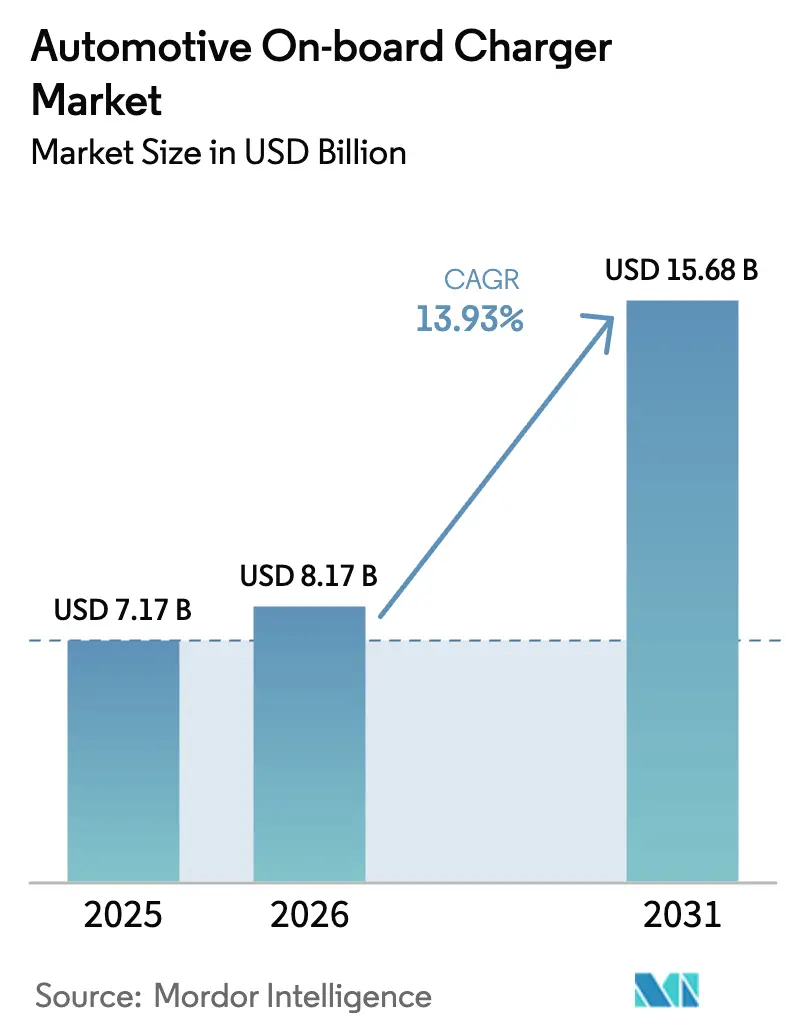
The automotive on-board charger market size is expected to grow from USD 7.17 billion in 2025 to USD 8.17 billion in 2026 and is forecast to reach USD 15.68 billion by 2031 at 13.93% CAGR over 2026-2031. Growing preference for higher-power AC charging, wider adoption of bidirectional functionality, and falling wide-band-gap semiconductor costs are aligning vehicle architectures and grid-integration roadmaps worldwide. Battery-electric models dominate demand, three-phase residential connections in Europe and parts of Asia are accelerating the shift toward 22 kW charging, and regulators on three continents now embed vehicle-to-grid readiness into funding rules. Silicon-carbide and gallium-nitride devices are squeezing inverter and charger footprints, enabling Tier-1 suppliers to fold 22 kW capability into 3-in-1 e-axles sold to both passenger and commercial OEM programs. At the same time, depot-based AC charging strategies among bus and delivery fleets are spurring specification upgrades that keep overnight charging windows under six hours without the demand-charge penalties associated with ultra-fast DC hubs.
Key Report Takeaways
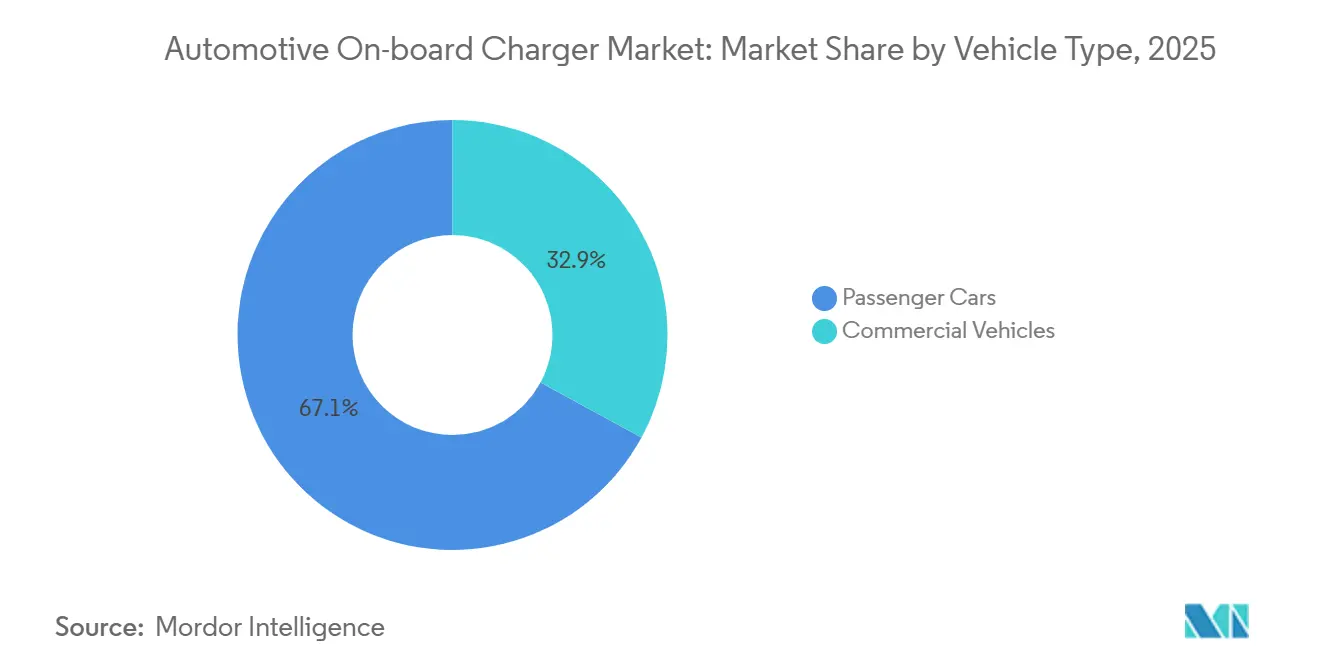
- By vehicle type, passenger cars accounted for 67.10% of the automotive on-board charger market share in 2025, whereas commercial vehicles are forecast to expand at 14.42% CAGR to 2031.
- By powertrain type, battery-electric vehicles led with 75.33% revenue share in 2025, and are advancing at a 15.48% CAGR through 2031.
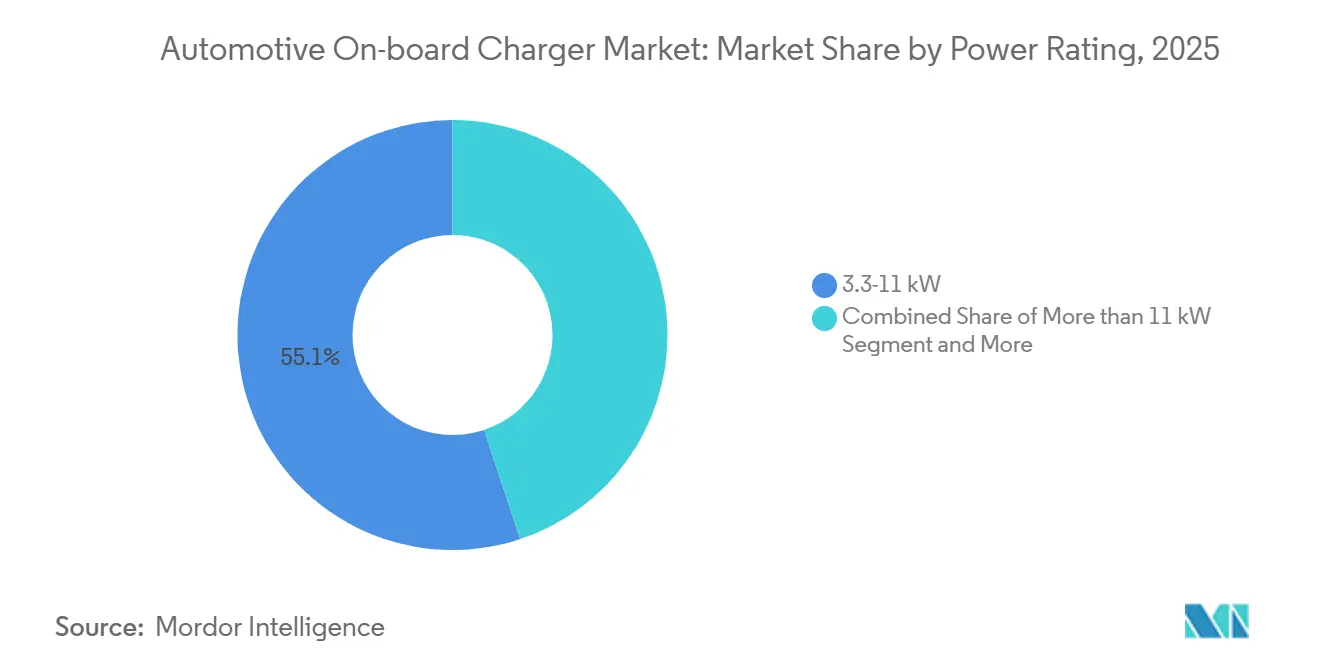
- By power rating, the 3.3-11 kW band captured 55.12% of 2025 revenue, but chargers above 11 kW are projected to grow at 14.71% CAGR over the same period.
- By sales channel, OEM-installed units represented 84.25% of 2025 shipments, yet the aftermarket is rising at 15.75% CAGR on retrofit demand across early-generation EVs.
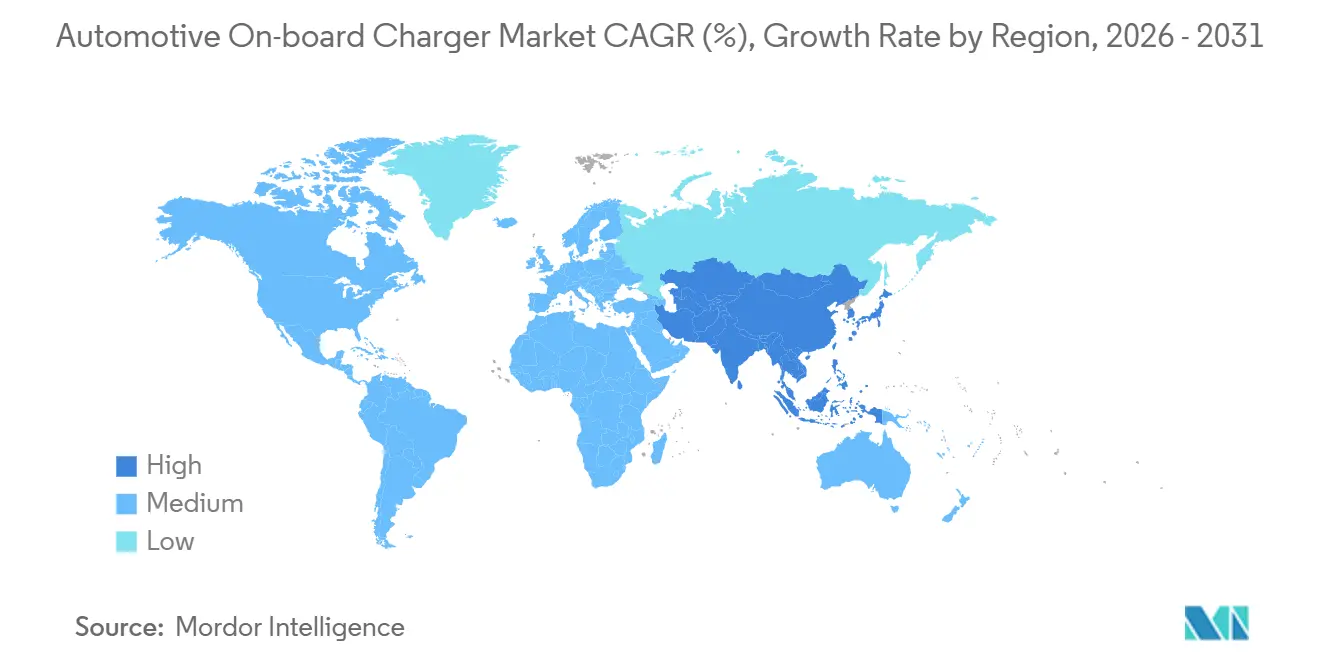
- By geography, Asia-Pacific held 39.05% share in 2025 and is set to record the fastest regional growth at 15.02% CAGR to 2031, propelled by China’s localization mandates and India’s FAME-II incentives.
Note: Market size and forecast figures in this report are generated using Mordor Intelligence’s proprietary estimation framework, updated with the latest available data and insights as of 2026.
Market Trends and Insights
Drivers Impact Analysis of Automotive On-board Charger Market*
| Driver | (~) % Impact on CAGR Forecast | Geographic Relevance | Impact Timeline |
|---|---|---|---|
| EV Adoption and Purchase Incentives | +3.2% | China, Europe, California | Medium term (2-4 years) |
| Switch to 800 V Architectures | +2.8% | Europe, China, North America premium | Medium term (2-4 years) |
| Declining SiC/GaN Prices | +2.1% | Asia-Pacific manufacturing hubs | Short term (≤ 2 years) |
| Plug-&-Charge and V2G Readiness | +1.9% | Europe, United States, Asia-Pacific export platforms | Long term (≥ 4 years) |
| Traction-Integrated and Bidirectional OBCs | +1.7% | Global premium and commercial | Long term (≥ 4 years) |
| PV-Integrator Channel in Emerging Markets | +1.4% | India, Southeast Asia, Brazil, Middle East | Long term (≥ 4 years) |
| Source: Mordor Intelligence | |||
Aggressive Global EV Adoption Targets and Purchase Incentives
Governments are front-loading subsidy budgets and tightening fleet CO₂ rules, forcing automakers to standardize 11 kW or higher chargers so vehicles qualify for evolving incentive tiers. The EU’s 2035 internal-combustion ban spurred volume brands to future-proof models with bidirectional-ready hardware [1]. China kept its New Energy Vehicle rebates through 2025 and excludes 3.3 kW designs from higher rebate brackets, while California’s Advanced Clean Cars II regulation is nudging several other United States states toward a de facto nationwide zero-emission sales mandate. India’s FAME-II extension channels significant investment into vehicles that embed domestic, bidirectional-capable chargers. Together, these policies compress product-cycle timelines and shift demand toward power-dense, protocol-rich chargers that accommodate future grid-services revenue streams.
Rapid Switch to 800 V Vehicle Architectures Enabling 11-22 kW OBCs
High-voltage platforms decouple AC charge time from battery size, letting 90 kWh packs add 22 kW home charging without oversizing cables or cooling loops. Porsche’s Taycan validated consumer appetite for premium AC performance, and Hyundai’s 2024 E-GMP rollout pushed 22 kW chargers into mid-segment sedans. GM’s Ultium migration to 800 V from 2027 aligns pickup and SUV families around 19.2 kW AC capability, while BYD’s e-Platform 3.0 integrates an 11 kW bidirectional charger inside the drive inverter, trimming underbody space and lowering parts count. Europe reaps the most benefit because three-phase 400 V home service is standard; North America’s single-phase limits keep adoption to 11 kW, yet premium fleets still value the reduced thermal losses of 800 V silicon-carbide designs.
Declining SIC/GAN Device Prices Lifting OBC Power Density
Wide-band-gap transistor prices fell significantly from 2024-2025, pushing SiC cost parity with silicon when cooling and passives are counted. Infineon’s CoolSiC line doubled shipments, ON Semiconductor monolithically integrated gate drivers, and Wolfspeed forecasts a significant wafer-price drop by 2027. GaN devices trail in cost yet lead in sub-11 kW form factors where 500 kHz switching shrinks magnetics. Automakers that once reserved SiC for halo trims now plan single-supply chains that amortize qualification costs across volume models, reinforcing the learning curve that further compresses price gaps.
Mandatory ISO 15118 / Plug-&-Charge and V2G Readiness Clauses in EU and US Funding Schemes
The European Alternative Fuels Infrastructure Regulation locks in ISO 15118-20 for all public AC posts by 2025, embedding secure authentication and bidirectional negotiation at the protocol layer. The U.S. National Electric Vehicle Infrastructure program requires bidirectional readiness for grant-funded chargers by 2025. These mandates ripple into vehicle bills-of-materials because incompatibility strands investment. OEMs are therefore synchronizing charger firmware and cybersecurity stacks in parallel with hardware upgrades, pulling forward development programs that had once been slated for the 2030 model year.
Restraints Impact Analysis of Automotive On-board Charger Market*
| Restraint | (~) % Impact on CAGR Forecast | Geographic Relevance | Impact Timeline |
|---|---|---|---|
| Wide-Band-Gap Substrate Costs | −1.8% | Global cost-sensitive segments | Medium term (2-4 years) |
| Hesitancy to Up-Spec AC Chargers | −1.5% | North America, Europe, China tier-1 cities | Short term (≤ 2 years) |
| Bottlenecks for Residential Upgrades | −1.1% | Europe urban centers, Japan, Korea, United States Northeast | Medium term (2-4 years) |
| Scrap-Recycling Regulation in China | −0.9% | China, potential Asia-Pacific spillover | Long term (≥ 4 years) |
| Source: Mordor Intelligence | |||
Persistently High Wide-Band-Gap Substrate Costs in 22 kW Three-Phase OBCs
In early 2026, six-inch SiC wafers were significantly more expensive than their silicon counterparts, leading to a notable cost premium for each 22 kW charger. While projections for 200 mm lines suggest a reduction in substrate costs by 2028, the current price gap confines high-power AC hardware to premium models. Meanwhile, Chinese Tier-2 suppliers explored low-frequency silicon solutions, but these resulted in a density drop below acceptable thresholds, making them unsuitable for compact platforms.
OEM Hesitancy to Up-Spec AC Chargers as DC Ultra-Fast (≥350 kW) Roll-Outs Accelerate
With Electrify America, Tesla, and IONITY saturating corridors with 350 kW posts, consumers are increasingly favoring en-route charging over home charging. A 2025 survey by the U.S. DOE revealed that buyers prioritize DC availability over Level 2 speed. In response, OEMs have halted upgrades to 11 kW specs and are channeling capital expenditures towards 800 V battery packs. This shift highlights the growing importance of ultra-fast charging infrastructure in shaping consumer behavior and influencing OEM strategies. Additionally, the increasing adoption of electric vehicles (EVs) is driving demand for faster and more efficient charging solutions, further accelerating the transition to DC ultra-fast chargers. As a result, the automotive on-board charger market is undergoing significant changes to align with evolving industry trends.
*Our forecasts treat driver/restraint impacts as directional, not additive. The impact forecasts reflect baseline growth, mix effects, and variable interactions.
Automotive On-board Charger Market Segment Analysis
By Vehicle Type:
Commercial Fleets Drive Specification UpgradesPassenger cars held 67.10% of 2025 shipments due to higher unit volumes, yet fleet procurement policies are tilting the momentum. Electric buses and last-mile vans equip 22 kW chargers to trim pack sizes by 100 kWh, saving significantly in battery cost per vehicle. Commercial vehicles are set to expand with the fastest growth at a 14.42% CAGR through 2031. Depot operators such as Amazon have validated 11 kW as their optimum trade-off between panel upgrade expense and overnight availability, influencing van OEMs to offer dual ratings. This interplay keeps the automotive on-board charger market diversified across duty cycles.
Ride-hail operators in Europe increasingly specify 11 kW-capable sedans so drivers can top up during shift changes; Tesla reports that a notable share of its 2025 European Model 3 sales went to such fleets. In heavy commercial, Proterra’s 19.2 kW AC solution allows midday top-ups without megawatt-scale infrastructure, an approach now mirrored by BYD’s eBus line in Latin America. These cases show how operational cost modeling, not just regulatory pressure, is reshaping charger choices.
By Powertrain Type:
BEVs Anchor Demand, PHEVs StabilizeBattery-electric vehicles represented 75.33% of 2025 revenue and will rise at 15.48% CAGR through 2031, underscoring their role as the core value pool of the automotive on-board charger market. Carmakers are converging on 11 kW as the baseline, with Tesla, Volkswagen, and GM overlaying software packages that later activate bidirectional functions for grid-services compensation. Plug-in hybrids retain a separate supply chain around 3.3-7.4 kW silicon designs that meet overnight charging needs for 20 kWh batteries, and updated EU CO₂ credits now push plug-in hybrid electric vehicle packs toward 30 kWh, nudging charger ratings up to 7.4 kW. Yet the incremental cost of 11 kW hardware still outweighs fleet-tax incentives in many markets, so the automotive on-board charger industry maintains dual product tiers to balance affordability and regulatory compliance.
A second dynamic shaping this segment is residual-value retention. Leasing companies in Germany report that BEVs equipped with 22 kW chargers command higher resale than 11 kW peers after four years, accelerating adoption among corporate fleets that optimize total cost of ownership. In contrast, North American suburban buyers show price sensitivity above 11 kW because single-phase home circuits seldom benefit, reinforcing regional divergence in charger specifications. As a result, the automotive on-board charger market size for plug-in hybrids is forecast to expand by 2031, whereas BEVs could grow further, keeping program volumes high enough for suppliers to amortize SiC qualification costs across both sectors.
By Power Rating:
Above-11 kW Segment Gains TractionThe 3.3-11 kW category dominated 55.12% of global shipments in 2025, yet chargers above 11 kW are on track for 14.71% CAGR, reflecting the pull from European three-phase grids and Chinese premium sport utility vehicles. Mercedes-Benz offers 22 kW standard across its EVA2 platform, and Polestar’s 3 SUV positions fast home charging as a core brand differentiator. This evolution is also visible in commercial deployments where buses and depot-based vans adopt 22 kW to halve turnaround time without incurring demand charges from 150 kW DC units. The automotive on-board charger market share thus migrates toward high-power tiers in jurisdictions with grid capacity and incentive alignment.
Conversely, the United States caps residential level-2 at 11 kW, and Canada’s winterized garages rarely upgrade beyond 7.4 kW because ambient cold moderates battery degradation. Automakers therefore modularize designs: Ford’s Lightning pickup uses a common PCB that supports either 11 kW or 19.2 kW, activated by a different component population. For suppliers, this structure increases SKU complexity but preserves production scale, supporting broader dispersion of SiC device costs.

By Sales Channel:
Aftermarket Gains as Retrofit Demand BuildsOEM sales dominated 84.25% in 2025, but the aftermarket is climbing 15.75% CAGR because early 3.3 kW EVs no longer satisfy consumer expectations once local utilities approve 7.4 kW or 11 kW home circuits. European subsidy programs reimburse for charger upgrades, triggering brisk demand for Delta Electronics’ 7.4 kW retrofit module that reuses the factory wiring harness. The automotive on-board charger market size for upgrades could grow further by 2031, but deeper integration in new vehicles threatens the long-term ceiling.
Valeo’s 3-in-1 e-axle, which embeds the charger, displaces discrete modules starting in 2026, raising the entry barrier for independent retrofit specialists. Consequently, firms such as Delta-Q pivot to add-on bidirectional kits rather than pure power-rating boosts, monetizing the regulatory push in California and the EU for emergency micro-grid capability. Suppliers that fail to invest in firmware and cybersecurity may exit the segment as compliance costs escalate, tightening channel competition and lifting margins for qualified players.
Geography Analysis
APAC Automotive On-board Charger Market
Asia-Pacific captured 39.05% of 2025 revenue and will expand at 15.02% CAGR through 2031. China alone produced 16.6 million New Energy Vehicles in 2025, leveraging local SiC supply chains and “Made in China 2025” rules that keep domestic charger content above 50%. India’s FAME-II ties per-vehicle payouts to indigenous OBC procurement, pushing Tata Motors and Mahindra to dual-source from Varroc and Sona BLW plants in Pune. Japan and South Korea remain cautious on home-wiring upgrades, capping chargers at 6 kW, which slows SiC diffusion despite subsidies. Southeast Asian rooftop-solar bundling, however, is opening a path for 7.4 kW bidirectional designs that store daytime generation for evening air-conditioning loads.
Europe Automotive On-board Charger Market
In 2025, Europe, led by three-phase residential grids in Germany, France, and the Nordics, captured a significant portion of the global turnover. By 2025, the Alternative Fuels Infrastructure Regulation mandates the integration of ISO 15118-20 into every public AC plug. This push has prompted Volkswagen to align its MEB platform with the 11 kW bidirectional hardware standard for the 2027 model year. In the Nordics, utilities are already compensating exported kilowatt-hours at spot prices. As a result, vehicle-to-grid trials are expanding beyond initial pilots, rewarding households with 22 kW chargers that can modulate their feed-in. The United Kingdom is echoing this sentiment with its 2025 smart-charging rule, promoting a similar demand-response approach and piquing supplier interest in mid-power OBCs rich in firmware.
North America, LATAM and Middle East Automotive On-board Charger Market
North America, contributing significantly in 2025, sees its automotive on-board charger market driven by the Inflation Reduction Act's credit and investments from the National Electric Vehicle Infrastructure[2]. Federal guidelines stipulate that hardware funded by grants must have bidirectional capabilities after 2026. Ford and GM have already pledged full compliance for their pickups and SUVs by 2027. In California, vehicle-to-grid pilots are incentivizing owners with reimbursements during peak stress events. This makes the bidirectional 11 kW chargers a financially appealing choice. On the other hand, Canada's colder climate leans towards block-heater circuits. Consequently, utilities are opting to subsidize 7.4 kW upgrades over the 11 kW, which is moderating the penetration rates of SiC. Latin America and the Middle East, while currently representing a smaller share, are witnessing significant growth. This surge is fueled by announcements of new plants in Brazil's Rota 2030 and the UAE's fee-waiver initiative. Both programs stipulate that to avail fiscal benefits, chargers above 7 kW must be locally assembled.
Regulatory Landscape
Automotive on-board chargers are covered by a layered framework spanning vehicle electrical safety, EMC, and charging communication interoperability. Key anchors at the component and vehicle level include IEC 61851-21-1 for EMC requirements and ISO 17409 for conductive charging safety, alongside UNECE Regulation No. 100 for electric powertrain safety, including isolation and high-voltage protections that shape OBC design, sensing, and diagnostics content.
Policy is increasingly linking public funding and deployment rules for charging points to smart charging and interoperability, and that in turn pulls through vehicle-side OBC communication and cybersecurity expectations. In Europe, Regulation (EU) 2023/1804 (AFIR) sets interoperability and smart-charging obligations for publicly accessible charging points, with 2026 positioned as an active implementation phase for ISO 15118-related requirements. In the United States, FHWA administers the NEVI program under 23 CFR part 680, and a February 2026 proposal to raise Buy America content requirements for federally funded EV charging stations from 55% to 100% increases the importance of localized sourcing and validation strategies for suppliers supporting OEM charging ecosystems.
Value Chain Analysis
The value chain starts upstream with wide-band-gap power semiconductors (SiC MOSFETs and GaN HEMTs), control ICs, passives, and thermal materials that influence OBC efficiency and power density, followed by midstream fabrication of power modules, PCBA, and custom magnetics. Magnetics (high-frequency inductors/transformers) remain a common constraint, since they depend on specialized materials and manufacturing know-how; as of 2026, custom magnetic components are associated with extended lead times (often cited in the 14-18 week range), which affects ramp schedules for higher-power (11-22 kW) designs.
Downstream, Tier-1 suppliers and power-electronics specialists integrate the OBC with DC-DC conversion and, increasingly, the traction inverter into multifunction power modules or 3-in-1 units that reduce weight, packaging, and assembly complexity. Qualification and homologation cycles (including UNECE R100 and ISO 6469-aligned safety expectations) commonly extend 12-18 months per vehicle platform, which encourages early supplier engagement and helps lock in long-term semiconductor and magnetics sourcing. OEM-installed units dominate distribution, while the aftermarket is served via retrofit kits and service networks, with localization supported through industrial tie-ups such as Sterling Gtake E-Mobilitys September 2025 licensing and supply agreement with Landworld Technology to manufacture OBCs and related power electronics at Faridabad, India.
Competitive Landscape
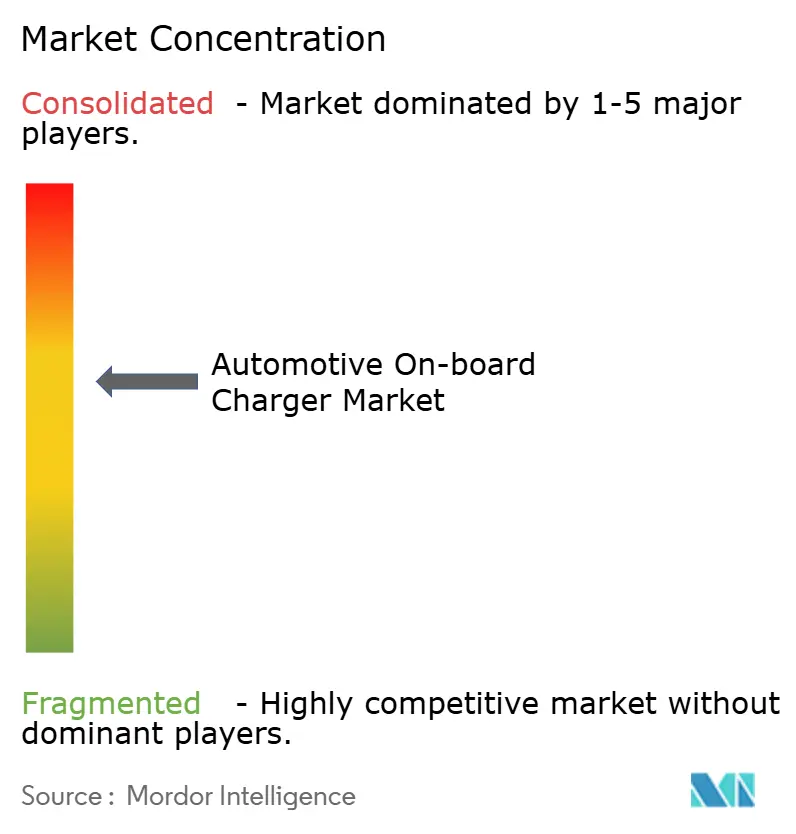
Market concentration is moderate: the top five suppliers—BorgWarner, Hyundai Mobis, LG Electronics, Valeo, and DENSO—held a notable share in 2025. All these players now target 800 V SiC designs with sealed-coolant jackets that allow 22 kW continuous operation at ambient 40 °C. Intellectual-property filings around ISO 15118-20 Plug & Charge rose last year, with Infineon, STMicroelectronics, and ON Semiconductor defending algorithmic authentication stacks. The competitive axis has shifted from basic efficiency claims to holistic system integration: software-defined chargers that can unlock vehicle-to-grid via over-the-air update without altering copper harnesses.
Specialists are carving niches. VisIC Technologies’ GaN platform won a 2025 order from a European premium marque for a 22 kW module, besting SiC density in the same envelope[3]. Delta Electronics, through co-marketing with independent service chains, secured a modest foothold in Europe's aftermarket, pricing its 7.4 kW kits at an affordable rate installed. Meanwhile, driven by component-level economics, STMicroelectronics eyes a target for 200 mm SiC wafers by 2027, aiming to reduce die costs. This ambitious timeline puts pressure on smaller fabs, nudging them towards technology licensing or an exit from the market.
As 3-in-1 e-axle penetration deepens, propulsion specialists—BorgWarner, Valeo, Hyundai Mobis—gain advantage because they can spread SiC dies across traction and charging duties. Pure-play charger firms risk relegation to retrofit niches unless they pair with inverter vendors or pivot to energy-storage systems. Software and cybersecurity capabilities are now must-have assets as regulators treat chargers as network nodes, lifting compliance costs and narrowing the viable competitive field.
Automotive On-board Charger Industry Leaders
-
BorgWarner Inc.
-
Hyundai Mobis Co., Ltd.
-
LG Electronics
-
Ficosa International S.A
-
Valeo SE
- *Disclaimer: Major Players sorted in no particular order
Automotive On-board Charger Market Companies Covered in this Report
- BorgWarner Inc.
- Hyundai Mobis Co., Ltd.
- LG Electronics
- STMicroelectronics NV
- Ficosa International S.A
- Valeo SE
- Delta Energy Systems AG
- Toyota Industries Corporation
- Brusa Elektronik AG
- VisIC Technologies Ltd.
- Infineon Technologies AG
- Eaton Corporation plc
- DENSO Corporation
- Panasonic Industry Co., Ltd.
- TDK Corporation
- ON Semiconductor Corporation
- Stercom Power Solutions GmbH
- Delta-Q Technologies
Market Opportunities and Future Outlook
A whitespace is forming around software-defined, standards-aligned bidirectional charging, where OBC hardware, communication controllers, and cybersecurity need to be developed in parallel to meet interoperability expectations and funding-linked requirements. AFIR provides a clear European anchor, formalizing smart charging and interoperability obligations for publicly accessible charging points and putting ISO 15118 implementation into focus during the 2026 execution window, which increases demand for vehicle-side capabilities to negotiate advanced charging functions reliably.
Technology programs and supplier actions are also pushing higher power density and new semiconductor stacks into mainstream design choices, opening room for compact 11-22 kW platforms and integrated power modules. In April 2026, the EU-funded HiPower 5.0 consortium (overseen by Fraunhofer IZM) reported progress toward a 22 kW GaN OBC targeting a 4-liter volume under a project budgeted at EUR 33.7 million through June 2028, supporting a pathway for smaller, lighter chargers that fit integrated e-drive architectures. On the supply base side, March 2026 capacity additions such as Exicom Tele-Systems Hyderabad facility (focused on AC and DC chargers) and localization moves in India and Europe support shorter lead times and regional compliance needs, while OEM and Tier-1 interest in bidirectional functionality keeps firmware, validation tooling, and secure communication stacks at the center of differentiation efforts.
Recent Industry Developments in Automotive On-board Charger Market
- July 2026: Toyota Industries announced successful hardware verification of AC-based vehicle-to-grid (V2G) capability using its proprietary bidirectional on-board charger. The result signals practical progress on bidirectional operation readiness and helps reduce integration risk for OEM programs targeting grid-interactive charging use cases.
- April 2026: The HiPower 5.0 consortium reported progress on an EU-funded 22 kW gallium nitride (GaN) on-board charger targeting a 4-liter volume, under a program running from August 2025 to June 2028 with EUR 33.7 million in funding. The work highlights an industry push toward higher power density and smaller packaging for 11-22 kW class OBCs, supporting wider fitment in integrated power electronics architectures.
- September 2025: BRUSA HyPower launched its OBC7 family certified for automotive use, supporting up to 19.2 kW single-phase and 22 kW three-phase across 400 V and 800 V systems. This expands commercial availability of higher-power AC charging options and supports OEM and fleet specifications that prioritize faster depot and home charging without relying exclusively on DC fast charging.
Automotive On-board Charger Market Report Scope and Research Methodology
Market Definition and Coverage
For this methodology, the automotive on-board charger market covers the value of on-vehicle AC charging power conversion hardware that converts grid AC power into DC to charge the traction battery, for passenger and commercial vehicles. It is counted when sold into vehicles or as replacement units.
Scope exclusions: External charging stations and standalone off-board chargers are excluded, and loose power semiconductors are not counted unless sold as part of an on-board charger unit.
Segments Covered in This Report
- By Vehicle Type
- Passenger Cars
- Commercial Vehicles
- By Powertrain Type
- Battery Electric Vehicles (BEVs)
- Plug-in Hybrid Electric Vehicles (PHEVs)
- By Power Rating
- Less than 3.3 kW
- 3.3-11 kW
- More than 11 kW
- By Sales Channel
- OEM-installed
- Aftermarket
- By Geography
- North America
- United States
- Canada
- Rest of North America
- South America
- Brazil
- Argentina
- Rest of South America
- Europe
- Germany
- United Kingdom
- France
- Italy
- Russia
- Rest of Europe
- Asia-Pacific
- China
- Japan
- India
- South Korea
- Rest of Asia-Pacific
- Middle East and Africa
- Saudi Arabia
- United Arab Emirates
- Turkey
- South Africa
- Egypt
- Rest of Middle East and Africa
- North America
Data Sources, Market Sizing, and Validation
Desk Research
Desk work starts with building the demand pool and the policy and infrastructure context that makes AC charging practical. We referenced public sources such as the International Energy Agency, national transport and energy agencies, customs and trade statistics portals, UNECE regulations, and standards bodies publications such as SAE and IEC, alongside select peer reviewed journals on charging efficiency.
Next, the model is filled with supply and pricing signals pulled from company annual reports, investor presentations, product catalogs, and technical datasheets, then checked against reputable automotive press coverage of platform launches and charging capability upgrades. Where available, we also used paid subscriptions for company financials and intelligence, patent databases, and shipment-level import-export records to stress-test volumes, manufacturing footprints, and ASP direction. The desk sources listed here are not exhaustive, and additional references were used for data collection, validation, and clarification.
Primary Interviews and Surveys
Primary inputs came from interviews and short surveys with OEM and supplier side roles that touch charging electronics, and also from channel participants that see replacement demand and regional mix changes. Because this market moves with EV platform cycles, we collected feedback across APAC, EMEA, and the Americas to validate power rating mix shifts, bidirectional readiness claims, and realistic pricing curves before locking the final assumptions.
Distribution of primary research fieldwork respondents
| Company type | Respondent position | Region |
|---|---|---|
| Top tier: 29% | CXOs: 21% | APAC: 42% |
| Mid tier: 49% | Functional/Unit leaders: 39% | EMEA: 37% |
| Smaller Players: 22% | Managers: 40% | Americas: 21% |
Market-Sizing & Forecasting
We sized the market using a top-down demand reconstruction, where EV and PHEV production by region is translated into fitted on-board charger demand, then converted into value using power rating mix and average selling prices. Totals are corroborated with selective bottom-up checks, including supplier revenue exposure to on-board chargers, sampled price bands derived from typical configurations, and channel checks for replacement units, which then help adjust any overcounts.
A few practical inputs are tracked closely because they change the outcome in visible ways. These include electrified vehicle production and sales by geography, penetration of OEM-installed chargers versus replacement units, the mix shift from below 3.3 kW to 3.3-11 kW and above 11 kW designs, the share of bidirectional-ready architectures, and regional AC grid norms that influence single-phase versus three-phase adoption. When data is missing for smaller markets or niche ratings, gaps are handled using proxy ratios from similar vehicle classes and by anchoring to known platform specifications.
For forecasting, we used scenario analysis supported by simple multivariate relationships, with EV production outlooks, AC charging availability, and pricing trend expectations as the main drivers. The forward curve was reviewed with industry experts so the final forecast reflects realistic ramp timing rather than straight line growth.
Data Validation & Update Cycle
Outputs are validated through several cross-checks so the number remains tied to real world signals. Analysts compare the modeled value against indicators such as EV parc growth, new model launch cadence, published charger power specifications by region, and supplier commentary on electrification order books, then investigate any sharp variances before sign-off.
Consistency checks are also run across regions and vehicle types so implied units, power mix, and pricing trends do not contradict each other. Reports refresh annually, and interim updates are triggered when material events occur such as regulation changes, platform delays, or abrupt cost moves in key electronics. Right before delivery, a fresh analyst review pass is completed so clients receive the most current view.
Mordor Intelligence's Automotive On Board Charger Market Size Versus Other Published Estimates
Published market sizes for on-board chargers often do not match because the scope line is drawn differently, and because pricing and currency timing are refreshed on different schedules. Another reason is that some models lean heavily on assumed EV growth, while others anchor more tightly to vehicle output and fitted content, which changes the unit base being valued.
During refresh cycles, ASP progression is rechecked against the shift toward higher power ratings (including 11 kW and above) and currency conversion is aligned to the same base-year timing. Validation loops revisit volume and mix assumptions, which helps explain why the 2026 number in Mordor Intelligence can land apart from figures built on older price points or blended charging hardware definitions.
Benchmark comparison
| Source | Market Size | Gaps in Research Methodology |
|---|---|---|
| Mordor Intelligence | USD 8.17 B (2026) | |
| Global Consultancy A | USD 7.40 B (2026) | Often applies a conservative ASP curve by holding price declines constant across power ratings, and may undercount the faster rise of higher power units in newer vehicle platforms. |
| Industry Association B | USD 9.10 B (2026) | Commonly folds in adjacent in-vehicle charging power electronics and supporting modules, which broadens the scope beyond the on-board charger unit and lifts the value total. |
The table indicates that most gaps come from how the product scope is set and how prices are carried into the base year. By tying volumes and ASPs to visible vehicle output and power rating mix signals, the final estimate stays traceable to repeatable steps that can be reviewed.
Key Questions Answered in the Report
How large will the automotive on-board charger market be by 2031?
It is projected to reach USD 15.68 billion by 2031, accelerating at 13.93% CAGR since 2026.
Which vehicle segment is growing fastest for on-board chargers?
Commercial vehicles, especially buses and delivery vans, are forecast to expand charger demand at 14.42% CAGR through 2031.
What role do SiC and GaN play in charger design?
Falling SiC and GaN prices enable lighter, more efficient chargers that fit inside 3-in-1 e-axles and support bidirectional energy flows.
Is retrofit demand expected to stay strong?
Yes, aftermarket revenue is growing 15.75% CAGR as early EV owners upgrade 3.3 kW units to 7.4 kW or 11 kW and add vehicle-to-load features.