
Automotive Inertial Systems Market Size and Share
Market Overview
| Study Period | 2020 - 2031 |
|---|---|
| Market Size (2026) | USD 3.43 Billion |
| Market Size (2031) | USD 5.61 Billion |
| Growth Rate (2026 - 2031) | 10.31 % |
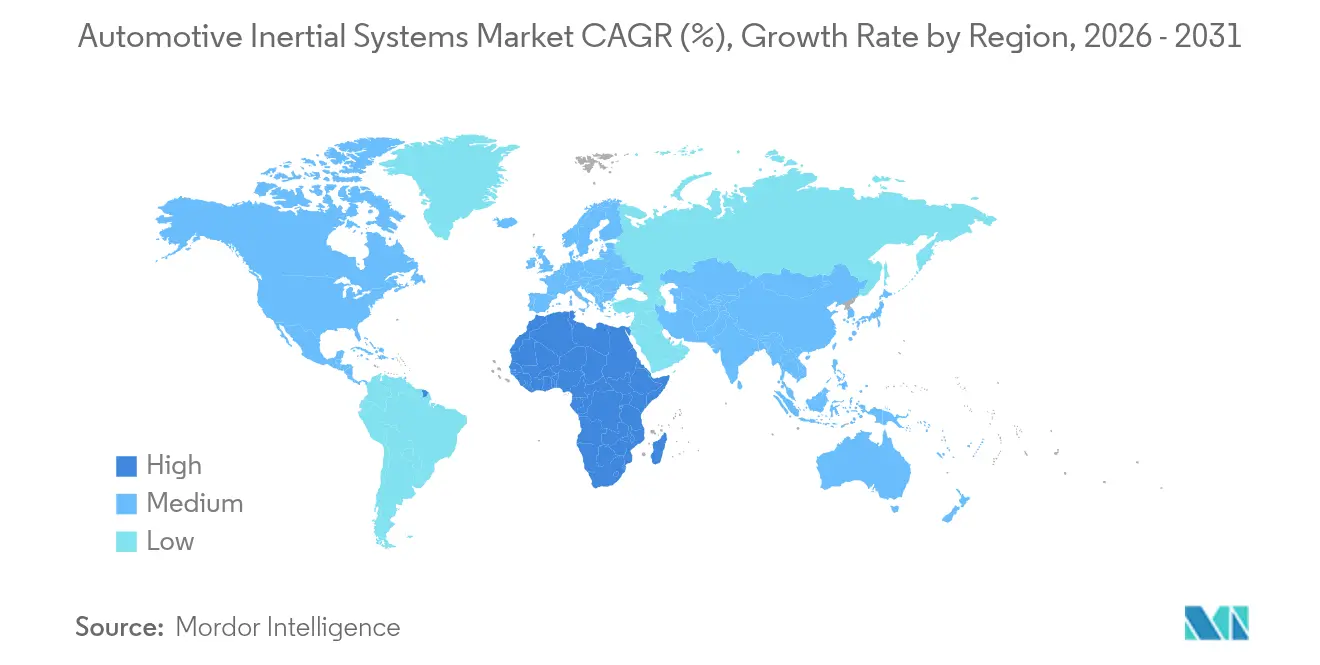
| Fastest Growing Market | Africa |
| Largest Market | Asia Pacific |
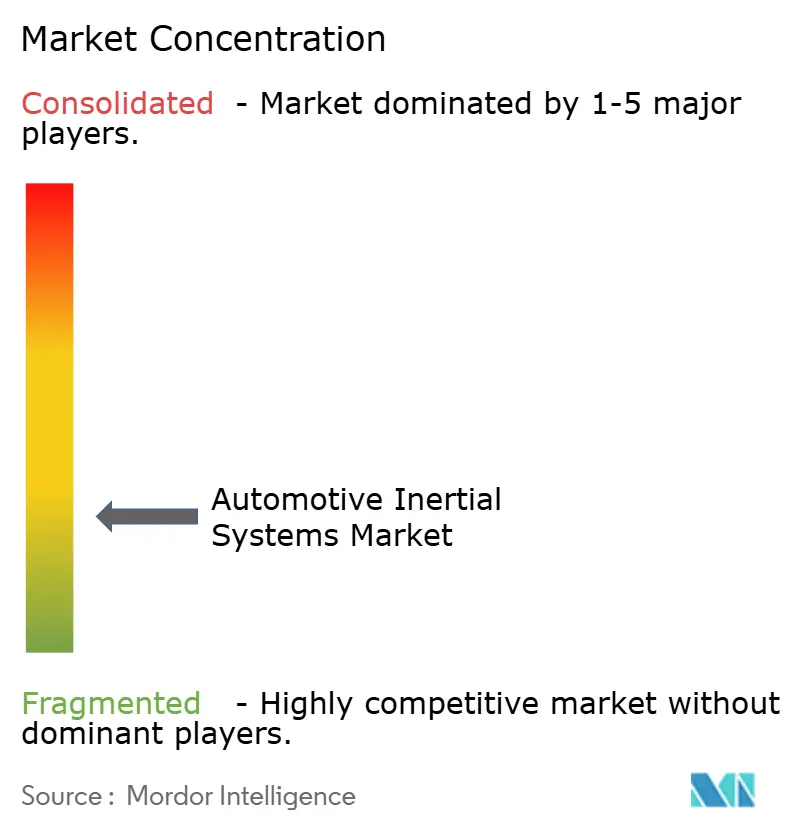
| Market Concentration | Low |
Major Players *Disclaimer: Major Players sorted in no particular order Image © Mordor Intelligence. Reuse requires attribution under CC BY 4.0. | |
Automotive Inertial Systems Market Analysis by Mordor Intelligence
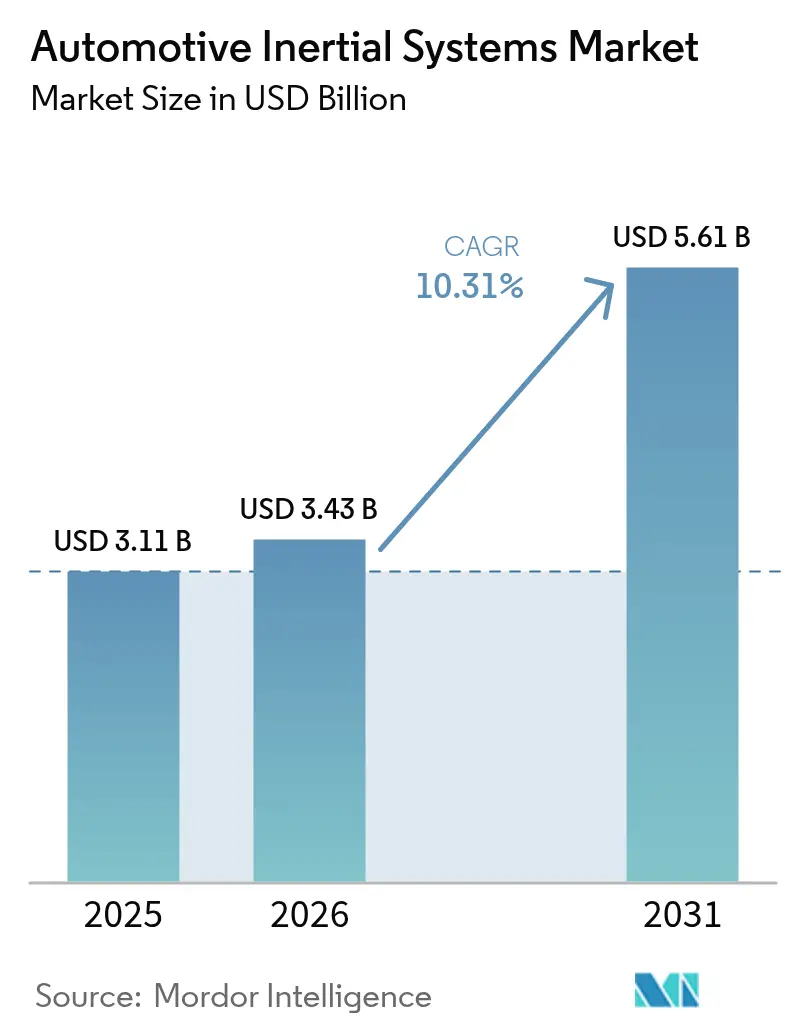
The Automotive Inertial Systems market size is expected to grow from USD 3.11 billion in 2025 to USD 3.43 billion in 2026 and is forecast to reach USD 5.61 billion by 2031 at 10.31% CAGR over 2026-2031. Mandatory electronic stability control (ESC) laws on every major continent, the mainstreaming of Level 2+ driver-assistance functions, and wafer-size migration in MEMS fabrication collectively expand yearly unit volumes and compress cost curves. Automakers are replacing single-axis sensors with six-axis inertial measurement units (IMUs) to simplify board layouts and lower calibration budgets, while chipmakers’ move from 8-inch to 12-inch silicon boosts throughput and halves die-level bias variation. Asia-Pacific contributes the largest revenue slice, supported by China’s GB 21670 and India’s Bharat New Vehicle Safety Assessment Program, whereas Africa registers the fastest pace on the back of South Africa’s Automotive Production and Development Programme incentives. Competitive risk centers around two foundry partners, Taiwan Semiconductor Manufacturing Company and GlobalFoundries, which raises single-point-of-failure exposure for MEMS supply chains.
Key Report Takeaways
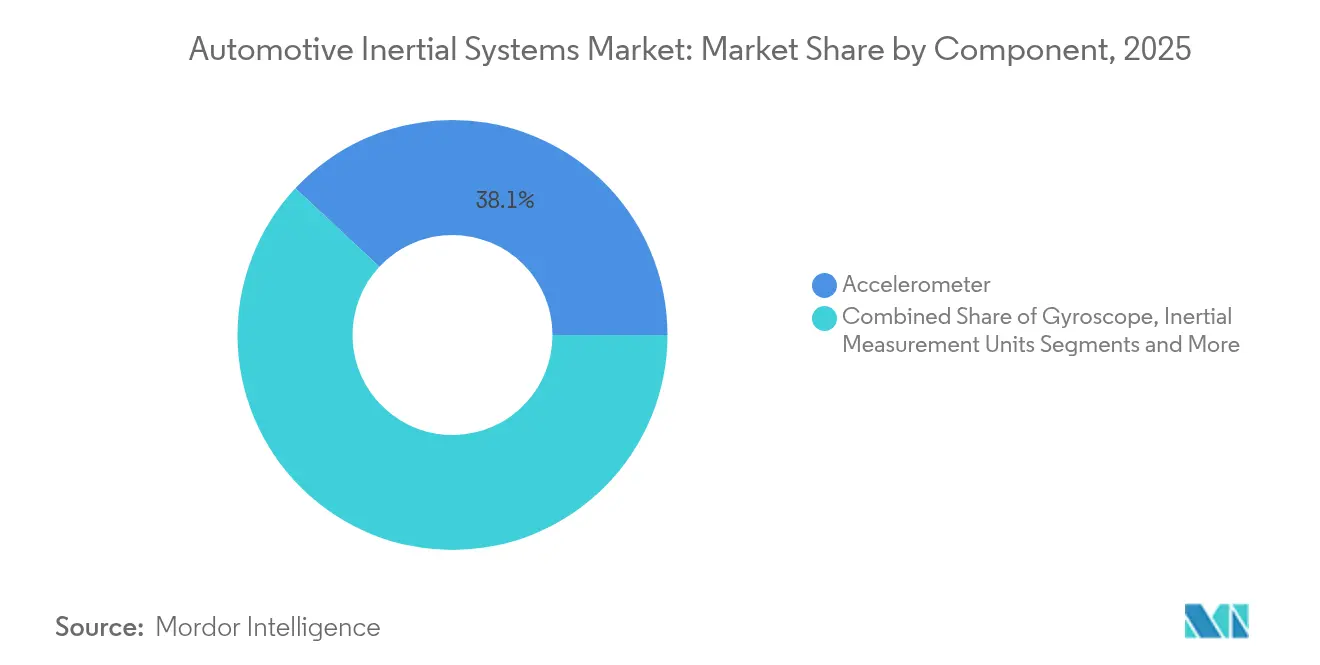
- By component, accelerometers led with 38.05% of the automotive inertial systems market share in 2025, while inertial measurement units are forecast to post the quickest 12.34% CAGR to 2031.
- By vehicle type, passenger cars retained 54.60% of the automotive inertial systems market share in 2025, whereas off-highway machinery is expected to surge at an 11.10% CAGR through 2031.
- By technology, MEMS devices accounted for 64.25% of the automotive inertial systems market share in 2025 and are on track for an 11.63% CAGR over the outlook period.
- By application, electronic stability control captured 40.55% of the automotive inertial systems market share in 2025, yet advanced driver assistance systems are projected to expand at an 11.05% CAGR to 2031.
- By sales channel, OEM-fitted systems dominated with 78.90% of the automotive inertial systems market share in 2025, but the aftermarket is poised for a 11.92% CAGR owing to insurance-driven retrofits.
- By geography, Asia Pacific captured 43.20% of the automotive inertial systems market share in 2025, whereas Africa is expected to witness at an 10.72% CAGR through 2031.
Note: Market size and forecast figures in this report are generated using Mordor Intelligence’s proprietary estimation framework, updated with the latest available data and insights as of 2026.
Market Trends and Insights
Drivers Impact Analysis of Automotive Inertial Systems Market*
| Driver | (~) % Impact on CAGR Forecast | Geographic Relevance | Impact Timeline |
|---|---|---|---|
| Advancements in MEMS Manufacturing Processes | +2.3% | Global (foundry hubs in Taiwan and Japan) | Medium term (2-4 years) |
| Rising Adoption of Inertial Measurement Units in ADAS | +2.8% | North America, Europe, China | Short term (≤ 2 years) |
| Increasing Vehicle Autonomy Levels Across Passenger Cars | +1.9% | North America, Europe, select Asia-Pacific markets | Long term (≥ 4 years) |
| Growing Demand for Precision Farming Machinery | +1.2% | North America, Europe, Brazil, Australia | Medium term (2-4 years) |
| Stringent Safety Mandates on ESC | +2.1% | Global with rapid uptake in India, Middle East and Africa | Short term (≤ 2 years) |
| Emergence of Low-Cost Solid-State IMUs for Two-Wheelers | +0.8% | Asia-Pacific, Europe | Medium term (2-4 years) |
| Source: Mordor Intelligence | |||
Advancements In MEMS Manufacturing Processes
Wafer-level packaging combined with through-silicon vias trims MEMS gyroscope footprints by 40% versus 2024 devices, letting Tier 1 suppliers place redundant IMUs inside compact ADAS domain controllers without redesigning multilayer boards.[1]STMicroelectronics press office, “LSM6DSV32X Six-Axis IMU Launch,” STMicroelectronics, st.com Transitioning to 12-inch silicon at Taiwanese fabs reduces per-unit cost by 28% while doubling wafer starts, a key enabler for the sub-USD 10 billion bill-of-materials target many automakers stipulate for entry-segment vehicles. Bosch’s ThELMA co-integration of MEMS and CMOS eliminates bond-wire parasitics and increases bandwidth tenfold to 10 kHz, unlocking active-suspension use cases that previously required bulky discrete electronics. Yield, however, remains hostage to deep-etch defect density; if faults exceed 0.1 cm-², automotive qualification turns uneconomical. Continued capex in vacuum wafer-level packaging is forecast to reduce cavity pressure below 1 Pa, thereby stabilizing the quality factor and bias over high-G crash profiles.
Rising Adoption Of Inertial Measurement Units In ADAS
Driver-assistance features such as automatic emergency braking and lane-keeping support now blend six-axis IMU data with vision and radar streams at 400 Hz for precise ego-motion estimates. Euro NCAP’s 2025 protocol awards full points only when lateral accelerations remain under 0.3 g during emergency maneuvers, a threshold that is viable solely with closed-loop IMU feedback. Integrating discrete accelerometers and gyroscopes into unified IMUs reduces USD 8-12 from the bill of materials and eliminates two separate calibration stages, thereby accelerating adoption, even in cost-sensitive compact cars. China’s GB/T 38186 data-logging rule requires Level 2+ vehicles to record IMU signals at a minimum of 100 Hz, effectively establishing a baseline performance tier that favors solution providers shipping fully characterized modules.
Increasing Vehicle Autonomy Levels Across Passenger Cars
Level 3 rollouts from Mercedes-Benz and BMW in 2024 hinge on redundant IMU arrays meeting ISO 26262 ASIL-D fail-operational rules. Tactical-grade devices, such as Honeywell’s HG4930, offer 0.5 °/h bias stability, keeping dead-reckoning errors under 50 m after 10 minutes of GNSS outage, a critical threshold in dense urban canyons. SAE’s J3216 performance classes set a 1 °/h maximum bias for Level 3, guiding procurement specifications and prompting chipmakers to target sub-USD 100 price points at that performance level. Waymo’s sixth-generation robo-taxi platform demonstrates how coupling high-stability IMUs with lidar point clouds cuts localization drift below 10 cm per kilometer. Cost pressure persists because existing tactical-grade parts exceed USD 500, stimulating R&D into silicon-carbide resonators and wafer-level vacuum encapsulation to narrow the price-performance gap.
Stringent Safety Mandates On Electronic Stability Control
India, Turkey, and the United Nations Economic Commission for Europe all enacted new ESC directives in 2024, covering heavy trucks, buses, and even high-speed tractors. The NHTSA broadened Federal Motor Vehicle Safety Standard 136 to include Class 8 trucks, requiring fleets to retrofit IMU-equipped ESCs by the 2025 model year. Entry-level cost has fallen to under USD 150 for an integrated modulator and six-axis sensor assembly, allowing OEMs to list ESC as standard rather than optional content. The regulatory wave particularly benefits suppliers offering pre-calibrated modules because fleet retrofits often occur outside factory environments.
Restraints Impact Analysis of Automotive Inertial Systems Market*
| Restraint | (~) % Impact on CAGR Forecast | Geographic Relevance | Impact Timeline |
|---|---|---|---|
| High Calibration Costs for Safety-Critical Applications | −1.4% | Global, heavier burden for low-volume OEMs | Short term (≤ 2 years) |
| Sensor Signal Drift Limiting Long-Term Navigation Accuracy | −1.1% | Global, particularly acute in GNSS-denied urban corridors | Medium term (2-4 years) |
| Supply Chain Concentration in Few MEMS Foundries | −0.7% | Global exposure to Taiwan and Japan geopolitical risks | Long term (≥ 4 years) |
| Price Pressure from Commodity Accelerometers | -0.3% | Global, strong OEM bargaining power, long-term sourcing contracts | Medium term (2-4 years) |
| Source: Mordor Intelligence | |||
High Calibration Costs For Safety-Critical Applications
Automotive-grade IMUs intended for ASIL-D functions must undergo 18-24 hours of multi-axis temperature cycling from −40 °C to +125 °C with 0.1 °C chamber precision, adding USD 12-18 per unit at the factory gate.[2]Analog Devices engineering team, “IMU Calibration for Automotive Applications,” Analog Devices, analog.com ISO 26262 traceability requires the annual recertification of calibration rigs, which can cost over USD 30,000, a non-trivial expense for small Tier 2 suppliers. Polynomial temperature-bias corrections stored in non-volatile memory increase firmware complexity and validation cycles by six to nine months. Machine-learning calibration, promising a two-hour throughput, is still awaiting automotive qualification, delaying near-term relief.
Sensor Signal Drift Limiting Long-Term Navigation Accuracy
MEMS gyroscope bias instability of 5-20 °/h causes dead-reckoning errors that balloon quadratically with time, reaching 200-500 m after a 15-minute GNSS blackout in parking structures. Kalman filtering with zero-velocity updates halves this error but requires the vehicle to stop for several seconds, an impractical constraint in highway tunnels. Continental found that even 0.5 °/h tactical devices drift 150 m after 20 min, forcing OEMs to double up on lidar or camera redundancy. Temperature-gradient spikes of 50-100 °/h during cold starts degrade parking-assist precision when drivers most expect flawless automation. Dual-IMU architectures mitigate the problem but double the sensor cost, while wheel-speed fusion introduces sensitivity to tire pressure and surface friction.
*Our forecasts treat driver/restraint impacts as directional, not additive. The impact forecasts reflect baseline growth, mix effects, and variable interactions.
Automotive Inertial Systems Market Segment Analysis
By Component:
Integrated IMUs Consolidate Board Real EstateAccelerometers held 38.05% of the automotive inertial systems market share in 2025, underpinning airbag triggers, rollover detection, and cost-sensitive ESC. In contrast, integrated IMUs will post a 12.34% CAGR as automakers merge accelerometer and gyroscope channels inside six-axis monolithic packages to shrink printed-circuit footprints. Bosch’s BHI360 couples a MEMS stack with an Arm Cortex-M0 processor that executes sensor-fusion algorithms locally, offloading 30% of the electronic control unit's load.
Standalone gyroscopes now serve niche yaw-rate loops in steer-by-wire applications, while premium inertial navigation systems, costing above USD 1,000, remain confined to high-end autonomy pilots. The migration from discrete accelerometers to IMUs reflects broader semiconductor trends toward co-packaging, which can eliminate two ADC channels, one voltage regulator, and several passive components per board, resulting in a 15-20% reduction in system cost. Integrated IMUs, therefore, command growing design wins despite accelerometers’ numeric supremacy within the automotive inertial systems market.



By Vehicle Type:
Off-Highway Equipment Accelerates Sensor UptakePassenger cars accounted for a significant 54.60% of total revenue in 2025. However, it's the precision-guided earthmoving and farming equipment that's witnessing the most rapid growth. Off-highway machinery is projected to expand at an impressive 11.10% CAGR. Caterpillar's innovative Grade Control system, utilizing dual IMUs and GNSS receivers, ensures blade height precision within 1 cm, effectively shortening duty cycles 25%.
Meanwhile, John Deere's Machine Sync technology harnesses IMU data on pitch and roll, allowing grain carts to stay within 5 cm of combines during transfers. This precision helps in reducing harvest losses by 3-5%. Komatsu, on the other hand, integrates IMUs into bucket-control loops, achieving trench accuracy of 2 cm and cutting down operator fatigue by a notable 40%. Such advanced applications demand high update rates and robust designs, leading to the quicker adoption of sensors, which outpace their already established use in the passenger car sector.
By Technology:
MEMS Retains Dominance Through Cost And IntegrationMEMS devices accounted for a commanding 64.25% share of the automotive inertial systems market revenue in 2025. With unit prices hovering below USD 10 and compact form factors under 5 mm³, MEMS devices are set to expand at an impressive 11.63% CAGR. Meanwhile, silicon-carbide resonators in the LSM6DSV32X are pushing the noise density envelope to 0.004 °/s/√Hz, closing the performance gap with pricier fiber-optic gyros.
While fiber-optic and ring-laser gyroscopes are favored in autonomous shuttles and defense applications for their impressive bias stabilities of below 0.01 °/h, their steep price tag, exceeding USD 5,000, and power draw of over 10 W make them a luxury. However, advancements like wafer-level vacuum packaging and atomic-layer deposition of piezoelectric films are bolstering MEMS' dominance. These innovations pave the way for passive energy harvesting, potentially eliminating the need for dedicated power rails. As a result, MEMS technology is firmly established as the gold standard in the automotive inertial systems market.

By Application:
ADAS Surpasses ESC As Growth CatalystElectronic stability control accounted for 40.55% of total sales in 2025. However, advanced driver assistance systems (ADAS) are on track to grow at an impressive 11.05% CAGR, positioning them to surpass ESC revenue by 2028. Highlighting the advancements, Continental’s MK C2 brake-by-wire boasts a six-axis IMU integrated into its hydraulic block, achieving a swift 100-ms stop time during automatic emergency braking.
Navigation and dead-reckoning modules play a crucial role in maintaining localization within a 50 m radius, even after a 10-minute GNSS dropout, a feature essential for automated parking garages. Furthermore, high-bandwidth inertial measurement units (IMUs) operating at 400 Hz facilitate adaptive damping, effectively reducing body roll by 30% during sudden lane changes. In energy management, Bosch’s eBooster pre-spin electric superchargers utilize pitch-angle forecasts to eliminate lag during hill climbs.
By Sales Channel:
Insurance Incentives Propel Aftermarket RetrofitsOEM-installed systems dominated the market, securing a substantial 78.90% share in 2025. This dominance underscores the importance of factory-level calibration and the warranty commitments that accompany these systems. Meanwhile, the aftermarket is poised for robust growth, projected at a 11.92% CAGR. This surge is largely attributed to fleet insurers in North America and Europe, who are slashing premiums by 10-15% for trucks equipped with retrofitted ESC modules.
Bosch has introduced a game-changing drop-in retrofit kit, designed for legacy trucks. This kit, which can be installed in just eight hours at a workshop, comes pre-calibrated, streamlining the process for smaller depots. Further incentivizing the shift, the European Union's General Safety Regulation 2 offers credits of up to EUR 500 (USD 565) per vehicle, alleviating initial financial burdens. However, challenges remain. Installers face calibration issues, requiring scan tools priced between USD 5,000 and USD 10,000 to adjust mounting-angle offsets. Yet, the investment pays off, with savings on insurance leading to a full return within three years.
Geography Analysis
APAC Automotive Inertial Systems Market
Asia-Pacific commanded 43.20% of 2025 revenue as China built 30 million light vehicles and India rose to the world’s third-largest market at 5 million units. China’s ESC test spec requires yaw-rate tracking within 5% during sine-with-dwell maneuvers, favoring six-axis IMUs with 400 Hz update rates. Japan subsidizes 30% of ADAS retrofit bills for commercial fleets, boosting demand for aftermarket modules, while South Korea’s Sejong testbed mandates dual-redundant sensors for Level 4 pilots.
The Americas and EMEA Automotive Inertial Systems Market
Africa is the fastest-growing region, with a 10.72% CAGR, driven by South Africa’s Automotive Production and Development Programme and Egypt’s tariff reduction on sensor imports from 40% to 10%. South Africa produced 631,000 vehicles in 2024, and OEMs have begun equipping entry-level trims with ESC to meet the harmonized rules of the Southern African Development Community. Egypt attracted USD 200 million of sensor-module investment clustered around the 10th of Ramadan industrial zone, positioning Cairo as a regional supply hub. North America and Europe focus on ADAS upgrades in otherwise saturated ESC environments. NHTSA’s pending rule for automatic emergency braking on heavy trucks will obligate IMU-based rollover detection on 400,000 U.S. Class 7-8 units annually. The European Union manufactured 13.2 million vehicles in 2024, and ties 2025 Euro NCAP star ratings to lateral-control metrics that require real-time inertial feedback. Middle East markets, which imported 1.8 million vehicles in 2024, align with Gulf Cooperation Council standards that enforce ESC for light commercial vehicles. South America lags on ADAS but will phase Mercosur Regulation 140 for commercial-vehicle ESC by 2027, opening retrofit opportunities in Brazil’s 2.1 million-unit industry.

Regulatory Landscape
Automotive inertial systems demand is anchored by safety and automated-driving compliance frameworks that specify validated vehicle dynamics sensing and data capture. ESC mandates across major markets continue to require yaw-rate and multi-axis acceleration sensing in braking and stability systems. Euro NCAP 2025 scoring links emergency maneuver performance to tightly controlled lateral dynamics, which reinforces the need for higher-rate, better-characterized IMUs in ADAS controllers.
Regulation is also shifting toward type approval and harmonized rules for automated driving and related data systems. UNECE WP.29 remains the core intergovernmental forum for harmonized technical requirements under the 1958 and 1998 Agreements, and in February 2026 the ADS IWG and EDR/DSSAD group approved a UN Regulation package for Automated Driving Systems that includes Data Storage System for Automated Driving (DSSAD) provisions. In the EU, Commission Implementing Regulation (EU) 2026/481 took effect on March 3, 2026, updating type-approval procedures for automated driving systems and enabling large-scale production pathways for automated valet parking (AVP), which increases the compliance premium on traceable, safety-managed inertial sensing and data logging.
Value Chain Analysis
The value chain starts with MEMS design, process development, and automotive-grade qualification, including ISO 26262-aligned safety work products where applicable, then moves into wafer fabrication, wafer-level packaging, and final assembly. Front-end MEMS die fabrication is concentrated within a limited set of geographies and foundry ecosystems, while packaging, calibration, and end-of-line testing often follow a regional-for-regional model near OEM and Tier-1 manufacturing footprints to reduce lead times and simplify logistics for safety-critical modules. Tier-1 suppliers integrate inertial sensors into ESC/ABS modules, brake-by-wire systems, and ADAS domain controllers, and deliver into OEM programs that prioritize long-term sourcing continuity and validated calibration traceability.
Key bottlenecks are concentrated in mature-node semiconductor capacity used across standard inertial and related sensor components, and in supply-chain dependencies below the Tier-1 layer. The report scope also highlights systemic exposure to concentrated foundry partnerships for MEMS supply, increasing single-point-of-failure risk. Separately, rare-earth-related dependencies (for example, neodymium iron boron magnet supply used in some sensor-adjacent modules) and trade-policy uncertainty can change assembly and sourcing decisions, which raises the need for multi-sourcing and deeper visibility into sub-tier operations as qualification cycles remain long.
Competitive Landscape
Bosch, Continental, and STMicroelectronics hold significant share of the automotive inertial systems market through vertical ownership of MEMS designs, ASICs, and ADAS electronic control units. Bosch’s SMI230 meets ASIL-D with 0.007 °/s/√Hz noise, anchoring Level 3 autonomy bids across multiple OEMs.[5]Bosch press office, “SMI230 IMU ASIL-D Qualification,” Bosch, bosch.com Continental complements proprietary sensors with a camera-radar fusion stack for one-stop ADAS sourcing. STMicroelectronics is expanding its Italian 12-inch MEMS capacity to lift annual output to 200 million units by 2027, ensuring supply resiliency.
Challengers include Analog Devices, now equipped with Inertial Labs’ 0.1 °/h tactical designs, and Infineon, which combines environmental and inertial sensing in a unified XENSIV package to reduce board real estate. Aceinna and VectorNav court smaller automakers by offering open-source algorithms that reduce integration time from 18 months to six. Dependence on TSMC and GlobalFoundries remains the primary systemic risk; the Kumamoto earthquake halted Sony’s accelerometer output for six weeks in 2024, resulting in delayed Tier 1 shipments of up to 16 weeks.
Product roadmaps center on bias-stability gains and system-level integration. Analog Devices’ ADIS16507 offers 0.5 °/h bias via temperature-compensated resonators. Infineon’s XENSIV adds barometric, humidity, and temperature channels inside a 3 mm × 3 mm footprint to speed chassis-control deployment. ISO 26262 certification costs USD 0.5-1 million per design, preserving the incumbents’ lead over start-ups.
Automotive Inertial Systems Industry Leaders
Robert Bosch GmbH
Continental AG
Honeywell International Inc.
STMicroelectronics N.V.
Murata Manufacturing Co., Ltd.
- *Disclaimer: Major Players sorted in no particular order
Automotive Inertial Systems Market Companies Covered in this Report
- Robert Bosch GmbH
- Continental AG
- Honeywell International Inc.
- STMicroelectronics N.V.
- Murata Manufacturing Co., Ltd.
- TE Connectivity Ltd.
- Analog Devices, Inc.
- Infineon Technologies AG
- Safran Electronics and Defense (Safran S.A.)
- Thales Group
- EMCORE Corporation
- MEMSIC, Inc.
- Lord Corporation (MicroStrain Inc.)
- Xsens Technologies B.V.
- VectorNav Technologies, LLC
- SBG Systems S.A.S.
- Aceinna Inc.
- Sensonor AS
- TDK Corporation (InvenSense)
- NXP Semiconductors N.V.

Market Opportunities and Future Outlook
Whitespace is forming where OEMs and Tier-1s need smaller, higher-temperature, functionally safe 6-axis IMUs that simplify integration into centralized ADAS and chassis controllers, while still supporting robust dead-reckoning during GNSS outages. Specific product activity in 2026 indicates active platform refresh cycles: Robert Bosch introduced the third-generation SMI330 MEMS inertial sensor in February 2026 with a 3.0 x 2.5 mm LGA footprint and 125 C operation. Murata announced the SCH1633-D05 6DoF IMU for direct AD/ADAS ECU integration in May 2026, with mass-production timing aligned to mid-2026. STMicroelectronics introduced the ASM330LHHG1 automotive-qualified inertial module in May 2026 for navigation and sensor-fusion use cases across a -40 C to 125 C range. These launches support design opportunities in domain-controller architectures that pull inertial sensing closer to compute, reducing cabling and module sprawl.
Opportunity also expands in programs and regulations that formalize higher-rate inertial data capture and safety-case management for automated driving. That shift increases demand for pre-calibrated, well-documented IMU modules and toolchains that reduce customer validation burden. UNECE WP.29 activity on Automated Driving Systems and DSSAD, along with EU type-approval procedure updates in March 2026 for automated driving systems (including AVP production enablement), increases the value of suppliers that can pair IMU hardware with compliance-ready data interfaces and functional-safety deliverables. Aftermarket retrofits for commercial fleets remain a defined gap where pre-calibrated ESC/IMU modules and installer tooling can reduce workshop time, aligning with insurer-driven retrofit economics already visible in mature markets.
Recent Industry Developments in Automotive Inertial Systems Market
- May 2026: Murata Manufacturing announced the SCH1633-D05 6DoF IMU for automated driving and ADAS ECU integration, with mass production scheduled for June 2026. The device targets direct ECU placement and functional-safety-aligned deployments, supporting tighter packaging and reduced harness complexity in centralized electronics architectures.
- July 2025: STMicroelectronics announced a definitive agreement to acquire NXP Semiconductors' MEMS sensor business for up to USD 950 million, with closing targeted in H1 2026. The acquisition expands ST's MEMS portfolio depth and strengthens its position in automotive-grade inertial sensing, where long qualification cycles typically reward scale, roadmap continuity, and supply assurance.
- May 2024: STMicroelectronics launched the ASM330LHBG1 automotive 3-axis accelerometer and gyroscope module designed to support functional-safety applications up to ASIL B. This module-level approach shortens customer integration and validation work compared with discrete sensor designs, reinforcing the shift toward pre-characterized inertial modules in safety-relevant vehicle functions.


Automotive Inertial Systems Market Report Scope and Research Methodology
Market Definition and Coverage
This market counts the revenue generated from automotive inertial systems used to measure vehicle motion and orientation, which then supports functions like stability, navigation, and driver assistance. We size it across passenger and commercial vehicle fitments, covering OEM-fitted and aftermarket sales.
Scope exclusions: We exclude inertial systems used outside road vehicles and we do not count unrelated automotive sensor types that do not measure inertial motion.
Segments Covered in This Report
- By Component
- Accelerometer
- Gyroscope
- Inertial Measurement Units (IMU)
- Inertial Navigation Systems (INS)
- Other Components
- By Vehicle Type
- Passenger Cars
- Light Commercial Vehicles
- Heavy Commercial Vehicles
- Off-Highway Vehicles
- By Technology
- MEMS
- Fiber-Optic Gyro
- Ring-Laser Gyro
- Others
- By Application
- Electronic Stability Control
- Advanced Driver Assistance Systems
- Navigation and Dead-Reckoning
- Suspension and Chassis Control
- By Sales Channel
- OEM-Fitted
- Aftermarket
- By Geography
- North America
- United States
- Canada
- Mexico
- South America
- Brazil
- Argentina
- Rest of South America
- Europe
- Germany
- United Kingdom
- France
- Italy
- Spain
- Rest of Europe
- Asia-Pacific
- China
- India
- Japan
- South Korea
- ASEAN
- Rest of Asia-Pacific
- Middle East and Africa
- Middle East
- Saudi Arabia
- United Arab Emirates
- Rest of Middle East
- Africa
- South Africa
- Nigeria
- Rest of Africa
- Middle East
- North America
Data Sources, Market Sizing, and Validation
Desk Research
Desk research started with building the demand backbone using vehicle production and parc signals, then mapping where inertial content is typically designed into the vehicle. We referenced public sources such as OICA vehicle production statistics, the US NHTSA safety rules and defect databases, UNECE vehicle regulation documents, Euro NCAP safety protocols, and OECD and World Bank macro indicators to interpret regional build-outs and safety feature diffusion.
To ground the commercial side, we reviewed company filings and investor presentations for sensor and automotive electronics suppliers, along with reputable press and association websites that track ADAS adoption and safety feature penetration. We also used a paid subscription database for company financials and another for patents, applied selectively to cross-check product focus shifts and new design activity. The desk research sources listed here are illustrative only, and many other public references were also used for data collection, validation, and clarification.
Primary Interviews and Surveys
Primary work was used to validate fitment rates, pricing direction, and how quickly newer applications, such as dead-reckoning support in ADAS stacks, are moving into mass models. We spoke with a mix of component suppliers, vehicle system integrators, and downstream automotive engineering roles across major producing regions, then reconciled their inputs against desk signals before finalizing the model.
Distribution of primary research fieldwork respondents
| Company type | Respondent position | Region |
|---|---|---|
| Top tier: 25% | CXOs: 13% | APAC: 41% |
| Mid tier: 56% | Functional/Unit leaders: 34% | EMEA: 36% |
| Smaller Players: 19% | Managers: 53% | Americas: 23% |
Market-Sizing & Forecasting
Sizing was constructed using top-down logic tied to automotive production and feature penetration, where vehicle builds by region were combined with application-level adoption of ESC, ADAS, and navigation and dead-reckoning needs. After that, average inertial content per vehicle was applied using a mix of component counts and system-level bill of material assumptions, then translated into value using typical price bands by technology, such as MEMS versus fiber-optic and ring-laser designs.
To keep totals from drifting, we corroborated results with selective bottom-up approximations, including sampled supplier revenue exposure checks, channel discussions on OEM-fitted versus aftermarket mix, and sanity checks on implied unit volumes versus expected vehicle fitments. Key inputs used in the model included global vehicle production by class, rate of ESC fitment including regulation-led markets, ADAS penetration by vehicle price tier, inertial system ASP progression, and the share of systems using higher-cost gyros in specialized applications. Forecasting relied mainly on scenario analysis, where production outlooks and feature penetration paths were stress-tested with expert feedback, then adjusted for expected cost-down trends and supply availability.
Data Validation & Update Cycle
Validation was done through several checks that look for mismatches between vehicle volumes, implied inertial unit shipments, and the final value outcome, and we revisit assumptions when the spread becomes hard to explain. Before sign-off, anomalies are reviewed in a second analyst pass, followed by targeted re-contacts with industry participants when a key input shifts, such as a sudden pricing reset or a change in safety feature rollout timing.
Reports are refreshed annually, and interim updates are made when there are material events, such as regulation changes, major platform launches, or supply disruptions, that can alter adoption rates. Right before delivery, we re-check the latest public signals so clients receive an updated view rather than an older frozen estimate.
Mordor Intelligence's Automotive Inertial Systems Market Size Measured Against Other Published Estimates
Published market sizes for automotive inertial systems can look far apart because the scope lines are drawn differently, and the same words can cover different components and pricing logic. We usually see gaps come from what gets counted as an inertial system, how OEM-fitted versus aftermarket is treated, and how quickly adoption is assumed to rise with ADAS and navigation use cases.
The main gap comes from whether broader automotive sensing and full navigation stacks are bundled into the number. In contrast, Mordor Intelligence counts inertial components and systems tied to vehicle motion measurement, including IMUs, accelerometers, gyroscopes, and INS, rather than folding in adjacent non-inertial sensors or complete infotainment modules. Differences also show up in how ASPs are moved forward over time. Some estimates assume flat pricing, while others model faster cost-down for MEMS. Currency timing and refresh cadence can also shift the reported USD value for the same year.
Benchmark comparison
| Source | Market Size | Gaps in Research Methodology |
|---|---|---|
| Mordor Intelligence | USD 3.11 B (2025) | |
| Industry Publisher A | USD 6.80 B (2025) | Often presented with a wider component set, and may bundle broader automotive sensing or full navigation system value, which lifts the total beyond inertial-only content. |
| Global Consultancy B | USD 3.96 B (2024) | Uses a different base year and may apply a more conservative adoption and pricing path, which can compress the near-term value even if long-run demand grows. |
The spread in the table is mostly explained by scope expansion versus a tighter inertial-only definition, plus timing differences in the reference year. By keeping the model tied to vehicle production, application penetration, and a transparent ASP pathway, the output stays traceable to real automotive demand signals and can be repeated when new inputs become available.


Key Questions Answered in the Report
How big is the automotive inertial systems market in 2026?
The automotive inertial systems market size is USD 3.43 billion in 2026, with a forecast CAGR of 10.31% over 2026-2031.
Which component is growing the fastest?
Integrated six-axis inertial measurement units are forecast to grow at 12.34% CAGR as automakers consolidate discrete sensors.
Why are MEMS sensors dominant over fiber-optic gyros?
MEMS devices cost under USD 10, occupy less than 5 mm³, and integrate easily with automotive ASICs, meeting most performance targets at a fraction of the price.
Which region is expanding quickest?
Africa leads regional growth at a 10.72% CAGR owing to production incentives in South Africa and tariff cuts in Egypt.
What is the main supply-chain risk?
Concentration of MEMS wafer output in two foundries exposes the market to geopolitical and natural-disaster disruptions.
How does aftermarket retrofitting benefit fleets?
Installing ESC retrofit kits can cut commercial-vehicle insurance premiums by 10-15%, delivering payback inside three years.
Page last updated on:





