
Authentication Orchestration Market Size and Share
Market Overview
| Study Period | 2020 - 2031 |
|---|---|
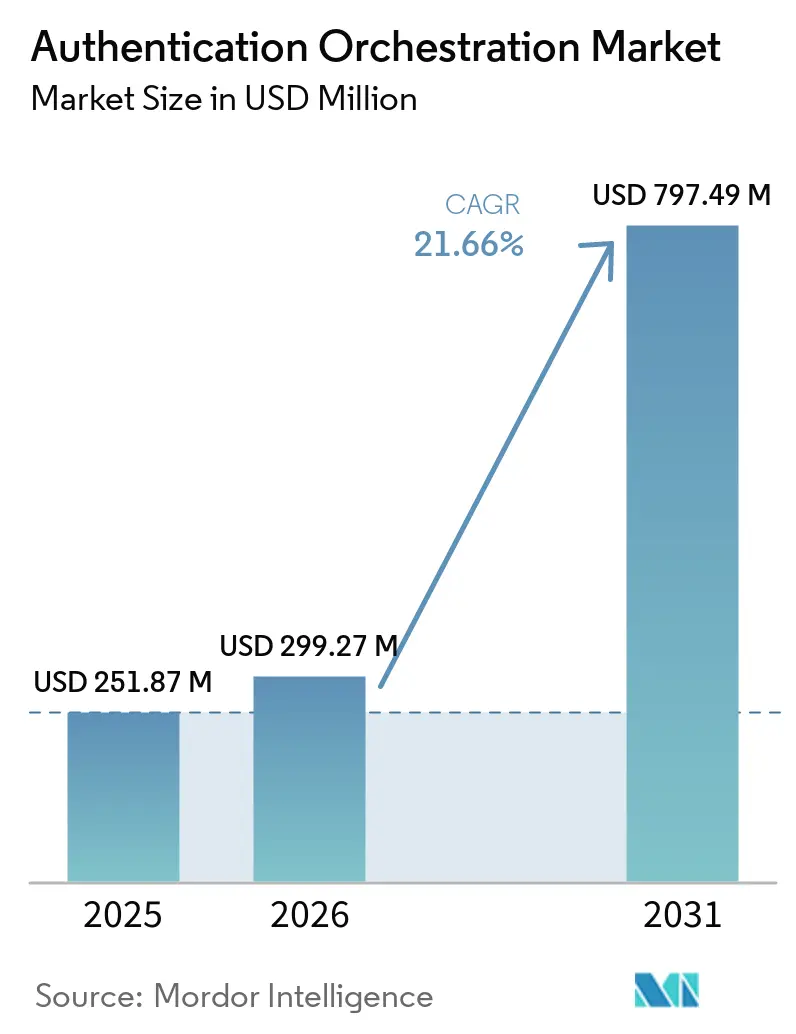
| Market Size (2026) | USD 299.27 Million |
| Market Size (2031) | USD 797.49 Million |
| Growth Rate (2026 - 2031) | 21.66 % |
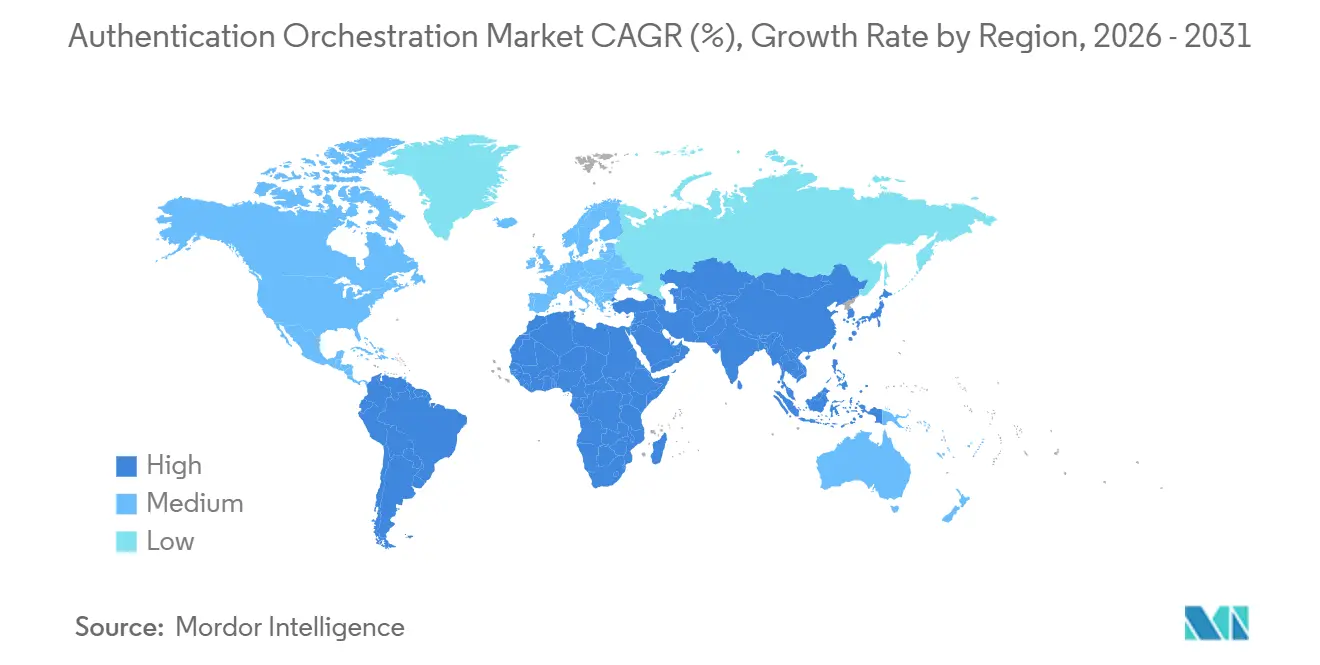
| Fastest Growing Market | Asia-Pacific |
| Largest Market | North America |
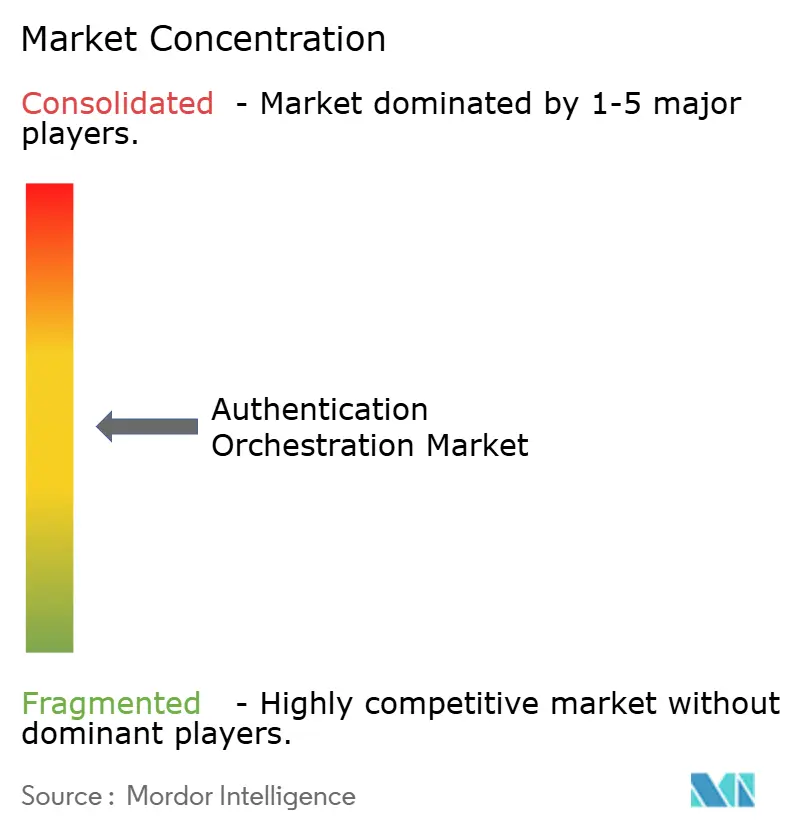
| Market Concentration | Medium |
Major Players *Disclaimer: Major Players sorted in no particular order Image © Mordor Intelligence. Reuse requires attribution under CC BY 4.0. | |
Authentication Orchestration Market Analysis by Mordor Intelligence
The authentication orchestration market size was USD 251.87 million in 2025 and is estimated to grow from USD 299.27 million in 2026 to reach USD 797.49 million by 2031, at a CAGR of 21.66% during the forecast period 2026-2031. The authentication orchestration market is expanding as regulated organizations replace disconnected authentication tools with centrally managed policy layers. These platforms can select authentication steps using risk context, user behavior, and access channel details. Demand is strongest where several identity providers, legacy directories, and cloud applications must operate together. Vendor strategies increasingly combine configurable authentication journeys with threat signals and device intelligence. The shift toward passkeys also increases the need for server-level controls that validate user verification and prevent replay.
Key Report Takeaways
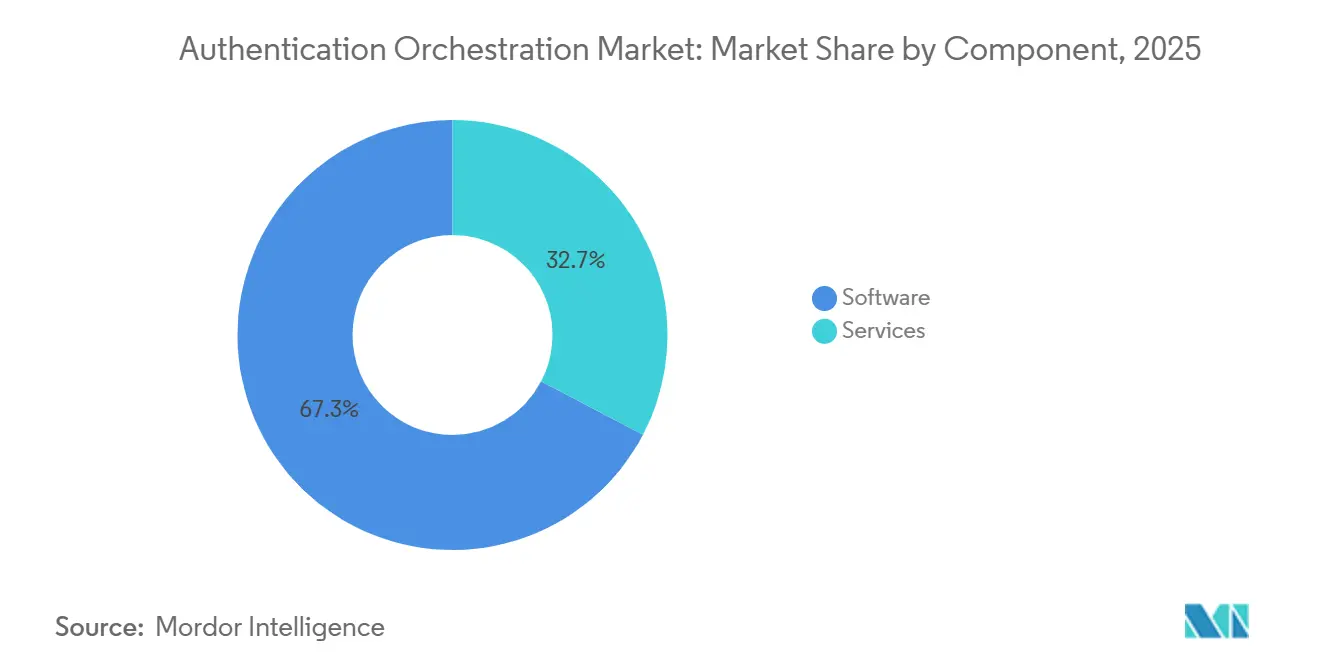
- By component, software held 67.33% of the authentication orchestration market share in 2025, while services are projected to expand at a 23.71% CAGR through 2031.
- By deployment mode, cloud accounted for 59.89% of the authentication orchestration market share in 2025, while hybrid deployment is projected to grow at a 23.02% CAGR through 2031.
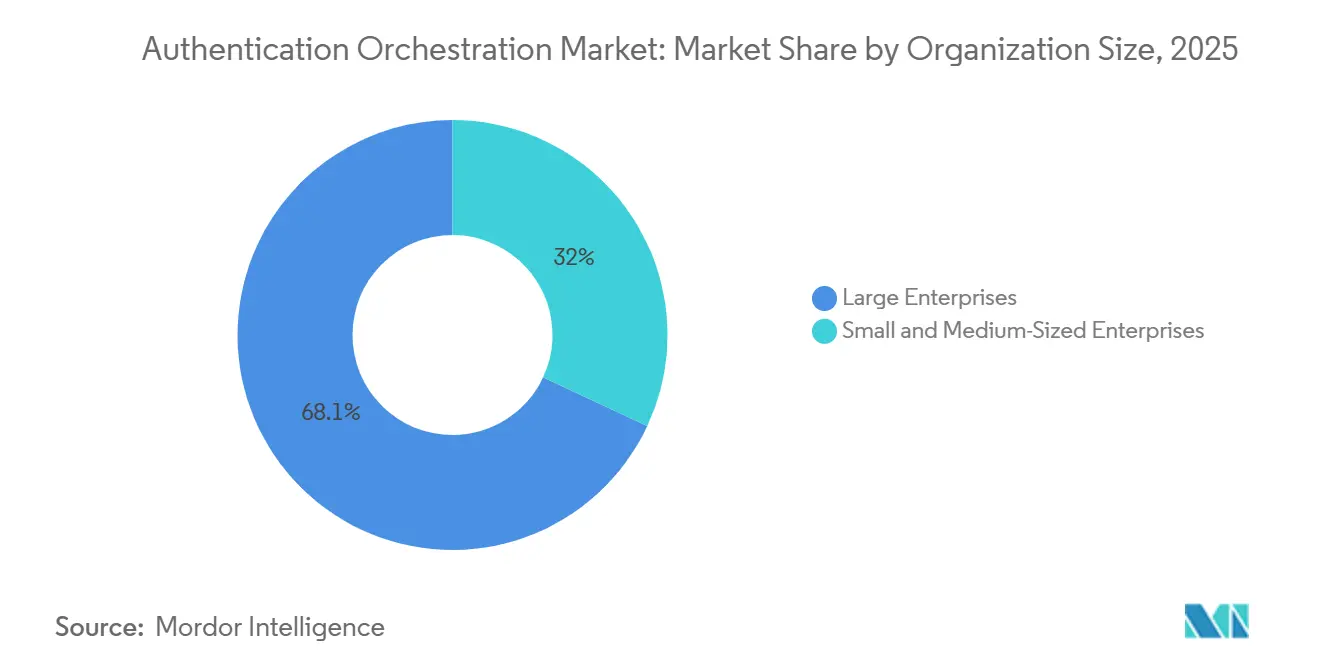
- By organization size, large enterprises held 68.05% of the authentication orchestration market revenue in 2025, while small and medium-sized enterprises are projected to grow at a 23.30% CAGR through 2031.
- By industry vertical, BFSI accounted for 22.41% of the authentication orchestration market revenue in 2025, while healthcare and life sciences are projected to grow at a 22.39% CAGR through 2031.
- By geography, North America held 35.16% of the authentication orchestration market in 2025, while Asia-Pacific is projected to expand at a 22.67% CAGR through 2031.
Note: Market size and forecast figures in this report are generated using Mordor Intelligence’s proprietary estimation framework, updated with the latest available data and insights as of January 2026.
Global Authentication Orchestration Market Trends and Insights
Drivers Impact Analysis*
| Driver | (~) % Impact on CAGR Forecast | Geographic Relevance | Impact Timeline |
|---|---|---|---|
| Identity-Centric Zero-Trust Adoption | +5.8% | Global | Long term (≥ 4 years) |
| Phishing-Resistant Authentication Requirements | +4.2% | North America and Europe, expanding to Asia-Pacific | Medium term (2-4 years) |
| Account-Takeover and Transaction-Fraud Escalation | +3.9% | Global, strongest in North America and Asia-Pacific | Short term (≤ 2 years) |
| Cloud and Hybrid Identity-Stack Complexity | +3.1% | Global, concentrated in North America and Europe | Medium term (2-4 years) |
| AI-Agent Identity Journeys and Non-Human Access | +2.7% | North America and Europe, with early growth in Asia-Pacific | Long term (≥ 4 years) |
| Authentication Policy Portability Across Identity Providers | +1.9% | Global, with early growth in large-enterprise hubs | Medium term (2-4 years) |
| Source: Mordor Intelligence | |||
Identity-Centric Zero-Trust Adoption Anchors Enterprise Authentication Spending
Zero-trust programs are moving from security plans into active purchasing requirements for many organizations, particularly those handling regulated data and complex workforce access. Continuous verification requires checks across sessions, devices, applications, and access requests. The authentication orchestration market benefits from the fact that a single authentication engine cannot reliably manage multiple identity providers and risk signals. Early-stage programs use orchestration software to apply multi-factor authentication consistently across separate environments, instead of maintaining different controls in each application. More mature programs add continuous session checks and behavioral scoring to those foundations, which expands the policy scope after initial deployment. The National Security Agency issued Zero Trust Implementation Guidelines for National Security Systems in January 2026, supporting standards-based procurement across government supply chains.
Phishing-Resistant Authentication Requirements Shorten Procurement Cycles
Regulatory requirements are making phishing-resistant authentication a more immediate purchasing issue for organizations with material digital access risk. NIS2 Article 21 requires multi-factor or continuous authentication for essential entities. The authentication orchestration market can support compliance by enabling organizations to use FIDO2, passkeys, and legacy authentication methods within a single access journey. NIST finalized SP 800-63-4 in July 2025 and recognized syncable passkeys at Authenticator Assurance Level 2. In 2026, the United Kingdom's National Cyber Security Center stated that it recommends using passkeys whenever services support them. These deadlines can reduce the time between technology evaluation and purchasing for regulated financial services organizations with overlapping obligations.
Account-Takeover and Transaction-Fraud Escalation Forces Authentication Modernization
Account-takeover fraud gives security and fraud teams a direct reason to modernize authentication, especially when automated attacks bypass basic credential checks. TransUnion reported that suspected digital account-takeover fraud rose 37% from 2024 to 2025 across its analysis, even as overall suspected digital fraud declined to 3.8% in 2025. LexisNexis Risk Solutions reported a 1.2% overall login attack rate in 2025, up 89% year over year. Desktop account-takeover attacks increased by more than 200% as automated campaigns expanded beyond mobile-first credential stuffing. Authentication orchestration platforms can use device and behavioral signals before approving a login, rather than relying solely on a fixed authentication challenge. This gives fraud and identity teams a shared platform to reduce risk, rather than only recording events after a breach.
Cloud and Hybrid Identity-Stack Complexity Creates Demand for Orchestration Layers
Organizations increasingly operate on-premises directories, cloud identity providers, and SaaS applications simultaneously, often under different administrative teams. These environments can leave gaps that a single-provider identity service does not close. The authentication orchestration market addresses this problem through a policy layer that works across applications and authentication methods. Older protocols such as Kerberos, LDAP, RACF PassTickets, and SOAP do not directly align with SAML assertions and OpenID Connect tokens. A purpose-built layer can translate these protocols without requiring changes to every application or lengthy custom middleware work. Vendors with connectors for older protocols can be well placed in regulated organizations where application replacement takes several years.
Restraints Impact Analysis*
| Restraint | (~) % Impact on CAGR Forecast | Geographic Relevance | Impact Timeline |
|---|---|---|---|
| Legacy Application and Protocol Integration Cost | -1.5% | Global, strongest in manufacturing, government, and financial services | Long term (≥ 4 years) |
| Privacy and Biometric Data-Governance Constraints | -0.8% | Europe and the United Kingdom, with spillover to Asia-Pacific | Medium term (2-4 years) |
| Passkey Recovery and Credential-Lifecycle Gaps | -0.6% | Global | Short term (≤ 2 years) |
| Risk-Model Explainability and False-Positive Exposure | -0.4% | North America and Europe, with early regulatory interest in Asia-Pacific | Medium term (2-4 years) |
| Source: Mordor Intelligence | |||
Legacy Application and Protocol Integration Cost Delays Deployment
Legacy integration remains a material barrier for organizations replacing authentication processes, particularly across heavily customized internal applications. Applications built around RACF, LDAP, or SOAP often need discovery work before new policies can go live. Session-based authentication models can also conflict with current OAuth 2.0 refresh-token designs. The authentication orchestration market may face slower near-term adoption where customers manage large on-premises estates and undocumented access flows. These organizations can operate hybrid systems for 12-36 months before policy coverage becomes consistent across their applications. Vendors that offer pre-certified connectors for older protocols can reduce deployment effort and improve their position in long replacement cycles.
Privacy and Biometric Data-Governance Constraints Raise Compliance Costs
Biometric authentication introduces additional compliance requirements in jurisdictions with strict privacy laws and stringent controls on sensitive personal data. GDPR Article 9 treats biometric data used for unique identification as special-category data.[1]European Parliament and Council of the European Union, “General Data Protection Regulation,” EUR-Lex, eur-lex.europa.eu Large-scale processing can require a Data Protection Impact Assessment before deployment. The EU AI Act also adds obligations where biometric identification workflows qualify as high-risk systems. India and South Korea have similar consent and data-handling requirements that complicate cross-border authentication data flows and centralized analytics. These conditions favor on-device biometric matching, where raw biometric data does not leave the user device.
*Our forecasts treat driver/restraint impacts as directional, not additive. The impact forecasts reflect baseline growth, mix effects, and variable interactions.
Segment Analysis
By Component: Software Platforms Lead Policy Management Across Authentication Methods
Software held 67.33% of the authentication orchestration market share in 2025. The leading position reflects demand for programmable policy engines across different channels and authentication methods. Organizations use these platforms to select the appropriate authenticator based on the risk context, user behavior, and compliance rules. This approach moves purchasing away from a focus on individual tokens or biometric sensors. It also avoids hardware upgrades and repeated application redeployment. Software can help teams maintain consistent policy logic as identity providers and access channels change.
Services are projected to grow at a 23.71% CAGR from 2026 to 2031. Professional implementation, managed services, and specialist support are becoming important as deployments cover more identity providers, risk engines, and channel-specific authentication journeys. Buyers need help configuring authentication journeys, tuning adaptive risk thresholds, and maintaining clear governance over policy changes. They also need connectors updated as protocols change and as applications add new integration requirements. Okta expanded its orchestration capabilities in early 2026 through its Mosaic Platform SDK and Auth0 platform features for AI agents and digital credentials.[2]Okta, “Okta Brings First-Class Identity to AI Agents with Agent SSO,” Okta, okta.com These releases show why implementation expertise remains important alongside software subscriptions in the authentication orchestration market.


By Deployment Mode: Cloud Leads While Hybrid Deployment Grows Fastest
Cloud accounted for 59.89% of the authentication orchestration market in 2025. Cloud delivery aligns with distributed application estates and identity-as-a-service operating models. It can support authentication across multiple applications without requiring customers to maintain all the infrastructure themselves. On-premises deployment remains relevant in sovereign data environments and classified government networks. It also serves banks that need single-tenant deployments under PCI DSS and HIPAA requirements. Its relative position is narrowing as cloud-managed and self-hosted operating models become easier to manage.
Hybrid deployment is projected to grow at a 23.02% CAGR through 2031. Organizations with legacy on-premises estates and cloud-native applications cannot always quickly adopt a fully cloud-based model. They need an identity layer that issues tokens accepted by both cloud services and internal applications, governed by common policy rules. This supports modernization without requiring the legacy environment to reauthenticate against a cloud provider for every request. Microsoft added passkey profiles and Linux support for phishing-resistant multi-factor authentication credentials in its March 2026 Entra releases. These capabilities reflect ongoing vendor investment in hybrid environments and the authentication orchestration market.
By Organization Size: Large Enterprises Lead While SMEs Expand Access
Large enterprises held 68.05% of authentication orchestration revenue in 2025. Their identity estates often include thousands of applications and several identity providers. This scale makes centralized orchestration an operating requirement rather than a discretionary security upgrade. Large organizations also face greater regulatory exposure and can fund complex integrations. Their deployments create reference architectures for connectors and policy designs. These projects remain central to enterprise vendor revenue in the authentication orchestration industry.
Small and medium-sized enterprises are projected to grow at a 23.30% CAGR through 2031. Consumption-based pricing and pre-built connectors lower the barrier to entry for organizations with fewer than 500 employees and limited specialist resources. No-code journey editors can reduce the need for large identity engineering teams and shorten configuration work. Vendors such as Descope, Authsignal, and Stytch offer tools aimed at these lower-resource deployments. Organizations can configure production authentication flows in weeks rather than quarters, using reusable flows for common SaaS applications. Large-enterprise implementation work also produces connector patterns that vendors can later package for smaller customers in the authentication orchestration market.
By Industry Vertical: BFSI Leads Spending While Healthcare and Life Sciences Accelerate
BFSI accounted for 22.41% of the authentication orchestration market in 2025. The segment faces high transaction volumes, sophisticated fraud attempts, and several compliance requirements. PCI DSS v4.0.1 extended multi-factor authentication requirements for access to cardholder data environments in March 2025. European firms must also address DORA Article 9, while U.S. institutions follow layered FFIEC authentication guidance. OneSpan launched DigipassONE in July 2026 to help financial institutions coordinate several authentication methods without replacing existing infrastructure. The company identified PSD3 readiness and the European Digital Identity Wallet rollout as commercial drivers for the platform.
Healthcare and life sciences are projected to grow at a 22.39% CAGR through 2031. The proposed HIPAA Security Rule changes announced in January 2025 would make multi-factor authentication an explicit requirement for systems handling electronic protected health information. NHS England's identity verification and authentication standard also added compliance pressure in the United Kingdom from December 2025. Ping Identity and OLOID partnered in May 2026 to provide passwordless, verified-trust authentication for the U.S. clinical workforce. Government, IT and telecommunications, retail and e-commerce, energy and utilities, and education also contribute to demand across the authentication orchestration market. TransUnion reported that suspected digital account-creation fraud reached 8.3% of attempts in retail in 2025.
Geography Analysis
North America held 35.16% of the authentication orchestration market share in 2025. The region combines extensive enterprise security budgets, active regulation, and a concentrated vendor base. U.S. federal zero-trust requirements have supported procurement of phishing-resistant multi-factor authentication across agencies and contractor networks. NIST SP 800-63-4 sets a current digital identity framework for federal systems and regulated private organizations.[3]National Institute of Standards and Technology, “Digital Identity Guidelines,” NIST, nist.gov Microsoft required multi-factor authentication for Azure sign-ins across tenants, with extended compliance deadlines continuing through July 2026.
Europe is the second-largest regional market in the authentication orchestration market. NIS2, DORA, and eIDAS 2.0 create parallel compliance requirements across financial services, healthcare, and large digital platforms. All 27 European Union member states must provide a European Digital Identity Wallet by December 2026. The FIDO Alliance stated in September 2025 that a FIDO passkey enrolled in an EUDI Wallet can meet relying-party authentication requirements at high eIDAS assurance levels. Germany, the United Kingdom, France, and the Benelux countries lead regional procurement. The NCSC recommendation for passkeys provides buyers with a clearer, government-aligned reference point. South America remains earlier in adoption, with Brazil and Argentina showing demand from larger financial institutions.
Asia-Pacific is projected to grow at a 22.67% CAGR through 2031. India’s Unified Payments Interface logged 102 billion authentication calls in 2025, adding scale and complexity to the authentication infrastructure. Razorpay launched a Reserve Bank of India-compliant biometric passkey solution with Mastercard in March 2026 for online card transactions. Fujitsu deployed its FIDO2 passkey service for SMBC Nikko Securities in February 2026 for online trading. The Middle East is also becoming more active, following the Central Bank of Jordan's selection of BIO-key International for a national biometric authentication initiative in July 2026. These programs extend the authentication orchestration market beyond its established North American and European base.

Competitive Landscape
The authentication orchestration market is moderately fragmented. Okta, Microsoft, and Ping Identity have strong positions because they are integrated into workforce identity environments. Pure-play providers, including Transmit Security, Descope, Strata Identity, and Authsignal, compete through configurable journey editors and real-time risk inputs. Large vendors can benefit from existing customer relationships and established administration tools. Specialists can compete without requiring customers to replace an incumbent workforce identity platform.
AI-agent identity has become a key area of product competition in the authentication orchestration market in 2026, allowing vendors to address AI workloads without requiring customers to replace their primary. Okta launched Okta for AI Agents in April 2026 and made Agent SSO generally available in August 2026. The offering treats AI agents as identities that require lifecycle management and controlled access. Microsoft made Entra Agent ID generally available to extend conditional access, lifecycle governance, and OAuth flows to AI workloads.[4]Microsoft, “Mandatory Multifactor Authentication for Azure and Admin Portals,” Microsoft Learn, microsoft.com It also supports organizations that retain Ping Identity or other workforce systems. These moves let vendors address AI workloads without asking customers to replace their main identity systems.
Smaller organizations remain an important opportunity because they have lower access to large identity engineering teams. Preconfigured compliance templates and outcome-based pricing can lower implementation costs for those buyers. Descope and Strata Identity use visual editors and standards-based connectors to win customer-identity projects alongside incumbent workforce systems. CyberArk and Transmit Security formed a technology alliance that combined privileged access management with customer identity orchestration and fraud prevention. Partnerships can help vendors assemble broader risk and access capabilities without having to build every component internally. The authentication orchestration market, therefore, combines platform integration, specialist functionality, and cross-category alliances.
Authentication Orchestration Industry Leaders
Microsoft Corporation
IBM Corporation
Cisco Systems, Inc.
Okta, Inc.
Ping Identity Corporation
- *Disclaimer: Major Players sorted in no particular order

Recent Industry Developments
- August 2026: Okta announced general availability of Agent SSO on August 24, 2026, introducing the Cross App Access standard to its identity product used by more than 20,000 customers, treating AI agents as first-class identities with centralized lifecycle governance, replacing static API keys and broad OAuth grants with least-privilege, short-lived, audited token flows.
- August 2026: Transmit Security released Mosaic Platform SDK 2.5.0 on August 4, 2026, introducing agentic AI recognition in device intelligence, replay protection for secured session tokens, and expanded Integration Hub connectors for identity orchestration and fraud prevention, enabling organizations to distinguish AI agent traffic from human sessions within a unified orchestration journey.
- July 2026: BIO-key International was selected by the Central Bank of Jordan on July 28, 2026, for a national biometric authentication initiative, supporting more than 30 million banking customers across more than 850 branches, making it one of the largest biometric authentication deployments in the Middle East and Africa.
- June 2026: Okta expanded its Cross App Access ecosystem to 25+ integrations on June 23, 2026, providing a standardized governance framework for AI agent-to-app and app-to-app connections with centralized identity policy enforcement, full action logging, and tightly scoped access through the Okta Integration Network starting August 2026.


Global Authentication Orchestration Market Report Scope
The Authentication Orchestration Market comprises software platforms and associated services that enable organizations to design, manage, and optimize authentication workflows across multiple identity providers, authentication methods, applications, devices, and user journeys through a centralized orchestration layer. These solutions facilitate seamless integration of passwordless authentication, multi-factor authentication (MFA), biometrics, passkeys, adaptive risk-based authentication, identity verification, and third-party identity services while improving security, user experience, regulatory compliance, and operational efficiency across workforce, customer, partner, and machine identities.
The Authentication Orchestration Market Report is Segmented by Component (Software and Services), Deployment Mode (Cloud, On-Premises, and Hybrid), Organization Size (Large Enterprises and Small and Medium-Sized Enterprises), Industry Vertical (Government and Public Administration, Industrial Manufacturing, Retail and E-Commerce, Transportation and Logistics, Energy and Utilities, Oil and Gas, IT and Telecommunication, Media and Entertainment, Education and Research Institutions, Healthcare and Life Sciences, Banking, Financial Services, and Insurance [BFSI], and Other Industry Verticals), and Geography (North America, South America, Europe, Asia-Pacific, and Middle East and Africa). The Market Forecasts are Provided in Terms of Value (USD).
| Software |
| Services |
| Cloud |
| On-Premises |
| Hybrid |
| Large Enterprises |
| Small and Medium-Sized Enterprises |
| Government and Public Administration |
| Retail and E-Commerce |
| Transportation and Logistics |
| Energy and Utilities |
| IT and Telecommunication |
| Media and Entertainment |
| Healthcare and Life Sciences |
| Banking, Financial Services, and Insurance (BFSI) |
| Other Industry Verticals |
| North America | United States | |
| Canada | ||
| Mexico | ||
| South America | Brazil | |
| Argentina | ||
| Rest of South America | ||
| Europe | Germany | |
| United Kingdom | ||
| France | ||
| Italy | ||
| BENELUX | ||
| Rest of Europe | ||
| Asia-Pacific | China | |
| Japan | ||
| India | ||
| South Korea | ||
| Australia | ||
| Rest of Asia-Pacific | ||
| Middle East and Africa | Middle East | United Arab Emirates |
| Saudi Arabia | ||
| Rest of Middle East | ||
| Africa | South Africa | |
| Nigeria | ||
| Egypt | ||
| Rest of Africa | ||
| By Component | Software | ||
| Services | |||
| By Deployment Mode | Cloud | ||
| On-Premises | |||
| Hybrid | |||
| By Organization Size | Large Enterprises | ||
| Small and Medium-Sized Enterprises | |||
| By Industry Vertical | Government and Public Administration | ||
| Retail and E-Commerce | |||
| Transportation and Logistics | |||
| Energy and Utilities | |||
| IT and Telecommunication | |||
| Media and Entertainment | |||
| Healthcare and Life Sciences | |||
| Banking, Financial Services, and Insurance (BFSI) | |||
| Other Industry Verticals | |||
| By Geography | North America | United States | |
| Canada | |||
| Mexico | |||
| South America | Brazil | ||
| Argentina | |||
| Rest of South America | |||
| Europe | Germany | ||
| United Kingdom | |||
| France | |||
| Italy | |||
| BENELUX | |||
| Rest of Europe | |||
| Asia-Pacific | China | ||
| Japan | |||
| India | |||
| South Korea | |||
| Australia | |||
| Rest of Asia-Pacific | |||
| Middle East and Africa | Middle East | United Arab Emirates | |
| Saudi Arabia | |||
| Rest of Middle East | |||
| Africa | South Africa | ||
| Nigeria | |||
| Egypt | |||
| Rest of Africa | |||


Key Questions Answered in the Report
What is the size of the authentication orchestration market?
The authentication orchestration market was USD 299.27 million in 2026 and is projected to reach USD 797.49 million by 2031 at a 21.66% CAGR.
What is authentication orchestration used for?
It coordinates authentication methods, identity providers, risk signals, and access policies across applications and channels.
Which component leads authentication orchestration spending?
Software led with 67.33% share in 2025 because organizations need programmable policy management across authentication methods.
Which deployment model is growing fastest?
Hybrid deployment is projected to grow at a 23.02% CAGR through 2031 as organizations operate legacy and cloud environments together.
Which end-user sector has the largest spending share?
BFSI held 22.41% share in 2025 because of fraud exposure, transaction volume, and compliance requirements.
Which region is growing fastest for authentication orchestration?
Asia-Pacific is projected to grow at a 22.67% CAGR through 2031, supported by digital identity and mobile-payment ecosystems.
Page last updated on:


 Your data is secure and never sold or shared.


