
Market Overview
| Study Period | 2020 - 2031 |
|---|---|
| Forecast Data Period | 2026 - 2031 |
| Base Year Market Size (2025) | USD 4.88 Billion |
| Market Size (2026) | USD 5.05 Billion |
| Market Size (2031) | USD 6.02 Billion |
| Growth Rate (2026 - 2031) | 3.55 % |
| Market Concentration | Medium |
Major Players *Disclaimer: Major Players sorted in no particular order Image © Mordor Intelligence. Reuse requires attribution under CC BY 4.0. | |
Australia Corrugated Board Packaging Market Analysis by Mordor Intelligence
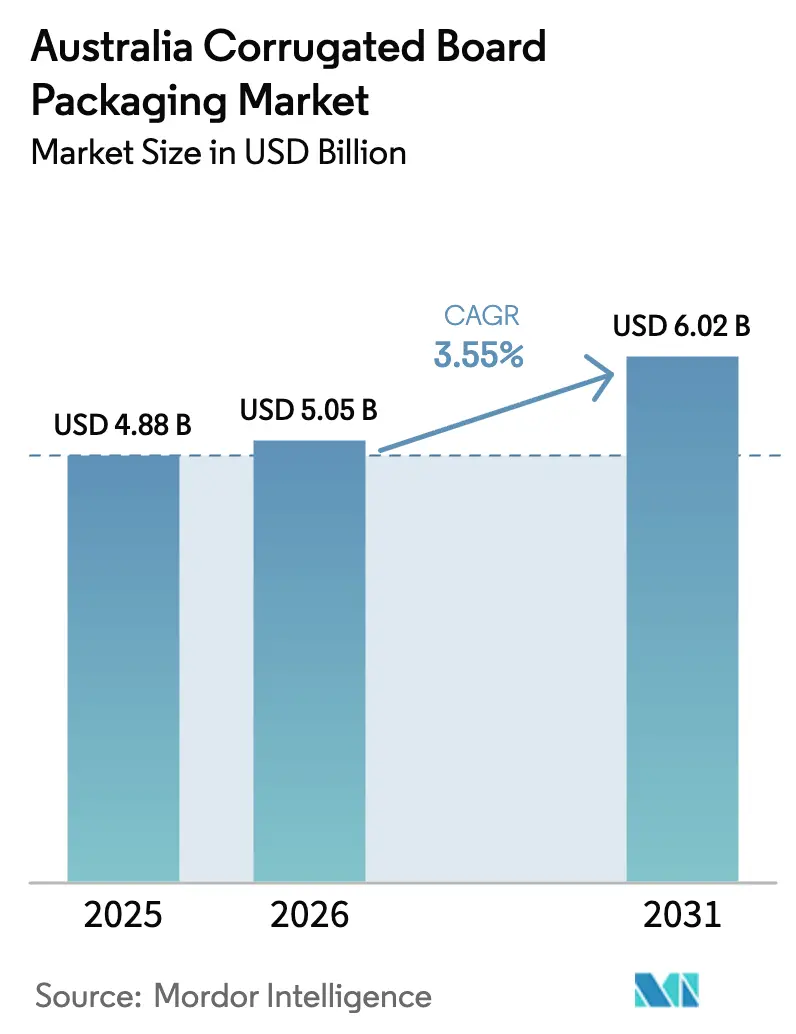
The Australia corrugated board packaging market size is expected to grow from USD 4.88 billion in 2025 to USD 5.05 billion in 2026 and is forecast to reach USD 6.02 billion by 2031 at 3.55% CAGR over 2026-2031. Expansion is underpinned by e-commerce parcel growth, state-backed recycling modernization, and manufacturers’ pivot toward box-on-demand systems that cut inventory waste while boosting customization. Domestic food and beverage demand ensures baseline volume stability even as private-label strategies raise the bar for shelf differentiation. Export-oriented fresh-produce and wine sectors further diversify volume streams, buffering the industry from cyclical swings in household consumption. At the same time, automation and digital printing are lowering minimum economic run lengths, enabling smaller converters to compete for niche accounts traditionally locked up by large integrated producers. Collectively, these structural shifts position the sector as a regional test bed for circular-economy innovation and technology-enabled fulfillment models.
Key Report Takeaways
- By end-user, food and beverage commanded 34.62% of the Australian corrugated board packaging market share in 2025, while e-commerce is projected to expand at a 5.05% CAGR through 2031.
- By board type, single-wall products represented 38.74% of the Australian corrugated board packaging market size in 2025, whereas triple-wall grades are set to grow at a 4.18% CAGR to 2031.
- By flute profile, C-flute led with 31.93% of the Australian corrugated board packaging market size in 2025, while microflute formats are advancing at a 4.71% CAGR through 2031.
- By printing technology, flexographic presses accounted for 28.08% of the Australian corrugated board packaging market size in 2025; digital printing is the fastest mover with a 5.78% CAGR projected to 2031.
Note: Market size and forecast figures in this report are generated using Mordor Intelligence’s proprietary estimation framework, updated with the latest available data and insights as of 2026.
Australia Corrugated Board Packaging Market Trends and Insights
Drivers Impact Analysis*
| Driver | (~) % Impact on CAGR Forecast | Geographic Relevance | Impact Timeline |
|---|---|---|---|
| E-commerce parcel volume boom | +1.2% | National, concentrated in Sydney, Melbourne, Brisbane metro areas | Short term (≤ 2 years) |
| Retail grocery private-label expansion | +0.8% | National, with stronger impact in regional markets | Medium term (2-4 years) |
| State recycling-modernisation funding | +0.6% | Queensland, NSW, Victoria, Western Australia | Medium term (2-4 years) |
| Warehouse automation and box-on-demand uptake | +0.4% | National, early adoption in major distribution hubs | Long term (≥ 4 years) |
| Cold-chain fresh-produce exports | +0.3% | Export-focused regions: Tasmania, South Australia, Western Australia | Medium term (2-4 years) |
| AI-enabled fit-to-product packaging lines | +0.2% | National, concentrated in major manufacturing centers | Long term (≥ 4 years) |
| Source: Mordor Intelligence | |||
E-commerce Parcel Volume Boom
Record parcel dispatches are forcing converters to engineer boxes that survive automated sortation, multi-handoff last-mile routes, and customer-friendly returns processes.[1]Australian Bureau of Statistics, “Retail Trade, Australia,” abs.gov.au Dimensional-weight pricing from Australia Post rewards right-sized packaging, accelerating adoption of precision-cut designs that minimize void fill. Triple-wall board, though a smaller slice of consumption, is growing as online merchants pay a premium for enhanced crush resistance. The boom also stimulates demand for track-and-trace graphics printed in small batches, a sweet spot for digital presses. Because parcel hubs sit near the nation’s three largest metros, converters with decentralized plants cut delivery lead times and win service-level contracts that traditional, centrally located mills struggle to match.
Retail Grocery Private-Label Expansion
Supermarket chains are leaning on private-label lines to defend margins, and packaging has become a frontline branding tool. Retailers now commission short-run holiday themes and region-specific SKUs that justify digital printing’s higher per-unit cost while slashing plate-change downtime. Rising input expenses-corrugated costs have climbed roughly 30% since 2022-press food manufacturers to rethink pack formats that optimize both shelf presence and pallet density. Converters offering design services help grocers reconcile branding ambitions with APCO recyclability rules, creating fee-based advisory revenue beyond the blank-box sale. This collaboration is particularly pronounced in produce crates, where shelf-life extenders such as breathable coatings bolster fresh quality.
State Recycling-Modernization Funding
Aggregate state spending that tops USD 100 million is building fiber-recovery hubs adjacent to major consuming regions, tightening the supply loop for recycled liner. Guaranteed bale offtake gives mills predictable raw-material input, reducing exposure to kraft-liner imports and volatile currency swings. Queensland’s ReMiQ program, for instance, funds contamination-detection sensors that boost recovered-fiber yield, sharpening mill economics without federal subsidies. Plants located within trucking distance of these hubs lock in freight savings and preferential access to high-grade secondary fiber, underscoring how policy is shaping competitive geography.
Warehouse Automation and Box-on-Demand Uptake
In-line pack stations that generate custom boxes at the pack-out lane cut SKU-specific inventory and free up warehouse space. Visy’s purchase of Packsize embeds this capability within an integrated containerboard–converting value chain, giving the market leader a solution few rivals can replicate. The equipment also overprints variable data such as last-mile routing codes, marrying structural and graphic customization in a single pass. Although capital-heavy, early adopters report measurable cuts in corrugated scrap, an environmental win that resonates with retailers pursuing APCO’s 100% recyclable goal. Smaller converters face a build-or-partner dilemma as the technology reshapes service expectations.
Restraints Impact Analysis*
| Restraint | (~) % Impact on CAGR Forecast | Geographic Relevance | Impact Timeline |
|---|---|---|---|
| Kraft liner pulp price volatility | -0.9% | National, with higher impact on import-dependent manufacturers | Short term (≤ 2 years) |
| Rail-freight capacity bottlenecks | -0.5% | Interstate routes, particularly Melbourne-Sydney-Brisbane corridor | Medium term (2-4 years) |
| Skilled-labour shortages in converting | -0.4% | National, concentrated in major manufacturing centers | Medium term (2-4 years) |
| Carbon-border adjustment risk on imports (under-reported) | -0.3% | National, affecting import-dependent manufacturers and customers | Long term (≥ 4 years) |
| Source: Mordor Intelligence | |||
Kraft Liner Pulp Price Volatility
Limited domestic pulp capacity exposes converters to global price swings amplified by exchange-rate shifts. Spikes during 2024 forced several independents to renegotiate quarterly supply or carry higher inventories financed at rising interest rates. Larger integrated producers hedge with longer-term fiber contracts, widening cost gaps that manifest in bid rounds. Volatility also complicates fixed-price commitments sought by big-box retailers and beverage fillers, prompting more frequent renegotiations and eroding trust in long-term frameworks.
Rail-Freight Capacity Bottlenecks
Australia’s east-coast intermodal network operates near saturation, and any disruption reverberates across raw-material inflow and finished-box deliveries.[2]Department of Infrastructure, Transport and Regional Development, “Freight and Supply Chain Priorities,” infrastructure.gov.au When wagons are unavailable, mills resort to truckload moves that inflate per-kilometer costs and carbon emissions-contradicting APCO targets. Converters located outside congestion pinch-points, such as regional NSW hubs, increasingly market supply-chain resilience as a differentiator, re-routing sheet stock by road only for the “last 100 kilometers.”
*Our forecasts treat driver/restraint impacts as directional, not additive. The impact forecasts reflect baseline growth, mix effects, and variable interactions.
Segment Analysis
By End-User Industry: E-commerce Drives Packaging Innovation
E-commerce demand is reshaping the Australia corrugated board packaging market, even though food and beverage led 2024 volume. Single-parcel shipments require impact-resistant designs, multi-depth formats, and readable codes for automated sorters. Online electronics sales layer in electrostatic discharge protection, while cosmetics brands pay premiums for unboxing aesthetics that reinforce social-media marketing. Food processors, hit by a 30% rise in packaging costs since 2022, now co-develop modular inserts that stabilize products across multiple SKU sizes without tooling changes.
As returns policies become a competitive lever, reverse-logistics-friendly boxes equipped with easy-tear strips win retailer favor. Meanwhile, the Australia corrugated board packaging market size tied to export-oriented fresh produce grows as growers trial water-resistant coatings compliant with Asian phytosanitary rules. Collectively, these shifts divert capital toward R&D rather than sheer capacity, signaling a move from commodity supply to solution-based selling.




By Board Type: Single-Wall Dominance Faces Triple-Wall Growth
Single-wall still accounts for the plurality of tonnage thanks to its cost-weight ratio in grocery and display units. Yet the tolerance for transit damage in direct-to-consumer channels is lower, nudging some buyers toward triple-wall crates that replace wood in bulky goods. Weight savings reduce airfreight surcharges on premium fruit exports, providing a margin offset against higher board cost. Manufacturers capitalize by offering hybrid double-wall with reinforced edge crush, balancing protection and pricing.
Investments in lighter-basis paper grades also help defend single-wall’s share, enabling downgauging without compromising stacking strength. APCO recyclability mandates favor corrugated over composite substrates, keeping the Australia corrugated board packaging market size for single-wall relatively stable even as new niches emerge for heavier construction.
By Flute Type: C-Flute Leadership Challenged by Microflute Innovation
C-flute’s middle-ground performance profile secures its dominance in standard shippers, but evolving shelf-ready designs turn attention to thinner microflutes that accept high-resolution graphics. Retailers appreciate the space savings on the shelf while maintaining enough compressive strength for mixed logistics. Microflute paired with digital print bridges the gap between corrugated and folding cartons, opening doorways for premium confectionery packs seeking plastic alternatives.
Temperature-controlled solutions such as DS Smith’s TailorTemp illustrate how flute engineering underwrites functional innovations by embedding insulation cavities without exotic foams. Although microflute material costs remain elevated, scale and print-on-demand economics are narrowing the gap, hinting at broader substitution ahead.

By Printing Technology: Digital Transformation Accelerates
Flexography’s entrenched network and economics keep it in pole position for high-volume FMCG work. Nonetheless, digital’s annualized growth eclipses any other process as converters chase on-demand color changes, serial coding, and versioned graphics. Opal Fibre Packaging’s 2024 investment demonstrates capacity shifting toward single-pass inkjet that eliminates plates and formulation wash-ups.
Hybrid workflows-digital for variable data atop pre-printed flexo bases-are meanwhile squeezing litho-lamination in mid-volume runs. Capital productivity metrics support the thesis: digital line changeovers measured in minutes unlock profitability even at a few hundred boxes per design, aligning perfectly with proliferating private-label SKUs.
Geography Analysis
Population-dense New South Wales and Victoria dominate consumption and house most integrated mills. Sydney and Melbourne also anchor e-commerce fulfillment zones, making rapid-response converting capacity indispensable. Queensland leverages USD 55 million in recycling grants to foster a closed-loop fiber supply near produce-export corridors, attracting box plants that cut inbound raw-material mileage. Western Australia’s mineral exports and agricultural bulk drive heavy-duty corrugated demand; geographic isolation incentivizes local factories that sidestep costly cross-continent truck legs.
South Australia’s wine route pushes specialty moisture-resistant liners that stabilize humidity during barrel-aging transit. Tasmania, while small in population, achieves outsized relevance through high-value cherry shipments needing vented, temperature-stable packs that secure premium shelf prices in Asia. Northern Territory’s industrial base is modest, yet mining projects periodically spike bulk packaging orders, rewarding converters with flexible capacity.
Rail-freight pinch-points along the east-coast spine steer some investment toward satellite converting in regional NSW, reducing reliance on congested intermodal links. These distributed footprints enable next-day delivery of sheets to independent box plants, a service differentiator that entrenched metro behemoths struggle to match without duplicating assets.
Regulatory Landscape
Australia operates a co-regulatory packaging stewardship framework anchored by the National Environment Protection (Used Packaging Materials) Measure 2011 (NEPM), with practical administration through the Australian Packaging Covenant Organisation (APCO). Under the NEPM, businesses with annual turnover of AUD 5 million or more must join the Australian Packaging Covenant or meet equivalent obligations, with reporting directed to relevant state or territory environment agencies. For many brand owners and their corrugated suppliers, this effectively makes APCO participation and associated documentation a commercial prerequisite.
Standards and food packaging requirements also influence corrugated specifications and compliance. Standards Australia published AS 3537:2024 for general purpose corrugated fibreboard boxes and blanks, while Food Standards Australia New Zealand (FSANZ) requirements, including Standard 3.2.2, govern food packaging fitness-for-purpose and contamination controls for the food and beverage end-use base. In parallel, the Department of Climate Change, Energy, the Environment and Water (DCCEEW) has referenced ongoing packaging regulatory reform work, but the new national regulatory settings are not in force as of mid-2026, leaving current NEPM and APCO-driven compliance as the operative regime.
Value Chain Analysis
The value chain starts with fibre sourcing, covering virgin kraft liner and recycled OCC, then moves through paper and containerboard manufacturing, corrugation and converting (die-cutting, flexo and digital print), and finally distribution to end users such as food and beverage, e-commerce, and produce exporters. Vertical integration remains a defining feature for major participants, combining recovered-fibre collection, recycled paper and liner production, and converting footprints to reduce exposure to pulp and energy cost swings while securing input quality for performance-critical applications.
In Australia, logistics and supply reliability are especially important due to constraints on the east-coast freight corridor referenced in the market context. Recent moves show how that operational focus is translating into capacity and network decisions: Visy points to high-throughput converting capability, including its Hemmant, Queensland site for very large daily box output, while scale-building integration is also reshaping independent networks, such as Abbe finalizing the integration of Oji Fibre Solutions Australian operations in April 2026 to consolidate manufacturing and logistics nationally. Imports add further pressure upstream, with packaging-grade paper import volumes reported as rising in the year ended May 2025, reinforcing the value of procurement discipline, inventory planning, and proximity-to-customer converting nodes for service levels.
Competitive Landscape
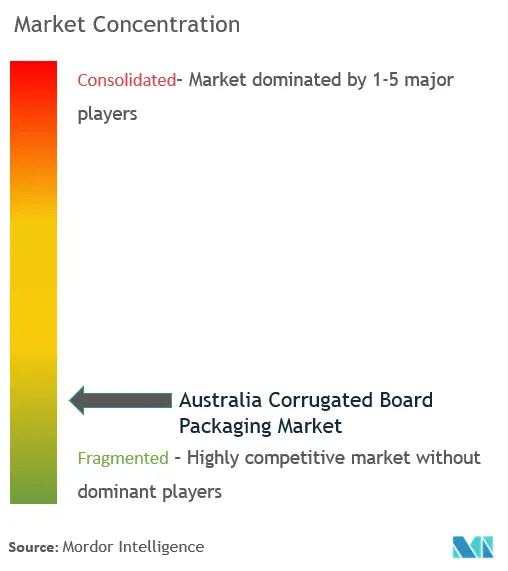
The market is moderately concentrated: Visy, Opal, Pratt Industries, and global incumbents such as DS Smith hold critical mass in linerboard supply, converting capacity, and recovered-fiber collection. Vertical integration from paper mill to recycling bins fortifies procurement advantages, particularly during kraft-liner spikes. Visy’s Packsize purchase embeds proprietary on-demand technology inside its network, while Pratt’s USD 5 billion expansion earmarks multi-wall capacity that could tilt future market share. Opal’s workforce realignment underscores cost-discipline imperatives as digital presses displace labor-intensive set-ups.
Niche disruptors deploy AI-driven cut-to-order lines, targeting mid-market e-commerce businesses frustrated by rigid minimum orders. Patent filings on water-resistant barrier coatings suggest new battlegrounds in produce export packaging. Sustainable substrate partnerships-Amcor with Kolon Industries on chemically recycled PET, for example-signal that corrugated producers are hedging with adjacent material R&D, broadening customer wallet share.
The APCO compliance regime raises the table stakes: converters adept at documentation and traceability secure retailer contracts wary of reputational risk. Automation investment cycles will likely widen the performance gulf between technology leaders and laggards, driving selective consolidation but stopping short of a monopoly due to diverse regional demand nodes.
Australia Corrugated Board Packaging Industry Leaders
Visy Industries Holdings Pty Ltd
Opal Fibre Packaging (Paper Australia Pty Ltd)
Oji Fibre Solutions (Australia) Pty Ltd
Amcor plc
Orora Ltd
- *Disclaimer: Major Players sorted in no particular order

Market Opportunities and Future Outlook
Regional manufacturing and distribution nodes aligned with primary production corridors create a practical whitespace for corrugated suppliers serving produce, food, and beverage customers that prioritize short lead times and lower freight exposure. This shows up in Visy opening a new packaging hub in Devonport, Tasmania in February 2026 to supply local agriculture and food and beverage demand, aligning capacity placement with export-oriented and seasonal volumes. East-coast freight congestion referenced in the market context also increases the value of multi-site networks and satellite converting, which can help maintain service when intermodal disruptions occur.
Compliance-led packaging design and reporting capabilities also support monetizable service layers beyond the box itself, since stewardship obligations remain active under the NEPM and APCO framework. Investments in recycled content and circularity infrastructure, including state recycling-modernisation programs cited in the report context, underpin opportunities for mills and converters that can secure high-grade recovered fibre and turn it into performance-focused corrugated formats for automated fulfillment and food supply chains. Data enablement is beginning to enter customer requirements as well: Opal Packaging Plus partnered with Phantm in February 2026 to develop a packaging data asset for improved reporting and regulatory compliance, signaling demand for traceability and documentation that corrugated converters can pair with design-for-recyclability and right-sized packaging programs.
Recent Industry Developments
- February 2026: Visy opened a new packaging hub in Devonport, Tasmania, including an 8,500 square metre warehouse to supply cardboard packaging to local agriculture, food, and beverage customers. The additional regional footprint supports faster turnaround and reduces freight complexity for Tasmanian producers that require consistent access to corrugated formats.
- February 2026: Opal Packaging Plus partnered with packaging technology company Phantm to develop a packaging data asset focused on enhanced reporting and regulatory compliance. The collaboration strengthens Opal's ability to serve brand owners needing better packaging intelligence and documentation as stewardship requirements tighten.
- November 2024: Amcor partnered with Kolon Industries to scale chemically recycled PET and bio-based polyethylene furanoate, broadening access to lower-impact packaging materials. While not corrugated-specific, the move influences broader Australian packaging sustainability programs and procurement priorities that corrugated suppliers increasingly compete against in secondary and adjacent applications.


Research Methodology Framework and Report Scope
Market Definition and Coverage
This market covers the value of corrugated board packaging sold and used in Australia, including corrugated boxes and related packaging formats made from corrugated board for shipment, storage, and product protection across industries.
Scope exclusions: It excludes non-corrugated paper packaging (such as folding cartons), flexible packaging, and plastic, metal, or glass packaging formats.
Segmentation Overview
- By End-User Industry
- Food
- Processed Foods
- Fresh Food and Produce
- Beverages
- E-commerce
- Electrical and Electronics
- Personal Care and Cosmetics
- Other End-User Industries
- Food
- By Board Type
- Single Face
- Single Wall
- Double Wall
- Triple Wall
- By Flute Type
- A-Flute
- B-Flute
- C-Flute
- E-Flute
- F-Flute and Micro-Flutes
- By Printing Technology
- Flexographic
- Digital
- Litho-lamination
- Other Printing Technologies
Data Sources, Market Sizing, and Validation
Desk Research
We start by building a fact base on Australia packaging demand and corrugated material flows, and then we narrow it to corrugated board packaging applications. Public sources help us anchor the direction and scale, especially when demand swings with e-commerce, food distribution, and manufacturing output.
For the desk work, we rely on sources such as the Australian Bureau of Statistics for production, trade, and industry indicators, and the Australian Packaging Covenant Organisation for packaging targets and progress signals. We also refer to government environment and recycling program publications, customs import and export series for paper and paperboard items, and technical references from peer-reviewed packaging and materials journals. Company annual reports, investor presentations, and industry association releases are used to understand capacity adds, grade shifts, and investment timing, supported by paid subscriptions for company financials and news screening, patent lookups, and shipment-level trade checks where needed. These sources are not exhaustive, and many additional public documents and datasets were reviewed to collect inputs, validate assumptions, and clarify gaps.
Primary Interviews and Surveys
Primary work is used to test how corrugated demand is behaving by end-use, and to convert desk indicators into realistic volumes and price points for the model. We speak with packaging converters, material suppliers, distributors, and large packaging buyers across food, beverage, e-commerce fulfillment, manufacturing, and healthcare so assumptions around box mix, flute preferences, and printing needs can be confirmed and corrected.
Distribution of primary research fieldwork respondents
| Company type | Respondent position |
|---|---|
| Top tier: 29% | CXOs: 12% |
| Mid tier: 57% | Functional/Unit leaders: 36% |
| Smaller Players: 14% | Managers: 52% |
Market-Sizing & Forecasting
The market value is built using a top-down approach where packaging demand is reconstructed from Australia end-use activity and corrugated adoption patterns, and then converted into value using observed price levels. When the logic is assembled and totals are produced, we corroborate them with selective bottom-up approximations, such as converter revenue splits, sampled price per box or price per square meter checks, and channel feedback on volume changes.
Inputs that matter in this market include e-commerce parcel volumes and fulfillment trends, food and beverage production and distribution activity, manufacturing output and export-linked shipment needs, recycled fiber availability and pricing pressure, and the shift toward automation and box-on-demand setups that can change wastage and box specifications. Printing technology mix is also tracked because higher print and customization typically moves average selling prices, even when tonnage is stable. Where direct data is thin, gaps are handled by using bounded ranges from interviews, followed by sensitivity checks so the model does not overreact to one-off signals.
For forecasting, we use scenario analysis supported by simple time-series smoothing on key demand indicators, and then adjust the path based on what buyers and suppliers expect for lead times, pricing resets, and recycled-content targets. The forecast is kept practical, and assumptions are tied back to variables that can be monitored each year.
Data Validation & Update Cycle
Outputs are validated through multiple checks, where results are compared against independent signals like trade movements, capacity and investment announcements, and end-user activity levels. If any number looks out of line, the drivers are re-opened and the key assumptions are re-tested with follow-up calls, before the final view is signed off.
A second analyst review is used to catch consistency issues across years, including price, volume, and mix shifts that do not match market behavior. Reports are refreshed annually, and interim updates are made when material events occur that can change demand, supply, or pricing. Before delivery, we run a fresh final pass so the client receives an updated view aligned to the latest available data.
Mordor Intelligence's Australia Corrugated Board Packaging Market Sizing Compared With Other Published Estimates
Published market sizes for corrugated board packaging in Australia can look far apart because firms choose different scope edges, price definitions, and timing for currency and inflation updates. The table helps show how choices like including manufacturing revenue, counting adjacent paper packaging, or using different base years can pull totals in different directions.
The benchmark table shows a spread that mainly comes from what gets counted as corrugated packaging value and how average selling prices are built, especially when product mix shifts between e-commerce shippers and heavier industrial boxes. In Mordor Intelligence's model, the value is limited to corrugated board packaging sold into Australia end-uses, and it does not fold in non-corrugated paper packaging or broader paperboard container categories, which can raise other published totals when bundled together.
Benchmark comparison
| Source | Market Size | Gaps in Research Methodology |
|---|---|---|
| Mordor Intelligence | USD 4.88 B (2025) | |
| Industry Database A | USD 4.20 B (2026) | Often aligned to manufacturing revenue reporting, which can exclude downstream packaging services and miss demand from imported packed goods, and it may use a different conversion for AUD to USD timing. |
| Trade Journal B | USD 5.60 B (2025) | May bundle corrugated packaging with adjacent paper and paperboard packaging formats, and it can apply a faster ASP uplift assumption without separating shifts in box mix and printing specification. |
Looking across the three figures, the gap is explained mostly by scope boundaries and price logic rather than a disagreement on overall packaging demand direction. By keeping the scope tied to corrugated board packaging only, and by checking prices against what buyers report paying across major end-uses, the final number stays traceable to clear drivers and repeatable steps.


Key Questions Answered in the Report
What is the current value of the Australia corrugated board packaging market?
It is valued at USD 5.05 billion in 2026, with a projection to reach USD 6.02 billion by 2031.
How fast is e-commerce driving corrugated demand in Australia?
The e-commerce segment is growing at a 5.05% CAGR over 2026-2031, surpassing all other end-use categories.
Which board type is gaining the most momentum?
Triple-wall grades are forecast to expand at a 4.18% CAGR over 2026-2031, fueled by heavy-duty export and bulky e-commerce shipments.
Why are microflutes important for retail packaging?
They combine space-saving thinness with high-resolution print compatibility, enhancing shelf appeal without sacrificing protection.
How will state recycling funding affect supply security?
Investments exceeding USD 100 million are creating regional fiber-recovery hubs, reducing raw-material volatility for local mills.
What technologies are reshaping the competitive landscape?
Digital printing and box-on-demand automation allow precise, short-run production, giving early adopters a service advantage.
Page last updated on:





