
Atrial Fibrillation Surgery Market Size and Share
Market Overview
| Study Period | 2020 - 2031 |
|---|---|
| Forecast Data Period | 2026 - 2031 |
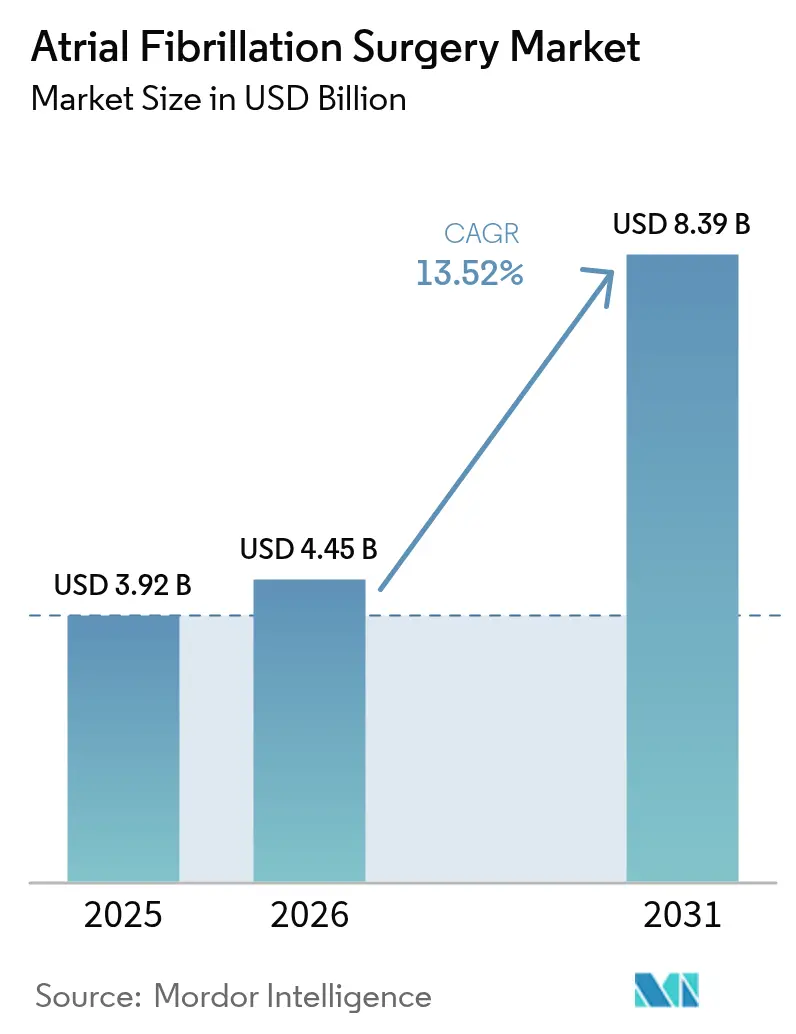
| Market Size (2026) | USD 4.45 Billion |
| Market Size (2031) | USD 8.39 Billion |
| Growth Rate (2026 - 2031) | 13.52 % |
| Fastest Growing Market | Asia Pacific |
| Largest Market | North America |
Major Players *Disclaimer: Major Players sorted in no particular order Image © Mordor Intelligence. Reuse requires attribution under CC BY 4.0. | |
Atrial Fibrillation Surgery Market Analysis by Mordor Intelligence
The atrial fibrillation surgery market size was valued at USD 3.92 billion in 2025 and estimated to grow from USD 4.45 billion in 2026 to reach USD 8.39 billion by 2031, at a CAGR of 13.52% during the forecast period (2026-2031). Rising procedure volumes track sharply higher atrial fibrillation (AF) prevalence, wider availability of elective electrophysiology programs, and rapid migration toward pulsed-field ablation (PFA) systems that shorten procedure times while improving safety. Hospitals keep investing in integrated electrophysiology-hybrid suites even as ambulatory surgical centers (ASCs) draw case volumes through site-neutral payment rules and same-day discharge protocols. Capital flows into innovations such as catheter technology, mapping software, and AI-guided workflow analytics continue to reshape competitive positioning. Meanwhile, reimbursement revisions in the United States and Europe now recognize the complexity of combined left-atrial appendage closure and ablation, supporting revenue expansion for providers.
Key Report Takeaways
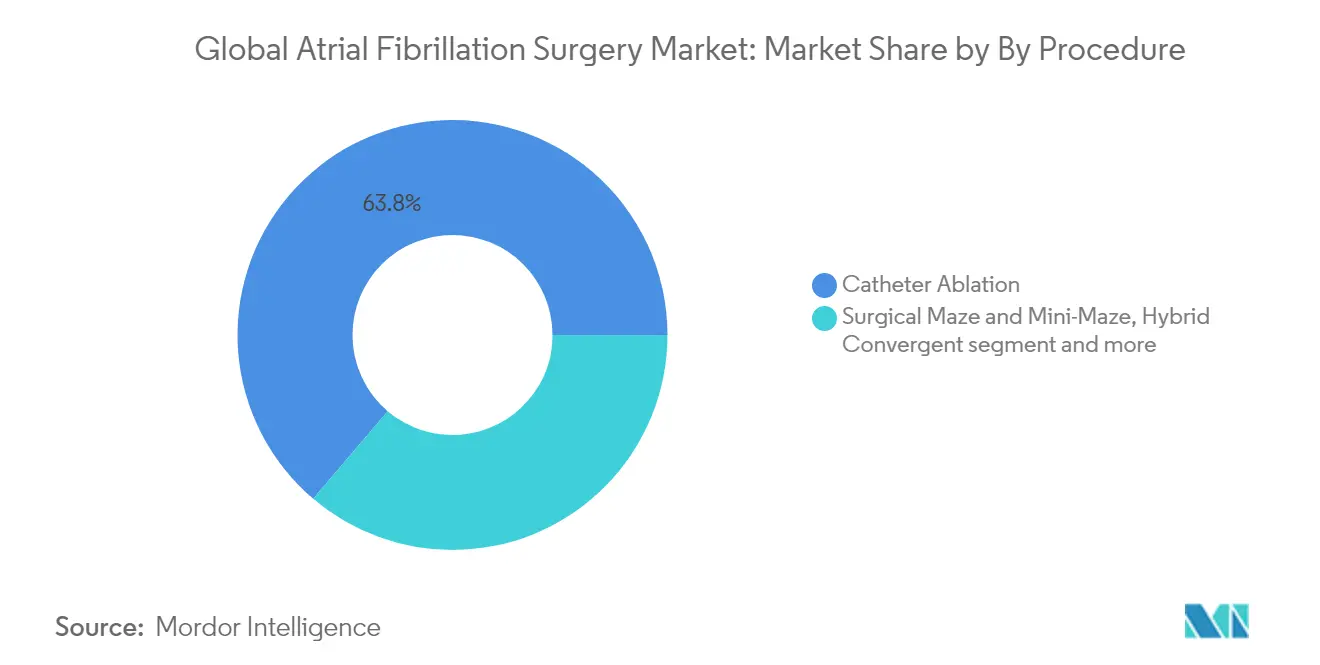
- By procedure, catheter ablation led with 63.78% revenue share in 2025, whereas pulsed-field ablation posts the strongest 14.31% CAGR through 2031.
- By product type, catheter ablation devices accounted for 57.92% of the atrial fibrillation surgery market size in 2025, while PFA systems expanded at a leading 15.02% CAGR to 2031.
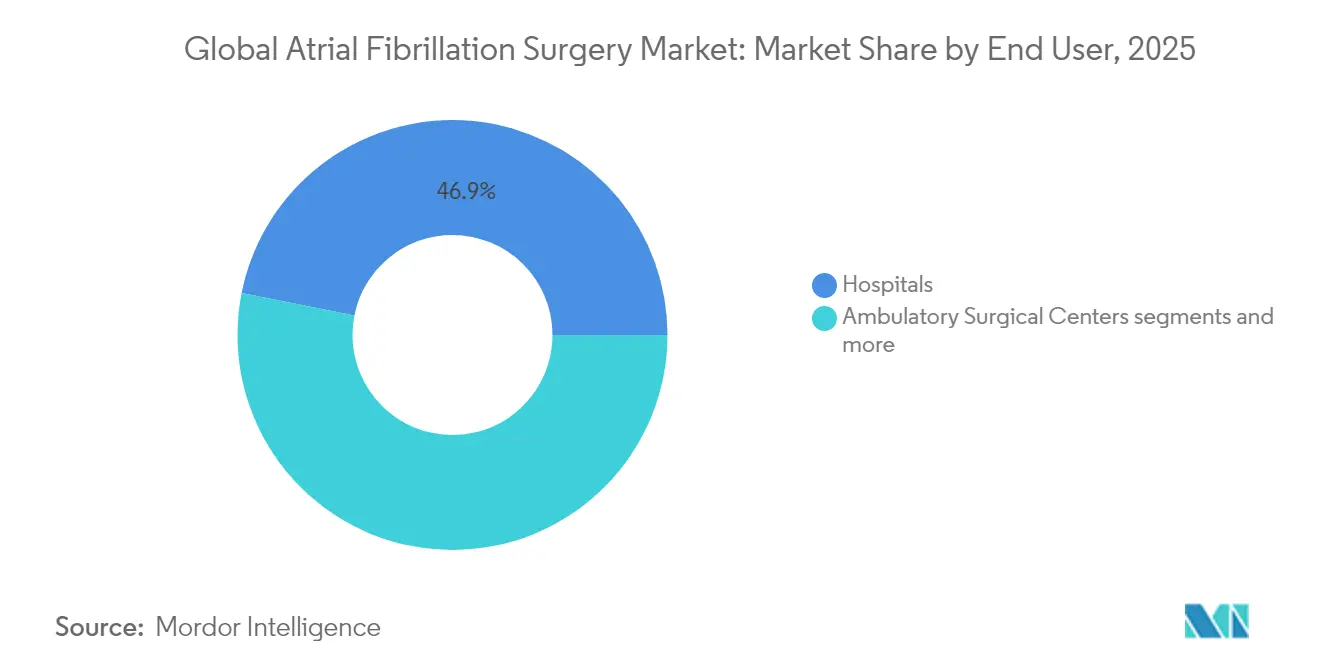
- By end user, hospitals accounted for 46.88% of the 2025 revenue; ASCs represent the fastest-growing setting, with a 15.72% CAGR through 2031.
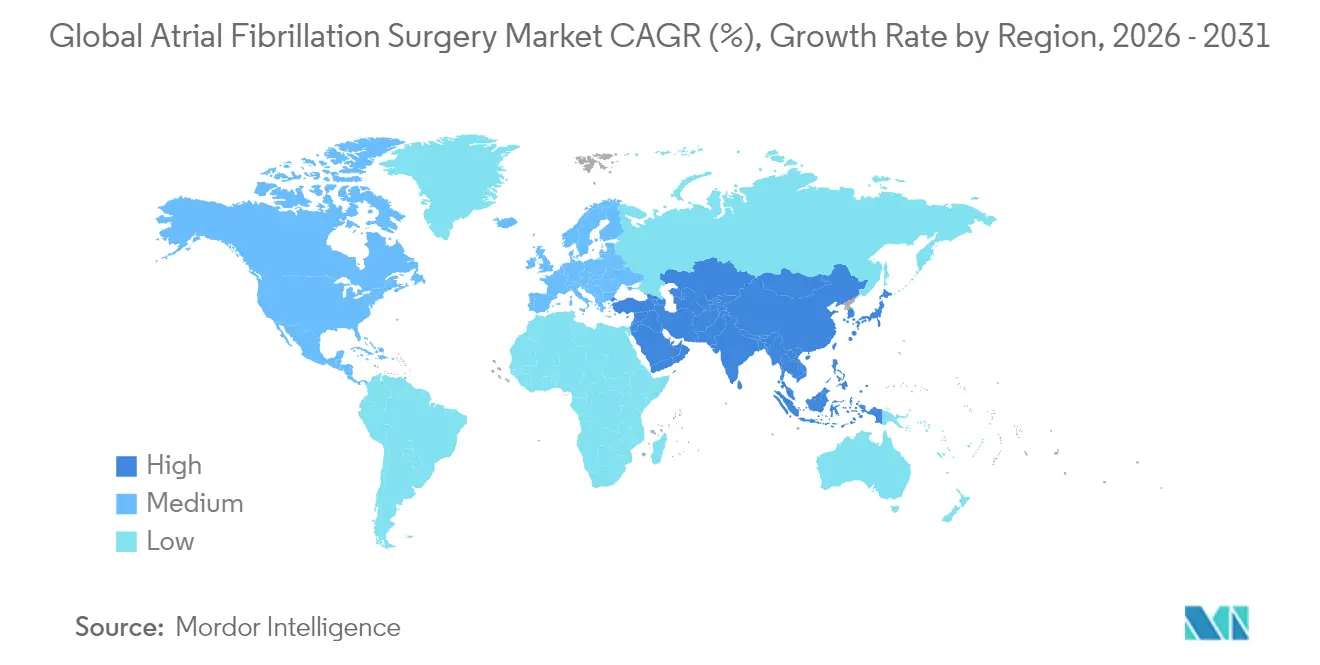
- By geography, North America captured 38.86% of the 2025 revenue; the Asia-Pacific region delivered the highest 16.58% CAGR to 2031.
Note: Market size and forecast figures in this report are generated using Mordor Intelligence’s proprietary estimation framework, updated with the latest available data and insights as of 2026.
Global Atrial Fibrillation Surgery Market Trends and Insights
Drivers Impact Analysis*
| Driver | (~) % Impact on CAGR Forecast | Geographic Relevance | Impact Timeline |
|---|---|---|---|
| Ageing population & AF prevalence surge | +3.2% | Global, with highest impact in North America & Europe | Long term (≥ 4 years) |
| Rising adoption of minimally-invasive catheter ablation | +2.8% | Global, led by developed markets | Medium term (2-4 years) |
| Expansion of outpatient EP labs & ambulatory centers | +2.1% | North America & Europe, expanding to APAC | Medium term (2-4 years) |
| Hospital cap-ex cycle toward single-shot PFA systems | +1.9% | North America & EU core markets | Short term (≤ 2 years) |
| Reimbursement upgrades for same-day discharge AF surgery | +1.6% | US Medicare markets, expanding globally | Short term (≤ 2 years) |
| Source: Mordor Intelligence | |||
Ageing population & AF prevalence surge
Lifetime AF risk climbed from 24.2% for Danes born 2000–2010 to 30.9% for those born 2011–2022, signaling a broad expansion of the treatable patient pool. US prevalence estimates now exceed prior forecasts as remote monitoring uncovers asymptomatic episodes. This demographic pressure intersects with improving detection technologies to lift referral volumes for rhythm-control procedures. Emerging economies mirror the trend; Korean national data reveal similar age-linked incidence curves. Health-system planners therefore frame AF ablation capacity expansion as a long-tail volume growth opportunity.
Rising adoption of minimally invasive catheter ablation
A meta-analysis of 22 randomized trials covering 6,400 patients confirmed that ablation halves AF relapse risk relative to medical therapy and cuts all-cause hospitalization by 43%. Endorsement of same-day discharge by US specialty societies accelerated uptake; Canadian centers reported 79.2% same-day release with negligible readmissions. Cumulative evidence positions ablation earlier in the treatment algorithm, making first-line rhythm control a mainstream option.
Hospital cap-ex cycle toward single-shot PFA systems
Hospitals allocate fresh budgets to PFA after FDA approvals of PulseSelect, VARIPULSE, and Affera systems demonstrated zero esophageal complications in pivotal trials. Administrators highlight predictable learning curves and <90-minute case times that translate to higher lab productivity.
Reimbursement upgrades for same-day discharge AF surgery
The US Centers for Medicare & Medicaid Services created MS-DRG 317 in 2025 for concomitant ablation and appendage closure, boosting average facility payments and validating the clinical resource mix in contemporary AF care[1].
Restraints Impact Analysis*
| Driver | (~) % Impact on CAGR Forecast | Geographic Relevance | Impact Timeline |
|---|---|---|---|
| Capital-intensive hybrid-OR build-outs | -1.8% | Global, particularly emerging markets | Medium term (2-4 years) |
| Shortage of EP-trained surgeons | -2.1% | Global, acute in rural and emerging regions | Long term (≥ 4 years) |
| Long-term durability concerns for PFA | -1.4% | Global, with regulatory focus in US & EU | Medium term (2-4 years |
| Source: Mordor Intelligence | |||
Capital-intensive hybrid-OR build-outs
Turn-key electrophysiology–surgical suites cost USD 2–5 million per room, straining rural or small-system budgets and slowing diffusion of advanced energy platforms outside tier-one centers.
Shortage of EP-trained surgeons
Electrophysiology fellowships remain capped relative to demand, and persistent urban clustering of specialists limits access in secondary markets. Workforce gaps complicate adoption of new tools such as dual-energy catheters that require dedicated training modules[2].
*Our forecasts treat driver/restraint impacts as directional, not additive. The impact forecasts reflect baseline growth, mix effects, and variable interactions.
Segment Analysis
By Procedure: PFA disrupts thermal dominance
Catheter ablation retained 63.78% revenue in 2025, anchoring the atrial fibrillation surgery market even as pulsed-field ablation logs a breakout 14.31% CAGR to 2031. The atrial fibrillation surgery market size for PFA-based procedures is therefore projected to almost triple within the decade. Balloon-based single-shot systems routinely isolate all pulmonary veins in under 20 minutes, while the MANIFEST-17K registry documented zero esophageal injuries versus historic 1-3% for thermal energy. Clinical validation, such as the ADVENT trial, confirmed non-inferiority on efficacy and superiority on safety against cryoablation, while procedure duration declined by 35%. Although the NEMESIS-PFA registry flagged elevated troponin release, ongoing waveform optimization aims to minimize myocardial stun.
Persistent AF remains challenging; hybrid maze or convergent approaches combine epicardial and endocardial lines to raise single-procedure success, but volumes stay niche. Surgical maze is anchored to valve or coronary bypass cases that already require sternotomy, keeping its share stable. Long-term, industry analysts expect PFA to capture incremental share from both radiofrequency and cryoballoon techniques as operator confidence strengthens and next-generation catheters expand lesion sets beyond pulmonary veins.

By Product Type: Single-shot systems drive innovation
Catheter ablation devices commanded 57.92% of revenue in 2025, yet PFA consoles and catheters post the field-leading 15.02% CAGR on the back of successful US and EU launches. Integrated mapping-plus-ablation platforms such as Medtronic Affera fuse high-density electroanatomical mapping with dual-energy delivery in one catheter, compressing capital costs and simplifying inventories. AI-enhanced mapping from Volta Medical improved durable freedom-from-AF to 88% in the TAILORED-AF study compared with 70% for standard pulmonary vein isolation tctmd.com. Ancillary disposables—including vascular closure, steerable sheaths, and hemostasis valves—benefit from volume growth but face hospital value committee price audits that crimp margin expansion.
PFA technology advantages have sparked new entrants: Kardium’s USD 104 million financing will accelerate Globe mapping and ablation commercialization. Field Medical’s FieldForce platform, backed by USD 40 million Series A, secured US FDA Breakthrough Device designation to explore ventricular arrhythmia use cases. Competitive intensity therefore shifts toward waveform IP, catheter ergonomics, and integrated software rather than commodity pricing.
By End User: ASCs challenge hospital dominance
Hospitals still held 46.88% revenue in 2025 thanks to broad payer contracts and intensive care backup. Yet ASCs register the highest 15.72% CAGR as payers favor lower-cost sites and clinicians embrace outpatient models. The atrial fibrillation surgery market share for ASCs is expected to rise to the mid-30% range by 2031 as Medicare adds complexity adjustments that reward advanced EP procedures outside the hospital. Private equity-backed groups such as Cardiovascular Associates of America now operate more than 149 locations, funneling volume into standardized care pathways that boost device pull-through. Hybrid ownership—hospital plus physician—emerges as a risk-sharing model that preserves inpatient referral streams while capturing ambulatory upside.
Cardiac catheterization laboratories within hospitals bridge the settings gap by offering same-day discharge for low-risk cases, though negative Medicare physician fee schedule updates reduce professional margin. Specialty clinics focusing exclusively on electrophysiology gain visibility in metropolitan hubs where patient density justifies dedicated infrastructure.
Geography Analysis
North America generated 38.86% of 2025 revenue and remains the benchmark for early adoption as payer coverage spans both thermal and pulsed-field technologies. FDA approvals of PulseSelect and VARIPULSE triggered a fresh equipment replacement cycle, while CMS creation of MS-DRG 317 improved facility reimbursement for combined ablation and appendage closure. Market tailwinds include robust ASC roll-outs across Texas, Florida, and California plus capital access that funds hybrid-suite builds. Headwinds are modest: a 2.93% cut in the 2025 Medicare Physician Fee Schedule trims professional income, but throughput gains offset revenue erosion.
Europe positions as the second-largest regional cluster with strong clinical-trial leadership and structured training programs. CE Mark clearance for Abbott’s Volt PFA system in March 2025 unlocked broad commercial use, and the MANIFEST-17K study—largely European—cemented safety credentials. Germany, France, and the United Kingdom anchor procedural volume, while Eastern Europe accelerates from a low base. The United Kingdom’s National Institute for Health and Care Excellence published an analysis indicating that PFA lowers average procedure costs by GBP 743 relative to cryoablation, supporting adoption inside the National Health Service.
Asia-Pacific is the growth engine with a forecast 16.58% CAGR to 2031. Japan validated PFA efficacy in the PULSED-AF trial, creating a template for other regulators. China’s Healthy China 2030 agenda prioritizes chronic disease management and domestic device innovation, prompting local start-ups to co-develop PFA catheters with academic hospitals. India’s middle-class expansion and widening insurance penetration diversify referral channels beyond elite private hospitals. South Korea and Australia function as training hubs for Southeast Asian electrophysiologists. Regional constraints include specialist shortages outside tier-one cities and fragmented reimbursement but remain outweighed by demographic drivers and rapid capital deployment into tertiary cardiac centers.
Latin America and the Middle East & Africa contribute smaller shares but show rising interest in single-shot balloons that shorten general-anesthesia time and fit within limited cath-lab schedules. Multinational vendors often bundle training and warranty packages to reduce ownership cost, easing entry barriers in resource-constrained systems.
Regulatory Landscape
Regulation of atrial fibrillation (AF) surgery devices continues to be shaped by rapid approvals for pulsed-field ablation (PFA) platforms and tighter post-market vigilance for cardiac ablation technologies. In the United States, the FDA approved Abbott's Volt PFA System in December 2025, followed by Johnson & Johnson's Dual Energy THERMOCOOL SMARTTOUCH SF Platform in July 2026. Together, these clearances reinforce a shift toward platforms that broaden physician choice across RF and PF energy modalities under a single workflow.
In Europe, compliance is anchored by the EU Medical Device Regulation (MDR 2017/745) and reinforced through device-specific vigilance expectations, including the EU Medical Device Coordination Group's January 2024 DSVG 01 guidance for cardiac ablation devices, which standardizes reporting and trend analysis for adverse events. China continues to expand access through NMPA approvals for PFA systems, including February 2025 approvals for Medtronic's PulseSelect PFA Generator and Loop Catheter and Farapulse's FARAWAVE catheter and FARASTAR generator, followed by a June 2025 approval for Biosense Webster's TRUPULSE Generator and Varipulse Bi-directional Catheter. These steps support multi-jurisdiction commercialization planning for global manufacturers.
Value Chain Analysis
The value chain spans specialized component suppliers (sensors, chips, and high-grade biocompatible polymers), device OEMs that integrate ablation catheters, generators, and mapping-navigation software, and distribution through direct sales and clinical support teams into hospitals, ambulatory surgical centers (ASCs), and cardiac catheterization laboratories. As the market migrates toward single-shot PFA and integrated mapping-plus-ablation platforms, upstream dependency concentrates around electronics, precision catheter manufacturing, and sterilization capacity (including ethylene oxide compatibility constraints for electronic components). This concentration keeps validated suppliers and process controls central to continuity of supply.
Downstream, reimbursement and care-site infrastructure drive access and throughput as much as technology availability. CMS added cardiac catheter ablation to the ASC-covered procedures list effective January 1, 2026, which supports channel expansion for outpatient EP programs. OEMs increasingly bundle training, proctoring, and workflow enablement to reduce adoption friction and protect utilization when components or finished devices tighten, as reflected in prior temporary supply constraints for Medtronic's PulseSelect PFA system in 2024 tied to third-party supplier issues that were later addressed through expanded supplier capacity.
Competitive Landscape
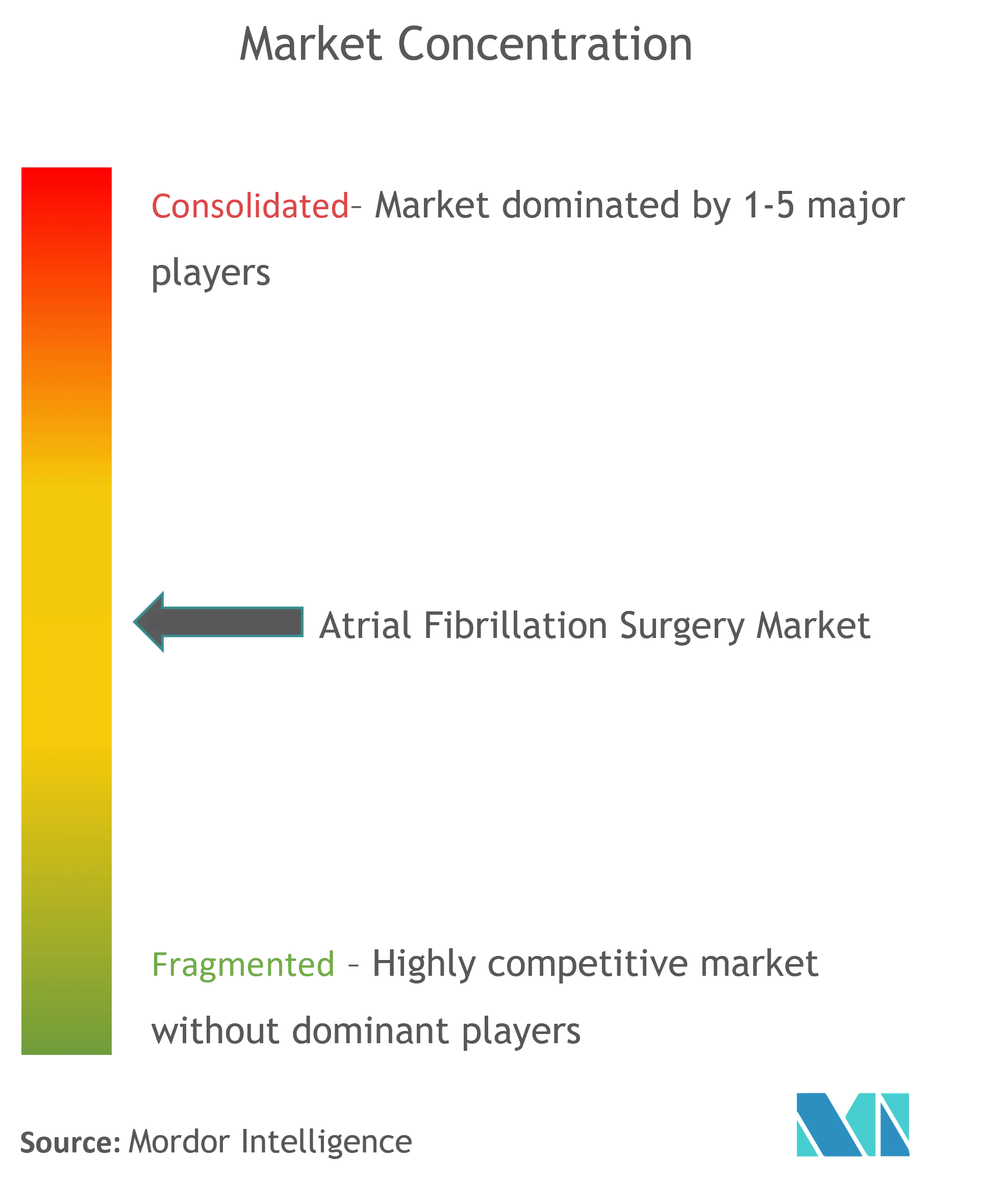
Thirteen firms account for the lion’s share of global revenue, reflecting moderate concentration. Medtronic, Boston Scientific, Johnson & Johnson’s Biosense Webster, and Abbott collectively control the platform segment. Each competes on differentiated energy source, catheter design, and data integration rather than price cuts. Medtronic’s USD 925 million acquisition of Affera delivered a dual-energy system and expanded mapping IP. Boston Scientific’s Cortex purchase improved lesion characterization and will feed next-generation FARAPULSE algorithms once FDA approves persistent-AF labeling.
Johnson & Johnson leverages CARTO 3’s installed base for rapid VARIPULSE rollout; however, an FDA Class I recall in February 2025 after elevated stroke events forced protocol tweaks. Abbott emphasizes integrated rhythm-management ecosystems, pairing Volt PFA with its HD Grid mapping catheter and AVEIR leadless pacemakers for comprehensive arrhythmia coverage.
Younger entrants focus on white-space opportunities. Kardium’s Globe integrates 122 electrodes on a single balloon for simultaneous mapping and therapy. Field Medical targets ventricular arrhythmias with its FieldForce waveform library. Volta Medical delivers AI pattern-recognition software now under multicenter evaluation. Private equity aggregates downstream delivery through cardiology ASC platforms that lock in device preferences while guaranteeing procedure volumes. Vendor contracting therefore increasingly incorporates data-analytics dashboards, remote case proctoring, and outcome-based rebates.
Looking forward, competitive advantage will hinge on lesion durability data beyond 3 years, integration with imaging-guided navigation, and algorithms that personalize energy dosing based on tissue impedance signatures. Vendors that bridge hardware, software, and training services should capture disproportionate share of the incremental USD 4.58 billion revenue opportunity forecast between 2025 and 2030.
Atrial Fibrillation Surgery Industry Leaders
-
Boston Scientific Corporation
-
Medtronic Plc
-
Biotronik
-
AtriCure, Inc.
-
Cardiofocus, Inc.
- *Disclaimer: Major Players sorted in no particular order
Market Opportunities and Future Outlook
PFA platform expansion is opening whitespace beyond pulmonary vein isolation as companies pursue broader lesion sets and more flexible energy delivery within a single workflow. Johnson & Johnson's July 2026 FDA approval for its Dual Energy THERMOCOOL SMARTTOUCH SF Platform illustrates an industry direction toward dual-modality catheters that can tailor RF and PF energy to anatomy and target substrate. April 2026 updates around VARIPULSE included interim effectiveness data and a CE mark enabling ablation outside the pulmonary veins, aligning product roadmaps with more complex AF populations and redo cases that require expanded mapping and lesion strategies.
Care-site shift and policy support create commercial room for providers and device makers that can package outpatient-ready systems, training, and standardized protocols. CMS added cardiac catheter ablation to the ASC-covered procedures list effective January 1, 2026, which supports procedure migration into ASCs and lifts demand for shorter-case-time systems, simplified inventory, and reliable supply of disposables. Surgical and hybrid segments also show an innovation pathway, with first-in-human feasibility work for nanosecond pulsed field ablation (nsPFA) during concomitant cardiac surgery signaling development activity that could translate into next-generation surgical clamps and hybrid convergent toolkits, where capital-intensive suite build-outs and training remain gating factors.
Recent Industry Developments
- July 2026: Johnson & Johnson's Dual Energy THERMOCOOL SMARTTOUCH SF Platform receives FDA approval, expanding dual-modality ablation options for EP labs. The clearance supports a shift toward combined energy delivery within a single workflow that can tailor RF and PF energy to anatomy and substrate.
- June 2026: Medtronic launched the PulseSelect pulsed-field ablation system in India, expanding access to single-shot PFA and strengthening the company's installed base outside North America and Europe. The rollout extends availability for operators evaluating single-shot PFA options in additional markets.
- April 2025: Boston Scientific reported that the second phase of its ADVANTAGE AF study for the FARAPULSE PFA System met primary safety and efficacy endpoints with 12-month data. The update reinforces clinical foundations for PFA adoption and supports the company's competitive positioning in the ablation portfolio.
Research Methodology Framework and Report Scope
Market Definition and Coverage
This market is defined as the revenue generated from procedures that surgically or catheter-wise ablate cardiac tissue to restore rhythm in diagnosed atrial fibrillation patients, along with the related devices and procedure-associated supplies billed at the point of care.
Scope exclusions: We exclude drug therapy for atrial fibrillation, wearable monitoring, and left atrial appendage closure implants that are purchased and used for stroke prevention.
Segmentation Overview
- By Procedure
- Catheter Ablation
- Surgical Maze & Mini-Maze
- Hybrid Convergent
- Pulsed Field Ablation (PFA)
- By Product Type
- Catheter Ablation Devices
- Surgical Ablation Systems
- PFA Systems
- Mapping & Navigation Systems
- Ancillary Accessories
- By End User
- Hospitals
- Ambulatory Surgical Centers
- Cardiac Catheterization Laboratories
- Specialty Clinics
- By Geography
- North America
- United States
- Canada
- Mexico
- Europe
- Germany
- United Kingdom
- France
- Italy
- Spain
- Rest of Europe
- Asia-Pacific
- China
- India
- Japan
- South Korea
- Australia
- Rest of Asia-Pacific
- South America
- Brazil
- Argentina
- Rest of South America
- Middle East and Africa
- GCC
- South Africa
- Rest of Middle East and Africa
- North America
Data Sources, Market Sizing, and Validation
Desk Research
Desk research is used to anchor the patient and procedure pool and to keep the pricing logic realistic across regions. We pull prevalence and treatment pathway signals from non-paywalled sources such as the US CDC, the OECD health statistics portal, WHO health datasets, and peer reviewed cardiology journals that publish ablation outcomes and adoption trends. For procedure environment and utilization context, we also refer to sources such as Medicare physician fee schedules and national health service procedure statistics where available, followed by cardiology society guideline updates.
On the commercial side, we review public company filings and investor presentations to understand revenue mix and the pace of technology shifts in atrial fibrillation ablation. Select paid subscriptions are used for company financial intelligence and for patent database screening so new energy modalities and mapping workflow changes are tracked. The sources mentioned here are illustrative only, and many other public and paid sources were also checked for data collection, validation, and clarification.
Primary Interviews and Surveys
Primary work focuses on confirming what is actually being performed and paid for across the care setting, before the numbers are finalized. We spoke with a mix of electrophysiologists, cardiac surgeons, cath lab and OR administrators, and procurement and reimbursement stakeholders across APAC, EMEA, and the Americas to test assumptions on procedure volumes, typical device use per case, and how prices move as newer modalities get adopted.
Distribution of primary research fieldwork respondents
| Company type | Respondent position | Region |
|---|---|---|
| Top tier: 39% | CXOs: 21% | APAC: 52% |
| Mid tier: 40% | Functional/Unit leaders: 26% | EMEA: 30% |
| Smaller Players: 21% | Managers: 53% | Americas: 18% |
Market-Sizing & Forecasting
Sizing starts with a top-down demand build that reconstructs the treated pool by geography, where atrial fibrillation prevalence is filtered through diagnosis rates and then through ablation eligibility and access to appropriate facilities. That treated cohort is translated into procedure volumes using cues such as repeat ablation incidence, share of paroxysmal versus persistent cases, and the mix between catheter ablation and surgical maze or mini-maze done alongside other cardiac surgeries. To avoid overcounting, procedure counts are tied back to how cases are coded and reimbursed in major systems, and then converted into value using typical per procedure spending.
Selective bottom-up checks are used to keep totals grounded, including sampled average selling price times estimated unit use per case, along with channel discussions on mapping and navigation pull-through. Where country-level procedure data is thin, gaps are handled by using proxy indicators such as cath lab availability per capita and cardiologist density, which are then stress-tested in interviews. Forecasting is based on scenario analysis supported by a light multivariate view of drivers such as aging population, penetration of pulsed-field ablation, reimbursement adjustments, and the shift toward outpatient settings where applicable.
Data Validation & Update Cycle
Outputs are checked against independent signals such as procedure growth reported in health statistics, adoption commentary from clinical publications, and public revenue disclosures from relevant product lines. Variances are reviewed across multiple analyst passes, and any outlier country is reopened to recheck prevalence, access assumptions, and the price build used for that market. When a material event occurs, such as a reimbursement revision or a meaningful technology uptake shift, experts are re-contacted so assumptions can be reset before updates are released.
The report is refreshed annually, and interim updates are made when key drivers change enough to move the short-term market direction. Before delivery, we do a fresh review so clients receive a view that reflects the latest available public data and confirmed field feedback.
Mordor Intelligence's Atrial Fibrillation Surgery Market Size Versus Other Published Estimates
Published market sizes for atrial fibrillation surgery can look far apart even when they are talking about similar procedures, because the counted services and the timing of price and volume assumptions are not the same. Differences also come from whether the estimate is built around treated patients, billed procedures, or device shipments, which each behave differently across regions.
The main gap comes from adjacent cardiac procedure add-ons being included, where Mordor Intelligence counts only ablation procedures and the related devices and supplies billed at the point of care, and keeps left atrial appendage closure implants outside the total. Other gaps typically show up in how repeat ablations are handled, whether hospital fees and physician fees are both counted, and how fast newer energy modalities are assumed to replace older approaches in average selling price progression.
Benchmark comparison
| Source | Market Size | Gaps in Research Methodology |
|---|---|---|
| Mordor Intelligence | USD 4.45 B (2026) | |
| Industry Publisher A | USD 4.16 B (2024) | The scope often groups a wider set of atrial fibrillation interventions and may mix procedure types such as AV node ablation with the core ablation revenue pool, which can shift totals depending on what is priced as surgery versus follow-on management. |
| Market Publisher B | USD 2.55 B (2024) | This estimate appears more device-led and can understate value if hospital and physician procedure fees are not consistently counted, and if mapping and navigation related spend is treated as optional rather than tied to ablation case growth. |
Looking across the figures, the spread is mainly explained by what is included as a billable ablation case and how the per case value is constructed. By using a treated-cohort to procedure conversion and then cross-checking it with practical per case spending logic, the result stays traceable to clear inputs that can be revisited when volumes, mix, or reimbursement changes.
Key Questions Answered in the Report
Q1: How big is the atrial fibrillation surgery market today?
A1: The atrial fibrillation surgery market stands at USD 4.45 billion in 2026 and is projected to reach USD 8.39 billion by 2031 at a 13.52% CAGR during 2026-2031.
Q2: Which procedure type is expanding the fastest?
A2: Pulsed-field ablation is the fastest-growing procedure, advancing at 14.31% CAGR through 2031 as zero esophageal complications and shorter case times propel adoption.
Q3: Why are ambulatory surgical centers important for future growth?
A3: ASCs post a 15.72% CAGR through 2031 because site-neutral reimbursement and same-day discharge protocols lower total episode cost without compromising outcomes, shifting volume from hospitals.
Q4: Which region offers the strongest upside?
A4: Asia-Pacific delivers the highest 16.58% CAGR to 2031 due to aging populations, improving electrophysiology capacity, and supportive regulatory pathways such as Japan’s early PFA approvals.
Q5: What technological trend will shape competition most?
A5: Integration of AI-guided mapping and dual-energy catheters will differentiate platforms by boosting durable success rates and trimming procedure times, creating defensible value propositions for vendors.