
Atomized Iron Powder Market Size and Share
Market Overview
| Study Period | 2021 - 2031 |
|---|---|
| Market Size (2026) | USD 1.19 Billion |
| Market Size (2031) | USD 1.58 Billion |
| Growth Rate (2026 - 2031) | 5.73 % |
| Fastest Growing Market | Asia-Pacific |
| Largest Market | Asia-Pacific |
| Market Concentration | Low |
Major Players *Disclaimer: Major Players sorted in no particular order Image © Mordor Intelligence. Reuse requires attribution under CC BY 4.0. | |
Atomized Iron Powder Market Analysis by Mordor Intelligence
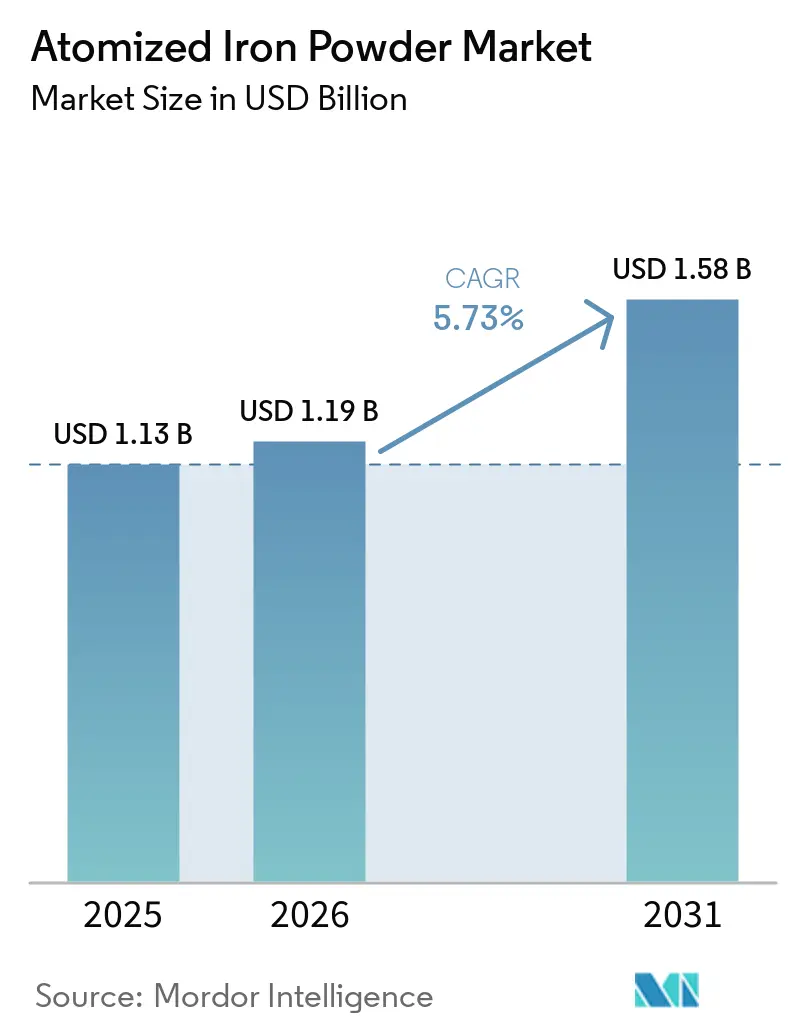
The Atomized Iron Powder Market size was valued at USD 1.13 billion in 2025 and is estimated to grow from USD 1.19 billion in 2026 to reach USD 1.58 billion by 2031, at a CAGR of 5.73% during the forecast period (2026-2031). Demand is supported by sintered components used in automotive and industrial equipment, including parts that need repeatable dimensions, high production volumes, and efficient material use. The atomized iron powder market is also benefiting from a shift toward soft magnetic composites in electric motors, where insulated iron powders can support designs with three-dimensional magnetic flux paths. Precisely graded iron powders support additive manufacturing and metal injection molding, where particle control, oxygen content, and flowability influence how powder moves and performs during processing. The Metal Powder Industries Federation expects stronger demand during 2026 as destocking ends and customer orders improve, favoring suppliers with soft magnetic composite and additive-manufacturing grades as demand moves away from conventional internal-combustion drivetrain parts.
Key Report Takeaways
- By technology, water atomization held 68.43% of the atomized iron powder market share in 2025, while gas atomization is projected to advance at a 6.56% CAGR through 2031.
- By application, powder metallurgy held 63.11% of the atomized iron powder market share in 2025, while electronic materials are projected to advance at a 6.85% CAGR through 2031.
- By geography, Asia-Pacific held 60.65% of the atomized iron powder market share in 2025 and is projected to advance at a 6.77% CAGR through 2031.
Note: Market size and forecast figures in this report are generated using Mordor Intelligence’s proprietary estimation framework, updated with the latest available data and insights as of January 2026.
Global Atomized Iron Powder Market Trends and Insights
Drivers Impact Analysis*
| Driver | (~) % Impact on CAGR Forecast | Geographic Relevance | Impact Timeline |
|---|---|---|---|
| Rising Powder Metallurgy Adoption in Automotive and Industrial Components | +2.0% | Global, core gains in Asia-Pacific, North America, and Germany | Medium term (2-4 years) |
| Electrification Demand for Soft Magnetic Iron-Powder Components | +1.4% | Asia-Pacific and EU core; spillover to North America | Long term (≥ 4 years) |
| Additive Manufacturing and Metal Injection Molding Adoption | +0.9% | North America, Europe, China, Japan | Long term (≥ 4 years) |
| Closed-Loop Scrap Feedstock and Lower Material Waste | +0.4% | Europe, China; early-stage in North America | Medium term (2-4 years) |
| Digital Process Control for Narrower Particle-Size Distributions | +0.2% | Global, led by Sweden, Japan, Germany, China | Long term (≥ 4 years) |
| Source: Mordor Intelligence | |||
Rising Powder Metallurgy Adoption in Automotive and Industrial Components
Powder metallurgy remains important to the atomized iron powder market because it forms complex parts with less machining, less material waste, and repeatable dimensional control in high-volume production. More than 70% of North American iron-powder shipments went to automotive applications in 2025, indicating that vehicle programs remained the principal demand base for regional powder suppliers. Passenger vehicles in the region used an average of 14.3 kg of powder-metallurgy components during that year, which reflects use across several functional systems rather than a single vehicle part. Gears, structural brackets, oil-pump rotors, and friction parts continue to give the atomized iron powder market a broad automotive base and a set of established manufacturing routes. Demand is rotating toward hybrid-powertrain parts, turbocharger components, and humanoid-robot actuators as conventional drivetrain content changes and vehicle makers revise component designs. Ferrous materials retain an advantage where compressive strength and cost remain important, supporting their continued role in applications that require durable components at a production scale.
Electrification Demand for Soft Magnetic Iron-Powder Components
Electric-motor applications are broadening the atomized iron powder market through soft magnetic composites (SMCs) which use insulated powder particles to create magnetic cores. These materials enable three-dimensional magnetic flux paths and net-shape fabrication for selected motor designs, giving engineers options beyond conventional laminated structures. A 2026 scientific study reported Fe-3.5Si SMC components with tensile strength above 650 MPa and coercivity below 10 Oe after friction-stir forging. JFE Steel Corporation reported that its insulation-coated pure-iron powder supported an axial-gap motor prototype that was 48% thinner and 40% lighter than comparable radial-gap designs at equivalent efficiency[1]JFE Steel Corporation, “JFE Steel’s New Insulated Pure-Iron Powder for Soft Magnetic Composites Enables Prototype Axial-Gap Motor to Be Slimmed Down by 48%,” JFE Steel Corporation, jfe-steel.co.jp. Höganäs AB introduced Somaloy 7P in June 2026 with a water-based coating intended to reduce core losses in high-frequency applications, where material selection influences both efficiency and thermal performance. International Electrotechnical Commission requirements for magnetic-core performance also preserve the value of established premium grades, since customers must verify material performance before using new powders in qualified designs.
Additive Manufacturing and Metal Injection Molding Adoption
Gas-atomized powders support the atomized iron powder market, where additive manufacturing, binder jetting, and metal injection molding need consistent feedstock with controlled physical characteristics. These processes require controlled particle sizes, low oxygen content, and dependable flowability because variation can affect powder spreading, density, and finished-part properties. Combined North American metal injection molding and additive-manufacturing powder shipments rose 5% in 2025 after a two-year inventory correction, indicating a return of purchasing activity in these channels. A 2025 Powder Technology study showed a method for selecting gas-atomization parameters to target particle-size distributions, which can help producers align output with specific application requirements. A 2026 Journal of Sustainable Metallurgy study found that steel grinding chips can provide a near-spherical feedstock for additive manufacturing and powder metallurgy with limited preprocessing. Updated Metal Powder Industries Federation standards in 2026 are also strengthening material confidence in binder jetting and directed energy deposition applications, where designers need defined properties before moving from trial work to repeat production.
Closed-Loop Scrap Feedstock and Lower Material Waste
Closed-loop feedstocks can support the atomized iron powder market by lowering exposure to iron ore and ingot price movements while turning manufacturing scrap into an input material. They can also help producers respond to customer requests for lower-carbon materials and improve the traceability of feedstock choices. Höganäs AB launched re-Astaloy 85 Mo in June 2025 and reported a 14% lower product carbon footprint through biogas substitution, showing an approach that changes process energy without changing product purpose[2]Höganäs AB, “Höganäs Launches Re-Astaloy 85 Mo as First Product in New Sustainability-Focused Portfolio,” Höganäs AB, hoganas.com. The company stated that the powder retained the compressibility and hardenability specifications needed by powder-metallurgy customers, limiting the need for customers to change established processing conditions. A 2025 scientific study reported recycled construction-steel powder achieving 99.9% relative density and 808 MPa average tensile strength in laser powder-bed fusion. Carbon Border Adjustment Mechanism obligations for iron and steel derivatives are encouraging European investment in lower-carbon feedstock routes, while customers increasingly consider emissions information alongside powder performance.
Restraints Impact Analysis*
| Restraint | (~) % Impact on CAGR Forecast | Geographic Relevance | Impact Timeline |
|---|---|---|---|
| High Energy and Equipment Costs for Atomization | -0.7% | Global, most acute in EU and North America | Short term (≤ 2 years) |
| Price Competition from Reduced and Electrolytic Iron Powders | -0.4% | Global, most intense in Asia-Pacific and price-sensitive segments | Medium term (2-4 years) |
| Qualification Risk from Powder Variability in Safety-Critical Components | -0.1% | Global | Long term (≥ 4 years) |
| Source: Mordor Intelligence | |||
High Energy and Equipment Costs for Atomization
Energy and equipment costs limit capacity expansion in the atomized iron powder market, particularly for smaller producers that cannot spread fixed costs over large output volumes. Water atomization needs high-pressure water and thermal energy, while gas atomization also needs inert gas and specialized recovery systems that add to operating requirements. Gas-atomization equipment requires melt handling, classification equipment, and strict control of powder handling to protect powder quality and manage fine particles safely. These requirements create long payback periods for projects that target premium grades, even when the commercial opportunity is supported by fast-growing end uses. Higher energy-price volatility has been particularly difficult for European and North American producers because cost increases cannot always be passed through quickly to qualified customers. Integrated operations with scrap or hydrogen-based feedstocks can reduce some operating exposure, although their facilities require higher initial investment and longer planning horizons.
Price Competition from Reduced and Electrolytic Iron Powders
Reduced and electrolytic powders constrain the atomized iron powder market in applications where irregular particle shape is acceptable, and users place greater weight on material cost. Reduced iron powder remains suitable for press-and-sinter applications where unit cost guides material selection and performance requirements are already well understood. Electrolytic producers are also improving consistency for pharmaceutical and high-purity electronic uses, where established suppliers have traditionally held stronger positions. Price pressure is strongest in boundary grades where sphericity provides limited performance benefit and does not fully justify a higher purchase price. Atomized-powder suppliers are therefore concentrating on additive manufacturing, and SMC uses where morphology is essential to final performance, and product qualification can support differentiated pricing.
*Our forecasts treat driver/restraint impacts as directional, not additive. The impact forecasts reflect baseline growth, mix effects, and variable interactions.
Segment Analysis
By Technology: Water Atomization Retains Scale While Gas Atomization Gains in Premium Uses
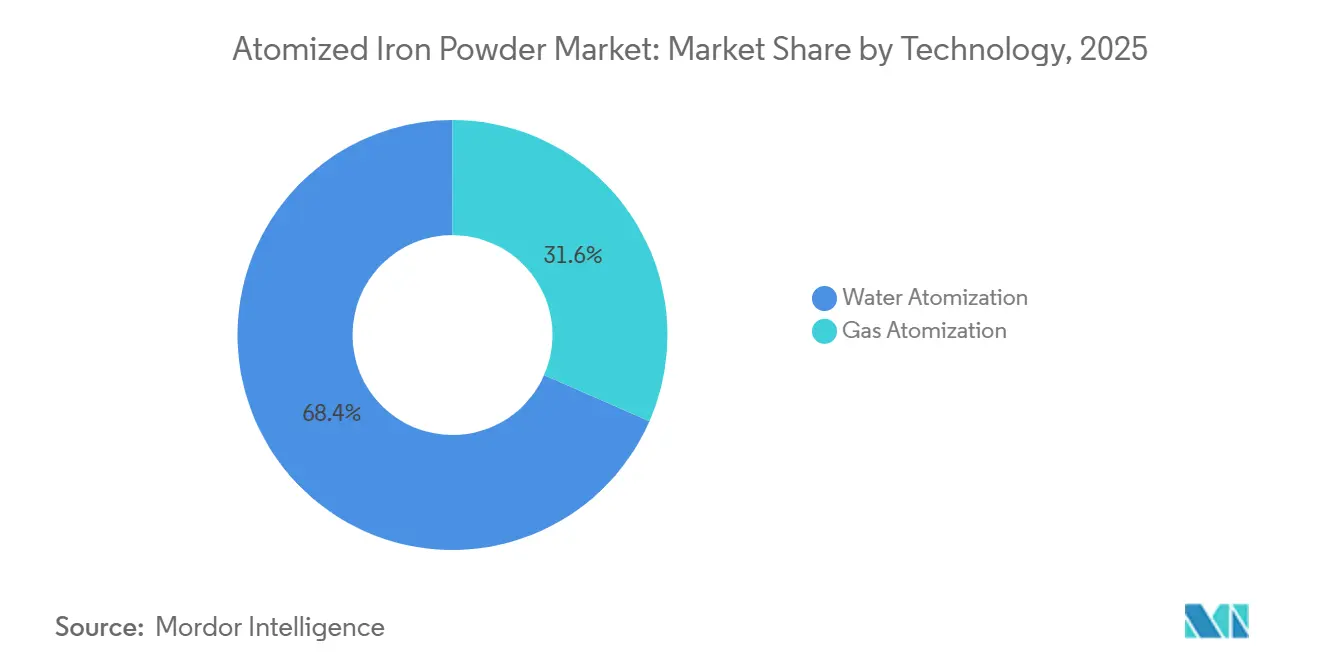
Water atomization held 68.43% of the atomized iron powder market share in 2025, reflecting extensive installed capacity and established customer approvals. It produces irregular powders commonly used in press-and-sinter applications. Its typical 45-150 μm particle range remains relevant to much of global powder-metallurgy demand. Water atomization also provides a cost-per-kilogram advantage for high-volume production. These attributes keep it central to the atomized iron powder industry across automotive and industrial supply chains.
Gas atomization is projected to advance at a 6.56% CAGR through 2031 as users seek spherical powders for laser powder-bed fusion, binder jetting, and SMC cores. A 2024 AIChE Journal review noted that sub-30 μm powder yields can remain below 50% for gas atomization, compared with 70%-80% for water atomization. This yield difference limits output growth and supports premium prices for tightly specified material. KOBE STEEL, LTD. expanded its MAGMEL range in 2026 with high-heat-resistant insulated coatings for magnetic annealing. The development supports demand for consistent base powders in applications that need reliable magnetic behavior.


By Application: Powder Metallurgy Holds Revenue, While Electronic Materials Expand
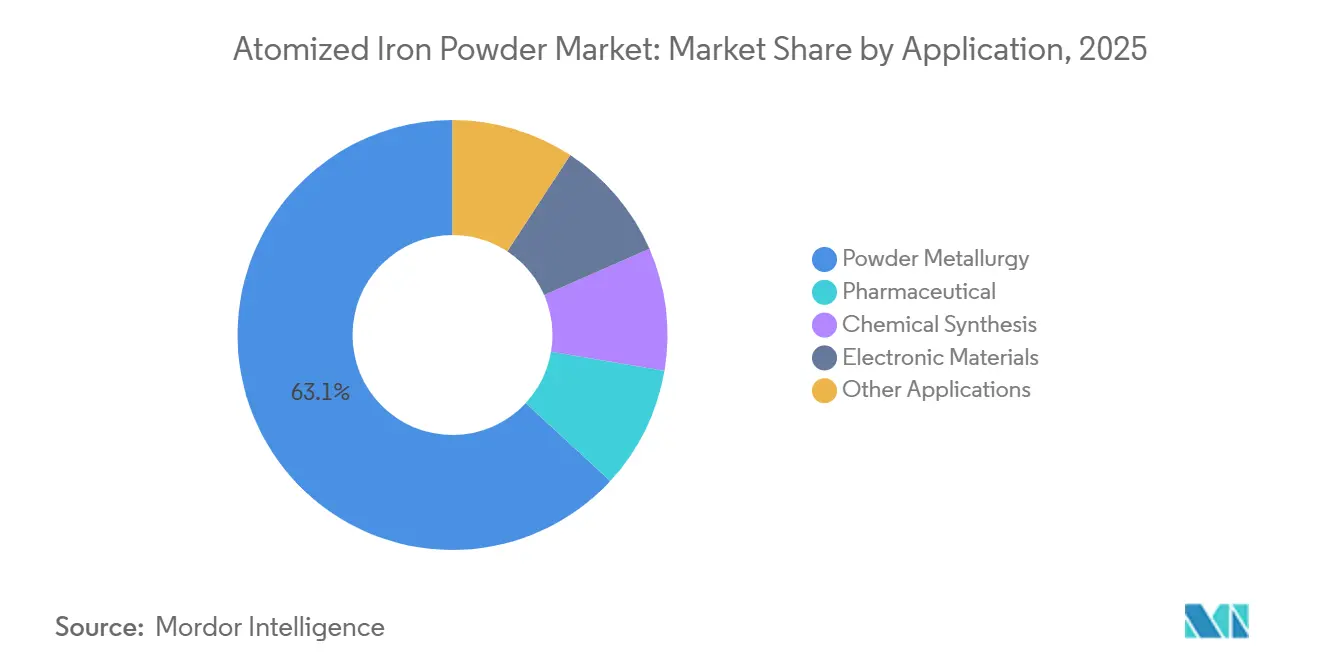
Powder metallurgy held 63.11% of the atomized iron powder market share in 2025, supported by sintered automotive components. The application includes gears, cam phasers, oil-pump rotors, and structural brackets. Its high material utilization reduces waste compared with conventional machining. Hybrid powertrains can add component requirements even as internal-combustion applications change. This established demand base continues to anchor the atomized iron powder market size for conventional components.
Electronic materials are projected to advance at a 6.85% CAGR through 2031. SMC cores are used in electric-vehicle traction motors, artificial-intelligence server inductors, and photovoltaic inverters, where compact designs and improved high-frequency behavior can be important. A 2026 Advanced Science study found that ultrasonic vibration-assisted cold pressing improved effective permeability by 21% and reduced core loss by 43.4% against conventional pressing. Chemical synthesis uses iron powder as a reducing agent and catalyst, while pharmaceutical applications are a premium niche governed by strict purity standards. Brazing, welding, and soil remediation account for additional applications with lower growth prospects, giving the atomized iron powder market exposure to several smaller end uses beyond automotive and electronics.

Geography Analysis
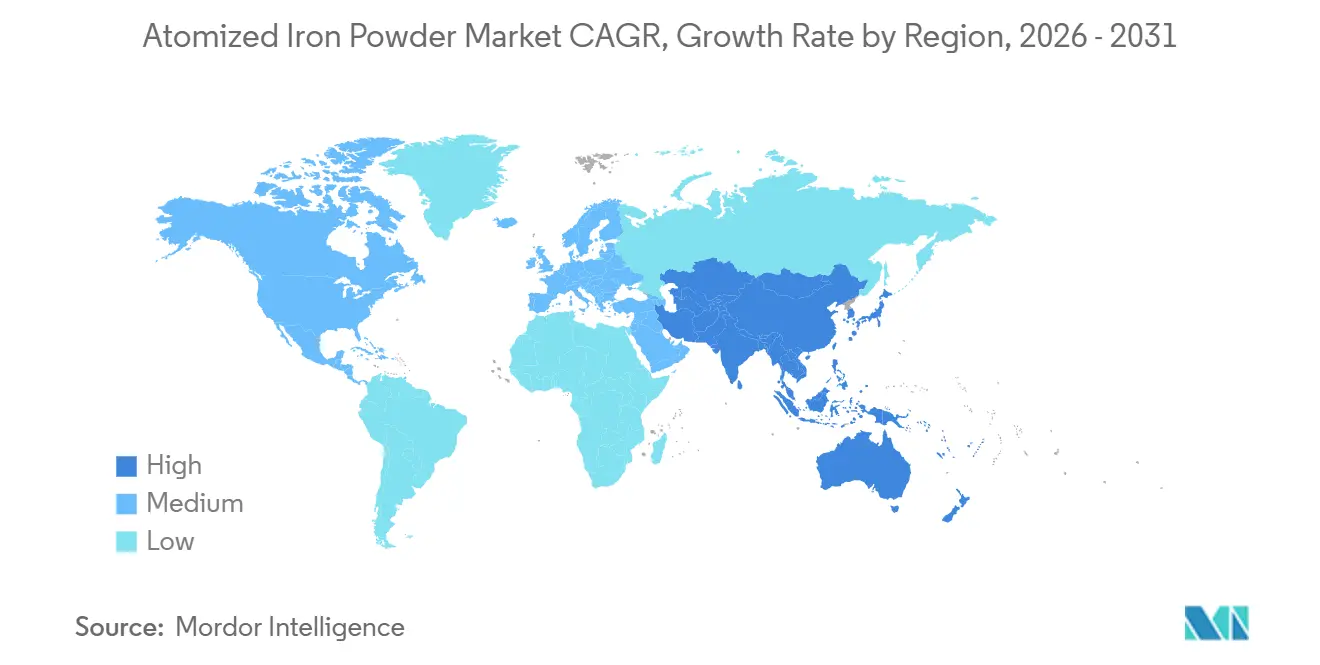
Asia-Pacific held 60.65% of the atomized iron powder revenue share in 2025 and is projected to advance at a 6.77% CAGR through 2031. China’s integrated steel-to-powder operations support cost-competitive supply, a large sintered-parts base, and regional demand from electric-vehicle drivetrain and SMC motor-core production. Japan and South Korea add advanced materials demand from consumer electronics and industrial motors, while JFE Steel Corporation’s insulated pure-iron powder has drawn interest for designs requiring thinner and lighter motors. India is gaining demand from automotive manufacturing and pharmaceutical production, and ASEAN countries receive industrial capacity transfers from higher-cost Northeast Asian locations. This mix gives the atomized iron powder market a broad base of standard-grade demand alongside premium magnetic-material applications.
In North America, iron and steel powder shipments reached 268,880 metric tons in 2025. Shipment volumes were lower than the prior year because some vehicle programs faced delays, although internal-combustion and hybrid demand provided partial support. Defense, aerospace, semiconductor equipment, and data-center hardware provide additional demand paths for higher-grade powder, especially where additive-manufacturing material qualifications are important. The region’s integrated supply base supports pricing stability for qualified material, while tariff uncertainty strengthens domestic-sourcing discussions with automotive customers. International Automotive Task Force (IATF) 16949 requirements and 2026 material-standard updates continue to shape supplier approvals and application evaluation for binder jetting and directed energy deposition.
Europe holds a position in the atomized iron powder market because of its technical supply base, established component manufacturers, and low-carbon production programs. Höganäs AB is pursuing hydrogen-based ironmaking with FerraVolt through a partnership announced in April 2026, while its work illustrates how European producers are linking feedstock changes with downstream powder applications. European automotive demand is changing as internal-combustion demand declines and hybrid, turbocharger, and motor-component uses grow, and Höganäs AB presented sustainable powder and compaction work at the Powder Metallurgy Association of India’s PM26 conference in March 2026. South America is linked to Brazil’s sintered-parts manufacturing base, while the Middle East and Africa have early non-automotive demand supported by Saudi Arabia’s industrialization agenda.

Competitive Landscape
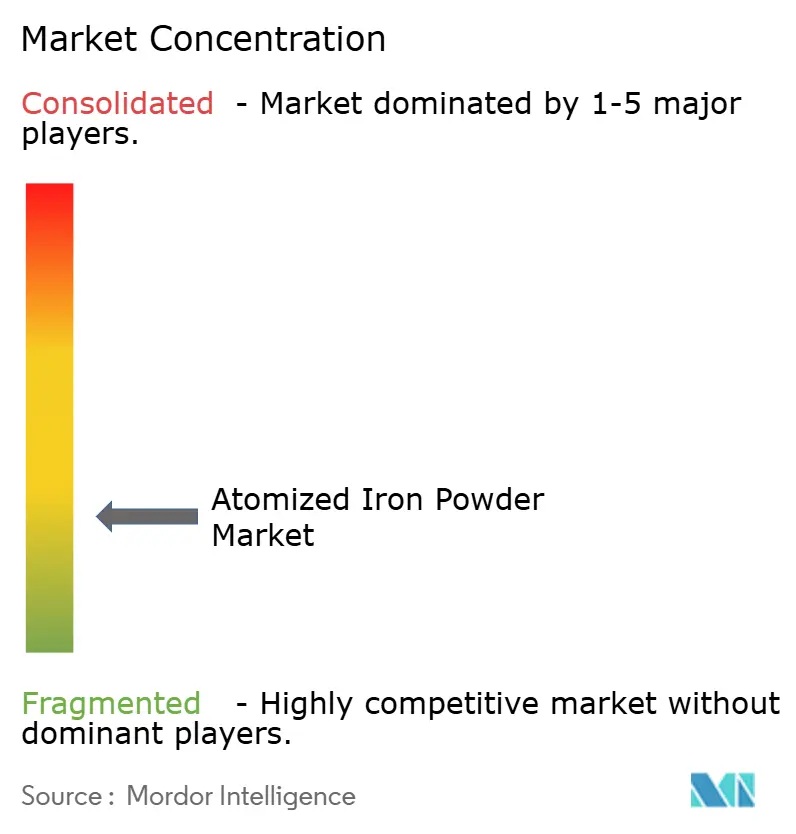
The atomized iron powder market is highly fragmented, with the top five players including Höganäs AB, KOBE STEEL, LTD., GKN Powder Metallurgy, JFE Steel Corporation, and Pometon S.p.A. Their proprietary production processes and customer approvals create barriers in safety-critical applications, while Chinese and Indian producers compete more actively for standard-grade volume. Leading producers are focusing on lower-carbon feedstocks, particle-quality control, and applications that need specialized magnetic or additive-manufacturing performance. This structure keeps the atomized iron powder market open to price competition in basic grades while protecting differentiated positions in qualified premium products.
Dauch Corporation completed the acquisition of Dowlais Group plc in February 2026, bringing GKN Powder Metallurgy into its automotive supplier platform and consolidating established powder-metallurgy capabilities. GKN Powder Metallurgy also canceled its European rare-earth permanent-magnet plan, demonstrating the commercial difficulty of extending beyond its core powder-metallurgy activities. Sandvik AB signed an agreement in June 2026 to sell its Osprey gas-atomized powder business to Mimir, separating a specialty powder operation that serves additive manufacturing, metal injection molding, and hot isostatic pressing. The Osprey transaction gives that operation a clearer standalone role in specialty powder supply, while the Dauch transaction brings a powder-metallurgy business closer to an automotive driveline platform. Together, these changes show that ownership models are shifting as companies decide which materials activities remain central to their product portfolios.
Höganäs AB is combining hydrogen-reduction work, SMC powder development, and carbon-accounting partnerships with component customers, extending its approach from feedstock to qualified end-use material. Its re-Astaloy 85 Mo launch showed how a lower-carbon powder can retain established processing properties. JFE Steel Corporation differentiates its Denjiro range through insulation-coated iron powder for soft magnetic composites, while KOBE STEEL, LTD.’s MAGMEL range addresses magnetic uses requiring thermal resistance. IATF 16949 and International Electrotechnical Commission standards remain important for suppliers seeking premium automotive and magnetic-core programs.
Atomized Iron Powder Industry Leaders
Höganäs AB
KOBE STEEL, LTD.
GKN Powder Metallurgy
JFE Steel Corporation
Pometon S.p.A.
- *Disclaimer: Major Players sorted in no particular order

Recent Industry Developments
- May 2026: Maharashtra Metal Powders reported 12,000 Metric Tons Per Annum (MTPA) of atomized powder production capacity at its Nagpur operations, alongside dedicated facilities for other metal powders and related products. The established atomized powder capacity strengthens regional supply for industrial applications, including powder metallurgy and engineered components.
- April 2026: Höganäs AB entered a co-development partnership with FerraVolt AB to advance a flexible hydrogen-based ironmaking process powered by renewable electricity. The initiative aims to produce low-carbon iron while reducing reliance on coal-based raw materials, supporting the development of lower-carbon iron feedstock for atomized iron powder production.


Global Atomized Iron Powder Market Report Scope
Atomized iron powder is a fine metallic powder produced by breaking molten iron into small particles through controlled atomization processes. It offers controlled particle characteristics and composition for applications requiring consistent material performance.
The Atomized Iron Powder Market is segmented by technology, application, and geography. By technology, the market is segmented into water atomization and gas atomization. By application, the market is segmented into powder metallurgy, chemical synthesis, electronic materials, pharmaceuticals, and other applications. The report also covers the market size and forecasts for atomized iron powder in 15 countries across major regions. For each segment, the market sizing and forecasts have been done on the basis of value (USD).
| Water Atomization |
| Gas Atomization |
| Powder Metallurgy |
| Chemical Synthesis |
| Electronic Materials |
| Pharmaceutical |
| Other Applications |
| Asia-Pacific | China |
| India | |
| Japan | |
| South Korea | |
| ASEAN Countries | |
| Rest of Asia-Pacific | |
| North America | United States |
| Canada | |
| Mexico | |
| Europe | Germany |
| United Kingdom | |
| France | |
| Italy | |
| NORDIC Countries | |
| Rest of Europe | |
| South America | Brazil |
| Argentina | |
| Rest of South America | |
| Middle East and Africa | Saudi Arabia |
| South Africa | |
| Rest of Middle East and Africa |
| By Technology | Water Atomization | |
| Gas Atomization | ||
| By Application | Powder Metallurgy | |
| Chemical Synthesis | ||
| Electronic Materials | ||
| Pharmaceutical | ||
| Other Applications | ||
| By Geography | Asia-Pacific | China |
| India | ||
| Japan | ||
| South Korea | ||
| ASEAN Countries | ||
| Rest of Asia-Pacific | ||
| North America | United States | |
| Canada | ||
| Mexico | ||
| Europe | Germany | |
| United Kingdom | ||
| France | ||
| Italy | ||
| NORDIC Countries | ||
| Rest of Europe | ||
| South America | Brazil | |
| Argentina | ||
| Rest of South America | ||
| Middle East and Africa | Saudi Arabia | |
| South Africa | ||
| Rest of Middle East and Africa | ||


Key Questions Answered in the Report
What is the size of the atomized iron powder market?
The atomized iron powder market stands at USD 1.19 billion in 2026 and is projected to reach USD 1.58 billion by 2031.
What is driving demand for atomized iron powder?
Sintered automotive parts, soft magnetic composites for electric motors, and tightly specified additive-manufacturing powders support demand.
Which technology led the market share in 2025?
Water atomization held 68.43% of revenue in 2025 because of its scale, cost advantages, and fit with press-and-sinter processing.
Which application is expected to grow fastest through 2031?
Electronic materials are projected to advance at a 6.85% CAGR through 2031.
Page last updated on:





