
Astable Multivibrator Market Size and Share
Market Overview
| Study Period | 2020 - 2031 |
|---|---|
| Market Size (2026) | USD 1.56 Billion |
| Market Size (2031) | USD 2.17 Billion |
| Growth Rate (2026 - 2031) | 6.82 % |
| Fastest Growing Market | Asia-Pacific |
| Largest Market | North America |
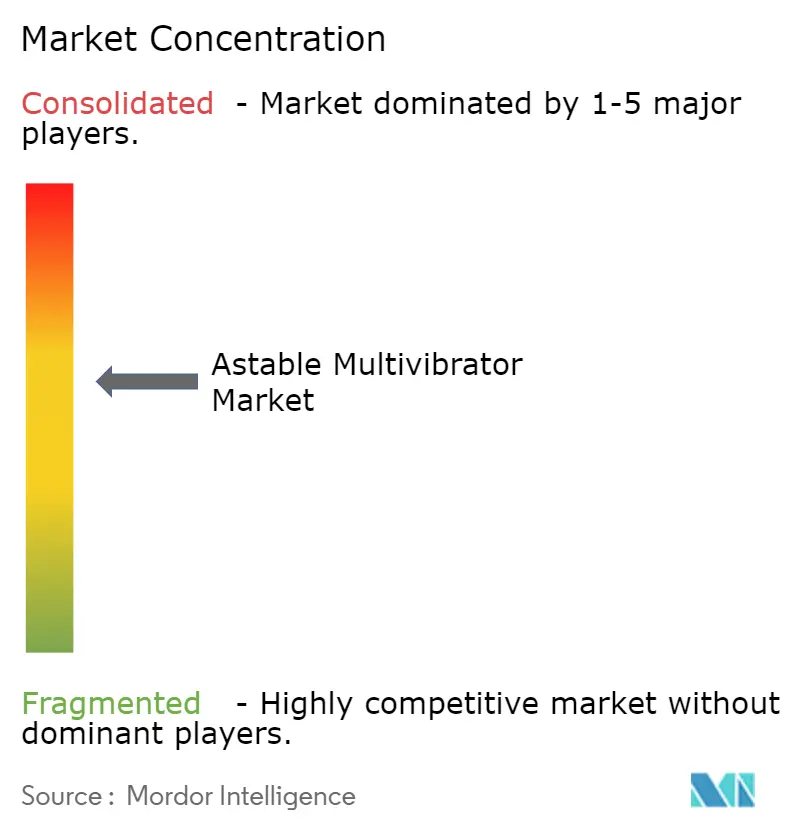
| Market Concentration | Medium |
Major Players *Disclaimer: Major Players sorted in no particular order Image © Mordor Intelligence. Reuse requires attribution under CC BY 4.0. | |
Astable Multivibrator Market Analysis by Mordor Intelligence
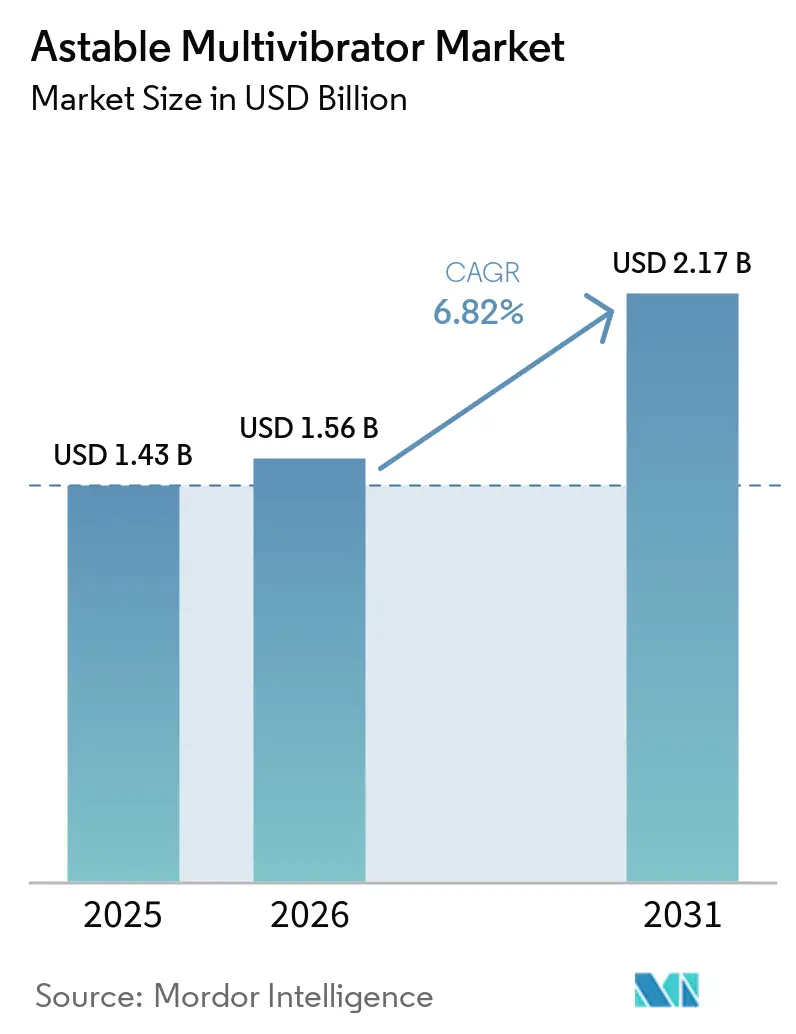
The astable multivibrator market size is expected to grow from USD 1.43 billion in 2025 to USD 1.56 billion in 2026 and is forecast to reach USD 2.17 billion by 2031 at 6.82% CAGR over 2026-2031. Growth is tied to the rising use of electronic content in consumer, industrial, and automotive products, where RC- and IC-based oscillator circuits still offer a low-cost timing option that larger programmable devices do not always justify at the unit level. Factory digitalization is also supporting demand, as timer ICs and related pulse-generation circuits remain embedded in industrial control modules as automation expands across production systems. China’s push to localize electronics content in new energy vehicles is adding pressure on foreign suppliers and creating room for domestic timer IC producers in the supply chain. At the same time, low-cost microcontrollers, SoCs, programmable clock devices, and MEMS-based precision timing products are taking over some functions that standalone astable circuits once served in simpler designs. Competition, therefore, remains moderately fragmented, with broad semiconductor vendors and specialized analog suppliers competing on product quality, qualification depth, long supply support, and fit for automotive and industrial use.
Key Report Takeaways
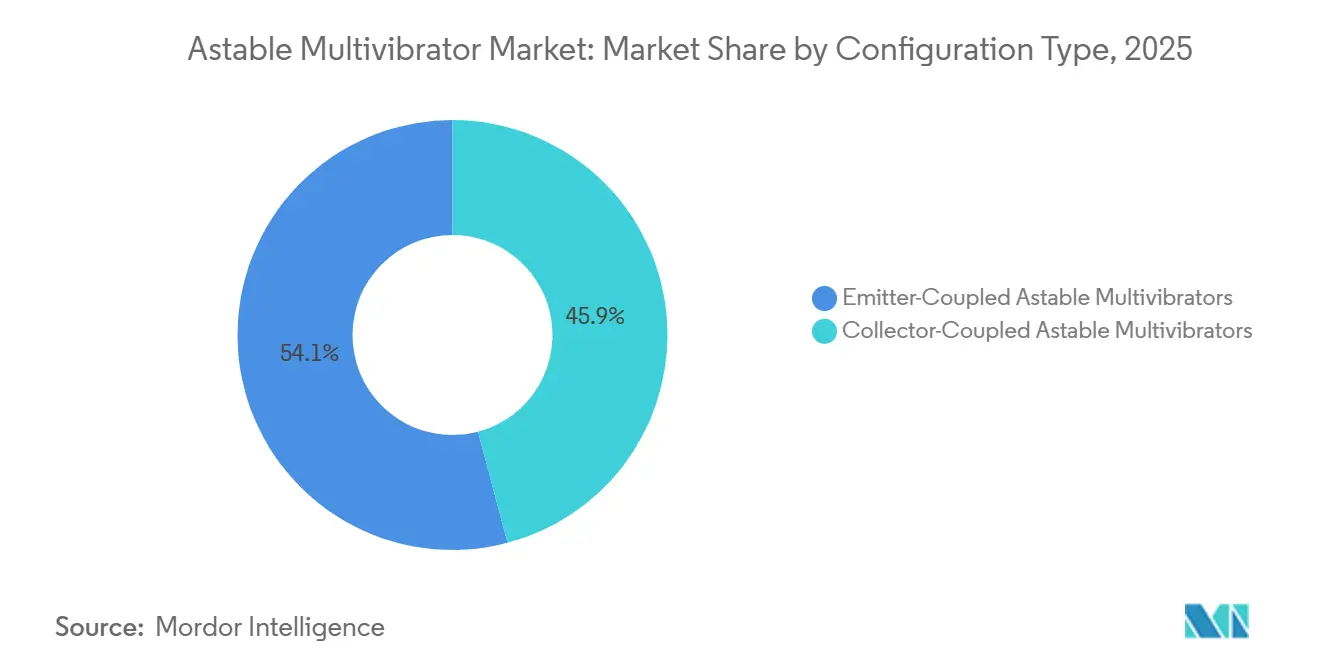
- By configuration type, emitter-coupled circuits held 54.12% of the astable multivibrator market share in 2025 and are projected to expand at a 7.22% CAGR through 2031.
- By circuit implementation, IC-based astable multivibrators accounted for 67.39% share in 2025, while the discrete component segment is projected to grow at a 7.62% CAGR through 2031.
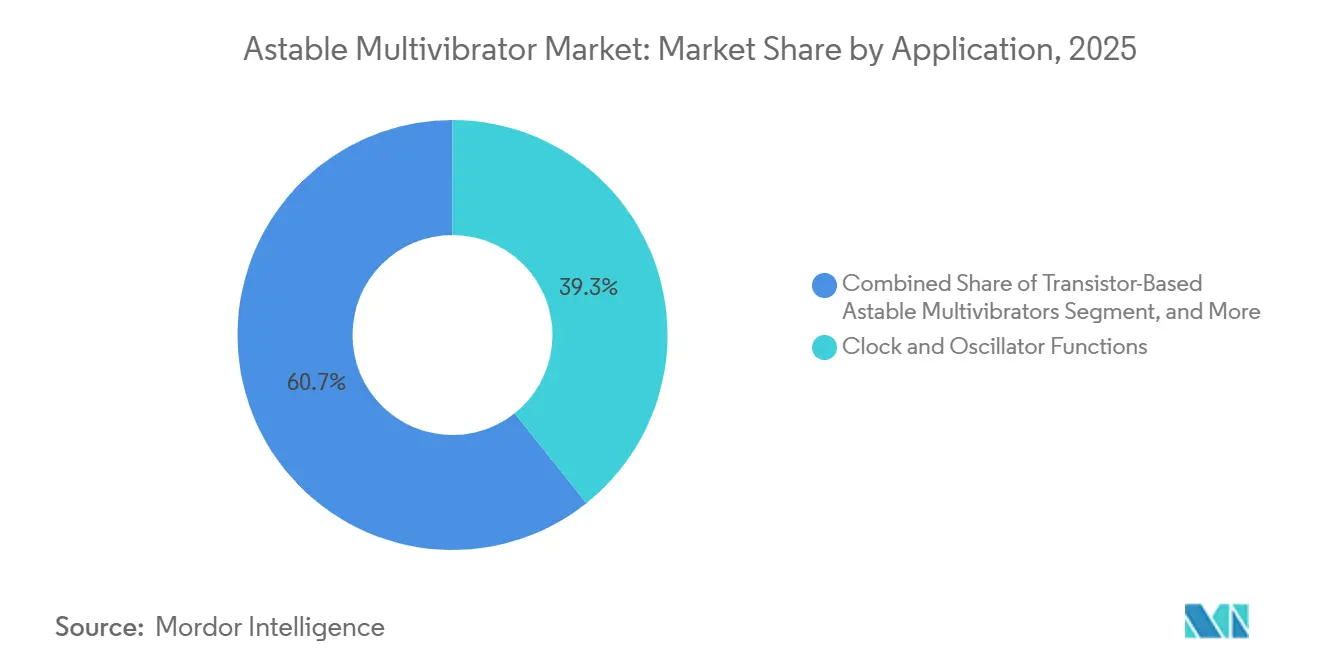
- By application, clock and oscillator functions accounted for 39.29% of the market in 2025, while signal generation is projected to expand at an 8.02% CAGR through 2031.
- By end-user industry, consumer electronics held 34.83% share in 2025, while automotive electronics is projected to record the highest CAGR at 8.21% through 2031.
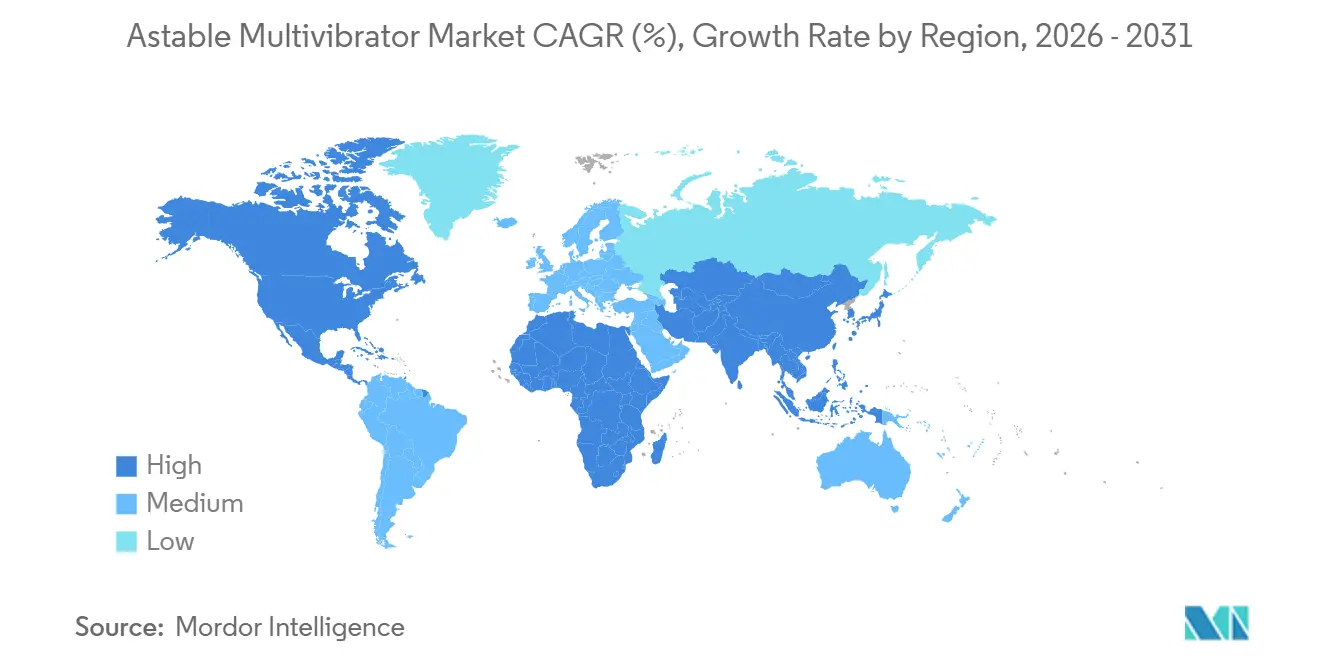
- By geography, North America held 36.16% share of the astable multivibrator market size in 2025, while Asia-Pacific is projected to expand at a 7.74% CAGR through 2031.
Note: Market size and forecast figures in this report are generated using Mordor Intelligence’s proprietary estimation framework, updated with the latest available data and insights as of January 2026.
Global Astable Multivibrator Market Trends and Insights
Drivers Impact Analysis*
| Driver | (~) % Impact on CAGR Forecast | Geographic Relevance | Impact Timeline |
|---|---|---|---|
| Rising Embedded Timing Demand in Consumer and Industrial Electronics | +2.1% | Global | Short term (≤ 2 years) |
| Industrial Automation and Low-Cost PWM Adoption | +1.6% | Global (APAC core, spill-over to EU and North America) | Medium term (2-4 years) |
| Automotive Electronics Content Growth in Lighting, Alarms, and Control Modules | +1.3% | Global (APAC and EU core, expanding to North America) | Medium term (2-4 years) |
| Telecom and Edge Device Demand for Low-Cost Clocking and Pulse Shaping | +0.9% | Global (APAC and North America core) | Short term (≤ 2 years) |
| Shift Toward Ultra-Low-Power CMOS Timer Architectures in Battery Designs | +0.6% | Global (North America and APAC core) | Medium term (2-4 years) |
| Wider Use of Schmitt-Trigger Inverter Topologies in Compact Low-Voltage Designs | +0.4% | Global (North America and EU) | Long term (≥ 4 years) |
| Source: Mordor Intelligence | |||
Rising Embedded Timing Demand in Consumer and Industrial Electronics
Embedded timing demand remains the strongest support for the astable multivibrator market, as low-cost electronic assemblies still require simple oscillator functions for sequencing and control. This applies across smart plugs, white goods, power tools, educational kits, and light industrial systems that continue to rely on familiar timer IC architectures. The large installed base of 555-family CMOS timers has created durable replacement demand and a wide design reference base, helping the astable multivibrator market remain relevant across mature product categories.[1]Texas Instruments, “LMC555 CMOS Timer,” Texas Instruments, ti.com CMOS implementations also retain an advantage in battery-assisted designs because supply current can be far lower than in bipolar equivalents, keeping the astable multivibrator market competitive in products that value simplicity and low standby draw. Continued product support from major suppliers indicates that OEMs still invest in this class of timing devices for 3.3 V and sub-5 V system rails, supporting the astable multivibrator market in both legacy and new low-voltage designs.
Industrial Automation and Low-Cost PWM Adoption
Industrial automation continues to support the astable multivibrator market because low-cost pulse width modulation, sequence control, sensor polling, and actuator timing are still handled at the board level in many factory systems. These functions appear in conveyor controls, motor soft-start circuits, and local signal conditioning blocks, where a purpose-built timer can be easier to validate and maintain than a programmable alternative. Published research in 2025 showed that CMOS counter-based precision time interval generators with logic-gate oscillator structures delivered pulse deviations of ±3 µs at 1 kHz in industrial IoT settings, supporting the reliability case for simple oscillator approaches in demanding environments. Long supply commitments also matter in this part of the astable multivibrator market, as plant operators and integrators prefer components that remain available for long product life cycles. That makes low-cost timer ICs and related oscillator circuits attractive where software maintenance is unnecessary, and change management costs remain high.
Automotive Electronics Content Growth in Lighting, Alarms, and Control Modules
Automotive electronics content growth is expanding the astable multivibrator market because each new vehicle platform adds more timing-dependent functions in lighting, alarms, body control, and gateway modules. The effect is stronger in EV architectures, where semiconductor content rises as automakers add battery management, cooling, lighting, and control functions across more electronic nodes. Automotive timing reliability is receiving greater design attention, and Texas Instruments’ 2025 launch of BAW-based automotive clock products showed how component selection is moving toward higher reliability standards across vehicle electronics. Nexperia’s 2024 launch of AEC-Q100-certified logic ICs in leadless MicroPak XSON5 packaging also showed how miniaturization and qualification are now shaping selection decisions for compact timer and oscillator circuits in chassis safety, battery monitoring, infotainment, and ADAS-related boards. These changes help the astable multivibrator market most in automotive designs that still value predictable edge quality, simple implementation, and qualified long-life components.
Telecom and Edge Device Demand for Low-Cost Clocking and Pulse Shaping
Telecom and edge devices continue to support the astable multivibrator market, as not every board in a network system needs a high-cost, precision timing source. Board-level pulse generation, GPIO toggling, LED control, and local duty-cycle management still favor simple oscillator circuits when cost and power matter more than extreme timing accuracy. Research published in npj Flexible Electronics in early 2025 documented an ultra-low-power wake-up timer operating at 26.7 nW at 0.7 V using relaxation-oscillator principles, demonstrating that CMOS astable approaches can scale into very low-power edge designs. This matters for the astable multivibrator market because network densification increases the number of timing-dependent edge nodes, access boards, and peripheral modules deployed in the field. It also supports the astable multivibrator market for communication and modulation applications, where a simple, configurable oscillator remains a practical, cost-effective starting point.
Restraints Impact Analysis*
| Restraint | (~) % Impact on CAGR Forecast | Geographic Relevance | Impact Timeline |
|---|---|---|---|
| Competition From MCU-, SoC-, and Programmable Clock-Based Alternatives | -2.0% | Global | Medium term (2-4 years) |
| Miniaturization and High-Frequency Integration Limits for Discrete Astable Designs | -1.4% | Global | Long term (≥ 4 years) |
| Sticky Design-In Cycles Once Timing Functions Are Embedded in ASICs and Controllers | -0.9% | North America and EU | Long term (≥ 4 years) |
| EMI, Jitter, and Thermal Qualification Requirements in Automotive and Industrial Systems | -0.6% | APAC, North America, EU | Medium term (2-4 years) |
| Source: Mordor Intelligence | |||
Competition from MCU-, SoC-, and Programmable Clock-Based Alternatives
The clearest pressure on the astable multivibrator market comes from the growing capabilities of microcontrollers, SoCs, and programmable clock devices, which now handle functions once handled by standalone oscillator circuits. Microchip’s PIC12LF1571/2 series combines three 16-bit PWM outputs, watchdog timing, and a precision internal oscillator calibrated to ±1% while operating at very low current in low-frequency mode, making a separate timer unnecessary in many small-node designs.[2]Microchip Technology Inc., “PIC12(L)F1571/2 8-Pin MCU with High-Precision 16-Bit PWMs,” Microchip Technology Inc., microchip.com Once a timing function moves into firmware, the cost of adding more channels falls sharply, thereby reducing the value of a dedicated astable stage in multifunction designs. Consolidation in adjacent timing markets is adding to that pressure, as SiTime’s announced acquisition of Renesas timing assets showed how programmable and MEMS-based timing portfolios are scaling to cover more applications around clocks and oscillators. Suppliers in the astable multivibrator market, therefore, need to defend use cases where simplicity, non-programmable operation, and no firmware dependency still matter at the system level.
Miniaturization and High-Frequency Integration Limits for Discrete Astable Designs
Discrete astable designs face hard physical limits as timing accuracy expectations rise and frequencies move beyond the range where RC-based approaches remain practical. The NE555 bipolar family can draw 3 mA to 15 mA and consume much more power than modern wearable, hearable, or implantable products can accept, which narrows the addressable space for older architectures. Even with CMOS alternatives, timing accuracy in astable operation still depends on supply voltage, temperature, and the tolerance of external RC components, creating a fundamental ceiling on frequency stability in designs that require tighter control. The 2025 npj Flexible Electronics study also showed that very low-power wake-up timer structures can still exhibit significant frequency variation across fabricated devices, highlighting the persistent variability challenge even in advanced low-power implementations. These limits mean the astable multivibrator market will remain strongest in applications where approximate timing is acceptable and cost per timing function remains the main decision point.
*Our forecasts treat driver/restraint impacts as directional, not additive. The impact forecasts reflect baseline growth, mix effects, and variable interactions.
Segment Analysis
By Configuration Type: Emitter-Coupled Circuits Lead on Speed and Edge Quality
Emitter-coupled circuits held 54.12% of the astable multivibrator market share in 2025, which gave them the leading position within the configuration type. That leadership reflects a clear performance advantage in applications where oscillation frequency, switching speed, and waveform symmetry matter more than minimum circuit simplicity. The main reason is that emitter-coupled designs avoid transistor saturation, thereby reducing storage-time effects and enabling cleaner switching transitions. This provides a stronger fit for the astable multivibrator market in telecommunications, automotive electronics, and precision instrumentation designs that require more stable local oscillation behavior. Collector-coupled circuits still retained a meaningful role because they remain easy to build, easy to teach, and easy to adapt in low-cost experiments and learning environments.
Emitter-coupled circuits are also projected to be the fastest-growing configuration, with a 7.22% CAGR during 2026-2031, indicating that higher-value uses are gaining traction in the astable multivibrator market. Demand is being helped by analog RF signal generation and by automotive designers who prefer more predictable switching edges in PWM-driven lighting and actuator modules. This split creates a two-track structure in the astable multivibrator industry, where cost-focused designs continue to use familiar saturated-mode approaches while higher-performance niches move toward active-region switching. ABLIC’s automotive convenience timer portfolio, which was still being updated in 2026, shows that specialized analog suppliers continue to invest in automotive-grade timing products that align with these higher-reliability requirements.


By Circuit Implementation: IC-Based Designs Remain Dominant While Discrete Options Gain Niche Ground
IC-based astable multivibrators commanded a 67.39% share of the circuit implementation segment in 2025, which kept them firmly ahead of discrete approaches. That position came from decades of standardization around 555-family timers and CMOS successors that offer compact footprints, predictable timing, broad availability, and familiar design practices. The astable multivibrator market has benefited from this installed base because engineers across consumer, industrial, and educational applications already know how to design around these parts. Support across the NE555, LMC555, TS556, and ICM7555 families has kept the category active and widely cross-referenced, which helps sustain replacement demand across regions. STMicroelectronics’ 2025 TS556 update also showed that suppliers continue to offer low-power dual CMOS timer lines to meet current design needs.
The discrete component segment is projected to grow at a 7.62% CAGR during 2026-2031, making it the fastest-growing circuit implementation group in the astable multivibrator market. That growth reflects the flexibility of transistor-based, logic-gate, Schmitt-trigger, and op-amp-based designs in applications where standard IC pinouts do not fit board constraints or voltage conditions. Logic families such as Schmitt-trigger inverters are becoming more relevant in compact low-voltage systems because they can support oscillator functions in spaces where classic 555 timers are less suitable. Research published in Electronics in 2025 showed that inverter-based crystal oscillator structures combined with counters achieved ±50 ppm stability, which supports the continued design relevance of logic-gate timing approaches in distributed IoT systems.
By Application: Clock Functions Hold Revenue Leadership While Signal Generation Grows Faster
Clock and oscillator functions accounted for 39.29% of the astable multivibrator market in 2025, making them the largest application segment. This leading position reflects the basic role of astable circuits in generating repetitive square-wave outputs that synchronize logic, memory, and communication subsystems in cost-sensitive embedded designs. The segment remains resilient because legacy industrial controls, appliances, and retrofit architectures continue to value simple, proven timer ICs over deeper integration into a mixed-signal controller. That makes the astable multivibrator market especially sticky in applications where product life cycles are long, and redesign costs stay high. Timing and delay circuits also remained stable because industrial automation and building controls continue to use simple astable and monostable functions for sequencing, watchdog reset, and conveyor timing.
Signal generation is projected to be the fastest-growing application, with a 8.02% CAGR during 2026-2031, indicating where the astable multivibrator market is gaining new traction. Communication and modulation circuits, low-cost wireless peripherals, and reference stages for basic frequency synthesis continue to favor tunable oscillators with low component counts. Texas Instruments’ TLC555-Q1 Automotive LinCMOS timer update in 2026 also showed that suppliers still position these devices for automotive lighting, traction inverter timing, and telematics uses, which helps the application base remain broad. Experimental and educational circuits add a steady self-renewing layer of demand because oscillator design is still commonly taught with 555-family parts as the standard entry component.

By End-User Industry: Consumer Electronics Leads Volume While Automotive Electronics Sets The Growth Pace
Consumer electronics accounted for 34.83% of the astable multivibrator market in 2025, making it the largest end-user industry by revenue. The size of this segment comes from the sheer number of timing circuits used in smart home devices, wearables, remote controls, power tools, and portable entertainment products. In these designs, IC-based astable circuits still offer a low-cost timing method without firmware overhead, which protects demand in high-volume categories. KYOCERA AVX’s 2025 launch of the KC1210A series, with a very small footprint and 0.9 V operation, demonstrated how consumer electronics are driving timing components toward ultra-compact and ultra-low-voltage designs.[3]Nicholas Kovalsky, “Kyocera Unveils the KC1210A Series Clock Oscillators,” KYOCERA AVX, kyocera-avx.com Industrial automation and control remained the second-largest end-user group because factory electronics still require timing, connectivity, and power management at multiple levels of system intelligence.
Automotive electronics is projected to expand at an 8.21% CAGR during 2026-2031, making it the fastest-growing end-user segment in the astable multivibrator market. More ECUs per vehicle, additional ambient lighting zones, proximity alarms, gateway controllers, and battery management modules are all widening the timing requirement per platform. ABLIC’s automotive convenience timers, rated for very low current and AEC-Q100 Grade 1 conditions, show how suppliers are targeting dark-current control and battery protection requirements that matter more as EV adoption grows. Medical devices and instrumentation remain smaller but important opportunities, as wearable and implantable systems increasingly align with low-power oscillator approaches documented in recent flexible electronics research.
Geography Analysis
North America held 36.16% of the astable multivibrator market share in 2025, which made it the largest regional contributor. The region benefits from a dense industrial automation base, a mature aerospace and defense electronics ecosystem, and semiconductor design centers that continue to qualify timer IC families for new platform generations. These long design-in cycles support the astable multivibrator market because once timer circuits are embedded in industrial control, power distribution, or building systems, replacement cycles can extend across multiple product generations. Asia-Pacific is projected to grow at a 7.74% CAGR during 2026-2031, which makes it the fastest-growing region for the astable multivibrator market.
China, Japan, South Korea, and India are driving that regional growth through large-scale production of battery-powered IoT devices, home appliances, consumer electronics, and automotive ECUs. This manufacturing concentration gives the astable multivibrator market a strong volume base, as timing circuits are used repeatedly across low-cost embedded nodes and control modules. Europe has a different profile, with Germany and France anchoring demand through automotive supply chains and industrial equipment makers that specify long-lifecycle timer IC families. Higher safety and qualification expectations in vehicle and factory electronics also support demand for more reliable timer and oscillator devices across European programs. South America maintained a modest but stable position in the astable multivibrator market, driven by consumer electronics assembly and agricultural automation equipment demand.
The Middle East and Africa remained early-stage markets, but telecom buildout and broader electronics penetration are expanding the installed base of low-cost timing circuits. Japan adds a more sophisticated demand profile because component sourcing there strongly favors product continuity and proven quality. ROHM’s CR control timer IC portfolio documents 10-year to 15-year supply commitments across automotive, industrial, and consumer applications, which supports the astable multivibrator market in long-life manufacturing programs. Renesas and ABLIC also reinforce this regional preference for long qualification cycles and dependable automotive timing supply.

Competitive Landscape
The astable multivibrator market remains moderately concentrated, with competition spread across broad-portfolio semiconductor companies and smaller analog specialists. Texas Instruments, STMicroelectronics, Semiconductor Components Industries, Renesas Electronics, and similar suppliers compete through extensive timer and logic portfolios, wide distribution reach, and long-standing design support across consumer, industrial, and automotive channels. No single company appears to dominate the astable multivibrator market, and share positioning is shaped more by application fit, reliability record, and qualification depth than by scale alone. That leaves room for both large catalog suppliers and niche vendors that can support specific voltage, packaging, or automotive-grade requirements.
Strategic behavior in the astable multivibrator market follows a clear pattern. One path is deeper automotive qualification, and Texas Instruments reinforced that direction in 2025 with its BAW-based automotive clock products aimed at higher reliability in vehicle electronics. A second path is package miniaturization, and Nexperia’s launch of AEC-Q100-certified logic ICs in MicroPak XSON5 packaging showed how suppliers are reducing board footprint while meeting automotive reliability needs. A third path is low-power CMOS refresh, and Texas Instruments’ TPUL multivibrator family showed how suppliers are cutting static supply current and simplifying migration from legacy device families. STMicroelectronics’ continuing support for the TS556 and ABLIC’s ongoing expansion of automotive convenience timers further show that sustained portfolio maintenance remains a practical competitive tool in this market.
White-space opportunities remain visible in flexible electronics, wearable devices, and other low-voltage formats, where current product catalogs remain thin. Educational and maker channels continue to support the astable multivibrator market by preserving global SKU availability and keeping the 555-family ecosystem familiar to new designers. There is also room for suppliers that package Schmitt-trigger and logic-oscillator approaches more effectively for compact automotive and IoT designs, especially where lower power and smaller footprints matter.[4]STMicroelectronics, “TS556 Low-Power Dual CMOS Timer Datasheet,” STMicroelectronics, st.com At the same time, substitute pressure from precision timing vendors outside the direct participant set is forcing companies in the astable multivibrator market to compete harder on simplicity, cost, and long-life support rather than on precision performance alone.
Astable Multivibrator Industry Leaders
Texas Instruments Incorporated
STMicroelectronics N.V.
Semiconductor Components Industries, LLC
Microchip Technology Incorporated
Renesas Electronics Corporation
- *Disclaimer: Major Players sorted in no particular order

Recent Industry Developments
- May 2026: SiTime Corporation launches the Elite 2 Super-TCXO for AI data center synchronization, delivering sub-nanosecond timing accuracy across GPU clusters, 10x better than the industry's 10-nanosecond target, and targeting a cumulative addressable market of USD 1.5 billion by 2030.
- February 2026: SiTime Corporation announced a definitive agreement to acquire certain timing business assets from Renesas Electronics Corporation for USD 1.5 billion in cash and approximately 4.13 million shares. The acquired business includes clock generators, buffers, network synchronizers, and jitter attenuators, with approximately 75% of acquired revenue derived from AI datacenter and communications markets.
- September 2025: SiTime Corporation entered the USD 4 billion resonator market with the launch of the Titan Platform, its sixth-generation MEMS/FujiMEMS technology resonator. The Titan SiT11100 (32 MHz) reached production sample availability in September 2025, with additional frequency variants due in December 2025.
- April 2025: Texas Instruments introduced the CDC6C-Q1 oscillator and the LMK3H0102-Q1 and LMK3C0105-Q1 clock generators, representing the automotive industry's first Bulk Acoustic Wave (BAW)-based clock products. Rated with a failure-in-time rate of 0.3, 100 times more reliable than quartz-based clocks, these devices target next-generation ADAS reliability and high-speed in-vehicle data processing.


Global Astable Multivibrator Market Report Scope
The Astable Multivibrator Market refers to the global industry focused on the design, development, manufacturing, integration, and commercialization of astable multivibrator circuits and related solutions for continuous-waveform and pulse-signal generation across electronic systems. Astable multivibrators are free-running oscillator circuits that continuously switch between two unstable states without requiring an external triggering signal, thereby generating square waves, clock pulses, timing signals, and repetitive electronic outputs essential for a wide range of analog and digital applications.
The Astable Multivibrator Market Report is Segmented by Configuration Type (Collector-Coupled Astable Multivibrators, and Emitter-Coupled Astable Multivibrators), Circuit Implementation (IC-Based Astable Multivibrators, Transistor-Based Astable Multivibrators, Logic Gate and Schmitt-Trigger-Based Astable Multivibrators, and Op-Amp-Based Astable Multivibrators), Application (Clock and Oscillator Functions, Oscillator Functions, Pulse Width Modulation and Signal Conditioning, LED Flashing and Tone Generation, Communication and Modulation Circuits, and Experimental and Educational Circuits), End-User Industry (Consumer Electronics, Industrial Automation and Control, Automotive Electronics, Telecommunications, Aerospace and Defense, Medical Devices and Instrumentation, and Education and Research), and Geography (North America, South America, Europe, Asia-Pacific, Middle East, and Africa). The Market Forecasts are Provided in Terms of Value (USD).
| Collector-Coupled Astable Multivibrators |
| Emitter-Coupled Astable Multivibrators |
| IC-Based Astable Multivibrators |
| Transistor-Based Astable Multivibrators |
| Logic Gate and Schmitt-Trigger-Based Astable Multivibrators |
| Op-Amp-Based Astable Multivibrators |
| Clock and Oscillator Functions |
| Timing and Delay Circuits |
| Pulse Width Modulation and Signal Conditioning |
| LED Flashing and Tone Generation |
| Communication and Modulation Circuits |
| Experimental and Educational Circuits |
| Consumer Electronics |
| Industrial Automation and Control |
| Automotive Electronics |
| Telecommunications |
| Aerospace and Defense |
| Medical Devices and Instrumentation |
| Education and Research |
| North America | United States |
| Canada | |
| Mexico | |
| South America | Brazil |
| Argentina | |
| Rest of South America | |
| Europe | Germany |
| United Kingdom | |
| France | |
| Italy | |
| Spain | |
| Rest of Europe | |
| Asia-Pacific | China |
| Japan | |
| India | |
| South Korea | |
| Rest of Asia-Pacific | |
| Middle East | Saudi Arabia |
| United Arab Emirates | |
| Rest of Middle East | |
| Africa | South Africa |
| Nigeria | |
| Rest of Africa |
| By Configuration Type | Collector-Coupled Astable Multivibrators | |
| Emitter-Coupled Astable Multivibrators | ||
| By Circuit Implementation | IC-Based Astable Multivibrators | |
| Transistor-Based Astable Multivibrators | ||
| Logic Gate and Schmitt-Trigger-Based Astable Multivibrators | ||
| Op-Amp-Based Astable Multivibrators | ||
| By Application | Clock and Oscillator Functions | |
| Timing and Delay Circuits | ||
| Pulse Width Modulation and Signal Conditioning | ||
| LED Flashing and Tone Generation | ||
| Communication and Modulation Circuits | ||
| Experimental and Educational Circuits | ||
| By End-User Industry | Consumer Electronics | |
| Industrial Automation and Control | ||
| Automotive Electronics | ||
| Telecommunications | ||
| Aerospace and Defense | ||
| Medical Devices and Instrumentation | ||
| Education and Research | ||
| By Geography | North America | United States |
| Canada | ||
| Mexico | ||
| South America | Brazil | |
| Argentina | ||
| Rest of South America | ||
| Europe | Germany | |
| United Kingdom | ||
| France | ||
| Italy | ||
| Spain | ||
| Rest of Europe | ||
| Asia-Pacific | China | |
| Japan | ||
| India | ||
| South Korea | ||
| Rest of Asia-Pacific | ||
| Middle East | Saudi Arabia | |
| United Arab Emirates | ||
| Rest of Middle East | ||
| Africa | South Africa | |
| Nigeria | ||
| Rest of Africa | ||


Key Questions Answered in the Report
What is the current size and outlook for the astable multivibrator market?
The astable multivibrator market stands at USD 1.56 billion in 2026 and is forecast to reach USD 2.17 billion by 2031, growing at a 6.82% CAGR over 2026-2031.
Which configuration leads demand for astable multivibrators?
Emitter-coupled circuits led configuration demand with a 54.12% share in 2025, supported by better switching speed and cleaner edge behavior in higher-performance uses.
Why are IC-based designs still ahead of discrete implementations?
IC-based designs held 67.39% share in 2025 because 555-family timers and CMOS successors offer standardization, compact packaging, and a familiar design base across many end uses.
Which application is expanding the fastest through 2031?
Signal generation is projected to grow the fastest at an 8.02% CAGR, reflecting demand in communication, modulation, and low-cost wireless circuit designs.
Which end-user category offers the strongest growth opportunity?
Automotive electronics is expected to post the fastest growth at an 8.21% CAGR as vehicles add more ECUs, lighting modules, alarms, and control systems that require timing functions.
Which region is creating the most new demand?
Asia-Pacific is projected to grow the fastest at a 7.74% CAGR, driven by electronics manufacturing scale across China, Japan, South Korea, and India.
Page last updated on:





