
Asia-Pacific Urban Design Market Size and Share
Market Overview
| Study Period | 2020 - 2031 |
|---|---|
| Forecast Data Period | 2026 - 2031 |
| Base Year Market Size (2025) | USD 35.80 Billion |
| Market Size (2026) | USD 38.10 Billion |
| Market Size (2031) | USD 58.80 Billion |
| Growth Rate (2026 - 2031) | 9.06 % |
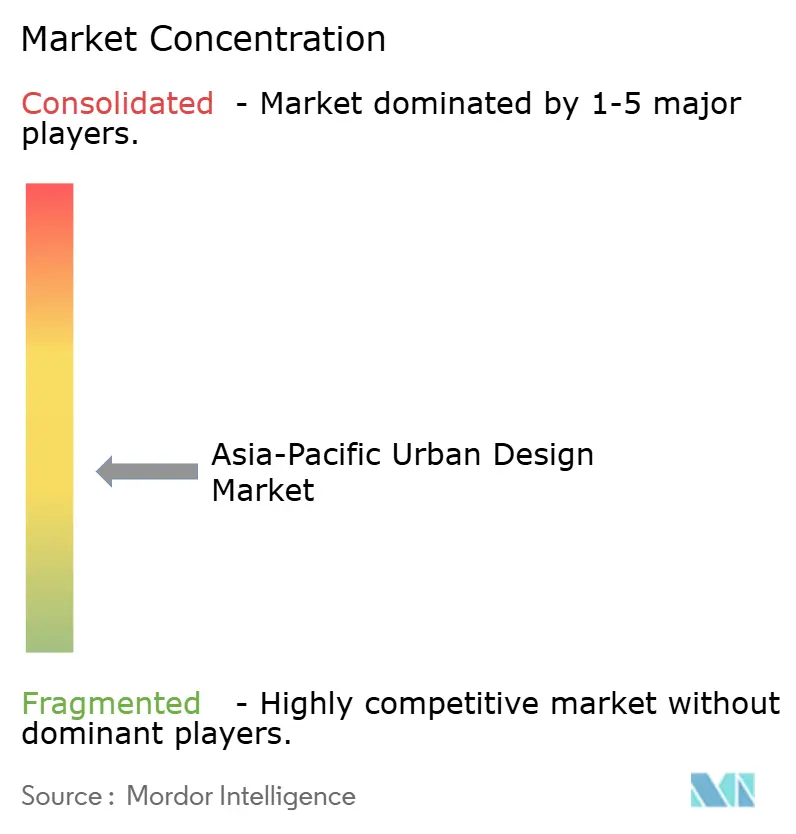
| Market Concentration | Medium |
Major Players *Disclaimer: Major Players sorted in no particular order Image © Mordor Intelligence. Reuse requires attribution under CC BY 4.0. | |
Asia-Pacific Urban Design Market Analysis by Mordor Intelligence
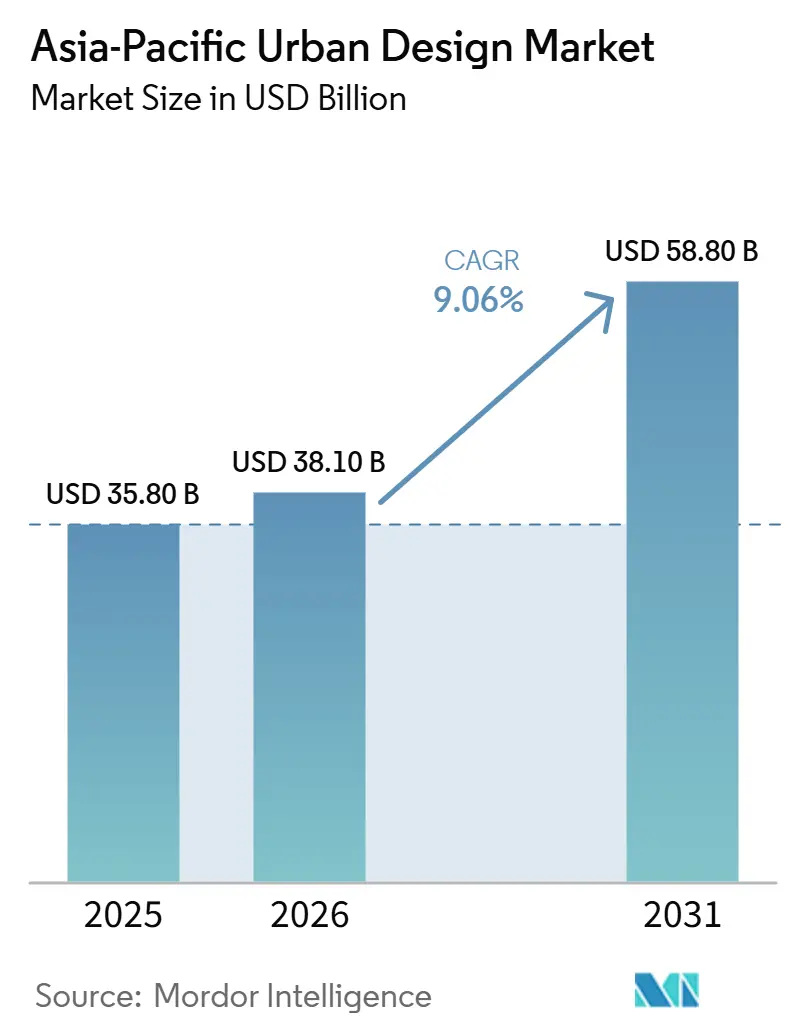
The Asia-Pacific Urban Design Market size is expected to increase from USD 35.80 billion in 2025 to USD 38.10 billion in 2026 and reach USD 58.80 billion by 2031, growing at a CAGR of 9.06% over 2026-2031. The Asia-Pacific urban design market is supported by sustained urban population growth, with 19 of the world’s 33 megacities located in Asia and the Pacific. Public authorities continue to set the project pipeline through city expansion, housing programs, rail networks, and urban renewal plans. Planning firms can gain from work that connects land use, mobility, public services, and climate resilience within a single commission. Digital planning tools are becoming increasingly important in public procurement, particularly when authorities seek coordinated data across an entire development area. Land disputes, uneven approval capacity, climate exposure, and shortages of qualified planners can delay projects and favor firms that have established public-sector relationships and larger technical teams.
Key Report Takeaways
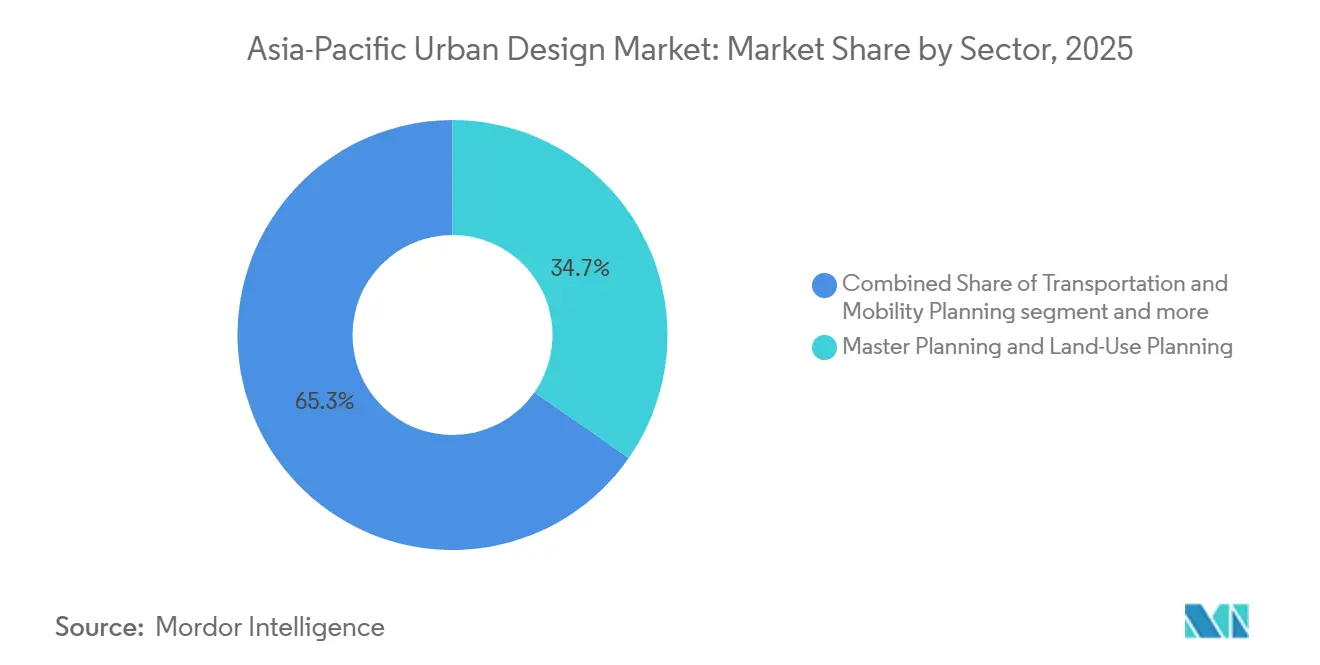
- By type, master planning and land-use planning held 34.7% of the Asia-Pacific urban design market share in 2025, while transportation and mobility planning is projected to grow at a 10.0% CAGR through 2031.
- By sector, mixed-use and township developments accounted for 42.1% of the Asia-Pacific urban design market size in 2025, while transportation and infrastructure is forecast to expand at a 10.4% CAGR through 2031.
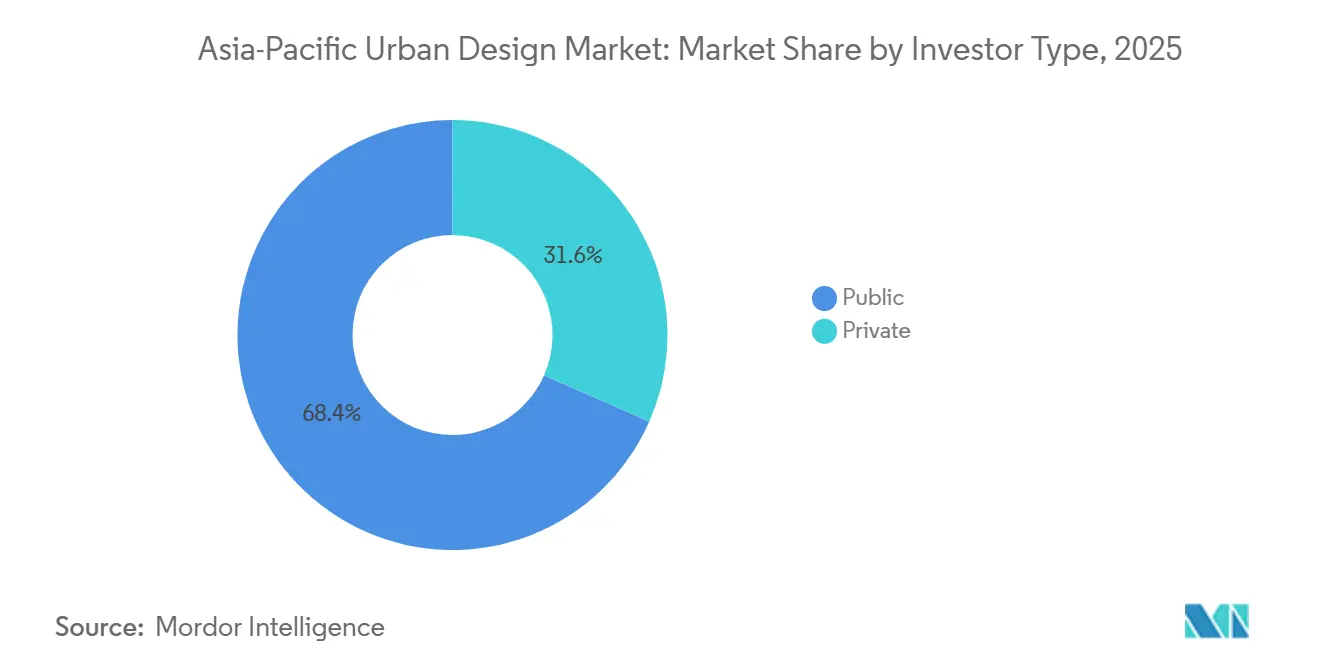
- By investor type, public investors accounted for 68.4% of commissioned services in 2025, while private investors are projected to record the highest CAGR of 11.0% through 2031.
- By geography, China held 41.8% of the Asia-Pacific urban design market share in 2025, while India is forecast to grow at an 11.8% CAGR through 2031.
Note: Market size and forecast figures in this report are generated using Mordor Intelligence’s proprietary estimation framework, updated with the latest available data and insights as of January 2026.
Asia-Pacific Urban Design Market Trends and Insights
Drivers Impact Analysis*
| Drivers | (~) % Impact on CAGR Forecast | Geographic Relevance | Impact Timeline |
|---|---|---|---|
| Rapid Metropolitan Population Growth | +2.2% | Pan-APAC, with acute pressure in India, Indonesia, the Philippines, and Vietnam megacity corridors | Medium term (2-4 years) |
| Metro, Rail and Urban Infrastructure Expansion | +2.0% | India, China, and Southeast Asia | Short term (≤ 2 years) |
| New-City and New-Town Programs | +1.6% | China, India, and Southeast Asia | Long term (≥ 4 years) |
| Smart-City and Digital Urban Planning Adoption | +1.5% | ASEAN, India, China, South Korea, and Japan | Medium term (2-4 years) |
| Affordable Housing and Planned Communities | +1.3% | India, Malaysia, Australia, and Vietnam | Medium term (2-4 years) |
| Source: Mordor Intelligence | |||
Rapid Metropolitan Population Growth
The Asia-Pacific urban design market benefits from the concentration of large urban populations across the region. Asia and the Pacific contains 19 of the world’s 33 megacities, while Jakarta had nearly 42 million residents and Dhaka approached 40 million residents in 2025. Smaller and medium-sized cities in South and Southeast Asia are also growing faster than several established megacities. This broadens demand beyond capital cities and creates commissions in secondary urban centers that have received less professional planning support. Higher density encourages mixed-use development, transit-oriented design, and public realm improvements, rather than relying solely on conventional land-use mapping. These assignments require wider coordination between transport agencies, local authorities, developers, and communities.
Metro, Rail and Urban Infrastructure Expansion
Transport investment supports a growing part of the Asia-Pacific urban design market. Rail corridors create demand for station-area planning, transit-oriented development, urban design, and land-use changes around new stations. India’s metro systems operated across 23 cities in 2026, which indicates the breadth of planning work associated with metropolitan transport expansion. AECOM and AtkinsRéalis received a July 2025 consultancy award for the Hong Kong section of the Hong Kong-Shenzhen Western Rail Link. Large rail projects also create related work in utilities, public space, social infrastructure, and development controls. The resulting commissions can extend beyond construction because authorities need long-term land-use and access management around transport assets.
New-City and New-Town Programs
State-led new-city programs remain an important source of work for the Asia-Pacific urban design market. China’s national policy is shifting toward urban renewal, but planned communities and new development areas continue to require long-term spatial strategies. China’s 15th Five-Year Plan for 2026-2030 includes the renovation of 115,000 old residential compounds, which shifts the planning mix toward renewal and phased implementation. This work requires detailed engagement with residents, consideration of heritage, infrastructure constraints, and project sequencing. Australia’s Housing Accord targets 1.2 million new homes over 5 years, supporting the need for statutory assessment and planned community capacity. Housing delivery and city expansion, therefore, sustain demand for master plans, zoning, infrastructure coordination, and implementation advice.
Smart-City and Digital Urban Planning Adoption
Digital tools are changing the work undertaken in the Asia-Pacific urban design market. The ASEAN Smart Cities Network recorded 134 active smart city projects by September 2025 and adopted an ASEAN Smart City Action Plan for 2026-2035. These programs raise demand for spatial data systems, digital twins, building information modeling, and geospatial analysis in planning assignments. AECOM’s appointment for Hong Kong’s San Tin Technopole included the development and implementation of a unified digital twin platform for the development area. South Korea’s 2026 K-City Network program extends AI-based urban planning technologies to 6 ASEAN cities. Firms that build digital delivery into their core planning process can meet more demanding procurement requirements and manage larger, more connected projects.
Restraints Impact Analysis*
| Restraints | (~) % Impact on CAGR Forecast | Geographic Relevance | Impact Timeline |
|---|---|---|---|
| Land Acquisition and Resettlement Challenges | -1.8% | Indonesia, India, Malaysia, and the Philippines | Short term (≤ 2 years) |
| Uneven Planning and Regulatory Capacity | -0.9% | South and Southeast Asia, including secondary cities in India, Indonesia, and Vietnam | Long term (≥ 4 years) |
| Climate and Disaster Exposure | -0.7% | Bangladesh, the Philippines, Vietnam, Indonesia, Bangkok, and Jakarta | Medium term (2-4 years) |
| Shortage of Qualified Urban Planning Professionals | -0.6% | Australia, India, and secondary urban centers | Medium term (2-4 years) |
| Source: Mordor Intelligence | |||
Land Acquisition and Resettlement Challenges
Land acquisition and resettlement issues can delay the start of major projects in the Asia-Pacific urban design market. Research from Utrecht University documented contestation around land authority and customary land rights in Indonesia’s Nusantara capital project. Delays can leave specialist teams committed to anticipated work without the expected project revenue. Secondary cities can also lack the planning and regulatory capacity needed to move complex schemes through the approval process. Climate exposure increases design requirements in coastal and flood-prone locations, including Bangkok, Jakarta, Manila, and cities in Bangladesh, Vietnam, and the Philippines. Flood resilience, drainage, heat management, and nature-based buffers add scope, but they can also increase coordination needs and extend approval periods.
Uneven Planning and Regulatory Capacity
Uneven planning and regulatory capacity constrains project delivery across secondary cities in South and Southeast Asia. The restraint is most relevant in secondary urban centers in India, Indonesia, and Vietnam, where planning systems may not keep pace with the scale of proposed development. Limited capacity can slow plan preparation, statutory approvals, land-use changes, and coordination between agencies. This creates uncertainty for developers and service providers that need clear timelines before committing specialist teams. It also makes it harder to translate national urban programs into local projects with consistent implementation standards. The effect is expected to remain relevant over the long term because institutional capacity takes time to strengthen.
*Our forecasts treat driver/restraint impacts as directional, not additive. The impact forecasts reflect baseline growth, mix effects, and variable interactions.
Segment Analysis
By Type: Master Planning Remains the Revenue Base While Transportation Planning Grows Faster
Master Planning and Land-Use Planning held 34.7% of the Asia-Pacific urban design market share in 2025. It remains the revenue base because large cities, townships, and regeneration assignments need an agreed spatial framework before detailed design work can progress. These contracts often have long delivery periods because they cover land use, infrastructure, development stages, regulatory alignment, and implementation arrangements. Transportation and Mobility Planning is projected to record the highest CAGR of 10.0% between 2026 and 2031. Transport assignments are expanding as metropolitan authorities connect rail investment with land-use changes and development around stations. The service type is gaining from metro and rail programs in India, Vietnam, Indonesia, and the Philippines. Rail corridors require coordinated work on access, public space, density, parking, utility needs, and development control.
Urban Design, Public Realm and Landscape Design is becoming more important where clients seek climate-responsive places that also support daily movement and community use. Hassell and SOM presented the master plan and concept design for Bradfield City’s First Land Release in February 2026. The plan combines density, multimodal transport, Indigenous Country principles, and links to the Sydney Metro Western Sydney Airport line[1]Skidmore, Owings and Merrill, “SOM and Hassell Unveil Vision for Australia’s First New City in 100+ Years,” SOM, som.com.. Zoning, Development Control and Implementation Advisory also provides recurring work in places where urban renewal projects require continued compliance and approval support. The Others category includes heritage planning, climate resilience assessment, and informal settlement upgrading. UNESCAP estimated that nearly 600 million people in Asia and the Pacific lived in slum or informal conditions, supporting the relevance of these specialized assignments.


By Sector: Mixed-Use Developments Lead Current Demand While Infrastructure Sets the Growth Rate
Mixed-Use and Township Developments accounted for 42.1% of the Asia-Pacific urban design market size in 2025. These developments combine homes, employment space, public facilities, transport, and community infrastructure in one planned area. The model is established in India, Vietnam, and Malaysia and is moving into second-tier and third-tier locations. It offers public authorities a way to coordinate housing and job creation while providing developers with a defined land-use framework. Planning firms can contribute from early master planning through infrastructure sequencing and development controls. Mixed-use schemes also need sustained engagement with developers, local authorities, utility providers, and transport agencies. Their broad scope supports a continuing need for integrated planning teams.
Transportation and Infrastructure is forecast to grow at a 10.4% CAGR from 2026 to 2031. This sector gains from the need to expand metro systems, highway links, logistics capacity, and airport-related development as cities grow. The Western Sydney Aerotropolis has engaged Hassell, SOM, and the Sydney Metro design consortium for an integrated framework across a 23 km corridor[2]Hassell, “Sydney Metro Western Sydney Airport,” Hassell, hassellstudio.com.. The work combines station design, urban design, and ecological restoration. Public, Civic and Institutional Developments remain a major source of planning work because urban growth increases the need for schools, health facilities, civic centers, and other distributed services. These projects are frequently commissioned by government bodies and can require complex coordination across agencies. They also create opportunities for firms that can connect facility planning with wider neighborhood and transport plans.
By Investor Type: Public Commissioning Dominates While Private Investment Gains Momentum
Public investors accounted for 68.4% of commissioned urban design services in 2025. This reflects the role of national, state, and local governments in directing urban renewal, housing programs, transit systems, and new development areas. Public clients set many of the region’s largest spatial planning mandates and often determine the procurement requirements that private developers must follow. Government-to-government arrangements can reduce procurement cycles by using prequalified agencies and established institutional relationships. This approach is particularly relevant when authorities need planning advice that can work across national standards, local regulations, and public infrastructure requirements. The public segment remains central to the Asia-Pacific urban planning services market because it controls the main pipeline of citywide and infrastructure-linked commissions. It also provides firms with opportunities to develop recurring advisory relationships rather than isolated project work.
Private investors are forecast to expand at a CAGR of 11.0% from 2026 to 2031. Private demand is growing through urban regeneration, mixed-use development, and development management assignments in mature capital markets. A 2026 Malaysian family office investment of MYR 1.1 billion, equivalent to USD 244 million, in Lendlease Exchange TRX illustrated the private capital participating in large urban projects. This example supports the role of investors beyond traditional public land authorities. Private developers often seek planning firms that can connect master planning with commercial strategy, project management, and construction advisory. The strongest private commissioning activity is expected in Australia, Singapore, Japan, and South Korea. In these markets, planning fees may be included within wider development management agreements instead of being purchased as standalone consulting work.
Geography Analysis
China held 41.8% of the Asia-Pacific urban design market share in 2025. Its position reflects the scale of state-directed urbanization and the depth of its planning institutions. The 15th Five-Year Plan for 2026-2030 directs renovation of 115,000 old urban residential compounds and supports a shift from greenfield expansion to urban renewal[3]China Daily, “Urban Renewal Targets Residents’ Needs,” China Daily, chinadaily.com.cn.. This change preserves demand for planning services but alters the required skills toward regeneration, stakeholder engagement, and phased delivery. China’s city cluster programs also support work across the Yangtze River Delta and Greater Bay Area. Xiongan New Area had more than 400 branch institutions and over 100 schools operating, showing the long delivery horizon attached to major Chinese planning programs.
India is projected to be the fastest-growing national market, with an 11.8% CAGR through 2031. India’s Smart Cities Mission had completed more than 8,063 projects valued at INR 1.64 lakh crore (USD 19.5 billion) by July 2025. These completed projects support a continuing base of infrastructure and planning activity in cities across the country. India’s planning demand also includes metro expansion, planned townships, and housing-led growth. Japan and South Korea are mature but technically demanding markets with needs in urban regeneration, age-friendly design, and transit-oriented densification. In Japan, population decline in several cities creates demand for retrofitting, consolidation, and shrinking-city planning rather than outward urban expansion. South Korea combines regeneration activity with public programs that strengthen digital planning and practitioner capability.
Australia, Indonesia, South Korea, and the Rest of Asia-Pacific form a second tier with distinct demand patterns. Australia’s 1.2 million-home Housing Accord target supports planning demand, although the shortage of qualified planners limits approval capacity in major east-coast cities.Indonesia combines the Nusantara capital project with growing metro networks in Jakarta, Surabaya, and Medan. Land acquisition and regulatory capacity remain constraints on project delivery in Indonesia. Vietnam, the Philippines, and Malaysia offer frontier opportunities through township projects, airport-city programs, and transport expansion. The Asia-Pacific urban planning services market can benefit in these locations when firms combine local partnerships with expertise in infrastructure coordination, climate resilience, and public approvals.
Competitive Landscape
The Asia-Pacific urban design market is moderately fragmented. Globally integrated firms such as AECOM, Arup, WSP Global, and Arcadis compete with regional specialists, including Surbana Jurong, Nikken Sekkei, and Hassell. Public procurement is more concentrated because prequalification panels and government-to-government arrangements limit the number of firms eligible for major commissions. Smaller practices remain relevant in public realm design, landscape architecture, urban design, and community engagement. These firms often join larger teams as specialist subcontractors on large projects. The competitive landscape, therefore, includes a small group of integrated firms alongside specialized regional and local providers. Climate resilience planning, nature-based infrastructure, and informal settlement upgrading remain areas where specialized capability can create opportunities.
Leading companies are building their positions through regional partnerships, technological capabilities, and broader service bundles. AECOM’s San Tin Technopole appointment included a unified digital twin platform, which shows how firms are connecting digital systems to city planning work. Arcadis signed a 3-year Framework Consultancy Agreement with Hong Kong’s Development Bureau in March 2026 for feasibility studies across public works assignments. The agreement covers technical, environmental, financial, and social assessments and embeds digital capabilities in the public works pipeline. Surbana Jurong has built a position through government-to-government engagement and public-sector relationships in Southeast Asia and India. This strategy can lower procurement risk for public clients and support repeat work across related programs.
The Asia-Pacific urban design industry also faces new forms of competition from government-backed planning agencies. South Korean organizations participating in the K-City Network can combine technology transfer with bilateral development assistance in ASEAN cities. This model may be competitive in markets where public agencies place value on technical support, training, and long-term cooperation. Larger firms respond by bundling planning with project management, construction advice, environmental assessment, and digital delivery. This makes client relationships more durable and can increase the value of a framework agreement. Specialist firms can compete where their local knowledge, design skill, or community engagement capability fills a gap within these larger teams. The Asia-Pacific urban planning services market remains open to both large integrated firms and focused specialists because projects require a wide range of technical and local capabilities.
Asia-Pacific Urban Design Industry Leaders
Surbana Jurong Private Limited
AECOM
Arup Group Limited
WSP Global Inc.
Arcadis N.V.
- *Disclaimer: Major Players sorted in no particular order

Recent Industry Developments
- June 2026: Lendlease was selected as the Queensland Government’s preferred Master Development Partner for the former Visy site in South Brisbane, a mixed-use riverfront precinct expected to deliver 4,000 new homes and support more than 3,000 jobs across planning, construction, and operations.
- May 2026: AECOM, Binnies, and Ramboll were appointed by Singapore’s National Environment Agency for Phase 2 of the Integrated Waste Management Facility, extending the joint venture’s Phase 1 role into a multidisciplinary planning, design, and construction supervision engagement for a facility processing up to 2,900 tons of waste daily.
- March 2026: Arcadis secured a 3-year Framework Consultancy Agreement for Studies on Driving Excellence in Public Works, Feasibility Studies, with the HKSAR Development Bureau. The agreement enables technical, environmental, financial, and social impact assessments across public infrastructure assignments.
- February 2026: Hassell and SOM unveiled the master plan and concept design for Bradfield City’s First Land Release in Western Sydney. The plan combines climate-responsive urban form, multimodal transport, Indigenous Country principles, and access to the Sydney Metro Western Sydney Airport line.


Asia-Pacific Urban Design Market Report Scope
| Master Planning and Land-Use Planning |
| Urban Design, Public Realm and Landscape Design |
| Transportation and Mobility Planning |
| Zoning, Development Control and Implementation Advisory |
| Others |
| Mixed-Use and Township Developments |
| Transportation and Infrastructure |
| Public, Civic and Institutional Developments |
| Others |
| Public |
| Private |
| China |
| India |
| Japan |
| South Korea |
| Australia |
| Indonesia |
| Rest of Asia-Pacific |
| By Type | Master Planning and Land-Use Planning |
| Urban Design, Public Realm and Landscape Design | |
| Transportation and Mobility Planning | |
| Zoning, Development Control and Implementation Advisory | |
| Others | |
| By Sector | Mixed-Use and Township Developments |
| Transportation and Infrastructure | |
| Public, Civic and Institutional Developments | |
| Others | |
| By Investor Type | Public |
| Private | |
| By Geography | China |
| India | |
| Japan | |
| South Korea | |
| Australia | |
| Indonesia | |
| Rest of Asia-Pacific |


Key Questions Answered in the Report
What is the 2026 value of Asia-Pacific urban planning services?
The sector is estimated at USD 38.1 billion in 2026 and is forecast to reach USD 58.8 billion by 2031 at a 9.1% CAGR.
Which service type has the largest revenue base?
Master Planning and Land-Use Planning led with 34.7% share in 2025, supported by large city, township, and regeneration commissions.
Which service type is expected to grow fastest?
Transportation and Mobility Planning is expected to grow at a 10.0% CAGR through 2031 as metro and rail corridors need station-area and transit-oriented planning.
Which sector accounts for the largest share of demand?
Mixed-Use and Township Developments accounted for 42.1% in 2025 because these projects combine homes, jobs, public facilities, and transport.
Page last updated on:





