
ASEAN Industrial Press Machines Market Size and Share
Market Overview
| Study Period | 2020 - 2031 |
|---|---|
| Forecast Data Period | 2026 - 2031 |
| Base Year Market Size (2025) | USD 1.32 Billion |
| Market Size (2026) | USD 1.40 Billion |
| Market Size (2031) | USD 1.93 Billion |
| Growth Rate (2026 - 2031) | 6.63 % |
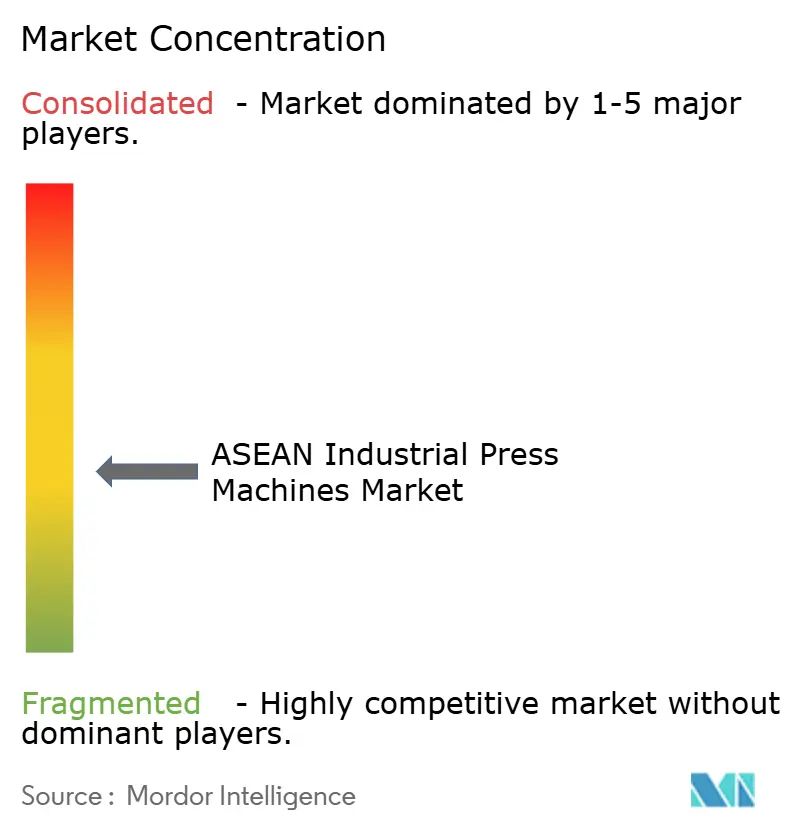
| Market Concentration | Medium |
Major Players *Disclaimer: Major Players sorted in no particular order Image © Mordor Intelligence. Reuse requires attribution under CC BY 4.0. | |
ASEAN Industrial Press Machines Market Analysis by Mordor Intelligence
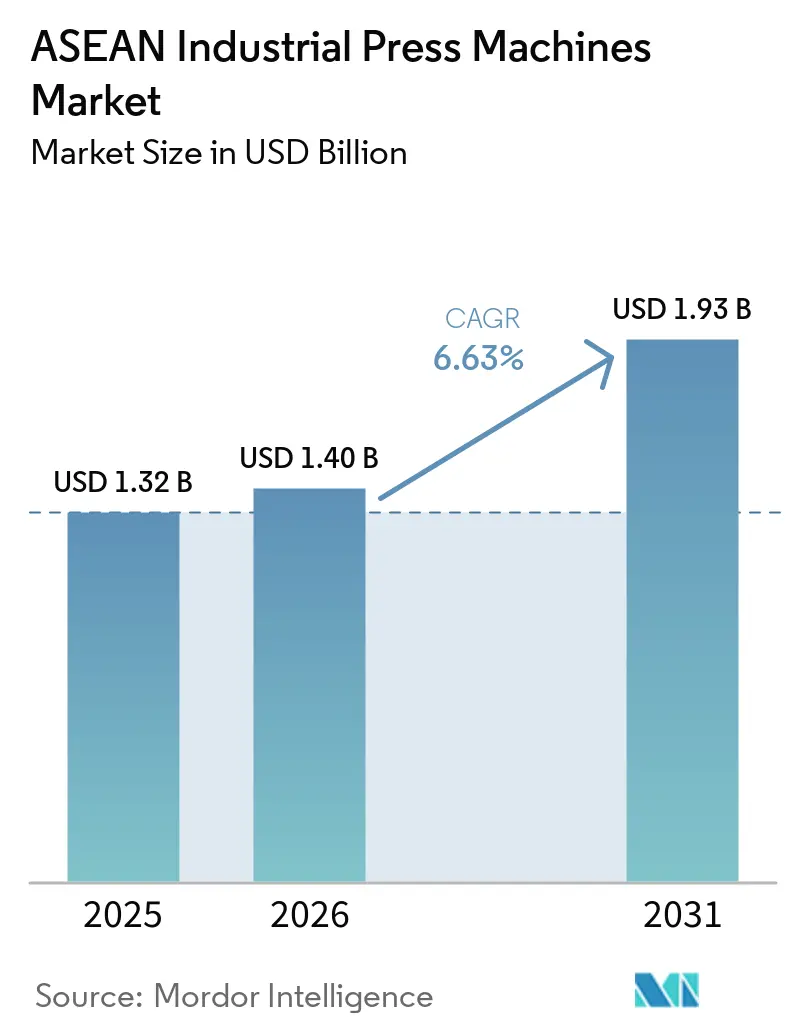
The ASEAN industrial press machines market size was valued at USD 1.32 billion in 2025 and is estimated to grow from USD 1.40 billion in 2026 to reach USD 1.93 billion by 2031, at a CAGR of 6.63% during the forecast period 2026-2031.
The region’s manufacturing investment is supporting equipment purchases because new plants need stamping, forming, and joining systems. Manufacturing foreign direct investment reached USD 44 billion in 2025, while greenfield commitments in electronics and electrical equipment increased 15% to USD 31 billion.[1]ASEAN Secretariat, “ASEAN Investment Report 2025,” 2025, asean.org Supply-chain diversification, EV localization programs, and semiconductor capacity additions are directing capital toward Thailand, Indonesia, Malaysia, and Vietnam. These investments favor suppliers that can combine equipment delivery with tooling, automation, installation, and maintenance support. Cost-sensitive fabricators still defer replacement decisions, which leaves service, retrofit, and uptime agreements important within the ASEAN industrial press machines market.
Key Report Takeaways
- By drive technology, conventional mechanical presses held 36.5% of the ASEAN industrial press machines market share in 2025, while servo-mechanical presses are forecast to grow at an 8.2% CAGR through 2031.
- By press capacity, the 101-500 ton category accounted for 40.6% of the ASEAN industrial press machines market share in 2025, while presses above 2,000 tons are forecast to grow at a 6.8% CAGR through 2031.
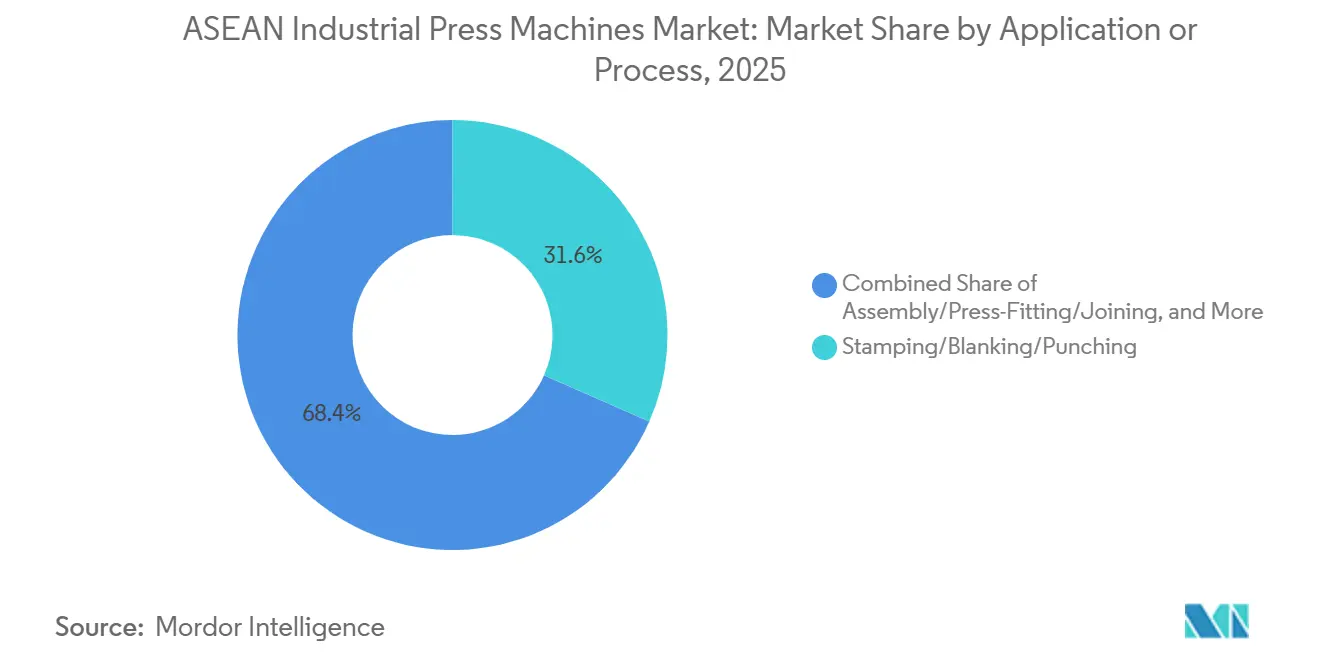
- By application, stamping, blanking, and punching accounted for 31.6% of application revenue in 2025, while assembly, press-fitting, and joining are forecast to expand at a 7.2% CAGR through 2031.
- By end-use industry, automotive and transportation held 35% of the ASEAN industrial press machines market size in 2025, while medical and precision manufacturing are forecast to grow at an 8% CAGR through 2031.
- By geography, Indonesia accounted for 33% of the ASEAN industrial press machines market size in 2025, while Vietnam is forecast to expand at a 7.5% CAGR through 2031.
Note: Market size and forecast figures in this report are generated using Mordor Intelligence’s proprietary estimation framework, updated with the latest available data and insights as of January 2026.
ASEAN Industrial Press Machines Market Trends and Insights
Drivers Impact Analysis*
| Driver | (~) % Impact on CAGR Forecast | Geographic Relevance | Impact Timeline |
|---|---|---|---|
| China Plus One Manufacturing Diversification | +2.0% | ASEAN-wide, with the strongest relevance in Vietnam, Indonesia, and Thailand | Short term (≤ 2 years) |
| Automotive and Electric Vehicle Component Localization | +1.6% | Thailand, Indonesia, Vietnam, with spillover to Malaysia | Short term (≤ 2 years) |
| Electronics and Semiconductor Manufacturing Expansion | +1.2% | Malaysia, Vietnam, Singapore, with spillover to the Philippines | Medium term (2-4 years) |
| Automation Adoption Amid Skilled-Labor Constraints | +0.8% | ASEAN-wide, with the strongest relevance in Vietnam and the Philippines | Medium term (2-4 years) |
| Cross-Border Press Service and Engineering Hubs | +0.5% | Singapore, Malaysia, and Thailand | Long term (≥ 4 years) |
| Battery-Enclosure and Lightweight-Structure Forming Requirements | +0.3% | Thailand, Indonesia, and Malaysia | Medium term (2-4 years) |
| Source: Mordor Intelligence | |||
China Plus One Manufacturing Diversification
Multinational producers are placing more production in ASEAN to reduce their dependence on China. The ASEAN Investment Report 2025 recorded USD 44 billion in manufacturing FDI during 2025. Greenfield commitments in electronics and electrical equipment rose 15% to USD 31 billion during the same year. New assembly and fabrication plants require stamping presses, progressive-die lines, and hydraulic forming systems. When a Tier 1 supplier establishes a site in Vietnam or Indonesia, local tooling and press-service activity tends to develop beside it. The ASEAN Secretariat also identified policy gaps, skills shortages, and infrastructure bottlenecks that can slow the conversion of announced investment into operating capacity.
Automotive and Electric Vehicle Component Localization
EV localization policies are shifting procurement from a replacement-led cycle toward new capital investment. Thailand’s Board of Investment had approved 198 EV projects worth more than THB 137 billion, or USD 3.9 billion, as of May 2026. The projects covered vehicle assembly, batteries, energy storage, traction motors, battery management systems, power-control components, and charging infrastructure.[2]Thailand Board of Investment, “Thailand’s EV Investment Tops THB 137 Billion as BOI Targets ASEAN Hub,” May 2026, boi.go.th Indonesia requires manufacturers that use duty-free EV import incentives to match imports with domestic production, with full compliance required by 2027. Malaysia ended completely built-up EV import incentives at the end of 2025 and retained completely knocked down vehicle incentives through 2027. Thailand’s battery electric vehicle capacity utilization averaged 20% in 2025, while Indonesia remained below 15%, and the International Energy Agency expects utilization to rise during 2026 as local production becomes more important.
Electronics and Semiconductor Manufacturing Expansion
Semiconductor expansion supports demand for precise stamping of lead frames, connectors, shielding cans, and packaging enclosures. X-FAB announced a MYR 3 billion (USD 740.23 million) expansion of its Sarawak fabrication facility in September 2025.[3]Malaysian Investment Development Authority, “X-FAB’s RM3-Billion State-of-the-Art Expansion in Sarawak Strengthens Malaysia’s Position as Global Semiconductor Hub,” September 2025, mida.gov.my The project raises monthly wafer output from 30,000 to 40,000 units and supports automotive, power, and medical chips. United Microelectronics Corporation began a Singapore greenfield fab project with a first-phase commitment of up to USD 5 billion and planned volume production in 2026. LG Innotek selected DEEP C Hai Phong 2 in Vietnam for a USD 1 billion semiconductor substrate complex, with construction beginning in Q3 2026 and pilot production planned for Q3 2027. These projects support the mid-range equipment used for precision enclosures and component parts in the ASEAN industrial press machines market.
Automation Adoption Amid Skilled-Labor Constraints
Rising labor costs and shortages of qualified operators make automated press systems more attractive. The skilled-worker shortage across Indonesia, Thailand, Malaysia, the Philippines, Singapore, and Vietnam stood at 6.6 million people in 2025.[4]Economic Research Institute for ASEAN and East Asia, “Preparing ASEAN Talent for the Future of Work,” 2025, eria.org Manufacturers are adopting servo presses with coil-feed automation, robotic transfer systems, and quick-die-change capability to maintain output with smaller teams. Malaysia’s robotics roadmap targets 195 robots per 10,000 manufacturing employees by 2030, compared with 67 units per 10,000 in 2025. Servo-electric and servo-hydraulic systems can reduce operator dependence at individual stations and provide data for maintenance planning. This supports demand for equipment that combines forming performance with automation in the ASEAN industrial press machines market and strengthens the case for higher-value equipment upgrades.
Restraints Impact Analysis*
| Restraint | (~) % Impact on CAGR Forecast | Geographic Relevance | Impact Timeline |
|---|---|---|---|
| High Capital Cost and Extended Payback Periods | -1.5% | ASEAN-wide, with the strongest relevance in Indonesia, the Philippines, and Vietnam | Short term (≤ 2 years) |
| Imported Controls, Hydraulics, Tooling, and Spare-Parts Dependence | -1.0% | ASEAN-wide, with the strongest relevance in Vietnam and Indonesia | Medium term (2-4 years) |
| Shortage of Press-Tooling and Advanced Maintenance Talent | -0.7% | ASEAN-wide, especially the Philippines, Cambodia, and Laos | Long term (≥ 4 years) |
| Fragmented Cross-Border Aftermarket Support | -0.4% | Indonesia, the Philippines, and the rest of ASEAN | Medium term (2-4 years) |
| Source: Mordor Intelligence | |||
High Capital Cost and Extended Payback Periods
Servo and hydraulic systems in the 200-2,000 ton range can cost more than USD 300,000 and can exceed USD 3 million per unit. This cost is difficult for smaller fabricators to finance. Indonesia launched the Labor-Intensive Industrial Credit program in 2025, offering subsidized machinery modernization loans from IDR 500 million (USD 0.3 million) to IDR 10 billion (USD 0.6 million) with a 5% annual interest subsidy. The program had disbursed 16.72% of its IDR 549 billion (USD 32.76 million) ceiling as of May 2026, reaching 26 enterprises against a target of 293. It applies to textiles, footwear, furniture, and food, rather than the broader metalworking base that purchases industrial presses. In Vietnam, small supporting-industry enterprises borrow at 8-10% annually, while FDI enterprises can access parent-company financing at 1-3%, which can delay equipment upgrades.
Imported Controls, Hydraulics, Tooling, and Spare-Parts Dependence
Many buyers rely on imports for servo drives, hydraulic units, proportional valves, and precision die tooling. ASEAN imports of Chinese electronics and machinery rose from USD 230 billion in 2024 to USD 309 billion in 2025. Vietnam, Malaysia, and Thailand accounted for more than four-fifths of the regional increase. Indonesia’s manufacturing clusters also rely on imported tooling, specialty steel, and semi-finished components routed through major ports. Import duties, foreign-exchange exposure, and longer lead times raise lifecycle costs for independent fabricators. Limited local availability of replacement parts can also extend press-line downtime when a component fails.
*Our forecasts treat driver/restraint impacts as directional, not additive. The impact forecasts reflect baseline growth, mix effects, and variable interactions.
Segment Analysis
By Drive/Actuation Technology: Conventional Equipment Remains the Largest Base
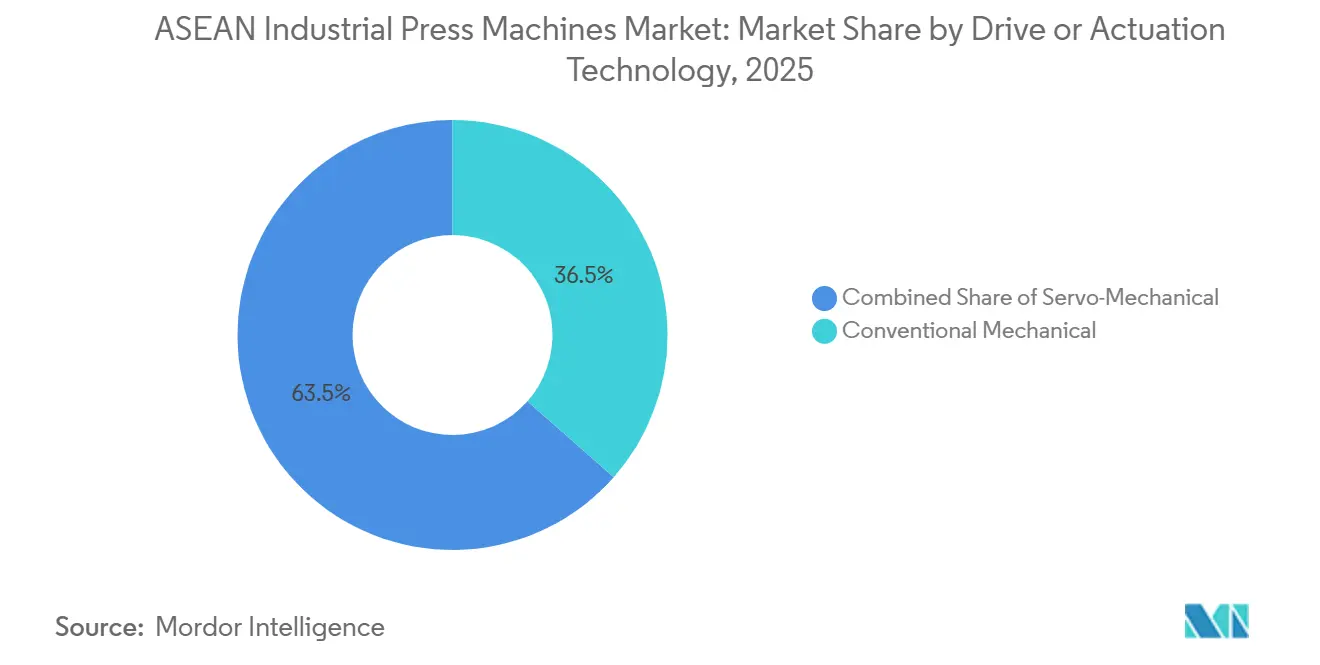
Conventional mechanical presses held 36.5% of the ASEAN industrial press machines market size in 2025. Their installed base reflects the established automotive stamping operations in Thailand, Indonesia, and Malaysia. Fabricators often select these proven systems because their initial cost is below that of premium servo alternatives and because operators are familiar with their fixed-cycle operating characteristics. Pneumatic presses remain relevant for light-duty punching and assembly work where compressed-air infrastructure already exists, particularly on electronics and consumer-appliance production lines. Hydraulic presses serve deep drawing, forging, and compression molding because controlled pressure and lower speeds suit these processes, including applications that require programmable pressure profiles.
Servo-mechanical presses are forecast to grow at an 8.2% CAGR through 2031, making them the fastest-growing drive type. EV battery trays and motor-core laminations need controlled force curves, die protection, programmable slide motion, energy recovery, and precise tonnage control during each forming cycle. AIDA Engineering has developed servo architectures across the 80-1,250 ton range. Its Johor manufacturing hub has served ASEAN automotive customers since 1997. Hybrid designs that combine servo drives and hydraulic accumulators are also suited to high-strength aluminum structural components where purely mechanical or hydraulic systems may not provide the required balance.


By Press Force/Capacity: Mid-Range Equipment Leads Demand
The 101-500 ton category held 40.6% of the ASEAN industrial press machines market in 2025, reflecting its broad role across the regional manufacturing base. It serves automotive panels, electronics enclosures, appliance frames, and structural brackets produced for vehicle, consumer durable, and industrial machinery supply chains. This range is offered in mechanical, hydraulic, and servo versions, giving buyers several configuration choices across suppliers from Japan, China, Europe, and Taiwan. It supports a large share of progressive-die and transfer-press work across regional industrial zones. Presses below 100 tons support connector stamping, lead-frame forming, small-part punching, and precision assembly for electronics, medical devices, and compact consumer products.
Presses above 2,000 tons are forecast to grow at a 6.8% CAGR through 2031, making them the fastest-growing capacity group. Localized large-panel production for EV platforms is the main source of demand, particularly where assemblers are developing body-in-white operations and domestic component supply. High-strength steel, aluminum crash structures, and battery enclosures need high forming force at production speed while maintaining repeatable part quality across long production runs. Yangli Group supplied 5,600-ton and 4,160-ton automated lines for Foton Motor, showing the scale used in vehicle body production. Its 3,750-ton TL4 transfer press can process high-strength steel body panels at up to 30 strokes per minute.
By Application/Process: Stamping Supports the Broadest Installed Base
Stamping, blanking, and punching remained the largest application in 2025. The process is used for automotive panels, electronics chassis, appliance frames, and structural components that enter several manufacturing supply chains. Its broad presence across end-use categories gives it the largest installed base. Deep drawing and sheet forming support battery enclosures and EV motor housings, which are among the more demanding applications in the current regional investment cycle. These applications require controlled force profiles to manage springback in high-strength aluminum.
Assembly, press-fitting, and joining is forecast to grow at a 7.2% CAGR through 2031, making it the fastest-growing application. Modular EV systems require joining operations for battery modules, motor subassemblies, and power-electronics housings where press force can replace conventional fasteners or adhesives. Forging presses process drivetrain and suspension parts, while compression molding supports industrial and aerospace composites, and general forming serves construction, shipbuilding, and heavy equipment. Powder compaction produces sintered components for electrical contacts, filters, and precision equipment. The wide application mix makes maintenance and aftermarket support complex across the ASEAN industrial press machines market.
By End-Use Industry: Automotive Is the Largest User Group
Automotive and transportation held 35% of the ASEAN industrial press machines market in 2025. Thailand’s stamping ecosystem, Indonesia’s EV assembly base, and Vietnam’s expanding Tier 2 supplier cluster support this position across established and newer vehicle programs. Electrical and electronics producers need light-to-mid-tonnage presses for connectors, lead frames, motor laminations, and power-module housings. Industrial machinery producers use heavy equipment for structural parts, gearbox housings, and hydraulic cylinders, particularly in Malaysia and Thailand, where fabrication capabilities are established. Appliances, consumer durables, aerospace, defense, and energy equipment add demand for specialized forming work.
Medical and precision manufacturing is forecast to grow at an 8% CAGR through 2031, making it the fastest-growing end-use. Malaysia, Singapore, and Vietnam are attracting medical device supply chains that need accurate forming and joining systems supported by electronics ecosystems, skilled labor, and compliance infrastructure. Cardiovascular devices, orthopedic components, and diagnostic housings need repeatable processes, sub-millimeter accuracy, and close force monitoring to meet their precision requirements. Samsung Electro-Mechanics committed PHP 50.7 billion, equivalent to approximately USD 905 million, to expand its Laguna facility in the Philippines in 2025. This investment is expected to support demand for precision equipment across electronics and EV-related supply chains.
Geography Analysis
Indonesia held 33% of the ASEAN industrial press machines market in 2025. Its position is supported by automotive assembly, appliance manufacturing, a developing EV component base, and a manufacturing workforce of more than 17 million people spread across major industrial regions. BYD’s Indonesian assembly plant is operational in 2026, and SAIC-GM-Wuling is increasing local press-and-weld content as EV import-duty waivers have expired. Thailand has the region’s deepest automotive stamping base and the highest concentration of high-tonnage servo and mechanical transfer lines serving both internal-combustion and electric vehicle production. The Board of Investment had approved 198 EV projects worth more than THB 137 billion ( USD 4.35 billion) as of May 2026.
Vietnam is forecast to grow at a 7.5% CAGR through 2031, making it the fastest-growing national market in the ASEAN industrial press machines market. LG Innotek selected DEEP C Hai Phong 2 for a USD 1 billion substrate complex in 2026. Samsung Electronics expansions in Bac Ninh and Thai Nguyen also support precision component production. EV investments by Great Wall Motor and SAIC are adding stamping and body-in-white requirements. Malaysia has a more technically advanced demand profile, supported by X-FAB’s MYR 3 billion (USD 740.23 million) Sarawak expansion and ASE Technology’s fifth Penang packaging plant, with demand focused on lead frames and precise enclosure components.
The Philippines received PHP 50.7 billion (USD 860.78 million) in semiconductor-related investment from Samsung Electro-Mechanics in 2025. Singapore mainly demands advanced servo and precision-forming equipment for aerospace, semiconductor packaging, and medtech applications, while acting as a regional spare-parts distribution center. Cambodia, Myanmar, Brunei, Lao PDR, and other ASEAN economies remain at an early equipment-investment stage with demand centered on garment auxiliary tooling and basic metal-forming work. Their future growth depends on FDI spillover from Vietnam, Thailand, and Indonesia as primary industrial zones become more constrained.
Competitive Landscape
The ASEAN industrial press machines market is moderately fragmented. In the ASEAN industrial press machines market, Japanese suppliers, including AIDA Engineering, Komatsu Industries, and AMADA, have traditionally been strong in precision servo and transfer presses. Chinese suppliers, including JIER Machine-Tool Group, Yangli Group, Hefei Metalforming, and Accurl CNC Machine, compete in mid-range hydraulic and mechanical equipment. European specialists, including ANDRITZ Schuler, Fagor Arrasate, and LVD, focus on high-tonnage and precision transfer applications. Chinese competition is increasing price pressure in standard-tonnage categories and encourages established suppliers to emphasize service, retrofits, uptime agreements, and machine availability over the installed life of equipment.
ANDRITZ Schuler introduced its HFA fineblanking press series with Feintool in January 2026. The series uses servo-controlled hydraulic pump drives to improve energy efficiency and stroke rates for precise automotive and electronics work. AIDA Engineering reported that service orders and factory automation became important revenue buffers in the fiscal year ended March 2026, while direct press orders faced weaker EV-related investment and U.S. tariff disruption. AMADA expanded 3 technical centers across ASEAN and reported regional sales growth of 14% year on year. Komatsu Industries is advancing the AI-enabled Komtrax predictive-maintenance platform for its installed press base.
Legacy mechanical equipment in the ASEAN industrial press machines market offers a retrofit opportunity for servo-drive and control-system integrators. Smaller fabricators outside Java, peninsular Malaysia, and the Bangkok metropolitan area often have limited access to certified hydraulic and servo servicing, spare parts, and advanced maintenance expertise. IoT monitoring, predictive maintenance, and AI-assisted die management are still at an early stage across the broader fleet. The competitive balance in the ASEAN industrial press machines market depends on equipment performance, financing access, and qualified service support.
ASEAN Industrial Press Machines Industry Leaders
AIDA Engineering, Ltd.
Komatsu Industries Corporation
ANDRITZ Schuler Group
JIER Machine-Tool Group Co., Ltd.
CHIN FONG MACHINE INDUSTRIAL CO., LTD.
- *Disclaimer: Major Players sorted in no particular order

Recent Industry Developments
- August 2026: JIER Machine-Tool Group completed delivery and commissioning of a 1,000-ton press system for a Tier 1 automotive client in Mexico, demonstrating cross-continental project execution capability across logistics coordination, on-site installation, and handover verification. The project reinforces JIER's position as a global high-tonnage stamping press supplier competing beyond its established Chinese and East Asian base.
- July 2026: Yangli Group Corporation launched the TL4-3750 transfer press, the largest single-tonnage standalone press produced in China at 3,750 tons, featuring servo-controlled adaptive transfer bars, online vision inspection, and full auto quick-die-change. The system processes 4 to 7 stamping operations per cycle at up to 30 strokes per minute and targets high-strength steel body panels and EV structural parts for automotive customers.
- June 2026: Fagor Arrasate secured an order for 3 HSP 4.3++ high-speed stamping presses from a leading European Tier 1 automotive supplier, targeting rotor and stator lamination applications for electric motor manufacturing. The project reinforces Fagor Arrasate's position in precision high-speed press systems for EV drivetrain components.
- January 2026: ANDRITZ Schuler, in partnership with Feintool, launched the HFA fineblanking press series with servo-controlled hydraulic pump drives, claiming improved energy efficiency and cycle rates over conventional fineblanking systems. The launch directly addresses precision automotive and electronics pressing work relevant to ASEAN OEM customers.


ASEAN Industrial Press Machines Market Report Scope
| Conventional Mechanical Presses |
| Servo-Mechanical Presses |
| Hydraulic Presses |
| Pneumatic Presses |
| Other and Hybrid Presses |
| Up to 100 Tons |
| 101–500 Tons |
| 501–1,000 Tons |
| 1,001–2,000 Tons |
| Above 2,000 Tons |
| Stamping, Blanking, and Punching |
| Deep Drawing and Sheet Forming |
| Forging |
| Straightening and General Forming |
| Compression Molding |
| Powder Compaction |
| Assembly, Press-Fitting, and Joining |
| Other Press Applications |
| Automotive and Transportation |
| Aerospace and Defense |
| Industrial Machinery and Equipment |
| Electrical and Electronics |
| Appliances and Consumer Durables |
| Construction and Heavy Equipment |
| Energy and Power Equipment |
| Metal Products and General Manufacturing |
| Medical and Precision Manufacturing |
| Other End-Use Industries |
| Indonesia |
| Malaysia |
| Philippines |
| Thailand |
| Vietnam |
| Rest of ASEAN (Brunei Darussalam, Cambodia, Singapore, Lao People's Democratic Republic, Myanmar, etc.) |
| By Drive / Actuation Technology | Conventional Mechanical Presses |
| Servo-Mechanical Presses | |
| Hydraulic Presses | |
| Pneumatic Presses | |
| Other and Hybrid Presses | |
| By Press Force / Capacity | Up to 100 Tons |
| 101–500 Tons | |
| 501–1,000 Tons | |
| 1,001–2,000 Tons | |
| Above 2,000 Tons | |
| By Application / Process | Stamping, Blanking, and Punching |
| Deep Drawing and Sheet Forming | |
| Forging | |
| Straightening and General Forming | |
| Compression Molding | |
| Powder Compaction | |
| Assembly, Press-Fitting, and Joining | |
| Other Press Applications | |
| By End-Use Industry | Automotive and Transportation |
| Aerospace and Defense | |
| Industrial Machinery and Equipment | |
| Electrical and Electronics | |
| Appliances and Consumer Durables | |
| Construction and Heavy Equipment | |
| Energy and Power Equipment | |
| Metal Products and General Manufacturing | |
| Medical and Precision Manufacturing | |
| Other End-Use Industries | |
| By Geography | Indonesia |
| Malaysia | |
| Philippines | |
| Thailand | |
| Vietnam | |
| Rest of ASEAN (Brunei Darussalam, Cambodia, Singapore, Lao People's Democratic Republic, Myanmar, etc.) |


Key Questions Answered in the Report
What is the forecast growth rate for industrial press machines in ASEAN?
The ASEAN industrial press machines market is forecast to grow at a 6.63% CAGR from 2026 to 2031. It is expected to increase from USD 1.40 billion in 2026 to USD 1.93 billion by 2031, as manufacturing investment, EV localization, and semiconductor expansion raise equipment needs.
Which drive technology is growing fastest in ASEAN?
Servo-mechanical presses are forecast to grow at an 8.2% CAGR through 2031. Demand comes from EV battery trays, motor laminations, automation needs, and requirements for programmable motion, controlled force curves, die protection, and production data.
Which press capacity category has the largest demand?
The 101-500 ton category held 40.6% in 2025. It serves automotive panels, electronics enclosures, appliance frames, structural brackets, progressive-die work, and transfer-press applications across Thailand, Indonesia, Vietnam, and Malaysia.
Which end-use sector is the largest buyer of industrial press machines?
Automotive and transportation held 35% in 2025. Thailand’s stamping ecosystem, Indonesia’s EV base, and Vietnam’s supplier network support demand for body panels, structural components, drivetrain parts, and related formed products.
Which ASEAN country has the highest demand for industrial press machines?
Indonesia held 33% in 2025. Automotive assembly, appliance manufacturing, EV components, and a manufacturing workforce of more than 17 million people support equipment demand in the country.
What is limiting equipment replacement by smaller fabricators?
High equipment costs, financing constraints, imported components, and shortages of tooling and maintenance talent can extend payback periods. These issues are particularly difficult for independent fabricators without OEM-linked support arrangements, certified local servicing, or access to lower-cost parent-company financing.
Page last updated on:


 Your data is secure and never sold or shared.


