
Asia-Pacific Professional Indemnity Insurance Market Size and Share
Market Overview
| Study Period | 2020 - 2031 |
|---|---|
| Forecast Data Period | 2026 - 2031 |
| Base Year Market Size (2025) | USD 5.90 Billion |
| Market Size (2026) | USD 6.20 Billion |
| Market Size (2031) | USD 8.20 Billion |
| Growth Rate (2026 - 2031) | 5.80 % |
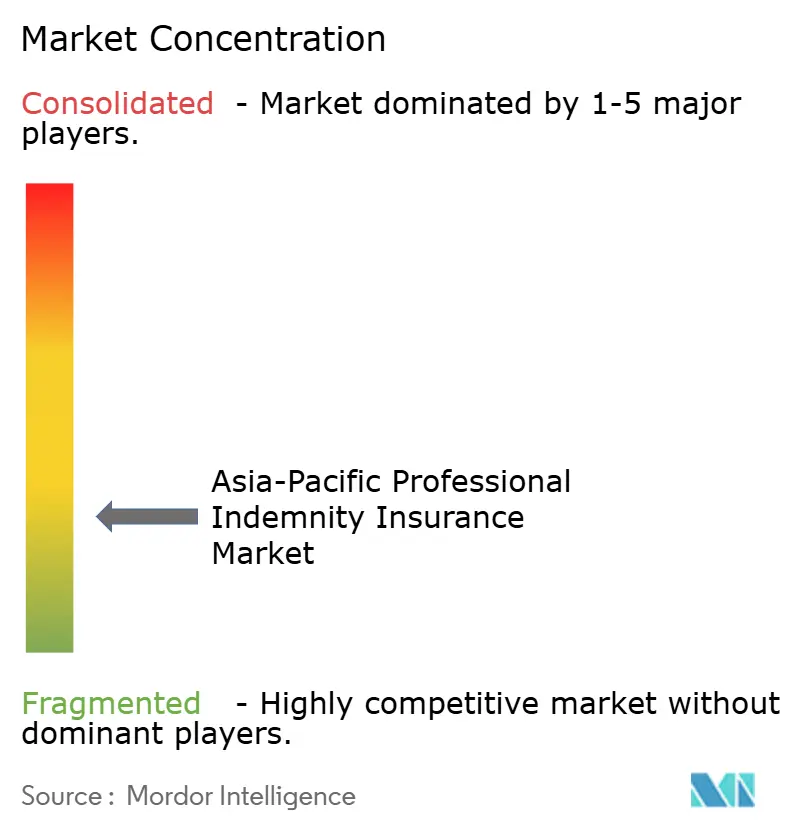
| Market Concentration | Low |
Major Players *Disclaimer: Major Players sorted in no particular order Image © Mordor Intelligence. Reuse requires attribution under CC BY 4.0. | |
Asia-Pacific Professional Indemnity Insurance Market Analysis by Mordor Intelligence
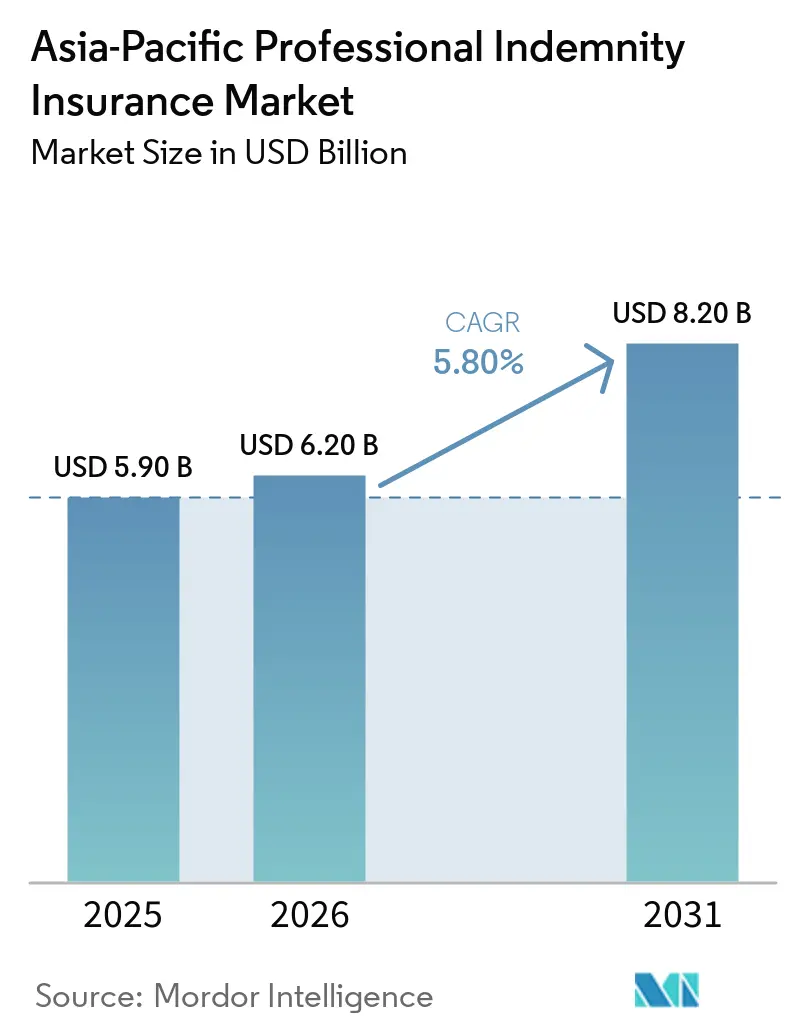
The Asia-Pacific Professional Indemnity Insurance Market size is expected to grow from USD 5.90 billion in 2025 to USD 6.20 billion in 2026 and is forecast to reach USD 8.20 billion by 2031 at 5.80% CAGR over 2026-2031.
The Asia-Pacific professional indemnity insurance market is supported by the expansion of service-led economies, where professional liability exposure is increasing alongside regulatory requirements and larger infrastructure projects. New professional mandates, stronger claims awareness, and digital distribution are expanding the insured population in several countries. This differs from mature United States and United Kingdom markets, where underwriting rate cycles have a more established influence on premium movements. Cross-border service delivery is also increasing contractual insurance requirements for technology, consulting, engineering, and financial services firms. Carriers are responding through profession-focused distribution, digital access for smaller firms, and products that combine professional indemnity with technology and cyber cover.
Key Report Takeaways
- By product type, miscellaneous/general professional indemnity captured 48.5% of the Asia-Pacific professional indemnity insurance market share in 2025, while technology professional indemnity is projected to grow at a 7.6% CAGR through 2031.
- By profession of the insured, legal services held 22.3% of the Asia-Pacific professional indemnity insurance market share in 2025, while IT, software, SaaS, and managed services are forecast to expand at a 7.8% CAGR through 2031.
- By insured firm size, small and medium-sized enterprises accounted for 46.4% of the Asia-Pacific professional indemnity insurance market share in 2025, while sole practitioners are forecast to grow at a 6.9% CAGR through 2031.
- By distribution channel, insurance brokers retained 61.2% of the Asia-Pacific professional indemnity insurance market share in 2025, while direct insurer distribution is projected to grow at a 7.0% CAGR through 2031.
- By policy structure, annual practice claims-made policies held 78.5% of the Asia-Pacific professional indemnity insurance market share in 2025, while project-specific professional indemnity is projected to grow at a 7.3% CAGR through 2031.
- By geography, China captured 27.4% of the Asia-Pacific professional indemnity insurance market share in 2025, while Vietnam is projected to grow at an 8.2% CAGR through 2031.
Note: Market size and forecast figures in this report are generated using Mordor Intelligence’s proprietary estimation framework, updated with the latest available data and insights as of January 2026.
Asia-Pacific Professional Indemnity Insurance Market Trends and Insights
Drivers Impact Analysis*
| Driver | (~) % Impact on CAGR Forecast | Geographic Relevance | Impact Timeline |
|---|---|---|---|
| Mandatory and contractual professional indemnity requirements | +1.8% | Global, with the highest intensity in Australia, Singapore, Malaysia, China, India, and Vietnam | Short term (≤ 2 years) |
| Expansion of technology, IT consulting, and digital professional services | +1.2% | Asia-Pacific, concentrated in India, South Korea, Australia, and Singapore | Medium term (2-4 years) |
| Growth in infrastructure, engineering, and construction projects | +0.7% | China, India, Vietnam, Indonesia, Australia, and Malaysia | Medium term (2-4 years) |
| Rising liability from outsourcing and third-party services | +0.5% | India, the Philippines, Singapore, Malaysia, and cross-border Asia-Pacific providers | Medium term (2-4 years) |
| Professional, technology, and cyber liability convergence | +0.5% | Australia, Singapore, South Korea, and Japan | Long term (≥ 4 years) |
| Cross-border professional services and regional operations | +0.3% | Association of Southeast Asian Nations corridor, India-Asia-Pacific links, and multinational service firms | Long term (≥ 4 years) |
| Source: Mordor Intelligence | |||
Mandatory And Contractual Professional Indemnity Requirements Across Regulated And Project-Based Professions
Profession-level insurance mandates are increasing across Asia-Pacific and create demand that is less dependent on premium-rate cycles. The Australian Securities and Investments Commission updated Regulatory Guide 126 in November 2024 and introduced the mandatory FS70 annual professional indemnity disclosure form for Australian financial services licensees. Malaysia’s professional indemnity requirement for dental practitioners under the Dental Act 2018 took effect on January 1, 2025. Vietnam’s Ministry of Finance issued Circular 76/2026/TT-BTC, requiring audit firms to maintain uninterrupted cover from September 1, 2026[1]. Singapore’s Legal Profession Rules require law corporations to maintain SGD 2 million (USD 1.5 million) per claim, while CPA Australia’s By-Law 9.8 sets requirements between AUD 2 million (USD 1.3 million) and AUD 75 million (USD 48.8 million) according to services and fees. Each new mandate can generate first-time demand, which favors insurers and brokers with established relationships in regulated professions.
Expansion Of Technology, IT Consulting, And Digitally Delivered Professional Services
Technology consulting and digitally delivered services are widening the professional exposures that buyers must ensure. Large enterprise and government buyers commonly require professional indemnity protection in technology service contracts, which makes cover part of the supplier onboarding process. Singapore’s technology risk requirements have increased the attention paid to vendor controls at regulated firms. This obligation can extend through IT subcontractors that had not previously arranged dedicated cover. The use of AI-assisted deliverables introduces potential liability for incorrect recommendations, biased outputs, and errors incorporated into client-facing systems. The Asia-Pacific professional indemnity insurance market, therefore, has a growing need for policy wording that addresses technology exposures without creating uncertainty for insured firms.
Growth Of Infrastructure, Engineering, And Construction Projects Across Asia-Pacific
Infrastructure activity is creating larger and more specialized professional indemnity exposures across the region. Data centers, battery facilities, and semiconductor plants have complex design, engineering, and construction risks. Government principals and development finance institutions increasingly specify project-specific cover as a financing requirement. Liberty Specialty Markets offers construction project professional indemnity cover in Singapore for periods of up to 15 years and limits of up to USD 15 million[2]. Project-specific policies can be priced for a defined duration and a clear risk profile, rather than the wider portfolio conditions that affect annual practice cover. This makes infrastructure-related business an important opportunity for specialty insurers in the Asia-Pacific professional indemnity insurance market.
Professional, Technology, And Cyber Liability Convergence
Professional indemnity is increasingly being combined with cyber liability, technology errors and omissions, and crime protection. Combined products can reduce gaps between policy classes and can simplify coverage decisions for buyers. CFC reported in January 2026 that 1 in 3 of its professional liability clients also bought cyber cover. Beazley launched a combined financial institutions and cyber policy for Asia-Pacific in February 2026, integrating crime, fraud, civil liability, and cyber protection. AI-related losses also create uncertainty when a professional service and a technology failure are part of the same claim. Insurers that rely only on exclusions may leave buyers uncertain whether mandatory insurance arrangements meet regulatory expectations.
Restraints Impact Analysis*
| Restraint | (~) % Impact on CAGR Forecast | Geographic Relevance | Impact Timeline |
|---|---|---|---|
| Competitive specialty capacity and pressure on premium rates | -1.1% | Australia, Singapore, Japan, and the Asia-Pacific for low-complexity risks | Short term (≤ 2 years) |
| Rising claims severity and defense costs in long-tail liability claims | -0.7% | Australia, Singapore, Hong Kong, and cross-border Asia-Pacific placements | Medium term (2-4 years) |
| Uncertainty over liability for AI-generated errors and technology failures | -0.4% | Australia, Singapore, South Korea, and advanced AI-adoption markets | Long term (≥ 4 years) |
| Regulatory fragmentation and limited historical claims data | -0.3% | Vietnam, Indonesia, Thailand, the Philippines, and frontier Asia-Pacific markets | Long term (≥ 4 years) |
| Source: Mordor Intelligence | |||
Competitive Specialty Capacity Expansion And Pressure On Professional Indemnity Premium Rates
Additional specialty capacity is putting pressure on professional indemnity premium rates in several developed Asia-Pacific markets. Standardized risks such as accounting, consulting, and lower-complexity engineering practices face the greatest pressure. The effect is most visible where domestic insurers and Lloyd’s capacity compete for established business. Rate pressure makes new mandate-led business more important because it can add insured firms even when renewal pricing is weak. Carriers need more detailed profession-level underwriting to protect margins on existing portfolios. The Asia-Pacific professional indemnity insurance market can therefore grow in premium volume while underwriting results remain constrained by competitive pricing.
Rising Claims Severity And Defense Costs In Long-Tail Professional Liability Claims
Claims-made professional indemnity policies can develop over several years, which increases reserve uncertainty. Complex engineering and financial advice claims can create substantial legal and defense costs before an indemnity outcome is reached. Regulatory Guide 126 requires defense costs for Australian financial services licensees to sit above, rather than within, the required indemnity limit. This requirement recognizes that defense spending can materially reduce the protection available to the insured. Singapore, Hong Kong, and Australia have established legal systems where complex disputes can involve lengthy proceedings. Insurers must reflect these costs in pricing and reserving as claims mature through multi-year litigation cycles.
*Our forecasts treat driver/restraint impacts as directional, not additive. The impact forecasts reflect baseline growth, mix effects, and variable interactions.
Segment Analysis
By Product Type: Technology Professional Indemnity Gains Strategic Importance
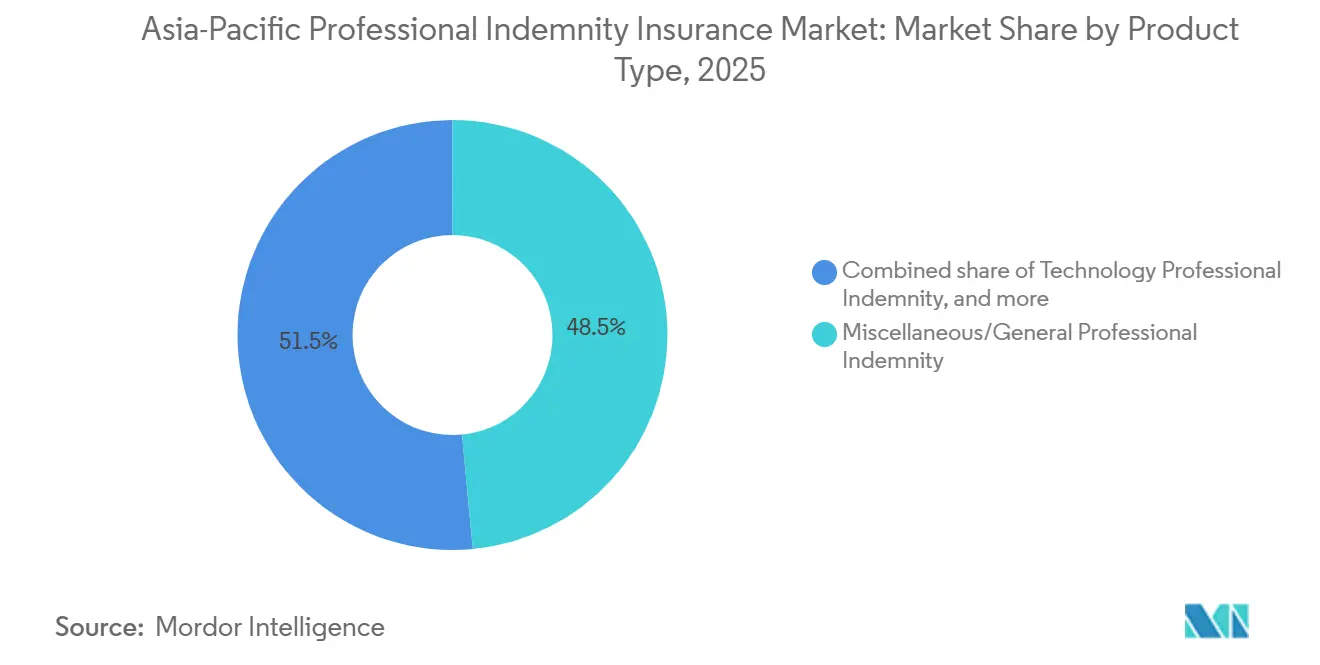
Miscellaneous/general professional indemnity held 48.5% of premiums in 2025 and remained the default form of cover for a broad range of professional service firms. Its position reflects the number of firms that do not fit a dedicated specialist product category. Construction and design professional indemnity remains relevant to firms serving infrastructure and industrial projects. Financial professionals' errors and omissions also benefit from more extensive regulation of advisory activity. Technology professional indemnity is forecast to grow at a 7.6% CAGR through 2031, the highest rate among product types. This rate reflects the expanding use of digital services and the contractual protection requested by enterprise clients.
The Asia-Pacific professional indemnity insurance market size for technology cover is influenced by the need to address errors in systems, advice, and client deliverables. QBE confirmed in February 2026 that it offers professional indemnity capacity of up to USD 50 million for technology and ICT liability in Hong Kong, Malaysia, Singapore, and Vietnam. Chubb’s PremierTech product in Singapore combines professional indemnity, cyber, and general liability cover for technology businesses. These products recognize that technology-related claims can involve professional advice and cyber events at the same time. A package cover can make protection easier to obtain for technology firms with multiple risk exposures. Product development will depend on insurers setting clear terms for AI-related errors and technology failures.
By Profession Of The Insured: Legal Services Anchors Premium Volume
Legal services accounted for 22.3% of premiums in 2025 and provided the largest profession-level share of the Asia-Pacific professional indemnity insurance market. Mandatory arrangements support this position in several established legal services jurisdictions. Singapore’s Legal Profession Rules set a minimum requirement of SGD 2 million (USD 1.5 million) per claim for law corporations. Architecture, engineering, surveying, and accountancy are also established insured professions because licensing and contract renewal can require evidence of cover. Financial advisory, fund management, and insurance broking have additional requirements as regulatory reporting becomes more formal.
IT, software, SaaS, and managed services are forecast to grow at a 7.8% CAGR through 2031, the fastest rate among insured professions. The category has a growing base of firms that provide digital systems, outsourced services, and ongoing managed support. Technology buyers often require vendors to maintain coverage for errors, omissions, and contractual liabilities. Management consulting, real estate, media, and education remain smaller professional groups with room for broader insurance participation. Digital broker platforms and profession association programs can reduce the effort required for first-time buyers. The Asia-Pacific professional indemnity insurance industry is therefore extending beyond traditional legal and accounting portfolios toward more varied service occupations.
By Insured Firm Size: Smaller Firms Lead Premium Volume
Small and Medium-Sized Enterprises represented 46.4% of premiums in 2025 and captured the largest share of the Asia-Pacific professional indemnity insurance market. Their position reflects their large number within the regional professional services workforce. Government procurement and corporate contracts increasingly ask these firms to show evidence of professional indemnity cover. Large firms continue to place high-limit and tailored programs for major accountancy practices, engineering consultants, and international law firms. These placements are important because complex work often requires higher limits and detailed policy conditions. Smaller firms, however, provide a larger pool of potential first-time insurance buyers.
Sole Practitioners are projected to grow at a 6.9% CAGR through 2031, the fastest rate among insured firm sizes. Malaysia’s dental practitioner requirement expanded mandatory cover to sole practitioners from January 2025. Digital distribution can also make the buying process simpler for small practices that lack internal insurance specialists. Zurich made professional indemnity cover available through BizCover’s Australian digital platform in March 2026 for eligible small businesses and sole traders. The offering provides limits up to AUD 10 million (USD 6.5 million) and serves businesses with revenue below AUD 7.5 million (USD 4.9 million). Direct access and simplified underwriting can help the Asia-Pacific professional indemnity insurance market reach firms that have historically remained uninsured.
By Distribution Channel: Brokers Retain Leadership While Direct Access Expands
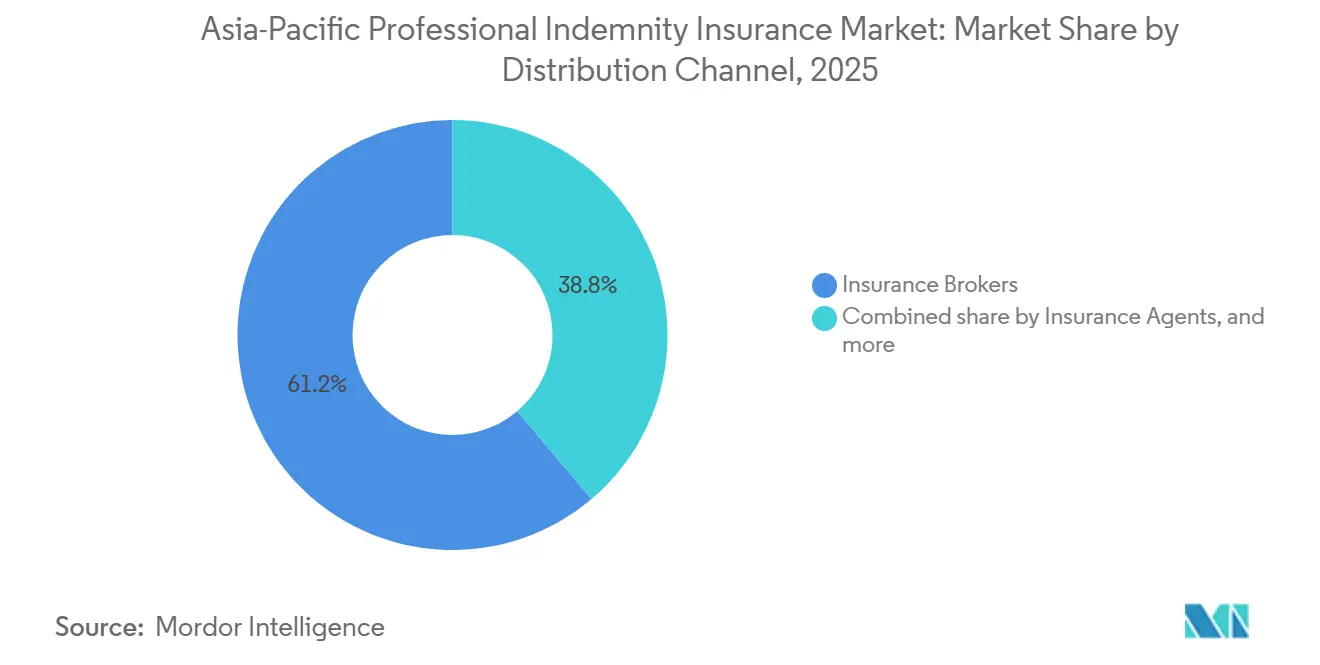
Insurance brokers retained 61.2% of premium placement in 2025 and held the leading position by distribution channel. Professional indemnity policies can involve retroactive date continuity, run-off terms, and defense cost provisions. Many buyers need specialist advice to compare these policy features. Brokers also help professional firms assess coverage limits against client contracts and regulatory requirements. Their role remains particularly important for complex, high-limit, and cross-border placements. Established broker networks, therefore, remain central to distribution across developed regional markets.
Direct insurer distribution is forecast to grow at a 7.0% CAGR through 2031. Insurers are using digital portals and automated pricing for lower-complexity risks. This channel can reduce the time needed to arrange cover for smaller professional firms. Insurance agents and association schemes also remain relevant in China, where established distribution relationships support professional group coverage. Digital systems are likely to complement broker-led placement rather than eliminate it for complex policies. The Asia-Pacific professional indemnity insurance market will continue to use multiple channels because buyer needs differ by firm size, profession, and policy limit.
By Policy Structure: Project-Specific Cover Records The Fastest Growth
Annual Practice Claims-Made Policies accounted for 78.5% of premiums in 2025 and represented the largest policy structure in the Asia-Pacific professional indemnity insurance market. They remain the standard form for businesses that need continuous protection for professional activities. Claims-made triggers are accepted or required under professional indemnity arrangements in Australia, Singapore, Malaysia, and India. Run-Off and Extended Reporting Period cover remains important when firms merge, close, or when practitioners retire. These extensions become more relevant as professional services firms mature and ownership changes become more frequent. Annual practice cover should therefore remain the core of premium volume.
Project-Specific Professional Indemnity is forecast to grow at a 7.3% CAGR through 2031. The product supports defined infrastructure projects with long construction and reporting periods. Liberty Specialty Markets offers construction project cover in Singapore for terms up to 15 years and limits up to USD 15 million. Project financing conditions can require dedicated cover, especially for complex engineering and construction assignments. This structure can give insurers clearer information on project duration and technical exposure. It also supports the Asia-Pacific professional indemnity insurance industry as infrastructure investment raises the need for specialized protection.
Geography Analysis
China held 27.4% of premiums in 2025 and represented the largest country share of the Asia-Pacific professional indemnity insurance market. Its scale reflects the potential for mandated cover across accounting, legal, and financial advisory professions. China’s 2026 product classification rules support wider recognition of professional indemnity needs across regulated work. Medical liability insurance already covers more than 12,000 medical institutions and 300 million patient encounters in China, showing the level of insurance penetration possible when regulatory enforcement is active. Japan has different pricing conditions from the broader region because domestic regulation and catastrophe exposure influence capacity decisions. Australia continues to face a soft professional indemnity cycle, which can limit premium growth even when the insured base expands.
India provides a significant opportunity for the Asia-Pacific professional indemnity insurance market because of its large technology and professional services base. Contractual requirements from global clients can encourage firms to maintain cover even where a formal mandate does not apply. South Korea recorded KRW 408.7 billion (USD 303 million) in professional indemnity premiums to November 2025, and new contract volumes reached 295,000 policies. Singapore and Malaysia have high insurance participation relative to their professional populations because legal, accounting, medical, and financial advisory professions operate under broad mandatory requirements. Singapore’s legal profession framework provides a clear example of how regulatory standards can support continuous demand. These markets also benefit from financial-sector compliance expectations and established insurance distribution networks.
Vietnam is projected to grow at an 8.2% CAGR through 2031, the fastest country rate in the Asia-Pacific professional indemnity insurance market. Circular 76/2026/TT-BTC requires certified public accountants at independent audit firms to hold professional liability cover from September 1, 2026. Foreign-invested professional services firms add to the addressable buyer base in Vietnam. QBE’s 2026 appetite statement includes Vietnam alongside Hong Kong, Malaysia, and Singapore. Indonesia, Thailand, and the Rest of Asia-Pacific have lower professional indemnity penetration. Infrastructure requirements and multinational project standards are generating early structured demand in these countries.
Competitive Landscape
The Asia-Pacific professional indemnity insurance market is fragmented. AIG, Chubb, QBE, Zurich, Beazley, and Hiscox compete for commercial placements across the region’s developed markets. Tokio Marine, MSIG, and Sompo Holdings use domestic distribution strengths in Japan and Southeast Asia. Competition is shaped by digital access for smaller firms, combined cover for technology risks, and expansion into faster-growing countries. Regulatory requirements also favor insurers that have established local licenses and admitted capacity. This can create an advantage where a buyer needs cover that meets local professional or procurement rules.
QBE confirmed technology and ICT professional indemnity capacity of up to USD 50 million in Hong Kong, Malaysia, Singapore, and Vietnam during 2026. Chubb has combined professional indemnity, cyber, and general liability cover for Singapore technology businesses through PremierTech. Beazley introduced a combined financial institutions and cyber policy in Asia-Pacific during February 2026. These moves show that product design is becoming an important competitive tool. Insurers are seeking to reduce coverage overlap for buyers with professional, cyber, fraud, and technology risks. The Asia-Pacific professional indemnity insurance market also gives carriers a reason to develop clear language for AI-assisted services.
Opportunities are concentrated in AI-related liability, digital distribution for smaller firms, and emerging professional categories. Buyers using AI in legal, accounting, consulting, and technology services need clarity on how policies respond to errors in assisted outputs. Insurers can use governance and underwriting requirements to distinguish between firms with different control environments. Specialty carriers can also expand through broker platforms while retaining broker support for complex placements. Regional incumbents retain an advantage where local relationships and licensing are central to distribution.
Asia-Pacific Professional Indemnity Insurance Industry Leaders
-
Chubb
-
AIG
-
QBE Insurance Group
-
Allianz
-
Tokio Marine Holdings
- *Disclaimer: Major Players sorted in no particular order
Recent Industry Developments
- June 2026: Vietnam’s Ministry of Finance issued Circular 76/2026/TT-BTC, effective September 1, 2026, mandating professional liability insurance for all certified public accountants at independent audit firms in Vietnam, including branches of foreign firms. The regulation creates a structural new demand cohort in the region’s fastest-growing country professional indemnity insurance market.
- May 2026: Chubb added Professional Indemnity as a third product line on the Steadfast Client Trading Platform, Australia’s largest general insurance broker network, enabling digital quote-and-bind professional indemnity placement across the network’s 500 member broker firms.
- March 2026: Zurich Insurance made its professional indemnity product available on BizCover’s digital SME platform, opening cover to Australian small businesses and sole traders with revenue below AUD 7.5 million (USD 5.0 million), indemnity limits of up to AUD 10 million (USD 6.6 million), and worldwide claims protection.
- February 2026: Beazley launched a combined financial institutions and cyber policy across Asia-Pacific, integrating crime, fraud, civil liability, and cyber protection in a single policy form to eliminate duplicate-cover costs for regional financial institutions.
Asia-Pacific Professional Indemnity Insurance Market Report Scope
| Miscellaneous/General Professional Indemnity |
| Construction and Design Professional Indemnity |
| Financial Professionals and Intermediaries E&O |
| Technology Professional Indemnity |
| Legal Services |
| Architecture, Engineering, and Surveying |
| Accountancy and Corporate Secretarial Services |
| Financial Advisory, Fund Management, and Insurance Broking |
| Management, Strategy, and Human Resources Consulting |
| Information Technology, Software, SaaS, and Managed Services |
| Real Estate and Property Management |
| Media, Advertising, Public Relations, and Events |
| Education, Training, and Teaching Organizations |
| Travel, Recruitment, and Employment Services |
| Other Professional Services |
| Sole Practitioners |
| Small and Medium-Sized Enterprises |
| Large Firms |
| Insurance Brokers |
| Insurance Agents |
| Direct Insurer Distribution |
| Other Channels |
| Annual Practice Claims-Made Policies |
| Project-Specific Professional Indemnity |
| Run-Off and Extended Reporting Period |
| China |
| Japan |
| India |
| South Korea |
| Australia |
| Indonesia |
| Thailand |
| Malaysia |
| Singapore |
| Vietnam |
| Rest of Asia-Pacific |
| By Product Type | Miscellaneous/General Professional Indemnity |
| Construction and Design Professional Indemnity | |
| Financial Professionals and Intermediaries E&O | |
| Technology Professional Indemnity | |
| By Profession of the Insured | Legal Services |
| Architecture, Engineering, and Surveying | |
| Accountancy and Corporate Secretarial Services | |
| Financial Advisory, Fund Management, and Insurance Broking | |
| Management, Strategy, and Human Resources Consulting | |
| Information Technology, Software, SaaS, and Managed Services | |
| Real Estate and Property Management | |
| Media, Advertising, Public Relations, and Events | |
| Education, Training, and Teaching Organizations | |
| Travel, Recruitment, and Employment Services | |
| Other Professional Services | |
| By Insured Firm Size | Sole Practitioners |
| Small and Medium-Sized Enterprises | |
| Large Firms | |
| By Distribution Channel | Insurance Brokers |
| Insurance Agents | |
| Direct Insurer Distribution | |
| Other Channels | |
| By Policy Structure | Annual Practice Claims-Made Policies |
| Project-Specific Professional Indemnity | |
| Run-Off and Extended Reporting Period | |
| By Country | China |
| Japan | |
| India | |
| South Korea | |
| Australia | |
| Indonesia | |
| Thailand | |
| Malaysia | |
| Singapore | |
| Vietnam | |
| Rest of Asia-Pacific |
Key Questions Answered in the Report
What is driving growth in professional indemnity insurance across Asia-Pacific?
Regulatory mandates, contract requirements, digital professional services, and infrastructure projects support growth from USD 6.2 billion in 2026 to USD 8.2 billion by 2031.
Which product category is growing fastest in Asia-Pacific?
Technology Professional Indemnity is forecast to grow at a 7.6% CAGR through 2031 as technology services and contractual insurance requirements expand.
Which insured profession is growing fastest?
IT, Software, SaaS, and Managed Services is projected to grow at a 7.8% CAGR through 2031.
Why do professional firms use claims-made policies?
Annual Practice Claims-Made Policies accounted for 78.5% of premiums in 2025 because they provide ongoing protection for professional activities.
Which country is expected to grow fastest through 2031?
Vietnam is projected to grow at an 8.2% CAGR through 2031, supported by professional liability requirements for certified public accountants.
How do insurers compete in Asia-Pacific professional indemnity insurance?
Insurers compete through specialist underwriting, broker relationships, digital distribution, and combined cover for professional, technology, cyber, fraud, and crime risks.