
Market Overview
| Study Period | 2021 - 2031 |
|---|---|
| Forecast Data Period | 2026 - 2031 |
| Historical Data Period | 2021 - 2024 |
| Growth Rate | 3.16 % |
| Market Concentration | Medium |
Major Players *Disclaimer: Major Players sorted in no particular order Image © Mordor Intelligence. Reuse requires attribution under CC BY 4.0. | |
Asia-Pacific Portable Generator Market Analysis by Mordor Intelligence
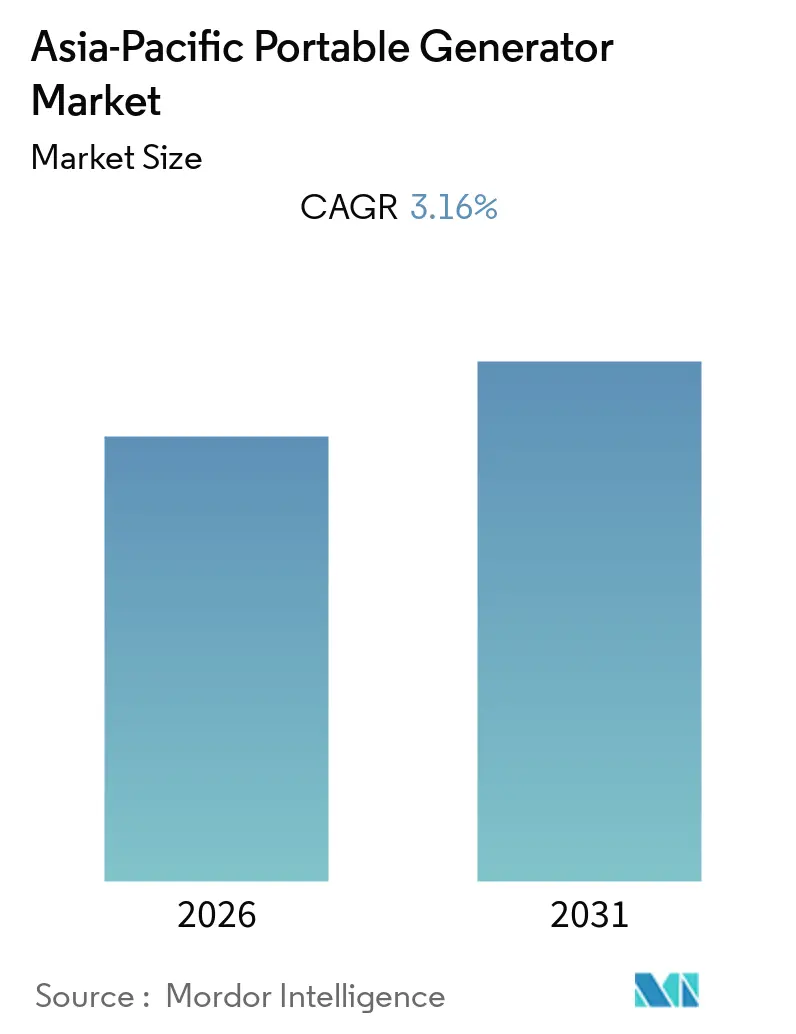
The Asia-Pacific Portable Generator Market size is expected to register a CAGR of 3.16% during the forecast period 2026-2031.
The market was negatively impacted by COVID-19 in 2020. Presently, the market reached pre-pandemic levels.
- Over the medium term, factors such as the ever-increasing demand for power, lack of reliable grid infrastructure, the need for emergency backup power solutions, and the demand for a steady power supply are driving the portable generator market in the Asia-Pacific region. Moreover, power outages have led to the adoption of standby power sources and portable generators, which can meet the requirements for reliable and regular electricity supply and be transported easily.
- On the flip side, increasing demand for battery storage systems and other cleaner sources of standby power is expected to restrain the growth of the portable generators market.
- Nevertheless, the commercial and industrial sectors of emerging economies, the residential sector of developed economies, and the increasing need for power in defense operations are expected to create significant opportunities for market participants in the Asia-Pacific region soon.
- During the forecast period, China is expected to dominate the portable generator market in the Asia-Pacific region.
Note: Market size and forecast figures in this report are generated using Mordor Intelligence’s proprietary estimation framework, updated with the latest available data and insights as of 2026.
Market Trends and Insights
Residential Sector to Witness Significant Growth
- The residential segment of the portable generators market is predicted to expand and drive the market, majorly caused by the prevalent installation of gensets across households to ensure the availability of emergency power supply in the event of a blackout or grid failure.
- According to the Energy Information Administration (EIA), about 70% of the increase in residential energy consumption is occurring in Asia-Pacific, led by China and India, as standards of living increase and as demand for lighting and energy-using appliances and equipment increases.
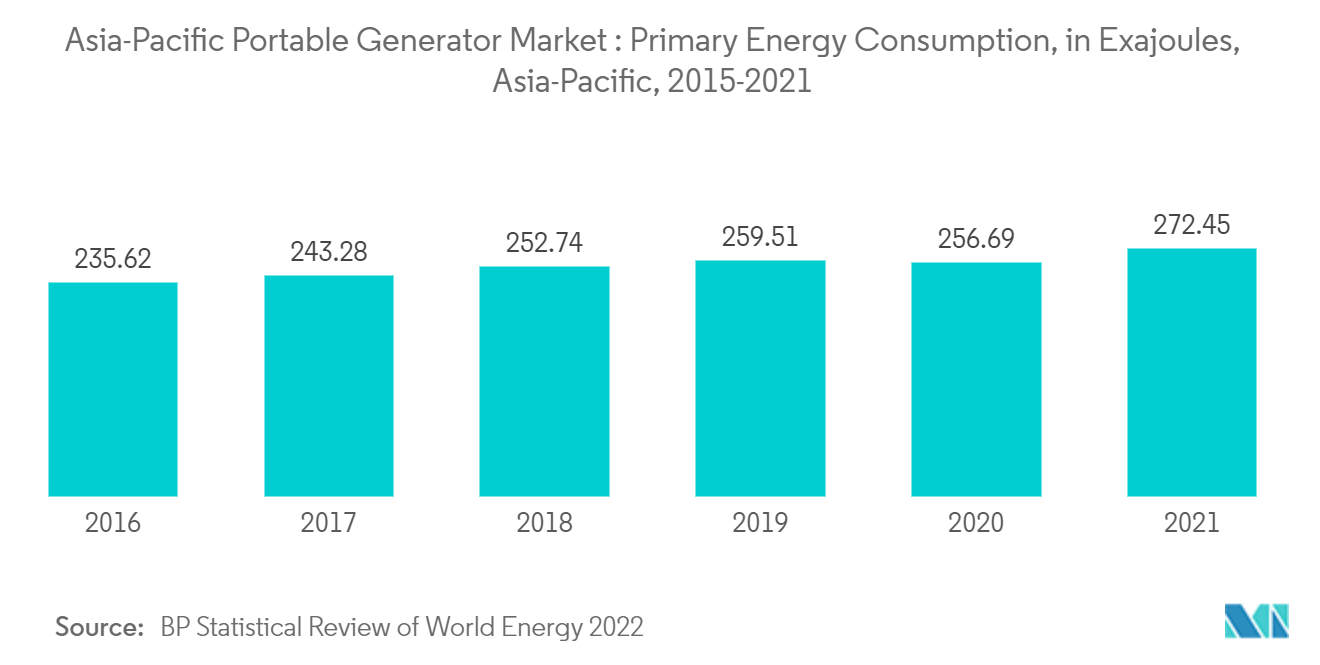
- Additionally, according to BP Statistical Review of World Energy 2022, the primary energy consumption in the Asia-Pacific region accounted for about 272.45 exajoules (EJ), i.e., an increase of nearly 6.4%, when compared to the previous year's value (256.69 EJ).
- Portable generators can be carried from one site to another, ensuring that all construction sites have the power necessary to run smoothly. Without them, it would be difficult to draw power from a central location to power various plants in various regions. A portable generator should always be available whether your construction is large or medium. For instance, in August 2022, South Korea's new government unveiled plans to increase home supply, i.e., around 2.7 million new homes across the country over the next five years, including hundreds of thousands of properties in big cities where a short supply has been blamed for rapid price rises. Additionally, the government would provide various financial, administrative, and tax advantages to young and lower-income earners when they buy or rent homes.
- As the population has grown, more marginalized people have been forced to live in areas prone to natural disasters, such as cyclonic activity and floods. Due to this, densely populated nations, such as India, China, and the ASEAN countries, which are highly vulnerable to havoc wrecked by massive cyclonic activities, earthquakes, and floods, rely on mobile power generation units during emergency response, which forms an important part of disaster management strategies after major natural disasters.
- Therefore, rising concerns about power instability in the residential sector due to natural calamities and the need for uninterrupted operations are driving the portable generator market in the Asia-Pacific region during the forecast period.
China to Dominate the Market
- China is expected to lead the Asia-Pacific market for asia pacific electric generators due to increasing infrastructure projects, expansion of manufacturing facilities across the nation, and rising commercial office spaces.
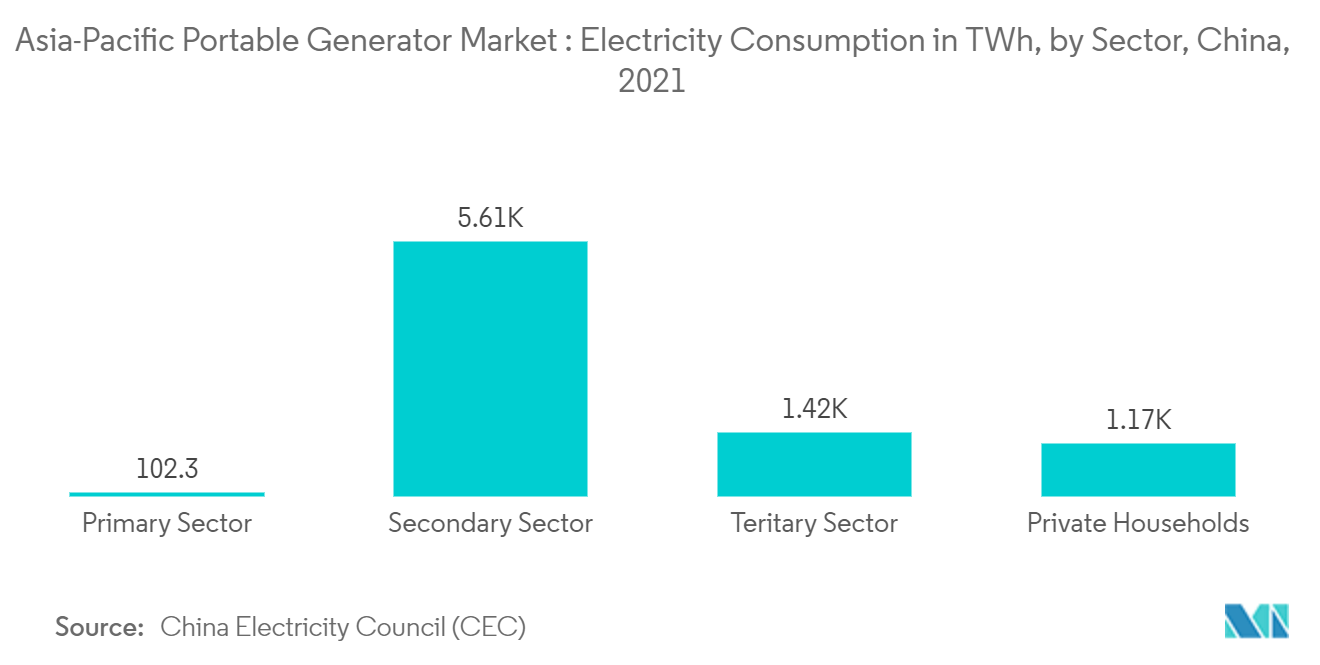
- The country benefits from the cost and effectiveness of portable generators, with improved living standards increasing the demand for power backup devices. According to China Electricity Council (CEC), Chinese households consumed around 1,170 terawatt hours (TWh) of electricity in 2021. The secondary sector, which includes the manufacturing industries happened to be the largest power-consuming sector, at some 5,610 terawatt hours.
- Factors, such as expanding existing manufacturing units across the country and the dedicated 'Made in China' initiative Lau China by the Chinese central government are expected to drive the portable generator market under the diesel-based fuel type segment.
- Also, in May 2021, owing to the electricity shortage in Guangdong province, China's power crunch China'sced factories to switch to portable generators. In China, the export- and the heavy-industry-led rebound had caused a surge in electricity use, with consumption climbing 20% through April 2021 compared with last year and up 15% from 2019 levels, when COVID-19 was not a factor. Temperatures in Guangdong, in the country's southern region, have also been higher than normal.
- At the same time, there has been a late start to the wet season, leaving hydropower reservoirs low. Coal prices have also surged as mining output has dropped amid a government-led safety campaign, making generators less keen to ramp up thermal power output. The electricity shortages, caused partly by the resurgence in economic activity, are causing disruptions to businesses that threaten to slow their recovery. Hence, due to the electricity shortages, many industries in the country have switched to portable generators, thus, increasing the market's demand during forecast period.
- Therefore, based on the above factors, China is expected to dominate the portable generators market in the Asia-Pacific region during the forecast period.
Regulatory Landscape
Across Asia-Pacific, portable and small gensets are shaped by stricter engine-emissions and product-safety compliance requirements, which can influence diesel-led demand and the cost to serve. In India, the Central Pollution Control Board (CPCB) framework for power generating set engines (procedures published March 28, 2023) formalizes emission compliance and certification expectations for genset engines, reinforcing the shift toward compliant engine platforms and documented testing for market access.
In developed sub-markets, electrical safety and performance standards still set the baseline for portable power supplies. Australia and New Zealand updated the AS/NZS 4417.2:2020 standard through Amendment 1:2026 (February 2026), which affects how suppliers demonstrate conformity for portable power supplies and associated equipment. This adds compliance workload for importers, brands, and channel partners distributing portable generators into these markets.
Value Chain Analysis
The Asia-Pacific portable generator value chain typically runs from engine and alternator/component suppliers to generator assembly (OEMs and private-label manufacturers), then moves through certification and testing, import/export logistics, distribution (industrial dealers, hardware/retail, and e-commerce), and aftersales service (spares, warranty, and field repairs). Compliance functions have become more embedded across the chain, with accredited testing and documentation increasingly required before products reach ports and channels.
Trade and inbound logistics are especially important for markets that rely on imported units or imported engines. In Southeast Asia, evidence points to customs and clearance processes placing greater emphasis on ISO/IEC 17025-accredited lab reports for diesel generator imports, which can extend lead times and increase the value of local testing partners and experienced importers. At the same time, localization policy in adjacent power-equipment value chains, such as India’s phased local-content requirements for HVDC substations (announced May 2026), supports supplier development and component localization that can spill over into generator ecosystems through shared electrical-component sourcing and domestic manufacturing capability building.
Competitive Landscape
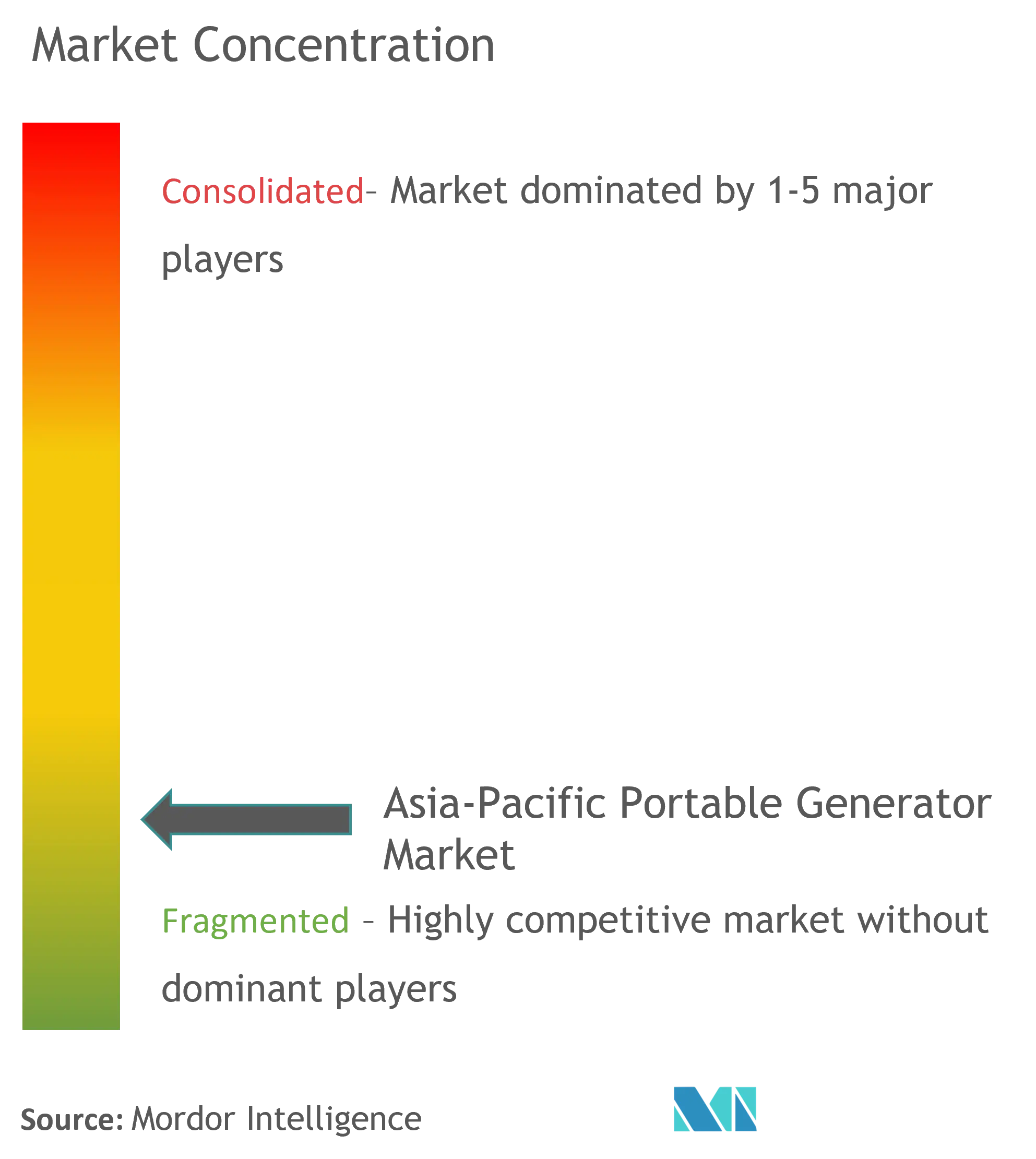
The Asia-Pacific portable generator market is moderately fragmented in nature. Some of the major players in the market (in no particular order) include Generac Holdings Inc., Caterpillar Inc., Honda Siel Power Products Ltd, Briggs & Stratton Corporation, and Kohler Power Systems.
Asia-Pacific Portable Generator Industry Leaders
-
Generac Holdings Inc.
-
Caterpillar Inc.
-
Honda Siel Power Products Ltd
-
Briggs & Stratton Corporation
-
Kohler Power Systems
- *Disclaimer: Major Players sorted in no particular order
Asia-Pacific Portable Generator Market Companies Covered in this Report
- Generac Holdings Inc.
- Caterpillar Inc.
- Honda Siel Power Products Ltd
- Briggs & Stratton Corporation
- Kohler Power Systems
- Wacker Neuson SE
- Atlas Copco AB
- Eaton Corporation PLC
- Yamaha Motor Co. Ltd
Market Opportunities and Future Outlook
Compliance-driven product refresh and verification services create room for OEMs and channel partners to package compliant diesel and dual-fuel offerings alongside documented testing. In parts of Southeast Asia, requirements referencing real-world testing approaches such as Portable Emission Measurement Systems (PEMS) for certain generator classes (for example, above 19 kW in some ASEAN-aligned regimes) raise the value of certified configurations, compliant engine platforms, and local test-lab partnerships, favoring suppliers with established certification workflows.
A second opportunity area is the link between backup power and power-system modernization, including distributed flexibility programs. Malaysia’s Large Scale Solar program direction (LSS6) includes Battery Energy Storage Systems (BESS) for grid stability, reinforcing hybrid backup architectures where portable generators are used alongside storage for resilience and site power continuity. In India, policy moves to strengthen grid infrastructure, including a reported proposed INR 10,000 crore scheme to boost underground power cable manufacturing, support continued spend on reliability and last-mile upgrades. That, in turn, supports demand for temporary and standby power during construction, maintenance, and outage management, while also increasing end-user scrutiny on emissions and noise compliance for portable gensets used at sites and in dense residential areas.
Recent Industry Developments in Asia-Pacific Portable Generator Market
- June 2026: Inauguration of Generac Business & Technology Centre (GBTC), a 21,494 sq ft Global Capability Centre (GCC) in Pune, India, to house over 150 employees for global engineering and technology operations. The expansion strengthens Generac's engineering footprint in India and establishes a regional hub for global R&D and digital operations. The initiative strengthens global capabilities and supports faster R&D cycles and time-to-market advantages.
- May 2026: Briggs & Stratton introduced the PowerProtect+ home standby generator line (18kW, 22kW, 26kW) with front-facing exhaust for emergency and utility demand response applications. The expansion of the residential standby power portfolio aligns with grid reliability needs. The product broadens the portfolio and aligns with demand response and resilience trends in APAC markets.
- April 2026: Generac Holdings Inc. issued a recall for 149,400 portable generator units due to fuel leak risk at the carburetor when first filled (GP3600, GP4000DF, GP6500, etc.). The recall action affects portable generator safety and distributor visibility. The remediation underscores quality assurance and risk management requirements and implications for supply chain and channel dynamics.
Asia-Pacific Portable Generator Market Report Scope and Research Methodology
Market Definition and Coverage
This market covers revenue earned from portable generators sold for temporary or backup power across Asia-Pacific, across common fuel types and power ratings, and across residential, commercial, and industrial end users.
Scope exclusions: This sizing does not count permanently installed standby generator sets or broader power-generation equipment that is not portable.
Segments Covered in This Report
- Power Rating
- Below 5 kW
- 5-10 kW
- Above 10 kW
- Fuel Type
- Gas
- Diesel
- Other Fuel Types
- End-User
- Industrial
- Commercial
- Residential
- Geography
- China
- India
- Japan
- Rest of Asia-Pacific
Data Sources, Market Sizing, and Validation
Desk Research
Desk work starts with building a clear demand and supply picture for portable generators in Asia-Pacific. We used public electricity access and outage indicators, construction and infrastructure signals, and fuel availability trends to shape the demand pool before any forecasting was done.
Typical sources include government energy and electrification statistics, customs and trade data portals for generator-related imports, and standards or safety regulator publications that influence product design and sales timing. We also refer to company filings and investor presentations, along with trade association releases and trusted news coverage for capacity additions, channel shifts, and pricing commentary. For certain checks, paid subscriptions covering company financials and news, patent databases, and shipment-level import/export records were used where relevant. This list is not exhaustive, and we reviewed many other public and paid sources to collect data, validate assumptions, and clarify open questions.
Primary Interviews and Surveys
Primary discussions were used to turn desk findings into a workable model, especially on which end users buy portable units, how power-rating preferences shift by country, and how pricing changes with fuel type and compliance needs. We spoke with manufacturers, distributors and dealers, rental and service firms, and large end users in construction, light industry, and households across key Asia-Pacific markets. We revisited experts when specific numbers did not align with the desk-derived estimates.
Distribution of primary research fieldwork respondents
| Company type | Respondent position |
|---|---|
| Top tier: 25% | CXOs: 16% |
| Mid tier: 59% | Functional/Unit leaders: 29% |
| Smaller Players: 16% | Managers: 55% |
Market-Sizing & Forecasting
Sizing is built using a top-down approach where the regional revenue pool is reconstructed from country-level demand drivers, and then split by end use, fuel, and power rating based on observed adoption patterns. To keep totals realistic, we corroborate the outcome with selective bottom-up checks such as sampled average selling price (ASP) by power band multiplied by implied unit demand, distributor channel checks, and a light supplier roll-up in countries with clearer visibility.
Inputs that matter in this market include grid reliability and outage exposure, construction activity and small-site electrification needs, fuel price movement for gasoline and diesel, adoption of small engine equipment standards, and the mix between residential backup buying and contractor or rental-led demand. Where gaps exist in country data, proxies are applied, for example using similar markets with comparable outage and construction profiles, and then adjusted through interview feedback.
Forecasting is done using scenario analysis supported by trend smoothing, so base case demand can be flexed for weather-related outage spikes, fuel price swings, and infrastructure cycle changes. Assumptions on ASP movement and product mix are refreshed each cycle so growth is not driven only by unit volume.
Data Validation & Update Cycle
Validation is carried out through multiple checks so the model does not drift away from real market signals. Outputs are compared against independent indicators like trade flows, channel feedback on inventory build or drawdown, and country-level demand events, and then anomalies are reviewed before sign-off.
If a major variance shows up by country, end user, or power rating, we re-contact relevant experts and revisit the assumption that caused the swing. Reports are refreshed annually, with interim updates when material events occur, and a final pre-delivery review is completed so clients receive the latest updated view.
Mordor Intelligence's Asia Pacific Portable Generator Market Estimate Compared With Other Published Estimates
Published market sizes for Asia-Pacific portable generators often do not match because the scope lines are drawn differently and the inputs are refreshed on different schedules. Differences also come from how firms treat pricing, currency conversion timing, and whether the numbers represent shipment value, retail value, or mixed channel revenue.
The largest spread usually comes from what is counted as portable, and when a sale is recognized, especially where rental fleets, small engine equipment, and borderline mobile power units are bundled together. Another gap driver is the base case used for outage-led demand, where some estimates assume aggressive storm-driven spikes every year, while others smooth them out and show a steadier run rate. The approach applied here smooths trends and is refreshed with country checks close to publication, which is the modeling choice used by Mordor Intelligence.
Benchmark comparison
| Source | Market Size | Gaps in Research Methodology |
|---|---|---|
| Mordor Intelligence | USD 0.84 B (2024) | |
| Global Market Publisher A | USD 4.80 B (2026) | Uses a later base year and a broader definition that can pull in adjacent mobile and distribution-channel revenue, which inflates the addressable pool versus portable-only sales in the region. |
| Industry Research Outlet B | USD 0.84 B (2024) | Derives Asia-Pacific value from a fixed regional share approach, which can miss country-level mix shifts across fuel types and power ratings and can lag on ASP changes. |
Looking across the figures, the main differences are explained by the year being referenced and by whether non-portable or channel-wide revenues get included. By keeping the market tied to clear revenue recognition and country demand signals, the estimate stays traceable to practical drivers that can be rechecked and repeated.
Key Questions Answered in the Report
What is the current Asia-Pacific Portable Generator Market size?
The Asia-Pacific Portable Generator Market is projected to register a CAGR of 3.16% during the forecast period (2026-2031)
Who are the key players in Asia-Pacific Portable Generator Market?
Generac Holdings Inc., Caterpillar Inc., Honda Siel Power Products Ltd, Briggs & Stratton Corporation and Kohler Power Systems are the major companies operating in the Asia-Pacific Portable Generator Market.
What years does this Asia-Pacific Portable Generator Market cover?
The report covers the Asia-Pacific Portable Generator Market historical market size for years: 2020, 2021, 2022, 2023, 2024 and 2025. The report also forecasts the Asia-Pacific Portable Generator Market size for years: 2026, 2027, 2028, 2029, 2030 and 2031.