
Asia-Pacific Physical Security Market Size and Share
| Study Period | 2019 - 2030 |
| Forecast Data Period | 2025 - 2030 |
| Historical Data Period | 2019 - 2023 |
| Market Size (2025) | USD 42.25 Billion |
| Market Size (2030) | USD 59.54 Billion |
| CAGR (2025 - 2030) | 7.10% |
| Market Concentration | Low |
Major Players *Disclaimer: Major Players sorted in no particular order |
Asia-Pacific Physical Security Market Analysis by Mordor Intelligence
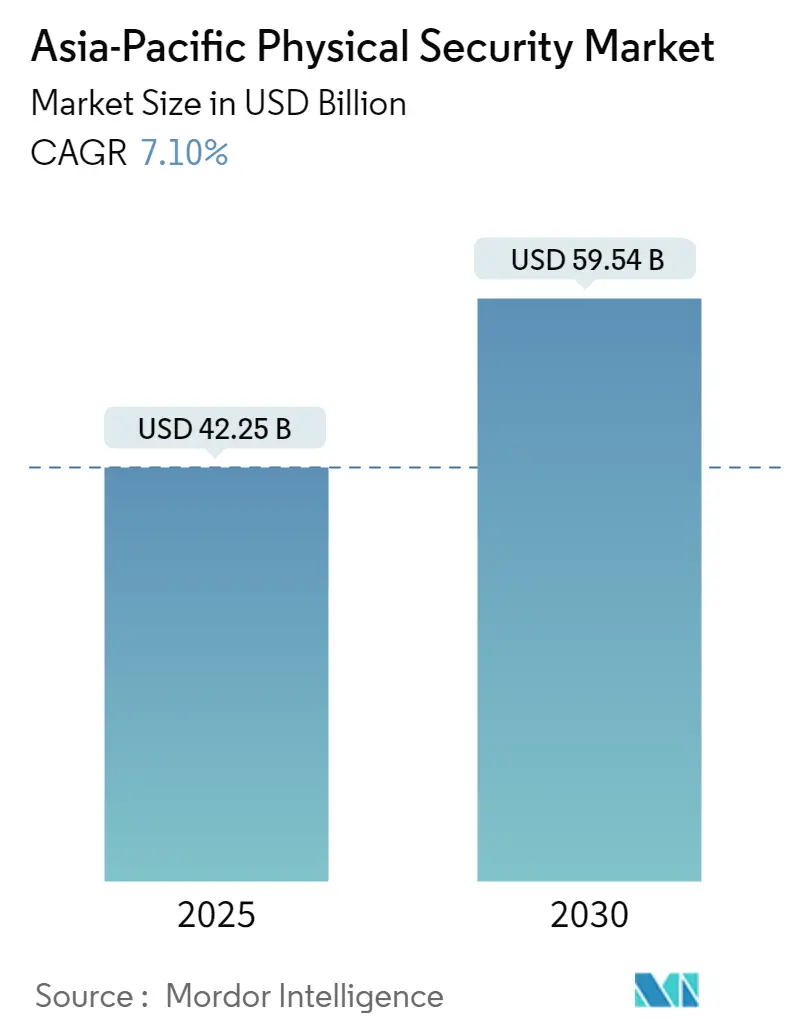
The Asia-Pacific Physical Security Market size is estimated at USD 42.25 billion in 2025, and is expected to reach USD 59.54 billion by 2030, at a CAGR of 7.1% during the forecast period (2025-2030).
- Physical security refers to protecting assets, such as data, software, hardware, and individuals, from unanticipated events that could result in loss or damage to these assets. Across the Asia-Pacific, physical security has become just as crucial for modern businesses as cybersecurity, protecting them from various risks, such as vandalism, theft, burglary, and natural disasters, such as fires or floods. The growing demand for high-safety protocols drives the adoption of physical security systems.
- The physical security market has undergone a significant transformation in the past decade due to the rapid advancements of cloud computing and the availability of video surveillance software. Additionally, the increasing awareness of public safety and security issues has led to expanding IP-based camera and video management systems.
- Also, the increased investment in smart city initiatives and decreased IP camera prices have increased the demand for physical security systems to protect citizens. These factors are the primary drivers of growth in the region's physical security market.
- The widespread utilization of AI-based technologies in the defense sector encompasses a wide range of roles and applications, including monitoring, logistics, cyber security, unmanned aerial vehicles (UAVs), sophisticated military equipment such as Lethal Autonomous Weapon Systems (LAWS), and autonomous combat vehicles (ACVs) and robots. These applications provide a strong foundation for modern warfare strategies.
- For instance, in August 2023, India implemented AI-based border surveillance solutions to strengthen border security by incorporating camera, radar, and sensor technology. The Indian Army installed approximately 140 AI-based border surveillance systems to acquire live feed from the Pakistani and Chinese borders. Utilizing these advanced technologies facilitates the detection of border intrusions, the identification of target classification, and the optimization of defense operations. The implementation of high-tech solutions reduces human involvement in monitoring and facilitates the detection of intrusions in more remote areas, such as the Line of Actual Control (LAC).
- Physical security systems, such as biometric authentication and real-time monitoring, are designed to prevent fraudulent activity and theft attempts against financial targets, thus providing a secure environment for clients and their assets. The proliferation of sophisticated cyberattacks and financial crimes has necessitated a heightened demand for physical security systems to safeguard banking operations' safety.
- In January 2023, the Indian government allowed banks to use facial recognition and, in a few cases, Iris scan to authenticate individual transactions that exceeded the annual limit of INR 2.0 million (USD 0.024 million). The new rules can be used to verify the identity of individuals who make deposits and withdrawals of more than INR 2.0 million (USD 0.024 million) in any financial year, provided they share their Aadhaar identity card as proof of identification.
- Despite technological advancements, physical security systems remain susceptible to physical data breaches and manipulation. The increasing data privacy concerns of consumers are restraining the growth of the physical security systems market. Not only are customers hesitant to adopt such solutions, but governments are also regulating the use and storage of data. As a result, enterprises need help creating datasets and expanding their offerings. For instance, according to AAG, between the Q2 and Q3 quarters of 2022, China experienced the highest number of data breaches, with 14,157,775 accounts breached.
- The physical security market is growing steadily. It was slightly affected by the COVID-19 pandemic. However, post-COVID-19, the customers moved away from traditional video cameras and toward IP-based cameras. The countries in Asia-Pacific have started investing heavily in smart city initiatives, helping grow the physical security market. Also, after the pandemic ended, the situation caused an increase in the digitization of overall commercial operations in the region. This led to a rise in the need for physical security systems in the Asia-Pacific region.
Global valuation is built by aggregating outputs from multiple regions, with Asia forming one of the important contributors. Mordor Intelligence's global physical security market size report represents that cumulative total.
Asia-Pacific Physical Security Market Trends and Insights
Video Surveillance Systems Are Expected to Hold a Significant Market Share
- Traditional video applications used to rely on AI to reduce the number of false alarms and enable forensic search of video based on object attributes. Currently, AI based on metadata has become the norm. There is a demand for video surveillance systems from airports to improve situational awareness, enhance security, and aid in operations.
- In April 2023, Infinova, a manufacturer of security systems and products, was selected as the Surveillance System OEM for more than 60 airports in India to enhance security measures and combat acts of terrorism. The airport teams chose Infinova to install over 6,000+ video surveillance cameras at major national airports, including PTZ (high-speed) domes, minidomes resistant to vandalism, and fixed day/night cameras. These cameras are installed in critical areas of the airport, including all significant personnel and baggage checkpoints, general locations, and all entry and exit points.
- The emergence of advanced technologies such as ML (machine learning) and AI has caused several companies to adopt AI in video surveillance systems. By incorporating these technologies into their products, companies can provide enhanced security and safety. Furthermore, surveillance systems integrated with technologies such as AI and ML are essential for law enforcement, emergency services, critical infrastructure, and various sectors.
- The prevalence of AI in video surveillance systems is increasing. In July 2023, Japan began the development of Public Security Cameras that use AI to anticipate the behavior of a crowd. The cameras and the AI are intended to detect "unusual" movements within the public and to improve their detection capabilities through algorithmic learning over time. Such detection can include weapons detection, intrusion detection into buildings, and detection of individuals in vulnerable areas.
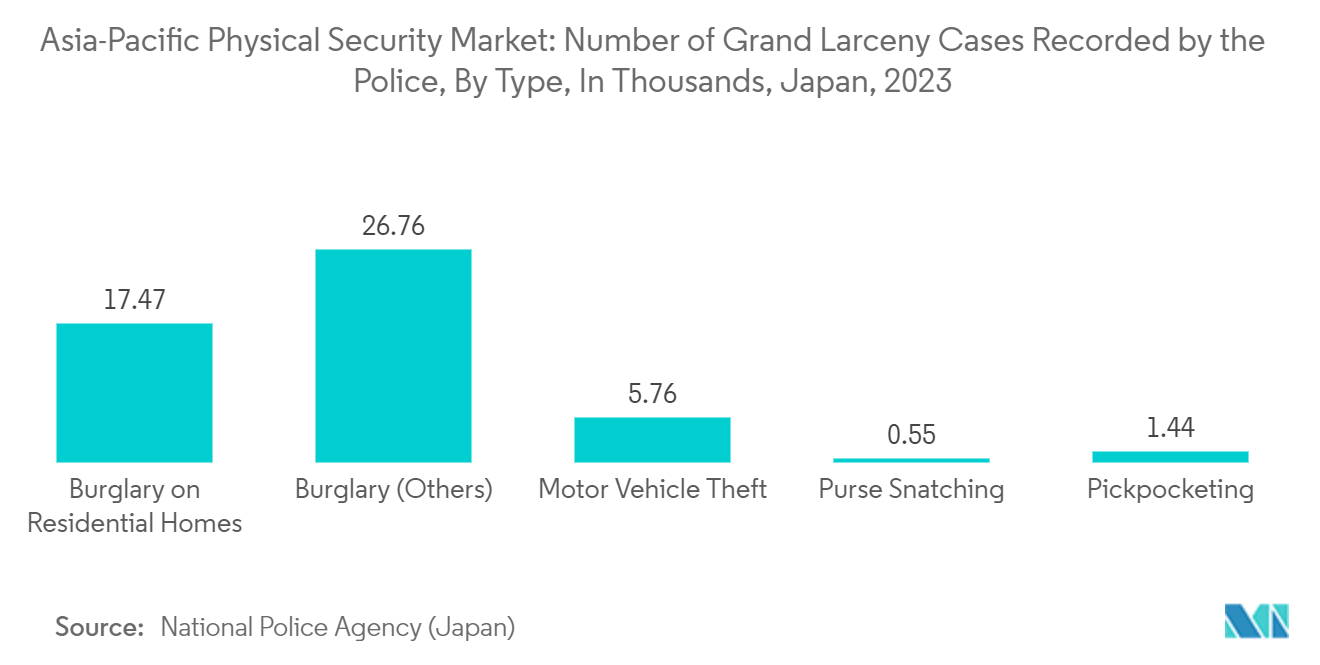
- Video surveillance systems are crucial components of security solutions. Surveillance cameras provide potential criminals with a disincentive to commit criminal offenses, which is often enough to deter them from doing so. For instance, the police in Japan recognized about 44.23 thousand grand theft offenses in 2023, almost 17.5 thousand of which were burglaries in non-residential properties. The rise in burglary rates also contributed to the expansion of video surveillance systems. The video surveillance systems provide remote monitoring and real-time notifications, allowing quick and effective responses to burglaries, thus deterring criminals and decreasing the overall rate of burglaries.
India is Expected to Witness a Significant Market Growth
- Smart security is becoming increasingly prevalent in India as smart city infrastructure grows. As smart city infrastructure in India continues to expand rapidly, using innovative security technologies is becoming increasingly important in reducing crime rates.
- Advanced technological advancements that allow cloud-based data storage and real-time analytics drive the growth of physical security systems. The physical security market is driven by various factors, including growing government regulations and mandates related to physical security and a growing preference for cloud-based physical security solutions.
- The Indian Railways is making every effort to ensure its regular passengers' safety and security and prevent criminal activity within its premises. As of August 2023, the Indian government reported that 866 of 7,349 operational railway stations were equipped with CCTV surveillance. Such measures have been instrumental in preventing child trafficking, tracking older adults, and apprehension of criminals. Furthermore, IP-based CCTV systems possess a critical cybersecurity element and are subject to stringent specifications to ensure security.
- As security concerns continue to grow, the demand for advanced video surveillance systems in airports is also anticipated to increase. For instance, in June 2023, Cochin International Airport Ltd (CIAL) planned to install a tall Perimeter Intrusion Detection System (PIDS). This advanced surveillance system would serve as a virtual wall of 13 kilometers around the airport. This system, equipped with thermal, infrared, and power and motion sensors and radars, will detect any breach of the boundary wall or barbed coil fencing and trigger an alarm, providing security that surpasses concrete boundary walls and staffed outposts.
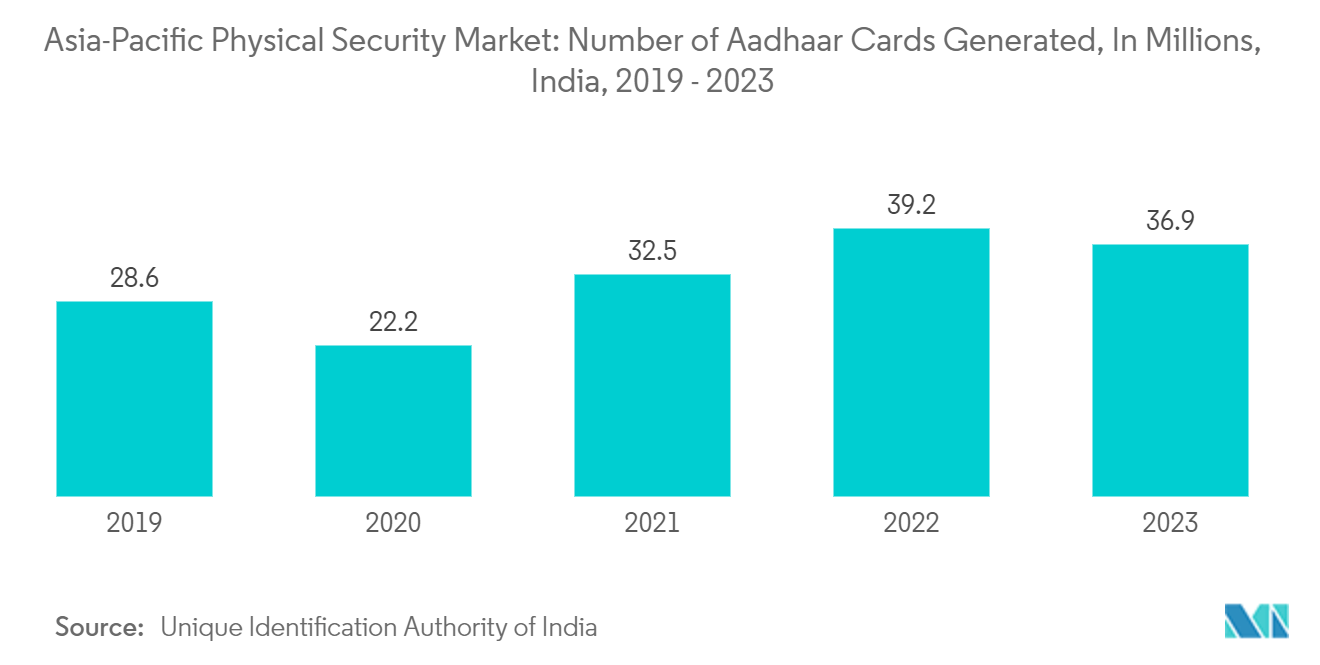
- In India, approximately 1.6 million Aadhaar identification cards were generated in September 2022. Implementing biometrics such as fingerprints and facial recognition contributes to the prevention of identity theft and fraudulent activities by providing an additional level of authentication that is not easily tampered with. For instance, the Government of India, in August 2023, announced the deployment of custom-coded Anti-Spoofing Software, expected to prevent biometrics fraud on the payment system enabled by the Aadhaar.
- The Unique Identity Authority of India (UIDAI) developed the AI code. This code is capable of recording finger-minute and image data and detecting liveness during the UID authentication process. The code was developed in response to the practice of creating silicone fingerprints to withdraw funds from accounts illegally.
- Additionally, in May 2023, the Unique Identity Authority of India (UIDAI) launched a facial recognition authentication application for Aadhaar-based transactions. Paytm, an Indian payments service firm, is developing AI to facilitate payments through facial recognition.
Coverage of the physical security market by Mordor Intelligence spans a wide geographic footprint, with regional analysis available for North America, Europe, and South America.
Competitive Landscape
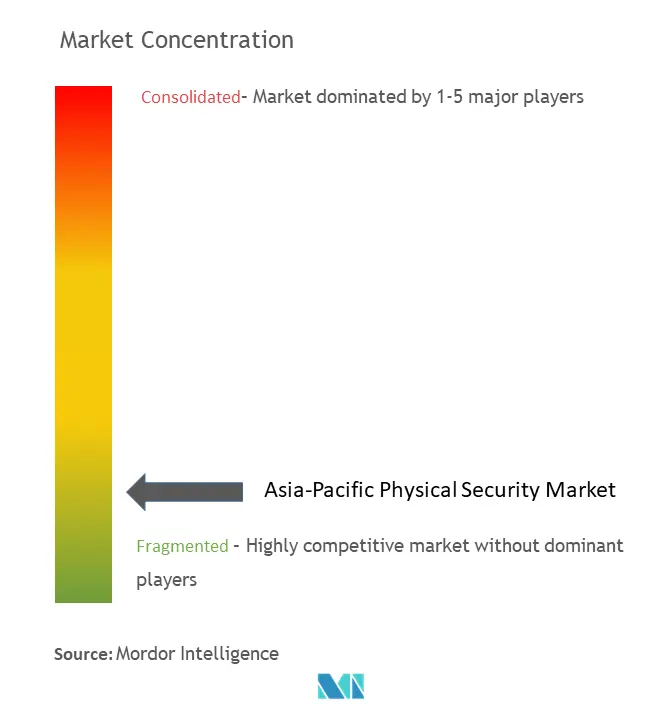
The Asia-Pacific physical security market is fragmented and highly competitive due to the presence of several companies. The market has several significant players adopting strategies like product innovation, new product launches, partnerships, collaborations, and mergers and acquisitions. Some of the major players in the market include Honeywell International Inc., Bosch Security Systems GmbH, Genetec Inc, Dahua Technology Co., Ltd, Axis Communications AB, Johnson Controls, NEC Corporation, Schneider Electric, and Hanwha Group.
- June 2023: Hanwha Vision announced the launch of SolidEDGE. This cloud-managed camera system provides secure video surveillance without needing a server. It is designed to meet the demands of security operations, which necessitate the ability to record multiple cameras, access remotely, and manage security systems from an on-site location. SolidEDGE has onboard SSD storage and a WAVE Video Management System (VMS). The company offers two models of SolidEDGE cameras, one with an onboard SSD storage capacity of 1 TB and the other with 2 TB, providing high-quality and reliable video surveillance.
- April 2023: Prysm Software entered a strategic partnership with Hikvision to enable the integration of various Security and Access Control solutions, including Fire and Building Management. By integrating the AppVision platform from Hikvision, the Building Management and Security Teams are expected to have a more comprehensive understanding of the activities occurring in their operations. This is expected to be done through integrating a unified interface for notification and data from a wide range of Mission-Critical Systems.
Asia-Pacific Physical Security Industry Leaders
-
Bosch Security Systems GmbH
-
Dahua Technology Co., Ltd
-
Honeywell International Inc.
-
Genetec Inc.
-
Hangzhou Hikvision Digital Technology Co., Ltd.
- *Disclaimer: Major Players sorted in no particular order
Recent Industry Developments
- August 2023: Verkada, a prominent enterprise-building security and management solutions provider, announced its expansion into South Korea. To better serve the increasing demand for advanced cloud-based physical security solutions, the company announced the opening of a new office in Seoul. Its products include video security cameras, door-based access control, environmental sensors, alarms, intercom systems, and workplace management tools. These offerings work together seamlessly to deliver unmatched building security via a highly secure and integrated cloud-based software platform.
- April 2023: Dahua, a provider of video-centric AIoT solutions and services, released a Touchless Insider Series access control solution. This solution provides touchless access with a lightweight system and simplified installation, ensuring maximum convenience and security for system installers and end users. It is capable of supporting one main controller and 19 sub-controllers, providing access to a total of 1,000 users and 40 doors. This lightweight solution includes user management, access control device management, real-time monitoring of access control status, event reporting, and remote control of doors.
- March 2023: Genetec partnered with Axis Communications, enabling the development of a comprehensive, enterprise-grade enterprise access control solution. This new access control solution is known as Axis Powered by Genetec and combines the capabilities of Genetec's access control software with Axis' network door controllers in a single, ready-to-use solution.
Asia-Pacific Physical Security Market Report Scope
Physical security refers to preventing unauthorized intruders from accessing controlled facilities. Physical security technologies have developed significantly recently, offering advanced protection at competitive prices. Physical security devices utilize cloud technology and AI for even more sophisticated real-time data processing. Various automated physical security components can perform multiple functions in a physical security system.
The Asia-Pacific physical security market is segmented by system type (video surveillance system [IP surveillance, analog surveillance, and hybrid surveillance], physical access control system (PACS), biometric system, perimeter security, and intrusion detection), service type (Access Control-as-a-Service (ACaaS) and Video Surveillance-as-a-Service (VSaaS)), type of deployment (on-premises and cloud), organization size (SMEs and large enterprises), end-user industry (government services, banking and financial services, IT and telecommunications, transportation and logistics, retail, healthcare, residential, and other end-user industries), and country (China, Japan, India, and the Rest of Asia-Pacific). The report offers the market sizes and forecasts for all the above segments in terms of value (USD).
| Video Surveillance System | IP Surveillance |
| Analog Surveillance | |
| Hybrid Surveillance | |
| Physical Access Control System (PACS) | |
| Biometric System | |
| Perimeter Security | |
| Intrusion Detection |
| Access Control-as-a-Service (ACaaS) |
| Video Surveillance-as-a-Service (VSaaS) |
| On-premises |
| Cloud |
| SMEs |
| Large Enterprises |
| Government Services |
| Banking and Financial Services |
| IT and Telecommunications |
| Transportation and Logistics |
| Retail |
| Healthcare |
| Residential |
| Other End-user Industries |
| China |
| Japan |
| India |
| South Korea |
| Australia and New Zealand |
| By System Type | Video Surveillance System | IP Surveillance |
| Analog Surveillance | ||
| Hybrid Surveillance | ||
| Physical Access Control System (PACS) | ||
| Biometric System | ||
| Perimeter Security | ||
| Intrusion Detection | ||
| By Service Type | Access Control-as-a-Service (ACaaS) | |
| Video Surveillance-as-a-Service (VSaaS) | ||
| By Type of Deployment | On-premises | |
| Cloud | ||
| By Organization Size | SMEs | |
| Large Enterprises | ||
| By End-user Industry | Government Services | |
| Banking and Financial Services | ||
| IT and Telecommunications | ||
| Transportation and Logistics | ||
| Retail | ||
| Healthcare | ||
| Residential | ||
| Other End-user Industries | ||
| By Country*** | China | |
| Japan | ||
| India | ||
| South Korea | ||
| Australia and New Zealand |
Key Questions Answered in the Report
How big is the Asia-Pacific Physical Security Market?
The Asia-Pacific Physical Security Market size is expected to reach USD 42.25 billion in 2025 and grow at a CAGR of 7.10% to reach USD 59.54 billion by 2030.
What is the current Asia-Pacific Physical Security Market size?
In 2025, the Asia-Pacific Physical Security Market size is expected to reach USD 42.25 billion.
Who are the key players in Asia-Pacific Physical Security Market?
Bosch Security Systems GmbH, Dahua Technology Co., Ltd, Honeywell International Inc., Genetec Inc. and Hangzhou Hikvision Digital Technology Co., Ltd. are the major companies operating in the Asia-Pacific Physical Security Market.
What years does this Asia-Pacific Physical Security Market cover, and what was the market size in 2024?
In 2024, the Asia-Pacific Physical Security Market size was estimated at USD 39.25 billion. The report covers the Asia-Pacific Physical Security Market historical market size for years: 2019, 2020, 2021, 2022, 2023 and 2024. The report also forecasts the Asia-Pacific Physical Security Market size for years: 2025, 2026, 2027, 2028, 2029 and 2030.
Asia-Pacific Physical Security Market Report
Statistics for the 2025 Asia-Pacific Physical Security market share, size and revenue growth rate, created by Mordor Intelligence™ Industry Reports. Asia-Pacific Physical Security analysis includes a market forecast outlook for 2025 to 2030 and historical overview. Get a sample of this industry analysis as a free report PDF download.