
Asia-Pacific Optical Transponder Market Size and Share
Market Overview
| Study Period | 2020 - 2031 |
|---|---|
| Forecast Data Period | 2026 - 2031 |
| Base Year Market Size (2025) | USD 2.71 Billion |
| Market Size (2026) | USD 2.99 Billion |
| Market Size (2031) | USD 4.94 Billion |
| Growth Rate (2026 - 2031) | 10.56 % |
| Market Concentration | Medium |
Major Players *Disclaimer: Major Players sorted in no particular order Image © Mordor Intelligence. Reuse requires attribution under CC BY 4.0. | |
Asia-Pacific Optical Transponder Market Analysis by Mordor Intelligence
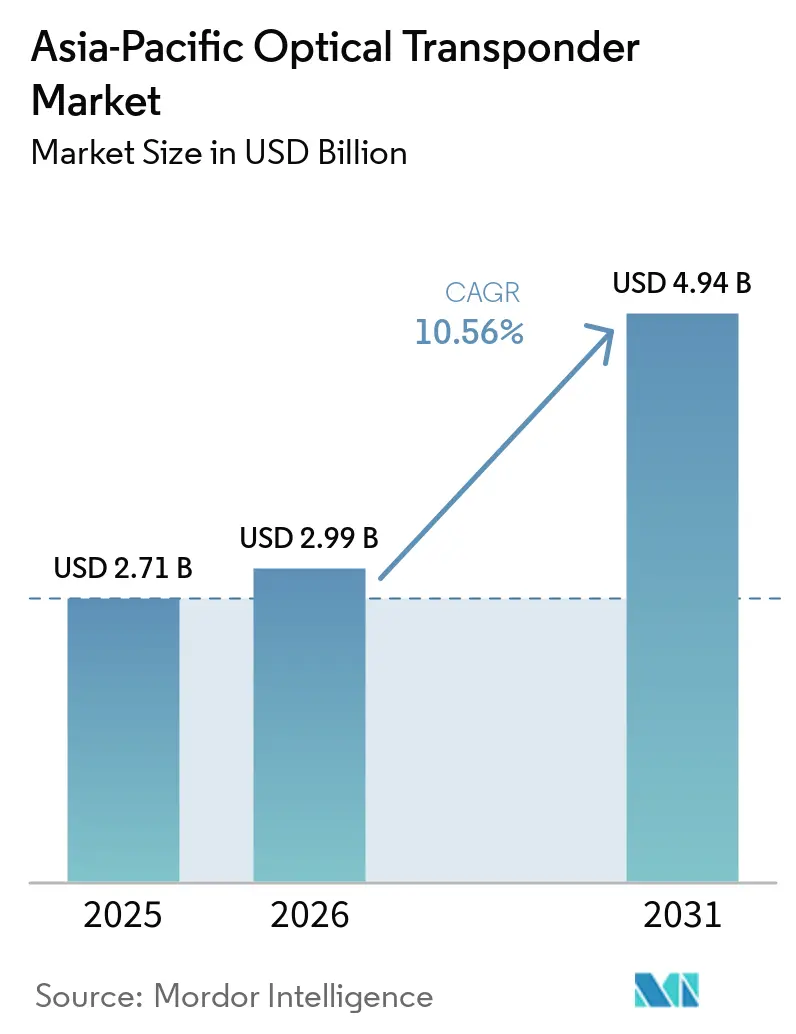
The Asia-Pacific Optical Transponder Market size is projected to be USD 2.71 billion in 2025, USD 2.99 billion in 2026, and reach USD 4.94 billion by 2031, growing at a CAGR of 10.56% from 2026 to 2031. Demand is moving toward equipment that supports predictable low-latency links between distributed AI computing clusters. Hyperscalers and cloud-native operators are taking a larger role in capacity planning, and their requirements differ from earlier carrier-led procurement. Their preference for 800G-class wavelengths and software-controlled systems is shortening the useful life of sub-100G coherent equipment. The Asia-Pacific optical transponder market also faces a shift in buyer relationships, as cloud providers increasingly purchase WDM equipment directly and secure long-term fiber access. Supply availability of indium phosphide (InP) and advanced digital signal processors remains a key constraint on equipment deliveries.
Key Report Takeaways
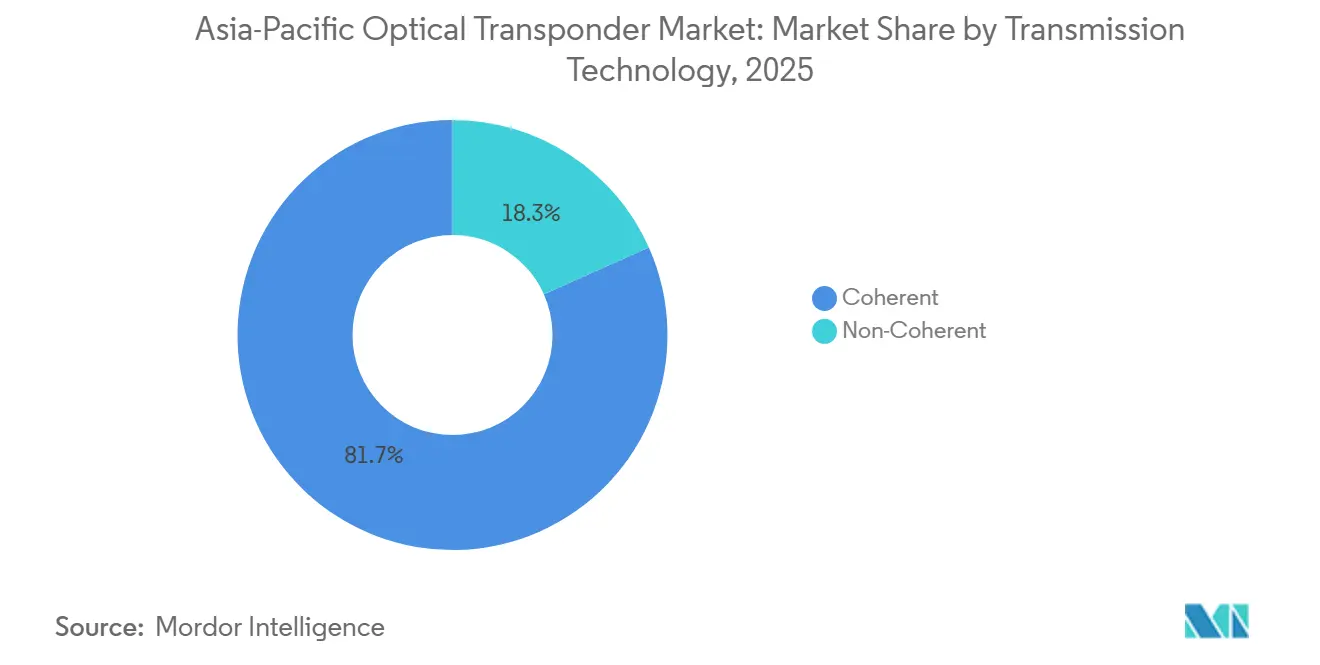
- By transmission technology, coherent technology accounted for 81.67% of the Asia-Pacific Optical Transponder Market share in 2025 and is projected to expand at an 11.08% CAGR through 2031.
- By data rate, the above 100 Gbps to 400 Gbps segment held a 47.29% of the Asia-Pacific optical transponder market share in 2025, while the above 800 Gbps segment is projected to expand at a 13.43% CAGR through 2031.
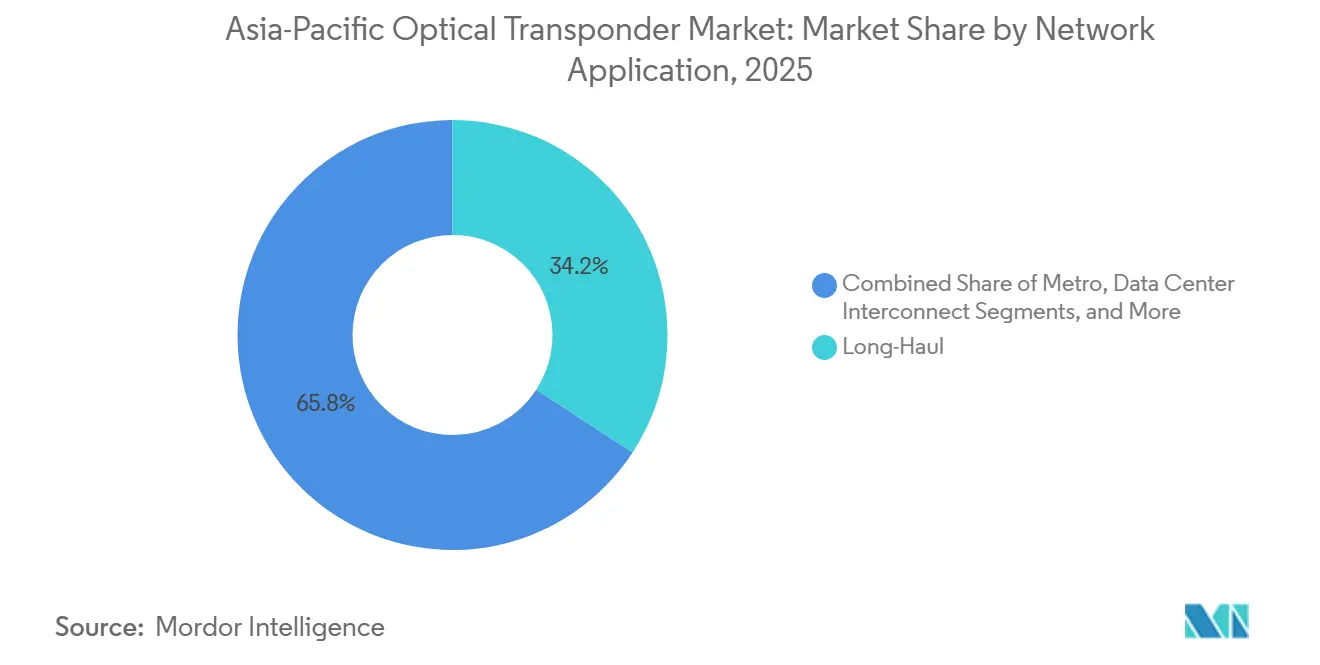
- By network application, long-haul held 34.20% of the Asia-Pacific optical transponder market share in 2025, while data center interconnect is projected to expand at a 12.35% CAGR through 2031.
- By end-user, telecommunication service providers held 64.95% of the Asia-Pacific optical transponder market share in 2025, while cloud and hyperscale data center operators are projected to expand at a 12.75% CAGR through 2031.
- By country, China held 50.29% of the Asia-Pacific optical transponder market share in 2025, while India is projected to expand at a 13.11% CAGR through 2031.
Note: Market size and forecast figures in this report are generated using Mordor Intelligence’s proprietary estimation framework, updated with the latest available data and insights as of January 2026.
Asia-Pacific Optical Transponder Market Trends and Insights
Drivers Impact Analysis*
| Driver | (~) % Impact on CAGR Forecast | Geographic Relevance | Impact Timeline |
|---|---|---|---|
| Hyperscaler AI Traffic and Data Center Interconnect Expansion | +3.2% | Asia-Pacific, concentrated in China, Singapore, Japan, and Australia | Short term (≤ 2 years) |
| 5G Backhaul Densification and Fiber Backbone Upgrades | +2.1% | China, India, Malaysia, South Korea, and Southeast Asia | Medium term (2-4 years) |
| Government-Backed Broadband and Digital Infrastructure Investment | +1.4% | India, China, Australia, Vietnam, and Indonesia | Medium term (2-4 years) |
| Adoption of 400ZR, 800G, and Higher-Capacity Coherent Optics | +1.2% | Asia-Pacific, with early adoption in Japan, Singapore, and Australia | Short term (≤ 2 years) |
| Singapore-Led Low-Latency Regional Data Center Interconnection | +0.8% | Singapore, Indonesia, Malaysia, and Thailand | Short term (≤ 2 years) |
| Open, Disaggregated Transponder and Optical Line System Procurement | +0.6% | Japan, India, Australia, and emerging Southeast Asian markets | Medium term (2-4 years) |
| Source: Mordor Intelligence | |||
Hyperscaler AI Traffic and Data Center Interconnect Expansion
AI training and inference workloads require predictable, low-latency bandwidth between GPU clusters in separate locations. This requirement makes optical transport part of the computing environment rather than a separate backhaul layer. Hyperscalers are therefore increasing direct purchases of WDM transponders and building their own data center interconnect capacity. Nokia states that 800G ZR and ZR+ pluggables have broad support through multi-source agreements and interoperability specifications, supporting their use in AI-scale connectivity.[1]Nokia, “800G ZR/ZR+: The New Currency in AI-Scale Connectivity,” Nokia, nokia.com The Asia-Pacific optical transponder market is affected by this change because carriers are no longer the only buyers who determine capacity additions. Alibaba, Tencent, and ByteDance are already linked to this procurement shift on China and Singapore routes.
5G Backhaul Densification and Fiber Backbone Upgrades
The move from microwave backhaul toward fiber transport creates recurring demand for optical equipment in access and aggregation networks. Standalone 5G deployments need higher throughput and lower latency than non-standalone networks. Dense urban small-cell networks require higher-capacity coherent solutions, including 400G and 800G equipment. Rural and suburban programs still need 100G and lower-speed equipment to preserve meaningful unit demand. India’s BharatNet program and Malaysia’s tower fiberization work support that lower-speed requirement. NTT DOCOMO completed a nationwide 100G coherent backhaul rollout in 2025 and is trialing 800G ZR+ optics for future extended-reality services, demonstrating how mobile network requirements can outpace subscriber trends.
Government-Backed Broadband and Digital Infrastructure Investment
Public digital infrastructure programs provide a more stable source of demand when commercial carrier budgets weaken. India’s Amended BharatNet program has an outlay of INR 1.40 lakh crore (USD 16.5 billion) and seeks to extend connectivity to 6.5 lakh villages. The Department of Telecommunications reported that 694,711 km of optical fiber had been laid by October 2025.[2]Ministry of Communications, Government of India, “2025 Year End Review for Department of Telecommunications,” Press Information Bureau, pib.gov.in This installed fiber base creates a later requirement for backhaul and transport upgrades. The Asia-Pacific optical transponder market benefits where public broadband work sustains equipment volumes through uneven commercial spending. Such programs also support demand for 10G, 100G, and 400G links in regional networks.
Adoption of 400ZR, 800G, and Higher-Capacity Coherent Optics
Pluggable coherent optics have improved the economics of router-integrated transmission. The Optical Internetworking Forum 400ZR specification and the emerging 800ZR ecosystem support common procurement requirements across vendors. A multi-vendor 800G demonstration at OFC 2026 operated over 1,602 km of fiber using 800G-OpenROADM, 800-ZR, and 800GBASE-2xFR4 specifications.[3]Optica Publishing Group, “Multi-Vendor Interoperable 800G Optical Communications over 1,602 km through 800G-OpenROADM, 800-ZR and 800GBASE-2xFR4 Fiber Links,” OFC 2026 Technical Digest, optica.org This result gives operators evidence that interoperable 800G systems can move beyond controlled testing. Marvell introduced COLORZ 1600, a 1.6T ZR/ZR+ pluggable, with 2nm coherent DSPs designed for AI scale-across connections.[4]Marvell Technology, “Marvell Extends ZR/ZR+ Leadership with Industry-First 1.6T ZR/ZR+ Pluggable and 2nm Coherent DSPs for Secure AI Scale-Across Interconnects,” Marvell Technology, marvell.com Operators in Japan, Singapore, and Australia are using standards-compliant specifications in procurement, which favors vendors with established, coherent chipset capabilities.
Restraints Impact Analysis*
| Restraint | (~) % Impact on CAGR Forecast | Geographic Relevance | Impact Timeline |
|---|---|---|---|
| Tier-2 Carrier Capital-Expenditure Freezes and Inventory Corrections | -1.4% | Southeast Asia, Pacific island markets, South Korea, and Taiwan | Short term (≤ 2 years) |
| Export Controls on Advanced Coherent DSPs and Photonic Components | -1.0% | China-facing supply chains and wider Asia-Pacific effects | Medium term (2-4 years) |
| Concentrated Indium Phosphide Epitaxy and Advanced-Node DSP Supply | -0.7% | Global, with risk concentrated in Japan, China, and United States component tiers | Short term (≤ 2 years) |
| Multi-Vendor Integration, Certification, and Field-Engineering Gaps | -0.5% | Asia-Pacific, especially developing markets with limited skilled labor | Medium term (2-4 years) |
| Source: Mordor Intelligence | |||
Tier-2 Carrier Capital Expenditure Freezes and Inventory Corrections
Carrier participation in the optical upgrade cycle varies widely across the region. Tier-2 and Tier-3 carriers in Southeast Asia, Pacific island markets, South Korea, and Taiwan face debt pressure, weaker subscriber revenue, and inventory accumulated during the 2022-2024 procurement cycle. These operators often defer new purchases and continue using installed equipment. The cost of 800G upgrades can be difficult to absorb while 5G commitments remain in place. China’s larger carriers have also shifted part of their spending toward AI computing infrastructure, reducing near-term demand for traditional WDM equipment. This uneven capital spending can slow equipment orders even when cloud and AI-related demand remains strong.
Export Controls on Advanced Coherent DSPs and Photonic Components
Advanced coherent DSPs and photonic components have become a supply-chain concern for vendors serving the region. U.S. export controls on advanced computing integrated circuits create licensing requirements for some high-performance components. These controls can extend review timelines for vendors seeking access to newer generations of coherent DSP. The resulting delays are important as customers move from 400G systems toward 800G and higher capacities. China’s controls on indium and InP introduce an additional source of supply uncertainty for international vendors. The Asia-Pacific optical transponder market must therefore manage exposure to both advanced DSP availability and photonic material supply.
*Our forecasts treat driver/restraint impacts as directional, not additive. The impact forecasts reflect baseline growth, mix effects, and variable interactions.
Segment Analysis
By Transmission Technology: Coherent Architecture Leads Demand
Coherent transmission accounted for 81.67% of revenue in 2025, making it the dominant technology in the Asia-Pacific optical transponder market, as carrier backbones and data center interconnects increasingly require long reach, high capacity, and more efficient use of installed fiber. It is projected to expand at an 11.08% CAGR through 2031, indicating that pluggable ZR and ZR+ modules are replacing direct-detect equipment across a wider set of metro and data center use cases. Lower DSP costs have extended coherent deployment beyond traditional long-haul networks and into shorter links where operators previously placed greater weight on equipment cost. The 1,602 km multi-vendor 800G demonstration at OFC 2026 using 800G-OpenROADM, 800-ZR, and 800GBASE-2xFR4 specifications supports the operational readiness of interoperable coherent transmission.
Non-coherent equipment continues to serve short intra-data-center connections and selected metro access deployments where limited reach and lower cost remain important. These installations still drive demand, particularly where capacity requirements are lower, but their addressable scope is narrowing as coherent pluggables become suitable for more 100G-class metro applications. Nokia introduced application-optimized coherent solutions in March 2026, featuring new DSPs and photonic front-ends, indicating that supplier development work is focused on coherent performance rather than renewed non-coherent innovation. NEC received the Telecom Infra Project Phoenix Gold Badge in March 2025 for a network operating system that supports disaggregated optical transponders and open optical deployment models. Vendors that lack reliable, coherent DSP relationships face a weaker position as operators standardize their capacity upgrades around this technology.


By Data Rate: 400G Revenue Base Meets 800G Demand
The above 100 Gbps to 400 Gbps band accounted for 47.29% of revenue in 2025 and remains important for carrier backbone and data center interconnect upgrade programs that use fiber routes equipped with earlier generations of coherent terminals. Much of the band’s 2026 demand comes from replacement and capacity upgrades on existing networks, while the above 800 Gbps segment is projected to expand at a 13.43% CAGR through 2031 as hyperscalers build campus-scale AI interconnects. Ciena deployed WaveLogic 6 Extreme on Vodafone Idea’s India transport network in March 2026 and achieved 1.6 Tb/s on one coherent optical channel, demonstrating that terabit-class wavelengths are moving into operational networks. Hyperscaler purchases of 800G ZR and ZR+ pluggables support this higher-capacity category because distributed GPU clusters require dense, low-latency links that can be expanded across separate data center locations. The Asia-Pacific optical transponder market is consequently balancing a large installed base of 400G with rapid demand for platforms that can support 800G and higher rates.
The above 400 Gbps to 800 Gbps category supports multi-rate strategies, allowing operators to add capacity without immediately replacing their entire terminal base. The up to 100 Gbps category remains relevant for rural backhaul, public broadband networks, and BharatNet-related infrastructure, where 10G and 100G links still have a defined role. Greater supplier competition is putting pressure on 400G pricing as the technology becomes established, even as shipment volumes remain meaningful across carrier and enterprise networks. Marvell introduced a 2nm 800G ZR/ZR+ coherent DSP platform and COLORZ 1600, a 1.6T ZR/ZR+ pluggable, which indicates a continuing rise in the capacity available through pluggable optics. As these platforms become available, migration decisions could occur sooner, reducing the time equipment vendors have to rely on the mature 400G tier.
By Network Application: Long-Haul Revenue and DCI Expansion
Long-Haul represented 34.20% of the Asia-Pacific optical transponder market size by network application in 2025, supported by inter-city and cross-border backbone upgrades across China, India, Japan, and Australia. These routes require high-performance coherent equipment that can manage multi-span transmission, advanced modulation formats, low-noise amplification, and capacity across longer fiber distances. Such operating requirements lead to higher average selling prices per wavelength than are common in metro networks or in shorter DCI links. Submarine networks are a related part of this architecture because their operators seek to increase capacity on existing fiber pairs without building new cables. Trans Pacific Networks selected Ciena technology for the Echo and Tabua subsea cable systems in January 2026, showing continued investment in higher-capacity Pacific and regional routes.
Data Center Interconnect is projected to expand at a 12.35% CAGR through 2031 as distributed AI computing requires predictable, high-throughput connections between separate data centers and GPU cluster nodes. The scale-across approach uses dense interconnect fabrics over tens of kilometers and favors pluggable 800G coherent transponders that can be deployed with more flexibility than embedded line-system approaches. Metro networks in Tokyo, Singapore, Mumbai, and Sydney also face faster replacement cycles as AI and cloud traffic increase the need for capacity within major urban areas. Matrix NAP Info activated Ciena WaveLogic 6 Extreme on the Batam-Jakarta submarine segment in May 2026, delivering 1 Tb/s per wavelength over a live 1,055 km link. The Asia-Pacific optical transponder market is supported by this overlap between long-haul, submarine, metro, and DCI capacity requirements.

By End-User: Telco Scale and Hyperscaler Demand
Telecommunication service providers accounted for 64.95% of revenue in 2025, reflecting their wholesale capacity commitments to cloud tenants and ongoing investment in 5G backhaul and transport upgrades across regional networks. Their procurement patterns increasingly depend on hyperscaler plans rather than only on subscriber traffic, because large cloud operators are important users of carrier capacity and direct buyers of network equipment. Cloud and hyperscale data center operators are projected to expand at a 12.75% CAGR through 2031, making them the fastest-growing end-user group despite the service provider's lead in revenue share. These operators are purchasing WDM transponders and wavelengths directly and are increasingly preferring software control and multi-vendor interoperability. The Asia-Pacific optical transponder market, therefore, includes both carrier-led deployments and cloud-led investments that operate under different planning and purchasing cycles.
Enterprises are a smaller but increasingly independent buyer category for campus and regional private optical links between data centers. Government and defense end users also provide protected demand in Japan, South Korea, India, and Australia through programs involving quantum-safe optical encryption and government cloud connectivity. Japan’s Ministry of Internal Affairs and Communications awarded ACCESS and IP Infusion a June 2026 research contract for all-photonics technologies in overseas AI data centers, supporting work on open optical architectures. Tejas Networks reported that its order book rose 49% year over year in FY26, supported in part by Indian government work, including BSNL programs and BharatNet Phase III. Public-sector programs create an additional demand path when commercial provider spending is uneven.
Geography Analysis
China held 50.29% of the Asia-Pacific optical transponder market share in 2025, reflecting the scale of its network infrastructure, cloud capacity, and established carrier base. In 2026, major carriers are redirecting part of their conventional telecommunications spending toward AI computing infrastructure, which softens some WDM backbone purchases but supports a different requirement for cloud interconnection. Alibaba, Tencent, and ByteDance are deploying higher-capacity links between inland AI computing clusters and coastal cloud hubs, shifting demand from carrier-centered upgrades to hyperscaler network design. China’s infrastructure focus keeps optical fiber and high-capacity transport important even as the distribution of spending changes. Japan is moving toward all-photonics architectures through NTT’s IOWN initiative and public research programs that are testing low-latency optical switching and data center connectivity.
India is projected to expand at a 13.11% CAGR through 2031, the region’s highest country-level rate, supported by population-scale broadband deployment and new Tier-I cloud capacity in Mumbai, Chennai, and Hyderabad. The Department of Telecommunications reported that 694,711 km of optical fiber had been laid by October 2025, while BharatNet’s INR 1.40 lakh crore (USD 16.5 billion) outlay supports a transport upgrade pipeline for 100G and 400G systems. Ciena’s 1.6 Tb/s deployment with Vodafone Idea demonstrates the country’s use of terabit-class coherent transport for data center interconnect. South Korea’s high fiber penetration and trials of holographic and ultra-high-definition XR services create a separate requirement for advanced optical capacity. These use cases make the country a reference point for the future bandwidth requirements of mobile and cloud networks across the Asia-Pacific optical transponder market.
Australia and New Zealand are important submarine cable locations, and Lightstorm upgraded the Japan-Guam-Australia route from 100 Gbps to 400 Gbps per wavelength in March 2026 using Ciena WaveLogic technology. The rest of the Asia-Pacific optical transponder market includes Singapore, Indonesia, Malaysia, Vietnam, Thailand, and the Philippines, where Singapore serves as a low-latency ASEAN interconnection hub. Telin selected Nokia’s 1830 GX platform and open optical line system for Singapore data center connections in September 2025, while Indonesia is adding submarine and terrestrial links between Jakarta and Singapore. These routes connect the region’s principal cloud and content hubs and support demand for DCI-oriented coherent equipment.
Competitive Landscape
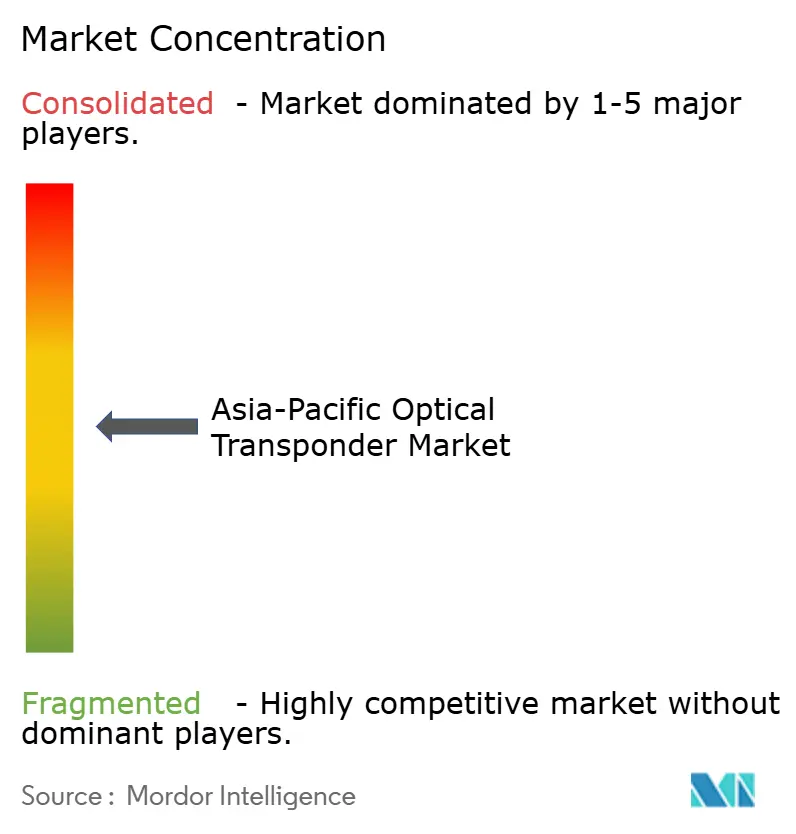
The Asia-Pacific optical transponder market is moderately concentrated among leading suppliers, Huawei, Nokia, ZTE, and Ciena, accounting for the substantial majority of regional WDM revenue. Nokia completed its USD 2.3 billion acquisition of Infinera in December 2024, combining Nokia’s silicon photonics capabilities with Infinera’s InP photonic integrated circuit experience. Nokia then introduced application-optimized coherent solutions in March 2026, using 4 DSPs and 13 products, providing a broader portfolio to meet different network requirements. The acquisition and new product program position Nokia to address coherent applications across carrier, cloud, metro, and long-haul networks. The Asia-Pacific optical transponder market also gives established suppliers an advantage where operators require documented interoperability, component supply, and field support.
Ciena has an early position in terabit-class deployments through WaveLogic 6 Extreme, with 2026 installations in India and Indonesia demonstrating 1.6 Tb/s and 1 Tb/s coherent capacity in operational networks. Huawei remains strongly positioned in China and unveiled 10 AI-Optical Network products at MWC Shanghai in June 2026 for AI computing-network integration and AI service delivery. Its strategy places optical transport within China’s national AI infrastructure, while regulatory constraints restrict its addressable opportunity in several external markets. Ciena and Huawei therefore compete from different regional positions and through distinct approaches to capacity deployment.
India-origin vendors are gaining visibility through government network programs and higher-capacity product launches, including Tejas Networks’ TJ1600-D3 platform, which supports 400G to 1.2T per wavelength and up to 51.2 Tbps of shelf capacity. Marvell influences the supplier environment as a component platform provider because its coherent DSPs enable other equipment vendors to build competing systems without developing their own photonic chipsets. NEC is positioned in open optical architectures following its receipt of the TIP Phoenix Gold Badge for its network operating system in 2025. These approaches provide alternatives for operators that seek vendor-agnostic control of coherent wavelengths across multi-vendor infrastructure.
Asia-Pacific Optical Transponder Industry Leaders
Huawei Technologies Co., Ltd.
Nokia Corporation
ZTE Corporation
Ciena Corporation
Cisco Systems, Inc.
- *Disclaimer: Major Players sorted in no particular order

Recent Industry Developments
- June 2026: Huawei unveiled 10 AI-Optical Network products at MWC Shanghai 2026, including its AI-FAN and AI-OTN product series targeting AI token monetization, 1 ms compute-network integration, and 50G PON fiber access, signaling a strategy to position optical transport as a billable AI-inference delivery layer for Chinese carriers operating under their 15th Five-Year Plan.
- June 2026: Japan's Ministry of Internal Affairs and Communications awarded a contract to ACCESS Co., Ltd. and its subsidiary, IP Infusion, for a research project to deploy all-photonics network technologies in overseas AI data centers, aimed at eliminating vendor lock-in and validating open optical architectures for distributed AI compute.
- May 2026: Matrix NAP Info activated Ciena's GeoMesh Extreme solution, powered by WaveLogic 6 Extreme coherent optics, on the Batam-Jakarta segment of the Matrix Cable System in Indonesia, delivering 1 Tb/s per wavelength over a live 1,055 km submarine link, among the first commercial activations of WL6e in an Asia-Pacific submarine deployment.
- March 2026: Vodafone Idea deployed Ciena WaveLogic 6 Extreme across its India transport network, achieving 1.6 Tb/s on a meshed DCI optical channel and establishing the foundation for 800G commercial services targeting hyperscaler, cloud, and AI-driven bandwidth demand in India.


Asia-Pacific Optical Transponder Market Report Scope
The Asia-Pacific optical transponder market revenue is generated through the sale of optical transponders and related transponder-based transmission equipment across data rates ranging from 100 Gbps to above 800 Gbps, supplied to telecommunication service providers, cloud and hyperscale data center operators, enterprises, government and defense organizations, and other end users.
The Asia-Pacific optical transponder market report is segmented by transmission technology (coherent and non-coherent), data rate (up to 100 Gbps, above 100 Gbps to 400 Gbps, above 400 Gbps to 800 Gbps, and above 800 Gbps), network application (metro, long-haul, data center interconnect, submarine, and other network applications), end-user (telecommunication service providers, cloud and hyperscale data center operators, enterprises, government and defense, and other end-users), and country (China, Japan, India, South Korea, Australia and New Zealand, and rest of Asia-Pacific). The market forecasts are provided in terms of value (USD).
| Coherent |
| Non-Coherent |
| Up to 100 Gbps |
| Above 100 Gbps to 400 Gbps |
| Above 400 Gbps to 800 Gbps |
| Above 800 Gbps |
| Metro |
| Long-Haul |
| Data Center Interconnect |
| Submarine |
| Other Network Applications |
| Telecommunication Service Providers |
| Cloud and Hyperscale Data Center Operators |
| Enterprises |
| Government and Defense |
| Other End-Users |
| China |
| Japan |
| India |
| South Korea |
| Australia and New Zealand |
| Rest of Asia-Pacific |
| By Transmission Technology | Coherent |
| Non-Coherent | |
| By Data Rate | Up to 100 Gbps |
| Above 100 Gbps to 400 Gbps | |
| Above 400 Gbps to 800 Gbps | |
| Above 800 Gbps | |
| By Network Application | Metro |
| Long-Haul | |
| Data Center Interconnect | |
| Submarine | |
| Other Network Applications | |
| By End-User | Telecommunication Service Providers |
| Cloud and Hyperscale Data Center Operators | |
| Enterprises | |
| Government and Defense | |
| Other End-Users | |
| By Country | China |
| Japan | |
| India | |
| South Korea | |
| Australia and New Zealand | |
| Rest of Asia-Pacific |


Key Questions Answered in the Report
What is the Asia-Pacific optical transponder market size?
The Asia-Pacific optical transponder market size is projected to expand from USD 2.7 billion in 2025 and USD 3 billion in 2026 to USD 4.9 billion by 2031, at a 10.56% CAGR. The forecast reflects greater demand for coherent capacity across carrier, cloud, data center, and submarine network applications.
What is driving demand for optical transponders in Asia-Pacific?
AI data center interconnection, fiber-based 5G backhaul, public broadband investment, and 400ZR and 800G coherent optics are supporting demand. Direct purchasing by hyperscalers and the requirement for predictable, low-latency GPU-cluster connections are also changing the equipment mix that suppliers must support.
Which transmission technology leads optical transponder demand in Asia-Pacific?
Coherent transmission led with 81.67% revenue share in 2025 and is projected to expand at an 11.08% CAGR through 2031. It is used for long reach and high-capacity networks, while lower DSP costs have also extended its relevance to metro and shorter-reach data center connections.
Which data rate is expanding fastest in the region?
The Above 800 Gbps segment is projected to expand at a 13.43% CAGR through 2031, supported by hyperscaler use of 800G ZR and ZR+ pluggables. These systems are suited to campus-scale AI interconnects and distributed computing designs that link separate data centers.
Which country is expected to expand fastest through 2031?
India is projected to expand at a 13.11% CAGR, supported by broadband deployment and hyperscale computing capacity. BharatNet and the expansion of data center locations in Mumbai, Chennai, and Hyderabad create a continuing need for backhaul, metro, and interconnect capacity.
How concentrated is the supplier environment?
The supplier environment is moderately concentrated among Huawei, Nokia, ZTE, and Ciena, while middle tiers remain fragmented and open optical systems create further supplier options. Component suppliers and India-origin vendors also provide additional routes for operators seeking technology choices outside fully integrated systems.
Page last updated on:





