
Market Overview
| Study Period | 2019 - 2030 |
|---|---|
| Forecast Data Period | 2025 - 2030 |
| Historical Data Period | 2019 - 2023 |
| Growth Rate | 7.10 % |
| Market Concentration | Medium |
Major Players *Disclaimer: Major Players sorted in no particular order Image © Mordor Intelligence. Reuse requires attribution under CC BY 4.0. | |
Asia-Pacific Minimally Invasive Devices Market Analysis by Mordor Intelligence
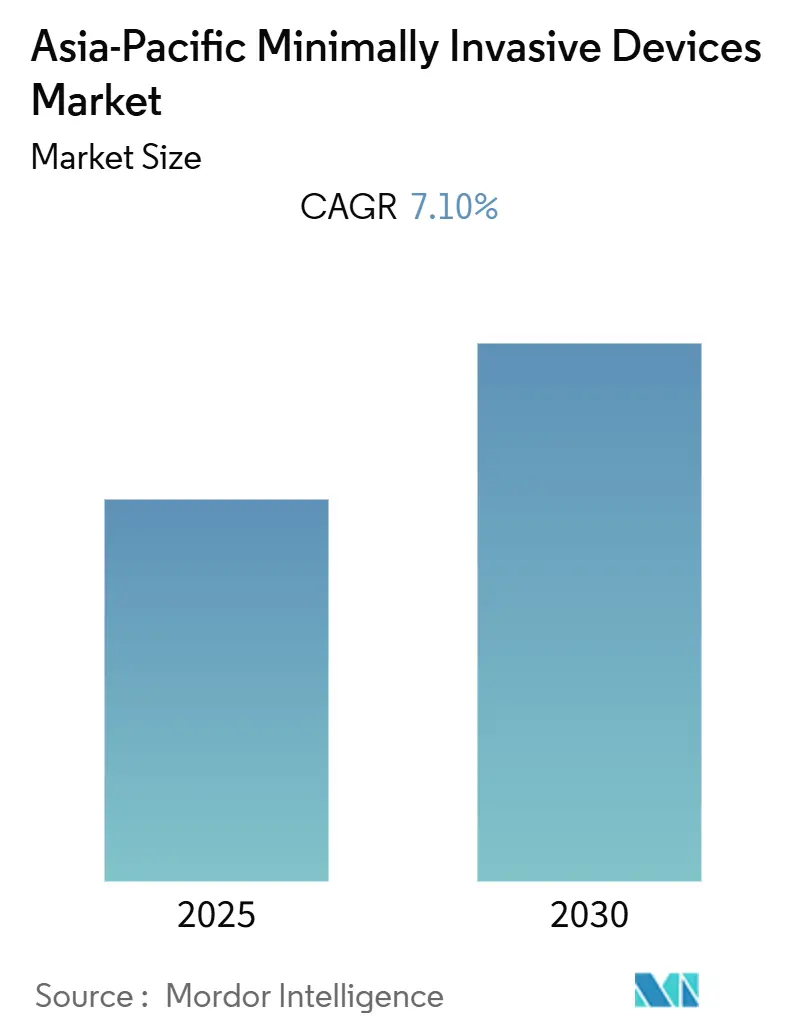
The Asia-Pacific Minimally Invasive Devices Market is expected to register a CAGR of 7.10% during the forecast period.
The COVID-19 pandemic has had an impact on a variety of surgical techniques, including minimally invasive ones. Due to the strict restrictions, patients with various lifestyle-related and chronic diseases experienced a delay in diagnosis and treatment due to fewer hospital visits which hampered the market studied. According to the January 2022 published study in the JMAS, overall elective operations and minimally invasive surgery (MIS) were reduced proportionally in India. Across the country, most surgeons reported a drop in overall elective surgical volume (93.2%) and MIS cases (88.4%). There was a corresponding decline in laparoscopic, thoracoscopic, and robotic cases among MIS cases across the country. As a result, in the early stages of the outbreak, COVID-19 harmed market growth. However, since the restrictions were lifted, the industry has recovered well. Over the last two years, the market recovery has been led by the high prevalence of diseases, new product launches, and increased demand for minimally invasive surgeries.
The major factors for the growth of the Asia-Pacific minimally invasive devices market include the increasing prevalence of lifestyle-related and chronic disorders and technological advancements. Alterations in metabolic activity and lifestyle changes are linked to cardiovascular risk, and the rising incidence of cardiovascular diseases is expected to propel the growth of the market. According to the article published in a White paper in May 2022, atherosclerotic cardiovascular disease (ASCVD) resulted in significant productivity loss in the Asia-Pacific region, including several countries such as Vietnam.
Cancer cases are also rising across the Asia-Pacific region, along with the demand for minimally invasive surgeries, which is expected to boost the demand for MIS devices. For instance, as per the Globocan 2020 statistics, the estimated number of new cancer cases was 9,503,710, and the number of prevalent cases (5 years) was 20,606,063 in the Asia-Pacific region in 2020. Among these, new cases of lung cancer were the highest, with 1,315,136 (13.8%) cases, followed by breast cancer cases at 1,026,171 (10.8%) in 2020. Thus, the high burden of cancer is expected to boost the demand for MIS devices during the forecast period.
Furthermore, there are various advantages of MIS over other surgeries, which are also likely to support market expansion. Minimally invasive surgeries (MIS) cause less post-operative pain, and patients receive smaller dosages of painkillers. As there are minimal cuts or stitches involved, the hospital stay is relatively short, and patients need not visit the hospital frequently. In addition, minimally invasive surgeries (MIS) provide a more detailed and magnified image of the organs or body parts operated on and increased precision due to video-assisted technology.
Moreover, various strategies adopted by key market players, such as product launches, mergers and acquisitions, and partnerships, are expected to support market growth. For instance, in June 2021, Pentax Medical formed a new joint venture (JV) with Jiangsu Vedkang Medical Science and Technology (Vedkang) to develop endoscopic therapies. Therapeutic devices and flexible medical endoscopes are used in minimally invasive procedures to benefit patients, physicians, and healthcare systems by dramatically reducing procedure cost/complexity and improving patient recovery time. As a result of the advantages associated with minimally invasive operations, the market is likely to expand during the forecast period.
However, a shortage of experienced professionals may restrain the market growth.
Asia-Pacific Minimally Invasive Devices Market Trends and Insights
Aesthetic Segment is expected to Grow Significantly During the Forecast Period
Aesthetic surgery is becoming more popular due to the increase in people's awareness. The importance of physical beauty in contemporary western culture is another element contributing to the rise of aesthetic procedures. Improvements in surgical methods, particularly in terms of safety and lower treatment costs have also helped to reduce patient anxiety regarding cosmetic treatments.
Several organic and inorganic strategies adopted by market players are likely to support the growth of the market. For instance, in August 2022, Allergan Healthcare India in Bangalore launched Juvéderm VOLUX in India under its business unit Allergan Aesthetics. Allergan Aesthetics obtained all the necessary approvals from the CDSCO office before launching this product in India. Juvéderm VOLUX is an injectable implant designed to repair and add volume to the face. It contains 25 mg of hyaluronic acid and 3 mg of lidocaine hydrochloride.
The market expansion is supported by strategies including mergers and acquisitions and partnerships with manufacturers of cosmetic devices. For instance, in March 2022, Cynosure LLC's subsidiary Cynosure KK partnered with Jeisys Medical KK, a subsidiary of Jeisys Medical Inc. in Japan. Under the terms of the agreement, Jerseys Medical will have exclusive distribution rights for products within Cynosure's energy-based laser portfolio in Japan. Thus, the above-mentioned factors are expected to increase the market growth.
China is Expected to Hold a Significant Share in the Market and is Expected to do Same During the Forecast Period
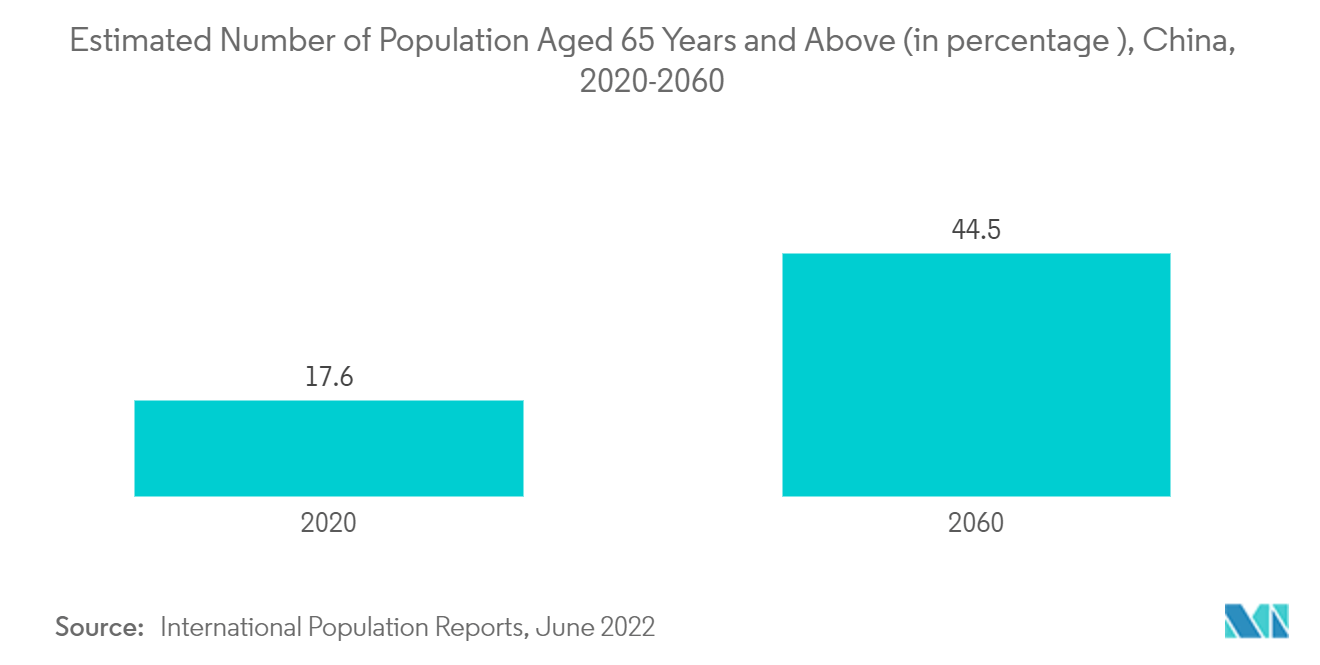
China is expected to hold a significant share due to the increasing prevalence of chronic diseases, the growing geriatric population, and the increased usage of advanced medical devices. The rising prevalence of lifestyle-related diseases such as cancer, cardiovascular disease, and obesity is expected to support market growth. For instance, according to a July 2021 published study in the Journal of Diagnostics, the prevalence of COPD in China was 16.7% in 2020. Furthermore, as the senior population grows, the country is seeing an increase in the number of individuals suffering from chronic diseases. For instance, according to the WHO Factsheet of 2022, China's population is aging at one of the fastest rates in the world. By 2040, 28% of China's population is projected to be over 60 years old. As the aged population is more prone to chronic illnesses such as cardiovascular, cancer, respiratory, and neurological diseases, the market is expected to rise during the forecast period.
Furthermore, companies are focusing on developing advanced products and expanding their product portfolio to cater to the complex requirements of a cardiac procedure. For instance, in January 2022, Medtronic plc reported that the National Medical Products Administration (NMPA) had approved the CoreValve Evolut PRO TAVR (Transcatheter aortic valve replacement) system to treat severe aortic stenosis (AS) for symptomatic patients in China who are at high or extreme risk of open-heart surgery.
Hence, all these factors are expected to propel the growth of the market in China during the forecast period.
Competitive Landscape
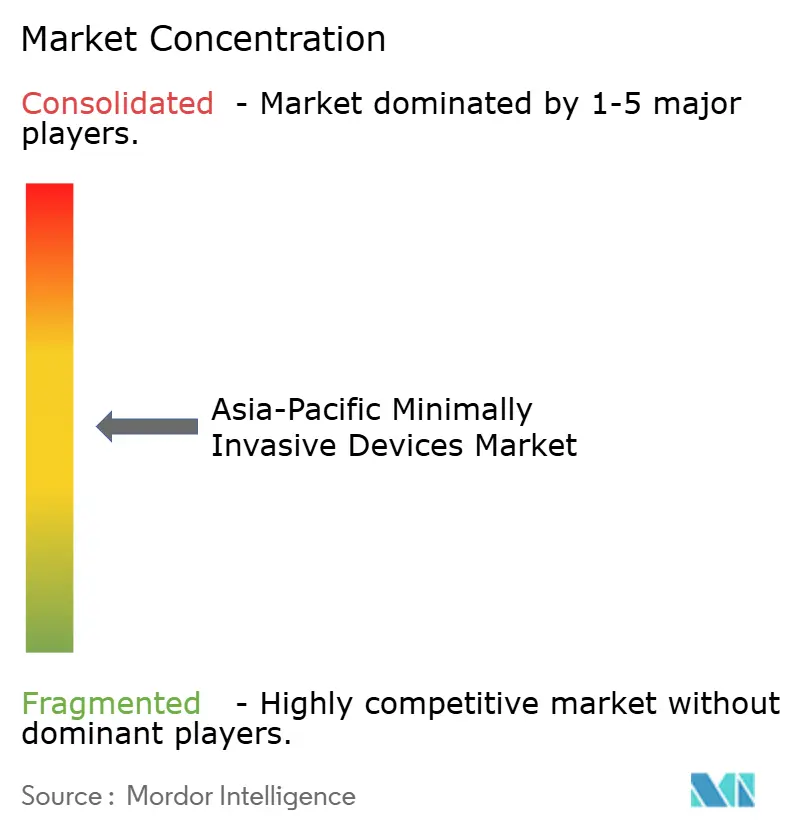
The Asia-Pacific minimally invasive devices market is consolidated owing to the presence of a few dominant players in the market. Some of the market players are Abbott Laboratories, GE Healthcare, Intuitive Surgical Inc., Koninklijke Philips NV, Medtronic PLC, Olympus Corporation, Siemens Healthineers, Smith & Nephew, Stryker Corporation, and Zimmer Biomet.
Asia-Pacific Minimally Invasive Devices Industry Leaders
-
Medtronic PLC
-
Olympus Corporation
-
Siemens Healthineers
-
Koninklijke Philips NV
-
GE Healthcare
- *Disclaimer: Major Players sorted in no particular order
Recent Industry Developments
- September 2022: Olympus Corporation introduced VISERA ELITE III, its newest surgical visualization platform designed to meet the demands of healthcare professionals (HCPs) performing endoscopic procedures in a variety of medical specialties.
- January 2022: Stryker Corporation agreed to buy Vocera Communications for USD 3.09 billion. Through the acquisition, the company aims to reduce cognitive overload for caregivers and enable them to deliver better patient care.
Asia-Pacific Minimally Invasive Devices Market Report Scope
Minimally-invasive surgical devices refer to electrosurgical systems, robot-assisted surgical systems, and surgical equipment, which are used during the minimally-invasive procedure.
The Asia-Pacific minimally invasive devices market is segmented by product (handheld instruments, guiding devices (guiding catheter, and guidewires), electrosurgical devices, endoscopic devices, laparoscopic devices, monitoring, visualization devices, ablation devices, laser-based devices, robotic-assisted surgical systems, and other MIS devices), application (aesthetic, cardiovascular, gastrointestinal, gynaecological, orthopaedic, urological, and other applications), and geography(China, Japan, India, Australia, South Korea, Rest of Asia-Pacific). The report offers the value (in USD million) for the above segments.
By Products
| Handheld Instruments | |
| Guiding Devices | Guiding Catheters |
| Guidewires | |
| Electrosurgical Devices | |
| Endoscopic Devices | |
| Laproscopic Devices | |
| Monitoring and Visualization Devices | |
| Robotic Assisted Surgical Systems | |
| Ablation Devices | |
| Laser-based Devices | |
| Other MIS Devices |
By Application
| Aesthetic |
| Cardiovascular |
| Gastrointestinal |
| Gynecological |
| Orthopedic |
| Urological |
| Other Applications |
Geography
| China |
| Japan |
| India |
| Australia |
| South Korea |
| Rest of Asia-Pacific |
| By Products | Handheld Instruments | |
| Guiding Devices | Guiding Catheters | |
| Guidewires | ||
| Electrosurgical Devices | ||
| Endoscopic Devices | ||
| Laproscopic Devices | ||
| Monitoring and Visualization Devices | ||
| Robotic Assisted Surgical Systems | ||
| Ablation Devices | ||
| Laser-based Devices | ||
| Other MIS Devices | ||
| By Application | Aesthetic | |
| Cardiovascular | ||
| Gastrointestinal | ||
| Gynecological | ||
| Orthopedic | ||
| Urological | ||
| Other Applications | ||
| Geography | China | |
| Japan | ||
| India | ||
| Australia | ||
| South Korea | ||
| Rest of Asia-Pacific | ||
Key Questions Answered in the Report
What is the current Asia-Pacific Minimally Invasive Devices Market size?
The Asia-Pacific Minimally Invasive Devices Market is projected to register a CAGR of 7.1% during the forecast period (2025-2030)
Who are the key players in Asia-Pacific Minimally Invasive Devices Market?
Medtronic PLC, Olympus Corporation, Siemens Healthineers, Koninklijke Philips NV and GE Healthcare are the major companies operating in the Asia-Pacific Minimally Invasive Devices Market.
What years does this Asia-Pacific Minimally Invasive Devices Market cover?
The report covers the Asia-Pacific Minimally Invasive Devices Market historical market size for years: 2019, 2020, 2021, 2022, 2023 and 2024. The report also forecasts the Asia-Pacific Minimally Invasive Devices Market size for years: 2025, 2026, 2027, 2028, 2029 and 2030.