
Market Overview
| Study Period | 2020 - 2031 |
|---|---|
| Forecast Data Period | 2026 - 2031 |
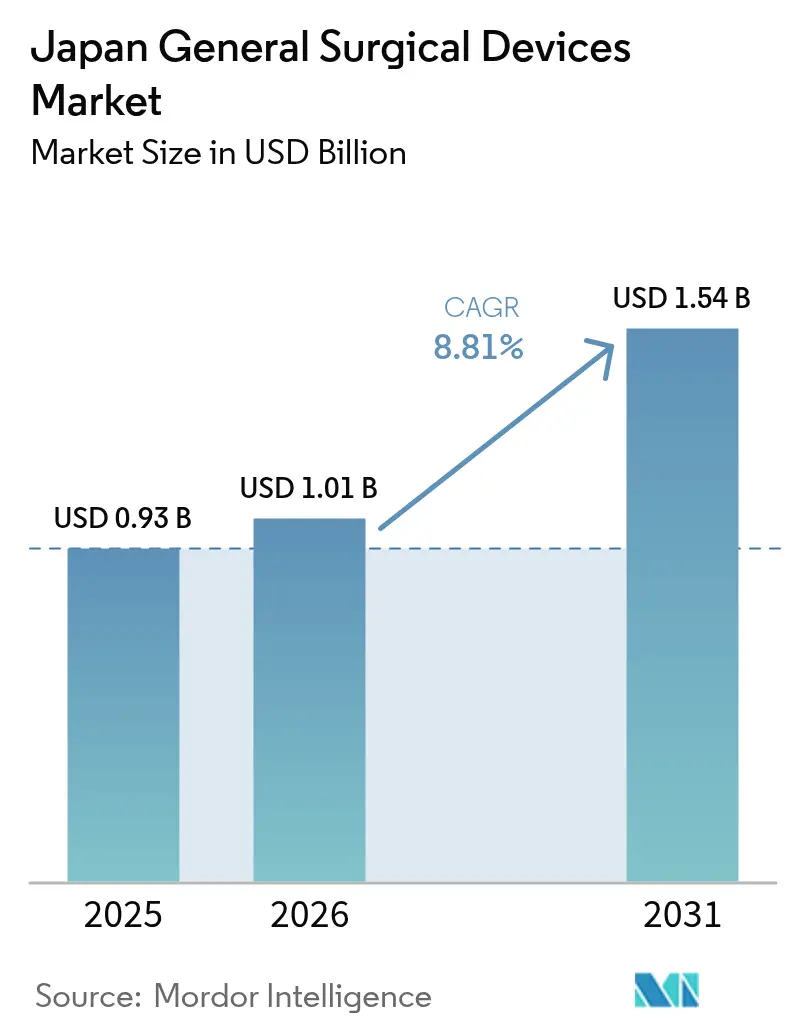
| Base Year Market Size (2025) | USD 0.93 Billion |
| Market Size (2026) | USD 1.01 Billion |
| Market Size (2031) | USD 1.54 Billion |
| Growth Rate (2026 - 2031) | 8.81 % |
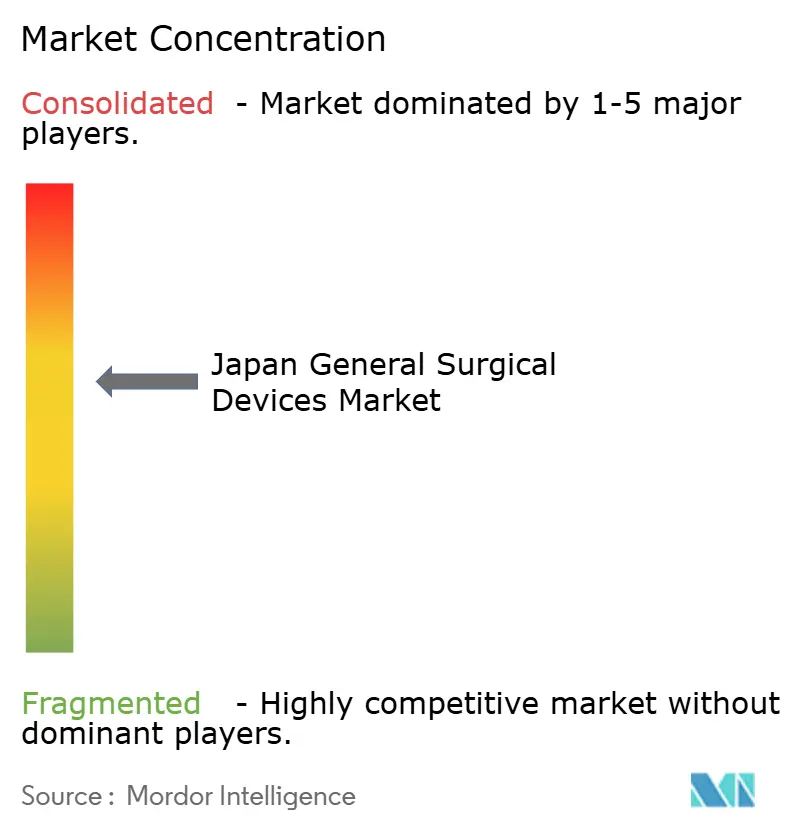
| Market Concentration | Medium |
Major Players *Disclaimer: Major Players sorted in no particular order Image © Mordor Intelligence. Reuse requires attribution under CC BY 4.0. | |
Japan General Surgical Devices Market Analysis by Mordor Intelligence
The Japan General Surgical Devices market size is expected to grow from USD 0.93 billion in 2025 to USD 1.01 billion in 2026 and is forecast to reach USD 1.54 billion by 2031 at 8.81% CAGR over 2026-2031. Growing surgical demand from an aging society where 29.1% of citizens are 65 years or older, an aggressive shift toward minimally invasive techniques, and the country’s deep bench strength in robotics and artificial intelligence are the foundational forces that keep the market on a steep upward path. Hospitals are scaling integrated digital operating rooms, private investors are funding ambulatory surgical centers, and government policies that reimburse remote proctoring are accelerating technology diffusion. Laparoscopic systems remain the revenue anchor, yet electrosurgical platforms paired with robotic consoles are setting the growth pace. Domestic manufacturers such as Olympus and Terumo secure share through local service networks, while global leaders work through strategic partnerships and Japan’s demanding approval pathway to keep competitive parity. Supply-chain re-shoring incentives, telepresence-enabled training models, and fast prototype–to-pilot cycles in university hospitals collectively create fertile ground for next-generation devices that embed imaging, analytics, and automation at the point of care.
Key Report Takeaways
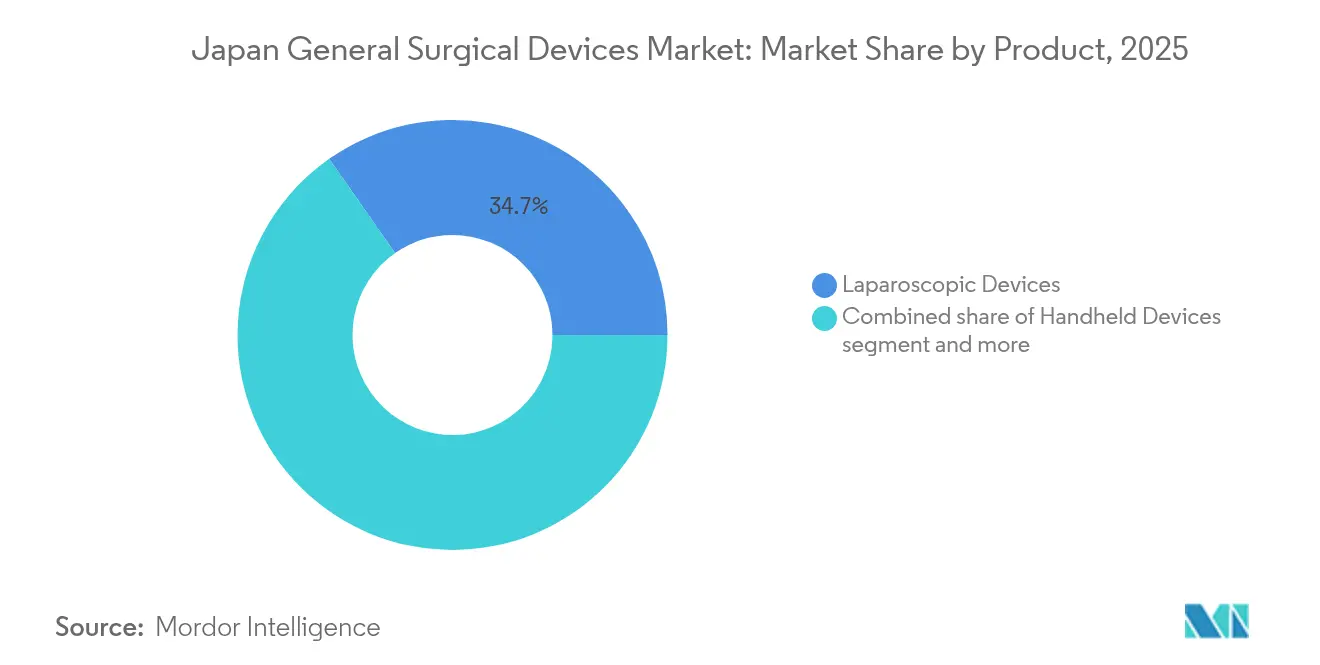
- By product, laparoscopic devices led with 34.72% revenue share in 2025; electrosurgical devices are projected to advance at a 9.41% CAGR through 2031.
- By procedure approach, minimally invasive surgery accounted for 72.30% of the Japan general surgical devices market share in 2025, while the same category posts the highest projected 9.14% CAGR to 2031.
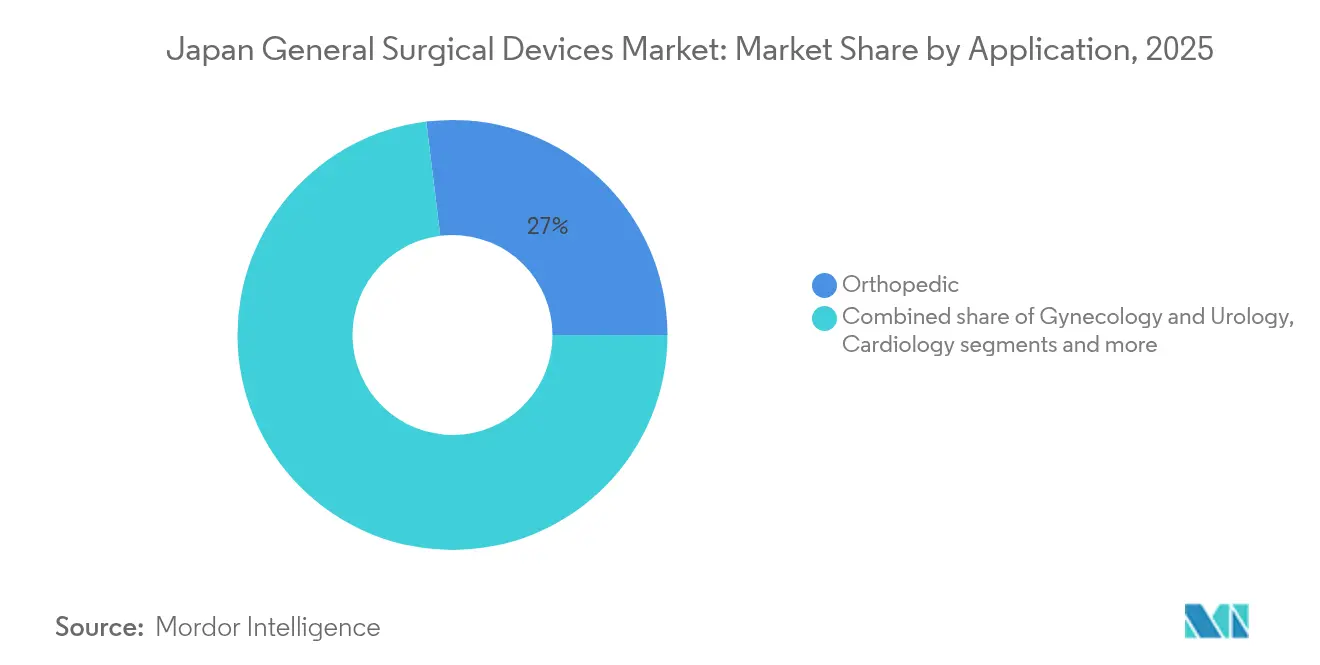
- By application, orthopedic procedures held 26.95% of the Japan general surgical devices market size in 2025 and gynecology and urology is growing at a 9.78% CAGR to 2031.
- By end-user, hospitals controlled 69.85% revenue share in 2025; ambulatory surgical centers are forecast to expand at a 9.65% CAGR through 2031.
Note: Market size and forecast figures in this report are generated using Mordor Intelligence’s proprietary estimation framework, updated with the latest available data and insights as of 2026.
Japan General Surgical Devices Market Trends and Insights
Drivers Impact Analysis*
| Driver | (~) % Impact on CAGR Forecast | Geographic Relevance | Impact Timeline |
|---|---|---|---|
| Aging-driven escalation in surgical volumes | +2.1% | National, with concentration in Tokyo, Osaka, Nagoya metropolitan areas | Long term (≥ 4 years) |
| Surge in minimally invasive procedures | +1.8% | National, with early adoption in university hospitals and private facilities | Medium term (2-4 years) |
| Rapid device innovation (robotics, AI, 4K/8K imaging) | +1.5% | National, with pilot programs in major medical centers | Medium term (2-4 years) |
| Remote-proctoring reimbursement accelerating adoption | +1.2% | National, with rural hospital priority implementation | Short term (≤ 2 years) |
| Domestic manufacturing-reshoring incentives | +0.9% | National, with focus on industrial clusters in Kyushu and Tohoku | Long term (≥ 4 years) |
| Expansion of private hospitals and ambulatory surgical centers | +0.7% | Urban areas, particularly Tokyo, Osaka, and regional capitals | Medium term (2-4 years) |
| Source: Mordor Intelligence | |||
Aging-driven escalation in surgical volumes
Japan’s demographic curve now places 20% of citizens in the 75-plus segment, pushing hospital case mix toward complex, multi-morbidity surgeries that rely on precise, low-trauma instrumentation.[1]Source: Statistics Bureau of Japan, “Statistical Handbook of Japan 2024,” stat.go.jp Older patients present higher perioperative risk, raising the premium on devices that shorten procedure times and reduce blood loss. Multicenter evidence shows that laparoscopic gastric cancer resections deliver 99.8% five-year disease-free survival, reinforcing confidence in minimally invasive approaches for senior cohorts. Workforce gaps intensify the imperative for robotic assistance that lets a leaner clinical team maintain throughput. Device makers that bundle analytics for pre-operative planning with ergonomic instruments positioned for arthritic hands are meeting an urgent and escalating need.
Surge in minimally invasive procedures
Minimally invasive surgery already dominates operating rooms and keeps growing as AI-driven visualization, 3-D mapping, and robotics tilt the risk-to-benefit ratio further in its favor. A comparative study of elderly liver resection patients showed no difference in complications versus younger cohorts, validating broader use in the oldest demographic. Tokyo startups now supply algorithms that illuminate loose connective tissue planes with 91.8% accuracy, reducing inadvertent injury and shortening learning curves. Office-based vitreoretinal surgery reached a single-session success rate of 97.3%, demonstrating how refined instruments migrate complex care from hospitals to outpatient suites. As clinical guidelines update, procurement cycles increasingly favor consoles and handpieces with plug-and-play AI modules that can be upgraded through software rather than hardware swaps.
Rapid device innovation (robotics, AI, 4K/8K imaging)
Japan’s intertwined electronics and medical technology clusters accelerate cross-domain breakthroughs. The hinotori Surgical Robot obtained domestic clearance with eight-axis arms and native 3-D vision. Sony’s microsurgery robot uses automatic instrument exchange to cut setup time and adds real-world haptics to featherweight movements. Thoracic surgery trials with the Saroa robot introduced force feedback that protects fragile tissue, an advance especially relevant for novice surgeons. Parallel progress in 4K and 8K endoscopes gives surgeons ultra-high-definition fields that improve margin assessment. These converging technologies reset procurement criteria toward platforms that integrate optics, navigation, and automation in a single ecosystem.
Remote-proctoring reimbursement accelerating adoption
A 2024 policy gave hospitals a clear reimbursement code for remote surgical guidance, letting one expert mentor multiple theaters simultaneously. Early 5G-enabled simulations completed without latency that might compromise patient safety. Rural centers now access skills previously concentrated in metropolitan teaching hospitals. Device developers respond by embedding cameras, dual-control modes, and encrypted data streams in consoles at the design stage. This policy lifts near-term demand because hospitals can justify capital spend with immediate utilization uplift.
Restraints Impact Analysis*
| Restraint | (~) % Impact on CAGR Forecast | Geographic Relevance | Impact Timeline |
|---|---|---|---|
| Lengthy PMDA approval & re-approval timelines | -1.4% | National, affecting all device categories and manufacturers | Medium term (2-4 years) |
| High cost of stem cell therapies and manufacturing | -0.8% | National, with particular impact on advanced therapy segments | Long term (≥ 4 years) |
| OR nursing/technician shortages | -1.1% | National, with acute impact in rural and mid-tier hospitals | Short term (≤ 2 years) |
| Limited standardization and scalability | -0.6% | National, affecting device interoperability and training programs | Medium term (2-4 years) |
| Source: Mordor Intelligence | |||
Lengthy PMDA approval & re-approval timelines
Despite recent Sakigake and fast-track schemes, the median 12-month technical review for Class II–III devices plus quality-system audits slows commercial launches. Inventors must budget for local clinical data, bilingual dossiers, and five-year quality re-certifications that divert capital from innovation. Smaller firms face disproportionate burden, narrowing the competitive field and occasionally delaying novel tools that could raise procedural safety.
OR nursing & technician shortages
Work style reform caps physician overtime, and the national nurse vacancy rate keeps climbing, particularly in surgery-intensive rural prefectures. During the 2024 Noto earthquake response, Kanazawa Medical University Hospital treated 421 trauma patients yet reported operating room staffing strain that limited elective cases for weeks.[2]Source: Uramoto H. et al., “Initial Response to the 2024 Noto Earthquake,” Scientific Reports, nature.com Hospitals therefore prioritize devices that cut cycle time, automate camera control, and simplify instrument exchange, yet absolute capacity caps still temper procedure volume growth.
*Our forecasts treat driver/restraint impacts as directional, not additive. The impact forecasts reflect baseline growth, mix effects, and variable interactions.
Segment Analysis
By Product: Laparoscopic Dominance Faces Electrosurgical Innovation
Laparoscopic systems held 34.72% revenue leadership in 2025, underscoring their entrenched role across gastrointestinal, bariatric, and hepatobiliary specialties. Over 700 hospitals now staff fellowship-trained laparoscopic surgeons, and five-year survival data reinforce the modality’s oncologic adequacy. The segment attracts upgrades to 4K cameras and articulating instruments, driving replacement cycles rather than first-time adoption. Handheld graspers and staplers maintain steady base demand, while wound-closure kits grow along with overall surgical volume. Trocars, insufflators, and access devices post mid-single-digit growth as procedural mix extends to colorectal, urologic, and gynecologic indications.
Electrosurgical platforms, although smaller today, expand at 9.41% and anchor the pivot toward fully digital suites. Integrated generators sync with robotic arms, detect tissue impedance, and auto-adjust energy delivery to minimize thermal spread. As these systems pair with AI algorithms that predict optimal coagulation settings, procedure times drop and consistency rises. Robotic and computer-assisted microscopes further blur traditional product lines, making energy systems a core module in smart OR ecosystems. Other niche tools, from fluorescence-guided clips to vessel sealing pens, capitalize on Japan’s appetite for specialized upgrades that boost precision without large workflow disruption. The transition signals that market value migrates from single-function devices to platform compatibility and software-driven enhancements.



By Procedure Approach: Minimally Invasive Surgery Reshapes Standards
Minimally invasive surgery encompassed 72.30% of all operations in 2025 and sustains a 9.14% CAGR as evidence keeps mounting for shorter stays, lower infection rates, and faster return to work. AI-modified visualization now identifies dissection planes, and standardized two-surgeon robot techniques in liver resection cut median operative time to 156 minutes with negligible complications.
Open surgery, while shrinking in relative terms, remains imperative for emergencies and late-stage malignancies. Hospitals therefore still procure high-throughput suction devices, lights, and retractors tailored for open fields, yet budgets shift incrementally toward laparoscopic stacks and robotic carts. Cross-training programs let surgeons alternate between open and laparoscopic techniques, sustaining a baseline for instrument demand across both categories. The outlook suggests that the binary open-versus-laparoscopic framing will fade, replaced by an integrated workflow where digital adjuncts optimize every incision size.
By Application: Orthopedic Leadership Meets Gynecology Growth
Orthopedic cases generated 26.95% of 2025 revenue as hip, knee, and spine surgeries rise with demographic joint degeneration. Japan general surgical devices market share for orthopedic applications remains high because advanced navigation and cementless implants lengthen prosthesis life. Robotic arms calibrate bone cuts within sub-millimeter tolerance, while patient-specific guides trim OR minutes and inventory. Cardiology interventions follow, supported by surgical patches and vessel sealing innovations. Neurology procedures adopt AI for trajectory planning in tumor resection, although the sub-segment stays smaller in revenue terms.
Gynecology and urology register the fastest 9.78% CAGR as robotic pelvic surgery gains insurer acceptance. Comparative studies show robotic lymph node dissection retrieves more nodes than conventional laparoscopy without added morbidity. Thulium-fiber laser adoption in kidney stone management halves basketing time and cuts thermal injury risk. Cross-fertilization of tools, such as flexible scopes originally designed for colorectal work now repurposed for hysterectomy, stimulates accessory sales. Other smaller applications, including thoracic and bariatric surgery, benefit from high-definition scopes and advanced staplers that shorten staple lines and lower leak rates.
By End-User: Hospital Dominance Challenged by ASC Innovation
Hospitals controlled 69.85% of 2025 revenue as tertiary centers bundle surgery with critical care, imaging, and oncology follow-up. This segment is anticipated to grow substantially as bed tower expansions are completed in Tokyo and Osaka. University hospitals pioneer smart OR deployments with ceiling-mounted 3-D cameras and integrated dashboards that pull lab and radiology data into real-time displays.
Ambulatory surgical centers grow at 9.65% because same-day reimbursement models align with minimally invasive techniques that require shorter observation. Devices purchased by ASCs emphasize portability, touchscreen interfaces, and rapid sterilization turnaround. Specialty clinics, often physician-owned, extend emergency capabilities with hospital-grade anesthesia machines, showing how advanced gear migrates into community settings. Procurement managers in these centers prioritize vendor service responsiveness and modular warranties that match tighter cash-flow models. The shifting end-user mix motivates manufacturers to design scalable platforms that deliver identical performance in 20-square-meter ORs and in 100-square-meter hybrid suites.
Geography Analysis
Japan’s surgical device demand clusters around the Tokyo, Osaka, and Nagoya metropolitan corridors where population density, teaching hospitals, and venture funding converge. Metropolitan hubs pilot novel robotics under joint studies between device start-ups and academic surgeons, shortening bench-to-bedside cycles. Rural prefectures, by contrast, grapple with surgeon shortages and rely on 5G telepresence consoles linked to urban experts. The Ministry of Economy, Trade and Industry underwrites regional factory upgrades so that Kyushu optics makers and Tohoku precision-machining firms can supply domestic surgical robots, reinforcing strategic autonomy.
Cross-regional policy such as remote-proctoring reimbursement reduces outcome disparities because a senior surgeon in Tokyo can mentor three rural rooms in real time. Post-earthquake response in Ishikawa Prefecture showed that hospitals equipped with mobile laparoscopic towers resumed elective operations sooner than open-only facilities, reinforcing the link between device flexibility and system resilience.
Foreign entrants often base market access teams in Osaka’s International Business District, leveraging the upcoming Japan Health 2025 showcase to display prototypes before formal PMDA filing. Domestic champions such as Olympus post 11% of global revenue inside Japan and use proximity to customers for iterative design feedback. Terumo leverages its Tokyo R&D hub to co-create catheter-based platforms that can be bundled with vascular closure tools in unified tenders. The geographic landscape therefore merges concentrated innovation islands with broad national demand, requiring supply chains that can quickly replenish consumables and field-service engineers nationwide.
Regulatory Landscape
General surgical devices in Japan are regulated under the Pharmaceuticals and Medical Devices Act (PMD Act), with oversight split between the Ministry of Health, Labour and Welfare (MHLW) and the Pharmaceuticals and Medical Devices Agency (PMDA). Market access depends on risk classification (Class I notification, Class II third-party certification, and Class III/IV MHLW approval after PMDA review), and non-Japan manufacturers generally work through a Marketing Authorization Holder (MAH) that holds licenses and manages local compliance.
Recent updates add compliance anchors that affect device makers and importers. Amendments effective in May 2025 strengthened MHLW authority over MAH governance and tightened expectations around adverse event collection and supply continuity, which increases post-market vigilance and supply resilience requirements for companies. From February 25, 2026, updated electromagnetic compatibility requirements under JIS T 0601-1-2:2023 apply to devices manufactured and marketed in Japan, raising documentation and verification requirements for connected and energy-based surgical platforms used in digitally integrated operating rooms.
Competitive Landscape
The Japan general surgical devices market displays a moderate concentration where start-ups and technology entrants increase churn through niche breakthroughs. Olympus leverages endoscopic imaging dominance and 4K product cycles to defend installed base contracts, capturing 11% of global revenue domestically. Terumo aligns catheter innovations with automated vascular closure systems and partners with contract research firm NAMSA to shorten trial timelines for combination products.
Intuitive Surgical keeps da Vinci console placements steady by rolling out dual-console training packages, yet faces competition from Medicaroid’s hinotori and Sony’s microsurgery robots built for Japanese ergonomics. Johnson & Johnson MedTech integrates DePuy implants with Ethicon energy systems through the Polyphonic digital ecosystem that shares analytics in real time across device families, raising switching costs for hospitals. Stryker’s next-generation Mako platform with multi-joint capabilities strengthens orthopedic footprints and ties implant sales to capital equipment.
Domestic electronics giants entering robotics alter the power balance because they bring advanced sensor, actuator, and camera know-how plus consumer-grade manufacturing scale. Start-ups such as Riverfield and F.MED target thoracic and micro-surgery niches with force feedback and mini-scale arms that fit smaller ORs, catching interest from venture funds aligned with national industrial policy. Foreign mid-caps seeking entry often collaborate with local distributors to navigate PMDA filings and hospital group purchasing organizations. Competitive advantage therefore shifts toward ecosystem depth: companies able to fuse instruments, software, and services into a single subscription-compatible offer are set to widen their edge as reimbursement models favor outcome-based payments.
Japan General Surgical Devices Industry Leaders
Boston Scientific Corporation
Medtronic plc
B. Braun SE
Johnson & Johnson (Ethicon & DePuy Synthes)
Stryker Corp.
- *Disclaimer: Major Players sorted in no particular order

Market Opportunities and Future Outlook
Hospitals and emerging ambulatory surgical centers are expanding minimally invasive and digitally enabled operating room workflows, creating whitespace for platforms that reduce variability in technique and shorten learning curves. A demand-side catalyst is the national reimbursement code introduced in 2024 for remote surgical guidance, which supports adoption of consoles and endoscopic systems that embed secure connectivity, dual-control modes, and integrated video capture for telementoring across urban and rural sites.
On the supply side, Japan-specific regulatory and quality requirements create opportunity for manufacturers that design for local compliance and lifecycle obligations, not only initial approval. The QMS Ordinance (aligned to ISO 13485) and mandatory early post-marketing safety information collection plans raise the value of vendors that can package devices with training, documentation, field service, and post-market data infrastructure. That fits the direction of integrated digital operating rooms and software-enabled upgrades, especially where PMDA pathways for software-related functions (including SaMD initiatives) and the need to meet updated EMC expectations steer procurement toward interoperable, standards-ready ecosystems rather than standalone instruments.
Recent Industry Developments
- May 2026: Boston Scientific announced a USD 1.5 billion investment in MiRus LLC tied to advancing the SIEGEL TAVR valve program, including a pivotal study intended to support regulatory submissions in Japan. The investment expands long-horizon portfolio depth in structural heart therapies that connect with operating room and cath lab procedural tool demand, shaping competitive positioning in high-acuity procedural categories.
- April 2026: Medtronic launched the Touch Surgery ecosystem in Japan, expanding its digital platform for surgical training and procedural learning. The rollout supports hospitals seeking standardization and throughput gains amid operating room staffing constraints, and it reinforces the trend toward bundling devices with software, analytics, and education services.
- May 2024: OrthAlign launched its Lantern navigation system in Japan through its established distribution partner. The introduction broadens access to digital navigation in orthopedic procedures and supports the shift toward workflow-assist technologies that improve consistency without requiring a full robotics capital buildout.


Research Methodology Framework and Report Scope
Market Definition and Coverage
This market covers the value of general surgical devices sold and used in Japan for open and minimally invasive procedures, including single-use and reusable instruments and powered platforms that support cutting, dissection, sealing, and access across care settings.
Scope exclusions: Devices primarily used for dental, ophthalmic, or veterinary procedures, and stand-alone imaging towers not sold as part of a general surgical device setup are excluded.
Segmentation Overview
- By Product
- Handheld Devices
- Laparoscopic Devices
- Electrosurgical Devices
- Wound-Closure Devices
- Trocars and Access Systems
- Robotic and Computer-Assisted Systems
- Other Devices
- By Procedure Approach
- Open Surgery
- Minimally Invasive Surgery
- By Application
- Gynecology and Urology
- Cardiology
- Orthopedic
- Neurology
- Other Applications
- By End-User
- Hospitals
- Ambulatory Surgical Centres
- Specialty Clinics
Data Sources, Market Sizing, and Validation
Desk Research
Desk research was used to build the first layer of the model and to keep assumptions grounded in Japan-specific healthcare realities. We typically start by checking procedure and hospital activity signals, then align those with device usage patterns and pricing direction seen in public disclosures.
Common public sources include Japan government health statistics and policy releases (such as from the Ministry of Health, Labour and Welfare), trade and customs summaries from Japan Customs, health system indicators from the OECD, device and safety notices from the PMDA, and peer reviewed clinical literature that discusses adoption of minimally invasive techniques and perioperative practice. We also review company annual reports, investor presentations, and reputable medical press coverage to track product mix shifts and procurement driven changes. Where needed, paid subscriptions that support company financials and news screening, patent lookups, and shipment-level import or export visibility are used to cross-check direction and fill small gaps. The sources mentioned above are only illustrative, and many other references were also used for data collection, validation, and clarification during the work.
Primary Interviews and Surveys
Primary work focused on confirming how general surgery volumes, disposable intensity, and procurement cycles are moving in Japan, since these points can differ by hospital type and by procedure mix. We spoke with a mix of clinical stakeholders, supply chain and procurement leaders, distributors, and manufacturing side experts across major Japanese regions so desk assumptions could be corrected and then triangulated into the final model.
Distribution of primary research fieldwork respondents
| Company type | Respondent position |
|---|---|
| Top tier: 26% | CXOs: 19% |
| Mid tier: 55% | Functional/Unit leaders: 27% |
| Smaller Players: 19% | Managers: 54% |
Market-Sizing & Forecasting
Sizing started with a top-down build where Japan procedure activity and care setting capacity were translated into an addressable demand pool for general surgical devices, then mapped to device categories commonly consumed per case. The total was checked against selective bottom-up approximations, such as sampled average selling price times volume for high-frequency disposables, along with channel feedback on annual purchasing patterns, before final totals were adjusted.
Key inputs in the model include the mix of open versus minimally invasive procedures, hospital and ambulatory surgical center case loads, replacement cycles for reusable instruments and powered platforms, disposable attachment rates per procedure, and price movement tied to product upgrades and procurement cycles. For forecasting, scenario analysis was used so growth could be expressed under a base case plus practical upside and downside views, shaped by what interviewees expect for procedure growth, staffing constraints, and adoption of energy-based tools. When bottom-up visibility is limited in certain sub-areas, gaps are handled by using proxy rates from comparable procedures, then re-checking the implied spend per case with primary feedback.
Data Validation & Update Cycle
Outputs were validated through triangulation across independent signals, including procedure direction, import and shipment cues, and company-reported regional performance where it was available. Large variances triggered a second round of checks, where assumptions such as disposable usage per case, device replacement timing, and price change were revisited and recalculated.
Before sign-off, the model is reviewed in steps so that arithmetic, unit consistency, and year-to-year behavior are verified, followed by a final read for any outliers that do not match market reality. Reports are refreshed annually, and interim updates are made when material events occur, such as policy shifts or sudden changes in procedure volumes. Right before delivery, we do a fresh pass to ensure clients receive the latest updated view based on the newest public releases and recent primary feedback.
Mordor Intelligence's Japan General Surgical Devices Market Size Versus Other Published Estimates
Published market sizes for Japan general surgical devices can look far apart because the scope line is not drawn the same way across studies, and because the build method can lean more on revenue aggregation or more on procedure-led demand. Differences also come from how fast pricing is assumed to move, which year is treated as the base, and whether the estimate is refreshed after new policy or hospital activity signals emerge.
In practice, the biggest gaps usually come from what is counted as a general surgical device versus adjacent capital equipment, and from whether stand-alone imaging platforms are added into the same number. Some estimates also use a broader hospital equipment definition, which can pull in non-general surgery categories and inflate the total, while others apply aggressive adoption curves for advanced platforms without validating replacement timing with local procurement teams.
Benchmark comparison
| Source | Market Size | Gaps in Research Methodology |
|---|---|---|
| Mordor Intelligence | USD 0.93 B (2025) | |
| Industry Publisher A | USD 0.83 B (2024) | Uses a different base year and tends to weight product groupings and generic growth rates more heavily than Japan procedure mix and disposable intensity checks, which can understate spend uplift tied to minimally invasive case growth. |
| Market Publisher B | USD 7.89 B (2024) | Applies a wider hospital equipment scope that can fold in adjacent surgical and non-surgical categories, and it may also treat large capital platforms as part of the same pool, which pushes the number far above a general surgical device only view. |
The spread in the table is mainly explained by category scope and what gets bundled into the total, followed by base year choice and how pricing is carried forward. When stand-alone imaging towers and non-general surgery device lines are kept outside the count and procedure-linked usage rates are used to sanity check implied spend per case, the market total stays closer to an auditable demand pool, which is the method used by Mordor Intelligence.


Key Questions Answered in the Report
What is the current size of the Japan general surgical devices market?
The Japan general surgical devices market size is USD 1.01 billion in 2026 and is forecast to reach USD 1.54 billion by 2031.
Which product segment leads revenue in Japan’s surgical device space?
Laparoscopic devices held 34.72% share in 2025, the highest among all product categories.
Why are ambulatory surgical centers growing faster than hospitals?
Same-day reimbursement models combined with minimally invasive techniques drive a 9.65% CAGR for ambulatory centers, compared with slower growth for hospital operating suites.
What regulatory hurdle most affects new device launches in Japan?
Lengthy Pharmaceutical and Medical Devices Agency approval and re-approval cycles, often taking 12 months or more, remain the biggest barrier for innovative entrants.
How does Japan’s aging population influence surgical device demand?
With 20% of residents already 75 years or older, procedure complexity and volume rise sharply, pushing hospitals to adopt robotic and AI-enhanced systems that maintain quality while easing workforce strain.
Which application area is expanding fastest?
Gynecology and urology surgeries, powered by robotic assistance and better imaging, are growing at 9.78% per year through 2031.
Page last updated on:





