
Asia-Pacific Metro Dense Wave Division Multiplexing (DWDM) Market Size and Share
Market Overview
| Study Period | 2020 - 2031 |
|---|---|
| Forecast Data Period | 2026 - 2031 |
| Base Year Market Size (2025) | USD 3.68 Billion |
| Market Size (2026) | USD 3.99 Billion |
| Market Size (2031) | USD 6.13 Billion |
| Growth Rate (2026 - 2031) | 8.97 % |
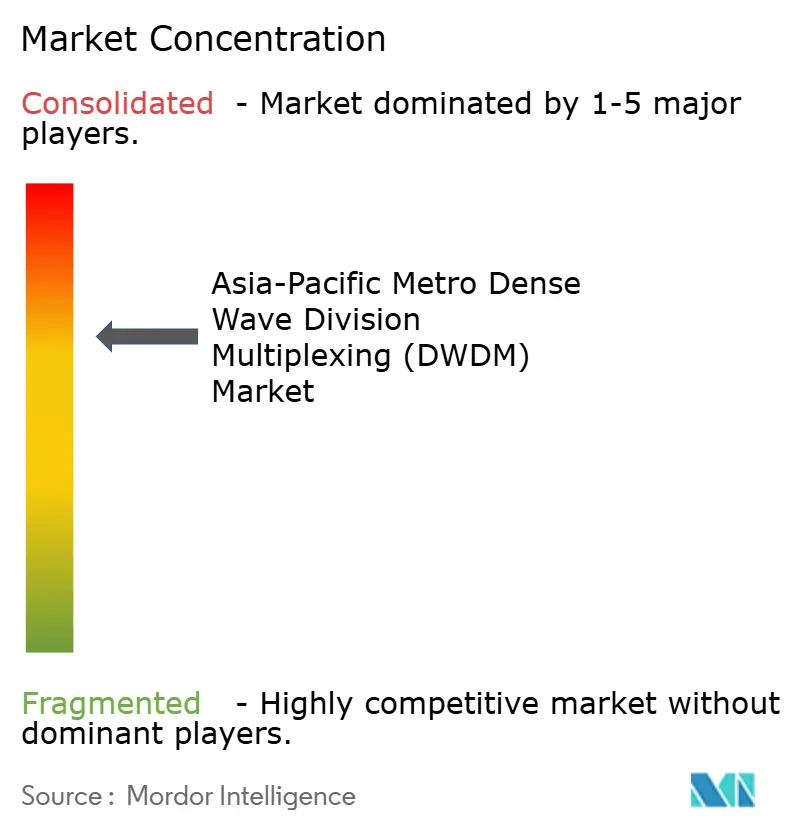
| Market Concentration | Medium |
Major Players *Disclaimer: Major Players sorted in no particular order Image © Mordor Intelligence. Reuse requires attribution under CC BY 4.0. | |
Asia-Pacific Metro Dense Wave Division Multiplexing (DWDM) Market Analysis by Mordor Intelligence
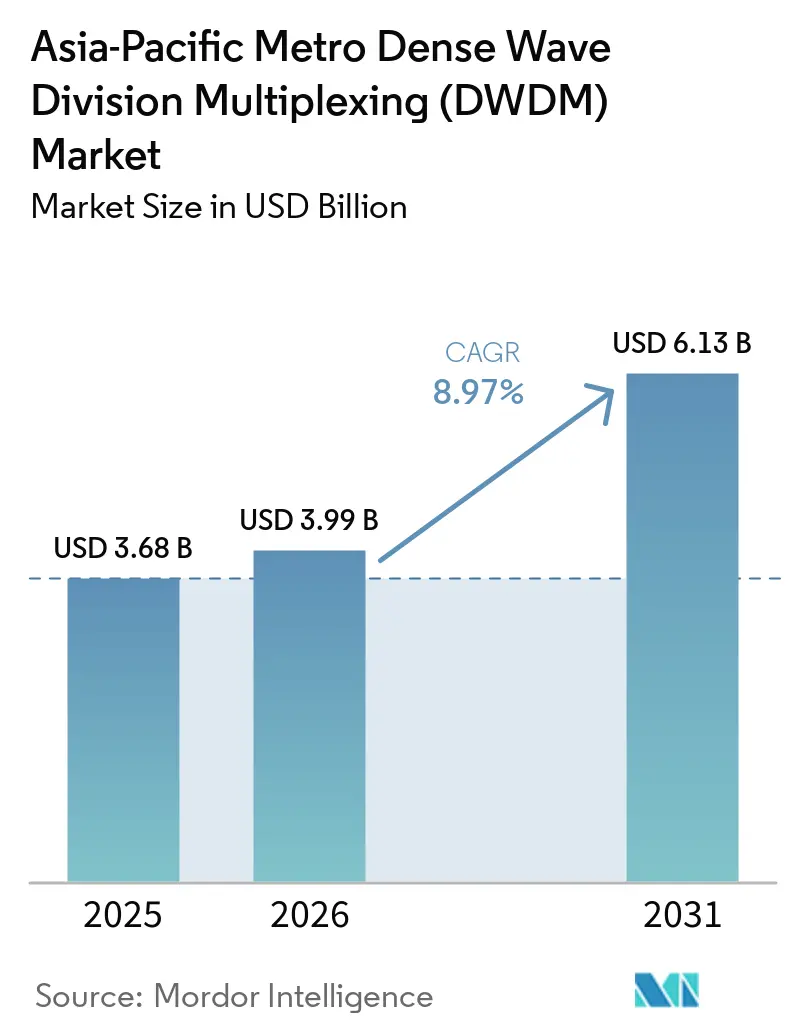
The Asia-Pacific Metro Dense Wave Division Multiplexing (DWDM) Market size is expected to increase from USD 3.68 billion in 2025 to USD 3.99 billion in 2026 and reach USD 6.13 billion by 2031, growing at a CAGR of 8.97% over 2026-2031. Demand is centered on metro networks that must carry more traffic for 5G, cloud, video, and artificial intelligence. Network operators are adding coherent optical capacity as they shorten the time between network upgrades. Government-backed fiber programs also extend the potential customer base beyond established mobile carriers. Suppliers are responding with higher-capacity systems, open network designs, and software that can manage complex optical layers. Procurement decisions increasingly weigh capacity, power use, interoperability, and exposure to concentrated component supply chains.
Key Report Takeaways
- By component, hardware held 84.73% of the Asia-Pacific Metro Dense Wave Division Multiplexing (DWDM) Market in 2025, while software is projected to expand at a 12.63% CAGR through 2031.
- By transmission capacity, 400 Gbps held 32.14% of the Asia-Pacific metro dense wave division multiplexing (DWDM) market in 2025, while above-400 Gbps solutions are projected to expand at a 13.32% CAGR through 2031.
- By application, mobile backhaul and fronthaul accounted for 31.87% of the Asia-Pacific metro DWDM market in 2025, while data center interconnect is projected to expand at a 12.53% CAGR through 2031.
- By end-user, communication service providers held 61.73% of the Asia-Pacific metro DWDM market in 2025, while cloud and data center providers are projected to expand at a 12.67% CAGR through 2031.
- By country, China held 42.87% of the Asia-Pacific metro DWDM market in 2025, while India is projected to expand at a 12.46% CAGR through 2031.
Note: Market size and forecast figures in this report are generated using Mordor Intelligence’s proprietary estimation framework, updated with the latest available data and insights as of January 2026.
Asia-Pacific Metro Dense Wave Division Multiplexing (DWDM) Market Trends and Insights
Drivers Impact Analysis*
| Driver | (~) % Impact on CAGR Forecast | Geographic Relevance | Impact Timeline |
|---|---|---|---|
| Accelerating 5G Metro Backhaul and Fronthaul Upgrades | +3.5% | China, India, Japan, South Korea, Southeast Asia | Short term (≤ 2 years) |
| Hyperscale Data Center Interconnect Expansion | +2.8% | China, India, Singapore, Australia and New Zealand | Medium term (2-4 years) |
| Rising Cloud, Video, AI and Internet Traffic | +2.2% | Global | Medium term (2-4 years) |
| Government-Led Fiber and Digital Infrastructure Investment | +1.5% | India, China, Indonesia, Philippines, Vietnam | Medium term (2-4 years) |
| Replacement of Legacy 100G Networks With 400G and 800G Coherent Systems | +1.0% | China, Japan, South Korea | Short term (≤ 2 years) |
| Expansion of Open and Disaggregated Optical Networking Architectures | +0.7% | Japan, South Korea, India, Australia and New Zealand | Long term (≥ 4 years) |
| Source: Mordor Intelligence | |||
Accelerating 5G Metro Backhaul and Fronthaul Upgrades
The Asia-Pacific Metro DWDM market benefits from 5G densification, as each new radio site increases transport requirements. Massive MIMO sites require sustained fronthaul or midhaul bandwidth that exceeds the requirements of legacy LTE sites. OTN-based transport remains suited to applications that require predictable latency and service isolation. Hybrid designs now place IPoDWDM in the IP core while keeping OTN in latency-sensitive fronthaul networks. China Mobile spent USD 18.4 billion on transport in 2025 and upgraded 580,000 base stations in tier-2 and tier-3 cities with 100 Gbps coherent backhaul. NTT Docomo completed a nationwide 100 Gbps rollout in March 2025 and continued trials of 800 Gbps ZR+ optics for extended reality services.
Hyperscale Data Center Interconnect Expansion
The Asia-Pacific Metro DWDM market is gaining momentum from data center links connecting large computing clusters. AI training and inference workloads require capacity between campuses, cloud regions, and landing stations. Vodafone Idea deployed Ciena WaveLogic 6 Extreme on its meshed DCI network in India in March 2026.[1] The deployment reached 1.6 Tb/s per wavelength without a new fiber build. This result showed how higher-baud optics can increase available capacity on established routes. It also reinforced the commercial case for upgrades where new cable construction would take longer or cost more.
Rising Cloud, Video, AI, and Internet Traffic
The Asia-Pacific Metro DWDM market is adapting to traffic that is more variable than conventional enterprise traffic. Generative AI and multimodel training can create bursts of data between computing, storage, and network locations. Such patterns place pressure on metro rings designed on the assumption of steady traffic. China Mobile activated a commercial three-band S+C+L optical fiber system in Qingdao in 2025. The deployment showed that operators can extract more capacity from existing fiber corridors through multiband transmission.
Government-Led Fiber and Digital Infrastructure Investment
The Asia-Pacific Metro DWDM market also draws support from public programs focused on fiber coverage and domestic computing capacity. China’s Six Networks initiative covers new-generation communications and computing power networks through 2030. The program keeps optical transport relevant to broader infrastructure planning. Vietnam requires USD 110 billion in digital infrastructure investment between 2026 and 2030.[2] Open-access fiber projects can create wholesale backbone capacity that private providers can use. This broadens demand beyond the usual group of national carrier buyers.
Restraints Impact Analysis*
| Restraint | (~) % Impact on CAGR Forecast | Geographic Relevance | Impact Timeline |
|---|---|---|---|
| High Initial Deployment and Integration Costs | -1.5% | Southeast Asia, India, Rest of Asia-Pacific | Medium term (2-4 years) |
| Export Controls and Fragmented Certification Requirements | -1.2% | Global, notably China-linked supply chains | Medium term (2-4 years) |
| Dependence on Specialized Coherent DSPs and Photonic Components | -0.8% | Global | Long term (≥ 4 years) |
| Country-Level Import Licensing and Local-Content Requirements | -0.5% | India, Indonesia, Southeast Asia | Medium term (2-4 years) |
| Source: Mordor Intelligence | |||
High Initial Deployment and Integration Costs
The Asia-Pacific Metro DWDM market faces a cost barrier, as operators have limited revenue per user and multiple network priorities. Deployments require coherent line systems, ROADM nodes, amplifiers, transponders, and management software. India’s fiberization reached 38% against a 75% target. Closing the gap requires INR 1.5-2.5 trillion (USD 17.9-29.8 billion) and competes with 5G radio investment. Multi-vendor networks can also add testing, certification, and operational costs. ITU-T and Open ROADM MSA frameworks help establish interoperability baselines, but they do not remove the cost of managing separate optical platforms.
Export Controls and Fragmented Certification Requirements
The Asia-Pacific Metro DWDM market remains exposed to supply disruptions involving indium phosphide and coherent optical components. China introduced export licensing controls on indium phosphide in February 2025. These controls affected a material used across coherent transceiver supply chains. Different certification requirements across China, Japan, South Korea, and India can further lengthen procurement cycles. The issue is significant for standardized transceivers used in high-volume mobile backhaul and fronthaul deployments. Operators may respond by qualifying more suppliers, although this approach can add further integration work.
*Our forecasts treat driver/restraint impacts as directional, not additive. The impact forecasts reflect baseline growth, mix effects, and variable interactions.
Segment Analysis
By Component: Hardware Leads While Software Adoption Expands
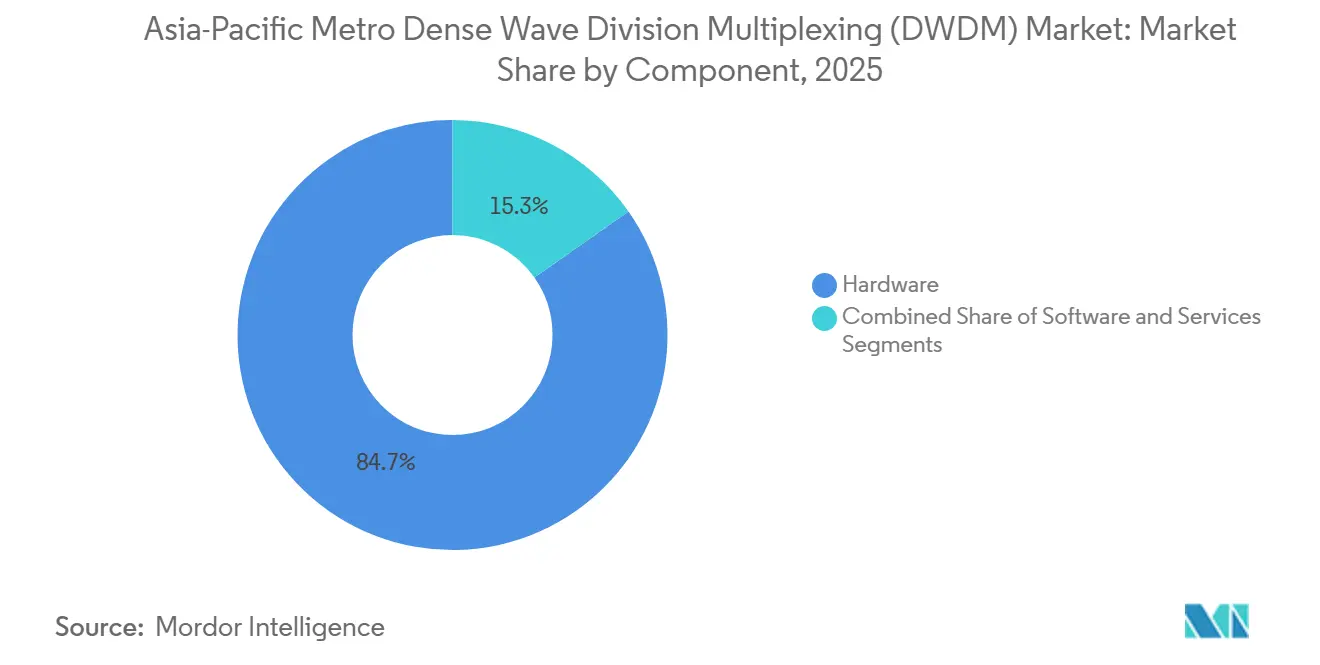
Hardware accounted for 84.73% of the Asia-Pacific Metro DWDM market share in 2025, reflecting the value of coherent line systems, ROADMs, amplifiers, and transponders. These assets set the performance limits of an optical deployment and remain central to vendor selection. Hardware spending is high because systems are installed across multiple network sites and must support long operating lives. Suppliers are advancing coherent optics to increase capacity on existing fiber routes. Huawei introduced a single-wavelength 2T metro solution on the OSN 9800 platform in March 2026. The platform supports 800G, 1.2T, 1.6T, and 2T operation per wavelength.[3]
Software is projected to expand at a 12.63% CAGR from 2026 to 2031, the fastest rate among component groups. Operators are shifting from isolated element management systems toward controllers that manage optical capacity across wider networks. KDDI began a large-scale deployment of Cluster-Based Distributed Disaggregated Backbone Routers in June 2026.[4] The system combined DriveNets software with UfiSpace hardware, reducing deployment costs by 50% compared with conventional chassis-based routers. Software-based control can improve how operators introduce new services and operate multi-vendor equipment. Services remain relevant because many operators need external support for network design and management. The Asia-Pacific Metro DWDM industry, therefore, continues to combine large equipment purchases with a rising need for software and specialist services.

By Transmission Capacity: 400 Gbps Remains Central as Higher Rates Advance
The 400 Gbps tier accounted for 32.14% of the Asia-Pacific Metro DWDM market in 2025. It became the core metro standard as operators replaced older 100G grid-based systems in China, Japan, and South Korea. Its balance of capacity, cost, and deployment readiness supported broad adoption. The OIF 400ZR Implementation Agreement established a coherent pluggable interface for metro links of up to 80 km. OpenZR+ then provided more flexibility for regional transport needs. These approaches enable the integration of coherent optics into routers and can reduce the number of network layers.
Capacity above 400 Gbps is projected to grow at a 13.32% CAGR through 2031. Demand comes from data center interconnect requirements and the availability of 800G coherent pluggables. Huawei’s 2T solution represented a further step in high-capacity metro transmission during 2026. The system provides multi-rate support and addresses routes with increasing AI and cloud traffic. ZTE and China Telecom completed an extended C+L-band 80×800 Gbps WDM trial on a live network in March 2025. The trial supported the case for improving fiber utilization by using a wider spectrum rather than by installing new cable. Up to 100 Gbps and 200 Gbps systems still serve edge metro and aggregation sites with lower traffic volumes.
By Application: Mobile Transport Leads While Data Center Links Accelerate
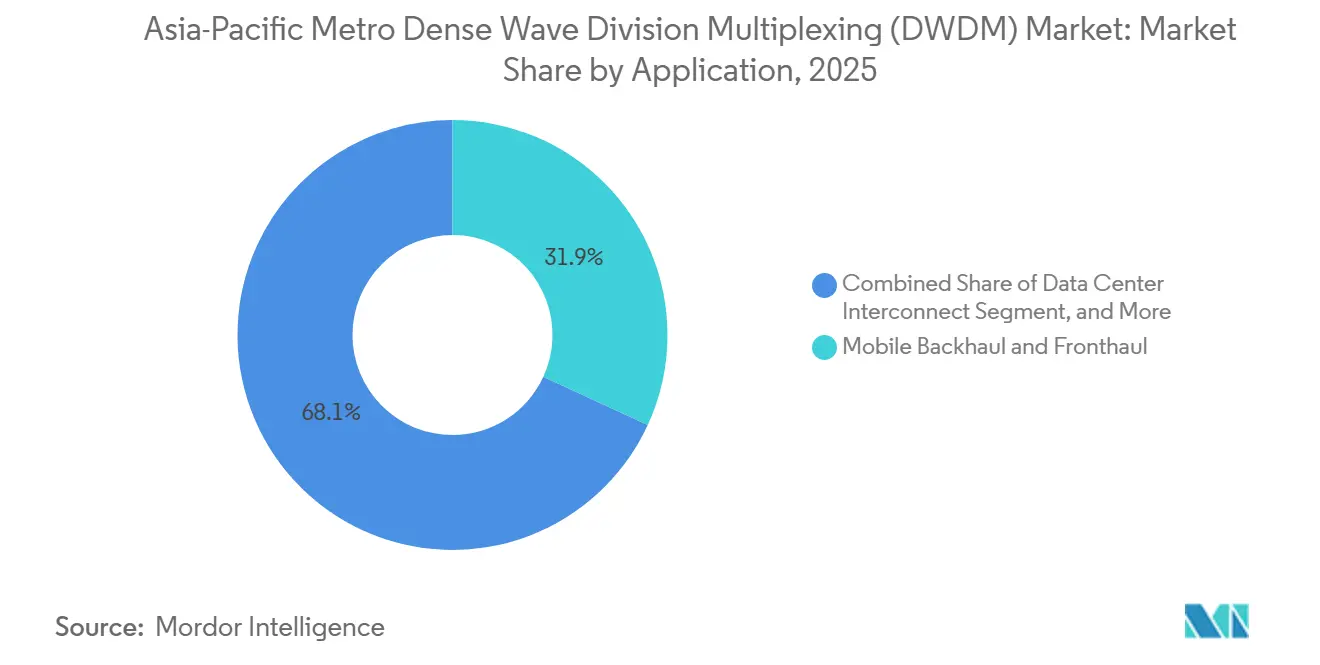
Mobile backhaul and fronthaul accounted for 31.87% of the Asia-Pacific Metro DWDM market revenue in 2025. Mobile operators need optical transport that can handle heavier 5G traffic while meeting tight timing requirements. China Unicom’s 5G-Advanced deployments covered more than 330 cities in 2026. The operator also directed more than 35% of its 2026 capital expenditure toward computing power, pre-commercial 10-gigabit optical fiber trials, and 5G-Advanced programs. Coherent metro DWDM is well-suited to fronthaul because eCPRI applications can require one-way latency as low as 100 µs. This need makes deterministic optical transport important, where mobile sites are closely coordinated.
Data center interconnect is projected to advance at a 12.53% CAGR through 2031. Lightstorm increased capacity on the Japan-Guam-Australia cable from 100 Gbps to 400 Gbps in March 2026 using Ciena WaveLogic coherent optics. The upgrade supported cloud and AI connectivity between Japanese and Australian data center locations. Faster upgrades can change the timing of optical investment because existing routes can be expanded before new construction is complete. The Telecom Infra Project open cable model also separates wet and dry plant in relevant cable builds. This arrangement can reduce vendor lock-in for future data center interconnect upgrades.
By End User: Communication Service Providers Lead as Cloud Providers Gain Influence
Communication service providers accounted for 61.73% of the Asia-Pacific Metro DWDM market revenue in 2025. They operate the broad metro footprints that connect mobile sites, business locations, cloud regions, and long-distance networks. China Mobile, China Telecom, and China Unicom directed a greater portion of capital expenditure toward AI computing infrastructure in 2025. This shifted procurement toward metro-coherent optics for data center interconnects rather than only for access expansion. South Korean carriers also tested holographic calling applications that require 1 Gbps per user. Such services can maintain the need for high-capacity optical transport through the forecast period.
Cloud and data center providers are projected to expand at a 12.67% CAGR from 2026 to 2031. Their requirements increasingly influence where metro capacity is added and how it is configured. NEC signed the supply contract for the I-2SEA submarine fiber-optic cable system in July 2026. The cable will connect Hyderabad and Chennai data center clusters with Singapore and Kuala Lumpur, with operations scheduled for 2029. Data sovereignty and local data residency rules are encouraging providers to develop local facilities in Japan, India, Indonesia, and Australia. Government and public sector customers also have greater strategic relevance as sovereign AI data center programs emerge.
Geography Analysis
China held 42.87% of the Asia-Pacific Metro DWDM market share in 2025. Its position reflects large infrastructure programs, coordinated investment, and a deep group of domestic equipment suppliers. The Six Networks initiative supports investment in communication and computing networks through 2030. China Mobile activated a commercial three-band S+C+L optical fiber system in Qingdao in 2025. This approach increased capacity within existing fiber corridors by using multiband spectrum. China Unicom reduced its overall capital expenditure to CNY 50 billion (USD 7.2 billion) in 2026. It nevertheless kept funding for computing power, 10-gigabit optical fiber trials, and 5G-Advanced deployments across more than 330 cities.
Japan, South Korea, Australia, and New Zealand represent a mature group with advanced optical research and demanding enterprise requirements. NTT demonstrated 160 Tbps transmission over more than 1,000 km using an X-band wavelength range and a 27 THz signal in August 2025. KDDI co-led the standardization of ITU-T Recommendation Y.3335 in August 2026. The recommendation defines requirements for low-latency photonic paths across multiple operators. KT validated 1.2 Tbps on the Seoul-Busan corridor, while SK Telecom completed a live IPoDWDM proof of concept on an all-photonics network. Australia’s expanding data center base and planned intercity fiber routes provide the physical foundation for additional metro optical services.
India is projected to record a 12.46% CAGR through 2031, making it the fastest-growing country in the Asia-Pacific Metro DWDM market. Nokia partnered with Constl to build a pan-India DWDM optical transport network that starts in Mumbai and expands nationwide. Tejas Networks won a PowerGrid Teleservices contract in October 2025 for a 400 Gbps DWDM upgrade using the TJ1600 DWDM/OTN platform. The platform supports up to 1.2 Tbps per wavelength. Southeast Asia includes Indonesia, Vietnam, the Philippines, and Malaysia within the Rest of Asia-Pacific segment. Telkom Group activated the Nongsa-Changi Cable between Indonesia and Singapore in July 2026. The link connects domestic network investment with international gateway capacity.
Competitive Landscape
The Asia-Pacific Metro DWDM market is moderately consolidated among system vendors. Huawei has the broadest product scope across high-capacity metro optical systems. Its 2T metro solution on the OSN 9800 platform became commercially available in 2026. Nokia strengthened its optical portfolio through the USD 2.3 billion acquisition of Infinera. Ciena competes with its WaveLogic 6 Extreme platform, which was commercially available in January 2025 with 1.2 Tbit/s per wavelength. These suppliers compete across Japan, India, South Korea, Australia, and other regional markets.
ZTE completed a C+L full-band integrated 1.6 Tbps live network trial with Turk Telekom in March 2026. The trial doubled backbone capacity and reduced per-Gbit power consumption by 25%. Huawei has also described AI-based optical performance simulation and traffic-based port hibernation as differentiators for optical network operations. The Asia-Pacific Metro DWDM market rewards vendors that can supply high capacity while reducing power use and operating complexity. Nokia, Ciena, Huawei, and ZTE also face a growing need to support open interfaces. This requirement can limit dependence on a single supplier in public and multi-operator projects.
India, Indonesia, Vietnam, and the Philippines offer opportunities among data center operators and utility carriers with limited optical engineering capacity. Tejas Networks offers alien wavelength technology for brownfield upgrades. Ribbon Communications deployed its Apollo 9608 modular DCI platform on a new DWDM link between Indonesian and Singaporean data centers in 2026. Open ROADM MSA conformance is becoming more relevant in government-backed tenders across India and Southeast Asia. PacketLight Networks and NEC demonstrated quantum key distribution on a 400G DWDM link in July 2025. The work showed an early application for quantum-secured optical transport. The Asia-Pacific Metro DWDM industry retains room for specialist suppliers, where integration, security, and open-network support are decisive factors.
Asia-Pacific Metro Dense Wave Division Multiplexing (DWDM) Industry Leaders
-
Huawei Technologies Co., Ltd.
-
Ciena Corporation
-
Nokia Corporation
-
ZTE Corporation
-
Cisco Systems, Inc.
- *Disclaimer: Major Players sorted in no particular order
Recent Industry Developments
- September 2026: The Australian government committed AUD 65 million (USD 46.6 million) to the AUD 135 million (USD 96.7 million) East Micronesia Cable System, a 2,250 km subsea link that completes connectivity for all Pacific Islands Forum members and strengthens the subsea backbone feeding regional metro DWDM networks.
- August 2026: KDDI, NTT, 1FINITY, NEC, Rakuten Mobile, OKI, and Sumitomo Electric co-led the international standardization of AI-era low-latency, low-power network design guidelines under ITU-T Recommendation Y.3335, ratified in August 2026, which defines technical requirements for constructing low-latency photonic paths across multiple operators.
- August 2026: FiberHome Telecommunication Technologies signed a contract with Globe Telecom for Phase II of the Globe Submarine Optical Cable Project in the Philippines, advancing implementation of a higher-bandwidth, lower-latency national connectivity system.
- July 2026: NEC signed the supply contract for the I-2SEA submarine fiber-optic cable system, a 3,600-km link connecting Hyderabad and Chennai AI data center clusters to Singapore and Kuala Lumpur, with operations scheduled for 2029.
Asia-Pacific Metro Dense Wave Division Multiplexing (DWDM) Market Report Scope
The Asia-Pacific metro dense wave division multiplexing (DWDM) market revenue is generated through the sale of DWDM hardware, software licenses and subscriptions, and associated deployment, integration, network management, maintenance, and support services provided to communication service providers, cloud and data center providers, enterprises, government organizations, and other end-users.
The Asia-Pacific metro dense wave division multiplexing (DWDM) market report is segmented by component (hardware, software, and services), transmission capacity (up to 100 Gbps, 200 Gbps, 400 Gbps, and above 400 Gbps), application (data center interconnect, mobile backhaul and fronthaul, broadband and access network aggregation, and other applications), end-user (communication service providers, cloud and data center providers, enterprises, and government and public sector), and country (China, Japan, South Korea, India, Australia and New Zealand, and rest of Asia-Pacific). The market forecasts are provided in terms of value (USD).
| Hardware |
| Software |
| Services |
| Up to 100 Gbps |
| 200 Gbps |
| 400 Gbps |
| Above 400 Gbps |
| Data Center Interconnect |
| Mobile Backhaul and Fronthaul |
| Broadband and Access Network Aggregation |
| Other Applications |
| Communication Service Providers |
| Cloud and Data Center Providers |
| Enterprises |
| Government and Public Sector |
| China |
| Japan |
| South Korea |
| India |
| Australia and New Zealand |
| Rest of Asia-Pacific |
| By Component | Hardware |
| Software | |
| Services | |
| By Transmission Capacity | Up to 100 Gbps |
| 200 Gbps | |
| 400 Gbps | |
| Above 400 Gbps | |
| By Application | Data Center Interconnect |
| Mobile Backhaul and Fronthaul | |
| Broadband and Access Network Aggregation | |
| Other Applications | |
| By End-User | Communication Service Providers |
| Cloud and Data Center Providers | |
| Enterprises | |
| Government and Public Sector | |
| By Country | China |
| Japan | |
| South Korea | |
| India | |
| Australia and New Zealand | |
| Rest of Asia-Pacific |
Key Questions Answered in the Report
What is the Asia-Pacific Metro DWDM market size?
The Asia-Pacific Metro DWDM market was valued at USD 3.68 billion in 2025 and is projected to reach USD 6.13 billion by 2031 at an 8.97% CAGR.
What is driving demand for metro DWDM systems in Asia-Pacific?
5G densification, data center interconnect needs, AI traffic, and public fiber investment are increasing demand for high-capacity optical transport.
Which component leads metro DWDM spending in Asia-Pacific?
Hardware led revenue with an 84.73% share in 2025 because coherent line systems, ROADMs, amplifiers, and transponders require substantial investment.
Which transmission capacity is expanding fastest?
Above-400 Gbps solutions are projected to expand at a 13.32% CAGR through 2031 as data center and cloud requirements increase.
Which country is projected to expand fastest through 2031?
India is projected to expand at a 12.46% CAGR, supported by data center corridor investment and nationwide optical transport deployments.
How concentrated is the Asia-Pacific Metro DWDM supplier base?
The supplier base is moderately consolidated, with global incumbents and regional challengers competing across major national markets and emerging deployment areas.