
Asia-Pacific Metal Forming Equipment Market Size and Share
Market Overview
| Study Period | 2020 - 2031 |
|---|---|
| Forecast Data Period | 2026 - 2031 |
| Base Year Market Size (2025) | USD 13.06 Billion |
| Market Size (2026) | USD 13.55 Billion |
| Market Size (2031) | USD 15.79 Billion |
| Growth Rate (2026 - 2031) | 3.10 % |
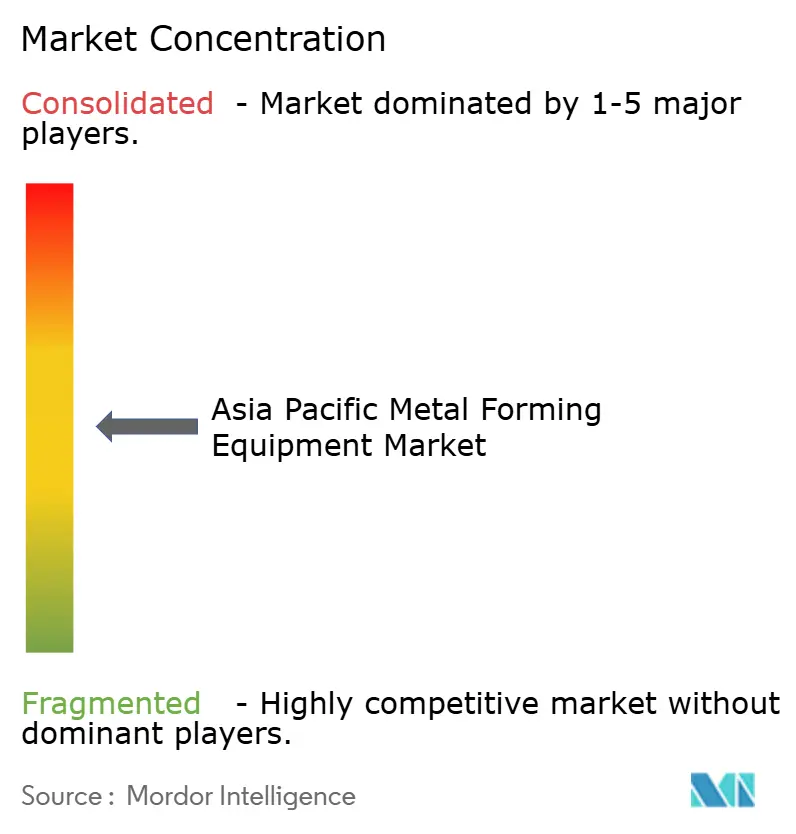
| Market Concentration | Medium |
Major Players *Disclaimer: Major Players sorted in no particular order Image © Mordor Intelligence. Reuse requires attribution under CC BY 4.0. | |
Asia-Pacific Metal Forming Equipment Market Analysis by Mordor Intelligence
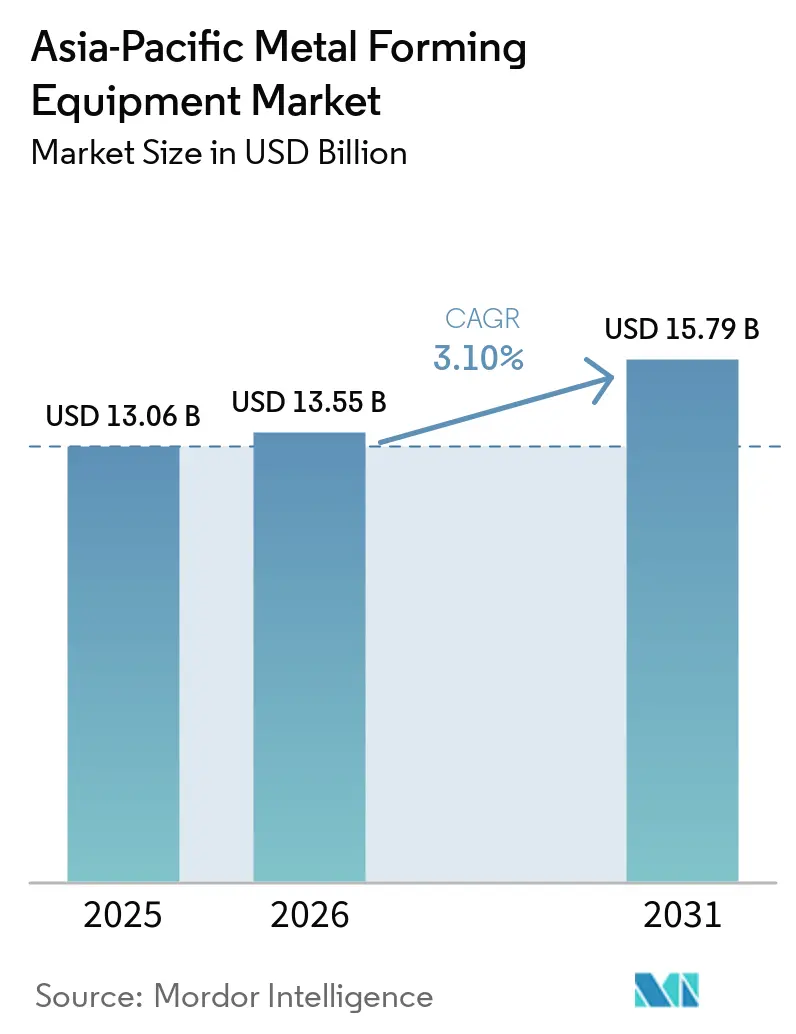
The Asia-Pacific Metal Forming Equipment Market size was valued at USD 13.06 billion in 2025 and is estimated to grow from USD 13.55 billion in 2026 to reach USD 15.79 billion by 2031, at a CAGR of 3.10% during the forecast period (2026-2031).
China remains the region’s largest production and consumption center for formed metal components, supported by established press manufacturing clusters. India and ASEAN are attracting capacity investment as EV supply chains, industrial corridors, and semiconductor production expand. Chinese suppliers are moving into higher-value servo press and automated bending applications, increasing pressure on Japanese and European suppliers. Demand is also being supported by investment in vehicle manufacturing, electronics facilities, renewable energy equipment, and grid infrastructure. High equipment costs, shortages of trained technicians, imported control components, and pricing pressure in standard press categories continue to shape procurement decisions across the Asia-Pacific metal forming equipment market.
Key Report Takeaways
- By equipment type, press machines held 38.5% of the Asia-Pacific metal forming equipment market share in 2025, while servo presses are forecast to grow at a 6.2% CAGR through 2031.
- By forming process, stamping and punching held 28.8% of the Asia-Pacific metal forming equipment market size in 2025, while hydroforming is forecast to grow at a 6.7% CAGR through 2031.
- By material formed, carbon and low-alloy steel held a 45.2% share in 2025, while aluminum and aluminum alloys are forecast to grow at a 5.1% CAGR through 2031.
- By end-use industry, automotive and transportation held a 35% share in 2025, while aerospace and defense are forecast to grow at a 5.9% CAGR through 2031.
- By geography, China held a 36.5% share in 2025, while India is forecast to grow at a 5.8% CAGR through 2031.
Note: Market size and forecast figures in this report are generated using Mordor Intelligence’s proprietary estimation framework, updated with the latest available data and insights as of January 2026.
Asia-Pacific Metal Forming Equipment Market Trends and Insights
Drivers Impact Analysis*
| Driver | (~) % Impact on CAGR Forecast | Geographic Relevance | Impact Timeline |
|---|---|---|---|
| Automotive, EV and Lightweight-Component Capacity Expansion | +0.9% | China, India, ASEAN | Short term (≤ 2 years) |
| Electronics, Semiconductor and Electrical-Enclosure Manufacturing Growth | +0.6% | South Korea, Japan, China, Taiwan | Medium term (2-4 years) |
| Industry 4.0, Robotics and Smart-Factory Modernization | +0.5% | China, Japan, South Korea, Singapore | Medium term (2-4 years) |
| Renewable Energy, Grid Infrastructure and Energy-Storage Component Demand | +0.4% | China, India, Vietnam, ASEAN | Long term (≥ 4 years) |
| Localized Servo-Press Ecosystems for Battery-Casing and Motor-Core Production | +0.3% | China, South Korea, Japan | Medium term (2-4 years) |
| RCEP-Enabled Supplier Diversification and Regional Production Migration | +0.2% | ASEAN, India | Medium term (2-4 years) |
| Source: Mordor Intelligence | |||
Automotive, EV and Lightweight-Component Capacity Expansion
Automotive supply-chain migration is the strongest demand driver for the Asia-Pacific metal forming equipment market. OEMs and Tier 1 suppliers are commissioning servo presses, hot-stamping cells, and transfer presses as they expand EV production. BYD inaugurated its IDR 16 trillion (USD 0.95 billion) integrated EV complex in Subang, Indonesia, with stamping, welding, painting, and assembly operations on a 126-hectare site with an annual capacity of 150,000 vehicles. The facility received 130 stamping dies weighing 2,489 tons from Shenzhen during May 2026, marking a shift from kit assembly toward local manufacturing. EV platforms require more stamped components than comparable internal-combustion vehicles because they add battery enclosures, motor housings, and underbody reinforcements. This expands press-cycle requirements even when headline vehicle capacity changes little. Automotive investment also increases demand for presses that can handle advanced high-strength steel and aluminum. Hot-stamping cells support structural crash parts such as door rings, B-pillars, and underbody reinforcements. Servo press lines are relevant for battery enclosures and motor-core laminations, while transfer presses improve throughput for repeated parts. The Asia-Pacific metal forming equipment market benefits when suppliers build these capabilities locally rather than importing finished components. India and ASEAN remain important locations because global producers are diversifying sourcing and manufacturing. The resulting purchases cover complete press lines, dies, material handling, inspection, and related service support.
Electronics, Semiconductor and Electrical-Enclosure Manufacturing Growth
Semiconductor and electronics production support demand for progressive-die stamping, CNC punching, and automated bending systems. These systems make enclosures, lead frames, heatsinks, shielding parts, and cleanroom hardware. SK hynix approved KRW 54.3 trillion (USD 38.2 billion) for its Y2 DRAM and M17 NAND facilities in 2026, creating downstream demand for precision-made production hardware. Kyocera completed its JPY 68 billion (USD 454.4 million) Nagasaki Isahaya plant in September 2026 for semiconductor component production. These investments support orders for smaller, accurately formed components used in facility infrastructure and equipment supply chains. Electronics applications place particular value on repeatable dimensional performance, fast cycle times, and clean handling. Factory modernization adds another source of demand beyond production volume. AIDA launched its SAT-M high-speed transfer robot and ARB-M1 articulated robot in April 2026 for direct press-to-press material movement. The equipment supports tandem-line takt times of 30 strokes per minute and reduces manual handling stages. SEYI demonstrated a 160-ton servo press with its SIMS+ monitoring system for hydrogen fuel-cell bipolar-plate stamping in 2025. Robotics, connected monitoring, and digital process control can reduce setup delays and improve press-line use. Workforce constraints in Japan, South Korea, and Taiwan make automated transfer systems more necessary for many manufacturers.
Industry 4.0, Robotics, And Smart Factory Modernization
Industry 4.0, robotics, and smart-factory modernization are supporting the replacement of legacy mechanical and hydraulic presses with connected servo-electric systems. Modern press lines increasingly integrate sensors, programmable controls, machine-vision systems, and production software to provide real-time visibility into machine performance and process quality. AIDA launched its SAT-M high-speed transfer robot and ARB-M1 articulated robot in April 2026 for direct press-to-press material movement. The equipment supports tandem-line takt times of 30 strokes per minute and reduces manual handling stages. Automated transfer can also improve part positioning consistency and reduce operator exposure to repetitive material-handling tasks. SEYI demonstrated a 160-ton servo press with its SIMS+ monitoring system for hydrogen fuel-cell bipolar-plate stamping in 2025. Robotics, connected monitoring, and digital process control can reduce setup delays and improve press-line use. Condition-monitoring capabilities can further support predictive maintenance by identifying abnormal vibration, temperature, force, or cycle-performance patterns before failures cause extended downtime. Workforce constraints in Japan, South Korea, and Taiwan make automated transfer systems more necessary for many manufacturers.
Renewable Energy, Grid Infrastructure and Energy-Storage Component Demand
Renewable energy projects require roll-forming, extrusion, and hydraulic press capacity for wind-tower sections, solar mounting profiles, and battery cabinet panels. Equipment suppliers need large bed sizes and corrosion-resistant specifications for these applications. China, India, and Vietnam are important demand centers because their renewable energy supply chains require local structural components. ReNew announced an INR 4,200 crore (USD 482.02 million) solar ingot-wafer facility in Andhra Pradesh in April 2026. Such investment supports fabrication activity around solar equipment and related structures. Renewable energy requirements differ from automotive production because they need continuous, large-format operations rather than repeated vehicle body-panel cycles. Grid and storage investment also broadens the customer base for the Asia-Pacific metal forming equipment market. Battery cabinets use formed panels that must provide structural strength and enclosure protection. Wind-related production uses heavy-gauge material and long sections that suit roll-forming processes. Solar applications rely on formed mounting and support components, which creates demand for extrusion and bending equipment. The need for corrosion resistance can affect tooling choices and the material handling requirements of a press line. Manufacturers serving this work need configurations that differ from conventional automotive installations. This makes renewable energy a distinct and growing area of equipment demand within regional manufacturing investment across several countries.
Restraints Impact Analysis*
| Restraint | (~) % Impact on CAGR Forecast | Geographic Relevance | Impact Timeline |
|---|---|---|---|
| High Capital Intensity and Long Payback Periods | -0.6% | ASEAN, India, China | Short term (≤ 2 years) |
| Skilled Tool-and-Die, Programming and Maintenance Labor Shortages | -0.5% | Japan, South Korea, Taiwan, Australia | Medium term (2-4 years) |
| Imported Controller, Servo, Linear-Guide and Hydraulic-Component Dependence | -0.4% | ASEAN, China, India | Medium term (2-4 years) |
| Price Competition and Margin Compression in Chinese and Southeast Asian Equipment Supply | -0.3% | China, ASEAN | Short term (≤ 2 years) |
| Source: Mordor Intelligence | |||
High Capital Intensity and Long Payback Periods
High capital costs restrict modernization by small and mid-sized press shops in ASEAN, South Asia, and inland China. A mid-range servo press line for EV battery-enclosure stamping can require USD 1 million to USD 3 million per unit. Greenfield Tier 2 automotive supplier press shops can exceed USD 15 million in total investment. These costs are difficult to recover when OEM order visibility often extends only 12 to 18 months. The Asian Development Bank identified access to finance as a major technology-adoption barrier for manufacturing SMEs in developing Asia-Pacific economies.[1]Asian Development Bank (ADB), “ADB Annual Report 2025,” Asian Development Bank, adb.org. Longer replacement cycles in mid-income economies can sustain the use of older mechanical presses. India’s Production Linked Incentive scheme for capital goods provides incentives of 5% to 6% on incremental production value for eligible manufacturers.[2]Ministry of Heavy Industries, Government of India, “Production Linked Incentive Scheme for Capital Goods,” Ministry of Heavy Industries, mhi.gov.in The policy recognizes the investment burden faced by domestic manufacturers. The Asia-Pacific metal forming equipment market also faces costs for proprietary software, calibration, spare parts, and service support. These costs extend the effective payback period for servo systems. Cost-sensitive buyers may choose refurbishment of mechanical presses rather than a new purchase. Price competition in standard hydraulic and mechanical machines further narrows supplier margins and limits pricing flexibility.
Skilled Tool-and-Die, Programming and Maintenance Labor Shortages
Shortages of tool-and-die workers, CNC programmers, and maintenance technicians limit the use of existing presses and raise the risk of new investment. Japan, South Korea, and Taiwan face retirement-driven losses among experienced operators. India and ASEAN have large workforces but fewer workers with advanced servo diagnostics, die design, and CNC programming capabilities. The Australian Manufacturing Technology Institute reported more than 1,000 unfilled CNC operator roles in 2025. Training gaps make it harder for smaller factories to deploy automated systems fully. They also increase demand for supplier-led installation, training, and maintenance support. The region also depends on imported servo drives, CNC controllers, linear guides, and selected hydraulic components. This is most evident in premium equipment applications across China, India, and ASEAN. Imported parts can lengthen repair timelines and increase working-capital needs for spare-parts inventories. China’s domestic-substitution programs seek to reduce reliance on imported servo and control technologies. The Asia-Pacific metal forming equipment market will still require reliable access to precision components while localization develops. Buyers must consider machine availability and serviceability, not only the price quoted at purchase.
*Our forecasts treat driver/restraint impacts as directional, not additive. The impact forecasts reflect baseline growth, mix effects, and variable interactions.
Segment Analysis
By Equipment Type: Press Technology Shifts Toward Servo Precision
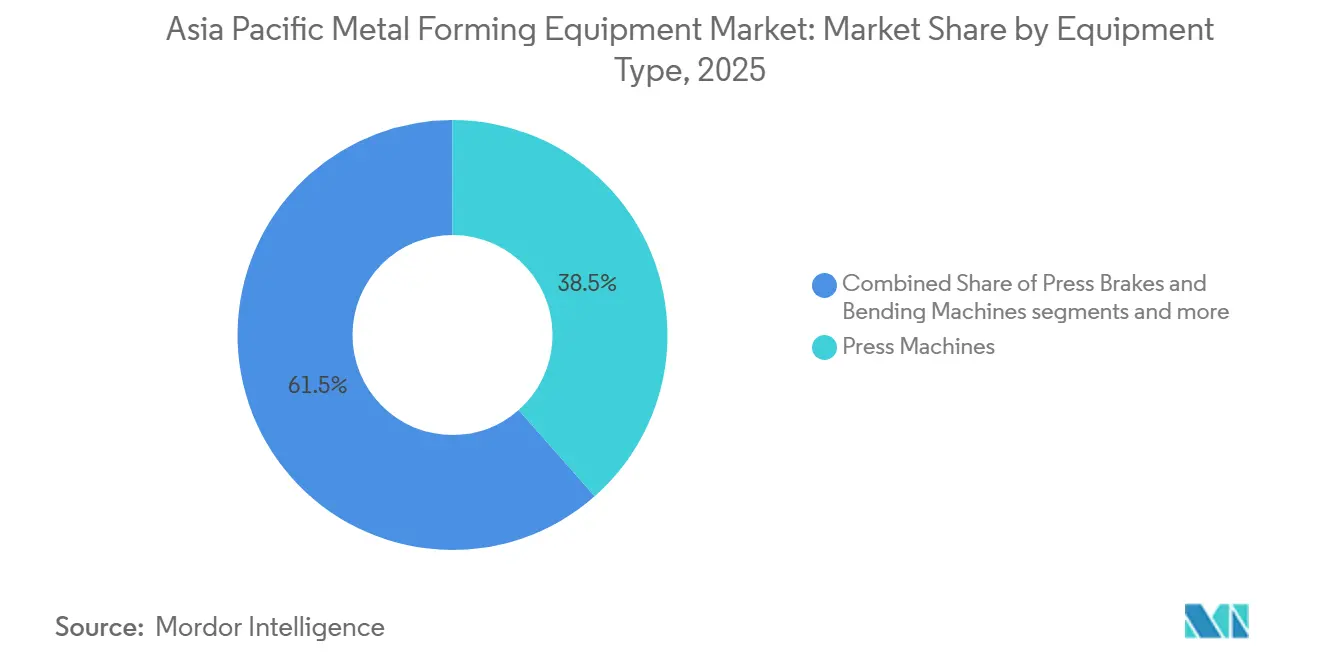
Press machines held 38.5% of the Asia-Pacific metal forming equipment market size in 2025 because they support stamping, deep drawing, blanking, and coining across automotive and electronics production. Mechanical presses lead the installed base in China, India, and ASEAN job shops because they have lower acquisition costs and simple maintenance. In contrast, hydraulic presses remain important in forging and heavy fabrication because they provide flexible force through the stroke. Press brakes and bending machines form the next major group, with South Korean and Taiwanese sheet-metal shops shifting toward servo-electric and hybrid servo-hydraulic configurations that can reduce energy use relative to constant-speed hydraulic equipment. Forging equipment supports defense and aerospace components, while roll-forming and extrusion presses serve wind-tower sections and solar-racking profiles, so material grade, production volume, precision, and plant space remain central purchasing considerations.
Servo presses are forecast to grow at a 6.2% CAGR through 2031 because EV battery enclosures, fuel-cell plates, and semiconductor lead frames need accurate forming, and AIDA’s transfer robot launches and SEYI’s demonstration show the closer link between press technology and automated handling. New purchases increasingly focus on integrated cells combining presses, robots, vision inspection, and connected monitoring, which shifts competition from individual machines toward complete systems. China’s JB/T requirements and Japan’s JIS requirements affect machine design and qualification, creating a more difficult path for suppliers without local compliance experience. The Asia-Pacific metal forming equipment industry remains divided between premium automation systems and lower-cost standard presses, although the fastest-growing applications favor suppliers with dependable controls and service.



By Forming Process: Stamping Scales as Hydroforming Earns EV Credentials
Stamping and punching held 28.8% share in 2025 because automotive panels, electronics enclosures, and appliance casings require high-cycle production, with progressive-die lines operating at 100 to 400 strokes per minute in electronics and connector supply chains. High-speed servo-punch demand is rising as EV power electronics and AI server hardware use smaller parts. At the same time, deep drawing serves battery-cell cans, pump housings, and pressure vessels with improved blank-holding control, enabling deeper aluminum forms. Bending with CNC press brakes and panel benders serves construction, energy, and data-center enclosures, while extrusion and rolling support renewable structures and industrial machinery parts. Stamping retains its leading position because it delivers repeatable high-volume output, with process selection determined by part geometry, material thickness, output needs, and secondary assembly requirements.
Hydroforming is forecast to grow at a 6.7% CAGR through 2031 in the Asia-Pacific metal forming equipment market because EV designers use it for aluminum and stainless steel battery-tray rails, chassis nodes, and cooling-manifold tubes. It removes secondary welding and supports lighter components for range requirements, and its use should rise as body structures incorporate more tubular members. Specialist OEMs hold much of the high-pressure equipment expertise, leaving an opening for mid-tier builders with the necessary high-pressure tooling and CNC machine-building capability. Forging continues to benefit from titanium and nickel alloy aerospace and defense demand in India, Japan, and South Korea, where procurement programs offer longer revenue visibility.
By Material Formed: Steel Holds Volume Advantage, Aluminum Gains Structural Ground
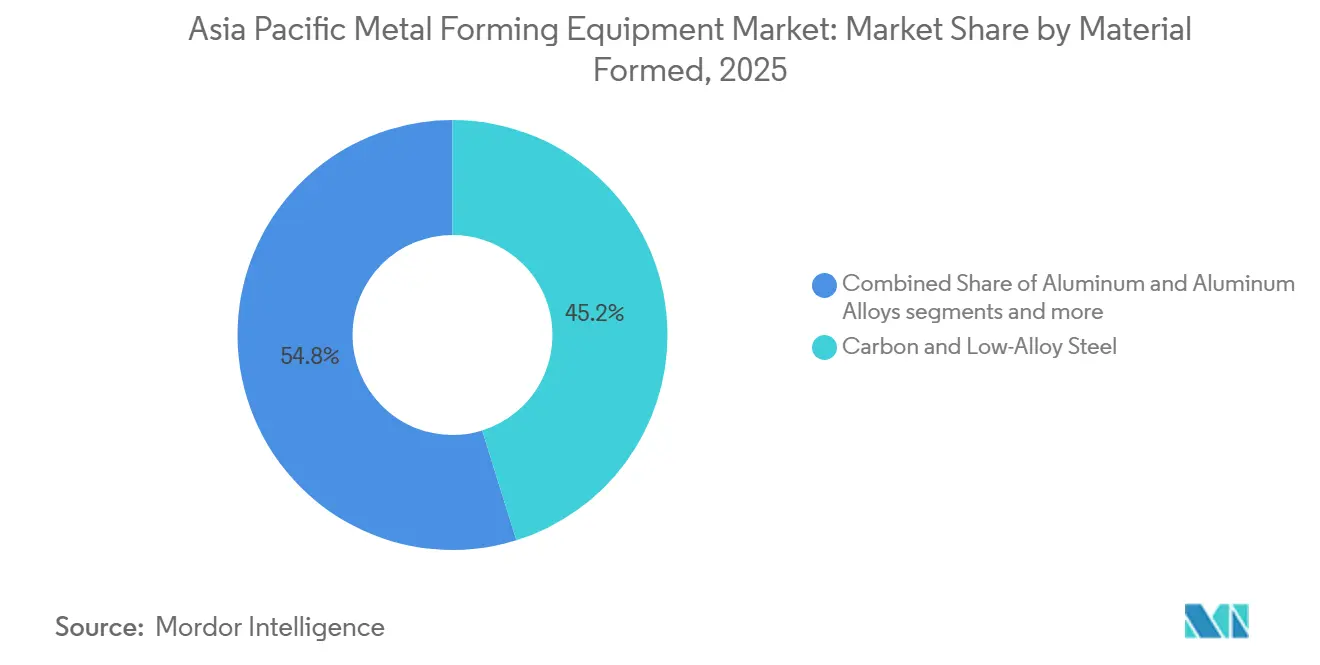
Carbon and low-alloy steel commanded 45.2% share in 2025, reflecting its use in automotive structures, construction profiles, and machinery housings where cost and weldability matter. Ultra-high-strength steel, including press-hardened grades of 1,500 MPa and above, is gaining use in door rings, B-pillars, and underbody reinforcements, requiring hot-stamping cells with rapid blank heating and quenching. Stainless steel remains relevant for food processing, pharmaceutical equipment, and solar mounting structures, while broad availability and an established supply chain support steel use across regional manufacturing. Buyers must match press force, tooling, and thermal systems to material grades, leaving hot stamping important even as lightweight materials increase.
Aluminum and aluminum alloys are forecast to grow at a 5.1% CAGR through 2031 because EV battery enclosures, motor housings, and structural parts use the material to reduce vehicle weight, while its springback and galling sensitivity favor accurate servo control and servo-hydraulic retrofits. AMADA demonstrated copper bus-bar processing for EV powertrain applications on an automated non-ferrous forming system in May 2026, and copper alloys remain a specialty stream for bus bars and connectors.[3]AMADA Co., Ltd., “Participation in the 2026 International Welding Show,” AMADA, amada.co.jp Titanium, nickel, and other non-ferrous metals serve close-tolerance aerospace and defense work in Japan, India, and South Korea, sometimes requiring isothermal presses. The shift from steel to aluminum changes press-line specifications and strengthens the role of suppliers with precision servo capability.
By End-Use Industry: Automotive Volume Underpins Market, Aerospace Defense Breaks Out
Automotive and transportation held 35% share in 2025 within the Asia-Pacific metal forming equipment market because China, Japan, South Korea, India, and ASEAN combine substantial vehicle production with growing local supplier capacity. EV production reshapes the equipment mix by adding battery enclosure presses, hot-stamping cells for crash parts, and transfer presses for motor-core laminations, as well as demand for dies, automation, inspection, and maintenance services. Industrial machinery, metal products, fabrication, and construction form a stable middle tier, while electrical and electronics applications draw support from semiconductor and facility investment. Consumer appliances remain substantial but mature, so automotive activity continues to set the pace for many high-volume equipment purchases.
Aerospace and defense is forecast to grow at a 5.9% CAGR through 2031, supported by India’s localized procurement policies and Japan and South Korea’s aircraft and naval programs, which require precision forging, sheet-metal forming, and tube bending. These applications demand tight tolerances for titanium and aluminum structural work and often have longer production programs than consumer applications. Medical and precision manufacturing is a smaller, higher-value field for fine-blanking and servo-controlled systems that need repeatable dimensions and ISO 13485-related validation. The Asia-Pacific metal forming equipment industry, therefore, serves both volume automotive orders and specialized aerospace, defense, medical, and appliance demand.
Geography Analysis
China held 36.5% share in 2025 within the Asia-Pacific metal forming equipment market because it is a major press manufacturer and user of formed components. Domestic producers meet much of the country’s standard mechanical and hydraulic press demand, although premium servo press work depends on imported motors, linear guides, and CNC controllers. Renewable energy, electronics, automotive, and industrial production create several demand sources. Domestic servo-drive and control development could reduce import dependence and reshape premium system-builder competition. The Asia-Pacific metal forming equipment market is therefore supported by China’s broad installed base and its ongoing technology upgrade cycle.
India is forecast to grow at a 5.8% CAGR through 2031, making it the fastest-growing geographic market, supported by industrial policy, manufacturing expansion, and China-plus-one investment. ISGEC approved an INR 218 crore (USD 25.02 million) Machine Building Division expansion in February 2026 for automotive, forging, defense, and nuclear applications. ASEAN adds demand through Thailand’s automotive base, Vietnam’s EV and electronics plans, and Indonesia’s vehicle investment. China, Japan, and South Korea provide capital and technology while ASEAN expands its manufacturing role. This distribution supports purchases of new production lines, tooling, automation, and related supplier equipment across the region over the forecast period.
Japan and South Korea are mature but active markets focused on technology upgrades and next-generation production platforms. Semiconductor facilities, electronics production, and EV modernization support high-precision stamping and fine-blanking demand, including supply-chain effects from SK hynix’s 2026 investment program. Taiwan adds a precision electronics forming ecosystem, while Australia, the Philippines, and Cambodia contribute renewable-energy and smaller-scale manufacturing demand. These markets broaden the regional customer base beyond China, India, and ASEAN.
Competitive Landscape
The Asia-Pacific metal forming equipment market exhibits a medium level of market concentration. AMADA, Komatsu, Schuler, ANDRITZ, and TRUMPF provide servo presses, automated bending cells, and integrated production systems, supported by control systems, precision engineering, application knowledge, and service networks. Chinese producers, including JIER Machine-Tool, Jiangsu Yangli, Hefei Metalforming Intelligent Manufacturing, Shandong Weida, Yawei, and Accurl, compete strongly in mechanical and hydraulic presses through price and delivery terms. The premium and standard equipment categories consequently have different competitive structures.
Chinese producers are moving into more demanding applications, illustrated by Yadon’s July 2026 export of a 3,500-ton multi-link multi-station transfer press to a Japanese Tier 1 automotive customer. SEYI demonstrated a high-precision servo press for hydrogen fuel-cell bipolar-plate stamping at MF-Tokyo 2025. AIDA’s 2026 robot launches provide a second example of a supplier extending its offer from a press toward an automated line. These actions make integration, automation, and connected production systems more important in customer selection. They also raise the engineering and support expectations placed on suppliers.
Affordable servo and hybrid presses offer an opportunity in Indian and ASEAN job shops, where service and spare-parts networks matter because imported component lead times can reach 6 to 12 months. Used-equipment certification and predictive refurbishment can provide SMEs with a lower-cost entry into newer press technology. ISGEC is expanding machine-building capacity and targets INR 1,000 crore (114.77 million) in annual press-division revenue by FY2028. ISO 11161 and national requirements in China, India, and South Korea add qualification costs and can favor incumbents with local certification knowledge.
Asia-Pacific Metal Forming Equipment Industry Leaders
AIDA ENGINEERING, LTD.
AMADA CO., LTD.
Komatsu Ltd.
Schuler AG
TRUMPF SE + Co. KG
- *Disclaimer: Major Players sorted in no particular order

Recent Industry Developments
- September 2026: Kyocera Corporation completed construction of its JPY 68 billion (USD 454.4 million) semiconductor component plant in Isahaya, Nagasaki, Japan, on September 1, targeting AI chipset packaging substrates and ceramic components for semiconductor fabrication equipment.
- April 2026: AIDA Engineering launched the SAT-M High-Speed Transfer Robot (2-axis, 8 kg payload) and ARB-M1 High-Speed Articulated Robot (6-axis, 50 kg payload), achieving 30-strokes-per-minute tandem-line takt time for direct press-to-press conveyance and eliminating nesting stages on C-frame press lines.


Asia-Pacific Metal Forming Equipment Market Report Scope
The Asia-Pacific Metal Forming Equipment Market is Segmented by Equipment Type, (Press Machines, Forging Equipment and More), by Forming Process (Stamping and Punching, Forging and More), by Material Formed (Carbon and Low-Alloy Steel, Stainless Steel and More), by End-Use Industry (Energy and Power, Aerospace and Defense and More), by Geography (China, India, and more). The Market Forecasts are Provided in Terms of Value (USD).
| Press Machines | Mechanical Presses |
| Hydraulic Presses | |
| Servo Presses | |
| Other General-Purpose Presses | |
| Press Brakes and Bending Machines | Hydraulic Press Brakes |
| Servo / Electric Press Brakes | |
| Mechanical Press Brakes | |
| Other Bending Machines | |
| Forging Equipment | Forging Presses |
| Forging Hammers | |
| Upsetting and Heading Machines | |
| Other Forging Equipment | |
| Roll Forming and Plate/Profile Rolling Equipment | Roll Forming Machines |
| Plate Rolling Machines | |
| Section and Profile Rolling Machines | |
| Other Secondary Rolling/Forming Equipment | |
| Wire, Tube and Profile Forming Equipment | Wire and Bar Drawing/Forming Equipment |
| Tube Forming and Bending Equipment | |
| Profile Forming Equipment | |
| Extrusion Presses | |
| Hydroforming Equipment | |
| Other Metal Forming Equipment |
| Stamping and Punching |
| Deep Drawing |
| Bending |
| Forging |
| Rolling and Roll Forming |
| Extrusion |
| Hydroforming |
| Other Forming Processes |
| Carbon and Low-Alloy Steel |
| Stainless Steel |
| Aluminum and Aluminum Alloys |
| Copper and Copper Alloys |
| Titanium, Nickel and Other Non-Ferrous Metals |
| Other Materials |
| Automotive and Transportation |
| Aerospace and Defense |
| Industrial Machinery and Capital Equipment |
| Metal Products and Fabrication |
| Electrical and Electronics |
| Construction and Infrastructure |
| Energy and Power |
| Consumer Appliances and Durable Goods |
| Medical and Precision Manufacturing |
| Other End-Use Industries |
| China | |
| India | |
| Japan | |
| South Korea | |
| ASEAN | Thailand |
| Vietnam | |
| Indonesia | |
| Malaysia | |
| Rest of ASEAN | |
| Rest of Asia-Pacific |
| By Equipment Type | Press Machines | Mechanical Presses |
| Hydraulic Presses | ||
| Servo Presses | ||
| Other General-Purpose Presses | ||
| Press Brakes and Bending Machines | Hydraulic Press Brakes | |
| Servo / Electric Press Brakes | ||
| Mechanical Press Brakes | ||
| Other Bending Machines | ||
| Forging Equipment | Forging Presses | |
| Forging Hammers | ||
| Upsetting and Heading Machines | ||
| Other Forging Equipment | ||
| Roll Forming and Plate/Profile Rolling Equipment | Roll Forming Machines | |
| Plate Rolling Machines | ||
| Section and Profile Rolling Machines | ||
| Other Secondary Rolling/Forming Equipment | ||
| Wire, Tube and Profile Forming Equipment | Wire and Bar Drawing/Forming Equipment | |
| Tube Forming and Bending Equipment | ||
| Profile Forming Equipment | ||
| Extrusion Presses | ||
| Hydroforming Equipment | ||
| Other Metal Forming Equipment | ||
| By Forming Process | Stamping and Punching | |
| Deep Drawing | ||
| Bending | ||
| Forging | ||
| Rolling and Roll Forming | ||
| Extrusion | ||
| Hydroforming | ||
| Other Forming Processes | ||
| By Material Formed | Carbon and Low-Alloy Steel | |
| Stainless Steel | ||
| Aluminum and Aluminum Alloys | ||
| Copper and Copper Alloys | ||
| Titanium, Nickel and Other Non-Ferrous Metals | ||
| Other Materials | ||
| By End-Use Industry | Automotive and Transportation | |
| Aerospace and Defense | ||
| Industrial Machinery and Capital Equipment | ||
| Metal Products and Fabrication | ||
| Electrical and Electronics | ||
| Construction and Infrastructure | ||
| Energy and Power | ||
| Consumer Appliances and Durable Goods | ||
| Medical and Precision Manufacturing | ||
| Other End-Use Industries | ||
| By Geography | China | |
| India | ||
| Japan | ||
| South Korea | ||
| ASEAN | Thailand | |
| Vietnam | ||
| Indonesia | ||
| Malaysia | ||
| Rest of ASEAN | ||
| Rest of Asia-Pacific | ||


Key Questions Answered in the Report
What is the projected value of the Asia-Pacific metal forming equipment market by 2031?
The market is forecast to reach USD 15.79 billion by 2031, expanding at a 3.1% CAGR from 2026 to 2031. Its value is USD 13.55 billion in 2026, and equipment demand is linked to regional manufacturing investment.
Which equipment category leads regional demand?
Press machines held 38.5% share in 2025 because they are used in stamping, deep drawing, blanking, and coining across major end uses. Mechanical presses remain common in China, India, and ASEAN job shops because they cost less and are easier to maintain.
What is driving demand for servo presses in the Asia-Pacific?
Servo presses are forecast to grow at a 6.2% CAGR through 2031. EV battery enclosures, fuel-cell plates, semiconductor lead frames, and automated manufacturing lines are supporting this growth. Buyers increasingly seek integrated cells that combine presses, robots, inspection, and connected monitoring.
Which forming process is growing fastest?
Hydroforming is forecast to grow at a 6.7% CAGR through 2031 as EV manufacturers use it for lightweight hollow structures such as chassis nodes and cooling tubes. The process can reduce secondary welding and support the shift toward tubular structural members.
Why is India important for equipment suppliers?
India is forecast to grow at a 5.8% CAGR through 2031, the fastest rate among the geographic segments: industrial policy, manufacturing expansion, and global supply-chain diversification support demand. Automotive, forging, defense, and nuclear applications are also attracting additional machine-building capacity.
What limits modernization by smaller press shops?
High equipment costs, extended payback periods, skills gaps, and reliance on imported controls and components constrain investment. Smaller factories also face costs for software, calibration, spare-parts inventory, and supplier service support, which can encourage refurbishment of older mechanical presses instead of immediate replacement.
Page last updated on:





