
Market Overview
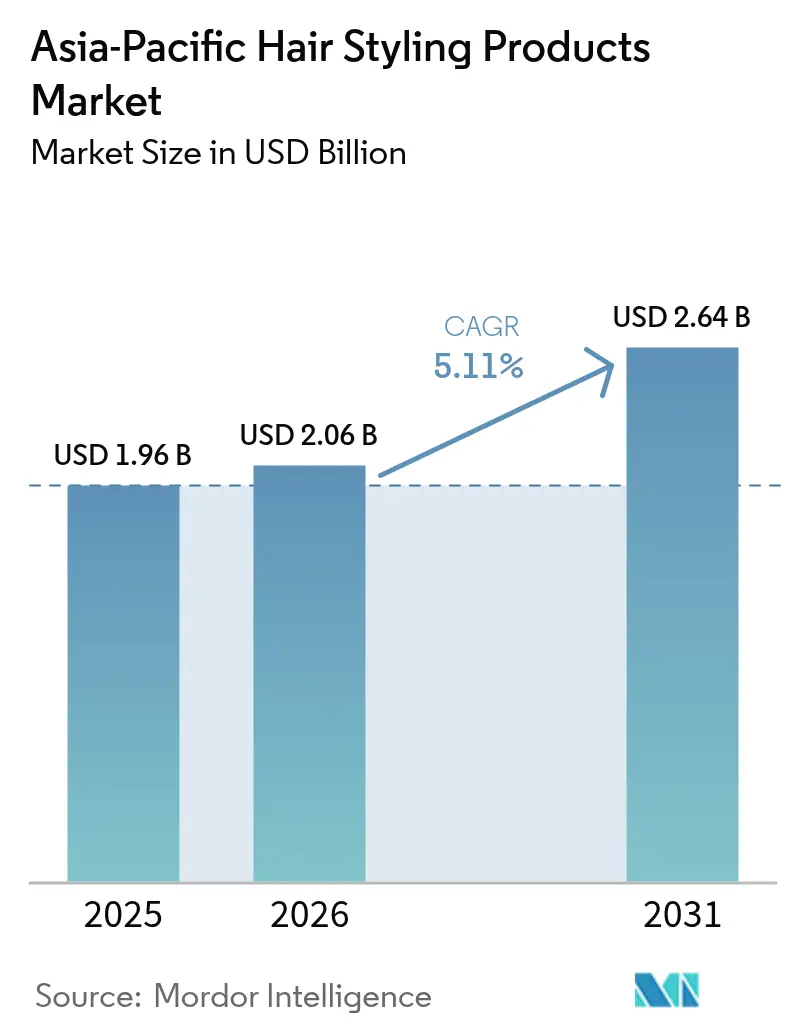
| Study Period | 2021 - 2031 |
|---|---|
| Forecast Data Period | 2026 - 2031 |
| Base Year Market Size (2025) | USD 1.96 Billion |
| Market Size (2026) | USD 2.06 Billion |
| Market Size (2031) | USD 2.64 Billion |
| Growth Rate (2026 - 2031) | 5.11 % |
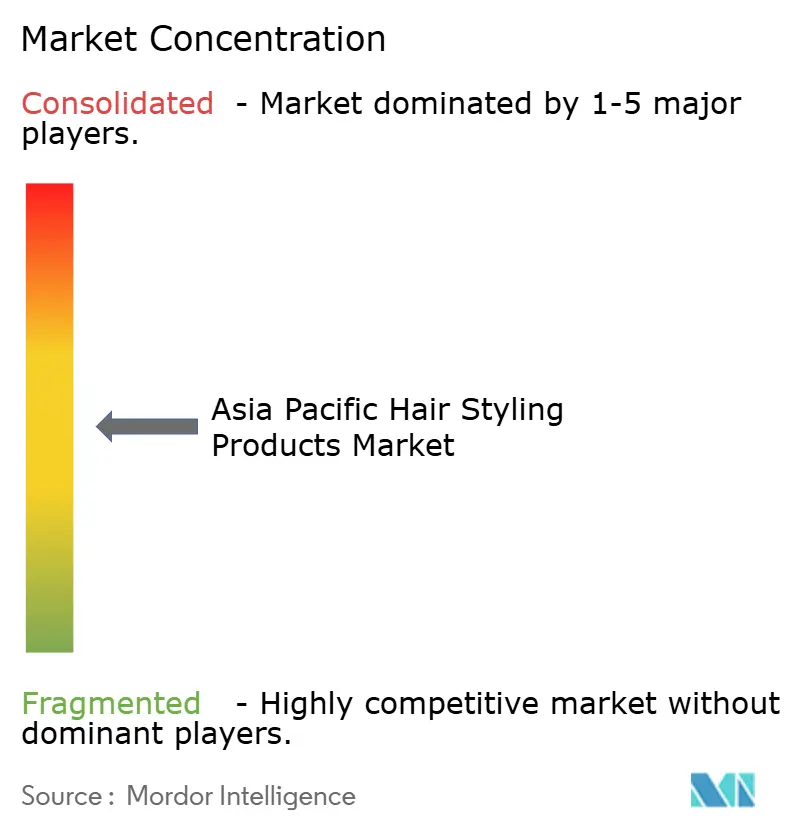
| Market Concentration | Medium |
Major Players *Disclaimer: Major Players sorted in no particular order Image © Mordor Intelligence. Reuse requires attribution under CC BY 4.0. | |
Asia-Pacific Hair Styling Products Market Analysis by Mordor Intelligence
The Asia-Pacific hair styling products market size was valued at USD 1.96 billion in 2025 and estimated to grow from USD 2.06 billion in 2026 to reach USD 2.64 billion by 2031, at a CAGR of 5.11% during the forecast period (2026-2031). This expansion is driven by structural changes in grooming habits rather than short-term trends. Factors such as increasing beauty awareness, the normalization of daily hairstyling among both men and women, and the influence of social media and digital platforms in promoting new styles, routines, and brand narratives are contributing to the rising demand. Additionally, consumers are becoming more conscious of ingredients and health, leading to a shift toward cleaner, scalp- and skin-friendly formulations. This trend is accelerating the growth of natural and organic products, although conventional products continue to dominate in terms of volume.
Key Report Takeaways
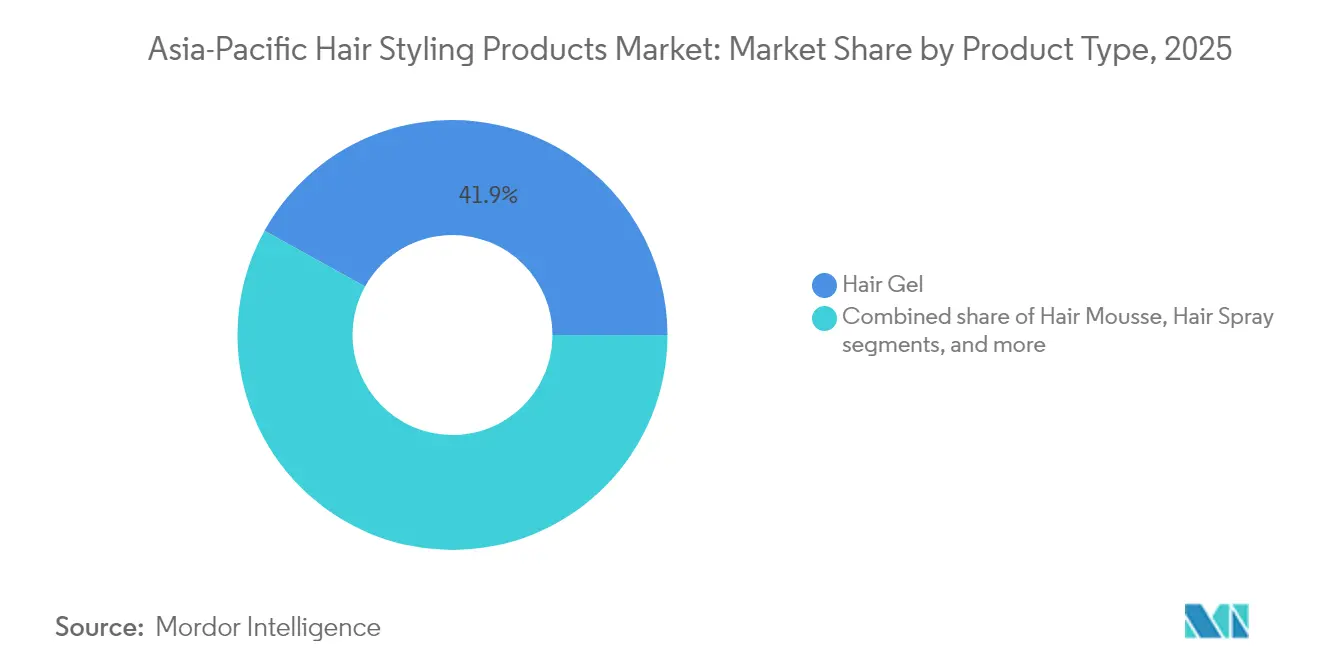
- By product type, hair gel led with 41.94% of the Asia-Pacific hair styling products market share in 2025. Styling creams and waxes are projected to expand at a 6.24% CAGR through 2031, the fastest within product categories.
- By end user, women accounted for 55.95% of 2025 revenue, while the male segment is advancing at a 6.46% CAGR to 2031.
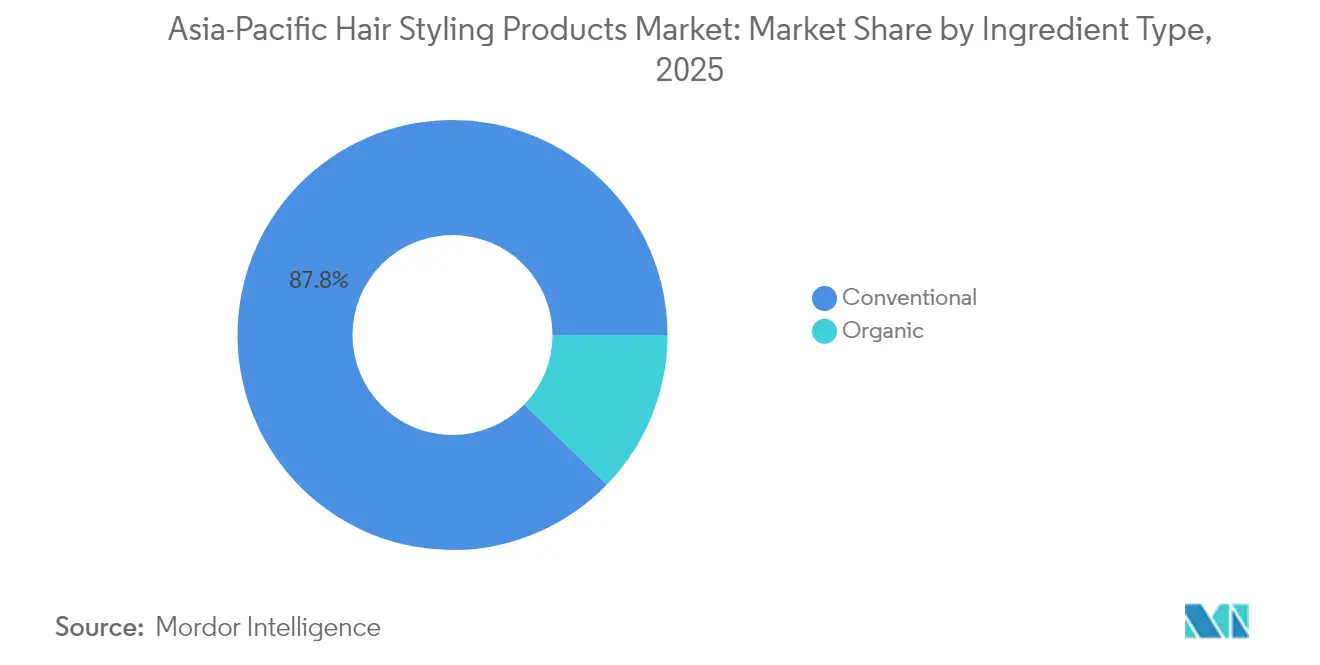
- By ingredient type, conventional formulas captured 87.76% share in 2025, yet organic variants are growing at 8.21% CAGR.
- By distribution channel, supermarkets and hypermarkets held a 43.01% share in 2025, whereas online retail is rising at a 7.31% CAGR.
- By geography, China commanded 37.93% of 2025 sales, while India is forecast to grow at a 7.20% CAGR through 2031.
Note: Market size and forecast figures in this report are generated using Mordor Intelligence’s proprietary estimation framework, updated with the latest available data and insights as of 2026.
Asia-Pacific Hair Styling Products Market Trends and Insights
Drivers Impact Analysis*
| Driver | (~) % Impact on CAGR Forecast | Geographic Relevance | Impact Timeline |
|---|---|---|---|
| Growing consumer interest in hairstyling and personal grooming | +0.8% | Global Asia-Pacific, with strongest momentum in India, Indonesia, Thailand, and Vietnam | Medium term (2-4 years) |
| Influence of social media and digital culture | +1.4% | China, India, South Korea, Indonesia; spillover to Thailand and Vietnam | Short term (≤ 2 years) |
| Rising demand for natural, organic, and clean hair-care formulations | +1.2% | Japan, South Korea, Australia, Singapore; expanding to urban China and India | Medium term (2-4 years) |
| Rising male grooming expenditure | +0.9% | India, China, Indonesia, Thailand; accelerating in Tier-2 cities | Long term (≥ 4 years) |
| Product innovation and multifunctional styling formulations | +1.0% | Global Asia-Pacific, with early adoption in Japan, South Korea, and Australia | Medium term (2-4 years) |
| Surge of sulfate-free and silicone-free formulations | +0.7% | Japan, South Korea, Australia; regulatory pressure spreading to China and ASEAN | Short term (≤ 2 years) |
| Source: Mordor Intelligence | |||
Growing consumer interest in hairstyling and personal grooming
Increasing consumer interest in hairstyling and personal grooming is a key demand-side driver of the Asia-Pacific Hair Styling Products Market. Rising beauty awareness and appearance-related social norms are prompting both women and men to allocate more time and money to maintaining styled hair for everyday life, rather than reserving it for special occasions. The influence of K-pop, C-beauty, J-beauty, social media influencers, and short-video platforms has popularized frequent experimentation with hairstyles, ranging from sleek office looks to textured, casual, and color-treated hair. This trend has created multiple styling occasions per week, driving the consumption of products such as gels, sprays, creams, and waxes. Additionally, urbanization and professionalization have led to an increase in service, corporate, and customer-facing roles, where well-groomed hair is often associated with professionalism. The growing male grooming culture and youth subcultures have further expanded hairstyling beyond traditional female usage. This diversification of the user base, coupled with a shift from basic hygiene routines to comprehensive grooming regimens that integrate hair care with skincare and fragrance, supports steady volume growth.
Influence of social media and digital culture
The influence of social media and digital culture serves as a significant structural driver for the Asia-Pacific Hair Styling Products Market. Platforms such as Instagram, TikTok, YouTube, and local short-video applications consistently promote new hairstyles and product reviews, shaping consumer preferences and encouraging frequent experimentation with styling products. Beauty influencers, K-pop and C-pop idols, and creator communities showcase specific hair styling products in real time, creating immediate demand surges and accelerating the adoption of trends. The scale of digital exposure is substantial. For example, according to World Population Review, India had the largest Instagram audience globally in 2024, with approximately 392.5 million users [1]. This provides brands with a vast, continuous channel to integrate hairstyling content and shoppable links directly into consumers' daily feeds. As consumers increasingly trust creator recommendations and social proof over traditional advertising, digital culture not only enhances awareness and trial of styling products but also drives premiumization. Viewers often seek to replicate influencer-endorsed looks using specific, higher-priced formulations featured online.
Rising demand for natural, organic, and clean hair‑care formulations
The growing demand for natural, organic, and clean hair-care formulations is a significant driver of the Asia-Pacific Hair Styling Products Market. Consumers in the region are increasingly concerned about scalp sensitivity, long-term damage caused by harsh chemicals, and the environmental impact of beauty products. As a result, there is a rising preference for styling gels, creams, sprays, and waxes that exclude sulfates, parabens, mineral oil, and certain silicones. Instead, these products incorporate plant-based ingredients such as aloe vera, coconut oil, argan oil, and herbal extracts inspired by local traditions, including Ayurveda and Japanese or Korean botanical remedies. For example, in India, brands like UrbanBotanics offer Pure Aloe Vera Skin/Hair Gel, marketed as a multipurpose, natural styling and conditioning product. It addresses frizz, hydrates hair, and soothes the scalp without synthetic additives, showcasing how clean and minimalist ingredient lists are being leveraged to stand out in a competitive market.
Product innovation and multifunctional styling formulations
Rising male grooming expenditure is a significant driver of the Asia-Pacific Hair Styling Products Market. Men are increasingly moving beyond basic shampoo and barbershop haircuts to adopt comprehensive grooming routines that include products such as gels, creams, and finishing sprays. Changing cultural norms, the influence of K-pop and C-pop idols, sports celebrities, social media influencers, and the growth of modern barbershops and men’s salons have positioned styled hair as a marker of self-expression and professionalism. This trend has encouraged regular spending on products designed to deliver specific finishes, including matte texture, wet look, high hold, or natural volume. In response, brands are expanding male-focused product lines with features such as tailored fragrances, specialized packaging, and claims addressing men’s needs, such as long-lasting hold for active lifestyles, scalp care, or solutions for thinning hair. These developments are driving higher category penetration and increasing average spending per male consumer, contributing to faster growth in the male end-user segment compared to the overall market.
Restraints Impact Analysis*
| Restraint | (~) % Impact on CAGR Forecast | Geographic Relevance | Impact Timeline |
|---|---|---|---|
| Health concerns over chemical ingredients | -0.7% | Japan, South Korea, Australia; regulatory pressure spreading to China and India | Short term (≤ 2 years) |
| Regulatory compliance and formulation constraints | -0.6% | China, Japan, South Korea, harmonization efforts ongoing | Medium term (2-4 years) |
| Intense competition and market saturation | -0.5% | China, Japan, South Korea; mature urban markets facing pricing pressure | Long term (≥ 4 years) |
| Complex distribution challenges | -0.4% | India, Indonesia, Thailand, Vietnam, infrastructure gaps in rural and semi-urban areas | Medium term (2-4 years) |
| Source: Mordor Intelligence | |||
Health Concerns Over Chemical Ingredients
Health concerns regarding chemical ingredients pose a significant restraint on the Asia-Pacific Hair Styling Products Market. Consumers and health experts are increasingly emphasizing the potential risks associated with common styling components such as sulfates, parabens, phthalates, synthetic fragrances, formaldehyde releasers, and certain silicones. Issues such as scalp irritation, allergic reactions, hair breakage, endocrine disruption, and potential carcinogenicity have led to growing distrust of chemical-heavy styling gels, sprays, and creams, particularly among urban, health-conscious users and parents purchasing for children. Media coverage, dermatologist advisories, and ingredient-awareness campaigns are encouraging consumers to scrutinize product labels more critically. This has resulted in reduced usage frequency or avoidance of entire product categories perceived as harsh, directly impacting demand for conventional styling products. Consequently, brands are compelled to reformulate products, invest in safety testing, and comply with stricter regulatory requirements, leading to increased costs and delays in new product launches.
Regulatory compliance and formulation constraints
Regulatory compliance and formulation constraints pose significant challenges to the Asia-Pacific Hair Styling Products Market. Brands must navigate a complex and evolving landscape of cosmetics regulations, which govern permissible ingredients, maximum concentration limits, safety assessments, labeling, claims, and testing standards across the region. These challenges are particularly pronounced in China, where the National Medical Products Administration introduced new guidelines in 2025 to advance regulatory reform and promote high-quality development within the domestic cosmetics industry. These guidelines have tightened requirements for ingredient registration, adverse-event monitoring, and efficacy substantiation, leading to increased compliance costs and extended time-to-market for new hair styling formulations. Similar regulatory shifts across other markets have made it more difficult for smaller or regional players to compete, restricted the use of certain high-performance but controversial chemicals, and necessitated the reformulation of existing products. These factors can disrupt supply chains, slow innovation, and ultimately moderate overall market growth, despite strong consumer demand for hair styling products.
*Our forecasts treat driver/restraint impacts as directional, not additive. The impact forecasts reflect baseline growth, mix effects, and variable interactions.
Segment Analysis
By Product Type: Texture Versatility Drives Premiumization
Hair gels are projected to hold a 41.94% market share in 2025, continuing to play a central role in driving the Asia Pacific Hair Styling Products Market. These products provide strong, all-day hold, catering to the grooming needs of both male and female consumers seeking reliable, office-appropriate, and school-appropriate hairstyles at affordable prices. The increasing participation of women in the workforce, particularly in key markets like Japan, is a significant factor. According to the Ministry of Internal Affairs and Communications, the female employment rate in Japan is expected to reach 54.2% in 2024 . This shift emphasizes the importance of daily grooming and time-efficient styling routines. Quick-setting gels, which help maintain neat ponytails, buns, and controlled fringes throughout long workdays, are well-positioned to benefit from these lifestyle changes. The growing female labor force effectively broadens the core user base for hair gels.
Styling creams and waxes are anticipated to grow at a compound annual growth rate (CAGR) of 6.24% through 2031, outpacing the overall market. This growth is driven by consumer preferences for natural-looking texture, as these products offer flexible, touchable hold, frizz control, and definition. These attributes are particularly suited to the thick, humidity-prone hair types common across the Asia Pacific region, while avoiding the stiffness and residue often associated with traditional gels and sprays. Additionally, cream- and wax-based formulations serve as effective carriers for conditioning oils, butters, and botanical extracts, enabling brands to position these products as hybrid solutions that nourish and protect hair while shaping it. This aligns with the regional demand for multifunctional, treatment-oriented beauty products. The segment also benefits from the popularity of K-beauty and J-beauty-inspired styles, which favor slightly undone, textured looks and enhanced natural curls over heavily set hairstyles.

By End User: Male Grooming Narrows the Gender Gap
The female segment accounted for a 55.95% share in 2025 in the Asia-Pacific Hair Styling Products Market. This dominance is primarily attributed to higher experimentation with hairstyles across various occasions, including work, social events, and festivals. Such behavior drives the ownership of multiple styling formats and sustains frequent product replenishment. Additionally, the segment benefits from strong beauty consciousness and routine-based haircare practices in countries like South Korea, Japan, China, and India. Women in these markets often follow multi-step regimens that incorporate styling with heat protection, frizz control, color protection, and damage repair, making styling products an integral part of their broader hair-care rituals rather than occasional add-ons.
In contrast, the male segment is projected to grow at a faster compound annual growth rate (CAGR) of 6.46% through 2031. This growth is driven by shifting grooming norms in the Asia-Pacific region, with younger men increasingly adopting hairstyling as part of their daily self-presentation. Influences such as K-pop, J-pop, esports celebrities, and social media creators play a significant role in this trend. The segment's rapid expansion is further supported by the growth of barbershop and men’s salon formats, targeted product launches of gels, waxes, and pomades designed for matte, natural, or textured looks, and marketing efforts addressing male-specific concerns like thinning hair, scalp health, and long-lasting hold for active lifestyles. These factors are gradually narrowing the historical usage gap with female consumers while contributing incremental volume and value to the overall market.
By Ingredient Type: Clean Formulations Command Premium Pricing
In 2025, conventional formulations are projected to account for 87.76% of the Asia-Pacific Hair Styling Products Market. This dominance is attributed to well-established supply chains, proven performance in providing strong hold, humidity resistance, and long wear across various hair types. Additionally, the lower cost of formulating conventional products compared to fully organic alternatives helps maintain competitive retail prices, which is crucial in price-sensitive emerging markets. Conventional products also benefit from decades of brand equity and consumer familiarity. Many leading gels, sprays, and creams that consumers have used over the years are conventional, reinforcing their perceived reliability, wide product variety, and availability in salons and households. These factors sustain their position as the default styling option, even as awareness of ingredient safety concerns gradually increases.
Organic hair styling products are expected to grow at a robust CAGR of 8.21% through 2031, expanding from a smaller base as they capitalize on trends favoring clean beauty, scalp health, and eco-conscious consumption across the Asia-Pacific. This growth is driven by consumers seeking formulations free from sulfates, parabens, phthalates, and certain silicones. Organic styling products increasingly incorporate plant oils, butters, and natural polymers to deliver comparable hold with gentler sensory profiles. Brands are also emphasizing sustainability through certified organic labels, cruelty-free claims, and recyclable or low-plastic packaging. These efforts aim to justify premium pricing and attract higher-income, health-conscious, and environmentally aware consumer segments.
By Distribution Channel: Digital Commerce Reshapes Retail Economics
In 2025, supermarkets and hypermarkets accounted for a 43.01% share of the Asia-Pacific Hair Styling Products Market. These outlets serve as primary, one-stop shopping destinations where consumers can physically compare brands, test product textures and fragrances, and benefit from frequent promotions on mass and mid-priced styling products. This format also caters to family and bulk purchases, encouraging shoppers to routinely add hair gels, sprays, and creams to their grocery baskets. This habit-based purchasing behavior reinforces the role of large-format stores as the primary volume driver for everyday styling products across both urban and semi-urban markets in the Asia-Pacific region.
Online retail stores are projected to grow at a robust CAGR of 7.31% through 2031, driven by rapid e-commerce adoption, high smartphone penetration, and the influence of social media and beauty influencers. These platforms facilitate the discovery of new styling formats and niche brands. Digital channels offer extensive assortments, including organic, vegan, and specialty styling products, which are not always available offline. Features such as user reviews, subscription options, and personalized recommendations encourage product trials and up-trading. Additionally, faster delivery, festival sales, and livestream shopping events are accelerating the shift of younger, tech-savvy consumers to online channels, making e-commerce the fastest-growing distribution channel for hair styling products in the region.
Geography Analysis
China is projected to account for 37.93% of Asia-Pacific hair styling revenue in 2025. This dominance is driven by its large urban middle class, an extensive salon network, and advanced e-commerce and social-commerce platforms that facilitate consumer access to a variety of styling products, including gels, sprays, creams, waxes, and specialty textures. The country's scale advantage is further supported by a strong presence of domestic and international brands, significant digital marketing investments, and rapid product innovation inspired by K-beauty and C-beauty trends. As a result, China not only generates the largest share of current revenues but also influences styling trends across neighboring markets.
India is expected to grow at a compound annual growth rate (CAGR) of 7.20% through 2031, marking the fastest growth among major geographies. Rising disposable incomes and aspirational consumption in Tier-2 and Tier-3 cities are driving increased adoption of dedicated styling products beyond basic oils and shampoos. The normalization of male grooming routines, influenced by barbershop modernization, Bollywood and cricket celebrities, and youth-oriented marketing, is expanding the consumer base. Additionally, rapid digitalization is enhancing market access. According to the India Brand Equity Foundation, India became the world’s second-largest e-retail market in 2024, with approximately 270 million online shoppers . This development provides a robust channel for styling brands to reach first-time users and promote premium products through influencer content, reviews, and targeted promotions.
Japan, South Korea, Australia, Indonesia, Thailand, and Singapore exhibit varied but positive growth trends, collectively contributing to the regional opportunity for hair styling products. Japan's market grows steadily due to high per-capita spending, an aging yet style-conscious population, and demand for advanced styling solutions such as damage-repair and anti-frizz products tailored to humid conditions. South Korea continues to lead as an innovation hub, particularly in men’s grooming and high-performance styling creams and waxes. Australia and Singapore show a preference for premium products with natural ingredients and clean-label formulations. Meanwhile, Indonesia and Thailand drive volume growth through their young, urban populations, who are increasingly influenced by beauty trends and social media in adopting everyday styling routines.
Regulatory Landscape
Hair styling products in Asia-Pacific are regulated under cosmetics frameworks that emphasize ingredient controls, safety substantiation, labeling, and post-market surveillance, with varying pre-market obligations by country. China remains a key reference point for compliance intensity: the National Medical Products Administration (NMPA) continued tightening the science-based rulebook by adding 18 new and revised items into the Cosmetic Safety Technical Standards (STSC, 2015) via Announcement No. 6 of 2026. The update revised lists of prohibited and restricted substances and raised requirements for dossiers and reformulation readiness.
ASEAN member markets largely align through the ASEAN Cosmetic Directive (ACD) and its annex updates, with national regulators implementing consolidated amendments. For example, the Philippines FDA issued Circular No. 2026-0001 to adopt consolidated ACD amendments agreed during the 40th to 42nd ASEAN Cosmetic Committee meetings, shaping region-wide compliance planning for multinational and regional brands supplying multiple ASEAN markets. NMPA also expanded technical depth for higher-risk hair categories by releasing technical guidelines in April 2026 and bringing new and revised cosmetic testing methods into effect in July 2026 under STSC (2015), which reinforces the need for robust testing and efficacy/safety substantiation processes when launching or updating hair styling formulations in China.
Competitive Landscape
The Asia-Pacific hair styling products market is moderately fragmented, with competition distributed between large multinational FMCG companies and a diverse range of regional and local brands. These regional players cater to specific hair types, price points, and cultural preferences unique to individual countries. Prominent multinational companies in this market include L’Oréal S.A., Unilever PLC, Procter & Gamble Company, Henkel AG & Co. KGaA, and Kao Corporation. These companies operate multiple mass and premium brands, securing significant shelf space and consumer attention in categories such as gels, sprays, creams, waxes, and multifunctional hybrids.
Multinational companies are utilizing global Research and Development (R&D) platforms to introduce multifunctional formulations that align with Asia-Pacific consumers' preference for products offering multiple benefits in fewer steps. Examples include styling creams that provide heat protection, anti-frizz control, pollution defense, and color care, as well as gels and waxes enriched with conditioning oils and scalp-friendly actives. This trend reflects a convergence of care and styling, with innovations incorporating skincare technologies such as hyaluronic acid and antioxidants to enhance hair fiber and scalp health. These premium offerings justify higher price points while differentiating from basic hold-only products.
Major players are leveraging strategic collaborations with salons, influencers, and e-commerce platforms to test and scale new multifunctional concepts efficiently. Additionally, acquisitions or partnerships with indie and clean-beauty brands enable them to tap into emerging niches, including natural, vegan, or scalp-therapy-focused styling ranges. This combination of localized strategies and diverse product portfolios allows these companies to maintain their position as key growth drivers in the Asia-Pacific hair styling products market. Despite the market's moderate fragmentation, it remains open to innovation from regional competitors.
Asia-Pacific Hair Styling Products Industry Leaders
-
L’Oréal S.A.
-
Unilever PLC
-
Procter & Gamble Company
-
Henkel AG & Co. KGaA
-
Kao Corporation
- *Disclaimer: Major Players sorted in no particular order
Market Opportunities and Future Outlook
Premiumization and capability-led differentiation are creating room in hybrid styling formats that combine hold with scalp and hair treatment benefits, consistent with the market shift toward cleaner, scalp- and skin-friendly formulations. Brands that can support formulation development with stronger claims substantiation can use tighter compliance requirements to drive faster compliant innovation cycles, particularly in China, where NMPA updates in 2026 underscore higher testing-method and standards sophistication. Within this environment, sulfate-free and silicone-free styling gels, creams, waxes, and sprays offer more direct pathways to communicate performance alongside safety in line with local cosmetics rules.
Technology-enabled personalization and professional ecosystem activation are also influencing near-term opportunity sets in Asia-Pacific. On the supply side, Henkel opened a new Asia R&D Center for Consumer Brands in Shanghai in January 2024, supporting faster iteration on formulations and sensory profiles for Asian hair needs across multiple markets. On demand creation, companies are using digital and salon tooling to deepen engagement, including LOréal highlighting AI-driven professional diagnostics and shade-selection tools in Thailand in 2026. With online retail expanding, these approaches widen routes to market for specialized styling solutions and pro-inspired regimens beyond mass retail shelf competition.
Recent Industry Developments
- July 2026: Kao Corporation announced a rollout of its Liese hair color series across seven countries and regions in Asia, starting from August 2026. The expansion supports wider regional distribution for at-home color and related hair routines, which typically feeds demand for complementary styling products used to finish and maintain color looks.
- January 2025: Hindustan Unilever Limited (Unilever) announced an agreement to acquire the premium beauty brand Minimalist. The deal expands Unilevers premium portfolio and strengthens its platform for ingredient-led positioning, a theme that is influencing adjacent hair styling formulations that emphasize scalp-friendly and clean claims.
- August 2024: Dyson introduced the Dyson Chitosan formulation range for wet-line styling, positioned to deliver flexible all-day hold without a crunchy texture. The launch added a new performance narrative around sensory feel and finish, raising competitive benchmarks for premium styling formulations in the region.
Research Methodology Framework and Report Scope
Market Definition and Coverage
For this study, the market covers consumer hair styling products sold in Asia-Pacific, including items used to shape, hold, and finish hair, such as gels, mousses, sprays, and styling creams and waxes, across offline retail and online retail.
Scope exclusions: This sizing excludes electrical styling tools and salon equipment, and it also excludes hair shampoos and conditioners that are positioned mainly as cleansing products.
Segmentation Overview
- By Product Type
- Hair Gel
- Hair Mousse
- Hair Spray
- Styling Creams and Waxes
- Other Styling Products
- By End User
- Male
- Female
- By Ingredient Type
- Conventional
- Organic
- By Distribution Channel
- Supermarkets/Hypermarkets
- Convenience/ Grocery Stores
- Specialist Stores
- Online Retail Stores
- Other Distribution Channels
- By Geography
- China
- India
- Japan
- Australia
- Indonesia
- South Korea
- Thailand
- Singapore
- Rest of Asia-Pacific
Data Sources, Market Sizing, and Validation
Desk Research
Desk work starts with building a clean fact base on grooming and personal care demand in Asia-Pacific, and then mapping it to styling product consumption. We reference public sources such as national statistics offices for consumer spending and price indexes, UN Comtrade for trade flows, World Bank indicators for income and urbanization, and WHO context where relevant for ingredients and safety related discussions.
We also use company annual reports, investor presentations, and earnings call notes to understand category mixes, geographic exposure, and pricing comments that affect styling products. To reduce gaps around product innovation and claims, patent databases and peer reviewed cosmetic science literature are checked for ingredient and format trends. Paid subscriptions are used selectively for company financials and news intelligence, and for shipment level import-export checks when trade classification is a helpful proxy. The sources listed here are illustrative, and many other public references were used for data collection, validation, and clarification.
Primary Interviews and Surveys
Interviews with manufacturers, distributors, salon product specialists, retailers, and category consultants active in Asia-Pacific markets help clarify product mix, channel movement, price changes, promotional intensity, and the share of styling products within broader hair care. CXOs, functional or unit leaders, and managers are used as separate checks on reported market signals. Their input helps test secondary data, address country-level gaps, and adjust the model when retail, customs, and company-reported figures do not align.
Distribution of primary research fieldwork respondents
| Company type | Respondent position |
|---|---|
| Top tier: 27% | CXOs: 18% |
| Mid tier: 48% | Functional/Unit leaders: 32% |
| Smaller Players: 25% | Managers: 50% |
Market-Sizing & Forecasting
The core sizing uses a top-down approach that reconstructs country demand from broader beauty and personal care spend, then narrows it to styling using penetration and share assumptions validated in interviews. To keep the totals realistic, we also do selective bottom-up approximations using sampled brand and channel checks, along with average selling price ranges multiplied by estimated volumes for key product formats.
Inputs used in the model include urban population and working age mix, per capita personal care spending, price inflation and pack size shifts, e-commerce share in beauty retail, and relative mix of gels, sprays, mousses, and creams and waxes. Where an input series is patchy for smaller markets, gaps are handled using proxy indicators such as import trends, retail shelf activity, and interpolation based on comparable country patterns, then adjusted after expert review.
For forecasting, scenario analysis is run with variable level expectations gathered in primary discussions, followed by sensitivity checks for pricing and channel shifts. Growth is not driven by a single CAGR assumption, since online penetration and premiumization can move value faster than volume in styling products.
Data Validation & Update Cycle
Outputs are validated through stepwise triangulation, where final totals are checked against independent signals like trade direction, reported category commentary in company disclosures, and the implied per capita consumption level by country. If any country shows a sharp jump that does not align with inflation, channel expansion, or known policy changes, assumptions are reviewed again and follow up calls are triggered.
Before sign-off, the model is reviewed by another analyst who checks arithmetic consistency, currency conversion timing, and whether country weights match the stated coverage. The report is refreshed annually, and interim updates are made when there are material events such as major pricing resets, regulatory changes for cosmetic ingredients, or sudden channel disruptions. Right before delivery, a final pass is done so the latest public information is reflected in the narrative and numbers.
Mordor Intelligence's Asia Pacific Hair Styling Products Market Size Compared With Other Published Estimates
It is common to see different market values for hair styling products in Asia-Pacific because publishers do not always count the same product set, time frame, or price basis, and that changes the final math even when the growth story sounds similar.
Some estimates fold in adjacent hair care items like dry shampoo or heat protectants, which can increase the value quickly. In Mordor Intelligence, the total is limited to the styling formats defined in the study (such as gels, mousses, sprays, and styling creams and waxes), and it is cross checked using country channel mix and realistic price progression, rather than a single blended uplift.
Benchmark comparison
| Source | Market Size | Gaps in Research Methodology |
|---|---|---|
| Mordor Intelligence | USD 1.96 B (2025) | |
| Trade Bulletin A | USD 3.47 B (2029) | Uses an incremental value outlook and broader product mentions, and the figure is tied to a later forecast year, so it is not directly comparable to a 2025 base without restating the model by year and product set. |
| Industry Portal B | USD 3.10 B (2035) | Extends the horizon to 2035 and may apply longer run pricing and premiumization assumptions, which can inflate value outcomes if short cycle promotions and country level channel realities are not explicitly tested. |
The spread across the table is mainly explained by year alignment and what each publisher chooses to include in the styling basket. By keeping the scope tight and then validating the country level inputs with practical checks, our estimate stays traceable to clear demand drivers and can be repeated when new data points are added.
Key Questions Answered in the Report
What is the current value of the Asia-Pacific hair styling products market?
It is valued at USD 2.06 billion in 2026 and is expected to reach USD 2.64 billion by 2031.
Which product category leads sales across the region?
Hair gel holds the top position with 41.94% share of 2025 revenue.
Which segment is growing fastest among end users?
The male segment is rising at 6.46% CAGR through 2031 as grooming becomes mainstream.
How fast is online retail growing for hair styling products?
Online retail is expanding at a 7.31% CAGR, led by livestream commerce in China.